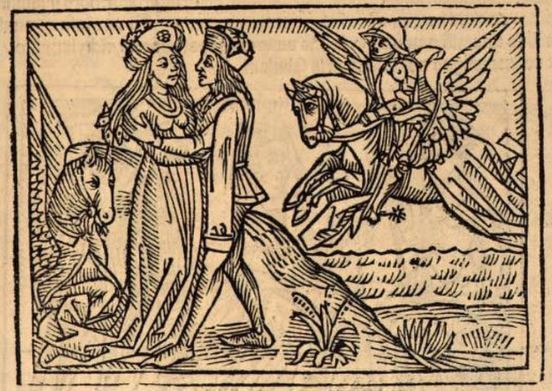
Medusa is illustrated on the left side of the engraving embracing the god Neptune. Medusa is depicted in her human form in this engraving before Minerva transformed her into a monster. Boccaccio explains that Minerva transforms Medusa into a monster because she was angry that she had sexual relations with Neptune inside one of her temples. Boccaccio also explains that Medusa ends up giving birth to a Pegasus. The Pegasus is illustrated laying down beside Medusa. The hero Perseus is depicted riding his Pegasus on the right side of the engraving as he is on his way to conquer Medusa’s kingdom.
In this image we see Gulliver’s ship setting sail shortly after returning from Brobdingnag. His wife and family protested his leaving again since he was very confused after returning from Brobdingnag. Nevertheless, Gulliver decided to set sail again and here we see the ship leaving the port. The same image appears in the 1839 Krabbe edition.
The left panel depicts Sosia, who is pointing upward and has a sword mounted on his belt. On the right, we see Tristan holding some sort of satchel. He also has a sword mounted on his belt. Beneath his feet there is a decorative panel, which appears to depict a flower and roots.The left panel is nearly identical to those found on pages 43 and 135 (where it is labeled ‘Pármeno’), and identical to those found on pages 190 and 221. The right panel is nearly identical to those found on pages 51 (where it is labeled ‘Pármeno’ and has a different decorative panel), 82 (labeled ‘Pármeno’ and has a different decorative panel), 125 (labeled ‘Pármeno’ and has no decorative panel), and 229 (labeled ‘Centurion’ and has no decorative panel).
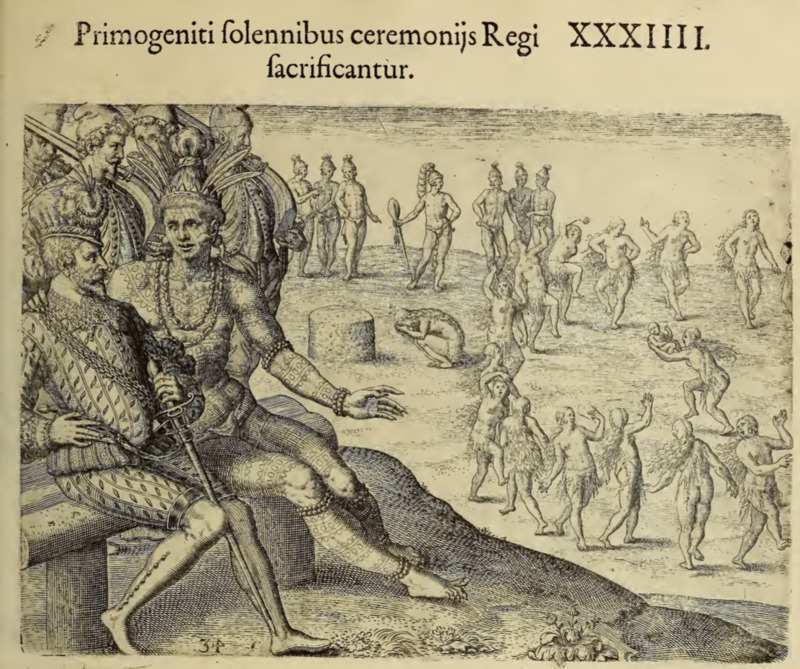
In the foreground, an Indigenous man sits on a wooden bench with a colonist. The Indigenous man wears feathers in his hair, strands of beads around his neck, elbows, wrists, knees, and ankles. His body is covered in tattooed or painted designs. In the background, a large circle of women dances. One woman holds a child aloft in the center of the circle. Another woman kneels on the ground beside a large block with her hands over her head. Several Indigenous men watch the women dance.
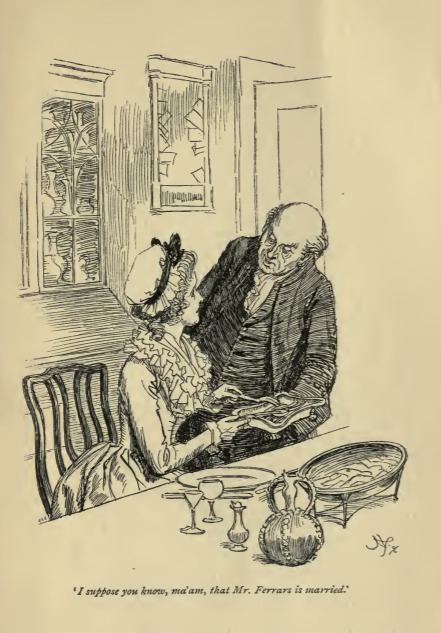
In this image one of the Dashwood’s servants tells Mrs. Dashwood that he heard in town that Mr. Ferrars was married to Lucy Steele. Elinor was upset by this, holding out hope that she might still marry him. The servant did not see Mr. Ferrars’ face, only speaking to Lucy Steele. It was later revealed that Lucy Steele married Robert Ferrars, not Edward. This scene occurs in chapter 47. The characters are shown in the traditional regency style. Mrs. Dashwood wears a regency style dress with an empire waist and a mop cap. The servant wears a waistcoat and tailcoat. The regency period dated to the early nineteenth century (1811-1820) when George, Prince of Wales, later George IV (r. 1820-1830), reigned as regent for his mentally ill father, King George III (r. 1760-1820). The regency period is associated with the rise of neoclassicism in art and fashion.
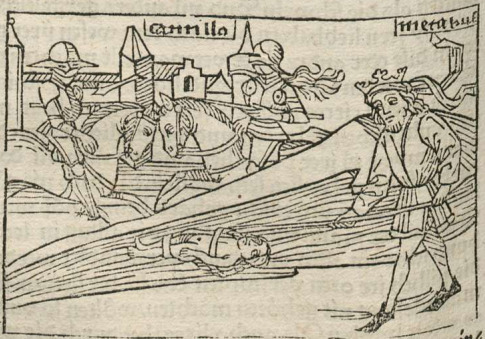
Metabus, king of the Volscians, is depicted on the right side of the engraving with a lance in his hands. We know that this is Metabus as his name is engraved above his head. Boccaccio explains that after being exiled from his kingdom, he took his only daughter with him to safety. When he came across a river, he tied his daughter Camilla to a lance and hurled it across the river in order to save her. They both survived, and Camilla grew up to be a strong, fierce warrior. Camilla goes to war against the Trojans and ends up getting wounded by a Trojan knight named Arruns. This is depicted in the background of the engraving, as Camilla is seen riding on her horse with a lance under her arm as she charges at the enemy. Her name is engraved above her head to identify her. The enemy’s lance is illustrated piercing the chest of Camilla which ends up killing her.
Here we see two scenes from Gulliver’s return to England. On the left side we see Gulliver in his boat approaching a large English ship. Gulliver was brought on board of the ship and returned home to England. In Gulliver’s boat we see several Lilliputian cows, along with Gulliver’s provisions. On the right side we see a rat with a Lilliputian sheep in its mouth. This shows the difference in size between the animals from Lilliput and those of the rest of the world.
In this image we see two stacks of cannon balls with two cannons. This image appears when Gulliver describes gunpowder to the King of Brobdingnag, offering to teach the King’s military to use it. The King is appalled at the thought of such a violent invention. The same image appears in the 1843 Krabbe edition.
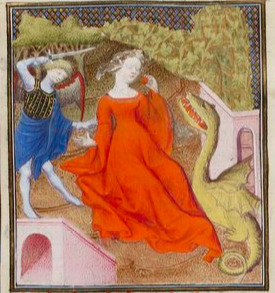
Eve is seated in the middle of the image in a red gown. The location is the garden of Eden, with trees seen in the background. Her eyes are closed as she brings the forbidden fruit, an apple, to her mouth. To the left of Eve is an angel with a sword, pointed at a dragon on the right of Eve. The dragon represents the serpent which is typical in the creation story. It watches Eve bring the apple to her mouth.
Rebecca Crawley walks into dinner on the arm of the Earl of Southdown. Behind them are her husband, Rawdon Crawley, and Mr. John Paul Jefferson Jones, from the American Embassy. Mr. Jones is scowling at Mr. Crawley, upset that he lost the chance to escort Mrs. Crawley.
Here we see Gulliver bowing and thanking his master standing on the shore before he leaves the Country of the Houyhnhnms. The Council of the Houyhnhnms told his master that Gulliver either had to live with the yahoos or return to Europe but could not live with the Houyhnhnms any longer. Gulliver was shocked by this, and decided he had to leave rather than live with the yahoos. Gulliver built a boat to leave the Country, seen in the water behind Gulliver. The same image appears in the 1839 Krabbe edition.
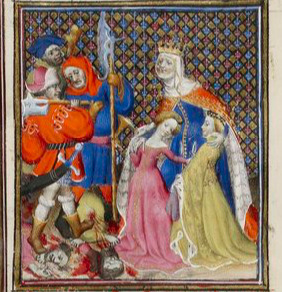
After surrendering to the hands of Cassander, the family and friends of those whom Olympias killed wanted her dead. She got dressed and went to the executioners with her companions, accepting her death. The image depicts the executioners standing on top of those that Olympias killed, on the left. To the right, Olympias enters, supported by her companions.
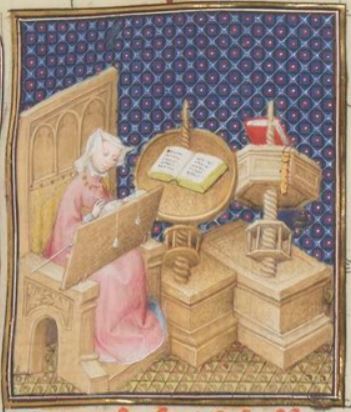
This illumination depicts Proba sitting in a chair as she looks at a book resting on a lectern. The books illustrated in the image are to represent her intellectual life and her teaching history to the world. Proba is renowned for her intellect and intensive knowledge of literature, including works from Virgil. Proba had taken lines from the Aeneid, Bucolics, and the Georgics and transformed them into a cento focusing on the Old and New Testaments. Proba was said to have known the Scriptures by memory, which was something not even many men were able to do.
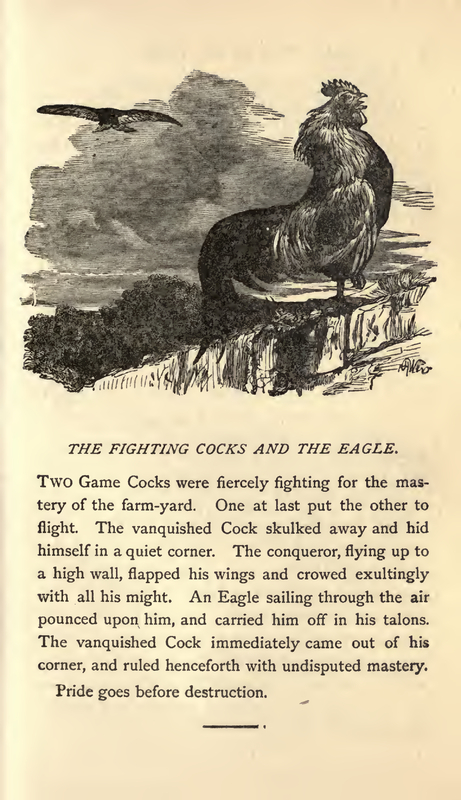
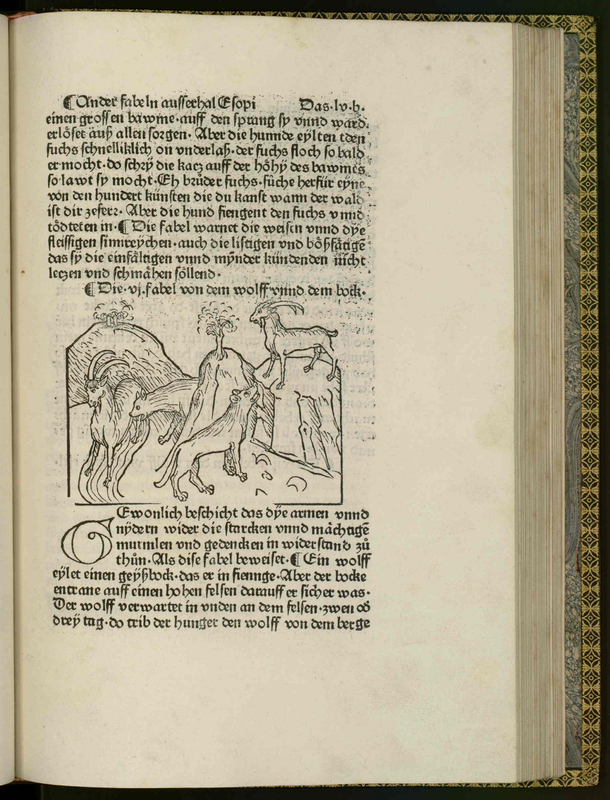
A monkey and fox are starring at each other on the dry ground. In the background there’s two trees and a large, tall rock. There’s also some footprints from the monkey and fox on the ground around them
Here we see native peoples of New Holland shooting arrows at Gulliver, who sails away. An arrow hit Gulliver on the inside of his knee. He paddled away, eventually turning into a sheltered creek where he treated the wound. The same image appears in the 1843 Krabbe edition.
In Luggnagg it was possible for someone to be born immortal. These children were identified by a large spot above their left eye. Gulliver was initially excited by the possibility of being immortal, however he quickly learned that the lives of the immortals were often sad and unfulfilled as they grew older.
The left panel depicts Calisto’s servant Sosia, who is wearing a hat and has a sword mounted on his belt. To the right, we see Calisto’s other servant Tristan wearing a hat. He also has a sword mounted on his belt, which is partially concealed by his coat. Both figures are placed outside.The left panel is identical to the one found on page 263, and nearly identical to those found on pages 60, 146, 173, and 187 (where it is labeled ‘Parmeno’), and page 299 (where it is labeled ‘Pleberio’). The right panel is nearly identical to those found on pages 70 and 114 (where it is labeled ‘Sempronio’), page 187 (labeled ‘Sepronio’ [likely a printing error]), pages 263 and 271 (labeled ‘Calisto’), and page 350 (labeled ‘Pleberio’).
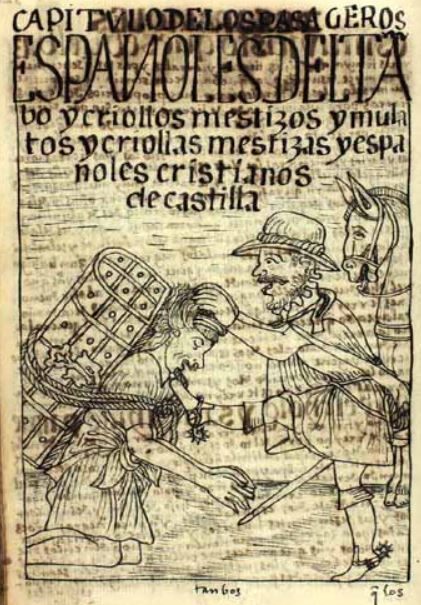
This image is illustrated in a chapter that discusses and criticizes the government and society in Spanish conquered Peru. This image demonstrates the mistreatment of indigenous peoples of Peru by Spanish travelers. The author explains that Inca way stations called tampu’s were turned into Spanish inns called tambo’s where Spanish travelers would misbehave towards the indigenous peoples. The Spaniard in the image is depicted kicking an indigenous man in the face. The indigenous man appears to be carrying luggage of the Spaniard.
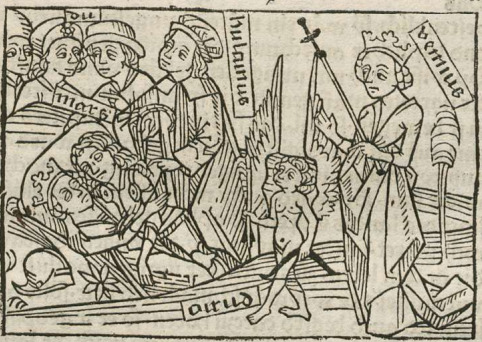
The goddess Venus is depicted on the right-hand side of the engraving wearing a crown and holding a scepter in her left hand. We can identify this figure as Venus as her name is engraved directly beside her. Her son, Cupid, is depicted walking alongside her with his bow and arrows in hand and his wings erected in the air. His name is engraved by his feet. The left-hand side of the engraving also depicts Venus as she commits adultery with her half-brother, Mars. Mars’ name is engraved just above Venus’ head. Boccaccio explains that Venus’ husband, Vulcan, had walked in on the adulterous crime, which is what the engraving is illustrating. Vulcan’s name is engraved behind him as Vulcanus. There are unidentified figures in the background of the engraving in the top left-hand corner. Boccaccio explains that Venus was highly adored in Cyprus as well as Rome, and he chose to write on her for her beauty. He criticizes her highly due to her invention of brothels.
![[Gulliver sets sail for Laputa]](https://collections.cemvc.ca/files/large/52d479a3e9cd1aae9b682610dec18eb70c799450.jpg)
![[Act XIX – Sosia and Tristan]](https://collections.cemvc.ca/files/large/94f8236649e5ac3e3b29bd1a7a3113f4c49df749.jpg)
![[Gulliver is rescued by an English ship and a Lilliputian sheep next to a rat]](https://collections.cemvc.ca/files/large/11989393934dccf54a24837fc8ba73ec9eff7a77.jpg)
![[Gulliver describes gunpowder to the King of Brobdingnag]](https://collections.cemvc.ca/files/large/51e9161088b31966f137bdb1082190a452c3aa22.jpg)
![[Dinner at Gaunt House]](https://collections.cemvc.ca/files/large/fb131bebdc956c14eb2b3be6d467d169db4c6700.jpg)
![[Gulliver thanks his master before he leaves the Country of the Houyhnhnms]](https://collections.cemvc.ca/files/large/78d175e93f60ed3b082eef5ebfd007d9c94ff8df.jpg)
![[The Monkey and Fox]](https://collections.cemvc.ca/files/large/87934b09c4b2ddaba90fab64d41171d7022059c3.jpg)
![[native peoples of New Holland shoot arrows at Gulliver]](https://collections.cemvc.ca/files/large/4a5be52c9cb741b488c6e865c2c4ce5767e1fc11.jpg)
![[An immortal child on Luggnagg]](https://collections.cemvc.ca/files/large/484f9af2d123b0895bf58bdb488e1977d7e0e858.jpg)
![[Act XIX – Sosia and Tristan]](https://collections.cemvc.ca/files/large/55defdc6dde3c319ae32d79b185844d2857b40eb.jpg)