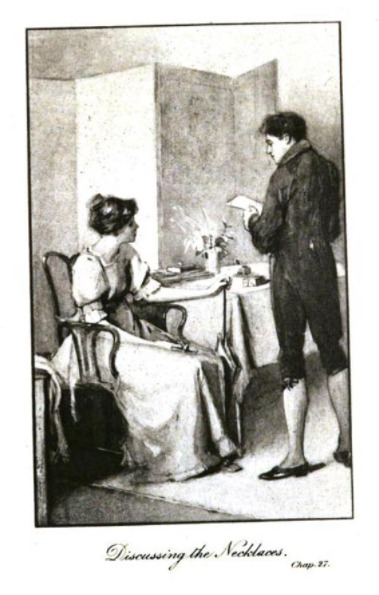
Here we see Fanny and Edmund in the East room at Mansfield. Before the ball, Fanny went to the Parsonage to discuss what to wear to the ball with Mary Crawford. Miss Crawford gave her a gold necklace to wear with William’s cross. William brought Fanny an amber cross from Sicily, and Fanny needed a gold chain to put it on. This scene mirrors one from Austen’s life, as Jane Austen’s brother, Charles, brought her an amber cross when he was serving in the navy in 1801. Austen records this in a letter to her sister, Cassandra, written on 27 May 1801. Charles also gave an amber cross to Cassandra. In Mansfield Park, the gold chain was a gift from Mr. Crawford that he wanted to give Fanny but, knowing she would not accept a gift from him, had Miss Crawford give it to her instead. When she came home, she found Edmund in the East room, a room only used by Fanny. He came in to leave her a necklace that he bought for her for the same purpose. Edmund was in love with Miss Crawford, and after hearing she gave Fanny a necklace, he fell more in love with her because of her kindness to Fanny. This scene occurs in chapter 27 as noted underneath the title of this image. The characters are shown in the traditional regency style, with Fanny wearing the regency style dress with an empire waist. Her hair is worn tied up, as was tradition for women at this time. Edmund wears a waistcoat and tailcoat, with knickers that stop at the knee. The regency period dated to the early nineteenth century (1811-1820) when George, Prince of Wales, later George IV (r. 1820-1830), reigned as regent for his mentally ill father, King George III (r. 1760-1820). The regency period is associated with the rise of neoclassicism in art and fashion. The same image appears as an insert between pages 24 and 25 for the Dent 1893, 1894, 1895, 1896, and 1897 editions of Mansfield Park.
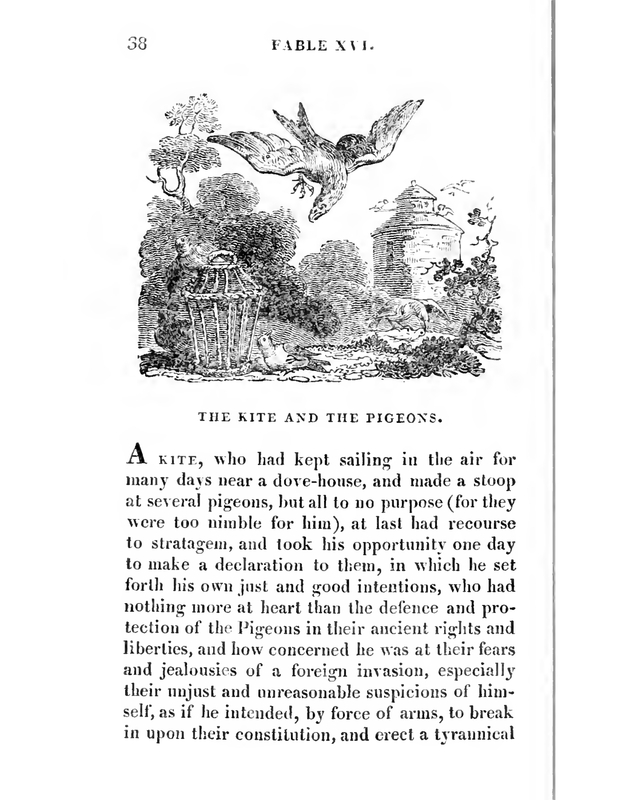
The Kite was sailing in the air, on the upper center of the illustration,near a dove-house, located at the bottom left. One pigeon was on top of the dove-house while another was ooutside of its gate. They both stared at the sailing Kite horror despite its declaration of peace. At the backgroung on the right, an other Kite was feeding on the pigeon.
A man in a turban and loose pants is lying down against a pillow, running his finger along the stem of a very long pipe. He has a platter with two jugs and a cup on it balanced on one foot. In the top right corner of the image is the letter W from When.
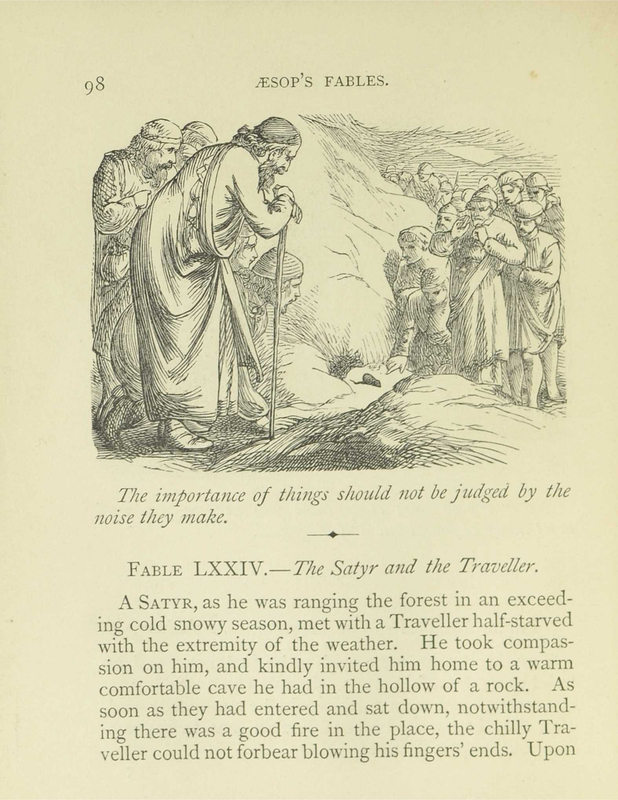
A large group of people are assembled on a mountain side. In the middle, a small mouse is barely visible on the ground. To the left of mouse, an older man stands leaning on a walking stick, intently looking at the mouse.
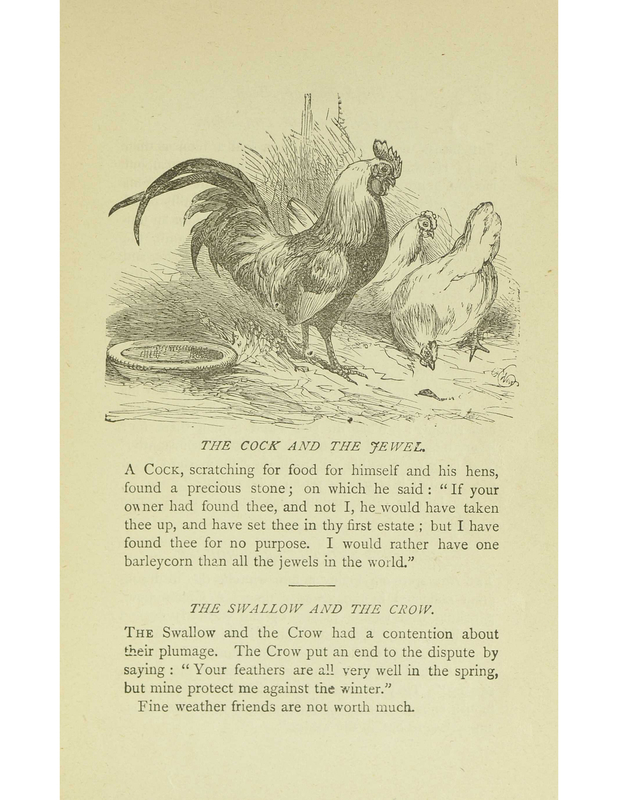
A cock is in the center of the image, standing tall. Behind the cock, on the right hand-side of the image, are two hens. The one nearest the cock is bent to the ground, checking out a small stone, possibly a jewel, hidden in the hay. Behind the cock is a low, bowl.
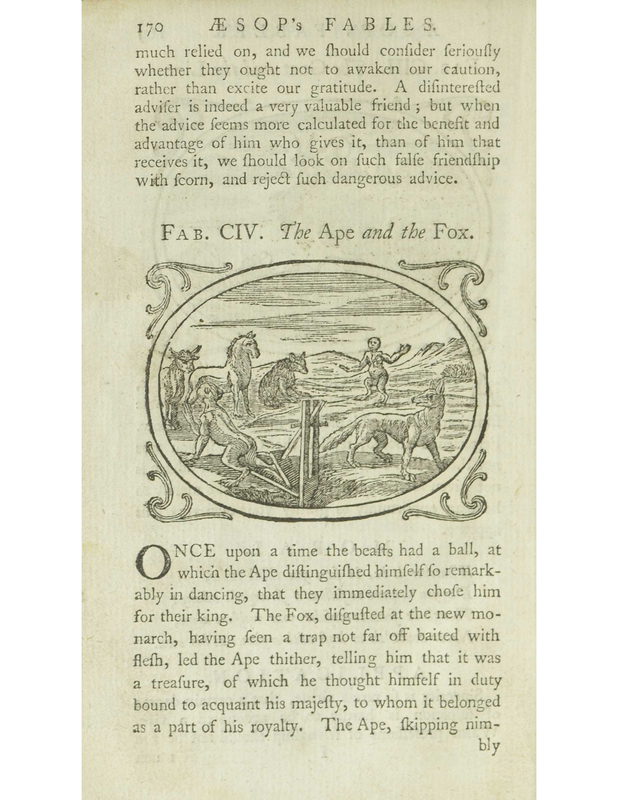
An ape attempts to crawl out of a trap of which it has its right foot stuck in. A fox stands to the right of the trapped ape, and is looking back at it. In the background there is the front half of a bull on the left side of the image. Next to the bull stands a horse, and a bear sitting down. Another ape is walking in the background with its arms spread out.
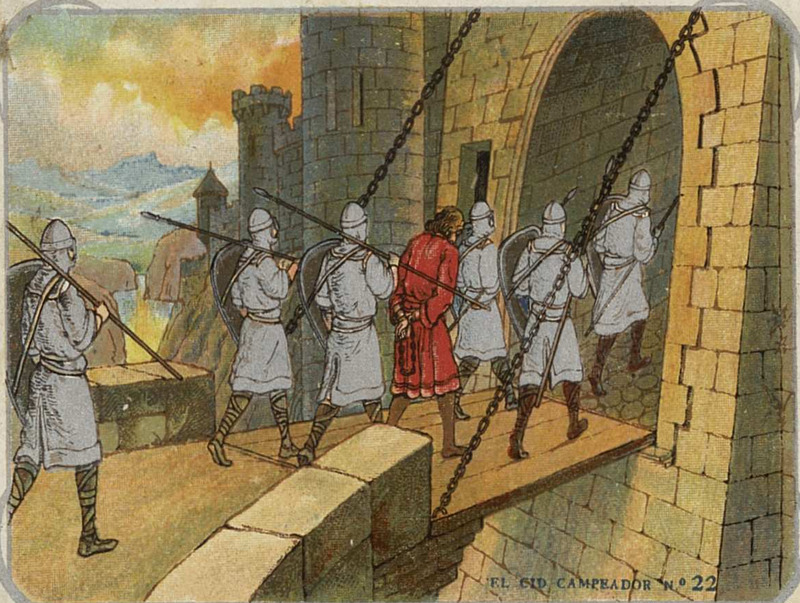
In this image there are six soldiers taking Don Garcia prisoner. The six soldiers are all wearing chainmail and carrying spears and shields. They are all wearing helmets. The prisoner is wearing a red tunic. They are all walking on a drawbridge to enter a castle. In the distance there are towers that are a part of the castle. Also, in the background a river is visible.
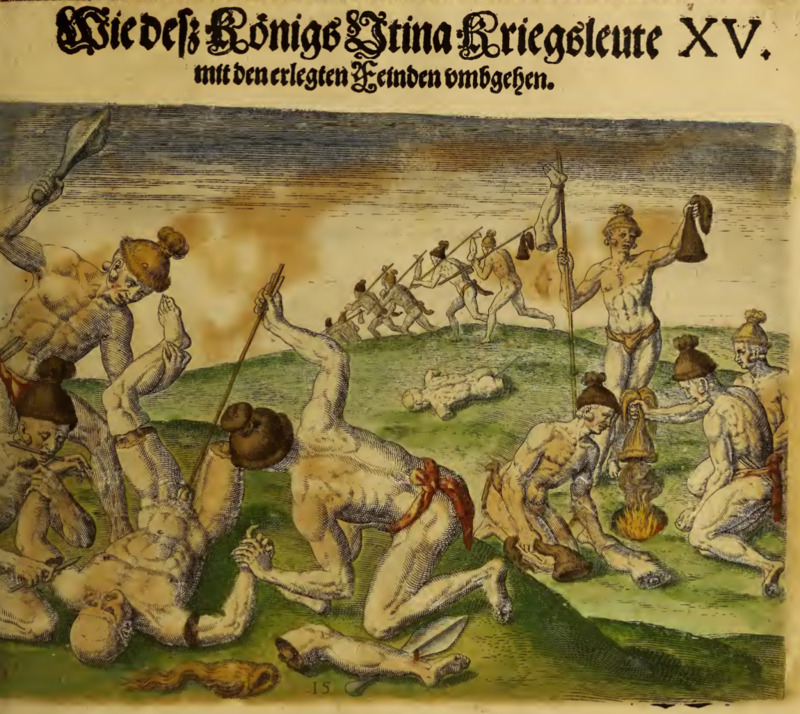
This image shows members of the Indigenous group led by Outina dismembering and scalping the deceased bodies of other Indigenous people from an enemy group. This illustration is identical to the one found on page 65 of Frankfurt 1591, but colored.
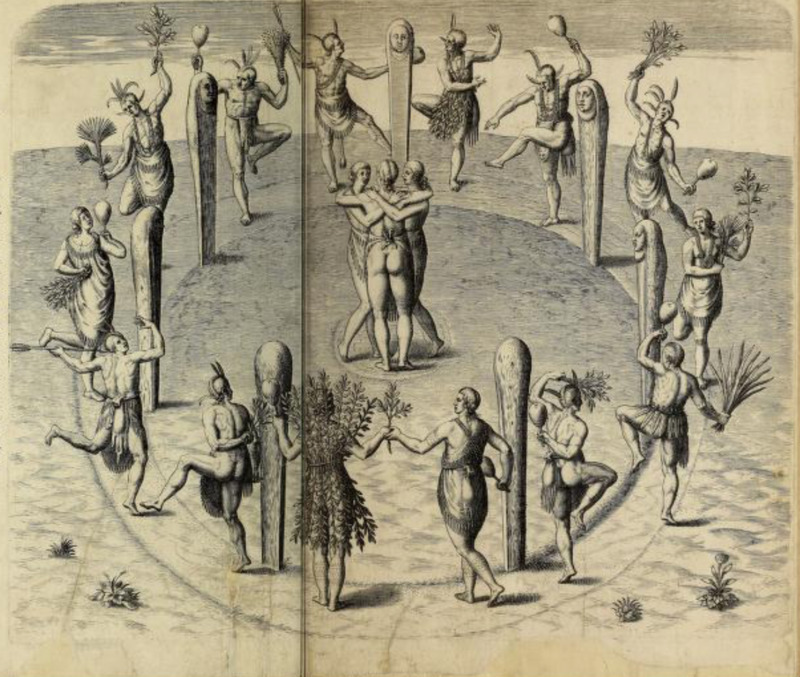
A group of Indigenous people are shown engaging in a dance. Three individuals embrace, and others dance in a circle around them. Some hold branches and other plants and objects in their hands. The circle is partially formed by wooden posts stuck into the ground. These posts have faces carved into the top of them, facing into the center of the dance circle.
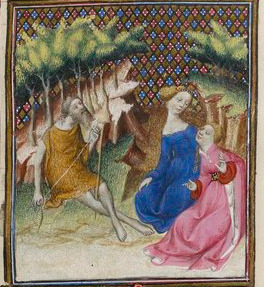
When King Eurytus of Aetolia broke his promise to Hercules that he could marry his daughter, Hercules took revenge and killed him. He married Iole, but Iole wanted to avenge her father’s death. To do so, she turned Hercules from being a strong, abrasive, masculine man, to a feminine, soft, gentle man. She knew that if she could change the man he was, she would truly avenge her father’s murder. In the image, Hercules wears a yellow cloak and is using instruments for weaving – something Iole taught him to do. He sits in a feminine position and looks weak and old, rather than powerful and strong. Iole and another young woman sit across from him, Iole wearing the blue gown.
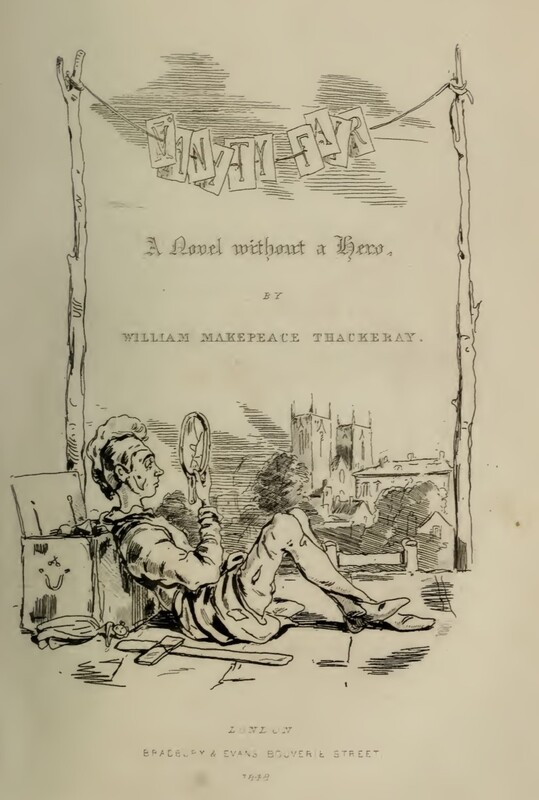
Two sticks-the left one forked, the right one pointed-hold up a banner with the title Vanity Fair, each letter on a separate piece of paper through which a string runs. Beneath the banner is printed the subtitle and author, A Novel without a Hero by William Makepeace Thackeray. At the base of the banner, a haggard man with a plumed helmet is lounging against an open chest, holding up a mirror from which he peruses his reflection. By his side are a doll and what appears to be a handmade axe or hammer, with a flat rectangular stone or piece of wood tied to a longer, thinner stick. In the background can be seen trees, a fence, and several buildings.
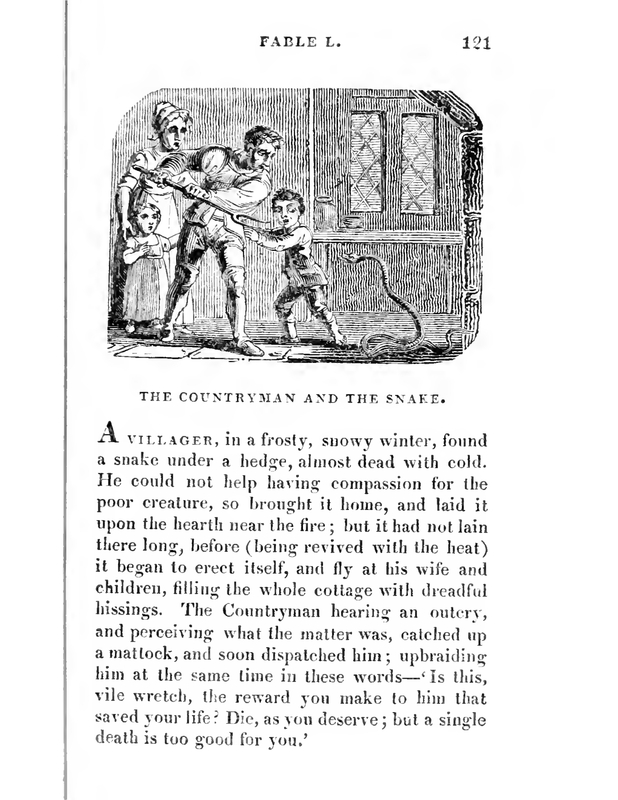
A group of people and a snake are inside a room. A woman, a man, and two small children are on the left-hand side of the image. The woman stands behind the man along with one of the small children. The other small child, who is currently on the right side of the man, appears to be moving towards the woman. The man wields a two-pronged pitchfork which he points at the snake. The snake is on the right-hand side of the image. The snake seems to be rearing up, mouth open and tongue out. Inside this room there are two windows and two pots in the background.
This image is depicted in the author’s chapter where he discusses cities, towns, villages, and provinces in colonial South America. The left side of the image depicts the indigenous pucara de chile [fortress of Chile] and the right side depicts the Spanish fuerte de cristiano del rrey [Christian fortress of the king]. The image depicts a battle between the indigenous population of Chile against the Christian Spaniards in Santa Cruz. There are three native soldiers standing atop their fortress under a small hut. The indigenous fortress displays large-stoned Incan architecture. The Spanish fortress depicts a cluster of European styled buildings which forms a square in the centre. There is a Spanish soldier standing on the edge of the fortress. At the base of both fortresses are Chilean native soldiers and Spanish soldiers preparing to battle with their spears. The word batalla [battle] is written in between both armies. A mountainous Andean landscape is illustrated in the background with birds flying over top.
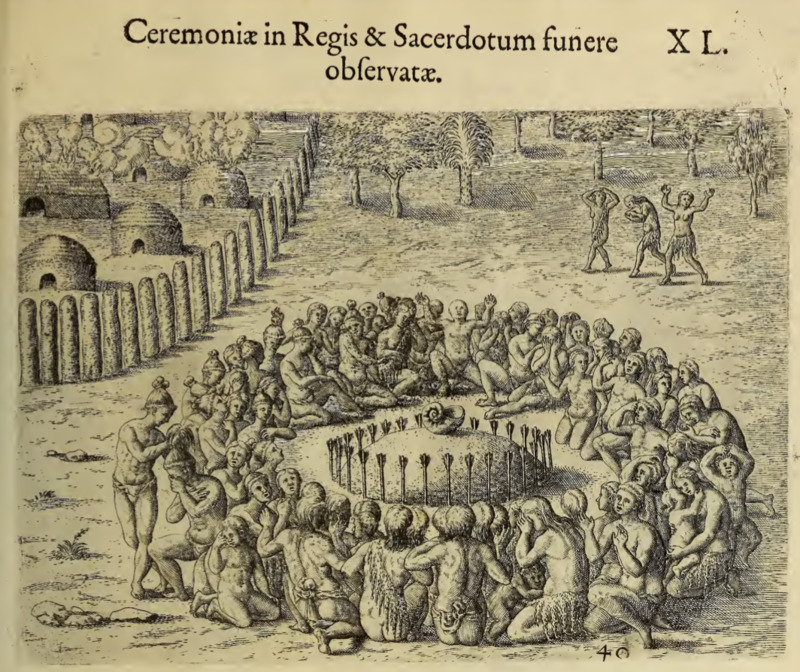
A large group of Indigenous people are shown clustered in a circle, most kneel or sit on the ground. The group appears to be openly mourning together. At the center of the circle there is a mound of earth surrounded by arrows planted tip first into the ground. A large shell sits on top of the ground. The ceremony is taking place outside the village close to the log fence encircling the village.
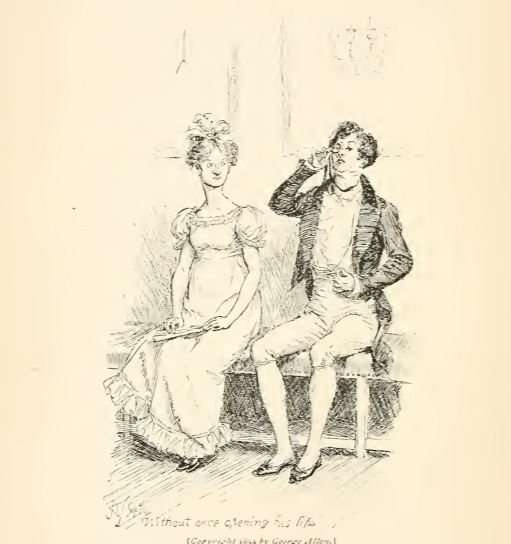
In this image Mr. Darcy sits near Lizzy at the ball in Meryton. Although Mr. Darcy refused to dance with Lizzy, he sat next to her without speaking for thirty minutes. Mrs. Bennet took this as a sign that Mr. Darcy was interested in Lizzy, despite his refusing to dance. This scene occurs in chapter 5. The characters are shown in the traditional regency style. Mr. Darcy wears a waistcoat and tailcoat with a cravat. Lizzy wears a regency style dress with an empire waistline and carries a fan. Fans were used at this time to communicate to others across the room at balls. The regency period dated to the early nineteenth century (1811-1820) when George, Prince of Wales, later George IV (r. 1820-1830), reigned as regent for his mentally ill father, King George III (r. 1760-1820). The regency period is associated with the rise of neoclassicism in art and fashion.
This image combines several aspects of the story. The central figure is one of the giants from Brobdingnag, holding Gulliver’s ship. There are two horses from the Country of the Houyhnhnms, which are being held by two eagles, presumably representing the one who took Gulliver from Brobdingnag. This image also appears in the 1747 von Wiering German edition.
Here we see Gulliver examining various musical instruments on Brobdingnag. Gulliver climbs inside the bell of a trumpet. Cymbals and a drum lie on the table next to him. The instruments are all lying on sheet music.
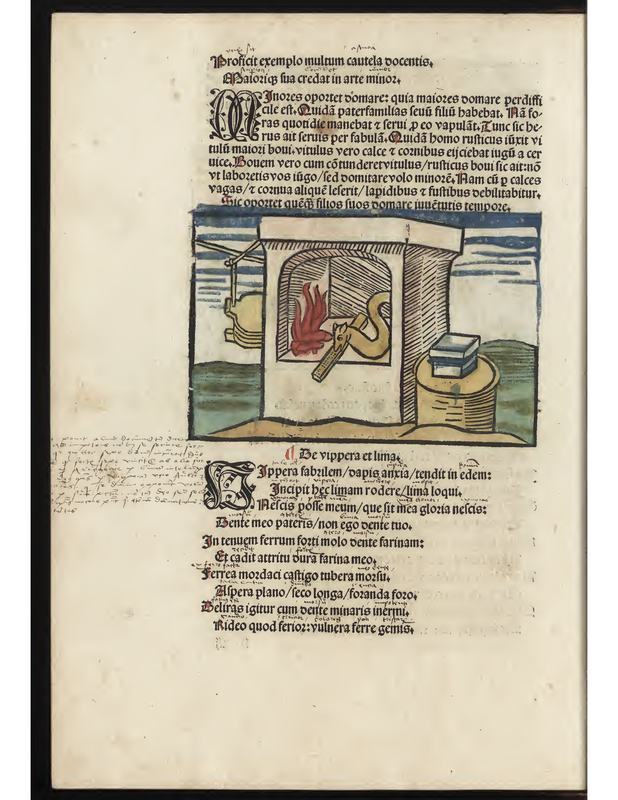
The adder is inside of a small structure of fire. Inside of the snake’s mouth is a file. Outside of the structure there is a stack of books. The snake is close the the fire.
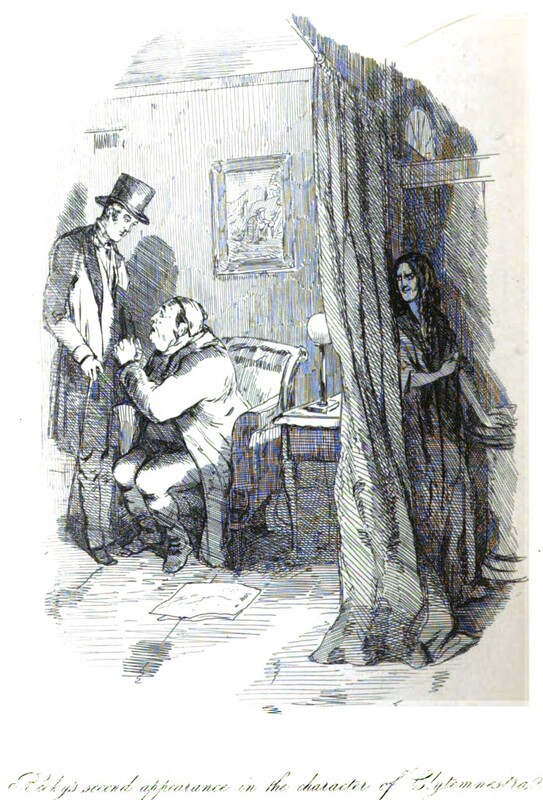
Joseph Sedley sits in a chair, begging William Dobbin, now his brother-in-law, to come and live near him, or else help him escape to India without Becky finding out. Dobbin was sent there by Amelia, who is worried about her brother after finding out that he has purchased a large life insurance policy. Behind a curtain on the far side of the room is Rebecca Crawley, listening in and holding a dagger in one hand. Below the illustration is printed in cursive its title, Becky’s second appearance in the character of Clytemnestra.
In this image we see Gulliver learning to read the language of the giants from Brobdingnag. We see Glumdalclitch’s hands, one holding the book, the other holding a pointer. On the page we see different letters, Glumdalclitch pointing to different ones. Gulliver is seated, holding on to one page. The same image appears in both the 1839 and 1843 Krabbe editions.
Here we see Gulliver standing behind a folding razor which was used by the king of Brobdingnag’s barber during the morning ceremony called the Levee. The Levee was a daily ceremony that originated in France and spread to other monarchies quickly thereafter. Gulliver attended the Levee and asked to take the soap with the king’s beard hair which he then used to make himself a new comb. In the image we see the bar of soap used on the bottom right corner, labeled savou. On the handle of the blade is the letter J, which is the first letter of the chapter. The same image appears in the 1839 Krabbe edition.
Georgy Osborne sits next to his friend Mr. Todd in the pit of the theater, where they are watching a play. Next to them is Mr. Rowson, Mr. Osborne’s footman and Georgy’s appointed servant, who is holding his cane and has placed his hat under the bench.

![[Vanity Fair Chapter LII Inhabited Initial]](https://collections.cemvc.ca/files/large/af4a7cbe0d8fcd088dd7628d735132d984111693.jpg)
![La Fverte de S[an]ta Crvs de Chile](https://collections.cemvc.ca/files/large/5259664b069cc4faca5cc02fbc8891ee669af7df.jpg)
![[Depiction of various aspects of the story of Gulliver’s Travels]](https://collections.cemvc.ca/files/large/099c817a8ac31cadd8db4d6af5ca1121bbdb5edc.jpg)
![[Gulliver examines the instruments on Brobdingnag]](https://collections.cemvc.ca/files/large/c445a09ae5d0712a92338a23a7870ee46ad79606.jpg)
![[Glumdalclitch teaches Gulliver to read the language of Brobdingnag]](https://collections.cemvc.ca/files/large/26aeb3d7e7f2b2f66d0c1373615359495b5390b1.jpg)
![[Gulliver with a folding razor from Brobdingnag]](https://collections.cemvc.ca/files/large/bf99bc5b9a98605b8a07535e634ec13704792f1c.jpg)
![[Rowson, Todd, and Georgy]](https://collections.cemvc.ca/files/large/0810a2bd149e829fe8498eb78e10ecdabfd3515f.jpg)