Here we see the eagle that carried Gulliver in his house away from Brobdingnag. The eagle picked up Gulliver’s house and carried it out over the ocean before dropping it. Gulliver was then rescued by a merchant’s ship. The image appears at the beginning of the eighth chapter, foreshadowing Gulliver’s escape from Brobdingnag. The same image appears in the 1843 Krabbe edition.
Celestina (leftmost figure) arrives at Melibea’s house, where she is greeted by Lucrecia (perhaps the rightmost figure), Melibea’s servant. As an old friend of Melibea’s mother Alisa (perhaps the rightmost figure), Celestina gains entry under the false pretense of paying her a visit and selling yarn. The servant of Alisa’s dying sister arrives and informs Alisa that her sister has requested her presence. Alisa departs, leaving Celestina alone with Melibea (central figure) and Lucrecia. She talks for a while with Melibea and eventually reveals that she is there on behalf of Calisto, which sends Melibea into a fit of rage. Celestina manages to quell her rage with a lie, telling her that Calisto’s cure requires only her girdle and a handwritten charm/spell. Melibea gives Celestina her girdle (as depicted in this illustration), and she asks Celestina to return the following morning to retrieve the spell.
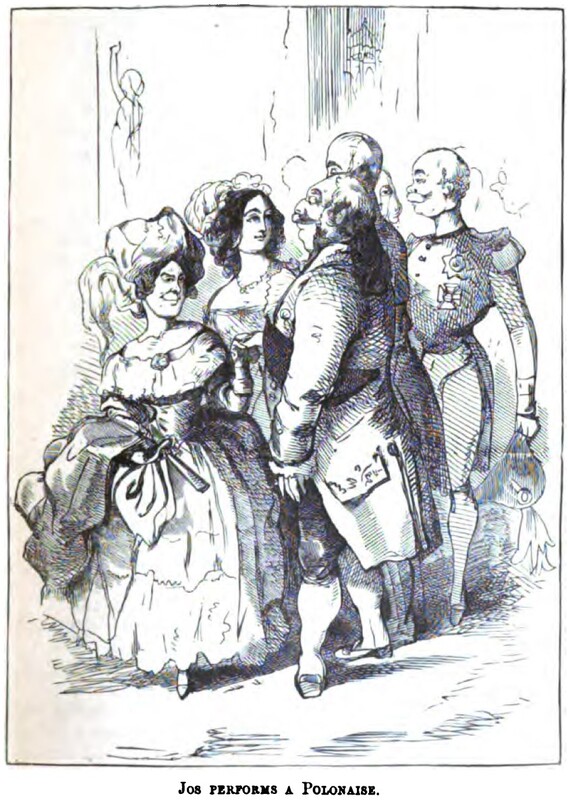
Joseph Sedley stands opposite the Countess of Schlüsselback, holding her hand as they walk a Polonaise at a Court-ball. Behind them in the row are Major Dobbin and Amelia Osborne, with another decorated officer in the pair after. Below the illustration is printed its title, Jos performs a Polonaise..
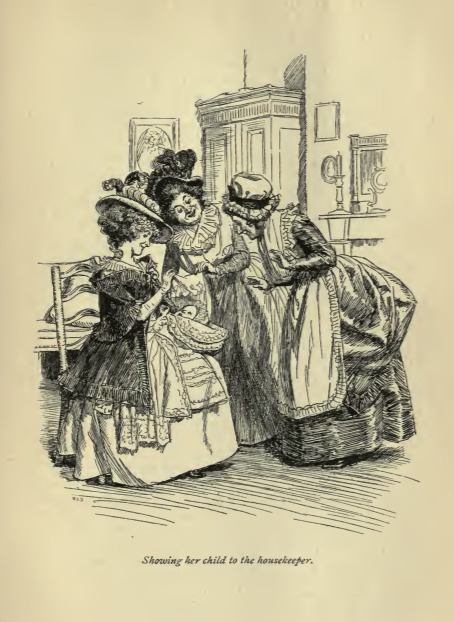
In this image Mrs. Palmer shows off her newborn baby to Mrs. Jennings housekeeper. Mrs. Palmer is Mrs. Jennings’ daughter, and she had a baby while Elinor and Marianne were staying in London with Mrs. Jennings. This scene occurs in chapter 42. The characters are shown in the traditional regency style. Mrs. Palmer, Mrs. Jennings, and the housekeeper wear regency style dresses with empire waistlines. Mrs. Palmer and Mrs. Jennings wear bonnets and the housekeeper wears a mop cap and an apron to protect her hair and clothes. The regency period dated to the early nineteenth century (1811-1820) when George, Prince of Wales, later George IV (r. 1820-1830), reigned as regent for his mentally ill father, King George III (r. 1760-1820). The regency period is associated with the rise of neoclassicism in art and fashion.
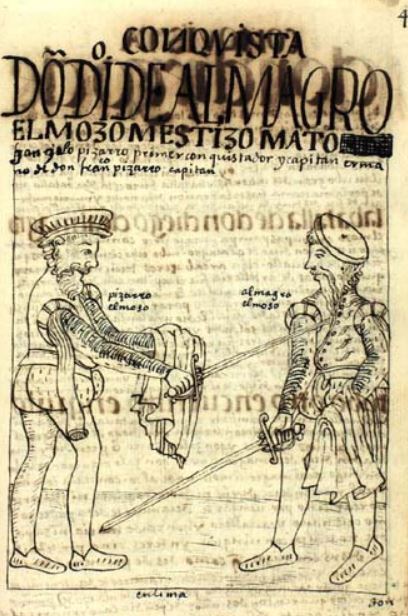
This chapter focuses on discussing the arrival of Spaniards and the Spanish conquest of Peru. This image depicts the murder of Don Diego de Almagro, one of the leading conquistadors of the conquest of Peru. He is illustrated on the right side of the image getting stabbed by the sword of Gonzalo Pizarro, another conquistador. They are both dressed in their traditional European clothing. The man on the left is identified as pizarro el moso, [Pizarro the waiter] and the man on the right is identified as almagro el moso [Almagro the waiter]. The caption at the bottom of the image reads, en lima [In Lima].
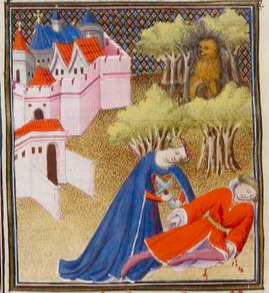
Thisbe, wearing the blue gown, throws herself onto her lover’s sword. Her lover in the red robe, Pyramus, lies on the ground dead after thinking he found evidence of Thisbe’s death. In the background, a lioness hides in the trees – the lioness is to blame for both deaths. She wiped her bloody mouth on Thisbe’s cloak, which Pyramus found and lead him to believe that Thisbe had been eaten. He killed himself out of heartbreak, which lead to Thisbe finding his body, and killing herself, too.
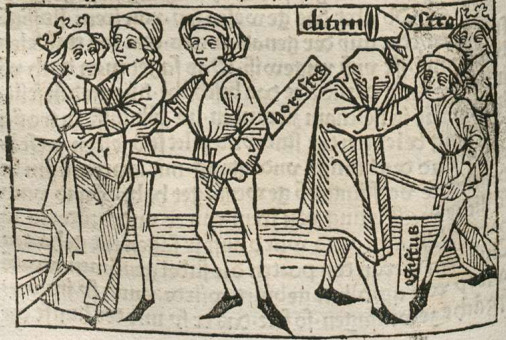
Clytemnestra, the queen of Mycenae, is depicted on the far-right side of the engraving wearing a crown. We know that this is Clytemnestra as her name is engraved beside her head. In front of Clytemnestra is the person she has been having an affair with: Aegisthus. His name is engraved beside his leg. Aegisthus and Clytemnestra, as explained by Boccaccio, had conjured a plan to kill Clytemnestra’s husband, king Agamemnon, in order to gain control of Mycenae. Clytemnestra gave Agamemnon a piece of clothing that had no neck hole. As he struggled with the garment, the adulterer Aegisthus pierced Agamemnon with a sword (this is depicted on the right side of the engraving). Orestes, the son of Agamemnon and Clytemnestra, sought to avenge his father’s death. He is depicted on the left side of the engraving, killing both his mother and Aegisthus. Orestes’ name is engraved behind his back.
Two Tupinambá men are shown. One of the men stands in front of the other. He wears a feathered adornment at his back, attached to his body with a strap over one shoulder, ruffled adornments around both calves, and is otherwise nude. He bends down with one hand outstretched towards a monkey that sits on the ground beside him. The man standing behind him wears a feathered headdress and an adornment on his chin and is otherwise nude. He holds a rattle or an ornament in one hand, and stares at a parrot on a perch to his left.
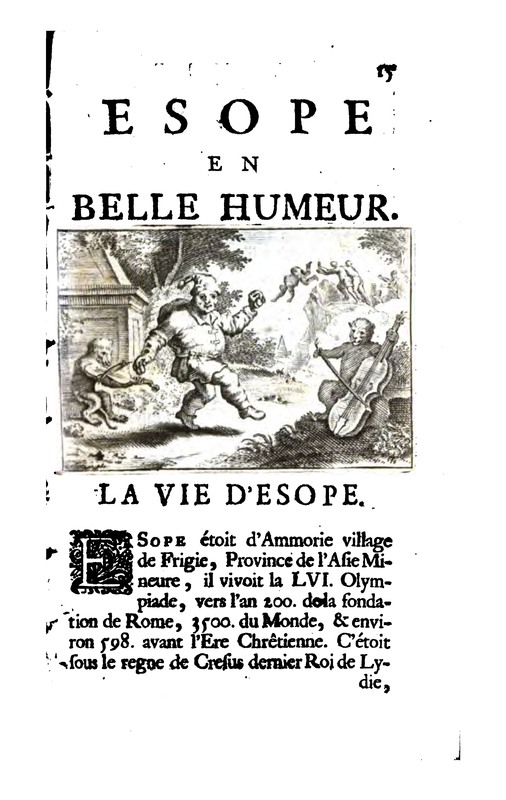
In this image there is a man with a hat dancing in the middle of a pathway. To his righ there is an animal sitting in front of a house resembling a monkey who is playing a string instrument like violin. To his left, there is an animal resembling a bear who is playing a string instrument like cello. Behind them there is cliff and two man are pushing off a human off the cliff. Not far behind them are people with their hands lifted like they are crying for help.
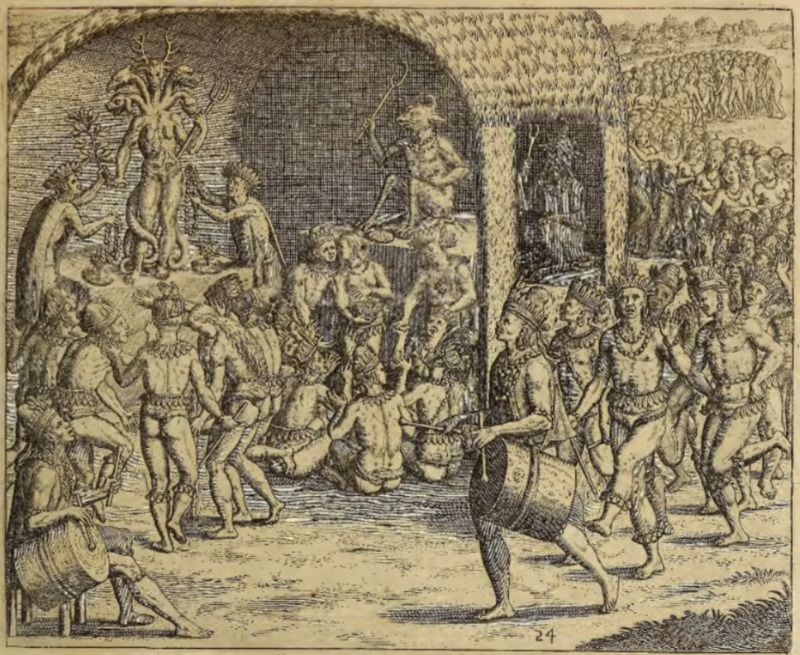
A large group of Indigenous people conduct a religious ceremony. One individual, dressed to reflect several different animals including an owl, snakes, a stag and wildcats, stands on a platform or altar inside a dwelling on the left. Two people offer strands of beads and a branch to this individual. Two other people wearing animal heads sit on altars further inside the building. Some of the Indigenous people sit on the ground inside the dwelling, some dance near the first altar, two play drums, and others arrive at the site in a long, dancing procession. Most of the individuals wear feathered headdresses, beaded jewelry, and other feathered adornments around their necks and waists. This image is identical to one found on page 195 of Frankfurt, 1594.
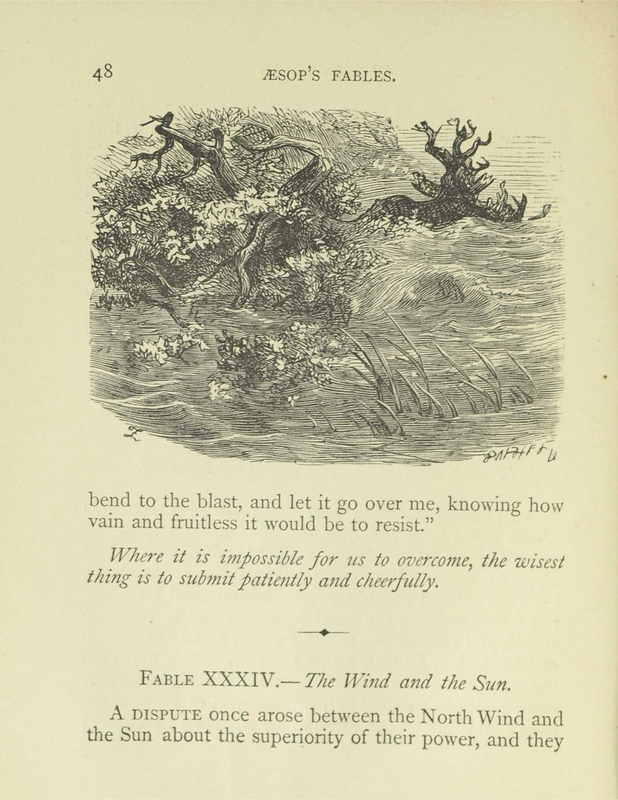
In the image we see a large and dramatic body of water that appears to have a lot of movement and waves crashing, perhaps stormy weather. In the body of water there is a large oak tree in the background that growing out of the water with lots of outstretched branches. Throughout the foreground we can also see many reeds poking up out of the water especially on the right side.
After the death of Sempronio and Pármeno, Calisto asks Sosia and Tristan (the two figures in the foreground) to accompany him to Melibea’s house. When they arrive at her house, they place a ladder on the high wall surrounding the garden (in this illustration it is depicted inside the garden, in the background to the left), and Calisto climbs over. He spends the night with Melibea (in the background to the left), and based on the dialogue, we can assume he takes her virginity. However, daylight begins its approach too quickly, occasioning his departure. He, Sosia, and Tristan return to his house, and he ascends to his bedroom to get some sleep. When he is alone, he laments the shortness of his visit with Melibea.[This illustration is quite similar to the one found on page 4 of the text (folio a3v), in terms of composition.]
Here we see a swallow building a nest. It appears when the Council of the Houyhnhnms discussed the possibility of exterminating the yahoos. Gulliver’s master defended Gulliver, arguing that Gulliver, like other Europeans were very civilized and explained their accomplishments, including building – much like the swallow - and industry - like the ant. Gulliver’s master that there was nothing wrong with learning from them. This passage is a reflection of European ideas about North Americans, who believed that the North Americans were a form of lesser being because of their racists and colonial ideologies. The same image appears in the 1843 Krabbe edition.
A group of Indigenous men, women, and children cry of happiness, some with their hands over their faces or clasped in front of them in displays of emotion. One man sits in a hammock, while two others stand around him, and three women and a child crouch or kneel on the ground. Two European men stand beside the group, dressed in long robes with caps on their heads. The child sits on the ground near the feet of one of the men and pulls on the bottom of his robes with one hand. Two structures are visible, one directly behind the group and another in the distance. This image is identical to one found on page 929 of Paris, 1575 (Chaudière).
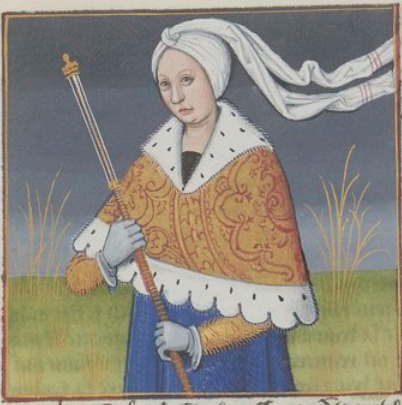
This illumination depicts Lavinia, queen of Laurentum. Lavinia married the famous hero, Aeneas of Troy, after her father heard from an oracle that she should marry a foreign man. Boccaccio explains that Aeneas died shortly after Lavinia gave birth to their first child, Postumus.
Gulliver is dressed in his finest clothes and carries a sceptre, as is the traditional formal attire in England. In this chapter Gulliver talks with the king of Brobdingnag about English traditions. Gulliver tells the King about diplomacy, religion, the justice system, the arts, the financial system, and the nobility, then debated these issues with the king. The same image appears in the 1839 Krabbe edition.
A female figure is seated in a wooden letter P of Poor on the banks of a stream or river. She holds in her left hand a fishing rod, which has attracted the attention of a single large fish. In the background are several trees and the shapes of buildings in a city or town in the distance.
This image is illustrated in a chapter that discusses and criticizes the government and society in Spanish conquered Peru. This image depicts a Corregidor [Magistrate] and a priest making their nightly rounds in indigenous pueblos. The author explains that these men made nightly rounds in local houses to lift women’s blankets and look at their genitals. The Corregidor is depicted lifting the blanket of a sleeping woman while the priest holds his candle and illuminates the room to look at the woman. The caption at the bottom of the image reads, probincias [provinces].

![[The eagle carrying Gulliver in his house away from Brobdingnag]](https://collections.cemvc.ca/files/large/ff3019ca6a502f7be8b963805eb0c9c19182b4d7.jpg)
![[Act IV – Celestina Talks to Melibea While Another Female Figure (Either Alisa or Lucrecia) Faces Away]](https://collections.cemvc.ca/files/large/b09f717d8432b3599682b09261b9b7d9f875354c.jpg)
![[Two Tupinambá men with a parrot and a monkey]](https://collections.cemvc.ca/files/large/f83e1b2d3e4d2bef2cd314fc1531e24e5e398ecb.jpg)
![[Act XIV – Melibea and Calisto Embrace, Sosia and Tristan Stand Guard, and Lucrecia Waits at a Distance]](https://collections.cemvc.ca/files/large/04b3b7bd5431b5fc4abc74757a1a1652ba755949.jpg)

![[a swallow building a nest]](https://collections.cemvc.ca/files/large/50a70ea5888edaeeca119047685039f7d03cc27a.jpg)
![Femmes & filles pleure[n]t de joye.](https://collections.cemvc.ca/files/large/c8437e72174585981168f72a500a9ee33aa3f54a.jpg)

![[Gulliver prepares to speak with the King of Brobdingnag wearing his best clothes]](https://collections.cemvc.ca/files/large/1f2714efcc8841d4a9e7494eb53cdcb199b6d301.jpg)
![[Vanity Fair Volume II. Chapter XXI Historiated Initial, G]](https://collections.cemvc.ca/files/large/b08786336b9d6c3ad3168ba4393f250457852320.jpg)

![[Vanity Fair Chapter IV Inhabited Initial]](https://collections.cemvc.ca/files/large/e8761e776adb0153385da4a0e7cd52ee03569601.jpg)
![El Coreg[id]or I P[adr]e, Tiniente Anda Rrondando y Mirando la Guerguenza de las Mugeres](https://collections.cemvc.ca/files/large/be42dd8aa8c8dc8b6bb99139bd25793076a212ec.jpg)