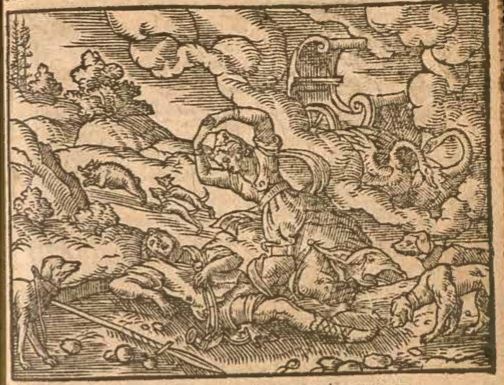
This engraving illustrates the death of Venus’ lover, Adonis. Adonis had ignored Venus’ advice on hunting smaller, less threatening animals, and had chased after a boar while on a hunt. One of Adonis’ hounds is illustrated chasing the boar away in the background of the engraving. Unfortunately, the boar attacked Adonis by piercing his groin with one of his sharp tusks. Adonis is illustrated laying on the ground, in pain by his fatal wounds. Venus heard his groans while she was flying in her chariot drawn by swans. She found Adonis’ lifeless body and mourned over him. She then turns his blood into an anemone flower.
A winged old man with a long grey beard walks over a cloud dressed in rags. His wings are white, feathered, and angelic, in his right hand he carries a book and over his left shoulder he carries a scythe.
Mistaking a basin for what he believes to Mambrino’s legendary helmet, Don Quixote attacks the barber, who falls from his mount. In the background, Sancho Panza throws up his arms. Accurate to Cervantes’ text, it is raining and the barber wears his basin on his head. Signed by J. Rivelles (illustrator) and T. L. Enguídanos (engraver). Part 1, ch. 21.
When Don Quixote, clad in armor, saw this cohort of master Peter's Moorish puppets, he he rose from his seat, unsheathed his sword, and, began to rain hacks and slashes upon the puppets, showering down strokes like hail and demolishing the castelet. The whole audience appears to be in consternation, and even Sancho (right) steps backwards having never seen his master so outraged. Master Peter lies on the ground next to his castelet reaching out to Quixote and begging him to cease in his destruction, while a young boy on the left peels back a curtain and watches Quixote destroy the puppets in horror.
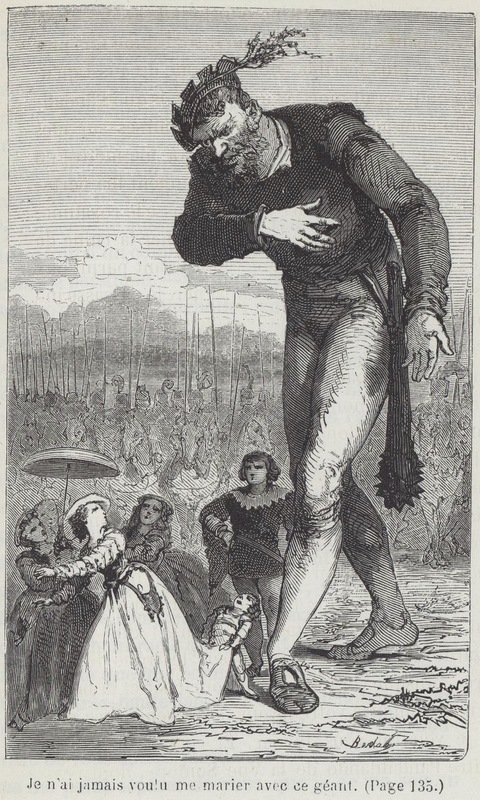
The illustration is a representation of princess Mimicona’s story as she tells it to Don Quixote in ch. 30. When she was a young girl, her father, Tinacrio the Mage, told her that she would soon be orphaned and that a monstrous giant would invade their kingdom with a mighty army. In the prophecy, the giant, Pandafilando of the Gloomy Glance, would ask her to marry him. Signed by A. ‘Bertall’ d’Arnoux (illustrator). Part 1, ch. 30.
Don Quixote attacks the wineskins while sleepwalking. He is half-dressed, has a blanket draped over his right arm, and wields his sword. The innkeeper clenches his fist, preparing to hit Don Quixote. The wine from a punctured wineskin spills onto the floor in the foreground. Signed by D.-N. Chodowiecki (illustrator) and D. Berger (engraver), dated 1781. Plate A.II. Part 1, ch. 35.
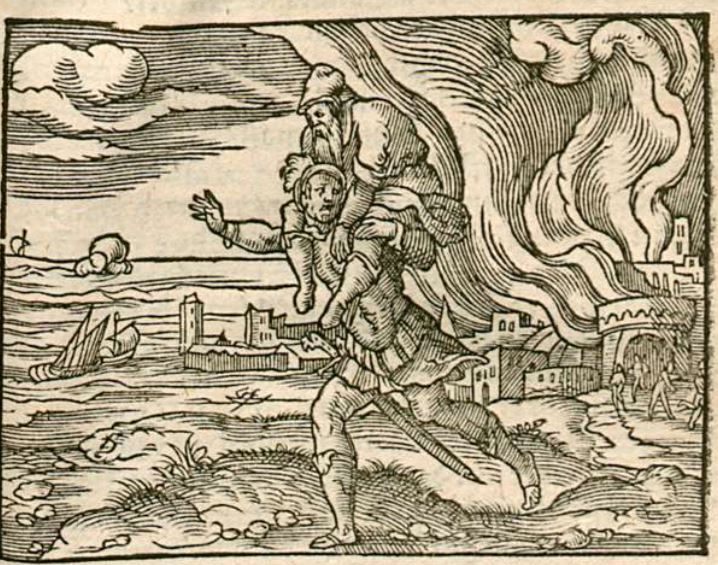
This engraving illustrates the Trojan warrior, Aeneas, escaping the fall of Troy with his father Anchises on his shoulders. The city of Troy is in the background of the engraving engulfed in flames as it burns to the ground. There are people depicted in the distance by the entrance of the city who follow Aeneas. Aeneas and his small company of people get in the ship that is illustrated on the water on the left side of the engraving which leads them to the island of Delos.
Having fallen into a deep dark pit while returning from Barataria, Sancho Panza (left) falls headfirst into the darkness, his arms stretched out before him to break his fall. On the right his donkey, Dapple, is falling just beneath him. Above Sancho, his hat flutters down at a slower pace.
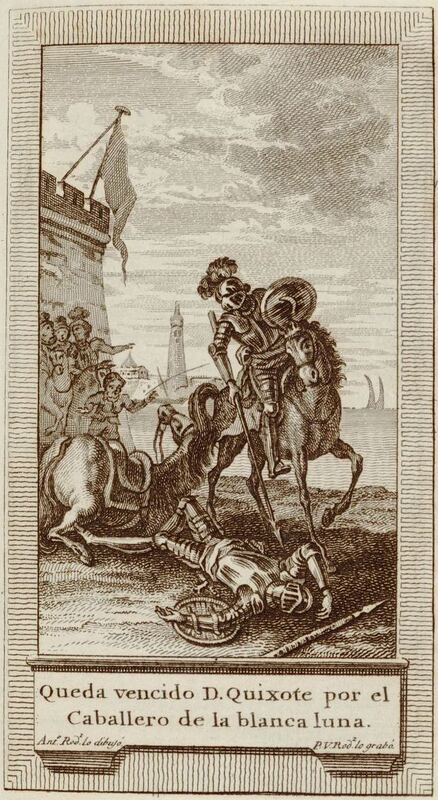
The Knight of the White Moon (Sansón Carrasco disguised) defeats Don Quixote on the beach at Barcelona. Sancho Panza, Don Antonio Moreno, and the viceroy watch. In the background, the port and lighthouse of Barcelona are depicted. Signed by A. Rodríguez (illustrator) and P. Rodríguez (engraver). Part 2, ch. 64.
Dorotea, frightened by the discovery of her bad reputation left the city and took refuge among the Sierra Morena mountains. But, while hiding in the mountains, Dorotea was assaulted by her servant who tried to force himself upon her. In defending herself, Dorotea found the strength to push the servant down a precipice. Dorotea is depicted clad in a drab coloured jerkin, girded closely around his body with a piece of white linen; wearing breeches, gaiters, and a cap in an effort to look the part of a shepherd. She appears to waving to her treacherous servant who, in trying to assault her, was pushed off a cliff.
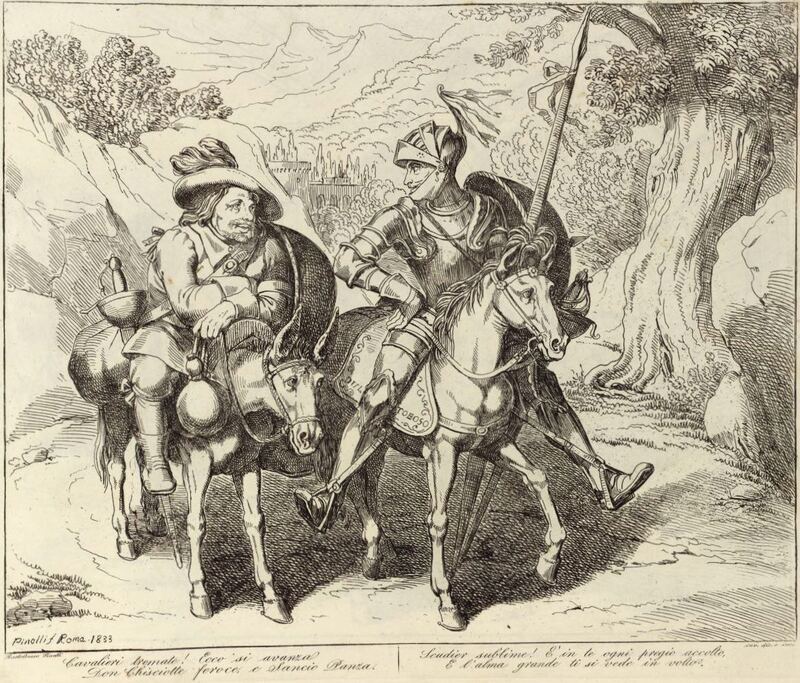
Don Quixote undertakes his second sally, now accompanied by his squire Sancho Panza. Don Quixote rides Rocinante, wearing his armour and holding his buckler and lance. Sancho is mounted on his donkey. Signed by Bartolomeo Pinelli (engraver and illustrator) and dated Rome, 1833. Plate 12. Part 1, ch. 8.
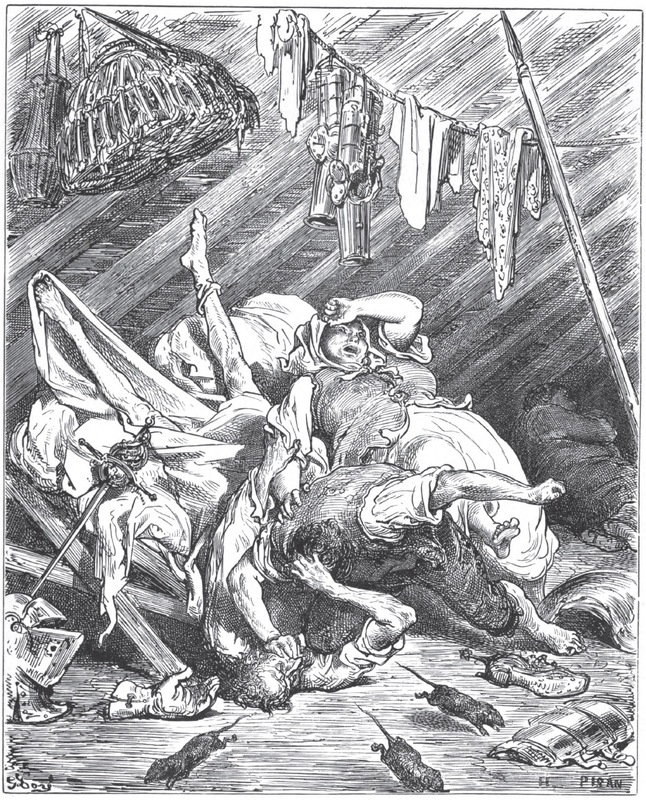
Maritornes, attempting to meet a carrier who was staying in the same inn and room as Don Quixote, was grabbed by Don Quixote himself. He believed that she had fallen. in love with him and had come to tempt him away from Dulcinea. He held on to her and told her that he could not cheat on his lady love, while Maritornes tried to get free. The carrier she had agreed to meet grew angry upon seeing her struggling, and so attacked Don Quixote. The added weight caused the poorly constructed bed to collapse, waking the innkeeper and starting a brawl that included Don Quixote, Sancho Panza, Maritornes, the innkeeper and the carrier. The image shows Don Quixote, the carrier and Maritornes piled on top of each other on the collapsing bed, while Sancho Panza sleeps nearby and rats run out from under the bed. Bits of armour and clothing are hanging from a clothesline, and the lance can be seen leaning against the ceiling. This scene can be found in Part 1, Book 3, Chapter 2.
A courier enters out of breath and extends out a letter in his right hand, in his left hand he holds a horse whip and under his arm a hat. He has arrived to deliver a letter to Sancho Panza on the duke's decree informing him of an upcoming attack on Barataria.
At the inn, Zoraida and the captive introduce themselves to the guests: Don Quixote, Don Fernando, Cardenio, Dorotea, Luscinda, and the barber. The illustration is not accurate to the text: Zoraida is depicted as a black woman. Signed by D.-N. Chodowiecki (illustrator) and D. Berger (engraver), dated 1779. Plate 7. Part 1, ch. 37.
An old man sits in a chair in white robes and buttoned shirt with white cloth draped back over his head, an illustrious beard and moustache to his name and a necklace set with a heavy stone slung across his shoulder. In his right hand he holds a quill and in his left a piece of paper which he has already begun drawing symbols upon from the bottom upwards. The image is occasioned by Don Quixote saying that "the author of this our history must be some sage enchanter. Nothing is hidden from those gentry that they have a mind to write."
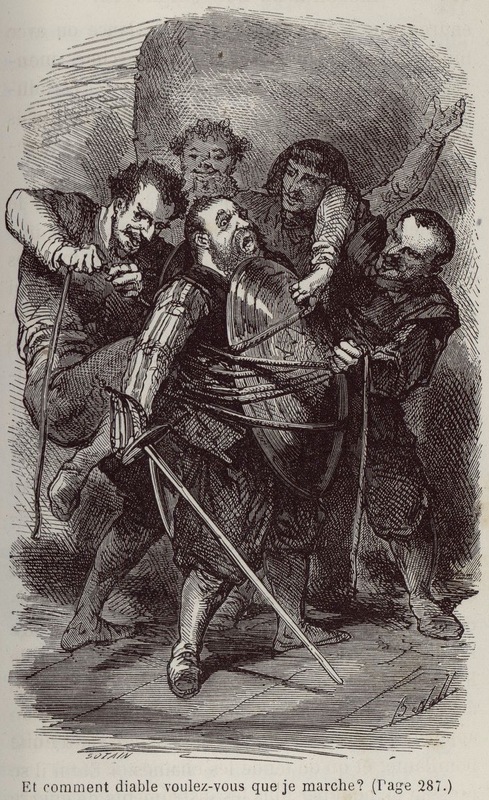
During the invasion of Barataria Island, soldiers tie Sancho Panza between two shields to protect him. In protest, he asks them how they expect him to walk. Signed by A. d’Arnoux (illustrator) and N. E. Sotain (engraver). Part 2, ch. 53.
A local farmer, Pedro Alonso, rescues Don Quixote after his encounter with the silk merchants of Toledo and takes him home on his mule. Rocinante carries Don Quixote’s armour and broken lance. The knight appears melancholic. Signed by J. Rivelles (illustrator) and T. L. Enguídanos (engraver). Part 1, ch. 5.
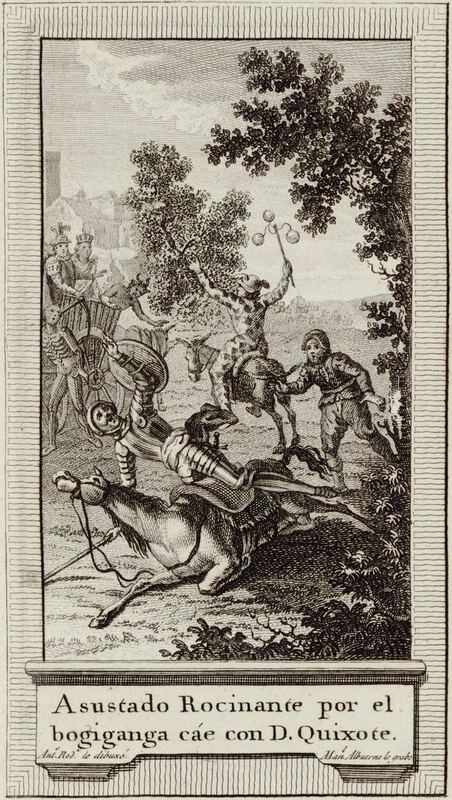
Don Quixote and Sancho Panza encounter a cart carrying the actors of Angulo el Malo’s company for the mystery play ‘The Assembly of Death.’ The latter are dressed as Devil, Cupid, Death, Angel, Emperor, Queen, and Soldier. Rocinante is alarmed by the sound of bells and runs across the field. While Sancho runs to Don Quixote’s assistance (foreground), a member of the company makes off with his donkey. Signed by A. Rodríguez (illustrator) and M. Albuerne (engraver). Part 2, ch. 11.
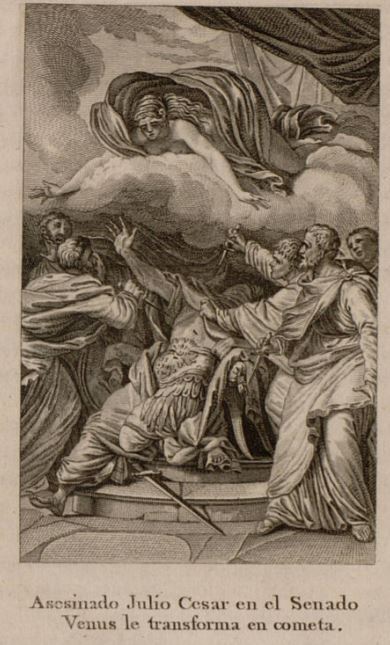
This image depicts the famous assassination of Julius Caesar at a meeting of the Senate. Caesar is in the centre of the image lying on the steps of the Theatre of Pompey as the other senators stab him to death. The goddess Venus is depicted floating on a bed of clouds above the scene as Caesar had claimed to be related to Venus through the bloodline of Aeneas. Venus transforms Caesar into a constellation and deifies him once he is dead.
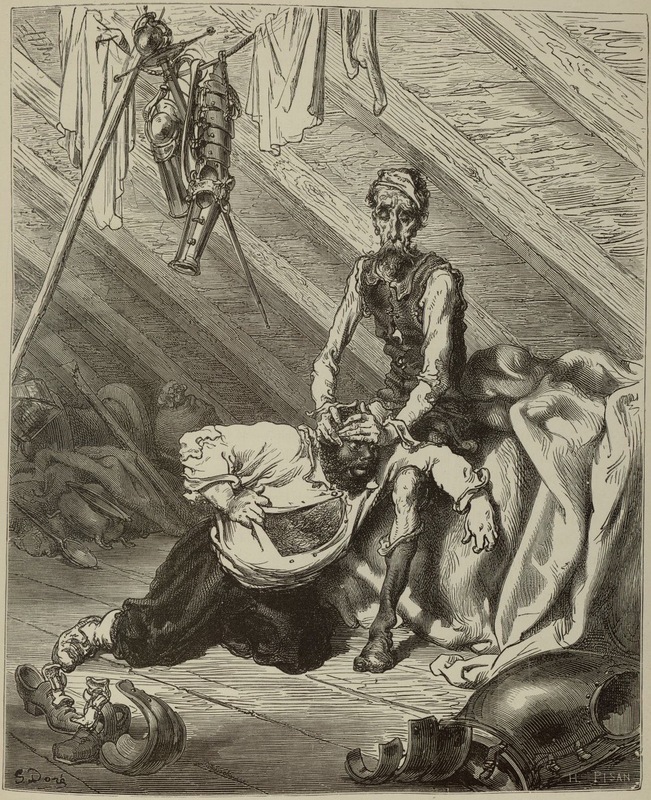
After drinking the balm of Fierabrás prepared by Don Quixote, Sancho Panza suffers bouts of nausea before vomiting. Signed by G. Doré (illustrator) and H.-J. Pisan (engraver). Part 1, ch. 17.
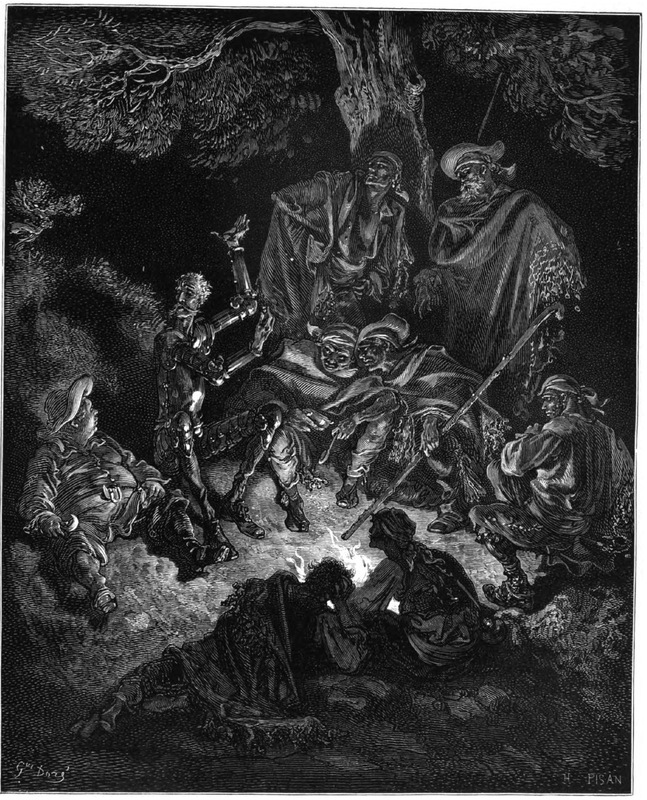
Don Quixote and Sancho Panza are hosted by a group of goatherds for dinner. Don Quixote, upon seeing some acorns offered as part of the meal, begins a long tangent about the golden age of nights-errant of which the acorns remind him. He concludes this by thanking the goatherds for their hospitality. The goatherds are confused and amazed by this long speech and offer music as entertainment and a balm to heal Don Quixote’s ear. Don Quixote and Sancho Panza are seated on overturned trough. Don Quixote is telling his story with his arms raised. The goatherds are gathered around the fire, some lying down, some seated, and some standing, watching Don Quixote attentively. This scene can be found in Part I, Book 2, Chapter 3.
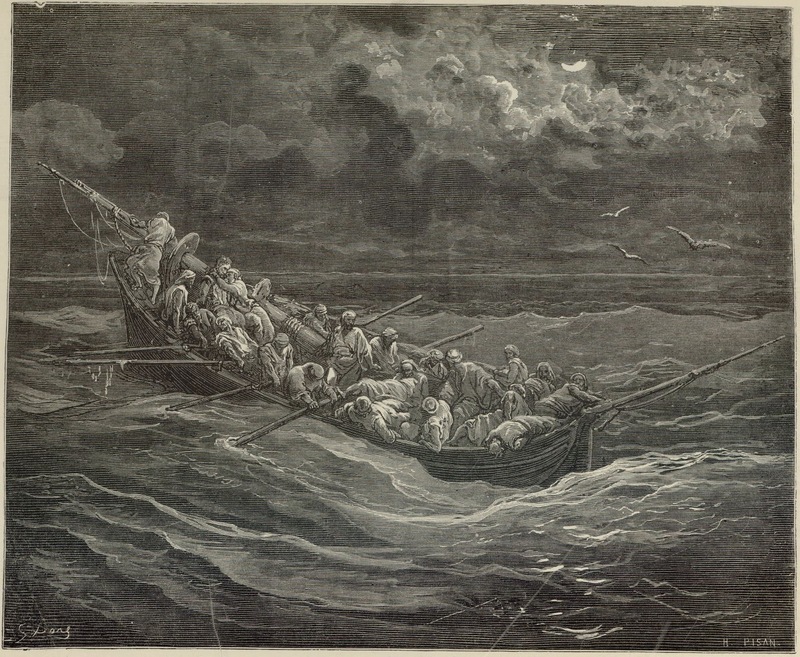
The illustration represents part of the captive’s tale: the captive and Zoraida escape in a boat, holding captive Agi Morato and the Moor oarsmen. They begin to row toward the islands of Mallorca, the closest Christian land. Signed by G. Doré (illustrator) and H.-J. Pisan (engraver). Part 1, ch. 41.
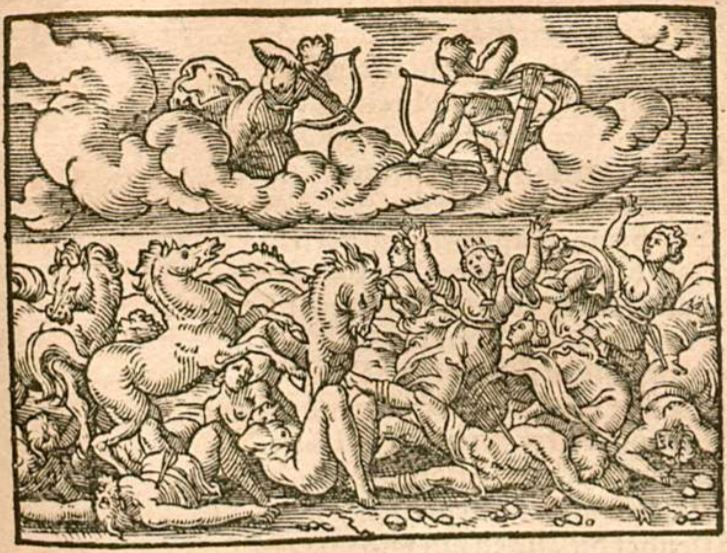
This image illustrates the goddess Diana and her twin brother Phoebus in the clouds with bows in their hands as they shoot arrows down to Earth. Diana and Phoebus are shooting and killing the fourteen children of Niobe as she had declared herself better than Latona, the daughter of Titans. Niobe boasted about having fourteen children as opposed to Latona who only had two. Latona ordered her children Diana and Phoebus to shoot down every single one of Niobe’s children as punishment for hubris. Niobe is illustrated in the chaos with her hands raised in the air with a crown on her head, as she watches her children get shot with arrows.
Don Quixote and a party of Shepherds attend the burial of Chrysostom, a shepherd who had fallen so deeply in love with Marcela, a shepherdess who refuses to marry, that he killed himself when he was rejected. At the burial Vivaldo (middle right), a passing scholar/gentleman (hidalgo), reads aloud one of Chrysostom's poems written in Marcela's absence to the approval of those who heard it. Vivaldo is about to read another one of Chrysostom's poems, but he is interrupted by Marcela who appears on top of the rock under which they are digging Chrysostom's grave. Ambrosio (left of Vivaldo), Chrysostom's closest friend, accuses Marcela of killing Chrysostom and asks why she has bothered to appear at her victims burial. She responds that she has returned to vindicate herself of the deed which she has been accused of. Don Quixote watches these events unfold clad in full armor, leaning passively upon his shield.
In the centre of the composition, the nymph Cupid dances before a wooden castle, while a maiden standing on the parapets watches. Cupid leads four nymphs (three pictured), Poetry, Discretion, Good Lineage, and Valor (left). To the right, the nymph Interest leads Liberality, Gifts, Treasure, and Peaceful Ownership. Sancho Panza eats chicken and geese while Don Quixote observes the performance. Signed by Bonard (illustrator), no given name, and L. Cars (engraver). Part 2, ch. 20.

![[Old Father Time]](https://collections.cemvc.ca/files/large/4bbbb2c394417c55549b0fbc13cc2191ac994a77.jpg)
![[Don Quixote attacks the barber]](https://collections.cemvc.ca/files/large/35bf011e181c6e03a997d1d5117ac87f3ec092aa.jpg)
![[Don Quixote Destroys master Peter's Castelet]](https://collections.cemvc.ca/files/large/a3915abc986275208d719a47ff3a7fe973120a43.jpg)
![[Don Quixote attacks the wineskins]](https://collections.cemvc.ca/files/large/414ca505ad7774d2e00203ede861445d967bddce.jpg)
![[Sancho Panza and Dapple Fall into a Deep Pit]](https://collections.cemvc.ca/files/large/d8828e775722825309ed70c6b9b55ba047b89a62.jpg)
![[Of How Dorotea Pushes her Servant off a Precipice]](https://collections.cemvc.ca/files/large/48ac235064a32cb24ef5b71f62f8593b282ff038.jpg)
![[A Courier Delivers a Letter]](https://collections.cemvc.ca/files/large/e47893f15b8e29411cc02926d998c2d843343570.jpg)
![[Zoraida arrives at the inn]](https://collections.cemvc.ca/files/large/91ca1ff10716b6c65cecfb00dd7f6eadbcedcd7f.jpg)
![[The Sage Enchanter who Quixote Imagines to be the Author of His Adventures]](https://collections.cemvc.ca/files/large/28e0dd42331a6161b2845f1192134cdcda5558bf.jpg)
![[Pedro Alonso rescues Don Quixote]](https://collections.cemvc.ca/files/large/35f846c29818c997a256c0ab42a20f017e1492c8.jpg)
![[The Burial of Chrysostom]](https://collections.cemvc.ca/files/large/61a9e06bd8c5c7fbb3c2cd1c45adc4cebe28809e.jpg)
![[Camacho's wedding]](https://collections.cemvc.ca/files/large/8d564aaa2fd30813813602ce81237ebbc04bc08d.jpg)