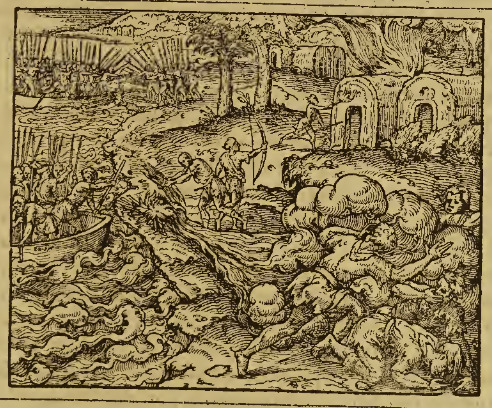
A group of Indigenous Canadians attacks the village of another group. The attackers arrive by canoe, bearing spears, bows and arrows, and torches. Some of them set fires along the shore and in the village. A few individuals on the right flee the fire by running and crawling away in an attempt to avoid the smoke. This image is identical to one found on page 1012 of Paris, 1575 (Chaudière), and in Thevet’s Les Singularitez de la France Antarctique (page 156 of Paris, 1557 and page 156 of Paris, 1558).
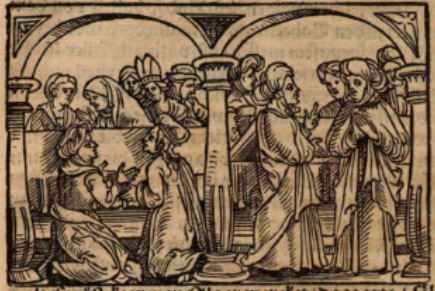
Verginia, a noble Roman woman is depicted in this engraving in both the right-hand and left-hand scenes. Boccaccio explains that Verginia, despite being a noble woman, was cast out of a temple in Rome by the other noble patrician women due to her being married to a plebeian man. The left side of the engraving depicts Verginia at the altar with noble women surrounding her as they cast her out of the temple. The right side of the engraving looks similar to the left side; however, the right side depicts Verginia with plebeian women. After being cast out of the Patricia Pudicitia temple, Verginia created her own temple and altar named it the Plebeia Pudicitia, and opened it up to the plebeian class.
Here we see shellfish including oysters and limpets on the shore of New Holland, where Gulliver landed after leaving the Country of the Houyhnhnms. Gulliver ate them raw, as he did not dare make a fire because he was unarmed and afraid that the peoples of New Holland might find and hurt him. The same image appears in the 1843 Krabbe edition.
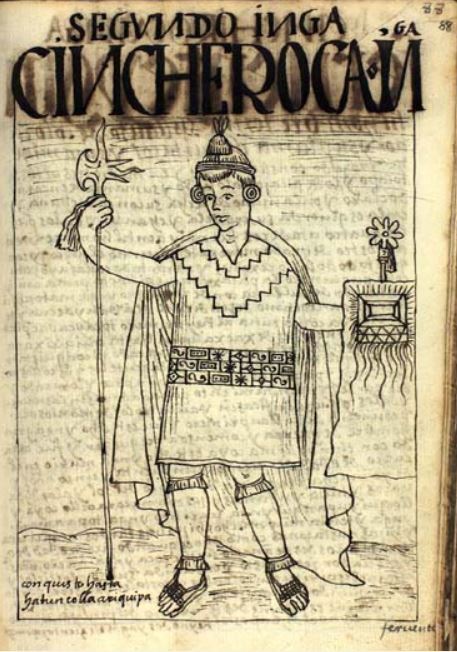
This image depicts the second Inca, Cinche Roca. He is depicted wearing a traditional feathered head visor, a long cloak, and his shirt has three embroidered stripes in the centre. He is holding a mantle in his right hand and a shield in his left. The words conquisto hasta hatun colla ariquipa are written in the bottom left corner of the image, which translates to he conquered up to Hatun Colla, Arequipa. The author mentions that Cinche Roca had killed the first legitimate Inca, Tocay Capac-Pinau, and governed the city of Cusco. The author claims that Cinche Roca died when he was 155 years old.
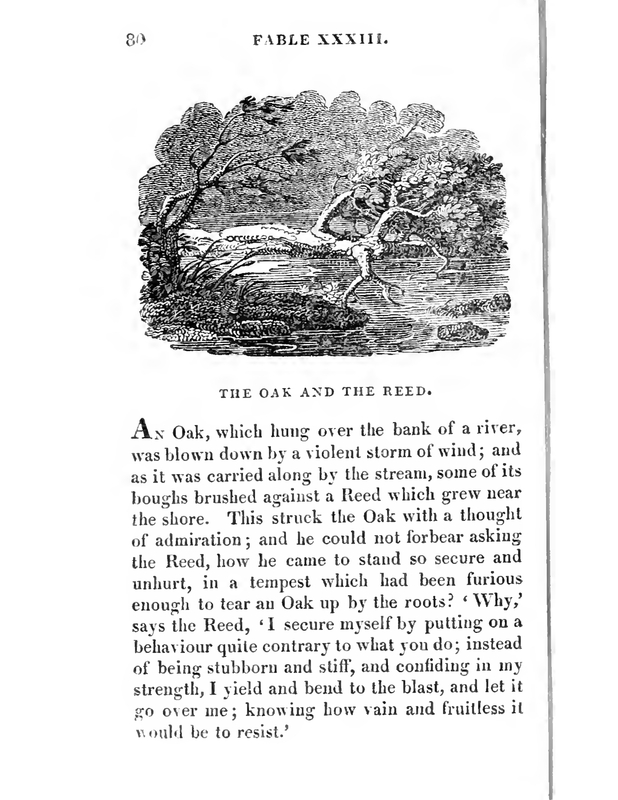
There is a body of water with a small section of outstretched land on the left. On this section of land are a few small grassy plants and a small tree bent to the right. Behind this small tree and lying across the water is a fallen tree. On the right end of the tree on the water are many leaves. There are two rocks in the water on the bottom right of the image. The background is a blur or trees.
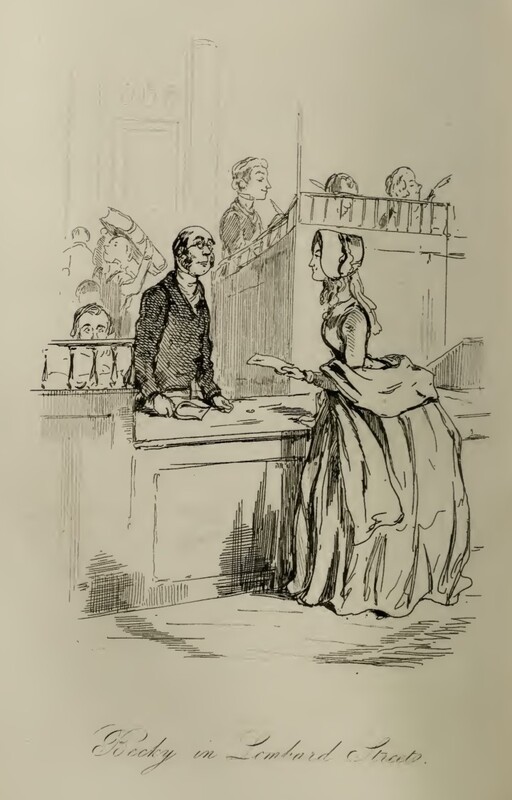
Rebecca Crawley stands at the desk of Messrs. Jones and Robinson’s bank. She is holding out a document which Lord Steyne sent to her, entitling her to a large sum of money. On the other side of the desk is a bank official, holding a coin shovel. In the background are other employees of the bank, seated and standing, carrying quills and books. Below the illustration is printed in cursive its title, Becky in Lombard-Street.
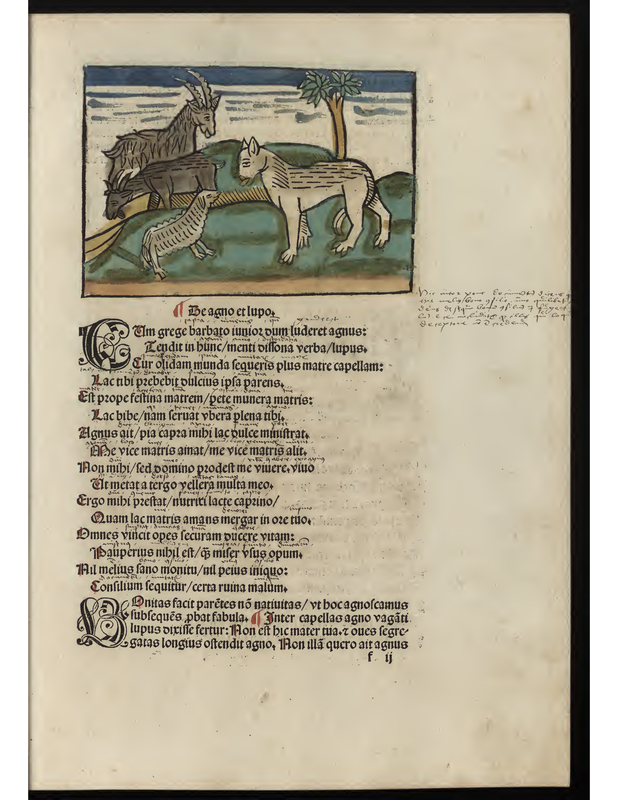
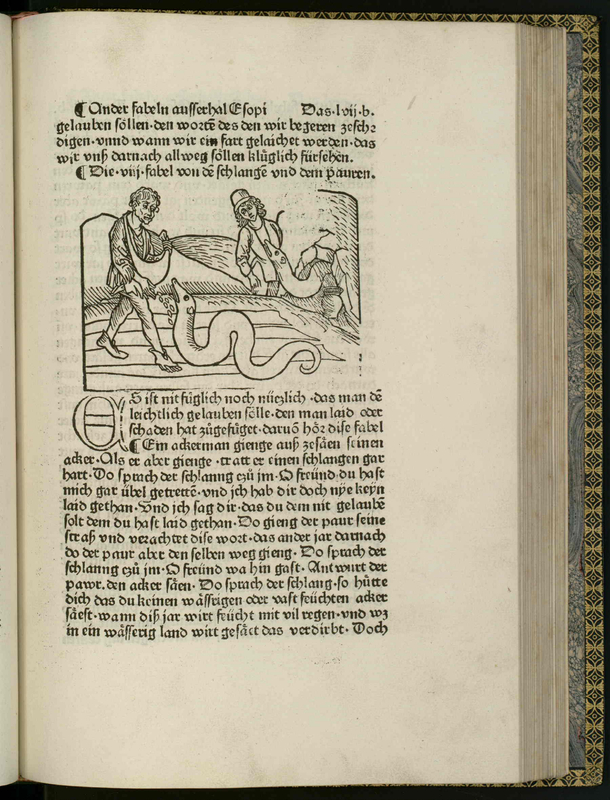
On the left side of the image, there is a human holding a bag of food and feeding an eel. On the right side of the image there is another human looking at an eel that is coming out of a small cave.
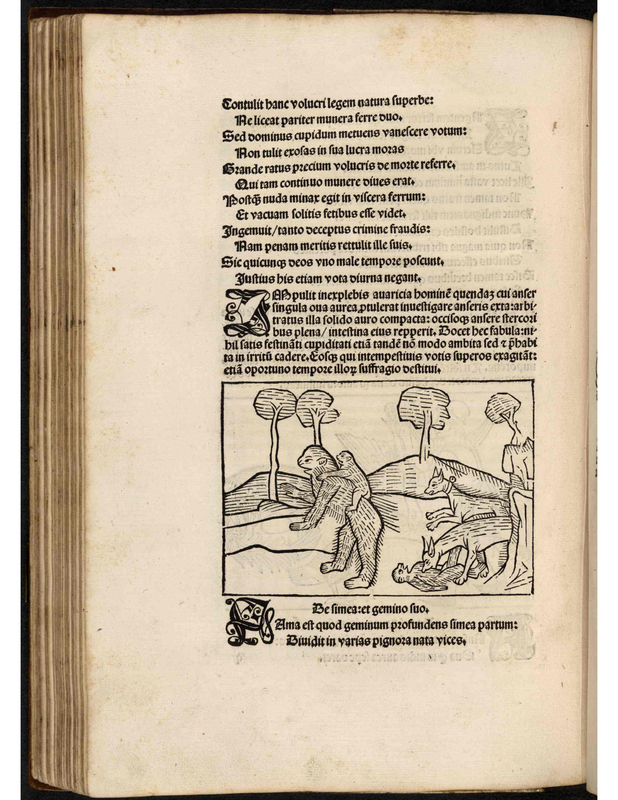
On the left side of the image, there is a mother monkey with a baby monkey on its back, being chased by two dogs. One of the baby monkeys have been left behind, eaten by one of the dogs.
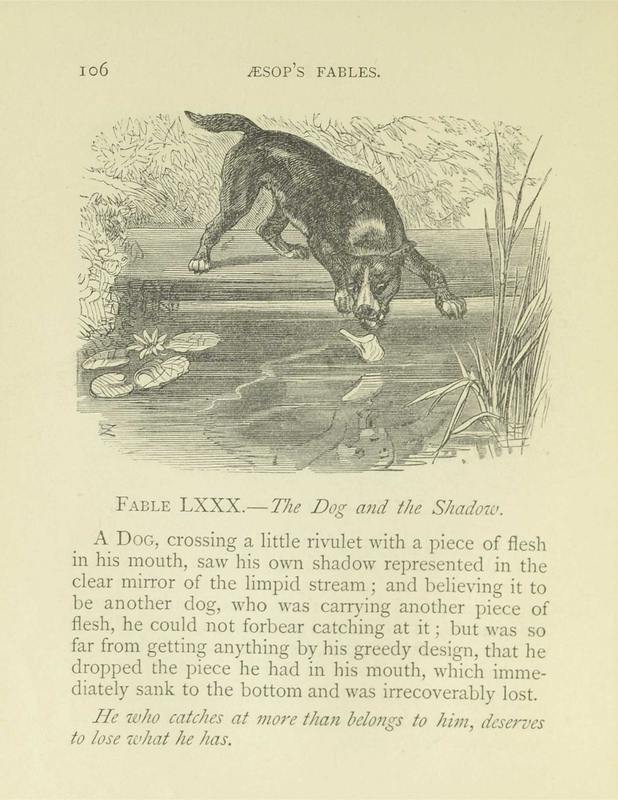
A black dog stands on a small bridge crossing a pond. He leans closely to the pond, dropping the piece of flesh he had into the water once he notices his reflection. The piece of flesh begins to sink.
During his first voyage, a storm hit, and Gulliver was separated from the rest of his crew. Here we see the ship sinking. Gulliver was able to escape and swim to shore, where he landed on the shores of Lilliput. The same image appears in both the 1839 and 1843 Krabbe editions.
During his time on Balnibarbi, Gulliver visited the Grand Academy of Lagado and the scholars who worked there. Here we see a scholar who was developing an alternate system of communication to talking. His theory was that speaking corroded people’s lungs, and that an alternate system could protect the lungs and prolong people’s lives.
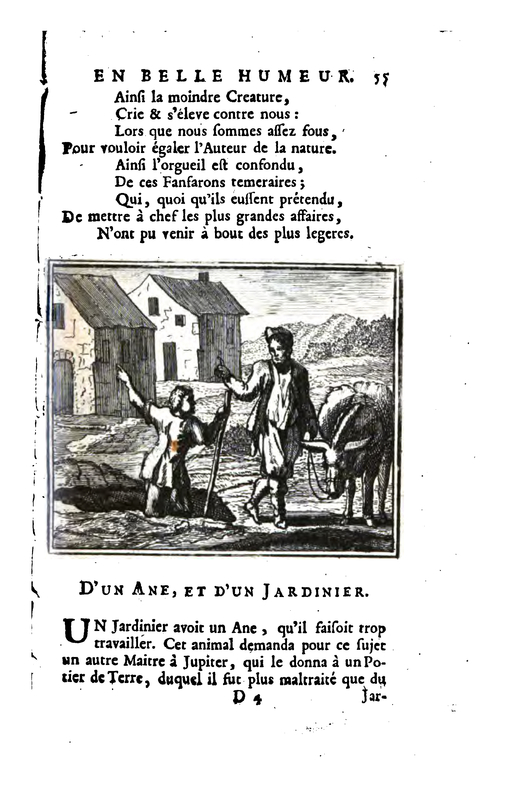
In this image, there is a man walking through a field holding a donkey, who is tied with a rope. On the other hand he is holding a wooden stick and a little girl is also holding it. The man is making eye contact with the little girl while the girl is pointing at something above them. There are two hourse in the background, one house has a red tint to it while the other is white. The red tint house has an arch front door which appears to be made out of brick wood.The white hous has a square frame for the front door. Both the houses have windows and chimney. In the background there are trees and a mountain range.
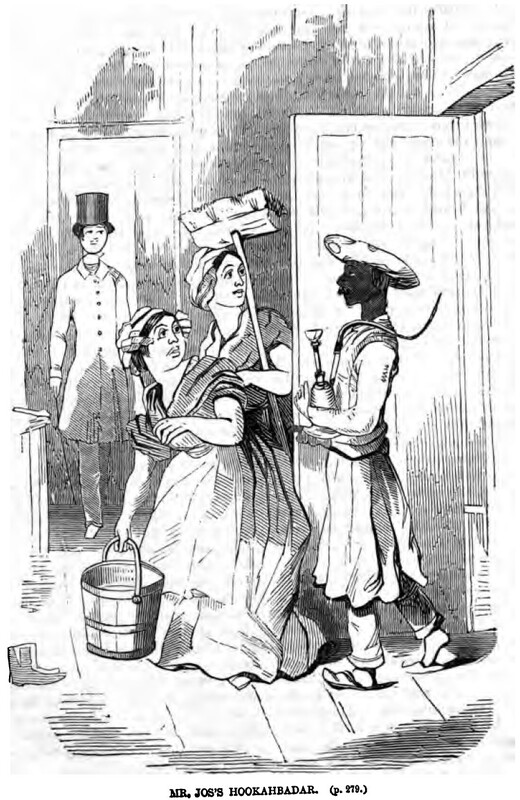
Loll Jewab, Joseph Sedley’s servant from India, carries his hookah into the inn, scaring the maids, one of whom is holding a bucket and the other a broom. The Boots stands next to an inside door, where he was going around picking up the patrons’ shoes. Below the illustration is printed in cursive its title, Mr. Jos’s Hookahbadar (p. 279.).
Here Gulliver performs Brobdingnag. Gulliver is the central figure, bowing on a small stage surrounded by giants. The young girl, Glumdalclitch, stands behind the stage, leaning over the back to give Gulliver his directions. There are several other giants watching Gulliver in awe, including a baby who is reaching out to Gulliver in the foreground. The scene takes place in the farmer’s living room, with a portrait of a man above the heads of the giants, and a large window looks out onto mountains. A small dog runs under the bench. The same image appears in the 1761 German edition, however the 1761 German edition is coloured.
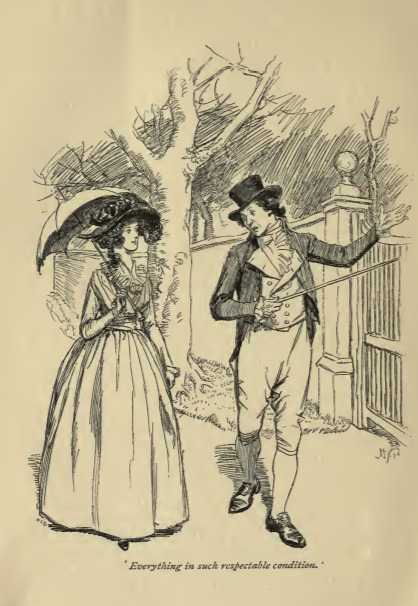
In this image Edward Ferrars and Elinor walk through the grounds of Delaford, Colonel Brandon’s estate. Edward Ferrars began working as the parish priest in Delaford, after Colonel Brandon offered him the post. Edward praises Colonel Brandon and his property, remarking that he would be happy to call Colonel Brandon his brother, implying he wished to see Marianne marry Colonel Brandon. This scene occurs in chapter 50. The characters are shown in the traditional regency style. Elinor wears a regency dress and carries a parasol to protect her from the sun. Edward Ferrars wears a waistcoat and tailcoat, with a top hat. The regency period dated to the early nineteenth century (1811-1820) when George, Prince of Wales, later George IV (r. 1820-1830), reigned as regent for his mentally ill father, King George III (r. 1760-1820). The regency period is associated with the rise of neoclassicism in art and fashion.
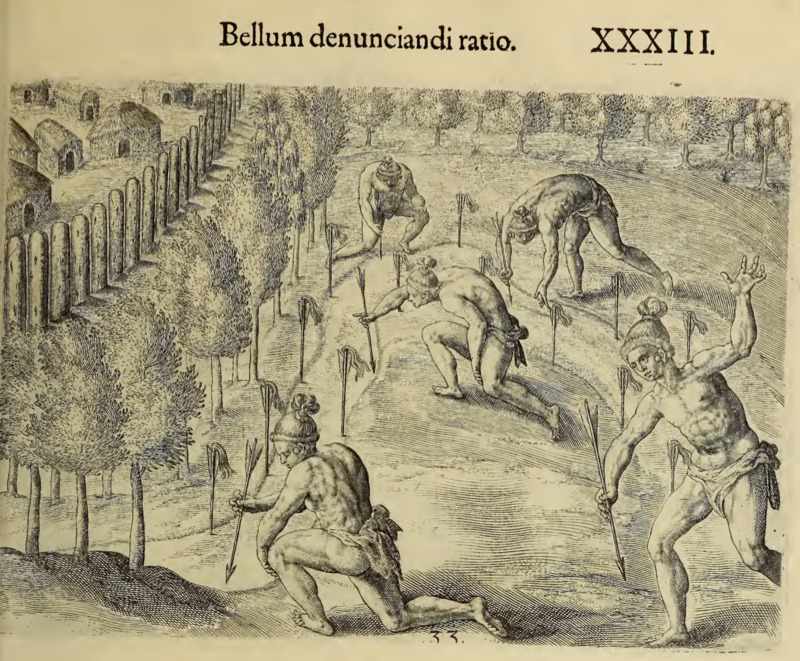
Five Indigenous men are shown. They are in the process of burying arrows, tip down in the ground with the shaft and fletching showing, around the outside of a village.
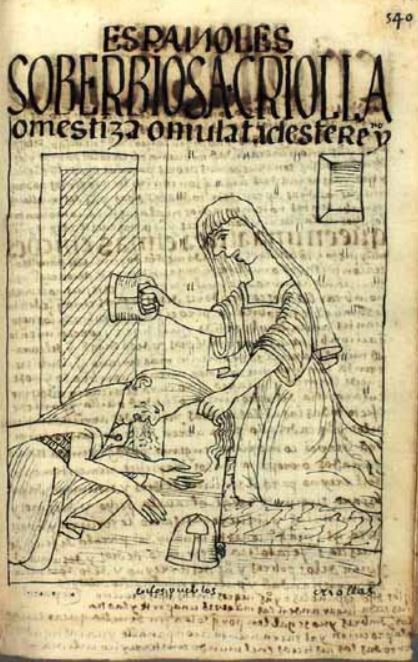
This image is illustrated in a chapter that discusses and criticizes the government and society in Spanish conquered Peru. This image depicts a creole woman (the author is referring to a Peruvian-born Spaniard) abusing an indigenous woman. The author criticizes creole, mulatto and mestizo women by calling them lazy, lying, and deceptive, and that they are enemies to the poor indigenous women. The creole woman in the image is holding the hair of a native woman and appears to be holding an axe of sorts to cut the woman’s hair. The caption at the bottom of the image reads, en los pueblos [in the pueblos].
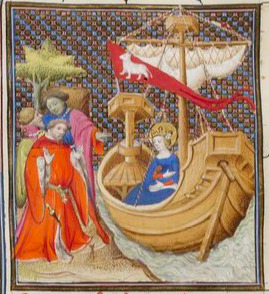
Isis is onboard the ship that will take her to Egypt, wearing a blue robe. She has two horns, and the symbolic white cow is pictured on the flag of the ship. The cow symbolism represents when Isis was raped by Jupiter and transformed into a cow before being sent away to hide the bad deed.
In this image we see a group of rabbits running. The image represents children who have been reprimanded, who then become too shy to answer again for fear of being incorrect. This serves as a detriment to children’s learning and is thus forbidden in Lilliput. The rabbits represent children who have been punished and then run away for fear of being punished again. This image appears in the appendix to Gulliver’s travels in Lilliput. In the appendix, Gulliver discusses various aspects of life on Lilliput, including education, employment, approaches to science and philosophy, language, and interactions between people in the community. The same image appears in the 1843 Krabbe edition.
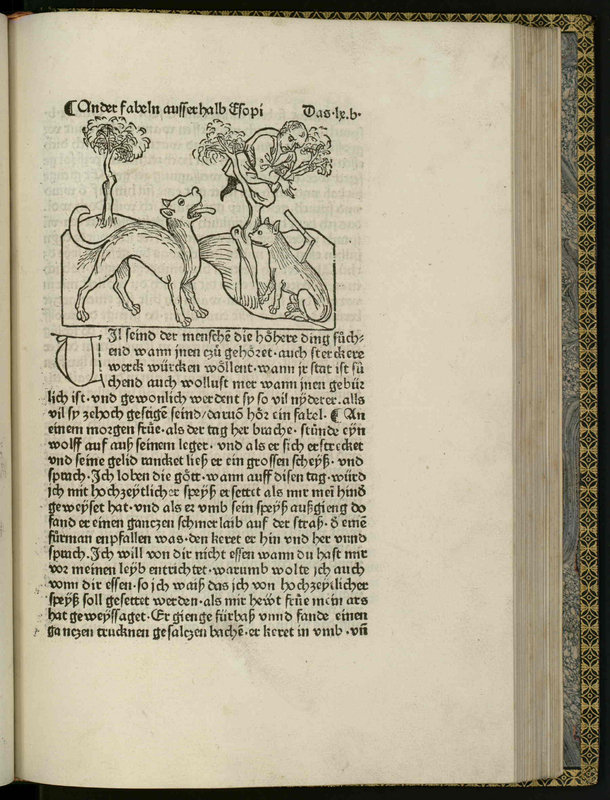
On the left side of the image, there is a wolf howling. On the right side of the image, there is a man on top of a tree that threw an ax at a wolf. There is a wolf at the bottom of the tree with the ax in its back.
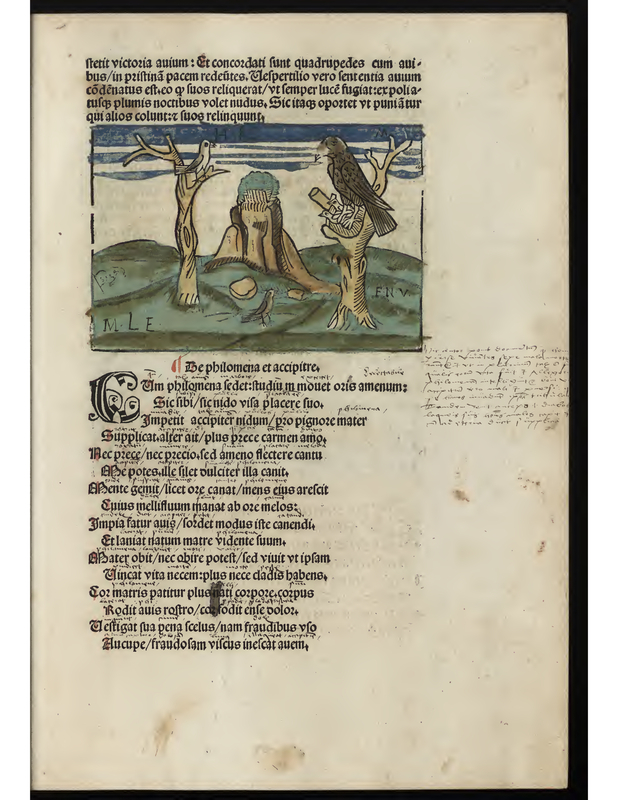
A nightingale and a hawk both sitting on branches looking at each other. They are on the only two trees that grew out of the hills. In the background, there are rocks, and a smaller bird looking up at one of the birds who has baby birds.


![[Shellfish on New Holland]](https://collections.cemvc.ca/files/large/6f228d04ba7b9160755b26c5c862c198c8ca81a1.jpg)

![[the shipwreck that separated Gulliver from the rest of his crew]](https://collections.cemvc.ca/files/large/282e2f587e6d22fda3861b2f9e9b3ec6b72e9843.jpg)

![[Gulliver performs for the Giants of Brobdingnag]](https://collections.cemvc.ca/files/large/03a182edff969ce6a9e9d949b08a3c5fa915d6d1.jpg)

![[rabbits running, representing Lilliputian children]](https://collections.cemvc.ca/files/large/98fa39027c8840b85198d38feb014a1bf3267667.jpg)