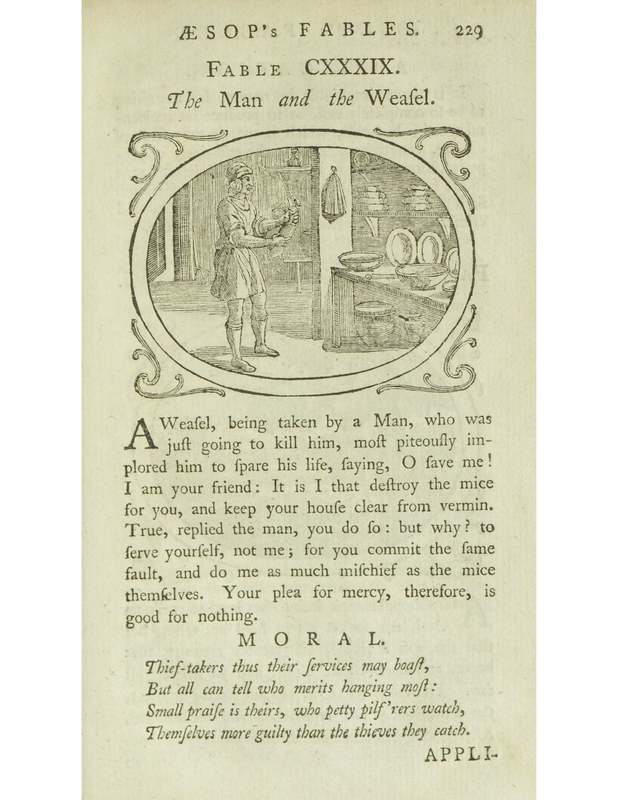
The scene is taken place inside the mans house, in the back there is a open door with a broom laying beside it. There is lots of plates, pots, pans, cloths and other objects and tables and throughout the disorder of the room. The man is holding a Weasel within his two hands as the Weasel asks him to spare his life.
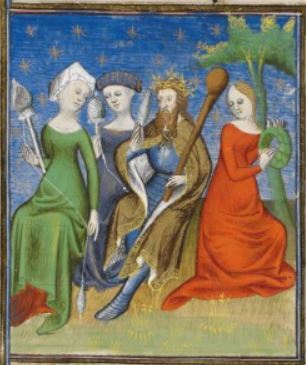
This illumination depicts Hercules weaving with his wife Iole. Hercules is depicted wearing a brown cloak made from the skin of the Nemean lion. There are two women sitting with Iole and Hercules who are listening to Hercules tell the tales of his labours. Iole is making Hercules weave to strip him of his pride as revenge for killing her father.
Four artists watch Rebecca Sharp performing a caricature with her two dolls, Miss Pinkerton and Miss Jemmy. Rebecca is seated upon a large cushion and leaning back against a table upon which there is a statue. One of the artists is seated backwards on a chair next to her with another standing behind him; the other two stand across from her, one leaning on a table with a bottle upon it, the other beneath a bust on the wall.
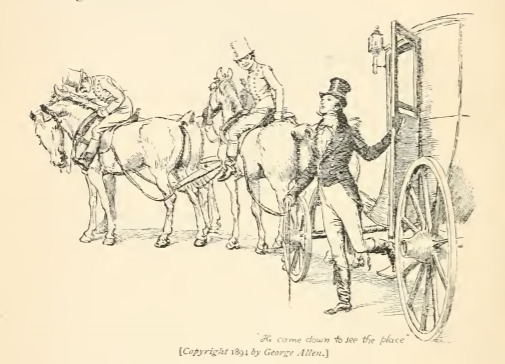
Here we see Mr. Bingley arriving at Netherfield Park. The novel opens with the wealthy Mr. Bingley coming to Netherfield. The Bennett family became acquainted with Mr. Bingley, his sisters, and Mr. Darcy. In this image Mr. Bingley steps out of his carriage examining Netherfield for the first time. This scene occurs in chapter 1. The characters are shown in the traditional regency style. Mr. Bingley wears a waistcoat and tailcoat and a top hat. The regency period dated to the early nineteenth century (1811-1820) when George, Prince of Wales, later George IV (r. 1820-1830), reigned as regent for his mentally ill father, King George III (r. 1760-1820). The regency period is associated with the rise of neoclassicism in art and fashion.
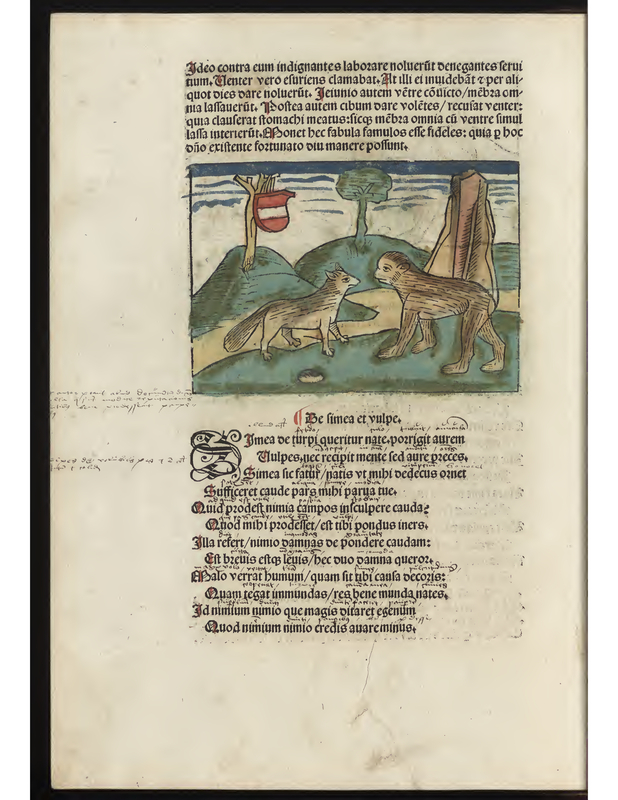
There is a fox on the left, and a monkey on the right. They are staring into each other’s eyes and standing extremely close to one another. In the background there is a tree with a red and white bag on one of the branches. There is also a large rock in the background and another tree.
To the left, we see Celestina wearing a robe and a veil, with what appears to be a rosary hanging from her waist. To the right, we see Calisto, who is wearing a hat and holding a long item of some sort, perhaps a cane/walking stick. Both figures are placed outside.The left panel is identical to the panel found on the title page, and on pages 70, 114, 146, and 208 of the text. The right panel is identical to those found on pages 12, 60, 122, and 235, and nearly identical to the one found on page 317 (where it is labeled ‘Centurio’).
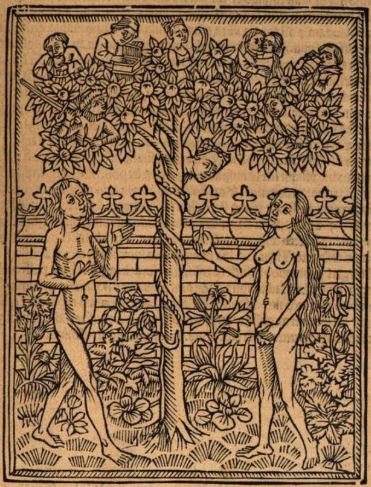
This engraving depicts Adam and Eve in the Garden of Eden. Eve is illustrated on the right side of the image taking an apple from the Tree of Good and Evil. The snake encouraging Eve to take the apple is depicted coiled around the tree. In the leaves of the tree, there are representations of the seven deadly sins. From left to right in the leaves, the figures represent wrath, gluttony, greed, pride, lust, envy and sloth. Boccaccio explains that he wrote on Eve as the first chapter in his book as she is the first mother of us all.
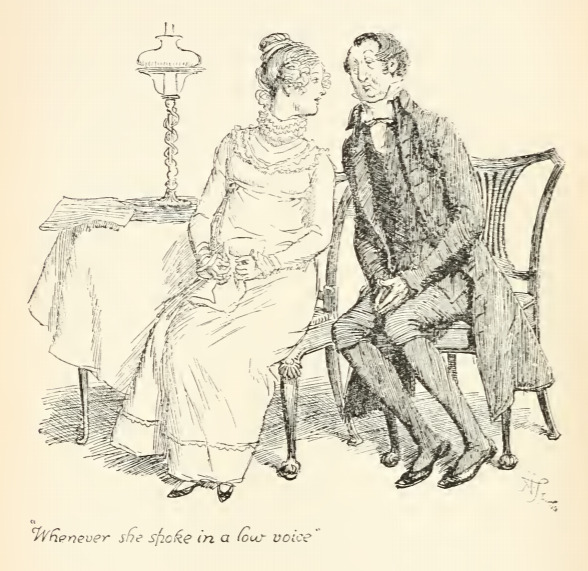
In this image Charlotte Lucas speaks to Mr. Collins. Mrs. Bennet was very angry with Elizabeth, Mr. Collins and Charlotte. Whenever Mrs. Bennet saw Charlotte and Mr. Collins speaking quietly together she was convinced that they were talking about Longbourn and their future there after they inherited it following Mr. Bennet’s death. This scene occurs in chapter 23. The characters are shown in the traditional regency style. Charlotte wears a regency style dress with an empire waistline. Mr. Collins wears a waistcoat and tailcoat. The regency period dated to the early nineteenth century (1811-1820) when George, Prince of Wales, later George IV (r. 1820-1830), reigned as regent for his mentally ill father, King George III (r. 1760-1820). The regency period is associated with the rise of neoclassicism in art and fashion.
Sempronio (figure with his sword raised) and Pármeno (rightmost figure) go to Celestina’s house. They ask Celestina (figure lying on the ground) to fulfill her promise and give them a share of the gold chain given to her by Calisto. She refuses, making up countless excuses and lies in order to escape her obligation. Sempronio draws his sword and threatens her, but she refuses to forfeit part of her reward and calls on Elicia (figure between Sempronio and Pármeno) for help. Sempronio begins striking her, and both she and Elicia scream in horror, calling for the alguacil’s men (the soldiers in the left panel of the illustration). Sempronio and Pármeno hear the men approaching the door and flee upstairs to the third storey. Realizing they have no other recourse for escape, they jump from the window.
Gulliver describes Laputan clothing as having a motif that combined suns, moons, and stars, with various musical instruments, including violins, flutes, harps, trumpets, guitars, as well as other instruments that were not played in Europe. This image is a detail of that pattern. In the centre is the letter A, because it is the first letter of the word Als - the first word of the second chapter. The same image appears in the 1843 Krabbe edition.
Here we see a child of the Houyhnhnms. Every four years a representative council of the Houyhnhnms meets in a large plain about twenty miles from the house where Gulliver was staying. They discuss the conditions of the different districts of the country. One of the issues discussed at these meetings are the regulations of children. This includes their redistribution between parents. For example, if one couple had two boys, and another had two girls, then the couples would switch one child, so each couple had one boy and one girl. Another example is when a child died, if the mother could no longer bear children, then another couple in the community will have a child to replace the deceased. The same image appears in the 1839 Krabbe edition.
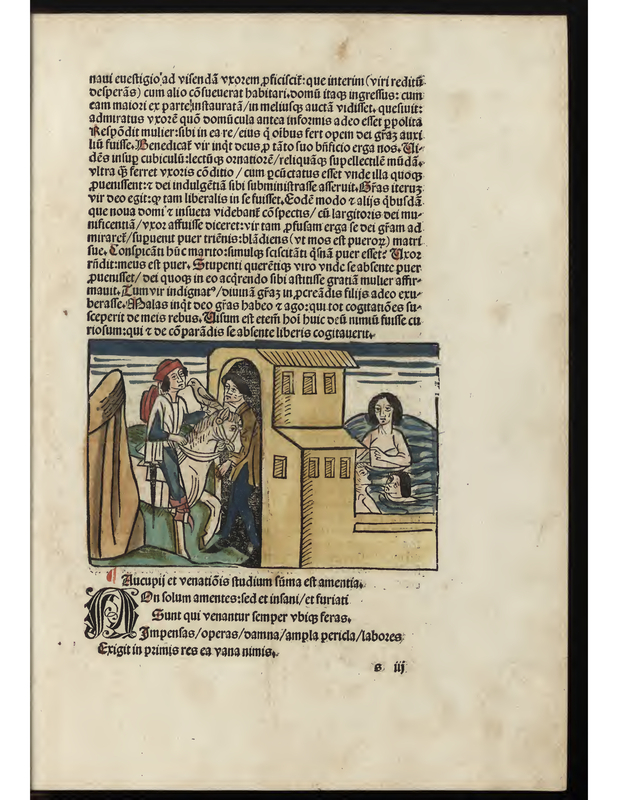
A man standing in the door of a house talks to another man with a sword on his belt who is riding a horse with a bird on its head. Behind the house there is water with 3 women swimming.
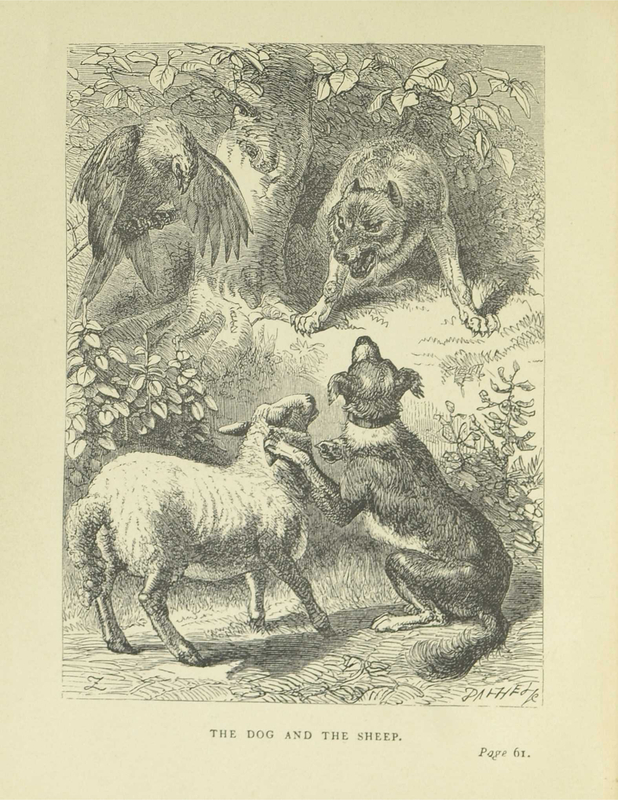
The Dog sued the Sheep for a debt, of which the kite and the wolf were to be judges. They, without debating long upon the matter, or making any scruple for want of evidence, gave sentence for the plaintiff, who immediately tore the poor Sheep in pieces, and divided the spoil with the unjust judges
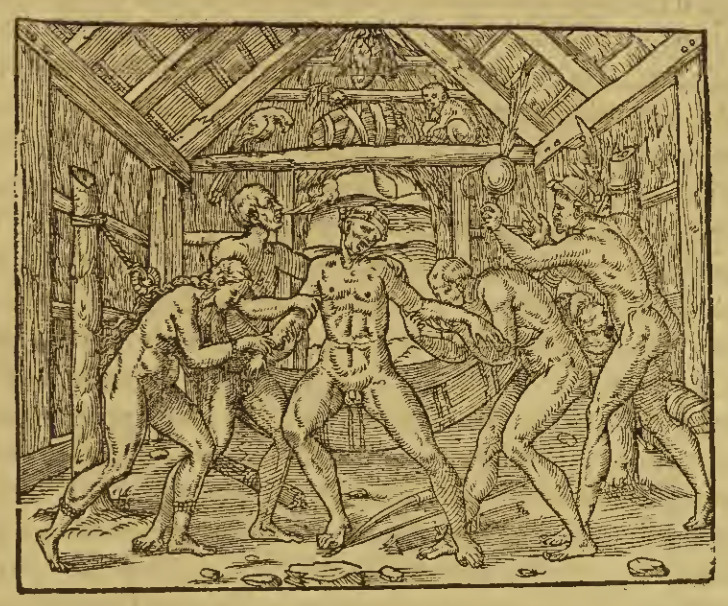
Inside a structure, a group of Indigenous people tend to a sick man. The man stands in the middle of the group with his arms outstretched to either side. Two people each hold one of the sick man’s arms, with the person on the right touching his lips to the man’s arm. Another man stands behind the afflicted man and holds him by the shoulders. To the right, a man wearing a feathered headdress holds a rattle or other ornament over the group. There is a hammock slung between two beams of the structure behind the group, above them a monkey and a bird sit on another beam and a bow and bundles of arrows lie on the ground. This image is identical to one found on page 935 of Paris, 1575 (Chaudière), and in Thevet’s Les Singularitez de la France Antarctique (page 88 verso of Paris, 1557 and page 88 verso of Paris, 1558).
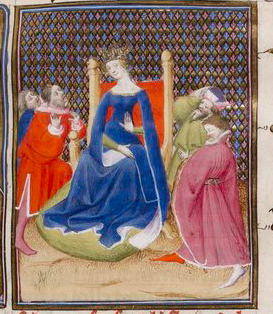
Queen Libya is pictured in her throne, wearing a blue gown. Her admirers surround her. Not much is known about her, but Libya being named after her indicates her importance.
Three dogs stand under a tree, with the one on the left having a large bell tied around his neck. The dog next to it is turned around snapping towards the bell, while the other stares at the first dog.
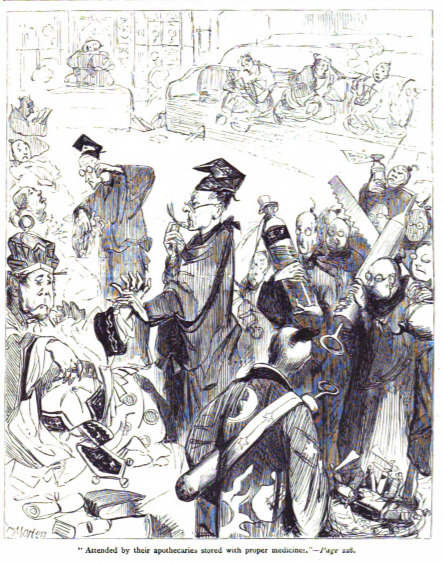
During his time on Balnibarbi Gulliver visited the Grand Academy of Lagado and the scholars who worked there. A proposal made by a doctor was to resolve political issues through treating politicians with various medicines. Through treating problems of the humours (a medical theory from the Ancient Greeks) then political disagreements could be easily resolved. In this image we see politicians sitting in parliament, with doctors standing nearby holding large bottles of medicines and needles.
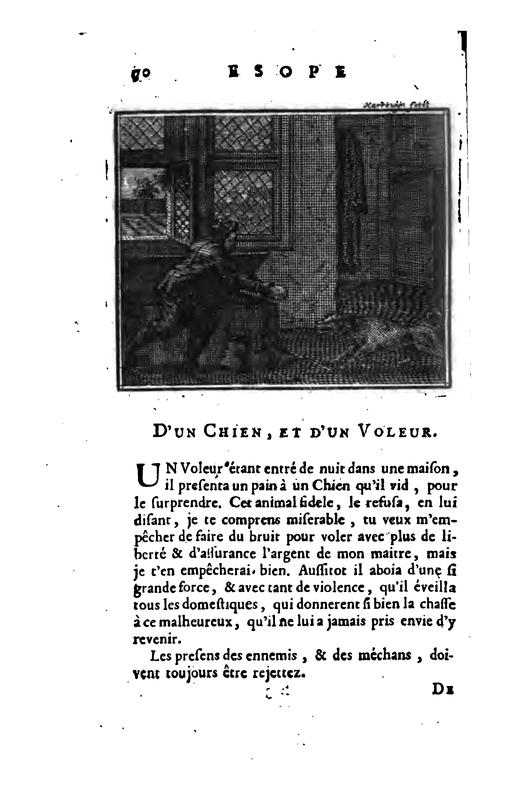
There is a thief entering the house holding a sharp object. The dog is angry and ready to attack this man. The house has four windows of which one of it is open. There is moon light shining through the window. To the left of the image there is coat rack and a long coat is hanging from it. The dog is in attack mode while the thief is scared and comtempleting his decisions.
A group of Tupinambá people – four women and a man – gather around a deceased man who lays in a hammock. Two women crouch beside the hammock with their hands over their faces in distress. Behind the hammock, two more women hold each other by the shoulders as they mourn, and a man stands behind them holding a rattle or ornament with one hand and wiping his face with the other. Both the deceased and living man have a facial adornment on their chin.
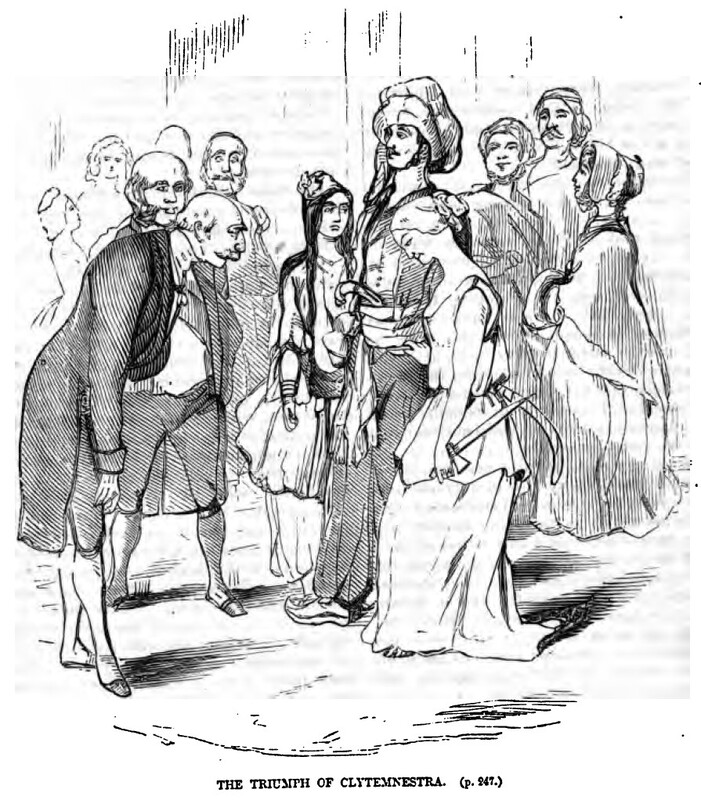
Rebecca Crawley, dressed in a toga and holding a dagger in the character of Clytemnestra, curtseys slightly to his Royal Highness, the prince of Peterwaradin, as he bows and compliments her performance. Next to her is Mr. Bedwin Sands, dressed as a Turkish officer, and behind him Mrs. Winkworth, whose performance as Zuleikah had been the focus of admiration prior to Becky’s appearance. Between Mrs. Winkworth and the prince of Peterwaradin is Lord Steyne, smiling jovially. In the background are several other admiring partygoers. Below the illustration is printed its title and location in the story, THE TRIUMPH OF CLYTEMNESTRA. (p. 247.).
This image shows the Yahoos and a Houyhnhnm in the Country of the Houyhnhnms. In the foreground is Gulliver fighting a Yahoo – a native human of the Country of the Houyhnhnms that Gulliver comes to despise along with all other humans as he learns the virtues of the Houyhnhnms. The scene is Gulliver’s first encounter with the species who live on this island. Gulliver is attacked by a Yahoo, and a Houyhnhnm – a horse – comes to Gulliver’s rescue. The two humans are fighting in a river. The Yahoo attacking Gulliver is drawn quite differently than Gulliver. The Yahoo has pointed ears, unkempt hair, and a flatter face than Gulliver. A small Yahoo child is on the left, holding a bow and arrow, with small wings, referencing Cupid. This child is used to show readers the difference between the humans that Gulliver is used to in England, and those in the foreign land in which Gulliver finds himself. This reflects the prejudices held by Europeans against Native Americans. This image is the same as that in the 1762 German edition.

![[Rebecca and the Artists]](https://collections.cemvc.ca/files/large/7636977613c5db4ffd1ee8c3b4974ffc90454762.jpg)
![[Act XI – Celestina and Calisto (Alternate)]](https://collections.cemvc.ca/files/large/0db19af256f9a2e6577c4f97c74df42471ded441.jpg)
![[Act XII (Second Illustration) – The Alguacil’s Men Knock on the Door as Sempronio Murders Celestina]](https://collections.cemvc.ca/files/large/5c3ec2f8653d75e41a9baf63e06db4678c19fff4.jpg)
![[Detail of the pattern of Laputan clothing]](https://collections.cemvc.ca/files/large/8b39c036db862254b3b596f84a9fea0c2484d9e4.jpg)
![[a young Houyhnhnms]](https://collections.cemvc.ca/files/large/9be18bd54435b77cf2676910ec4e09249ed184f8.jpg)

![[Tupinambá men and women mourn a deceased man]](https://collections.cemvc.ca/files/large/272f361456e00c906351b8d74a49ae3605a95b26.jpg)
![[Gulliver arrives in the Country of the Houyhnhnms]](https://collections.cemvc.ca/files/large/bb94349a280e64837ada8ffba87a9ef032ed7ca1.jpg)
![[Vanity Fair Chapter XLVI Inhabited Initial]](https://collections.cemvc.ca/files/large/095718a4ab19c867cba4d4fc16cf52295ee1ccf2.jpg)