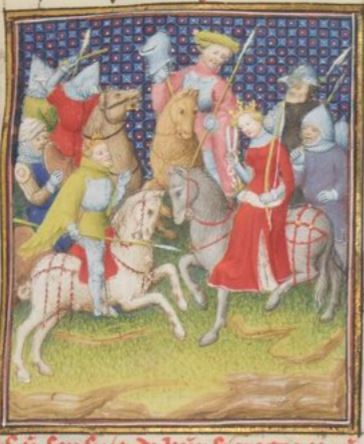
This illumination depicts Hypsicratea, the wife of King Mithridates VI of Pontus, riding horseback on the right side of the image. Mithridates is depicted on the left side of the image, also riding a horse. There are soldiers depicted behind Mithridates and Hypsicratea. Boccaccio explains that Hypsicratea is praiseworthy as she bravely risked her life as she regularly followed her husband on his military expeditions, which is why she is illustrated riding horseback with soldiers surrounding her in this image.
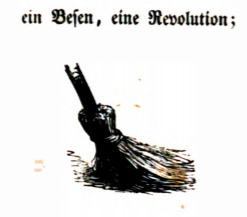
This image shows a broom, which is the code word for a revolution. This image comes in a description of a conspiracy found by a professor from the Grand Academy on Balnibarbi. This idea is representing code word for terms in the conspiracy that Swift is satirizing. The professor advises that those named in the conspiracy papers be closely monitored at all times, naming specifically while they were using the bathroom, as this is when men were most thoughtful. This conspiracy is thought to be an allusion to the trial of Francis Atterbury, the bishop of Rochester for allegedly plotting with the Jacobites. Atterbury was charged with treason in 1722 and was exiled to France. The same image appears in the 1843 Krabbe edition.
In chapter five, Gulliver explains several aspects of society in England. Here we see two lawyers in a debate in a court. Gulliver casts lawyers in a very negative light, saying their job was to convince people that white was black and black was white. The same image appears in the 1839 Krabbe edition.
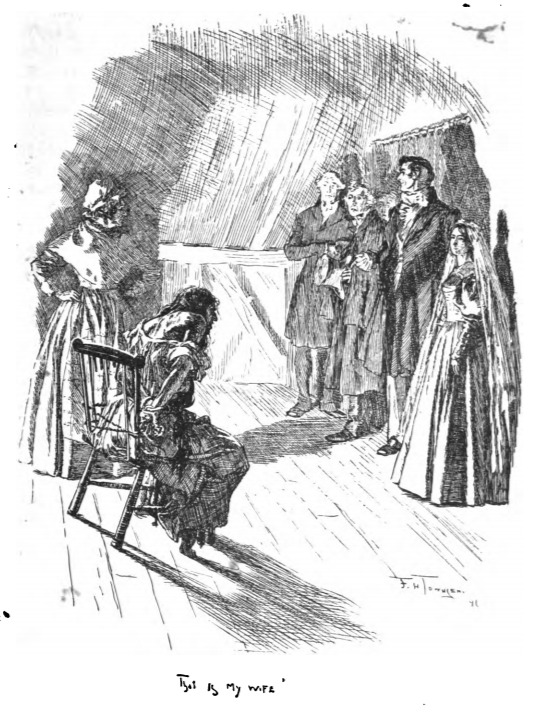
Jane's marriage to Mr. Rochester was interrupted by the arrival of the lawyer, Mr. Briggs, and Mr. Mason, objecting to the marriage on the grounds that Mr. Rochester was already married to Mr. Mason’s sister and thus could not legally be married. Mr. Rochester then took Jane, Mr. Mason, and Mr. Briggs to the third floor of Thornfield and showed them Mrs. Rochester, who was severely mentally ill. In this image we see Mrs. Rochester tied to a chair and her nurse, Grace Poole, standing nearby. Mr. Rochester, Jane, Mr. Mason, and Mr. Briggs stand near the door looking at Mr. Rochester.
Two men are walking outside with two goats. The men are talking to each other while they walk as one of them is looking behind him to speak. There is a single tree in the background with some sort of wooden piece hanging from a branch.
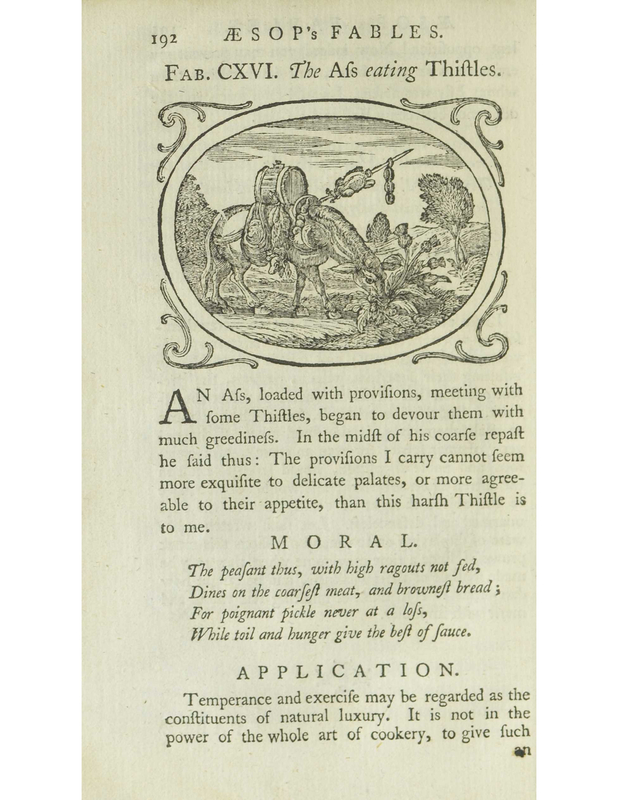
A donkey with a lot of provisions on its back leans its head down to eat a thistle plant growing from the ground. On the donkeys back are bags of food, jugs and a barrel of liquid, a dead rabbit, and a roasted turkey and sausages skewered on a sword.
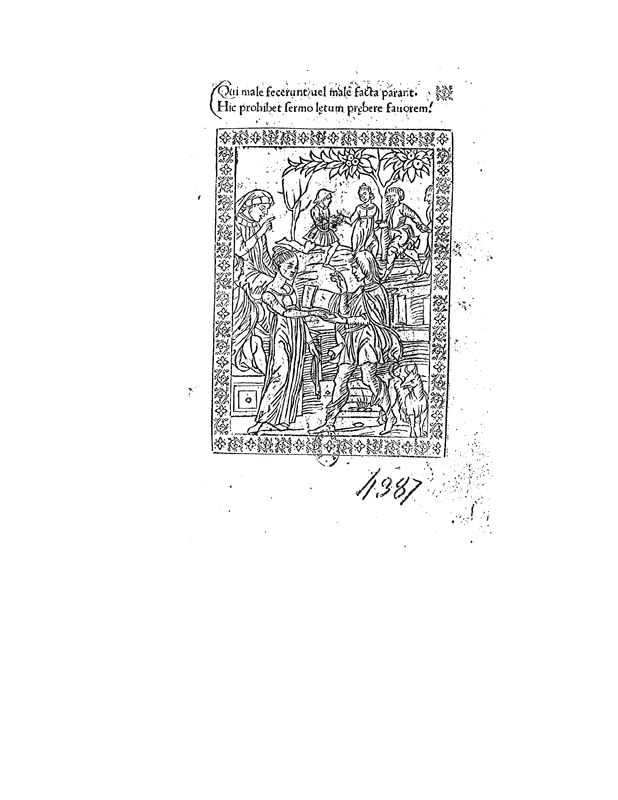
The left panel depicts Celestina standing outside. She is wearing a robe and veil, with what looks like a rosary hanging from her waist. On the right, we see Melibea dressed in a long robe. In her left hand she is holding the girdle cord that will become important later in the narrative. She has a flower in her right hand, which she appears to be holding it in front of her face (perhaps an expression of her modesty). A small dog stands at her feet, perched on its two hind legs while extending its front paws toward her.The left panel is identical to the panel found on the title page (with the exception of the colour found there), the one found at the end of the book, and those found on pages 51, 82, 105, 162, and 221. The right panel is identical to those on pages 8, 196, and 244.
When Elicia arrives at Areusa’s house, she hears Areusa screaming and wailing. At first, she thinks that Areusa has already heard about the deaths of Celestina, Sempronio, and Pármeno, but she hears a second voice and realizes Areusa is having an argument with a man (presumably depicted by the two rightmost figures). Elicia waits outside (presumably depicted by the leftmost figure) until Centurio emerges from Areusa’s house, after which she enters. Areusa notices her sadness and asks its cause. She tells Areusa about the deaths, and they both blame the illicit love affair between Calisto and Melibea. Setting their sights on revenge, they decide to ask Centurio to kill Calisto. Elicia then returns home.[The figures in this illustration are used in multiple other illustrations throughout this edition.]
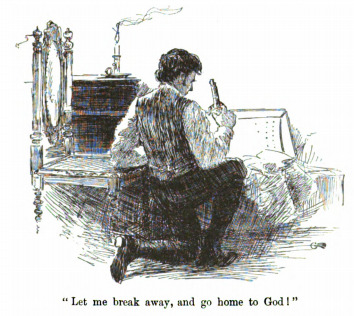
Here we see Mr. Rivers, Jane’s cousin and the pastor for Morton village. He is kneeling holding a candle, reading. He is speaking with Jane about India, where he was planning on going as a missionary. Mr. Rivers tried to persuade Jane to join him on his mission, but she refused.
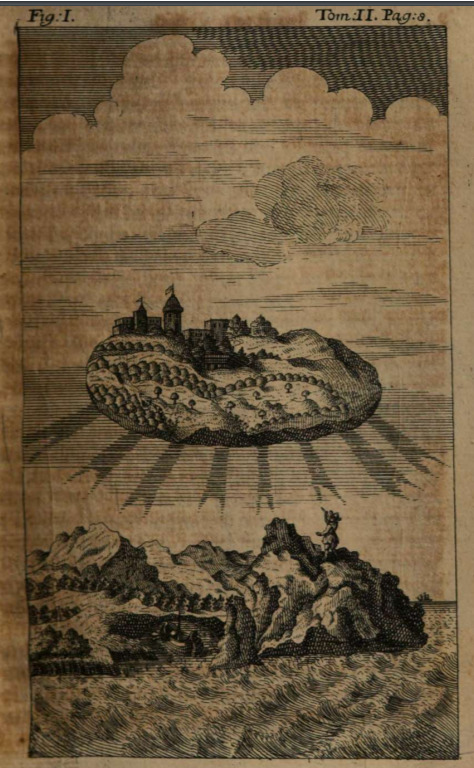
This image depicts the fictional land of Laputa and Balnibarbi. In the foreground is the water and Balnibarbi, on which Gulliver stands, looking through his telescope at the floating island of Laputa above. On the island is a castle, with rows of trees in front. The same image appears in the 1739 von Wiering edition.
When Celestina arrives at Melibea’s house with Lucrecia, Melibea explains the pain in her heart and asks Celestina to tell her its cause. Celestina responds that the cause is love, and that she will only be cured if she confesses her passion for Calisto. In denial, Melibea angrily rejects this suggestion, but Celestina eventually persuades her to confess her love. Celestina proposes that the two lovers meet in Melibea’s garden that night at midnight, and Melibea agrees. Every figure in this illustration is female, and each is wearing a robe and a veil. Based on the narrative, we know that the two figures on the right are Lucrecia and Celestina, and we can infer that the rightmost figure is Celestina since she is being led into the house. The particular identities of the figures to the left of the image are less certain, although we can suppose that the figure on the right is Melibea, seeing as her robe appears more refined, and her facial expression and body language seem to express anger. We also know that the other two figures are Celestina and Lucrecia, since they are the only ones present when Melibea is upset.The entire image is identical to the one found on page 64 of the text.
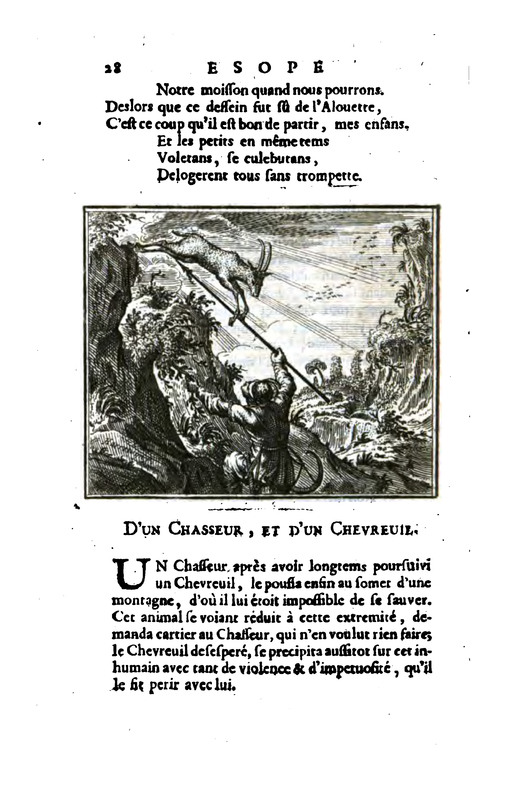
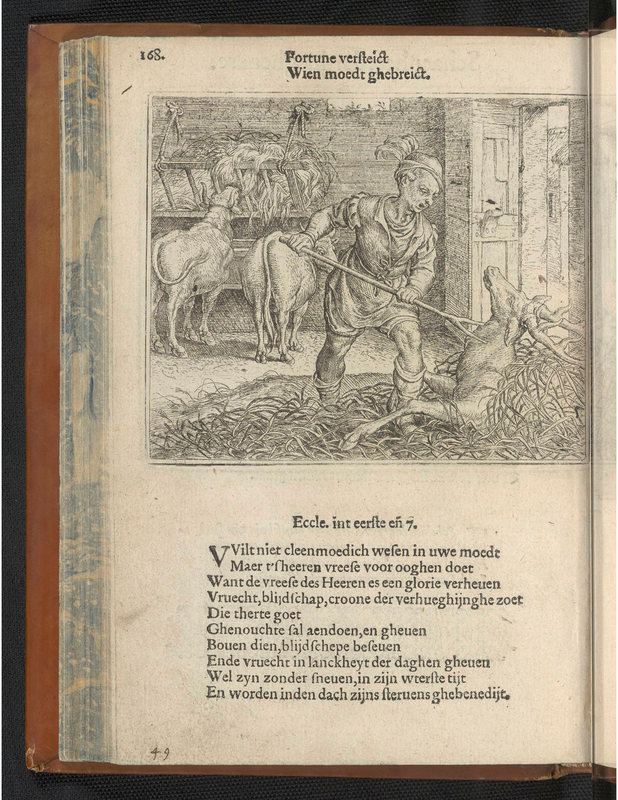
A man appears to be hunting by trying to spear a deer as it jumps off a small rocky cliff. The deer is quicker than the hunter because the hunter looks as though he will miss or hit the deer's feet. The illustration has the signature of Harrewijn in the bottom left corner.
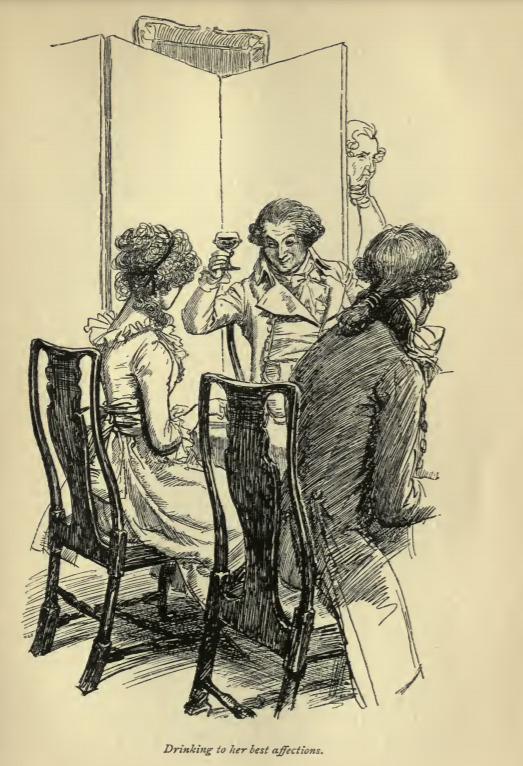
In this image Sir John holds up a drink, nodding to Elinor offering a toast to her affections. While dining at Barton Park with Sir John, Lady Middleton, and the Steeles, Sir John tried to bring up Edward Ferrars. Elinor was unwilling to talk about him, and Sir John simply called him Mr. F. It was later revealed that the Steeles knew Edward Ferrars and Lucy was engaged to him. This scene occurs in chapter 21. The characters are shown in the traditional regency style, as Elinor wears the regency style dress with an empire waist. Sir John wears a waistcoat and tailcoat with a cravat. The regency period dated to the early nineteenth century (1811-1820) when George, Prince of Wales, later George IV (r. 1820-1830), reigned as regent for his mentally ill father, King George III (r. 1760-1820). The regency period is associated with the rise of neoclassicism in art and fashion.
To the left of the image, Miss Jemima is standing in front of and looking out of a window, watching the arrival of the Sedley carriage. Miss Pinkerton, wearing a feathered turban, is in the foreground. She is seated at her desk with feet on a raised footrest and writing with a quill in her right hand.
Here we see Gulliver playing the piano in Brobdingnag. The piano is over sixty feet long, so Gulliver devised a new way of playing using two round bars. Gulliver used this method to play traditional English songs for the court of Brobdingnag. Gulliver stands on a raised bench. The king and queen look over the edge of the piano, watching Gulliver perform. The same image appears in the 1843 Krabbe edition.
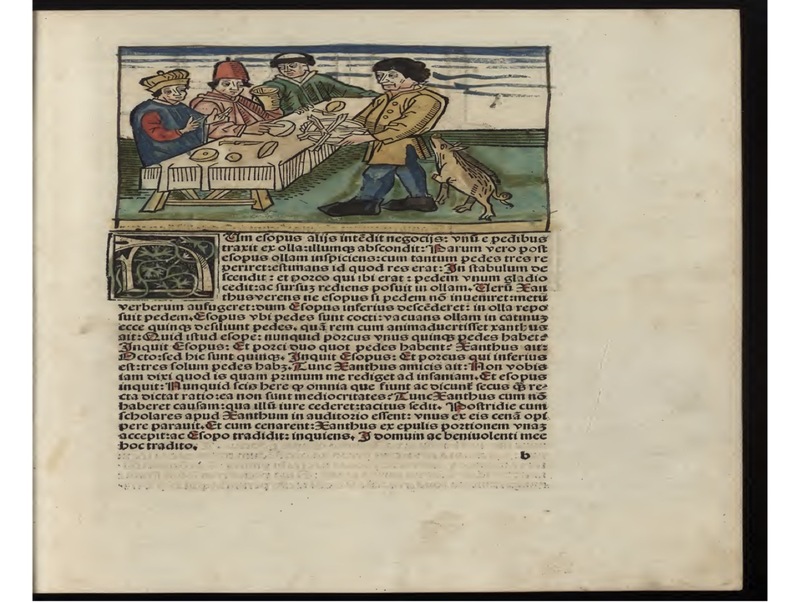
Three men sit at a table to the left of the engraving, waiting to be served a feast. Aesop, their servant, approaches carrying a tray of food. He is followed by a pig that is smelling him.
A farmer in a stable holds a pitchfork to a deer's throat; the deer is lying in a bale of hay at right; in the background there are two cows eating from a bale of hay in the stable.
Here we see a stack of books and scrolls. There is also an inkwell and a quill. This image appears before the story begins, and likely represents Gulliver writing the story of his adventures. The same image appears in the 1839 Krabbe edition.

![[lawyers in a court]](https://collections.cemvc.ca/files/large/74ab8cdedda98885f7302eb3ff2c6d6c172c1f33.jpg)
![[The men and Goats]](https://collections.cemvc.ca/files/large/1d7620c32bb2ee0c75a7edb2fa14e8c352b61958.jpg)

![[Act X (Mislabeled as ‘Septiesme acte’/Seventh Act) – Celestina and Melibea]](https://collections.cemvc.ca/files/large/d81f16089d6852f900e67a2a7f7c1dbccb32b350.jpg)
![[Vanity Fair Volume II. Chapter VII Inhabited Initial, C]](https://collections.cemvc.ca/files/large/b5362cf70974c53f7b0112a2b13a7011ad725407.jpg)

![[Act XV – Elicia, Centurio, and Areusa]](https://collections.cemvc.ca/files/large/7387868de5e3976cd32252b0c5aa0f24037ec917.jpg)
![[Act X] Melibea ontsteken zijnde met de minne van Calisto / spreect aldus](https://collections.cemvc.ca/files/large/70da5647349678978e4f48e2dbd057a2d79f7f8d.jpg)
![[Miss Pinkerton’s Drawing-Room]](https://collections.cemvc.ca/files/large/e834dba56f6e7ee2efd135f8b5dea60344484297.jpg)
![[Gulliver plays the piano in Brobdingnag]](https://collections.cemvc.ca/files/large/a203a6a9ed8d731b91997f6534de75af7ea3313b.jpg)
![[Books and Scrolls]](https://collections.cemvc.ca/files/large/600882e203fe0d7fef7e961b43d51df59cb2178d.jpg)