Two children, a boy and a girl, stand huddled under a large umbrella, their backs turned to the rain which is coming at them from the right at a steep angle. Behind them, to the right of the image, the letter W from We is beneath an arch.
This image depicts a relief with the profiles of Voltaire, Rabelais, and Swift. Voltaire is in the left side, facing Rabelais and Swift. Rabelais and Swift are both on the right hand side, with Rabelais behind Swift. The names of the writers are written above their heads. The image is a part of Swift’s Biography which precedes Part One of Gulliver’s Travels. The purpose of this illustration in the biography is to provide context for the political atmosphere and insight into Swift’s satirical writings. Through the image, Swift is compared to other notable writers of the same era, securing his importance in the writing stage. This edition was published over a century after Swift’s initial publication, thus Swift’s importance had already been secured. The same image appears in the 1843 Krabbe edition.
Here we see a depiction of the corruption of the English legal system. The image shows a desk with bribes on top of the verdict. A framed picture of a lawyer is in the back. We see a rabbit and several bottles, likely of expensive goods, and a coin purse with coins spilling out on top of a stack of papers, with the word verdict written on it. Gulliver tells the king about diplomacy, religion, the justice system, the arts, the financial system, and the nobility, then debated these issues with the king. This image comes when Gulliver is discussing the corrupt legal system, speaking to how the wealthy could buy their desired outcome. The same image appears in the 1839 Krabbe edition.
This image is illustrated in a chapter that discusses the Christian priests in the colonial government in Peru. This image depicts a priest on the right side of the image dressed in ecclesiastic adornments as he performs a baptism on an indigenous baby. A man on the left is illustrated holding the child as the priest pours the holy water over the head of the baby. The man in the centre is illustrated holding the Bible in his right hand and a candle in his left. The author explains that when a Christian native child receives the sacrament of baptism the people would hold great feasts and celebrations and offer gifts to the priests.
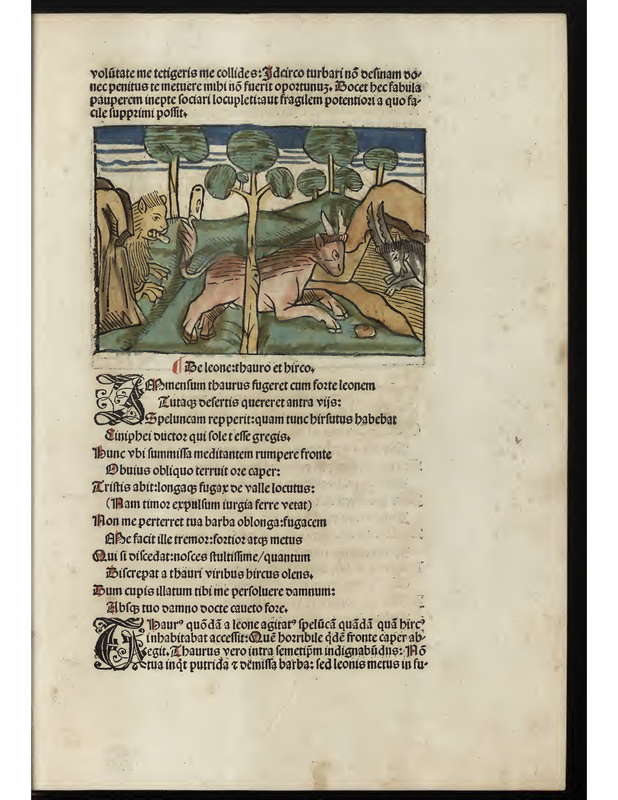
A bull and a goat are sparring head on outdoors near a cave. A lion appears with his mouth open, hiding from the fight behind the bull. There are trees surrounding the animals.
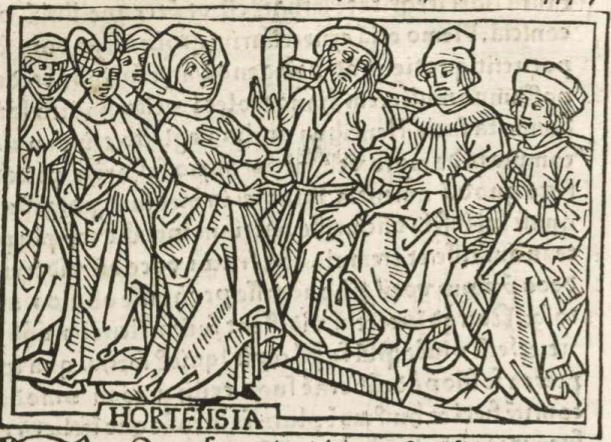
This engraving depicts Hortensia, the daughter of famous orator Quintus Hortensius, speaking in front of the triumvirs. Hortensia inherited the gift of oration from her father, and when the triumvirs raised the taxes unbearably high, she spoke so eloquently to them that they revoked the taxes. The triumvirs have pleasantly surprised looks on their faces as they are impressed with Hortensia’s abilities. Hortensia appears to look confident as she speaks to them. There are other women standing behind her in support of her approaching the triumvirs.
Here we see the Prime Minister of England surrounded by his wife and his ministers. At this point in the story, Gulliver explains various aspects of society and politics to his master and the other Houyhnhnms. Gulliver describes the corruption of the political system. Gulliver explains how someone becomes Prime Minister. The first way is through prudent deposition of any women his life, the second is by betraying or undermining his predecessor, the third is by his zeal in public assemblies opposing the corruption of the court. The same image appears in the 1843 Krabbe edition.
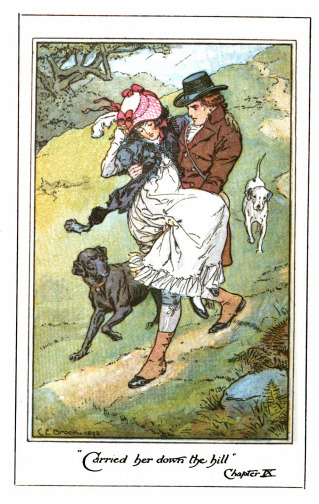
Here we see Willoughby carrying Marianne down the hill after she sprained her ankle. Marianne and Margaret were out for a walk when it suddenly began to rain. They ran down the hill trying to get home as quickly as possible. While running down the hill Marianne tripped and fell. Willoughby, who had just arrived in Barton Park, saw Marianne fall, and came to her rescue. He picked her up and carried her back home. This was their first meeting and Marianne then fell in love with him. This scene appears in chapter 9 as indicated underneath the image. The characters are shown in the traditional regency style, with Willoughby wearing a waistcoat, overcoat, and knickers that stopped at the knee. Marianne wears the regency style dress with an empire waist. Her hair is worn tied up, as was tradition for women after their coming out before the queen, signaling her entrance into society. She wears a bonnet, worn often by women of this era to protect their faces from the sun while out on walks. Going for walks was a popular pastime for the upper classes during the regency era. The regency period dated to the early nineteenth century (1811-1820) when George, Prince of Wales, later George IV (r. 1820-1830), reigned as regent for his mentally ill father, King George III (r. 1760-1820). The regency period is associated with the rise of neoclassicism in art and fashion.
Here we see the River’s family outside of Moor House. In the center is St. John Rivers, with his sisters Mary and Diana and their dog. After Jane ran away from Thornfield, she ended up at Moor House, where she was taken in at Moor House. She later learned that they were cousins. The title appears in the contents of illustrations.
Here we see a professor from the Grand Academy on Balnibarbi holding a stack of papers that had details about a conspiracy against the government. The professor advises that those named in the papers be closely monitored at all times, naming specifically while they were using the bathroom, as this is when men were most thoughtful. This conspiracy is thought to be an allusion to the trial of Francis Atterbury, the bishop of Rochester for allegedly plotting with the Jacobites. Atterbury was charged with treason in 1722 and was exiled to France. The evidence used against him were papers found in his close-stool. Many believe this evidence to have been fabricated. The same image appears in the 1843 Krabbe edition.
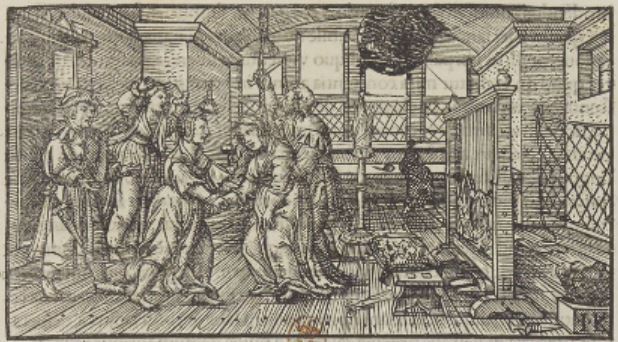
This engraving depicts the prostitute Leaena being tortured for information regarding a conspiracy. She is depicted with her hands bound by rope, which is attached to some sort of torturing device that a man is controlling. There are three other figures standing in front of her participating in her torture. Boccaccio explains that she is being tortured for being involved in a conspiracy to overthrow a tyrant. In order to avoid revealing information to those torturing her, she bites off her own tongue.
This image depicts many saints of the Christian church. In the centre of the image, Saint Peter is visible holding a book in his left arm and a key with his right hand. Saint Peter was often depicted holding keys in Christian iconography to symbolize the keys to Heaven. On Saint Peter’s right, there is a saint bound to a tree and has arrows sticking out from his body. This is Saint Sebastian, who was tied to a tree and shot with arrows during Roman emperor Diocletian’s persecution of Chrisitians. Saint Paul is depicted standing behind Saint Peter. He is illustrated holding a sword, as he was often depicted holding a sword and a book in Christian iconography. The woman standing behind Saint Peter’s left shoulder is Saint Lucia (also called Saint Lucy). She is depicted holding a plate with her eyes on it, as they were gouged out before her execution. Saint Barbara is the woman to Saint Peter’s left. She is illustrated holding a palm leaf in her left hand and a book with a tower on it in her right. She was executed for building a tower that had three windows to symbolize the Holy Trinity. The author included this image as he wanted to demonstrate that the indigenous commoners of colonial Peru were devout Christians.
A mammal that resembles a wolf in standing in a stream. The animal has sharp fangs and has something rectangular in its mouth. The animal seems to very malnourished, its rib cage is prominent. The animal appears to be angry.
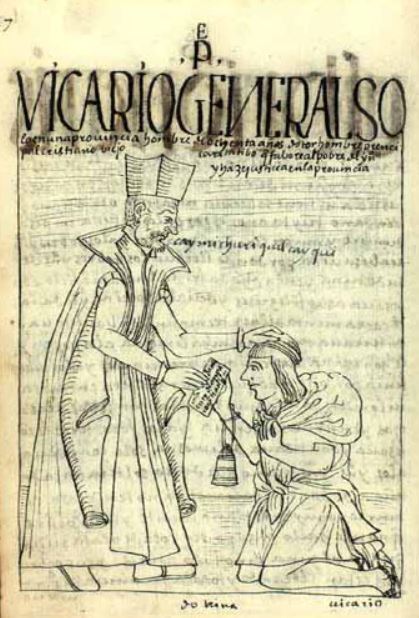
This image is illustrated in a chapter that discusses the Christian priests in the colonial government in Peru. This image depicts a vicar who the author praises for keeping true to his religious duties. The author criticized many priests for having abused their powers against the indigenous peoples of Peru. The vicar in this image is depicted protecting an indigenous man. He is handing him a letter that reads, mandamiento de anparo confiad [mandate of protection, confidential]. There are words written by the vicar’s head that read, caymi, churi, quilcayqui [here you go, my son, your message]. The vicar passes the man the note as he rests his hand on his head for blessing.
A barefoot woman with loose, wild hair stands amongst scattered rocks. She holds a thin, tapered stick which is covered by a vine, the end of which curls up into the air to form the letter S from Such.
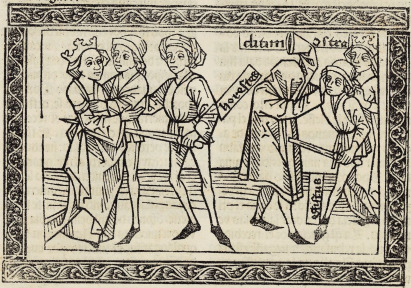
Clytemnestra, the queen of Mycenae, is depicted on the far-right side of the engraving with a crown on her head. We know that this is Clytemnestra as her name is engraved beside her head. In front of Clytemnestra is the person she has been having an affair with, Aegisthus. His name is engraved beside his leg. Aegisthus and Clytemnestra, as explained by Boccaccio, had conjured a plan to kill Clytemnestra’s husband, king Agamemnon, in order to gain control of Mycenae. Clytemnestra gave Agamemnon a piece of clothing that had no neck hole. As he struggled with the garment, the adulterer Aegisthus pierced Agamemnon with a sword (this is depicted on the right-hand side of the engraving). Orestes, the son of Agamemnon and Clytemnestra, sought to avenge his father’s death. He is depicted on the left side of the engraving, killing both his mother and Aegisthus. Orestes’ name is engraved behind his back.
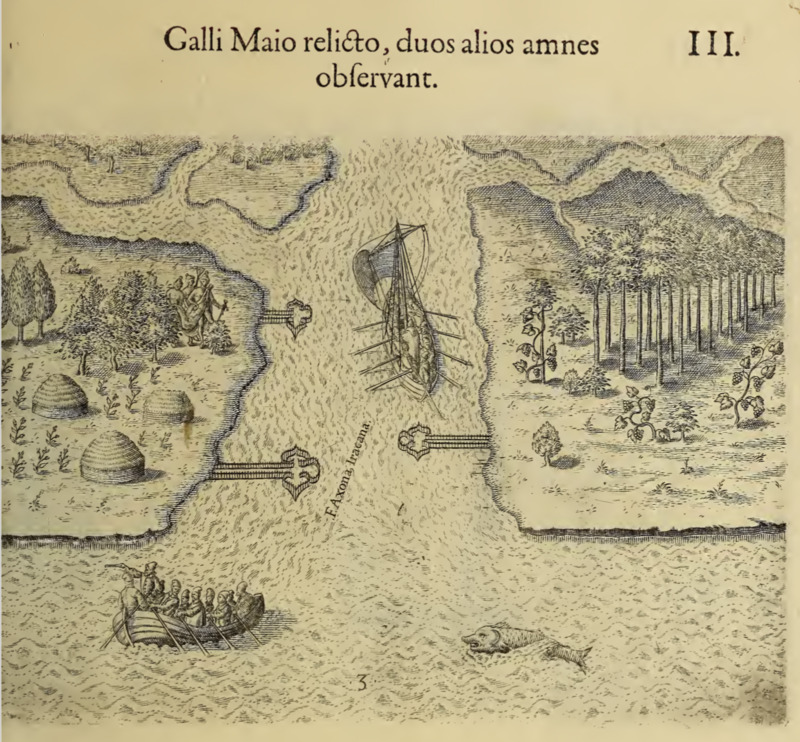
Two rowing boats filled with colonists are shown entering the mouth of a river. Three round structures sit on the left bank of the river. Three Indigenous figures also stand on the left bank; however, their figures are indistinct.
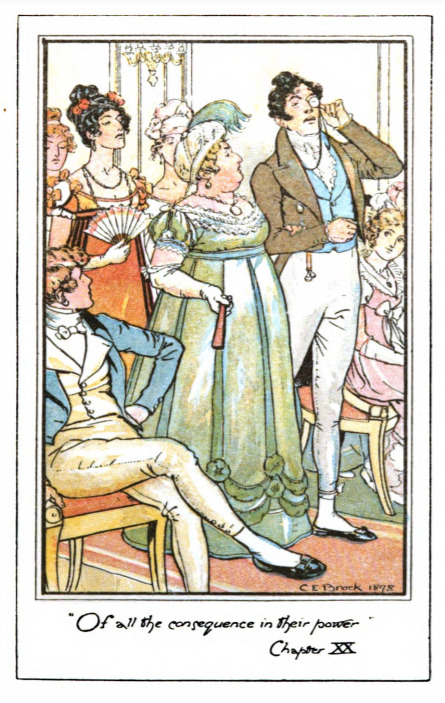
Here we see Viscountess Dowager Dalyrumple entering the Concert Hall in Bath with Mr. Elliot. Elizabeth Elliot is behind the Viscountess, arm in arm with her friend, Miss Cartaret. All the upper-class people in Bath attended this concert. This scene occurs in chapter 20 as noted underneath the title of this image. The characters are shown in the traditional regency style, with Elizabeth, the Viscountess, and Miss Cartaret wearing the regency style dress with an empire waist. Their hair is worn tied up, as was tradition for women after their coming out before the queen, signaling her entrance into society. Elizabeth and the Viscountess holds a fan, used in the regency era at balls, concerts, and other evening events both to provide relief from the often-hot ballroom or concert hall, but also to signal to others in the room. This language using fans was used most frequently when trying to communicate with a love interest, as it could be an invitation for the suitor to come over to a woman, indicate that they were being watched, among other things. Mr. Elliot wears a waistcoat and tailcoat with breeches and holds a monocle up to his eye. The regency period dated to the early nineteenth century (1811-1820) when George, Prince of Wales, later George IV (r. 1820-1830), reigned as regent for his mentally ill father, King George III (r. 1760-1820). The regency period is associated with the rise of neoclassicism in art and fashion.
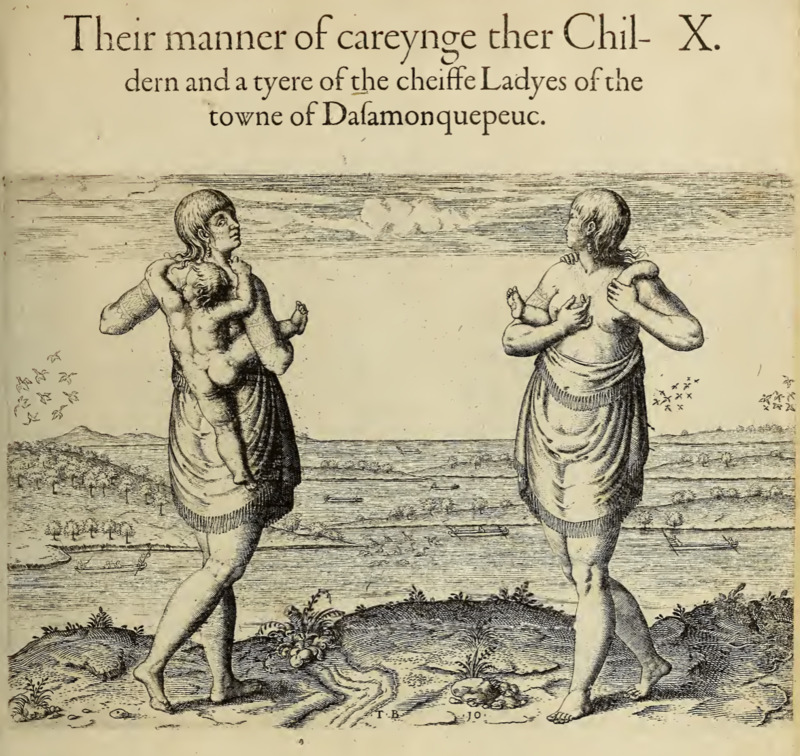
An Indigenous woman is pictured from the front and from behind standing on the bank of a river. She wears a fringed skirt around her waist, her hair is unbound, and she is topless and shoeless. She holds a young child on her back, with the child’s left arm over her shoulder and their left hand in hers, and their right leg tucked under her right arm against her hip. Behind them, other Indigenous people are seen in canoes.
Calisto goes to spend another night with Melibea, and while there he seduces her. As he is leaving via the ladder used to scale the high garden walls (seen to the right, leaning against the tower in the background), he falls and is killed (on the ground in the bottom right corner).In this scene we see his servants Sosia and Tristán shocked by what has happened. To the left we also see Melibea, in despair at what she is witnessing, standing alongside Lucrecia who appears to be comforting her.
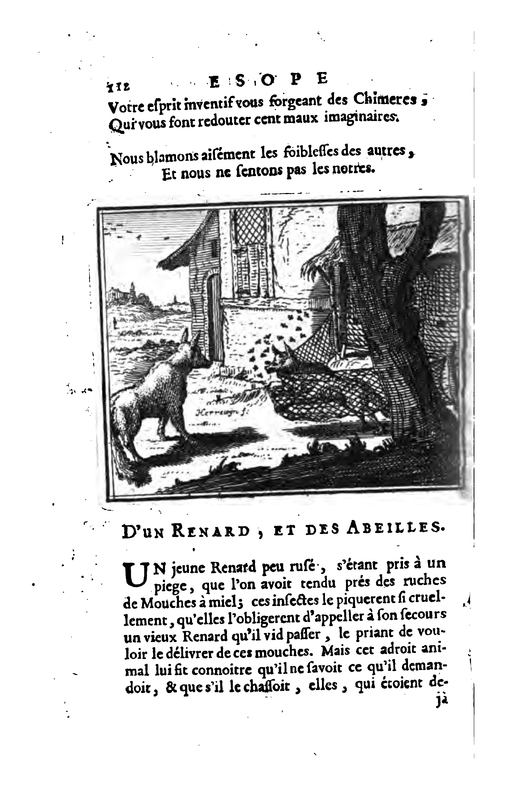
The image depicts a young fox caught in a trap near a bee’s nest being stung by bees. The trapped fox pleads with a fox to the left of the image to help be freed from the trap.
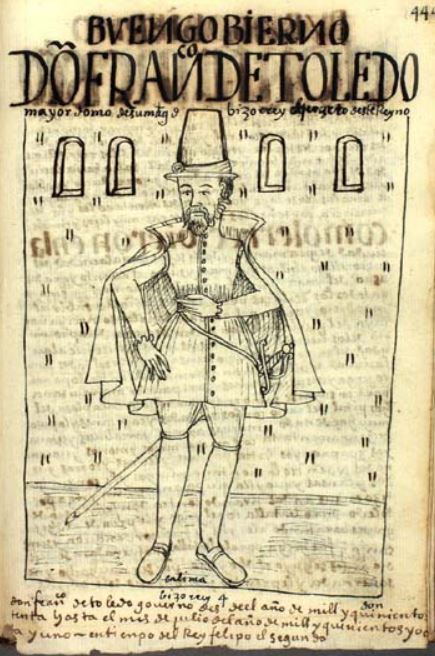
This chapter of the book focuses on discussing the good government of post-conquest Peru that the Spanish viceroys maintained. This image depicts a standing portrait of the fourth viceroy of Peru, Don Francisco de Toledo. He is depicted wearing traditional Spanish/European clothing. There is a caption at the bottom of the image which reads, Don Francisco de Toledo gouerno desde el año de mill y quinientos setenta hasta el mes de julio del año de mill y quinientos y ochenta y uno, en tienpo del rrey Felipo el segundo [Don Francisco de Toledo governed from the year 1570 to July 1581 in the time of King Philip II]. This viceroy is well-known for creating settlements for the indigenous peoples of Peru to congregate to in order to Christianize the land.

![[Vanity Fair Volume II. Chapter III Inhabited Initial, W]](https://collections.cemvc.ca/files/large/444004cfa72abd1d6bda26df109e7c0d7c3b3e60.jpg)
![[Relief drawing of Voltaire, Rabelais, and Swift]](https://collections.cemvc.ca/files/large/67405c69f92d99c3e320572a4500a8d47d74576a.jpg)
![[Symbols of bribery of the English legal system]](https://collections.cemvc.ca/files/large/fabbd7b6229c2dba191f5ee18ad59703759bd6ce.jpg)

![Sacramento Del Bav[tis]mo](https://collections.cemvc.ca/files/large/d6a2bd6eca078ebf8b7f592ffbae232e109fd51f.jpg)
![[the Prime Minister]](https://collections.cemvc.ca/files/large/1451ee259679873f78416b89c7333502a1a6888f.jpg)

![[a professor from Grand Academy on Balnibarbi holds a stack of papers outlining a conspiracy against the government]](https://collections.cemvc.ca/files/large/a067367f799d7918ad1e546ededc48325beff143.jpg)

![Debocion a Todos los S[an]tos](https://collections.cemvc.ca/files/large/ad24dd188d8949ae445bd45c59204ade2309255c.jpg)
![[Wolf in a Stream]](https://collections.cemvc.ca/files/large/c95e312b0b8c3bdcf72387ca0fda3b2200e836a5.jpg)
![[Vanity Fair Chapter LXIII Inhabited Initial]](https://collections.cemvc.ca/files/large/270f1bb9472a5b45275908e546e8aeb46f5dfc06.jpg)
![[Act XIV - Death of Calisto]](https://collections.cemvc.ca/files/large/7c86440fd411a10ee8e8c86f6cf87c9682675d3c.jpg)