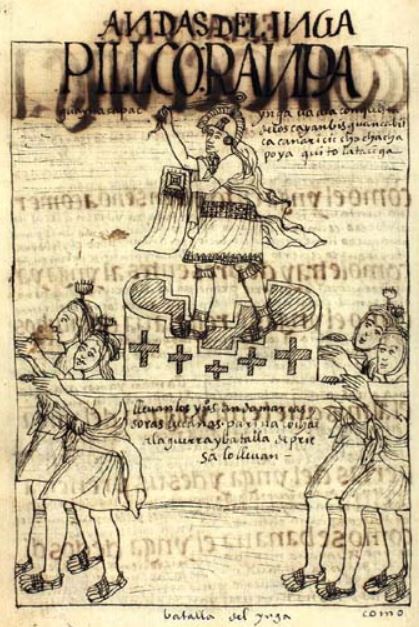
This chapter is dedicated to discussing the Inca and his life. This image depicts the Inca king, Huayna Capac, standing as he is being carried on his litter into battle. There are four figures carrying him on his litter with two people in the front and two people in the back with the wooden posts resting on their shoulders. The Inca is illustrated wearing a helmet and carrying a sword and shield as he goes into battle. The caption at the top of the image reads Guayna Capac Ynga ua a la conquista de los Cayanbis Guanca Bilca Canari Ciccho Chachapoya Quito Lataconga [Huayna Capac Inca goes to conquer the provinces of Cayambe, Huancavilca, Canari, Ciccho, Chacapoya, Quito, Lataconga]. The caption located below the litter reads Lleuan los yndios Andamarcas y Soras Lucanas Parinacochas a la guerra y batalla de priesa lo lleuan [The Inca took soldiers from the provinces of Andamarca, Sora, Lucana and Parinacocha to do battle].
This image is a depiction of Gulliver and Robinson Crusoe. The story of Robinson Crusoe is referenced several times throughout Gulliver’s Travels. The image is a part of Swift’s biography which precedes Part One of Gulliver’s Travels. The purpose of this illustration in the biography is to provide context for the political atmosphere and insight into Swift’s satirical writings. The same image appears in the 1839 Krabbe edition.
This image depicts multiple events in the first act. On the right, we see what is, presumably, the scene in which Sempronio visits Celestina to request her assistance on behalf of Calisto. To the left of this, the interaction between two figures is likely intended to represent the scene in which Calisto first encounters Melibea. The leftmost figure could be either Pármeno or Crito, although Pármeno’s relationship with Calisto, along with his greater importance in the narrative, signals that this is likely meant to represent Pármeno. Celestina is depicted wearing a robe and veil, with a rosary in her right hand. Melibea is wearing a robe. The three male figures are wearing hats, while Pármeno and Sempronio have swords.[The figures in this illustration are used in multiple other illustrations throughout this edition.]
The scene is taken place outside, there are mountains and trees in the distance as well as a house with a fence around it with a long path leading from the house through another fence with plants around it, to a old well where two frogs are sitting on top of it with other plants surrounding it. The two frogs marsh where they had lived, dried up and are now debating on living in the well with water in it.
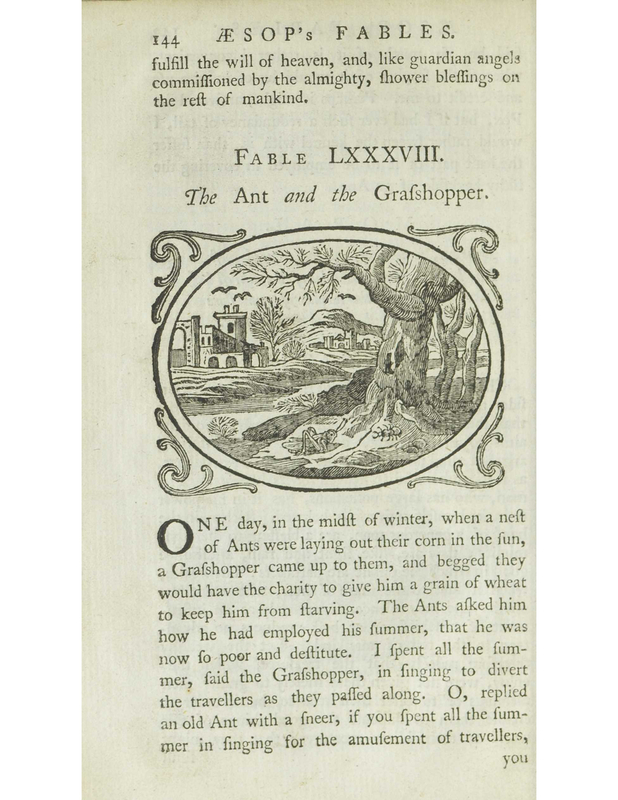
An ant and a grasshopper are seen conversing with one another under a tree in the winter. There are many other small ants climbing over the tree as well. A stream passes behind them, with a village on the opposite side of the bank and three birds can be observed flying in the sky.
Here Gulliver stands on a map of Brobdingnag. This image appears at the end of chapter four, in which Gulliver describes the country of Brobdingnag, as he travelled throughout the country both with the farmer and the King and Queen.
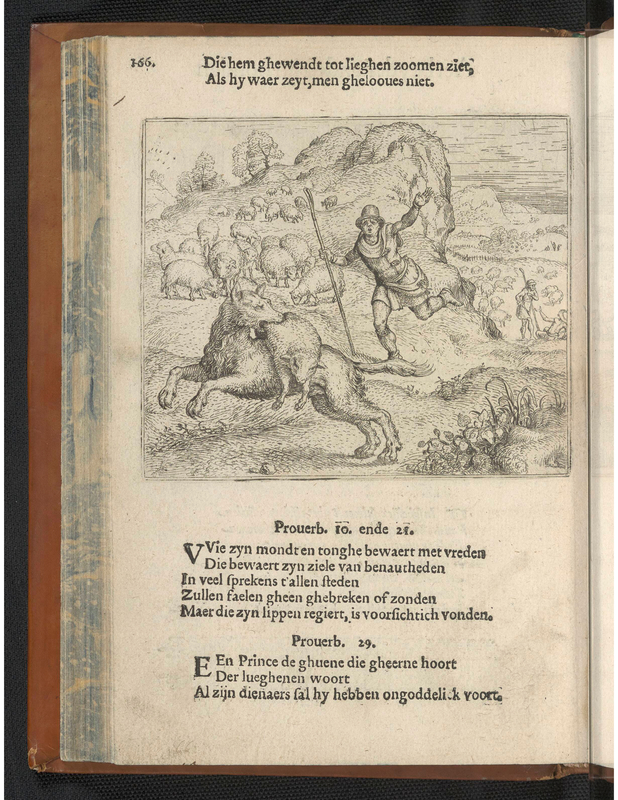
A man swings a hammer at a cow that is lying dead on the ground at left; on his right there are two running dogs; in the background there is a boar, there are two sheep and a barn with two cows in it.
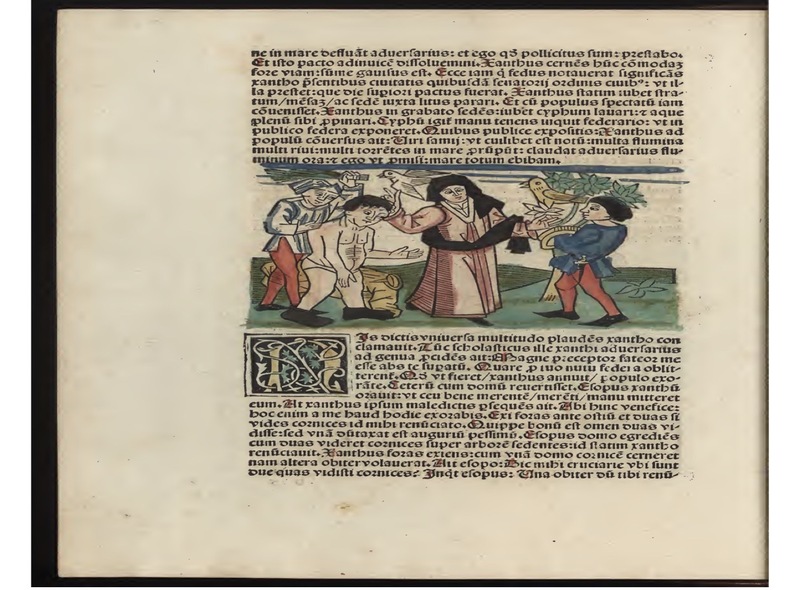
Four men stand outside, punishing one of the group members. The man receiving the discipline stands naked except for shoes. The other men carry with them doves and brandish a whip made of grasses.
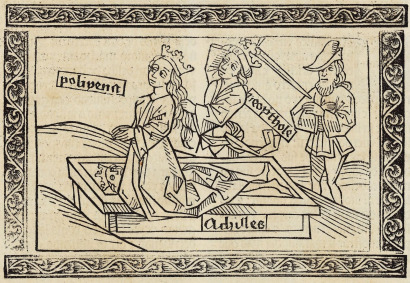
This engraving depicts Polyxena, the daughter of king Priam of Troy, getting executed on top of Achilles’ tomb. Polyxena is illustrated kneeling on the tomb of Achilles with her hands crossed while looking up to the sky as she accepts her fate. Her name is engraved beside her body to identify her. Achilles’ name is engraved on the side of his tomb. The man about to execute Polyxena is Neoptolemus, the son of Achilles. His name is engraved above his sword. Polyxena had lured Achilles into the temple of Apollo, where Paris shot Achilles with his arrow. Neoptolemus is the one to execute her as she is the one who is partly responsible for killing his father. She had done this through her mother’s instructions. Boccaccio explains that he wrote on Polyxena due to her fearlessness before her execution.
Gulliver is dressed in his finest clothes and carries a sceptre, as is the traditional formal attire in England. In this chapter Gulliver talks with the King of Brobdingnag about English traditions. Gulliver tells the King about diplomacy, religion, the justice system, the arts, the financial system, and the nobility, then debated these issues with the king. The same image appears in the 1843 Krabbe edition.
While returning home from her meeting with Melibea, Celestina spots Sempronio and Pármeno, who are going to Saint Mary Magdalene’s Church to check on Calisto, and follows them. The two servants enter first and begin talking with Calisto, while Celestina enters afterward and tells them that she has good news. They go to Calisto’s house for privacy, and Celestina reveals that Melibea is passionately in love with Calisto. Calisto is overjoyed when Celestina tells him that Melibea wants to meet him at midnight, Sempronio and Pármeno are suspicious of Melibea’s sudden change in heart. Calisto tells everyone to leave so that he can rest before night comes, and Celestina returns home. Calisto (the leftmost figure) is seen kneeled in prayer in front of a statue, likely intended to represent a statue of Jesus (considering the geographic location and time period of this edition). This illustration and the one depicting his death are unique, insofar as they are the only ones in which he is not wearing a hat. Sempronio and Pármeno (the two central figures) are both wearing hats, and Celestina (rightmost figure) is wearing her usual robe and veil.
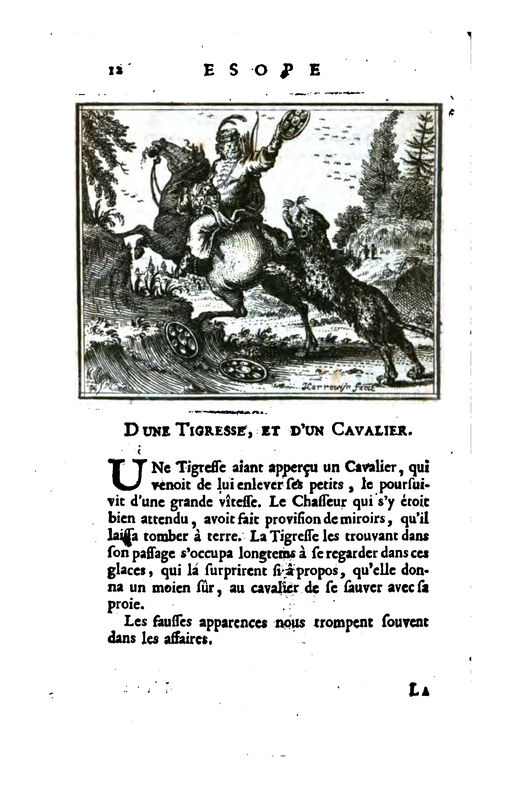
A man on a horse that is trying to jump up a hill holds a shield in the air above a tigress that appears to be trying to attack the man and his horse. There are two shields on the ground, and grass and trees in the background. The illustration has the signature of Harrewijn in the bottom right corner.
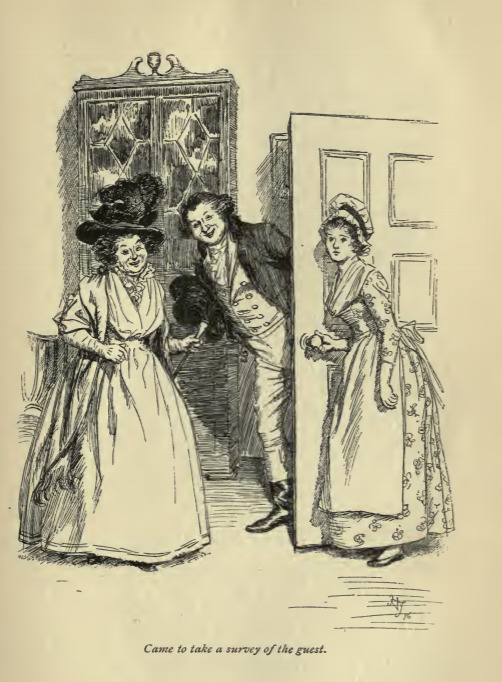
In this image Sir John and Mrs. Jennings come to visit Barton Cottage to meet Edward Ferrars. Both Sir John and Mrs. Jennings were very friendly and liked to gossip. They came to the cottage shortly after Edward’s arrival to meet him. In this image the maid opens the door to Sir John and Mrs. Jennings. This scene occurs in chapter 17. The characters are shown in the traditional regency style, as Mrs. Jennings and the maid wear the regency style dress with an empire waist. Mrs. Jennings wears a bonnet and carries a parasol. The maid wears a mop cap and an apron to protect her dress. Sir John a waistcoat and tailcoat with breeches and carries a top hat. The regency period dated to the early nineteenth century (1811-1820) when George, Prince of Wales, later George IV (r. 1820-1830), reigned as regent for his mentally ill father, King George III (r. 1760-1820). The regency period is associated with the rise of neoclassicism in art and fashion.
The background depicts the Cid rushing out from the gates of Burgos on horseback. He has just been exiled from Castile by King Alfonso, and none but one of the inhabitants of the town would interact with him for fear of punishment. He was even barred from his own house, causing him to be forced to leave the city with little in the way of supplies. The foreground shows several swords, a spear, a shield, a cloak, and a helmet leaning against a wall or suspended by what seems to be a mace.
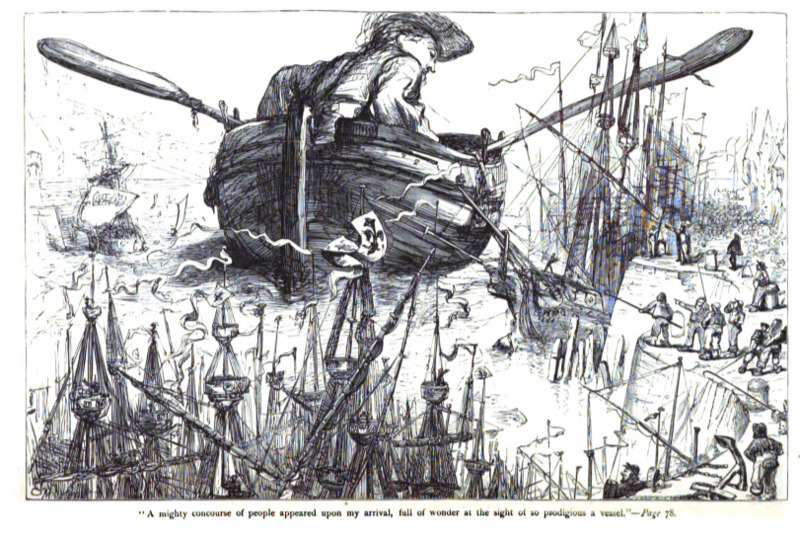
Here Gulliver rows the abandoned boat to the shore of Blefuscu. A crowd formed as the Blefuscudians had never seen a boat this big. They helped Gulliver bring it ashore so that he could repair it.
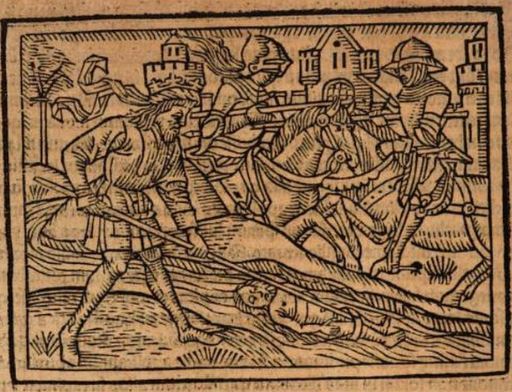
Metabus, king of the Volscians, is depicted on the left side of the engraving with a lance in his hands. Boccaccio explains that after being exiled from his kingdom, he took his only daughter with him to safety. When he came across a river, he tied his daughter Camilla to a lance and hurled it across the river in order to save her. Camilla is depicted laying down as her father secures the lance onto her body. They both survived, and Camilla grew up to be a strong, fierce warrior. Camilla goes to war against the Trojans and ends up getting wounded by a Trojan knight named Arruns. This is depicted in the background of the engraving, as Camilla is seen riding on her horse with a lance under her arm while she charges at the enemy. The enemy’s lance is illustrated piercing the chest of Camilla which ends up killing her.
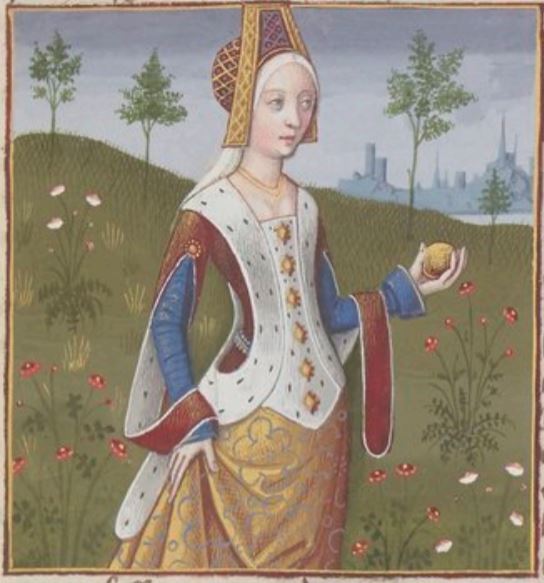
This illuminated image depicts the goddess Venus. Boccaccio explains that Venus was most likely a woman of Cyprus, and he wrote on her due to her incomparable beauty. Venus is depicted holding a part of her dress in her right hand and holding an object in her left. Venus has many symbols that she is associated with, and the object she is holding is assumed to be one of them (perhaps a pearl or a scallop shell).
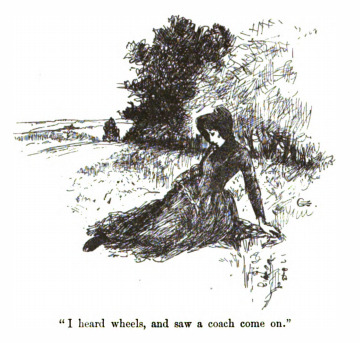
Here Jane sits outside as a carriage drives towards her. She gathered all her money and got a carriage and rode until she ran out of money. The driver dropped her off by the side of the road and she walked until she reached the nearest village, Morton. She wandered outside for two days until she was taken in by the pastor, Mr. Rivers.
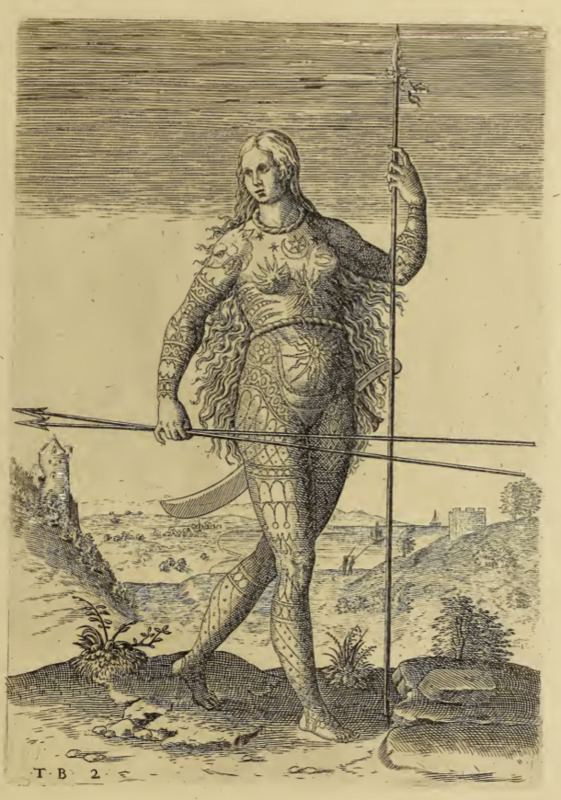
An Indigenous woman is shown from the front. She carries a spear in her left hand and two in her right. Her hair is long, she wears a twisted cord around her neck, and a sword with a curved blade hangs from another cord around her waist. She is nude, and her body is covered in painted designs. The Picts were an Indigenous group who lived in Britain long before the author’s time. Images of Picts were included in this book so that readers could compare their customs to those of the Indigenous people living in Virginia.
Gulliver explains to the reader the relationships between husbands and wives on Laputa. He tells us that the women frequently have affairs and are given more freedom than he is used to. Their husbands are oblivious to their actions because they are too focused on their studies that they do not notice, and their Flappers are not there to alert them. The men can become so wrapped up in his studies that his wife could be in the same room with him and have her lover there and he would not notice. This is the situation shown in this image. The scholar is shown sitting at his desk with a problem in front of him, wearing the typical clothing with astronomical and musical motifs. His wife is next to the desk in the arms of another man, who wears dark clothes rather than the usual pattern, but the scholar does not notice. The same image appears in the 1839 Krabbe edition.
The left panel depicts Celestina standing outside. She is wearing a robe and veil, with what looks like a rosary hanging from her waist. On the right, we see Pármeno pointing upward with a sword mounted on his belt.The entire image is nearly identical to the one found on page 221 (where the left panel is labeled ‘Elicia’ and the right is labeled ‘Sosia’). The left panel is identical to the panel found on the title page (with the exception of the colour found there), the one found at the end of the book, and those found on pages 51, 82, 150, and 162. The right panel is identical to those found on pages 43 and 135, and nearly identical to the one found on page 190 (where it is labeled ‘Sosia’).

![[Gulliver with Robinson Crusoe]](https://collections.cemvc.ca/files/large/a01b2a02211e4a139ae9aaef09fb32ce9705fe7d.jpg)
![[Act I – Pármeno (?), Calisto, Melibea, Sempronio, and Celestina]](https://collections.cemvc.ca/files/large/666c11dd7e3cf9b8ea0a3e9549c61672bf07a0aa.jpg)


![[Gulliver stands on a map of Brobdingnag]](https://collections.cemvc.ca/files/large/61eb2c42c1da31d6169b5908ae03e5978311bb4e.jpg)
![[Gulliver is dressed in his finest clothes, speaks to the King of Brobdingnag]](https://collections.cemvc.ca/files/large/6ead7c6127d16d4b690c37eee4bce2328be6565a.jpg)
![[Act XI – Sempronio, Pármeno, and Celestina Stand Behind Calisto While he Prays in a Church]](https://collections.cemvc.ca/files/large/661abd14ef9a37fe09e4a8461ad75c193034d661.jpg)
![[Person Cutting Vegetation]](https://collections.cemvc.ca/files/large/a4c6b7186616c6e2b977f136a1541c13ad906159.jpg)

![[A Laputan scholar wrapped up in work while his wife has an affair]](https://collections.cemvc.ca/files/large/37b9a55957ceb63430bf530a7d106eeb89da7722.jpg)
![[Act VII – Celestina and Pármeno]](https://collections.cemvc.ca/files/large/f53039ec9207233f8b558405e361997c35ebd773.jpg)