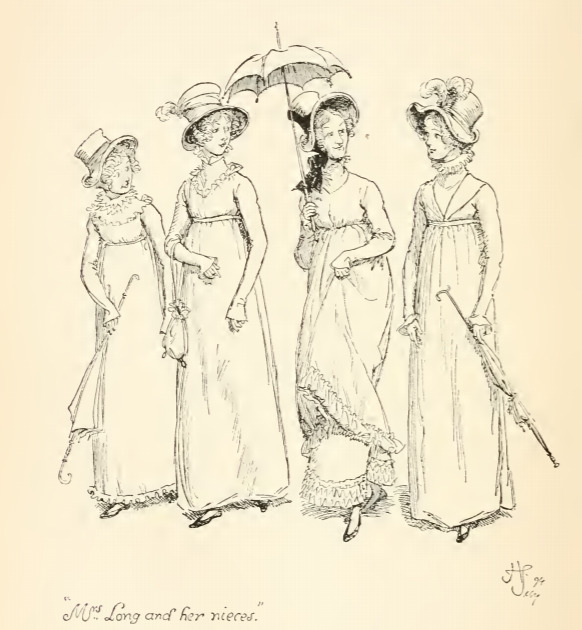
In this image we see Mrs. Long with her nieces, Jane, Elizabeth and Mary. After their dinner with Mr. Bingley and Mr. Darcy, Mrs. Bennet discuss its success. Mrs. Bennet praises Jane’s beauty, telling her daughter how she asked her sister, Mrs. Long agreed that she had never seen Jane look so beautiful. This scene occurs in chapter 54. The characters are shown in the traditional regency style. Mrs. Long, Jane, Elizabeth, and Mary wear regency dresses with empire waistlines. They wear bonnets and carry parasols, and Elizabeth carries a purse. The regency period dated to the early nineteenth century (1811-1820) when George, Prince of Wales, later George IV (r. 1820-1830), reigned as regent for his mentally ill father, King George III (r. 1760-1820). The regency period is associated with the rise of neoclassicism in art and fashion.
This illumination depicts a Roman woman named Sempronia embracing a man. Boccaccio explains that Sempronia was incredibly skilled at dancing and singing and would charm anyone that would hear her music abilities. There are harps and lyres depicted on the table behind her to signify her musical abilities. Sempronia was also known to be lustful and seek out the company men, which is why she is embracing a man in this image.
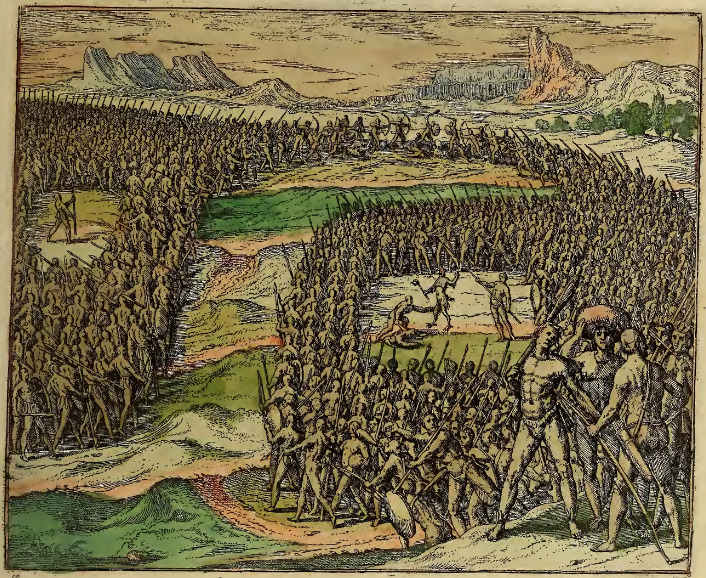
Two large groups of Indigenous people have massed in anticipation of war, with fighting breaking out at the far side of the groups. In a clearing at the center of the group on the right, a man holds up an idol – a figure with the head of a bird and talons for feet – that has been attached to the long pole held by the man (similar to a puppet). In front of the idol, a warrior kills another person while reaching out towards the idol. There is a gap in the center of the group on the left as well, where an individual holds a long pole. Most of the warriors are armed with spears, bows and arrows, clubs, and shields. This image is identical to one found on page 139 of Frankfurt, 1595, but colored.
A wolf and a lamb are both drinking from the same river on opposite sides but quite close to one another. The lamb seems to be unaware or unconcerened about the wolf's prescence. The wolf is staring at the lamb.
Here we see a bust of Queen Anne. This image appears when Gulliver explains England’s political system. Gulliver begins with the Glorious Revolution of 1688 which removed the Catholic James II, replacing him with Protestant William III. He continues on to explain to the war of Spanish Succession. He ends with the current system, with the accession of Queen Anne. The same image appears in the 1839 Krabbe edition.
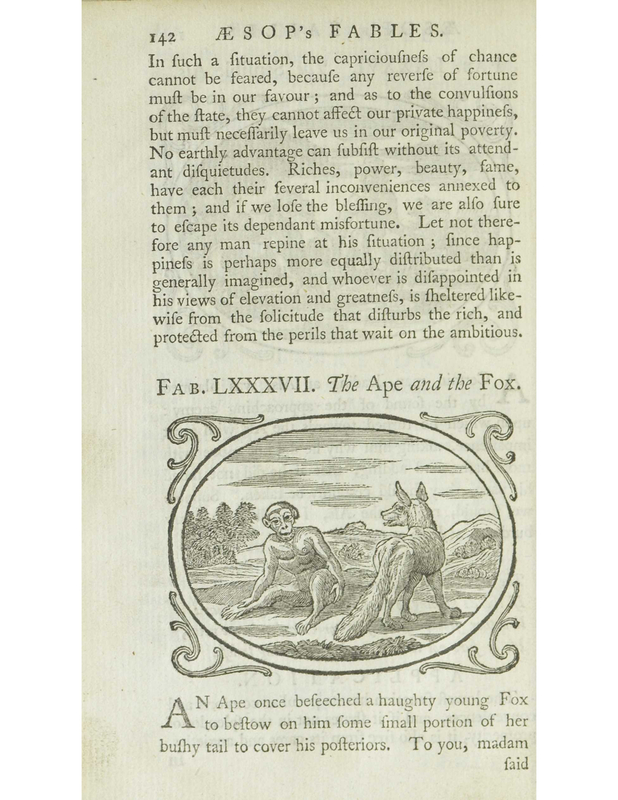
An sits in the grass while talking to a large fox. The terrain on which they can be found is very mountainous, with some trees and bushes dispersed throughout.
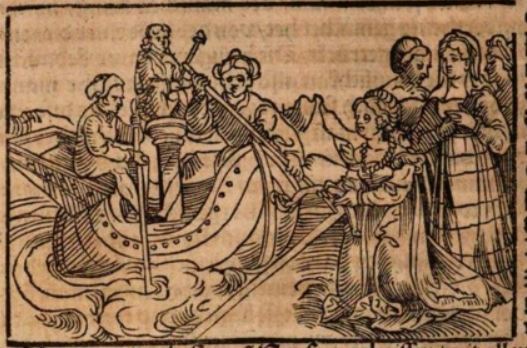
This engraving depicts Claudia Quinta, a Roman woman, standing on land as she pulls a ship to shore. Boccaccio explains that after Claudia Quinta was accused by other matrons of not being chaste, she prayed to the goddess Ceres to help prove her virtue. After a ship that contained a statue of Ceres had gotten stuck on a sandbar, Ceres gave Claudia Quinta the power to pull the ship to shore as proof of her chastity. The women who accused Claudia Quinta of being unchaste are standing behind her in the engraving as they watch her pull the ship to shore. The statue of the goddess is illustrated on top of a platform on the ship. There are two men sitting on the boat holding oars.
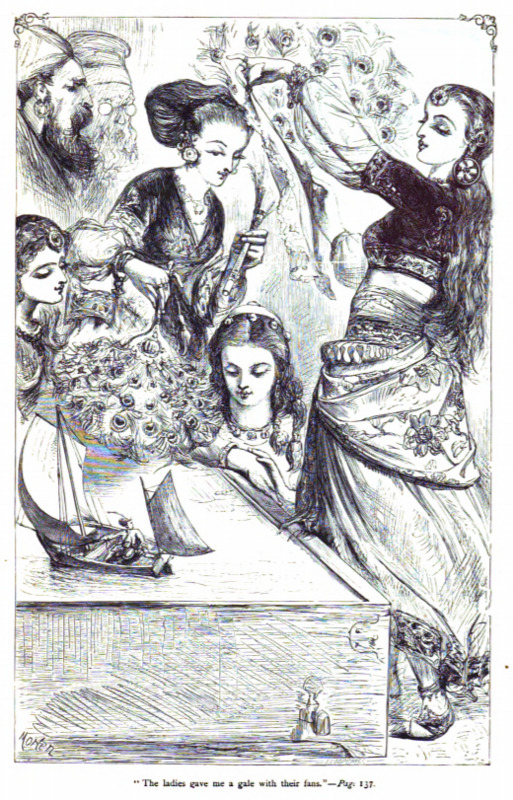
Gulliver explained to the Queen of Brobdingnag that he arrived on Brobdingnag by sailing. The Queen was not familiar with this mode of travel and built a trough in the court so that Gulliver could demonstrate sailing to the court. Gulliver was given the supplies to build himself a small boat. Here Gulliver demonstrates his sailing skills and the ladies of the court use their fans to make wind.
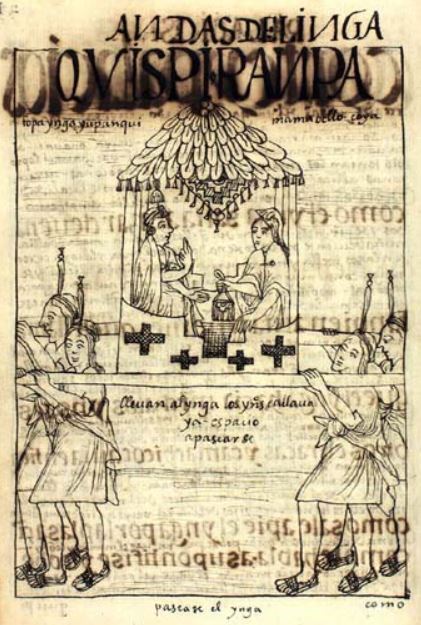
This chapter is dedicated to discussing the Inca and his life. This illustration depicts the Inca king sitting in a litter which is being carried by two people in the front and two people at the back. The litter is decorated with tassels hanging from a roof made of leaves. The Inca king is sitting on the left side of the litter and he is identified as Topa Inca Yupanqui. His coya [queen] is sitting on the right side of the litter and she is identified as Mama Ocllo Coya. The caption written below the litter reads llevan al ynga los yndios callauaya espacio a pasearse [the Callahuaya carry the Inca slowly on a ride].
This is a bust of King William III, who reigned from 1689-1702. The image is a part of Swift’s biography which precedes Part One of Gulliver’s Travels, in which the biographer is describing the political climate of the early eighteenth century to provide readers with context for the story. The same image appears in the 1839 Krabbe edition.
Celestina arrives at Melibea’s house, where she is greeted by Lucrecia, Melibea’s servant. As an old friend of Melibea’s mother Alisa, Celestina gains entry under the false pretense of paying her a visit and selling yarn. The servant of Alisa’s dying sister arrives and informs Alisa that her sister has requested her presence. Alisa departs, leaving Celestina alone with Melibea and Lucrecia. She talks for a while with Melibea and eventually reveals that she is there on behalf of Calisto, sending Melibea into a fit of rage. Celestina manages to quell her rage with a lie, telling her that Calisto’s cure requires only her girdle and a handwritten charm/spell. Melibea gives Celestina her girdle (as depicted in this illustration), and she asks Celestina to return the following morning to retrieve the charm.All four figures are depicted wearing robes. Additionally, the three leftmost figures are wearing veils, and the central left figure (presumably Celestina) has a rosary in her right hand.[The figures in this illustration are used in multiple other illustrations throughout this edition.]
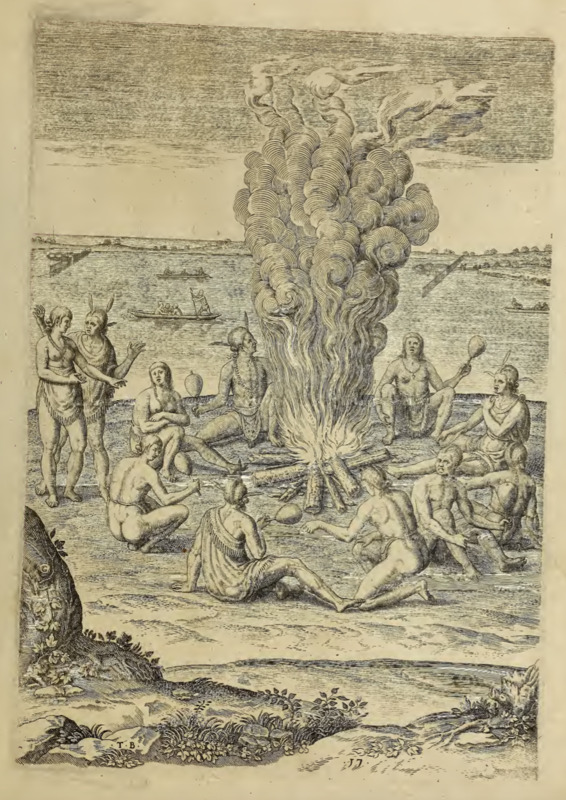
A group of Indigenous people sit on the ground around a bonfire on the bank of a river. Some of the individuals hold rattles. All wear fringed garments, either draped around their bodies and over their shoulders, over one shoulder, or tied around their waist. The men wear feathers in their hair, and at least one woman wears strands of beads. Behind the group, other individuals are seen in canoes on the river.
Celestina chastises Pármeno for murmuring during her encounter with Calisto and for opposing his own best interest (scamming Calisto), because it would negatively impact the outcome of all. She tells him that he needs to love if he wants to be loved, and offers him her prostitute Areusa in exchange for his loyalty. In this scene, we see Pármeno and Areusa having an intimate conversation, while Celestina talks with her other prostitute Elicia.
The image depicts the backside of a carriage, over the top of which the coachman’s hat can be seen. Sambo is standing on the base of the back of the carriage, holding on to two straps, as it drives away from Miss Pinkerton’s in a cloud of dust.
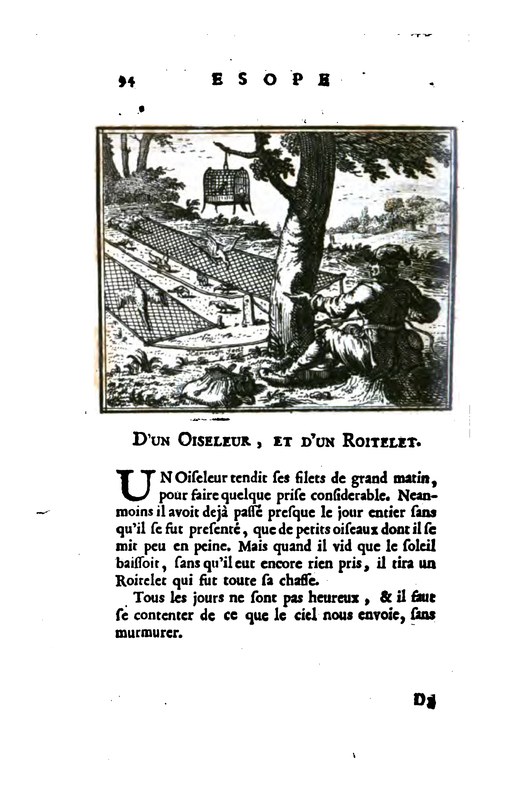
A bird catcher stretched his nets early in the morning, to make some considerable catch. Nevertheless, he had already spent almost the whole day without being present, only small birds of which made little noise. But when he saw that the sun was going down, without having taken anything yet, he drew a Wren which was all his hunt.
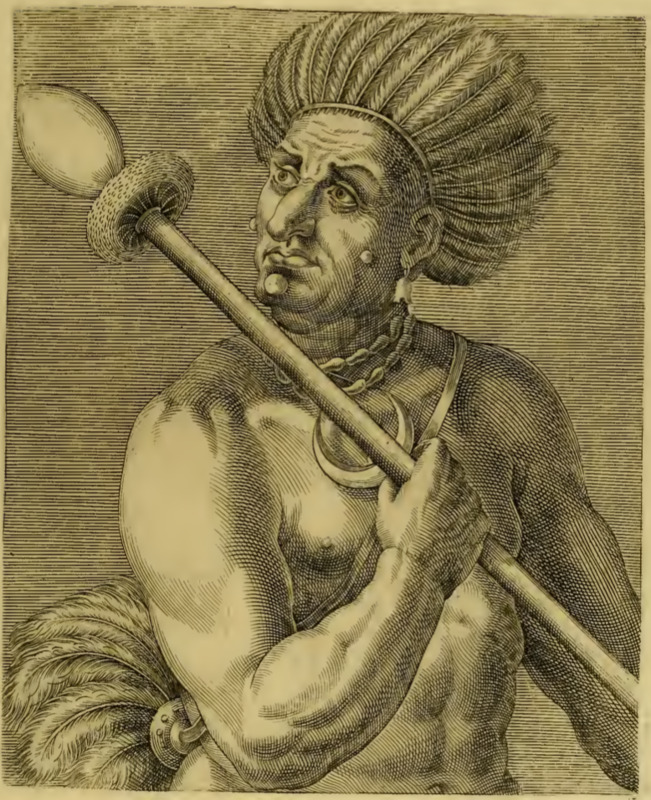
Quoniambec (also known as Cunhambebe) is shown in portrait from the waist up, with his torso angled to his left and his head turned to the right gazing into the distance. He wears a headdress made of long feathers pointing skyward and three round facestones, one in each cheek and a larger one in his chin. Quoniambec also wears a beaded multi-strand necklace with a large crescent-shaped pendant. He has a round feathered adornment hanging at his back from a strap that crosses his body from his left shoulder. He carries an ornamental club in his right hand. Cunhambebe was a Tupinambá chief in the Guanabara region (today Rio de Janeiro) and down to Bertioga (present-day Saõ Paulo), of Brazil. He also led the Tamoio Confederacy, a group of Brazilian Tupinambá peoples united to fight the French colonization of Guanabara.
This engraving depicts Nicaula, the queen of Ethiopia, on the right-hand side of the engraving shaking hands with king Solomon of Jerusalem. We know that these figures are Nicaula and Solomon as their names are engraved beside their heads to identify them. Nicaula, as Boccaccio explains, was incredibly wise and wanted to hear and listen to the wisdom and intellect of Solomon. She had traveled from Ethiopia to Jerusalem to meet him. This engraving depicts their first meeting. Behind Nicaula is presumably one of her servants, who is carrying a balsam tree. The tree was one of many gifts that Nicaula had given to Solomon.
Georgy Osborne sits on top of his family’s carriage after climbing across the others, holding his hat in one hand. On the deck next to the railing below him are three workers; Mr. Kirsch, the courier, is lifting his hat in greeting to Georgy.
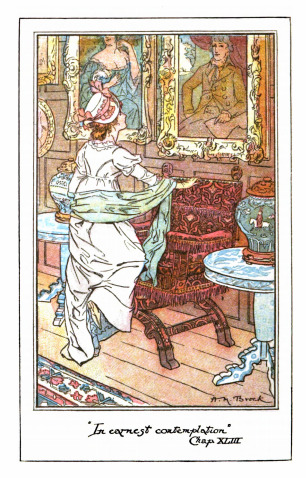
Here we see Elizabeth touring Mr. Darcy’s estate, Pemberley. She visited his estate in the north of England while on vacation with her aunt and uncle. They went on a tour with Mr. Darcy’s housekeeper, Mrs. Reynolds. In this image, she admires some of the portraits in Pemberley. She particularly admires the portraits of Mr. Darcy and Mr. Wickham. In this image, Elizabeth kneels on a chair to get a closer look at the portrait of Mr. Darcy. There are vases on either side of the couch. This scene occurs in chapter 43 as noted underneath the title of this image. Elizabeth wears the regency style dress with an empire waist. Her hair is worn tied up, as was tradition for women after their coming out before the queen, signaling her entrance into society. She wears a bonnet, a popular fashion of this period to protect her from the sun. Bonnets were especially popular because in this period a common pastime for women was going out on walks. Elizabeth has a shawl wrapped around her shoulders. The regency period dated to the early nineteenth century (1811-1820) when George, Prince of Wales, later George IV (r. 1820-1830), reigned as regent for his mentally ill father, King George III (r. 1760-1820). The regency period is associated with the rise of neoclassicism in art and fashion.
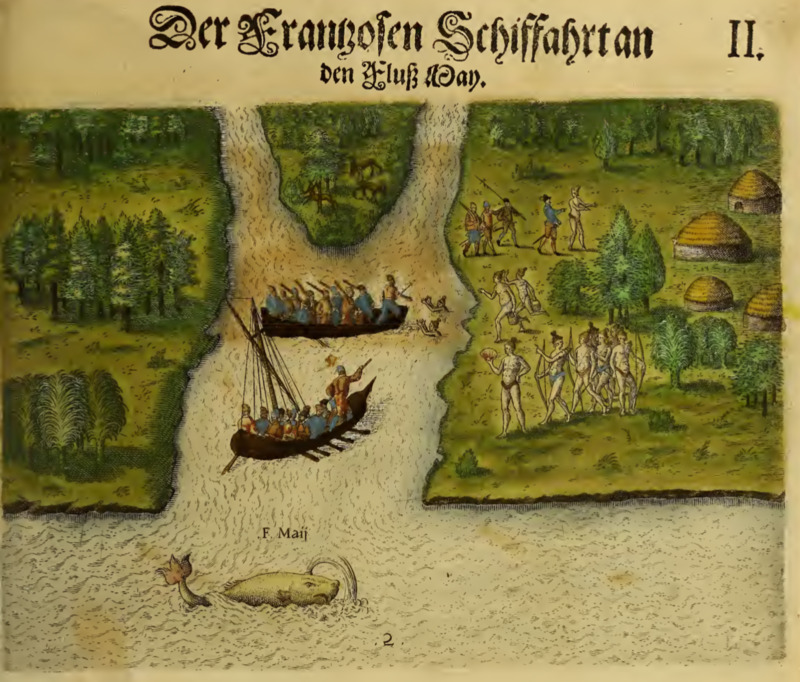
Two small rowboats of settlers are shown at the mouth of the May River (known today as the St. Johns River) on the coast of Florida. There are two Indigenous people in the water, appearing to greet one of the boats. On the right bank, a group of Indigenous people stand, some hold bows and arrows. Some are looking at and gesturing towards the colonists’ boats. Four small round structures are also pictured on the right bank. This illustration is identical to the one found on page 39 of Frankfurt 1591, but colored.
In this image we see Melibea talking to her father Pleberio, whose hand is placed over his heart. This is presumably the scene in which they are taking a walk, after Lucrecia tells him of the illness that has affected Melibea's heart (Melibea has not yet revealed that this illness is one of sorrow, caused by the death of Calisto). Alisa is also present, to the right of the image. This is somewhat odd, seeing as she is said to stay in bed when Pleberio goes to check on Melibea. Her presence here, with her hand placed over her heart, may simply be intended to convey the pain she feels upon hearing that Melibea is ill.


![[The Roman Woman Sempronia Embracing a Man]](https://collections.cemvc.ca/files/large/05ab4cd1b79efb28cf404a28cfd37bd9fc1b452a.jpg)

![[A bust of Queen Anne]](https://collections.cemvc.ca/files/large/003c18f7ba0d49a6c02c0a15b87d9925527a5d2c.jpg)

![[William III]](https://collections.cemvc.ca/files/large/c902fab7e563972f1d3bc2b2cf0ebb5c82c76488.jpg)
![[Act IV – Lucrecia, Celestina, Alisa, and Melibea]](https://collections.cemvc.ca/files/large/fee4211b252bdc5a9fed9bd423eaa5a4b35881b5.jpg)
![[Act VII - The Intimacy of Pármeno and Areusa]](https://collections.cemvc.ca/files/large/745b209f75253d488309ad090b8ccd269847b415.jpg)
![[The Carriage Departs]](https://collections.cemvc.ca/files/large/b4c61892dfb32045aa2982a3bfff1d3f13ffb663.jpg)

![[Georgy Climbs the Carriages]](https://collections.cemvc.ca/files/large/9f123e27669d122638fec4f635fb5d6e5c120e95.jpg)
![[Act XV - Melibea Tells Her Father of the Pain in Her Heart]](https://collections.cemvc.ca/files/large/6cd70c2c291caee3faaf9643af5ca2aa8ed90d2a.jpg)