This image depicts Cloelia, a noble Roman virgin, emerging out of the Tiber river after having escaped imprisonment. A foreign king had taken many women hostage from Rome, and Cloelia was able to successfully escape. When she escaped, she took many other hostages with her to help them. The other women in this image are most likely the other hostages, as Cloelia is looking at them and pointing. After escaping, Cloelia crosses the Tiber river back into Rome.
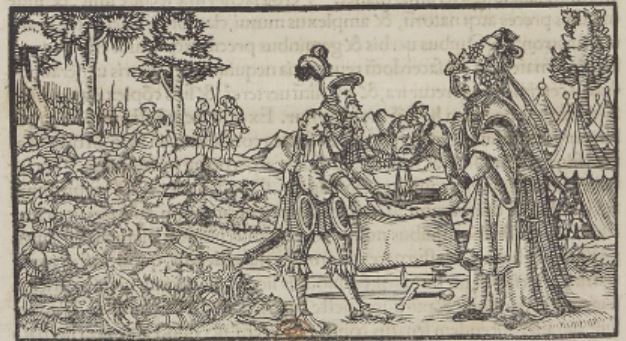
There are two women by the name of Thamyris that Boccaccio describes in his book. One was a fierce queen of Scythia who decapitated the head of her enemy. This engraving depicts Queen Thamyris of Scythia as she puts the decapitated head of her enemy into a bag. This engraving, however, is wrongly placed in the book as this engraving is meant to depict the other Thamyris. The Thamyris the engraving should have depicted was a painter from Greece (also known by the name Timarete). Thamyris was the daughter of a painter named Micon, and she grew up to be a renowned painter herself.
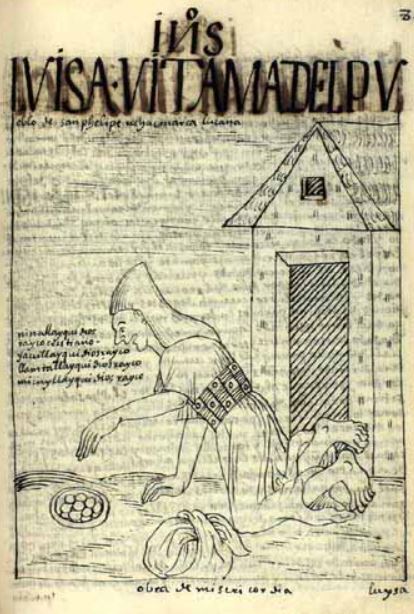
This image depicts a disabled Andean woman who cannot walk, kneeling in front of a house on the ground as she does chores. She is reaching to what appears to be a plate of food and there is a cloth bag to her left. The author explains that the disabled people of Spanish colonial Peru suffered much mistreatment and ostracization from priests, nobles, and lords. The woman has dialogue written by her face which reads, ninallayqui diosrayco, cristiano yacullayqui diosrayco, llamtallayqui diosrayco, micuyllayqui diosrayco [your fire, christian, is for God, your water, christian, is for God, your wood is for God and your food is for God].
This image is illustrated in a chapter that discusses the Christian priests in the colonial government in Peru. This image depicts the sacrament of confession between a Spanish priest and an indigenous Christian. The indigenous person is depicted on their knees in front of the priest with their hands together in prayer and their eyes looking towards the ground. The author explains that it was custom for both the penitent and priest to avoid eye contact with one another during the confession. The priest is depicted sitting in a chair and holding his cap in his left hand. He is pointing to penitent with his right hand as he offers his blessing.
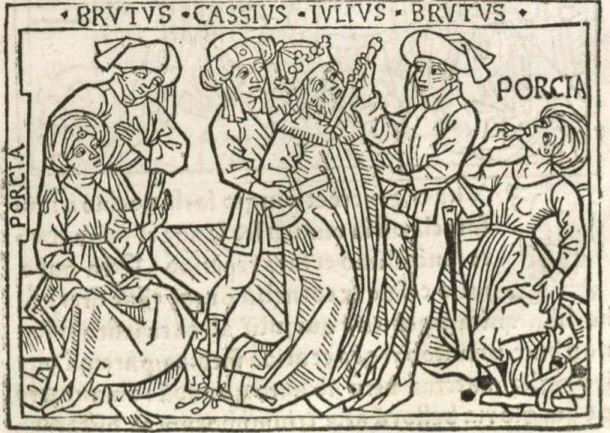
This engraving depicts three separate events. The far left of the engraving depicts a man named Brutus having a discussion with his wife Portia. We know that these figures are Brutus and Portia as Portia’s name is engraved beside her body and Brutus’ name is engraved above his head. Brutus is telling his wife the conspiracy plan to kill Julius Caesar. After hearing the conspiracy plans, Portia took a barber’s razor and cut herself with it. The engraving depicts the barber’s razor sticking out of her foot. She does this to prepare herself in case she has to kill herself should the conspiracy not work out in Brutus’ favour. The centre of the engraving depicts the assassination of Julius Caesar. Brutus is on the right side of Caesar, stabbing him in the chest. A man named Cassius is behind Caesar as he stabs his abdominal area. Their names are engraved above their heads. The far right of the engraving depicts Portia eating burning hot coals from the fire directly beside her after hearing of her husband’s death.
Gulliver explains the various medicines used in England to treat disease. In this image we see a doctor in his office, with his back to the viewer. This image appears when Gulliver explains the practice of prognosis to the Houyhnhnms. The same image appears in the 1843 Krabbe edition.
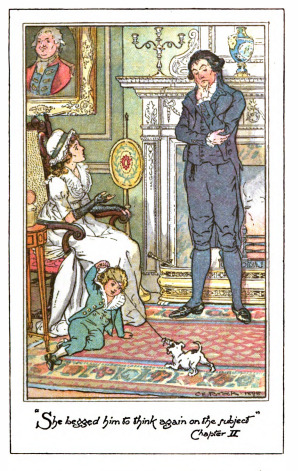
Here we see John Dashwood, his wife, Fanny, and their son after inheriting Norland. John Dashwood was Elinor, Marianne, and Margaret’s half-brother. He inherited the house from their father and was supposed to support his half-sisters. Initially he was planning to give them each one thousand pounds, but his wife Fanny implored him to rethink his decision, telling him to think of their son. Because both Fanny and John Dashwood were selfish people, they resolved to give each of his half-sisters an occasional gift of a small amount of money. In this image John Dashwood stands in front of the fireplace with his hand on his chin, contemplating his decision as Fanny tries to convince him to keep reducing the amount that he will give his half-sisters. Their son sits on the floor, playing with their dog. This scene occurs in Norland, the home in which Elinor, Marianne, Margaret, and their mother lived before the death of their father. This scene appears in chapter 2 as indicated underneath the image. The characters are shown in the traditional regency style, as Elinor wears the regency style dress with an empire waist. Her hair is worn tied up, as was tradition for women after their coming out before the queen, signaling her entrance into society. The regency period dated to the early nineteenth century (1811-1820) when George, Prince of Wales, later George IV (r. 1820-1830), reigned as regent for his mentally ill father, King George III (r. 1760-1820). The regency period is associated with the rise of neoclassicism in art and fashion.
Here we see Lowood School, where Jane Eyre lived from age ten to eighteen. Jane left her aunt at Gatehead Hall when she was ten years old, and attended the school for six years, then taught there for two. The school was a charity school, funded by Mr. Brocklehurst, the local parson. Jane left the school to be a governess for Mr. Rochester and his charge, Adele. The title underneath the image is somewhat obscured, however titles for all the images are shown in a table of contents for all images.
A pair of young children stand by the seaside. The girl is wearing a bonnet and has her fingers gripped behind her back, while the boy is holding onto the string of a kite. The kite is shaped like a cone with a rounded top, and flies next to the letter I.
In this image. Gulliver sits reading at a table. This appears during the first chapter where Gulliver introduces himself. The image represents Gulliver studying to become a surgeon, so that he could join a ship. Several busts, a skull, and the skeleton of a small animal are visible on the shelves behind Gulliver, along with various medicine bottles. The same image appears in the 1843 Krabbe edition.
Here Gulliver stands on a stack of military regalia of the army of Brobdingnag. We see a sword, axe, circular shield, helmet, and chest plate. The armour is highly decorated with engraving and gemstones, particularly on the chest plate and the sword. The same image appears in the 1839 Krabbe edition.
In this image, Swift is the central figure, with his teachers looking over his shoulder. The image appears in Swift’s biography, during the discussion of Swift’s university years at the Trinity College in Dublin. A shadowy figure behind Swift’s shoulder on the left of the image reads a book. The same image appears in the 1839 Krabbe edition.
This engraving illustrates Queen Semiramis of the Assyrians lying in bed while having sexual relations with her son, Ninyas. We know that these figures are Semiramis and her son, as the creator engraved their names above their heads to identify them. There is a statue sitting on a platform on the left side of the engraving which appears to be a king. The statue is in fact Semiramis, who had a substantial military career and took part in many battles. The three almost naked women that are illustrated in front of the bed represent the women who Semiramis feared. She was afraid that they would desire her son and take her away from him. Semiramis is said to have invented the chastity belt to avoid anyone having sexual relations with her son. The women are illustrated with undergarments on, which is suggested to be the chastity belts.
This is a portrait of Jonathan Swift. The image is a part of Swift’s biography which precedes Part One of Gulliver’s Travels. The purpose of this illustration in the biography is to provide context for the political atmosphere and insight into Swift’s satirical writings. The same image appears in the 1839 Krabbe edition.
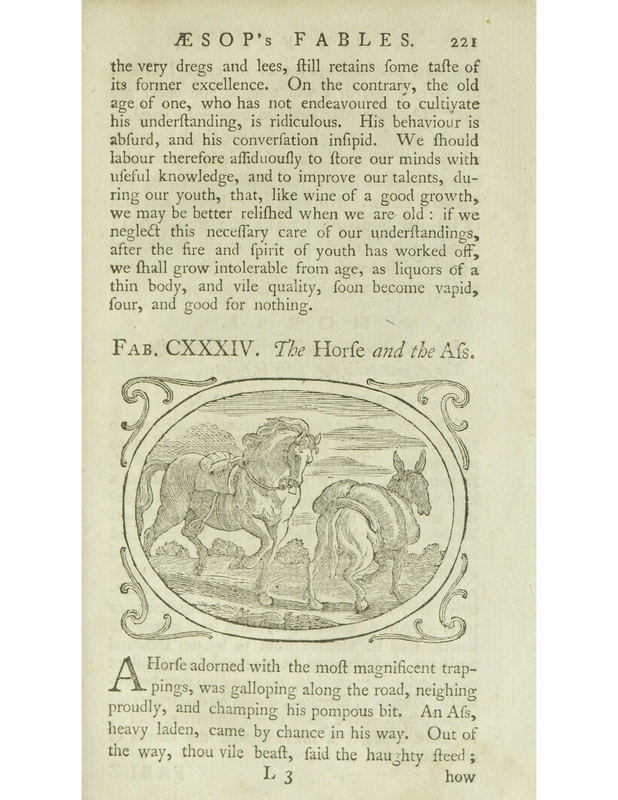
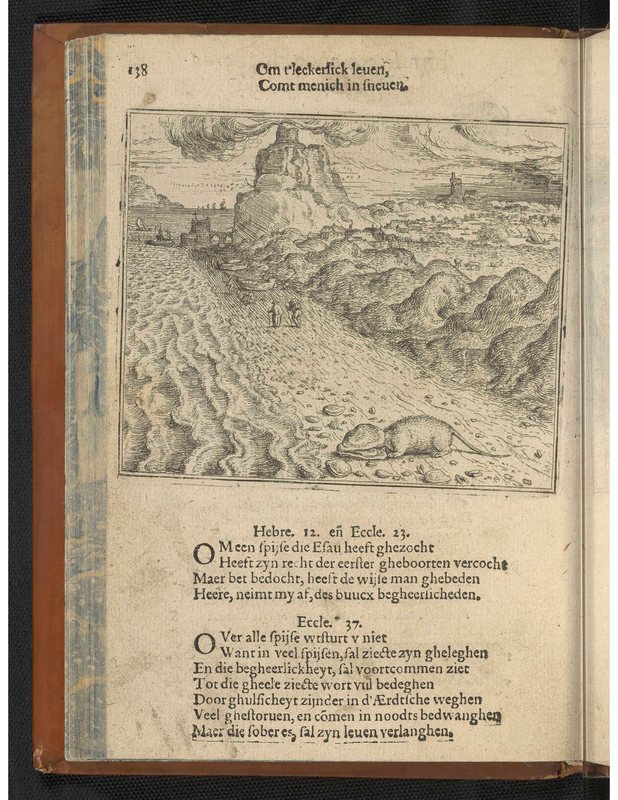
The scene is taken place outside, there are multiple large bushes and hills in the distance. A horse with trappings is galloping along a road as an ass with heavy cargo came across in the horses way and the horse demands him to move.
The left panel depicts a male figure. This must be Pármeno, since he is the only male character included in the act. The figure, dressed in regal attire, is wearing a hat and has a sword mounted on his belt. In the right panel we see a female figure, either Celestina, Areusa, or Elicia, who is wearing a robe and a veil. She is holding a book of some sort between her body and her right arm.The left panel is a near carbon-copy of a panel found multiple times throughout the earlier 1529 Lyon edition. However, the lower attention to detail in this panel makes it clear that it is a reproduction and not a duplicate. The artist likely referred to a copy of the 1529 edition when creating this panel.
Rawdon Crawley stands in an opera box, looking up and to the right through his opera glasses. General Tufto and Rebecca Crawley are seated on either side of him, looking at each other, with a bouquet between them.
There is a frog, a porcupine, and a mouse standing on the ground to the left. To the right there is a rabbit, a fox, and a baby fox. The two groups of animals face each other. Behind them there are hills and trees.
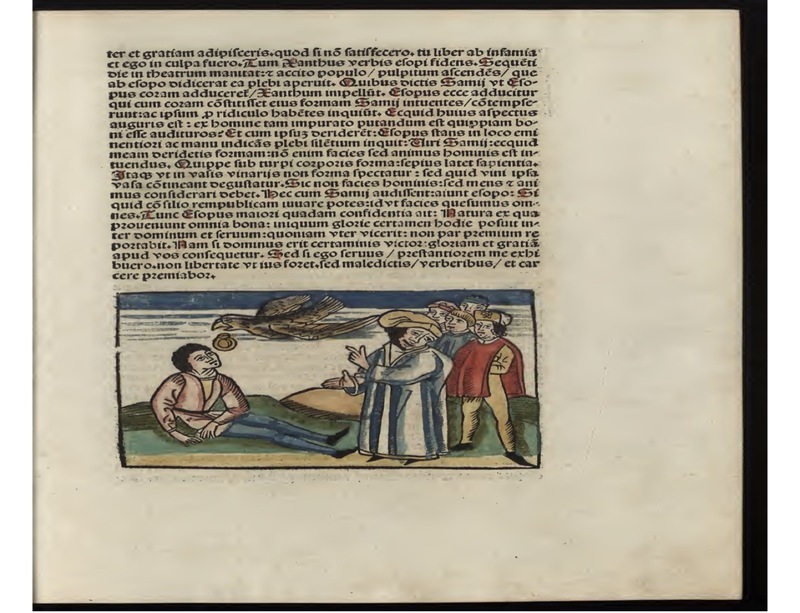
One man sits on the ground while a group of five stands off to the side. Above the man sitting is a hawk which drops an object from its mouth to the sitting man. The group of men watch this occurrence with looks of fear.
This image is illustrated in a chapter that discusses and criticizes the government and society in Spanish conquered Peru. This image depicts a hermit who the author praises for keeping true to his religious duties. The author previously criticized many priests for having abused their powers against the indigenous peoples of Peru. The hermit of the order of Saint Paul is depicted kneeling on the right side of the image begging for alms. He is illustrated having long hair and holding a skull in his right hand and a long staff with a cross at the top in his left. The indigenous man that the hermit is receving alms from is holding out a plate of what appears to be either money or food. A second person is partially illustrated standing behind the indigenous man. There are words of dialogue written by the indigenous man which reads, caymi limosna, padre [here are the alms, Father]. The hermit responds, diosrayco [for God].


![[Cloelia Emerges from the Tiber River]](https://collections.cemvc.ca/files/large/0536852bc6b88020ea80feeb6bcf7eb58536c06f.jpg)
![Sacramento de la Con[fici]on](https://collections.cemvc.ca/files/large/8947faedbec85f9e6a65b0a0fcc92d8c46afe701.jpg)
![[a doctor practicing prognosis]](https://collections.cemvc.ca/files/large/2964097781c3f5249f60de4f63f550b67c68fd0f.jpg)

![[Vanity Fair Volume II. Chapter I Inhabited Initial, I]](https://collections.cemvc.ca/files/large/6209ce476bea92f38488a01fdec6c767b9ed968f.jpg)
![[Gulliver reading at a table]](https://collections.cemvc.ca/files/large/2b0bf5d01d93eef968d54915e9af05744506ffa4.jpg)
![[Gulliver stands next to military equipment on Brobdingnag]](https://collections.cemvc.ca/files/large/16cfbbca73dfd078b2279b6d55cf9b93f13ee537.jpg)
![[Swift and his teachers]](https://collections.cemvc.ca/files/large/8336e8c113f3dad1053a3b1097ec19093130a71b.jpg)

![[Portrait of Jonathan Swift]](https://collections.cemvc.ca/files/large/c31df4339e08764187b85dc71f1b6b7b501852d4.jpg)
![[Act VII – Pármeno and (?)]](https://collections.cemvc.ca/files/large/9f6a403ffaaf7217c6f54b725d9676eb8c65bc29.jpg)
![[General Tufto and the Crawleys at the Opera]](https://collections.cemvc.ca/files/large/a55e431ced75e41bd1a6ecd47d53d0874ed9268f.jpg)
![[Animals Face Each Other]](https://collections.cemvc.ca/files/large/1705d083830cab5a4ebfc3c92079dd71a47f8e8b.jpg)
![Hermitanos, S[an]tos, De Ellos](https://collections.cemvc.ca/files/large/5f11eb463a54ec96153f70a2e9d3c299609fe048.jpg)