In this image we see Gulliver sitting among several large leaves. He is crouched down, contemplating his experiences in the past days on Brobdingnag. The image comes at the end of the first chapter of the second part of the story, after Gulliver described how much more difficult basic things were on Brobdingnag because of his size – specifically moving around and going to the bathroom. The same image appears in the 1843 Krabbe edition.
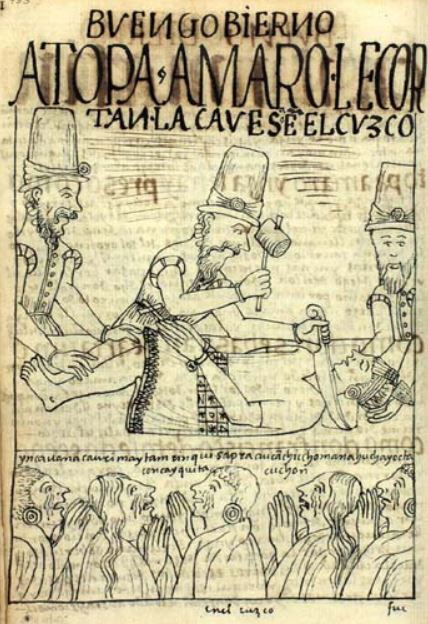
This image depicts the beheading of the young fifteen-year-old Inca, Topa Amaro Inca. The young Inca had expressed he had no desire to meet Don Francisco de Toledo, the viceroy of Peru, and the viceroy was offended by the Inca’s words. The viceroy sentenced the Inca to be beheaded for this reason. Topa Amaro Inca is illustrated laying on a table with his hands bound together. There are three Spaniards depicted aiding in the beheading. One man is holding down the Inca’s legs while another man holds the Inca’s head still. The third man is depicted holding a sword to the Inca’s neck with one hand and a hammer in his other hand. There is a group of indigenous peoples at the bottom of the image looking up at the scene of the beheading of the Inca. They are depicted crying and grieving for the young Inca. The caption written above their heads reads, ynga uana cauri maytam rinqui sapra aucanchiccho mana huchayocta concayquita cuchon [Inca Wanacauri, where are you going? Is our wicked enemy cutting your blameless neck?]. The caption at the bottom of the image reads, en el cuzco [in Cusco].
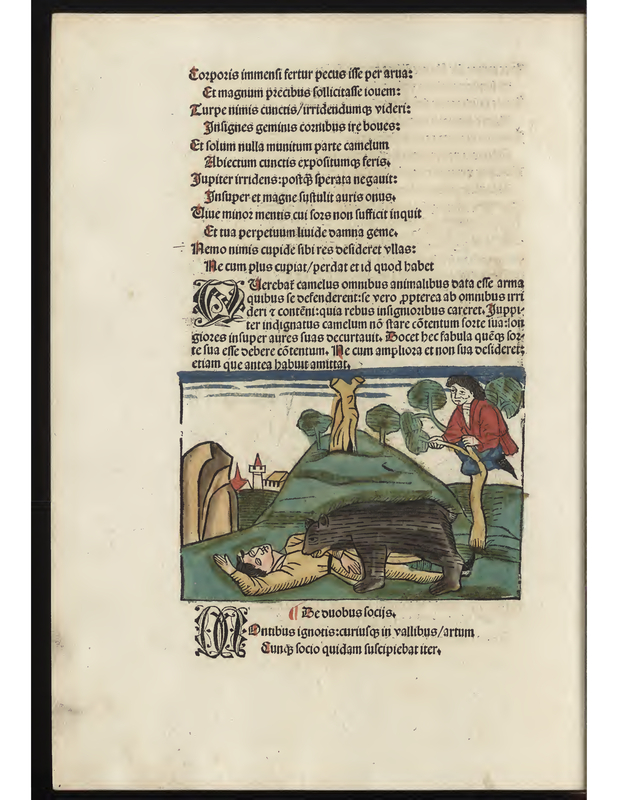
Two men are outside; one is attacked by a bear. The first man lays on the floor while being eaten by a bear, the second man hides on top of a tree. There is a castle in the distance and a hilly landscape.
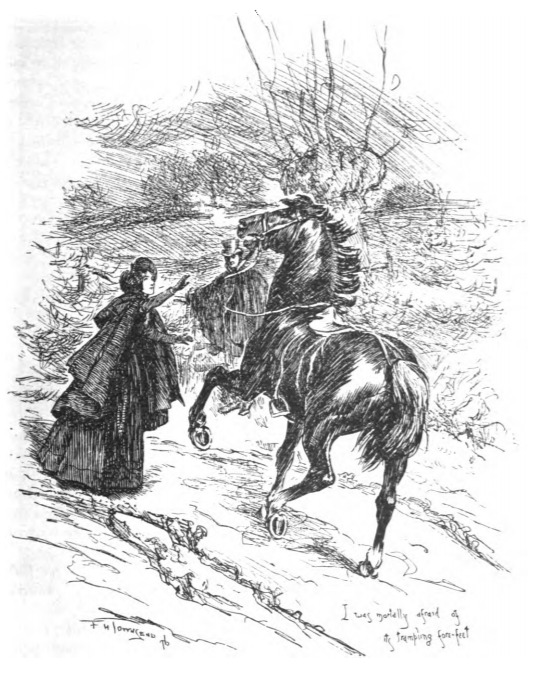
Here we scene where Jane and Mr. Rochester first meet. Jane was walking into town when Mr. Rochester rode past her and his horse slid on ice, throwing him off. Mr. Rochester hurt his ankle and Jane offered to help. Neither knew who the other was. Mr. Rochester initially asked Jane to get a hold of the reigns of his horse but she was unable as she was afraid of it, seen in this image. Then Jane helped Mr. Rochester walk to his horse and calm it down, then mount it.
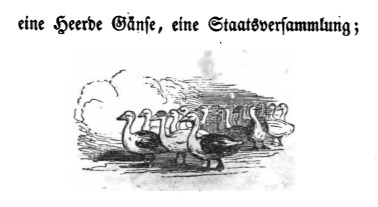
This image is of a herd of geese representing a senate. This image comes in a description of a conspiracy found by a professor from the Grand Academy on Balnibarbi. This idea is representing code word for terms in the conspiracy that Swift is satirizing. The professor advises that those named in the conspiracy plan be closely monitored at all times, naming specifically while they were using the bathroom, as this is when men were most thoughtful. This conspiracy is thought to be an allusion to the trial of Francis Atterbury, the bishop of Rochester for allegedly plotting with the Jacobites. Atterbury was charged with treason in 1722 and was exiled to France. The same image appears in the 1843 Krabbe edition.
Gulliver explains the various medicines used in England to treat disease. In this image we see a man vomiting after taking medicines. Gulliver explains that the man vomits because of the foul taste of the medicine which included ingredients such as reptile skins, bones, excrements, insects, herbs, minerals, gums, oils, and juices. The same image appears in the 1839 Krabbe edition.
This illustration depicts Artemisia, the queen of Caria, on the right side of the image wearing a crown and holding out her arm towards the monument in front of her. The crown she is wearing is to signify her royal status. There are two men standing behind the monument with chisels and other tools as they construct a sepulcher for Artemisia’s husband. Artemisia was married to Mausolus, the king of Caria and was so grieved by his death that she ordered a magnificent sepulcher to be erected in his honour.
Sempronio (rightmost figure) is shown arriving at Celestina’s house to request her aid on behalf of Calisto, and he encounters Celestina (central figure) in the street. In this illustration, she is shown opening her door. Inside, we see Crito (leftmost figure) descending the staircase. Celestina and Elicia attempt to hide him from Sempronio.The entire illustration is identical to the one found on page 95 of the text (folio f1r): [Act V – Pármeno Opening the Door for Celestina and Sempronio].
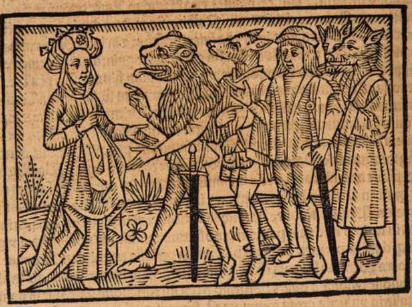
This engraving depicts Circe, the daughter of the Sun, on the left side of the engraving. Boccaccio explains that Circe was skilled in the art of magic and would often turn people who landed on her shores into animals. When Ulysses and his men happened upon Circe, she transformed Ulysses’ companions into beasts. They are depicted in the engraving with their bodies still in human form, while their heads are changed into animals such as lions and pigs. Ulysses is the one man among them that is still in human form. Ulysses threatens Circe with his sword, and she eventually changes his companions back into their original forms.
The illustration is divided into two panels. On the left we see Calisto dressed in noble attire, with a sword mounted on his belt. On the right we see Melibea dressed in a robe and a veil. In her left hand she is holding the girdle cord that played an important role earlier in the story. In her right hand she has a flower, which she appears to be holding in front of her face (perhaps an expression of her modesty). A small dog stands at her feet, perched on its two hind legs while extending its front paws toward her. The entire image is identical to the one on page 8 of the text. The left panel is identical to those on pages 43, 162, and 190. The right panel is identical to those on pages 150 and 244.
The Reverend Mr. Binny sits on a sofa with Georgy Osborne on his lap. Opposite him sits Amelia Osborne, to whom he has just proposed marriage and been turned down. She is knitting or crocheting. Above the sofa is a framed portrait of the elder George Osborne.
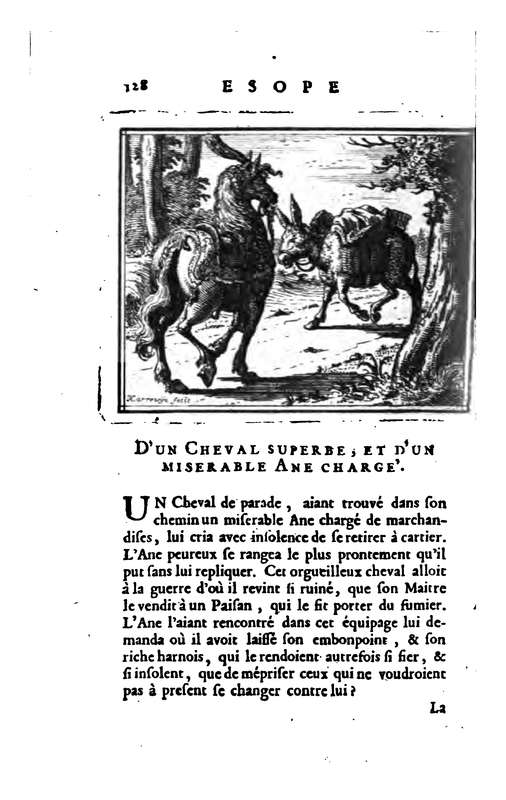
The image depicts a donkey carrying a load on its back and highly decorated horse on a road. The donkey is blocking the path of the horse on the road and is trying to move out of the way.
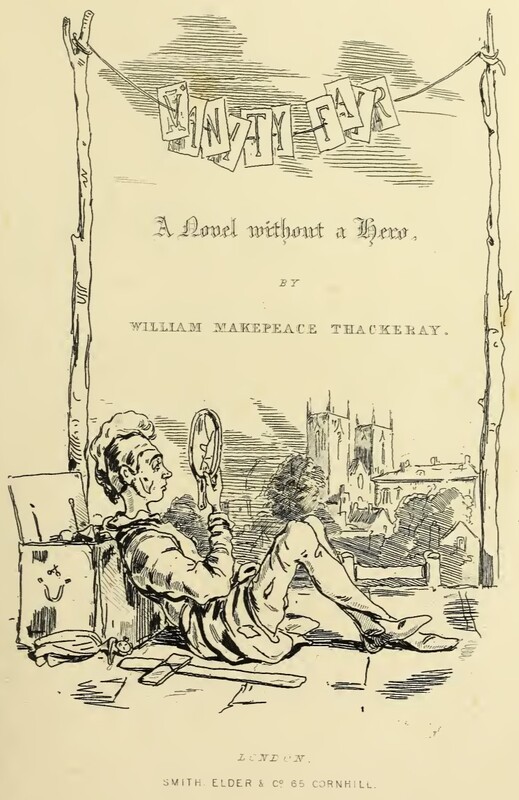
Two sticks-the left one forked, the right one pointed-hold up a banner with the title Vanity Fair. Each letter is on a separate piece of paper, connected by a string tied to the sticks. Beneath the banner is printed the subtitle and author, A Novel without a Hero by William Makepeace Thackeray. At the base of the banner, a haggard man with a plumed helmet is lounging against an open chest, holding up a mirror from which he peruses his reflection. By his side are a doll and what appears to be a handmade axe or hammer, with a flat rectangular stone or piece of wood tied to a longer, thinner stick. In the background can be seen trees, a fence, and several buildings. The text under the illustration has been updated from the original information to reflect the current printing.
This image depicts a native official demanding tribute from an elderly native woman. The native official is standing on the left side of the image pointing his fingers angrily towards the old woman. The old woman is sitting in front of a house as he holds a cane in her right hand and a rosary in her left. The woman’s response to the official demanding tribute is written at the bottom right corner of the image. It reads, Yma tasatam noca, paya, uaccha, coscayque? Diosrayco. Ama uaycauaycho, camachicoc [What tribute could I give you as a poor woman? For God’s sake do not attack me sir].
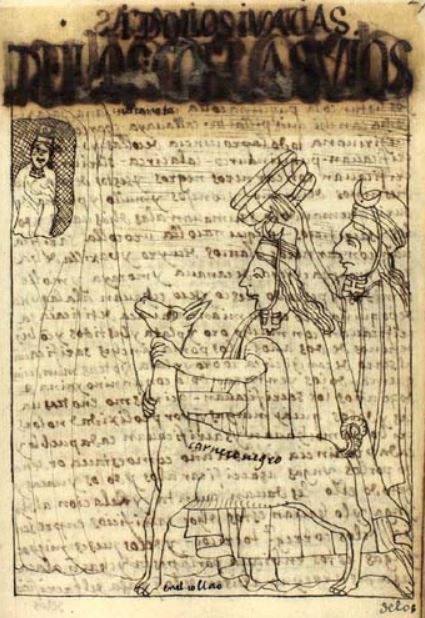
This chapter is dedicated to describing the idols and gods of the Incas. This image depicts the indigenous people of the Collasuyo region in Peru making sacrifices to their local huaca [deity]. The two men standing on the right side of the image are depicted offering their sacrifices to the deity. One man is illustrated offering a llama. There is a caption on the llama which reads carnero negro [black llama]. The second man is depicted offering what appears to be coco pods. The deity on the left side of the image is illustrated being in a niche on a mountain in the form of a human. The author does not explicitly say the name of this deity.
A dog is walking next to a town. There is a small house to the right with three windows on its left side, and a sun shape at its front just above the door. To the left of that house is a bigger building, with plants at the top. The dog is walking on a wood-like surface and his reflexion is seen in the lower half of the page, insinuating that he is walking by water. The dog has something in its mouth, it seems like a bag, or possibly a prey.
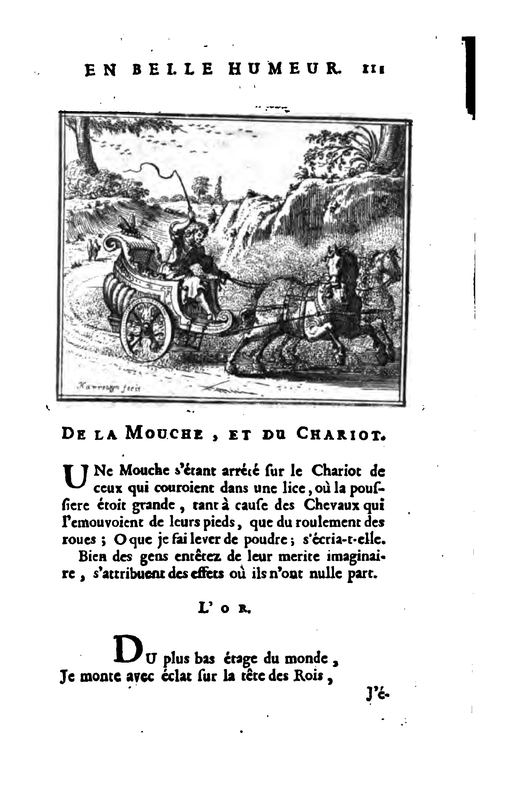
A Fly stopped on the carriage of those who were running in a race, where the dust was great, both because of the Horses who were moving it with their feet, and because of the rolling of the wheels; O that I raised powder; she wrote. Many people buried in their imaginary merit, attribute to themselves effects where they have no part.
A boy kneels before a black man, likely either a teacher or judge, with his hands together in entreaty. The man is dressed in a black robe and tasseled cap, holding a short-handled broom. In the background are many other boys, some smiling, some with expressions of shock. In the top right corner of the image is the letter W from Whatever.
Here we see the queen of Laputa with her two children. All three figures are wearing the traditional Laputan motifs of mathematical and musical figures. The king of Laputa and his two eldest sons are not permitted to leave the island for fear that something might happen with the trajectory of the island and it might come crashing down or remain in one place blocking the sun and causing disease. These occurrences would happen if the king wanted to punish a region on Balnibarbi (the land underneath Laputa). The queen was only permitted to leave the island after she was past child-bearing years. The same image appears in the 1839 Krabbe edition.
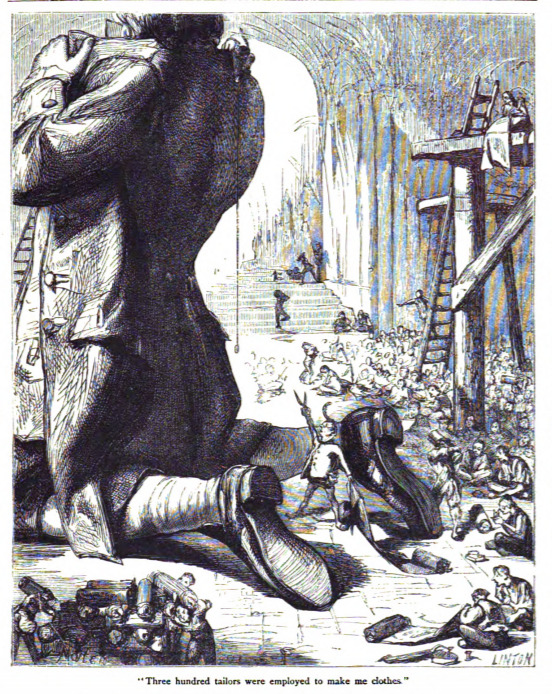
Here we see Gulliver kneeling with his back to the viewer as he is measured for new clothing. A Lilliputian drops a measuring tape down Gulliver’s back while standing on his shoulder. A ladder leans against Gulliver’s chest. Three hundred other tailors sit on the ground working on piecing together cloth large enough to make clothes for Gulliver. A cart with rolls of cloth is visible in the foreground.
There is a fox standing on a goats head as the goat assists the fox over a cliff. There is a machine near the right of the image. There is grass and flowers in front of the animals.

![[Gulliver sits among large leaves on Brobdingnag]](https://collections.cemvc.ca/files/large/9874ab72fb3202acbe18fd7fa498a433d86bb01f.jpg)
![[a man vomits]](https://collections.cemvc.ca/files/large/912e2e016707d4c9e635a400f12f6aab447d903c.jpg)
![[Artemisia Overseeing the Construction of her Husband’s Sepulchre]](https://collections.cemvc.ca/files/large/35e598ff40a7220e5146ca5c1f485f84c41aafc4.jpg)
![[Act I (Third Illustration) – Celestina and Sempronio Talking as Crito Descends the Staircase]](https://collections.cemvc.ca/files/large/f1f716ebb9862df91d143e5523ba878f3ab39266.jpg)
![[Act XIV – Calisto and Melibea (Repeated)]](https://collections.cemvc.ca/files/large/0a033a44b2f41a817e92f75cc06af8576b49b9a1.jpg)
![[Amelia and Georgy with Mr. Binny]](https://collections.cemvc.ca/files/large/a5539d7fa7633c88c6c8a4bc7ae73550e61b4de1.jpg)
![Q[ve] Pide el Tribvto a la Pobre Vieja, Deciendole Questa en su Casa y Chacara, Apamoy, Paya Taza Chacrayque Uaciquipim Tianqui. Yamtata Yacota Opyanqui Masanqui. Ama Pinachiuaycho, Por Esta, Paya](https://collections.cemvc.ca/files/large/69bb8967da3147022ebda39ec316166ec877f4c4.jpg)
![[A Dog by the Seaside with Its Prey]](https://collections.cemvc.ca/files/large/f4ba1144959670d2f41586de5301e385a3302435.jpg)
![[Vanity Fair Chapter LXVII Inhabited Initial]](https://collections.cemvc.ca/files/large/ff6e9fe95d36fc0e4a52441922cdc92d33cbf6d7.jpg)
![[The Queen of Laputa and her children]](https://collections.cemvc.ca/files/large/f33f5467a4cc7f3b6f41ed9063335919eec628bf.jpg)
![[Goat helps fox]](https://collections.cemvc.ca/files/large/0100185e89e166e99af9632c65e63b8c196e6f0a.jpg)