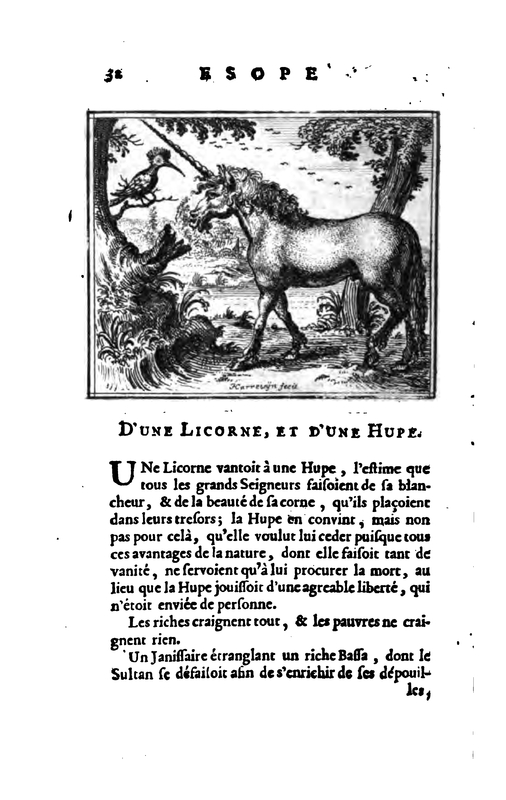
A hoopoe sits on a branch in a tree and exchanges a stare with a unicorn. Birds are flying in the sky above. The illustration has the signature of Harrewijn in the center on the bottom.
Cephalus was warned by an admirer that since he would not leave his wife, Procris, that Procris would leave him for jewels and money. Being anxious, Cephalus tested his wife by leaving town and having large gifts sent to her. This is represented on the left of the image, where Cephalus is tempting Procris with valuable gifts. Originally, Procris turned them down, but over time she accepted it. She was so upset with herself that she ran to the woods where she would live in solitude, but Cephalus retrieved her against her will. He was very upset with himself about tricking Procris, even though it went poorly. They both grew paranoid, and Procris began stalking Cephalus while he was hunting. One day, he mistook her for a wild animal and shot her, killing her by mistake. This is represented on the right of the image, where Cephalus has an arrow pointed at Procris.
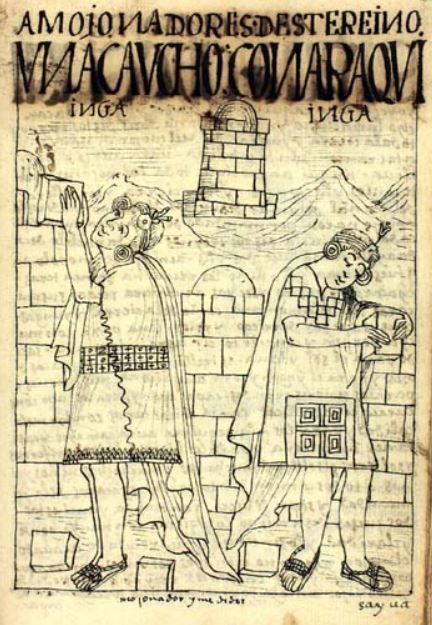
This chapter discusses the system of administrative officials in the Inca Empire. This image depicts two men named Una Caucho Inca and Conaraqui Inca establishing boundary markers within the Inca Empire. By order of the Inca king, Topa Inca Yupanqui, these men were tasked with creating ditches and landmarks to mark the borders of the territories and provinces in the empire. Both men in this image are illustrated working hard by placing bricks on a boundary marker which appears to be a walled structure. There is another territory marker in the background of the image surrounded by the Andes.
Gulliver waved his arms at the floating island of Laputa and got the attention of a few Laputans and soon a crowd assembled to see Gulliver. They lowered a chair down then raised Gulliver up to the island on the chair using a pulley system, as is seen here. Gulliver is raised up over the rocks and arrives on Laputa. The same image appears in the 1839 Krabbe edition.
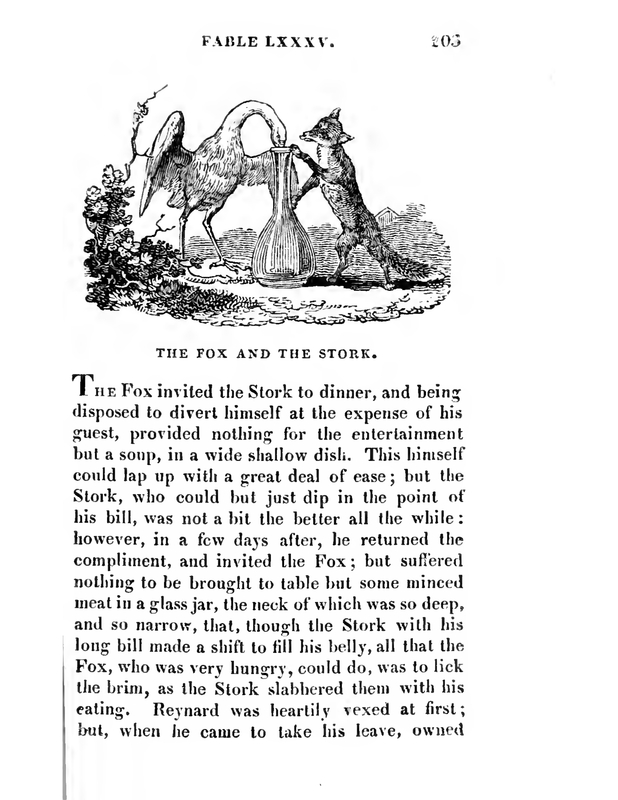
In the middle of the image there a large dish. To the right side of the dish there is a fox standing up, touching, and observing the dish. To the left side of the dish there is a stork, standing up as well, observing the dish with its head slightly peaked inside. Surrounding the dish, fox, and stork there are various plants, bushes, and branches.
A coach labelled OMNIBUS drives along a narrow road away from London, passing a stone marked with an X. One of the passengers is leaning out from the back with his arm outstretched, while two others can be seen seated inside. The coachman is seated above the carriage, holding his crop. Near the tip of the crop, in the sky, is the letter S from So.
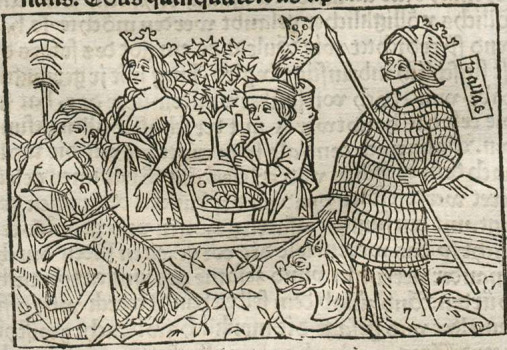
This engraving illustrates Minerva, also known as Pallas, standing on the right side of the engraving suited in armor, holding a lance in her left hand and a shield (with a depiction of Medusa on the front) in her right. We know this is Minerva as the name Pallas is engraved directly beside her. This engraving represents the importance of Minerva and what she brought to the world. Boccaccio explains that Minerva had discovered wool work and weaving. There is a woman in the left corner of the engraving shearing a sheep to signify this discovery. The woman standing behind her has fabric in her hand to signify the art of weaving that Minerva had given to the world. The man in the centre of the engraving is depicted with a millstone in his hand, pressing down into a bucket of olives. Boccaccio explains that Minerva had taught the world of men to do this so that they can extract and use oil from the olives. An olive tree stands in the background to further the significance. There is an owl resting on a tree stump next to Minerva, which Boccaccio explains, represents her wisdom.
The morning come, Calisto calls for Tristan, one of his servants, and asks him to get Sempronio and Pármeno. Tristan tells Calisto that they are not present, and Calisto asks him to find them. As Tristan waits outside the front door, he sees Sosia, another of Calisto’s servants, approaching in tears. Sosia tells Tristan that Pármeno and Sempronio are dead, and they go to inform Calisto. Sosia explains that they were publicly decapitated by the Alguacil’s men (as seen in this illustration). Calisto asks the reason of their execution, and he replies that they murdered Celestina because she would not give them their share in the gold chain that Calisto had given her as payment. Calisto laments this sad outcome, blaming it on Celestina’s deceptive and treacherous ways.[None of the elements in this illustration are found elsewhere in this edition.]
Here we see one of the Houyhnhnms preparing dinner. The Houyhnhnm stands on its back legs, holding a bowl of warm oats, boiled in milk, between its front legs. Gulliver kneels on a pile of hay, which is another element of their meal. The same image appears in both the 1839 and 1843 Krabbe editions.
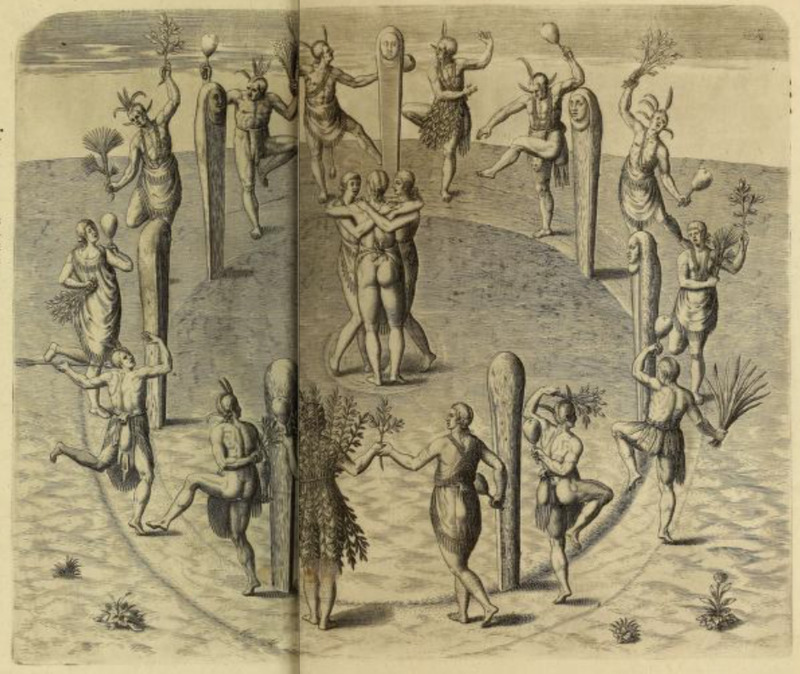
A group of Indigenous people are shown engaging in a dance. Three individuals embrace, and others dance in a circle around them. Some hold branches and other plants and objects in their hands. The circle is partially formed by wooden posts stuck into the ground. These posts have faces carved into the top of them, facing into the center of the dance circle.
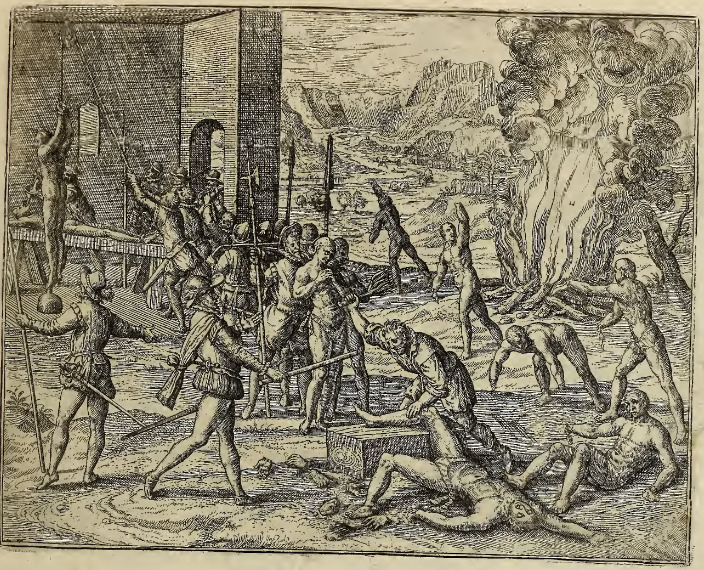
Hernando de Soto was a Spanish man who governed the Spanish territories of Cuba and La Florida (a large area of the modern Southern United States, including the present-day state of Florida) from 1536 to his death in 1542. Here, he and several fellow Spaniards torture and kill Indigenous people in Florida. In the foreground, an Indigenous man lays on the ground with one leg raised on a wooden block while a Spaniard holds a weapon poised over his raised leg. The Indigenous man has already lost both hands, and several other Indigenous people nearby have also had their hands cut off by the Spanish. Several severed limbs lay on the ground. To the left, an Indigenous man has been hung inside a structure while several Spaniards watch. Another Indigenous man has been tied down on his back on a wooden table while a Spanish man pours a liquid into his mouth using a funnel. A large fire burns on the right.
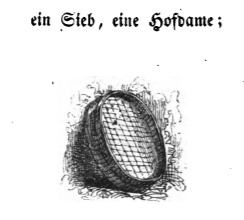
This image shows a sieve, which is the code word for a court lady. This image comes in a description of a conspiracy found by a professor from the Grand Academy on Balnibarbi. This idea is representing code word for terms in the conspiracy that Swift is satirizing. The professor advises that those named in the conspiracy papers be closely monitored at all times, naming specifically while they were using the bathroom, as this is when men were most thoughtful. This conspiracy is thought to be an allusion to the trial of Francis Atterbury, the bishop of Rochester for allegedly plotting with the Jacobites. Atterbury was charged with treason in 1722 and was exiled to France. The same image appears in the 1843 Krabbe edition.
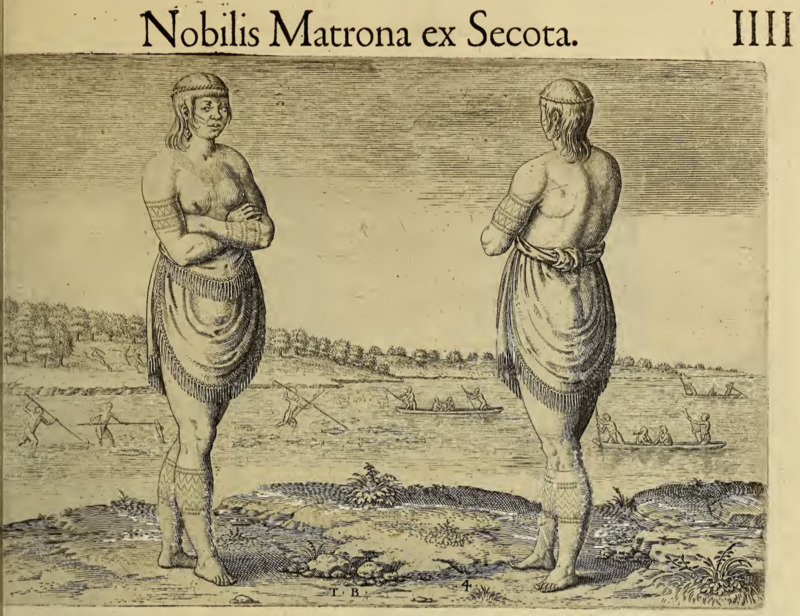
An Indigenous woman is pictured standing on the bank of a river, from the front and from behind. She wears cuffs on her upper biceps and forearms, and on her calves. Her clothing consists of a fringed skirt tied around her waist, she is barefoot and shirtless. In the background behind her, other Indigenous people can be seen in canoes and fishing in the river. On the opposite bank of the river there is a forest.
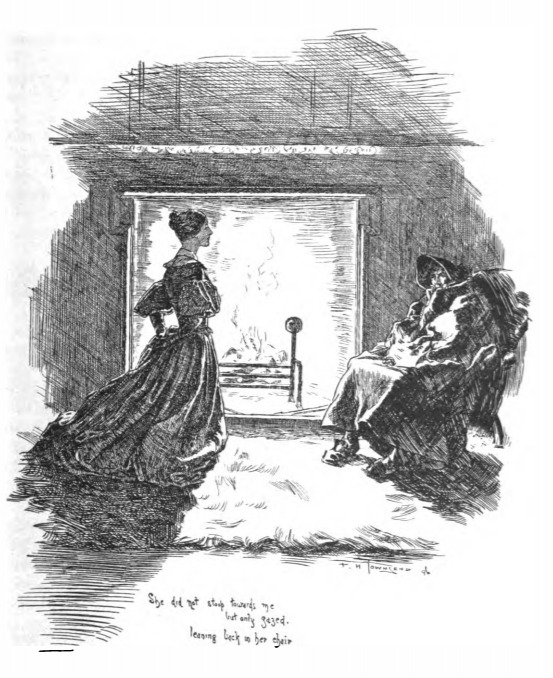
During the time in which Mr. Rochester hosted company at Thornfield, a psychic shows up at Thornfield while Mr. Rochester was out. Here Jane meets with the psychic. The psychic drew out the fact that Jane was in love with Mr. Rochester. Jane discovers at the end of the conversation that the psychic was really Mr. Rochester in disguise.
In foreground, a deer is bent towards the lower right corner of the image, where a small section of a river is visible. The deer’s reflection is seen through the water. To the left of the image, a fruit bush is growing. Behind that deer, in the background, is another deer running towards the right as a hungry wolf is hunting it. The wolf has its tongue sticking out. The trees behind them are lightly bent towards the left, as though there was a strong gust of wind coming from the right.
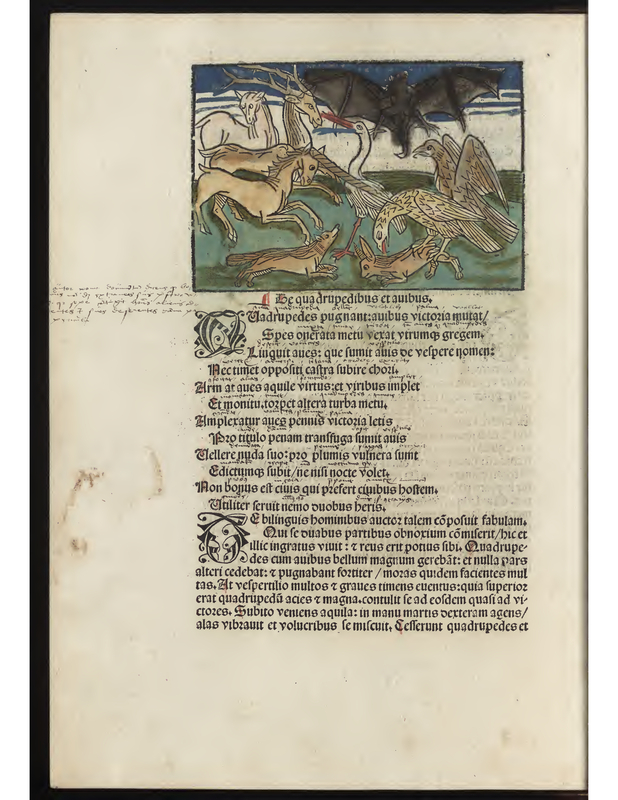
A group of three hooved animals: one with antlers, one with horns, and one with no bone structure on its head are facing two birds of prey, a waterfowl, and a bat; possibly in some type of altercation. a rabbit and a fox are also depicted in the lower area of the image.
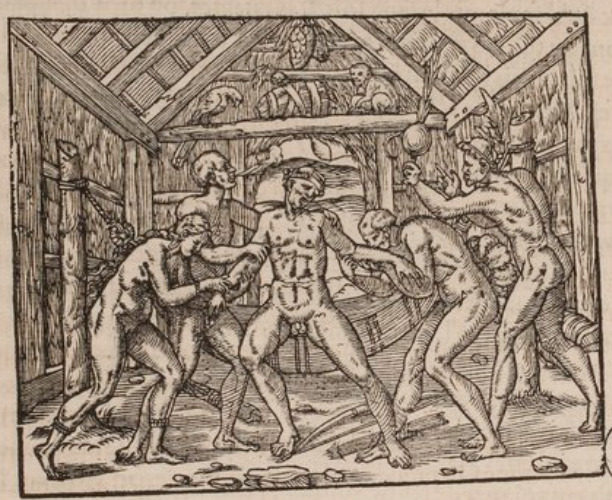
Inside a structure, a group of Indigenous people tend to a sick man. The man stands in the middle of the group with his arms outstretched to either side. Two people each hold one of the sick man’s arms, with the person on the right touching his lips to the man’s arm. Another man stands behind the afflicted man and holds him by the shoulders. To the right, a man wearing a feathered headdress holds a rattle or other ornament over the group. There is a hammock slung between two beams of the structure behind the group, above them a monkey and a bird sit on another beam and a bow and bundles of arrows lie on the ground. This image is identical to one found on page 935 of Paris, 1575 (l’Huillier), and in Thevet’s Les Singularitez de la France Antarctique (page 88 verso of Paris, 1557 and page 88 verso of Paris, 1558).
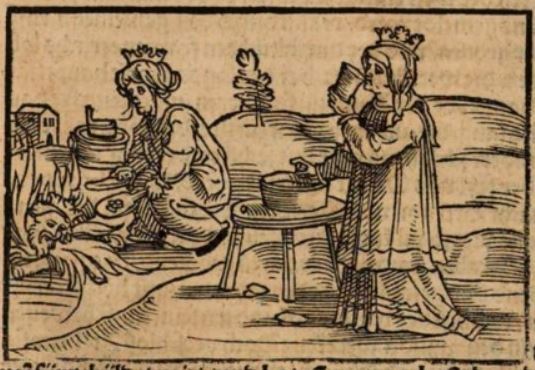
Artemisia was married to Mausolus, the king of Caria. Boccaccio explains that when he died, Artemisia was so grieved by his death that instead of putting his ashes in an urn after his cremation, she drank the ashes in order to be closer to him. The left side of the engraving depicts Artemisia cremating her husband’s body in a fire. Mausolus’ head is visible in the fire. Artemisia is illustrated scooping her husband’s ashes. The right side of the engraving depicts Artemisia drinking her husband’s ashes.
Here we see two canaries in a cage. The image comes after the King of Brobdingnag said he wanted to find another woman who was the same size as Gulliver so they could reproduce, then keep his children as pets for other families on Brobdingnag. Gulliver’s response was that he would rather die than be kept in a cage like a canary. The same image appears in the 1839 Krabbe edition.
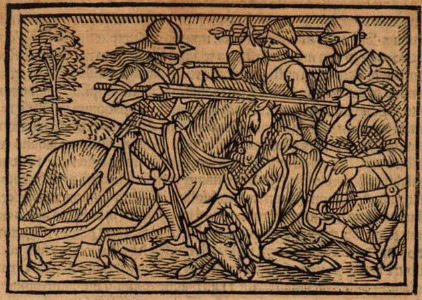
This engraving depicts Penthesilea, the queen of the Amazons, riding a horse into battle with her lance pointed towards her enemies. She is depicted with her long hair sticking out from her helmet to identify her as a woman. Penthesilea, as Boccaccio describes, was a great warrior. She wanted to secure a strong heir for the Amazons, so she sought out Hector of Troy to provide her with an heir. She fought in a battle against the Greeks to prove herself worthy of bearing Hectors child. The enemies she is fighting against in the image are the Greek soldiers in the Trojan War.


![[Gulliver is pulled up to the floating island of Laputa]](https://collections.cemvc.ca/files/large/0174d3aa89bf722912a0b4bb569e7e791d23692d.jpg)

![[Vanity Fair Volume II. Chapter VI Historiated Initial, S]](https://collections.cemvc.ca/files/large/6bbeb1a9629c2a08adadf5dfa5dbec2eb2c9ac54.jpg)
![[Act XIII – Execution of Pármeno and Sempronio]](https://collections.cemvc.ca/files/large/64aa35d75d3dc35902ff106e7f5f5efa6a0d2358.jpg)
![[Gulliver watches a Houyhnhnm prepare dinner]](https://collections.cemvc.ca/files/large/ca82dfa9625084c115b8d0b536d4d5f79e4b3dc0.jpg)
![[The Wolf Hunting the Deer]](https://collections.cemvc.ca/files/large/0323257be5cf18b1cb570575dd7d7c9615185b67.jpg)
![[Caged canaries]](https://collections.cemvc.ca/files/large/d0546b3f3968cb53d770c5fb88bfb94f6b3d0d77.jpg)