This engraving depicts the god of healing, Aesculapius, transformed in the form of a winged snake. He is illustrated just outside of his own temple. There are men standing in front of Aesculapius who appear to be extremely afraid of the snake. These men, as told by Ovid, are Romans who sought the help of Aesculapius as their city was ravaged by the plague. Aesculapius had appeared to one of these Roman delegates in his dream to inform him that he would help their city and accompany them back to Rome on their ships in the form of a serpent.
Sancho Panza pretends to give himself lashes to disenchant Dulcinea (he whips tree trunks), while Don Quixote counts the lashes. Signed by A J.-J.-M. Devéria (illustrator) and A. J. Simonet, jeune (engraver). Part 2, ch. 71.
After having attacked a flock of sheep and been stoned by shepherds (in the background), Don Quixote asks Sancho Panza to count his remaining teeth. Don Quixote’s shield, sword, and lance are pictured, as is Rocinante. In the background, the shepherd and their sheep are pictured on a hill. Signed by F. Hayman (illustrator) and C. Grignion I (engraver). Part 1, ch. 18.
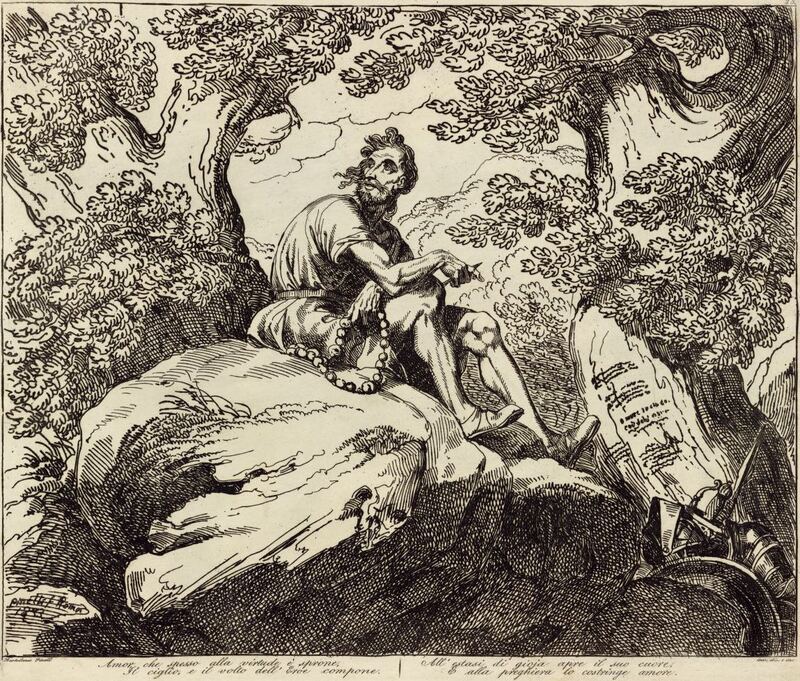
In Sierra Morena, Don Quixote and Sancho Panza arrive at the foot of a high mountain, standing alone among the many others that surround it. Don Quixote chooses this place for his penance. He inscribes verses for Dulcinea into the tree trunks, and prays with his makeshift rosary, fashioned by tying eleven knots in a strip of cloth torn from his shirt. He has removed his armour, for he must be as naked as the day he was born if he is to follow Roland. Signed by Bartolomeo Pinelli (engraver and illustrator) and dated Rome, 1833. Plate 28. Part 1, ch. 26.
The innkeeper, with sword and book in hand, knights Don Quixote, who kneels before him. Don Quixote wears his armour. Doña Molinera and Doña Tolosa stand to the left, while a boy holding a candle is depicted to the right. Two more figures, who do not appear in Cervantes’ text, watch the proceedings. In the background, the inn, with a thatched roof and stone walls. The scene is accurately depicted at night: the characters are illuminated by the light of the boy’s candle and that of the moon. Signed by F. Hayman (illustrator) and C. Grignion I (engraver). Part 1, ch. 3.
After being interrupted by Quixote and subsequently being called both a liar and a scoundrel, Cardenio is overcome by a fit of a madness. In his madness, Cardenio, snatched up a stone and threw it at Don Quixote's breast with such force that it laid him on his back. Unwilling to let this offence go unpunished, Sancho Panza tried to fight Cardenio but was quickly knocked off his feet and pummeled to Cardenio's satisfaction. Once satisfied, Cardenio returned to his spot in the mountains. Sancho Panza can be seen eyeing Cardenio murderously, as Cardenio walks off indignantly. To Sancho's left, Quixote lies unconscious beneath the tree, while the shepherd who introduced Cardenio to Quixote looks over worriedly to Sancho Panza, afraid that Sancho will direct his anger on him.
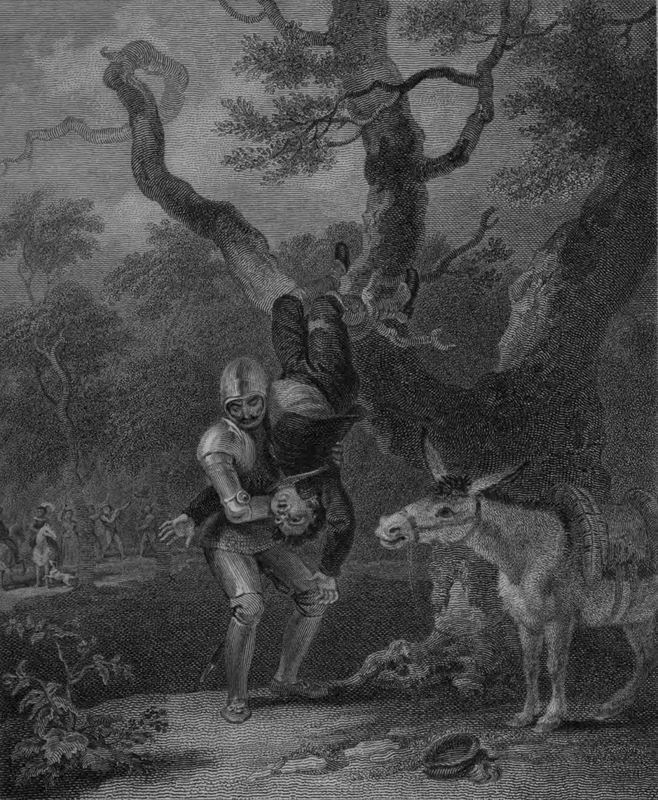
Don Quixote, wearing armor, holds Sancho Panza steady as the squire has gotten stuck upside-down, his foot caught in the stump of an oak branch which has torn his coat. Sancho's donkey, Dapple, stands on the right. In the background the Duke, Duchess, and their attendants finish their boar hunt.
Sancho Panza (left) sits with his hands on his knees and passes in introductory discourse with the Squire of the Woods (right) who is wearing a forwardly brimmed hat and kneels on one knee, his left arm resting on his left knee and his right hand stroking his moustache.
The priest and the barber (right) walk with Cardenio through a sable mountain pass, comforting Cardenio's love troubles. As they walk they hear a nearby voice complaining about hiding their body. Sensing that the voice is quite near, they search for the source and they soon find that behind a rock sits a youth (Lucinda), dressed like a peasant, sitting at the foot of an ash tree; whose face they could not then see, because he hung down his head, and was washing his feet in a rivulet which ran by. When the youth looked up, it is apparent that the figure is a girl, and Cardenio notes that the person must be divine on account of their beauty.
Having drawn near the brink of the cave, and hewing down the brambles and bushes which concealed the mouth of the cave with his sword Don Quixote, clad in armor was knocked over by a number of huge ravens, owls, and bats that flew out of the cave. Don Quixote lands on his behind, his arms raised in the air, his left foot hanging over the edge of the abyss. On the right Sancho Panza holds the rope tied to Quixote's doublet with both hands, his eyes wide and his mouth agape. In the background the scholar drops the rope and moves towards Quixote.
Sancho Panza (left), wearing a wide brimmed hat extends his arms towards his master. Don Quixote (right), clad in armor, sits on a chair with a text in his left hand while he points to the ceiling with his right hand. The image is occasioned by Don Quixote giving instructions to Sancho in writing on the topic of governance.
A woman with long wavy hair stands with her hands crossed against her chest, a veil hanging from her head that falls to the floor and which she holds in her hands. She is clad in a white dress with a stately collar. The image is occasioned by countess Trifaldi saying "Now, in process of time, the young Antonomasia attained the age of fourteen, with such perfection of beauty, that nature could not raise it a pitch higher, and, what is more, discretion itself was but a child to her."
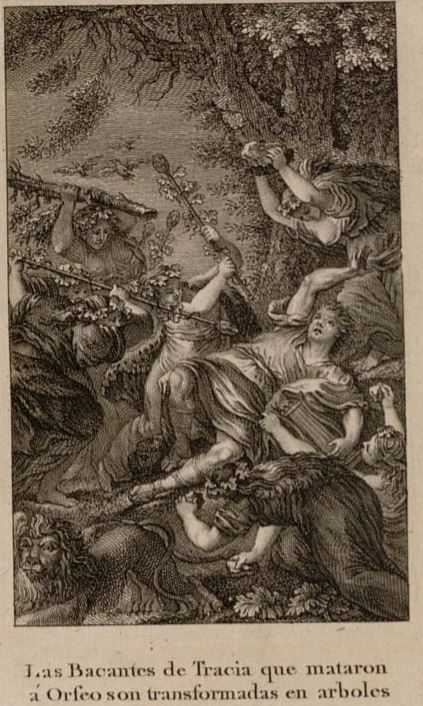
This engraving illustrates the horrific death of Orpheus. Orpheus is sitting in the forest with his lyre in his hand. Orpheus is being approached by the Maenads, a frenzied group of women who worship the god Bacchus. They first attack the animals that surround Orpheus and tear them to pieces. Then they attack Orpheus by throwing stones and spears at him. Just like the animals, the Maenads end up tearing Orpheus to pieces.
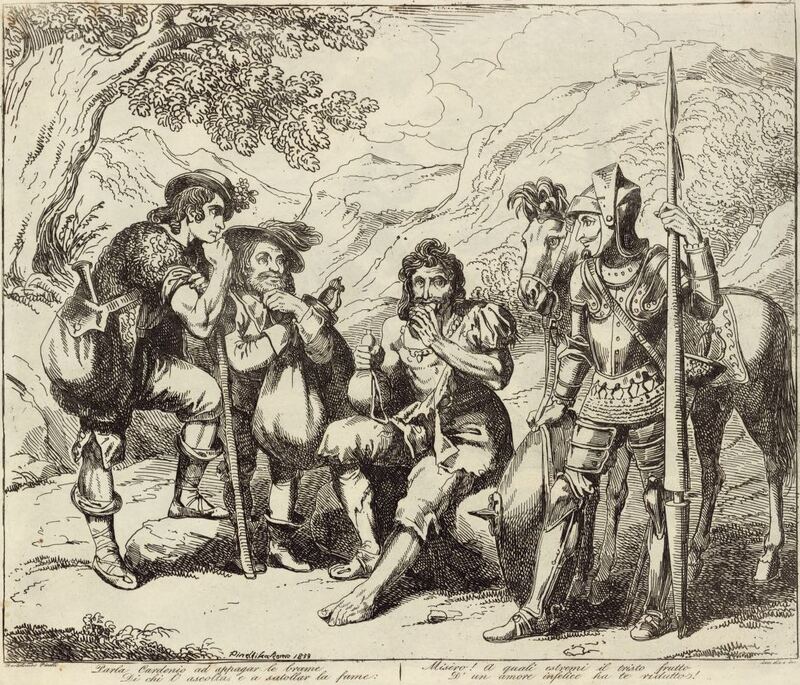
Cardenio recounts his story to Don Quixote, Sancho Panza, and the goatherd. He asks them not to interrupt him because he would like to pass quickly through the tale of his misfortunes. Signed by Bartolomeo Pinelli (engraver and illustrator) and dated Rome, 1833. Plate 27. Part 1, ch. 24.
In the center of the illustration, an older woman (countess Trifaldi) is led by the hand of the Squire Trifaldin of the White Beard who holds a large scimitar in his hand. She is clad in a robe of the finest serge. The tail of her robe is divided into three corners, supported by three pages, clad in buttoned vests, in three acute angles. In her left hand she holds a white handkerchief.
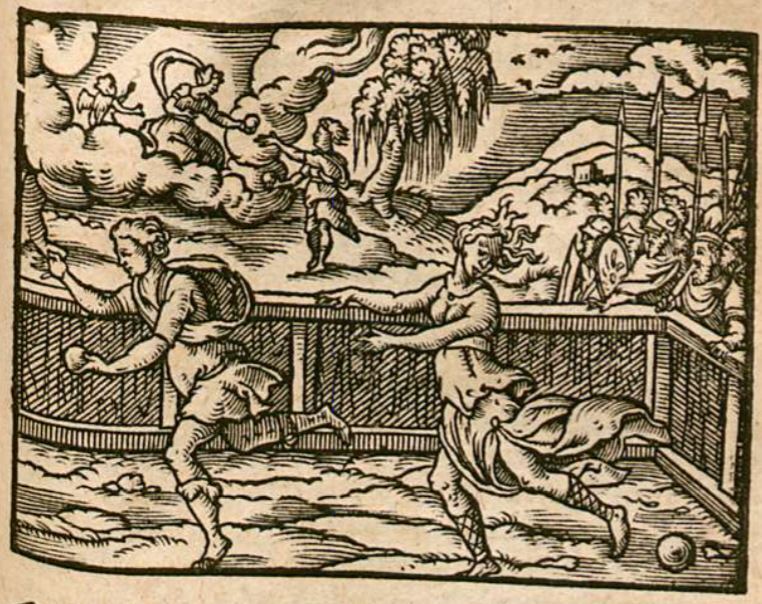
This engraving illustrates the footrace between Atalanta and Hippomenes. Atalanta was an incredibly fast runner and could beat any man who challenged her. She decided that she would host a running contest. The man to beat her in a race would win her as a prize, and whoever lost against her would die. A man named Hippomenes decided to race her, as he was taken with her beauty and athletic abilities. He prayed to the goddess Venus for help. Venus is illustrated in the background of the engraving coming out of the sky and handing golden apples to Hippomenes. The race is taking place in the fore-front of the engraving, with Hippomenes in first place. He uses the apples that Venus had given him to distract Atalanta. She is depicted running with her head turned looking at the apples that Hippomenes is throwing, causing her to slow down and come in second place.
The priest, the barber, and Cardenio encounter Dorotea, washing her feet in a stream. The trees and shrubbery pictured in the illustration are well detailed. Signed by F. Hayman (illustrator) and C. Grignion I (engraver). Part 1, ch. 28.
Don Quixote returns home from his first sally, on Pedro Alonso’s mule. Rocinante carries Don Quixote’s shield, lance, and armour. The housekeeper, the niece, and another character (either the priest or the barber) are pictured in the doorway, receiving the travellers. Signed by F. Hayman (illustrator) and C. Grignion I (engraver). Part 1, ch. 5.
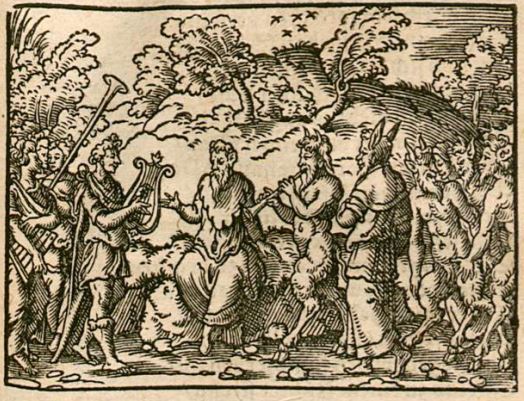
This engraving depicts a music competition between the gods Pan and Apollo. The judge of the competition is the god of Mount Tmolus, who is illustrated sitting down in the centre of the engraving with his legs crossed and arms pointed outwards. Pan is depicted as a satyr on the right side of the engraving playing his pipe. The left side of the engraving depicts the god Apollo with his lyre resting in his left hand while his right hand strums. The god of Mount Tmolus is depicted looking at Apollo, as he ends up choosing Apollo as the winner of the competition. King Midas of Phrygia is depicted standing next to Pan with the long ears of a donkey. Apollo had transformed his ears after Midas disagreed with Tmolus’ judging.
Having ridden from the duchess' estate, a page (left) falls to a knee and taking off his hat offers a letter to Teresa Panza (middle). The woman in the middle (Teresa) comes out from her house spinning a distaff full of tow, she is dressed in a short grey petticoat, with a grey boddice, and her smock-sleeves hanging about. On the right, a young girl in bare feet (Sancho's daughter) clasps her hands together and looks towards the page.
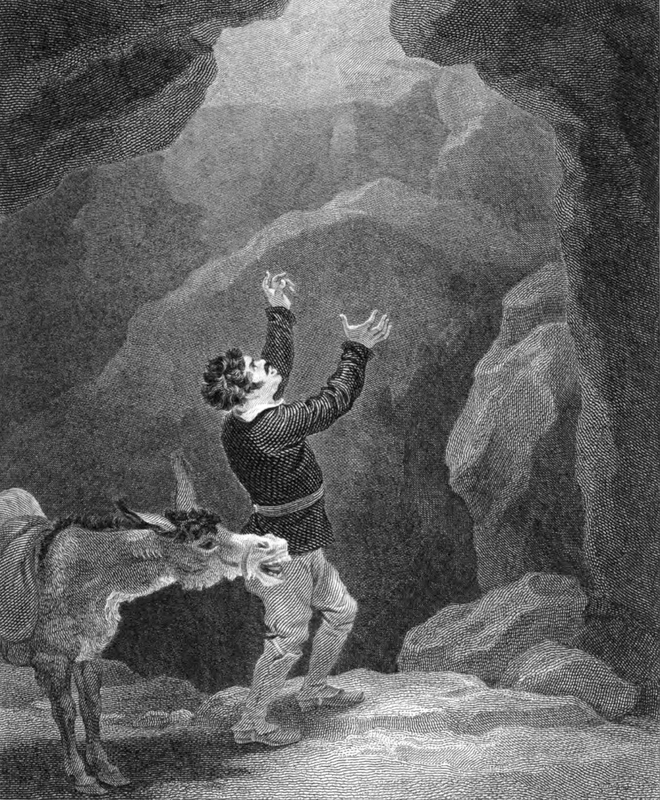
Having sought a convenient shelter for the night, Sancho Panza and Dapple fell together into a cavity, among the ruins of an old building. Lamenting and despairing in the pit, which was half a league, he perceived a kind of glimmering light, breaking through some aperture above, that seemed to him an entrance to the other world. And so Sancho stands among the rock walls of the pit, looking up towards the light with his arms upraised. Dapple, his donkey, is behind him.
In the aftermath of their battle, Don Quixote, with a gesture of clemency, orders the Knight of the Mirrors (Sansón Carrasco) to present himself to Dulcinea in El Toboso on his behalf. Sansón’s squire, Tomé Cecial (left) takes off his fake big nose, revealing himself to Don Quixote and Sancho Panza. Unsigned. Part 2, ch. 14.
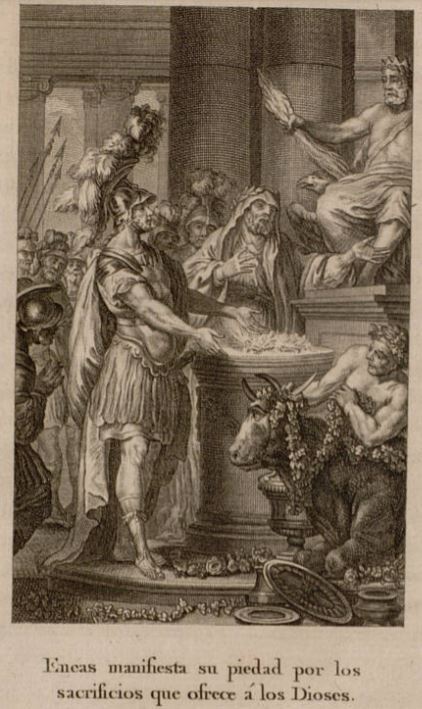
This image depicts the Trojan hero Aeneas standing in front of an altar as he performs a sacrifice to the god Jupiter. A statue of Jupiter is on the right side of the image. Jupiter is holding lightning bolts and there is an eagle beside him as these are two of his most common symbols. There is a heifer on the right side of the image adorned with flowers as it is being prepared to be offered as a sacrifice.
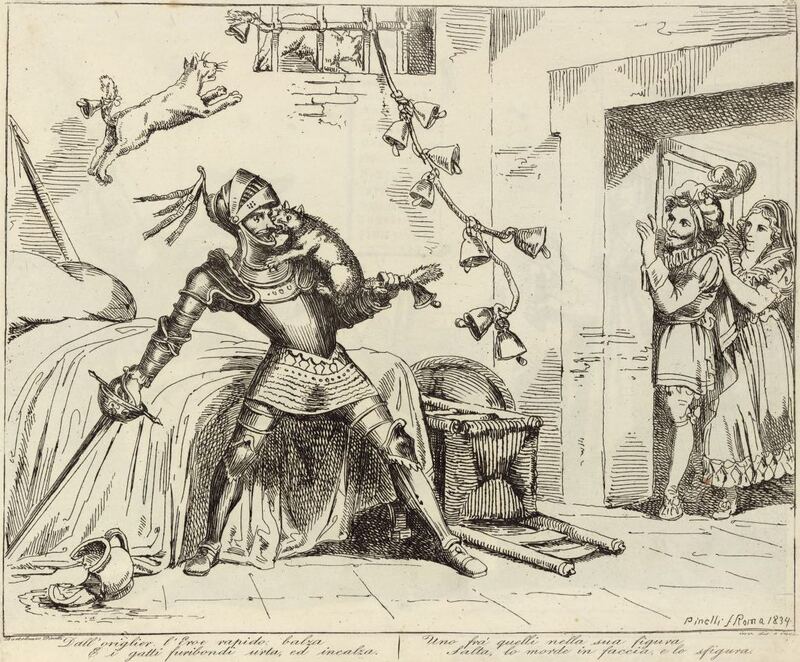
From a gallery above Don Quixote’s window, a cord with more than a hundred cowbells attached is lowered, followed by a sack full of cats, with smaller bells attached to their tails. Some of the cats make their way into Don Quixote’s room via the window and are mistaken by the knight for enchanters or wizards. He attacks them and manages to scare most of them off, but one cat is so hounded by Don Quixote’s sword thrusts that he claws at the knight’s face. Signed by Bartolomeo Pinelli (engraver and illustrator) and dated Rome, 1833. Plate 59. Part 2, ch. 46.
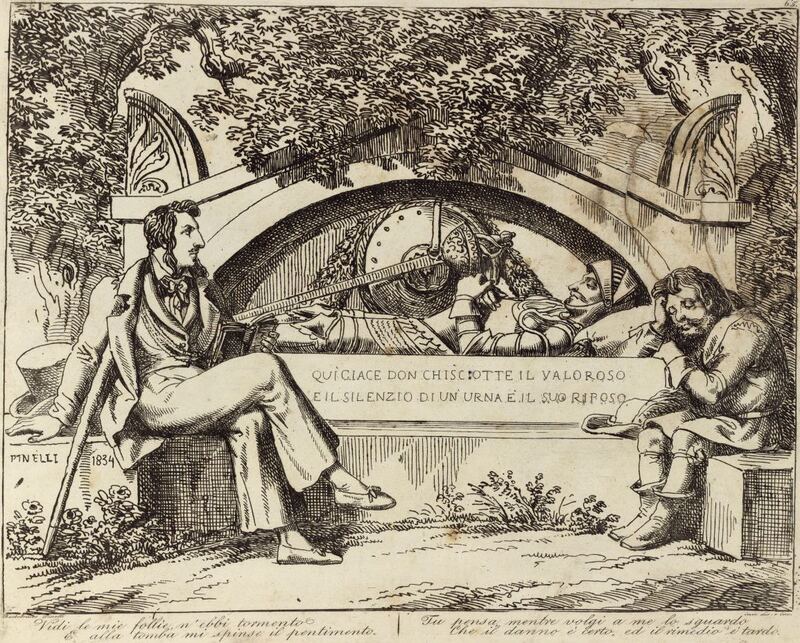
Don Quixote lies in his tomb, with his armour, sword, and buckler. The illustrator Bartolomeo Pinelli (left) and Sancho Panza (right) are also pictured. Signed by Bartolomeo Pinelli (engraver and illustrator) and dated Rome, 1833. Plate 65. Part 2, ch. 74.

![[Aesculapius Presents Himself in the Form of a Snake]](https://collections.cemvc.ca/files/large/6ae5fc4ddd0b4f39a411682aca2cd7d3d7c60036.jpg)
![[Sancho Panza whips himself]](https://collections.cemvc.ca/files/large/a1939c0fb2dd1177c6c480ec5ee5c5c71098c24a.jpg)
![[Sancho Panza counts Don Quixote's teeth]](https://collections.cemvc.ca/files/large/2deda7d2f63b4d39dde73db09dea2ad7dc70f216.jpg)
![[Don Quixote knighted at the inn]](https://collections.cemvc.ca/files/large/8b3ab815d635a3ccd1af54ec89be1bfcc24b577b.jpg)
![Of How Cardenio Assaulted Don Quixote]](https://collections.cemvc.ca/files/large/3b8422b470a5d1d2fe3ed608ddedc3d1d3e7e33a.jpg)
![[Sancho Panza and the Squire of the Woods Withdraw Next to a Bush]](https://collections.cemvc.ca/files/large/8f602439b0fc084583b6962af7cce14501480409.jpg)
![[Lucinda Washes her Feet in the Rivulet]](https://collections.cemvc.ca/files/large/e0845613ad46d75097a4b7a5326dfbcc07e8cbbd.jpg)
![[Of How Quixote Was Surprised by the Bats and Birds Which Flew Forth from the Cave]](https://collections.cemvc.ca/files/large/10abe3579cbde1c1e589076669ba0321b800f344.jpg)
![[Don Quixote Provides Sancho a List of Governance Notes]](https://collections.cemvc.ca/files/large/920208ad46218e1c1ffbe6dd256fe600523e57a8.jpg)
![[The Young Antonomasia]](https://collections.cemvc.ca/files/large/56d7c8928e8caecd42c2284ddac12703c0cbf586.jpg)
![[The Countess Trifaldi of Three Skirts and Her Procession]](https://collections.cemvc.ca/files/large/8b1fdb2c3d27b4c9ebc978e2dab19ee88436e32c.jpg)
![[The priest, the barber, and Cardenio encounter Dorotea]](https://collections.cemvc.ca/files/large/1e1f0be4b478f507dc7e06da6c5c30558baf32de.jpg)
![[Don Quixote returns from his first sally]](https://collections.cemvc.ca/files/large/732e2b8e2443d482010e00d5b7bd204e64f20914.jpg)
![[The Duchess' Page Delivers Sancho's Letter To Teresa]](https://collections.cemvc.ca/files/large/4551970431890d52941bb5259d46925cd46b8cf3.jpg)
![[Don Quixote defeats Sansón Carrasco]](https://collections.cemvc.ca/files/large/643934f6806688751c7183e5d6345e8fb7a733dc.jpg)