This engraving illustrates the importance that the goddess Juno holds to the city of Samos. The background of the engraving on the right side illustrates a temple which was erected in the goddess’ honour. In the foreground of the engraving, there is a marble statue of Juno dressed in her wedding attire standing in front of the temple. We know that this is Juno as her name is engraved directly above her head. There are people standing in front of the statue of Juno, most likely engaging in a wedding ceremony as Juno is a goddess of marriage. Boccaccio explains that Juno was sent to live in Samos during her early childhood years until she hit puberty and married her brother Jupiter. The people of Samos built the temple and statue to honour their connection to the goddess.
Gulliver explains the various medicines used in England to treat disease. In this image we see a doctor standing at a counter mixing various herbs, minerals, juices, skins, and other ingredients to make medicines. On the counter we see vials with ingredients, and above the counter is an alligator which would be used in some medicines. The same image appears in the 1839 Krabbe edition.
Sempronio (rightmost figure) arrives at the house of Celestina (central figure) and angrily chastises her for the slackness with which she is fulfilling Calisto’s request. She explains that she will be able to extract more compensation from Calisto if she takes her time. She asks him to join her in scamming Calisto, offering him an equal share of the profits and her prostitute Elicia (top-left corner, looking out from the window) in exchange for his loyalty. Sempronio readily agrees, and when Celestina departs for Melibea’s house, he stays behind to spend time with Elicia.
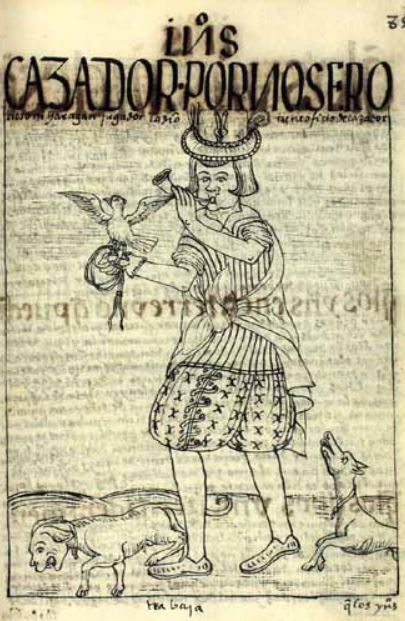
This image depicts an Andean hunter in Spanish colonial Peru. The hunter is illustrated wearing Spanish clothing with puffed trousers and a tunic. There is a cloak around his neck that he has tied at the waist, most likely to keep it out of his way as he hunts. He is depicted standing in the centre of the image as he blows through a horn and holds a hawk on his right hand. The hunter also has dogs by his feet. Hunters would raise dogs and hawks as companions for the hunt as well as to guard homes from thieves. The hunting and guard dogs were highly protected, and if anyone were to harm or kill the dogs they would be punished and charged fees. The caption at the bottom of the image reads, trabajo [labour].
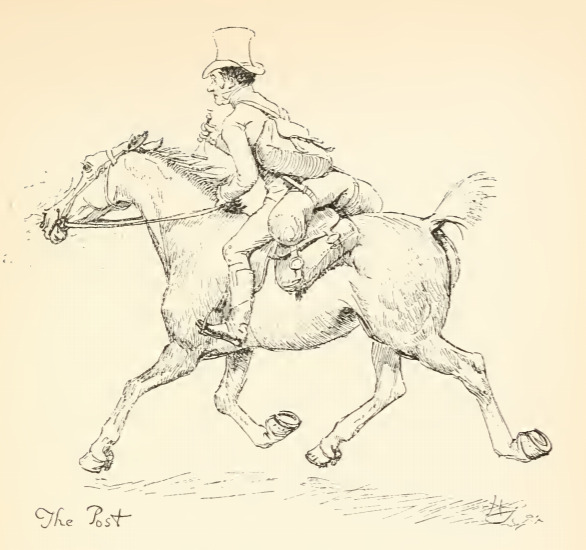
In this image we see a postman riding on horseback. The Bennets spent several days anxiously awaiting the post to bring news of Lydia and Wickham. This scene occurs in chapter 48. The characters are shown in the traditional regency style. The postman wears a short coat and top hat. He rides on horseback with bags of mail worn over his shoulders and attached to the saddle. The regency period dated to the early nineteenth century (1811-1820) when George, Prince of Wales, later George IV (r. 1820-1830), reigned as regent for his mentally ill father, King George III (r. 1760-1820). The regency period is associated with the rise of neoclassicism in art and fashion.
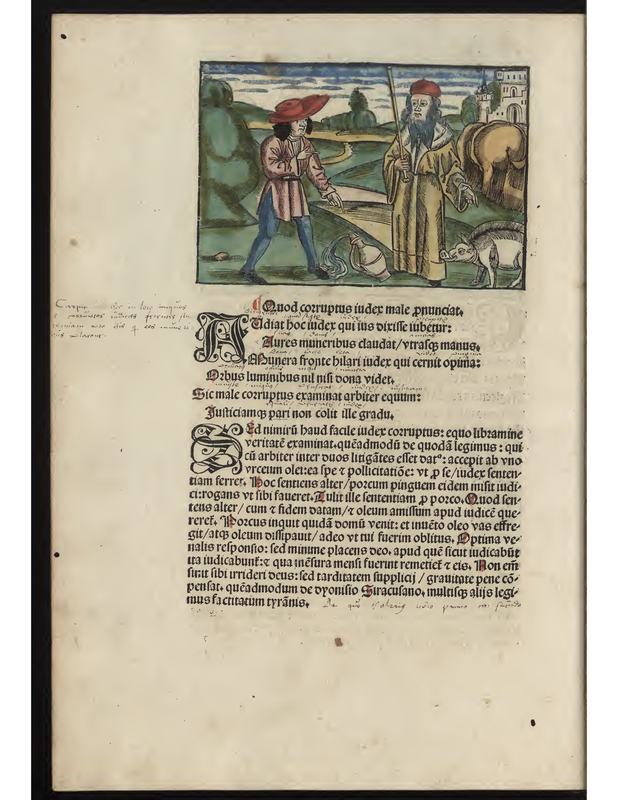
A man in a red hat talks to a man with a long grey beard and cane. The man with the red hat points to the ground where there is a vase that is spilling water. The man with the beard points to a warthog that is standing beside him. Behind the men is a castle and what appears to be a pile of hay.
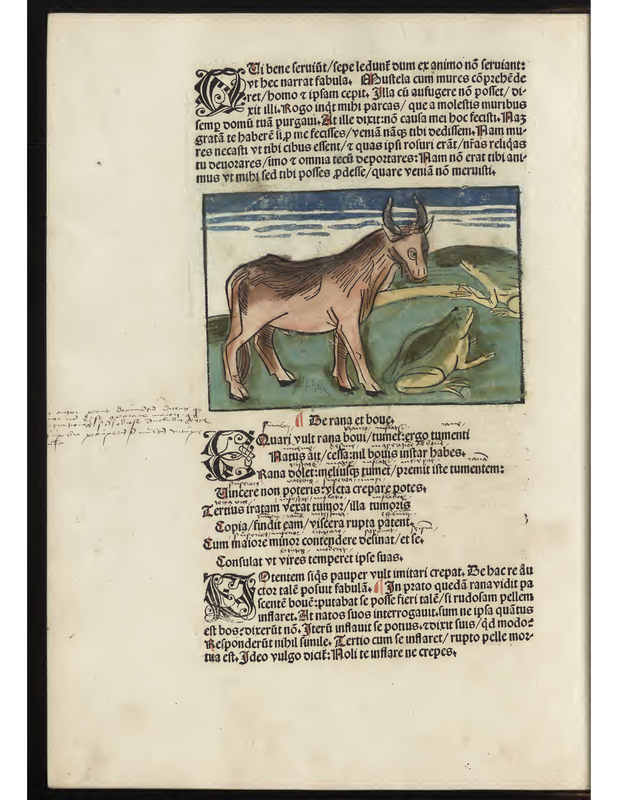
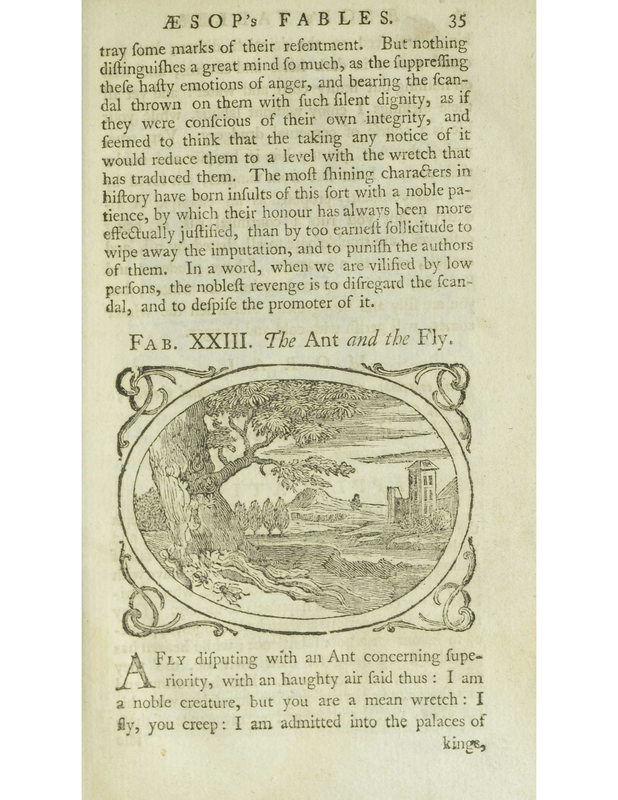
An ant and a fly are close to each other at a base of a tree. The fly is larger than the ant. A building with fencing can be seen in the background of the image. Above the base where the ant and the fly are positioned is a large tree with foliage. Behind this there are multiple trees and hills. Between the tree and the building, there is a small body of water. The fly and ant are facing each other.
In this image we see two Giants looking at Gulliver. The Giant in the front wears circular glasses with shoulder length hair and a beard. He also has hoop earrings with beads on the bottom. The second giant stands behind the left shoulder of the first. He wears a cap and has a large grin. Gulliver stands on the table at shoulder height, leaning back from the giants. The same image appears in the 1843 Krabbe edition.
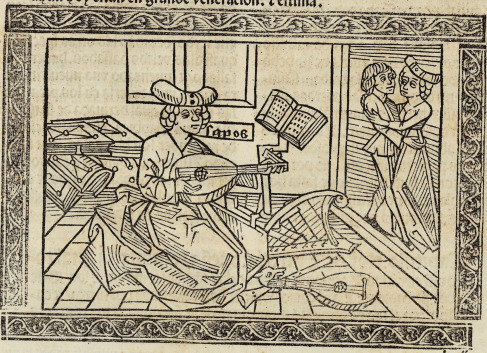
This engraving depicts Sappho, the famous poetess from Lesbos, sitting in the foreground while playing the lyre. We know that this is Sappho as her name is engraved beside her head. There are other stringed instruments and sheet music surrounding her. Sappho was in love with a man (depicted on the right-hand side of the engraving) who did not share the mutual feelings. Boccaccio explains that this is the reason as to why her poems and music verses were so somber.
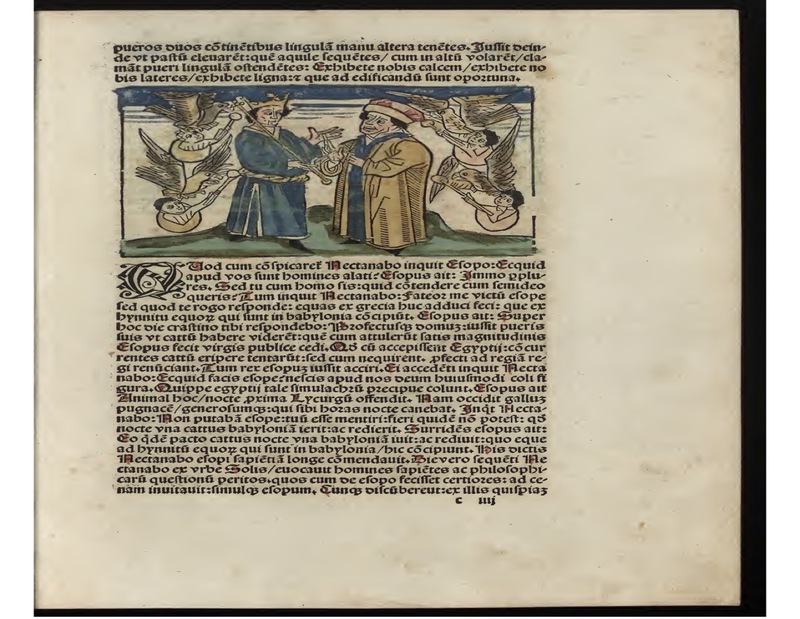
A king stands talking to another man. Surrounding the men are the heads of boys, who hold in their hand’s horns pointed towards the two men. Flying overhead of the men are hawks.
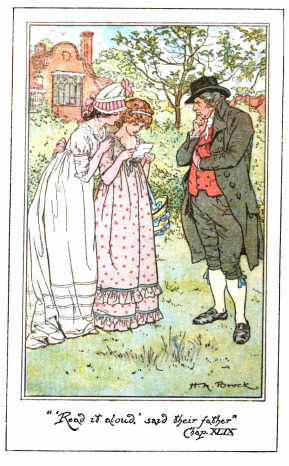
Here we see Elizabeth, Jane and Mr. Bennet reading a letter from Mr. Gardiner telling them that he has located Lydia and Mr. Wickham in London. Mr. Gardiner is Mr. Bennet’s brother. Elizabeth reads the letter as Jane looks over her shoulder. The letter says that Mr. Wickham will marry Lydia, Jane and Elizabeth’s sister, if Mr. Bennet will provide him with an income. Mr. Bennet gladly agreed to save the reputation of the family. Lydia’s running away with Mr. Wickham while unmarried threatened the reputation of the whole family and put her sisters’ marriage prospects in jeopardy. This scene occurs in chapter 49 as noted underneath the title of this image. The characters are shown in the traditional regency style, with Mr. Bennet wearing waistcoat, tailcoat, and knickers that stopped at the knee. Elizabeth and Jane wear the regency style dress with an empire waist. Their hair is worn tied up, as was tradition for women after their coming out before the queen, signaling her entrance into society. Jane wears a bonnet, a popular fashion of this period to protect her from the sun. Bonnets were especially popular because in this period a common pastime for women was going out on walks. The regency period dated to the early nineteenth century (1811-1820) when George, Prince of Wales, later George IV (r. 1820-1830), reigned as regent for his mentally ill father, King George III (r. 1760-1820). The regency period is associated with the rise of neoclassicism in art and fashion.
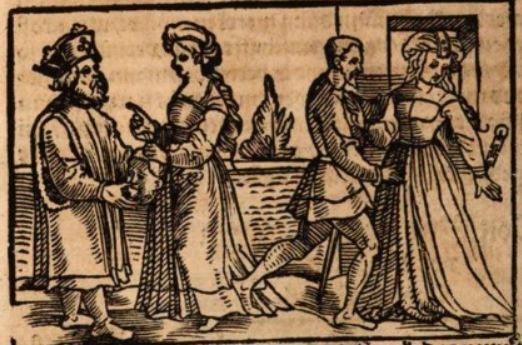
This engraving depicts the queen of the Galatians standing on the left side of the image holding a decapitated head. This woman’s name is unknown; however, she is the wife of King Drigiagon. After being taken as a captive by Roman enemies, the Galatian queen was defiled by a Roman centurion. This is depicted on the right side of the engraving as the queen is bound by a chain on her left hand while the centurion approaches her. To seek her vengeance, once she was freed through ransom, she ordered her servant to decapitate the centurion who raped her. The Galatian queen is holding the severed head as she presents it to her husband to prove that she was defiled by this man. Boccaccio explains that she wrote on this woman to highlight her daring and courageous nature.
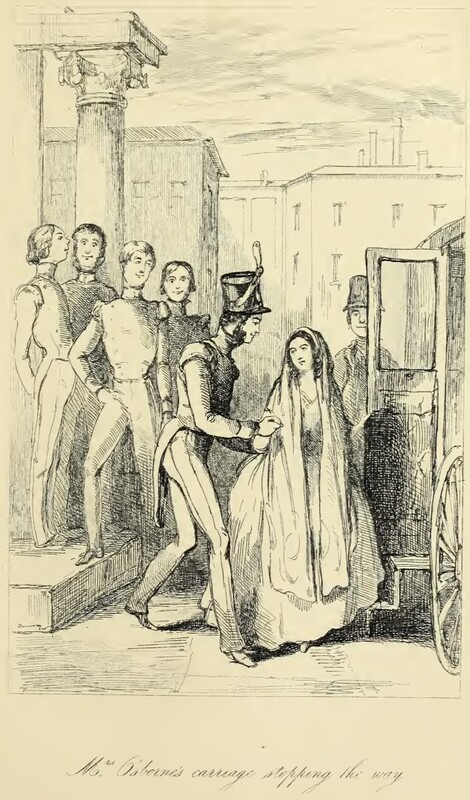
William Dobbin hands Amelia Osborne into her carriage as she leaves the ball. Behind the carriage door, the footman can be seen, and to the left of Dobbin, on the stair four young men are talking and smiling. In contrast to the others in the image, Amelia looks quite tired and sad. Below the illustration is printed in cursive its title, Mrs. Osborne’s carriage stopping the way.
Here we see Gulliver lying in bed after being kidnapped by a monkey on Brobdingnag. The monkey grabbed and threw Gulliver around, and forced things into Gulliver’s mouth. Gulliver then had to spend several weeks in bed recovering from this episode.
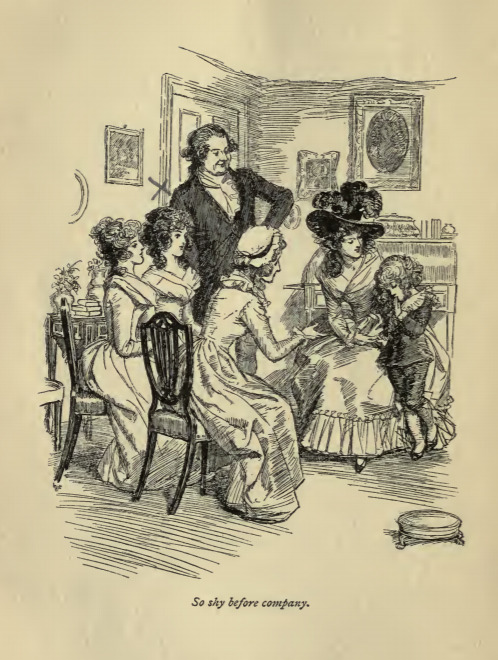
In this image we see Elinor, Marianne, and Mrs. Dashwood meeting Sir John and Lady Middleton for the first time. The Dashwoods were distant relatives of the Middletons and moved into Barton Cottage after Mr. Dashwood died. The Middletons lived at Barton Park. In this image the Dashwoods meet Sir John and Lady Middleton’s son who was very shy. This scene occurs in chapter 6. The characters are shown in the traditional regency style, as the women wear the regency style dress with empire waists. Lady Middleton’s son is leaning on her knee. He wears breeches and a short coat. Sir John wears a waistcoat and tailcoat with breeches and a cravat. The regency period dated to the early nineteenth century (1811-1820) when George, Prince of Wales, later George IV (r. 1820-1830), reigned as regent for his mentally ill father, King George III (r. 1760-1820). The regency period is associated with the rise of neoclassicism in art and fashion.
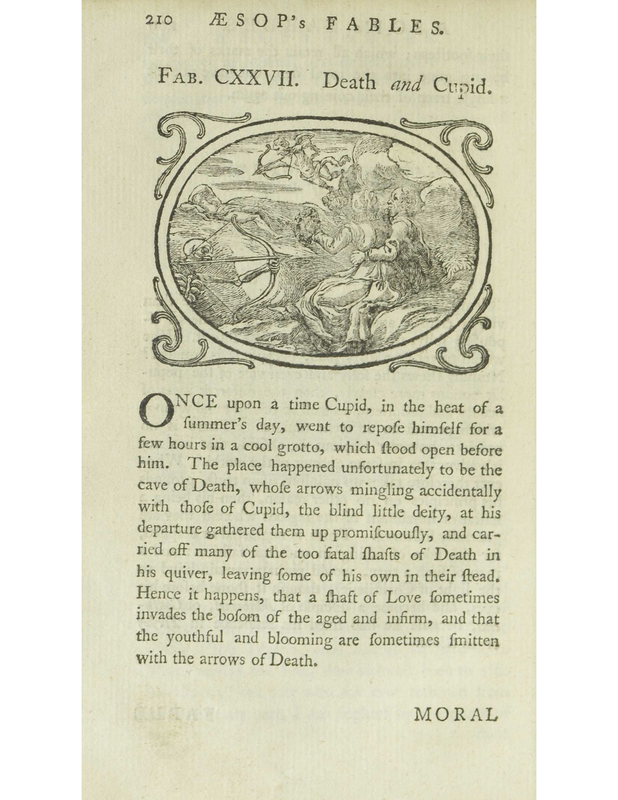
The scene is taken place outside, there is multiple human and angel like figures in the image. One being cupid Is holding up a bow and arrow towards another human laying down. Another skeleton looking figure (most likely representing death) is also pointing a bow and towards two humans sitting down, one is holding flowers in one hand and what looks like a garland in another hand while the other human is hugging the other.
In chapter six, Gulliver explains finances and the English fiscal system and Treasury to his Master on the Country of the Houyhnhnms. Here we see a figure made out of bags of money. The figure sits on a globe, standing on the European continent. On the left side we see the scales of justice, unevenly balanced towards the money, representing the unevenness of the justice system. The same image appears in the 1843 Krabbe edition.
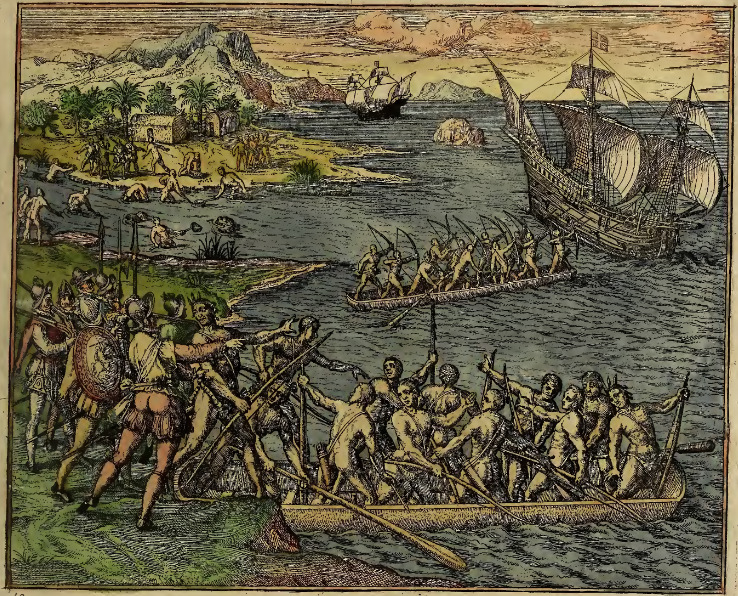
A group of Indigenous people are encouraged by Spanish colonists to attack and drive away a French ship near the island of Cubagua – the pearl island of Venezuela – in order to preserve the Spanish monopoly over the pearl trade. The Indigenous people launch their attack on the French ship from dugout canoes, using bows and arrows. In the background a group of Indigenous people harvest pearl oysters near the shore using long-handled nets, supervised by more Spaniards. There is also a village near the group. Another French ship sails further along the coast. This image is identical to one found on page 135 of Frankfurt, 1595, but colored.
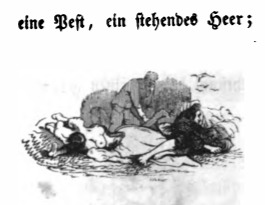
This image is showing bodies of those who have died of the plague. The plague was the code for the army. This image comes in a description of a conspiracy found by a professor from the Grand Academy on Balnibarbi. This idea is representing code word for terms in the conspiracy that Swift is satirizing. The professor advises that those named in the conspiracy papers be closely monitored at all times, naming specifically while they were using the bathroom, as this is when men were most thoughtful. This conspiracy is thought to be an allusion to the trial of Francis Atterbury, the bishop of Rochester for allegedly plotting with the Jacobites. Atterbury was charged with treason in 1722 and was exiled to France. The same image appears in the 1843 Krabbe edition.


![[a doctor mixes medicine]](https://collections.cemvc.ca/files/large/3ddbf00578516ddae9669502c25e9f7f8f0b1133.jpg)
![[Act III – Elicia Watches as Sempronio and Celestina Enter the House]](https://collections.cemvc.ca/files/large/6abfe55f17b083f72e50e393a0ca590d5ab50170.jpg)
![[Two giants examine Gulliver on Brobdingnag]](https://collections.cemvc.ca/files/large/e6450038e81334e1ca72954b74ad8b90727a9e8c.jpg)
![[Gulliver recovers in bed from his escapade with the monkey on Brobdingnag]](https://collections.cemvc.ca/files/large/25984516e7e82899e949d1b32a9e2d49354da491.jpg)
![[A representation of uses of money in Europe]](https://collections.cemvc.ca/files/large/c50aea88fb18f7bc8216154fca5c24f0fb3e590d.jpg)