This illuminated image depicts Ceres, the goddess of the harvest and queen of Sicily, holding a scythe in her right hand. There is wheat illustrated behind her to demonstrate that she is the goddess of agriculture. Boccaccio explains that she had tamed oxen and discovered how to plow fields and cultivate the harvest. She had taught men how to husk grain and turn it into edible fare, which is why the wheat in the image is significant.
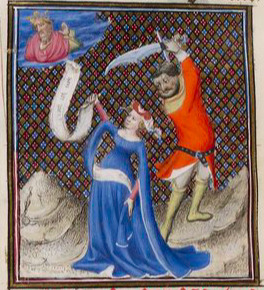
Cassandra is said to have been gifted the ability to predict the future by Apollo after promising to be his mistress. When she broke her promise, he added the curse that nobody would believe her predictions. The image depicts her prediction of her own death that was not believed, with her murderer standing behind her holding a sword. To the top left corner is Agamemnon, whom she confided to.
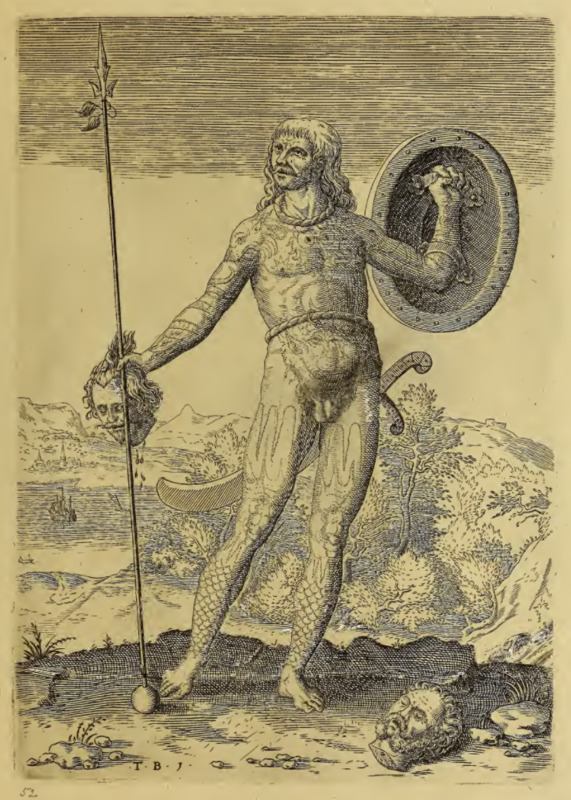
An Indigenous man is shown from the front. He carries a shield strapped to his left forearm and a long spear in his right hand. Also in his right hand is a severed human head, another head lays on the ground at his feet. His hair is long, he wears a twisted cord around his neck, and a sword with a curved blade hangs from another cord around his waist. He is nude, and his body is covered in painted designs. The Picts were an Indigenous group who lived in Britain long before the author’s time. Images of Picts were included in this book so that readers could compare their customs to those of the Indigenous people living in Virginia.
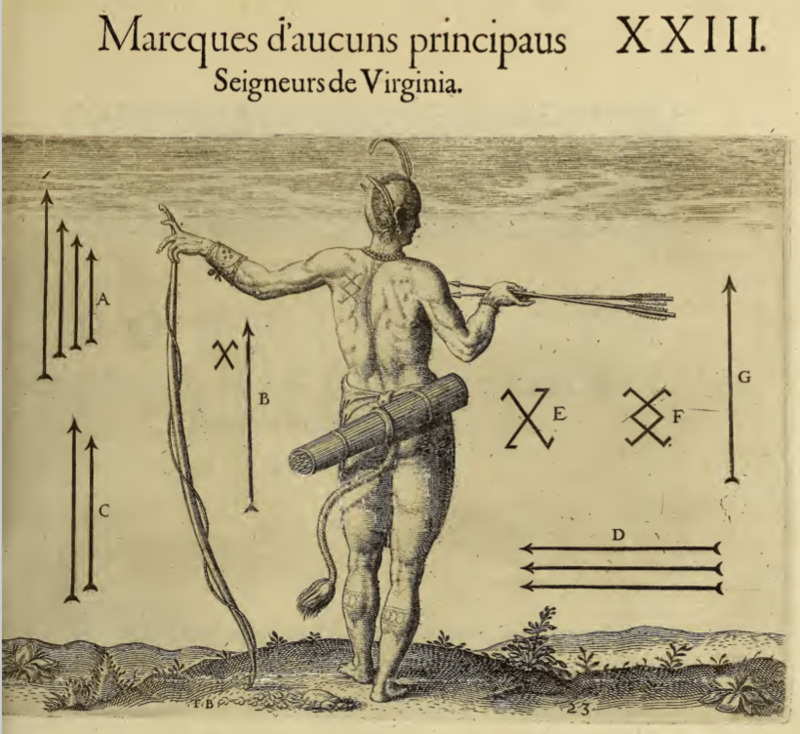
An Indigenous man is shown from behind. He holds a longbow in his right hand and two arrows in his left, and a quiver of arrows is tied around his waist. Drawn around him are seven designs that are labelled with the letters A to G. Design A is comprised of four arrows side by side pointing upwards, with the sizes decreasing from right to left. Design B has an arrow pointing upwards with a stylized ‘X’ to the left of the arrowhead. Design C has two arrows side by side pointing upwards in decreasing size from right to left. Design D has three arrows of the same size side by side pointing to the left. Design E is a stylized ‘X’. Design F is a crosshatch pattern. Design G is a singe arrow pointing upwards. The man has design F on the back of his left shoulder, suggesting that the designs are common tattoo/scarification art.
Here we see Gulliver meeting the King of Laputa. When Gulliver and his escorts arrive at court, the king is seated in his throne with a table in front of him. On the table are a variety of mathematical instruments and globes. The king has his head in hands and is deep in thought trying to work out a problem. Gulliver tells us that despite the noise they made when they entered, Gulliver stood before the king for an hour before the king worked out his problem. On either side of the King are pages, both of whom hold bladders. Once the king had solved his problem the two pages got the king’s attention by gently tapping him with the bladders, one on his right ear and the other on his mouth. This got the king’s attention and he looked at Gulliver, reminded of Gulliver’s arrival, of which he had already been informed. The king spoke to Gulliver, and Gulliver waved away the Flapper who tried to tap him, indicating he could hear the king. In this image, Gulliver has his arms crossed, leaning forward, waiting for the King to notice him. The same image appears in the 1839 Krabbe edition.
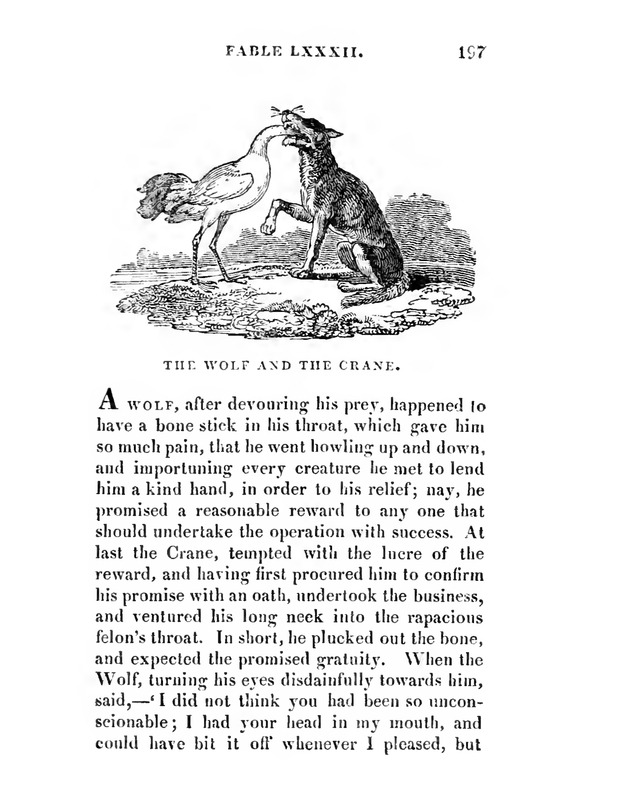
In the middle of this image there is a wolf and a crane. The crane is standing up and its head is inside the wolf’s mouth. The wolf is sitting with one paw held up as it eats the crane.
Miss Betsy Horrocks, the butler’s daughter, with very large ribbons in her hair, sits on a low stool in front of the piano in the Crawley manor’s drawing-room, singing and playing a song. Beside her stands Miss Hester, the kitchen maid, who is insincerely praising her music.
Two men and two women are in a town with multiple buildings around them. A man and a woman are holding hands while the other two stand next to them. Three of the people are wearing long robes and one man is wearing pants.
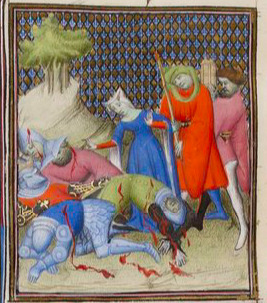
Argia’s husband, Polynices, was killed in battle. When Argia found out that his body was left out to rot and was not buried, she searched until she found his corpse. In the image, she is seen wearing a blue dress, looking down at corpses trying to find her husband. Behind her, Creon and others pull her back to stop her from looking through the rotting bodies.
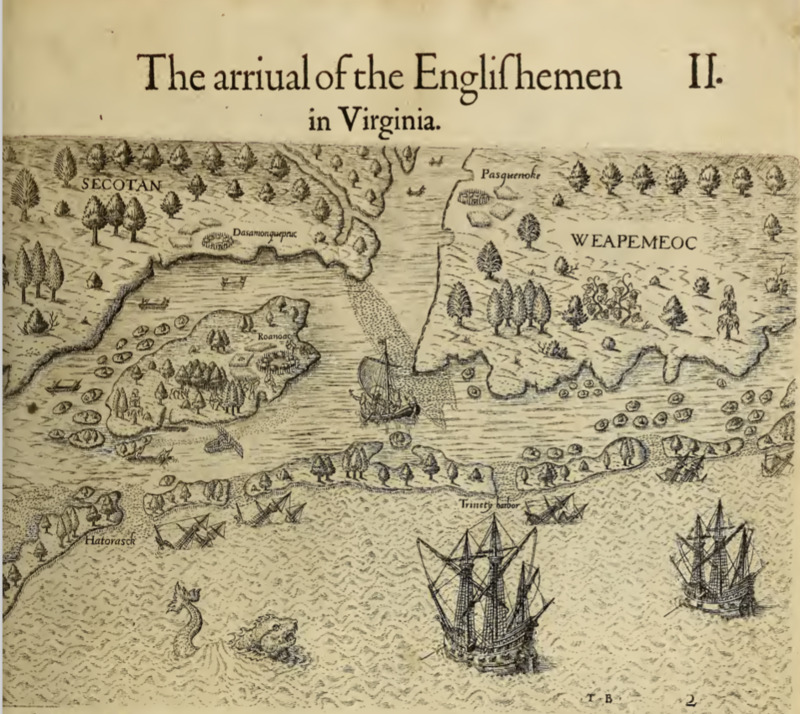
Two English ships are pictured sailing near the coast of Virginia (what is known today as the Outer Banks of North Carolina). One smaller ship is pictured within the outer islands, closer to the coast. Several Indigenous towns are labelled.
This is a diagram showing how the floating island of Laputa moves over the mainland of Balnibarbi. The course of the island is shown from above, with each letter indicating different extremities that the island can move to. The lines also show the different dominions into which the island is divided. The same image appears in the 1839 Krabbe edition.
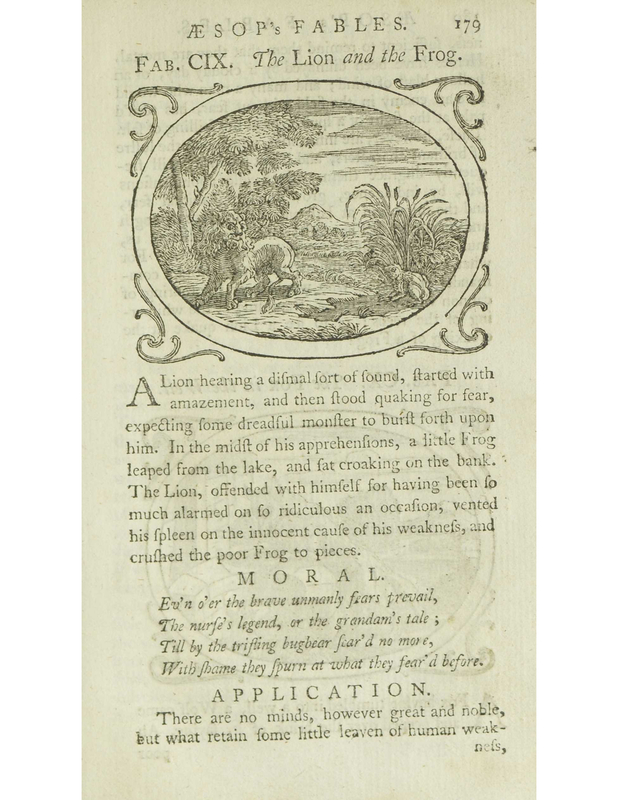
On the left side of the illustration, a lion stands in a forest, looking to its right. To the right of the lion is a small frog sitting on the bank of a lake, with some reeds behind it. There is a mountain in the background.
Here we see Gulliver sleeping outside on the ground outside the city in Blefuscu. Because of his size, there was not a building large enough to accommodate Gulliver, so he slept outside using is coat as a blanket. A man stood on guard as Gulliver slept, seen here holding a lantern.
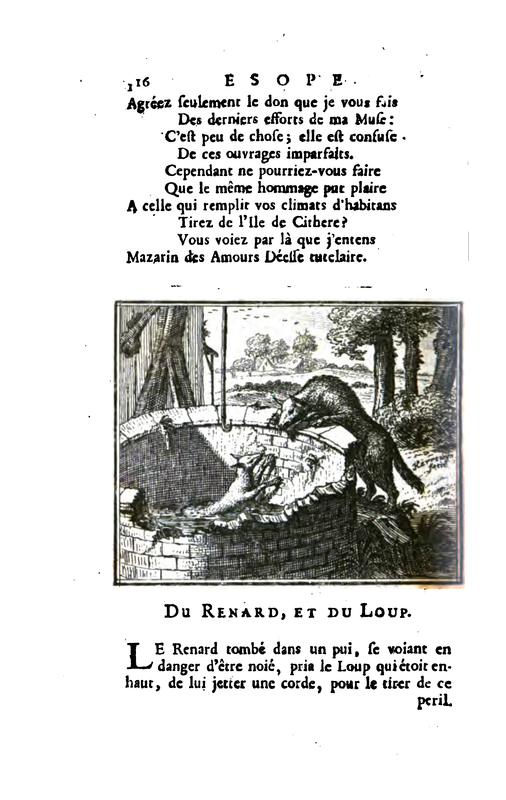
The Fox fell into a pond, seeing himself in danger of being drowned, and begged the Wolf, who was upstairs, to throw him a rope, to get him out of this peril.
Rebecca Crawley, in a low-cut dress and black mask, leans over a gambling table. Behind her stands Georgy Osborne, who was brought there by Mr. Kirsch, his uncle’s courier, while the others went to the ball.
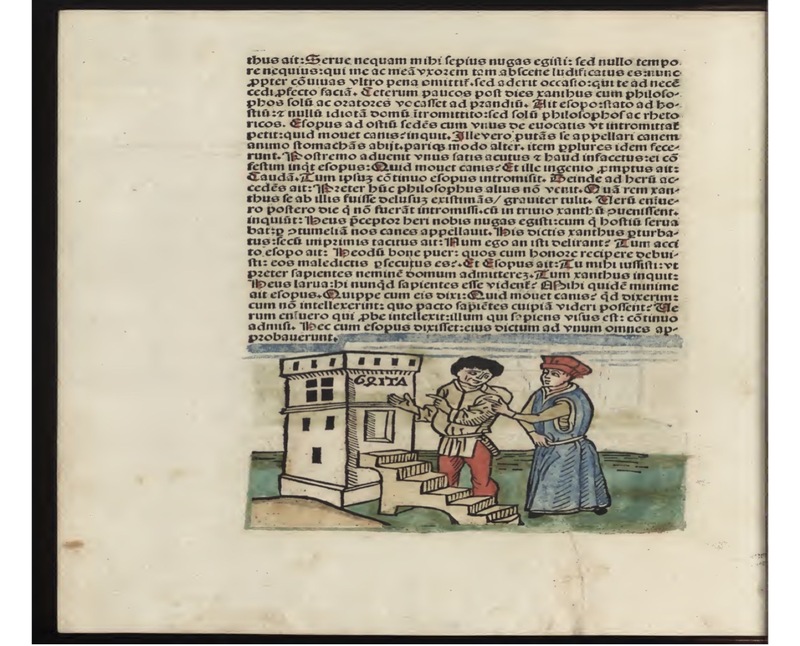
Two men stand in front of a tower. One of the men gestures at the stairs for the other to climb ascend to the top of the tower. The tower is called Grita.
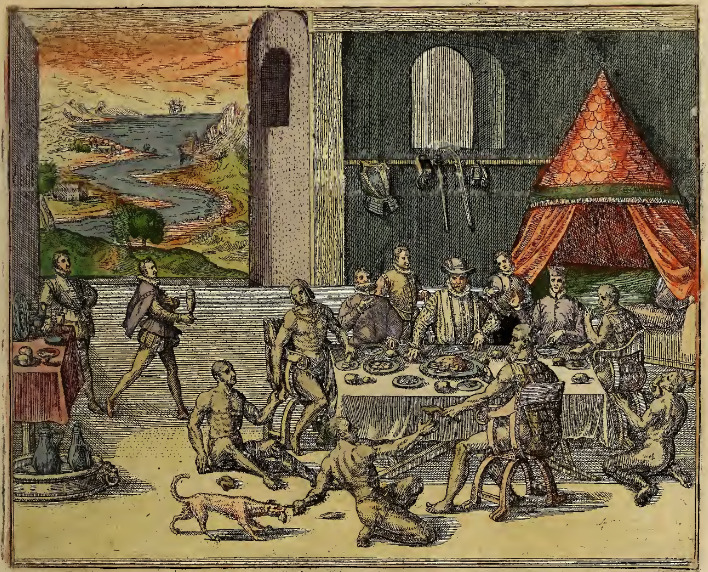
A group of Spaniards, one of whom is Diego Guttierez, governor of Costa Rica, share a meal with several Indigenous leaders, called Caciques. The group dines in a large structure with a canopy bed in one corner, two dining tables and wooden chairs. Several pieces of armor and weaponry have been hung on a rail near the bed. At the table, three Indigenous men wearing capes of feathers and necklaces (the Caciques) sit in chairs, while three more Indigenous men sit on the floor, one beside each leader. One of the Caciques passes meat to the man near him on the floor, who in turn feeds it to a dog. This image is identical to one found on page 145 of Frankfurt, 1595.
Here we see a bust of Socrates. This image appears when Gulliver’s master explains their views on philosophy, reason, and morals. Gulliver explained the European views on natural philosophy, including those of Socrates, with which the Houyhnhnms agreed. According to Plato’s Republic, Socrates preferred knowledge to be informed by ethics, not just what can be observed in the real world. The same image appears in the 1839 Krabbe edition.
Here we see a magic lantern, which was a form of image projection developed in the seventeenth century, becoming popular in the eighteenth century, and used until the twentieth century. Glass slides with images on them would be placed in front of a light source and one or more lenses and then projected. The magic lantern was the predecessor of the twentieth century slide projector. In this image we see several slides on the table in front of the lantern and a candle next to it. There are human figures on the slides and likely represent the various historical figures with whom Gulliver spoke throughout the eighth chapter. In the nineteenth century the magic lantern became a popular tool for education, and it is likely that they could be used in classrooms to teach children about history and historical figures. This image appears at the end of the eighth chapter. The same image appears in the 1843 Krabbe edition.



![[Ceres Holding a Scythe]](https://collections.cemvc.ca/files/large/b14fe025fc80430df8671a3783317fb0a712845a.jpg)
![[Gulliver first meets the King of Laputa]](https://collections.cemvc.ca/files/large/06d5b4cca5760c7d665682c342b7ac268d983404.jpg)
![[Besty Horrocks Playing the Piano]](https://collections.cemvc.ca/files/large/75fe70ee000979e0a8b295636eeeb6ce6f3a2862.jpg)
![[Holding hands]](https://collections.cemvc.ca/files/large/31664744d10e6aef3fff8179ada6afd6a0a091ca.jpg)
![[Diagram showing the movement of Laputa over Balnibarbi]](https://collections.cemvc.ca/files/large/a95c8d39ca28bbddbfb0ab370e81ea27ce8cd49e.jpg)
![[Gulliver sleeps on the ground in Blefuscu]](https://collections.cemvc.ca/files/large/f6ce4407d21bdd252e71c22602081911e1396039.jpg)
![[Becky Gambling]](https://collections.cemvc.ca/files/large/b27e7fb901731b37a73a9bcb83274397ba7a1b1a.jpg)
![[Bust of Socrates]](https://collections.cemvc.ca/files/large/d7db62aaf86334c13d6d6ba7c6e558caf4e3bd19.jpg)
![[a magic lantern from the eighteenth century]](https://collections.cemvc.ca/files/large/db6755a638b76cad5ebd30a091edf34c16b67197.jpg)