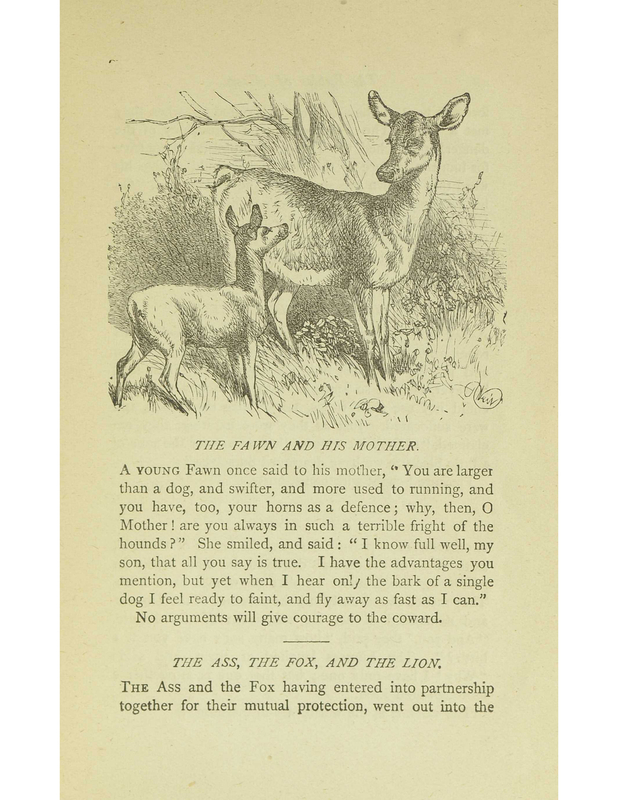
In a forest, a small fawn and his mother are looking at one another near a tree. The fawn is still small and must look up to his mother to see her. He is on the left-hand side of the image, while the mother stands tall on the right-hand side, and is looking down at her son. Both have their ears perked up. Grass and wildflowers grow everywhere on the ground where they are standing.
Here we see Gulliver talking to his family when he first sees them after returning to England from Brobdingnag. Gulliver tells us how he knelt down when his wife came to kiss him, because he felt like a giant. When his daughter came to speak with him, she knelt down but he could not see her until she stood up because he became so used to looking up to the giants. In the image, Gulliver’s family looks concerned as Gulliver tells them what he saw, thinking he had gone crazy. The same image appears in the 1843 Krabbe edition.
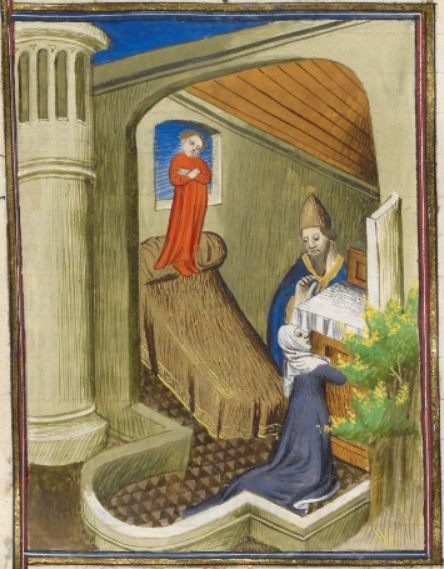
This illumination depicts a Roman woman named Paulina speaking with a priest on the right side of the image. Paulina was a chaste and devout woman and is renowned for her naivety by being tricked into losing her virtue. A man named Mundus (who is depicted on the left side of the image) had fallen in love with Paulina and devised a plan to trick her into having relations with him. He bribed a priest to tell Paulina that if she stayed the night at the temple, the Egyptian God, Anubis, would come to her in her sleep. She believed this deception, and when she slept at the temple, Mundus disguised himself as Anubis and tricked Paulina into having intercourse with him. When Paulina realized she was deceived, her husband went to the emperor and had Mundus exiled. The priest of the temple was tortured as his punishment.
Here we see a child who is immortal. There is a small population of immortal people on Luggnag. These people are identified by a spot on their forehead, which is red when the child is born and changes colour throughout their lives. The same image appears in the 1843 Krabbe edition.
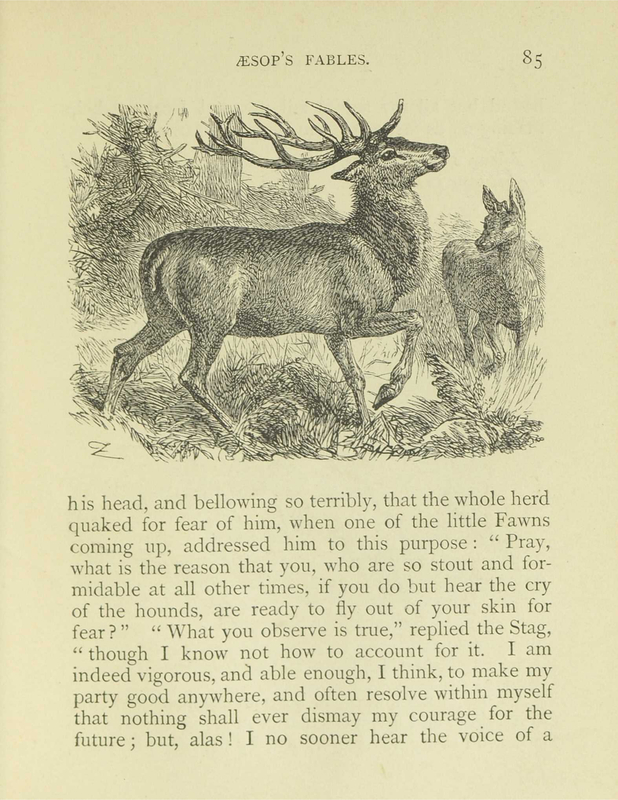
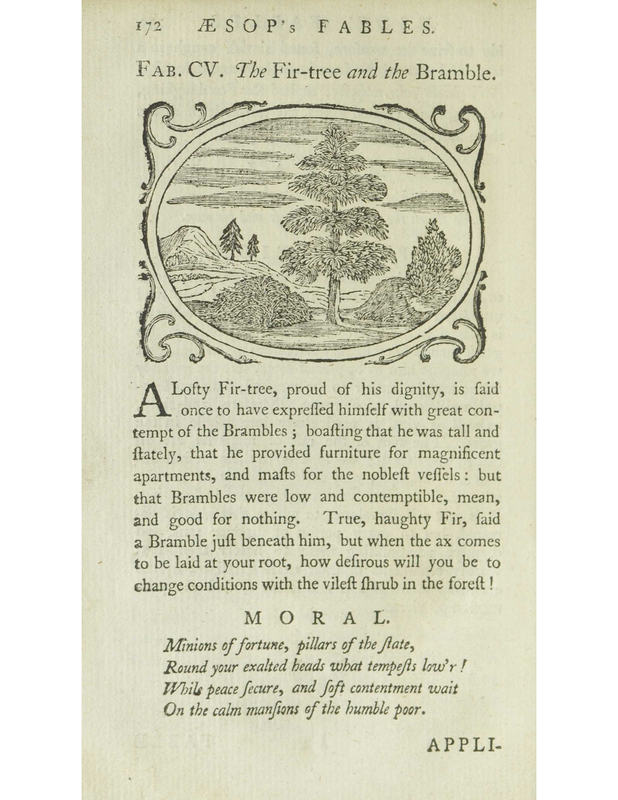
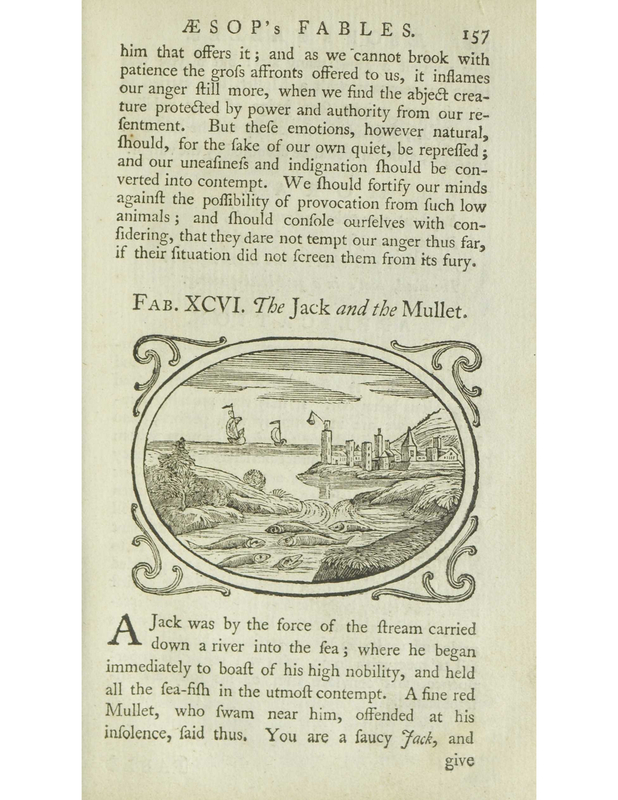
A tall fir-tree is in the middle of the image. A bramble shrubs sits on the ground to the left of the tree. A bush sits on the ground to the right of the tree. A mountain and two coniferous trees are seen far in the background.
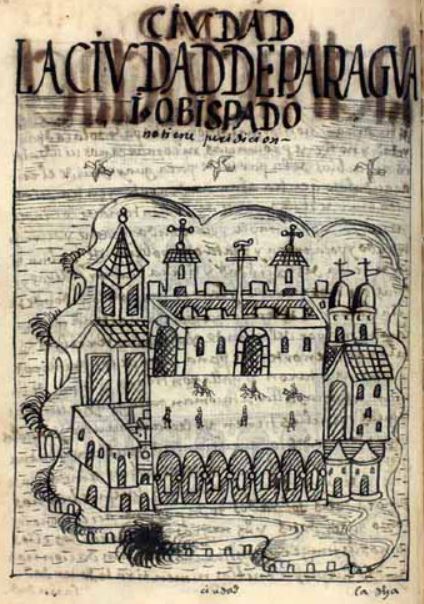
This image is depicted in the author’s chapter where he discusses cities, towns, villages, and provinces in colonial South America. The city depicted in this image is Paraguay, which is now a country in modern-day South America. The city is arranged in a cluster of colonial buildings which forms a square in the centre where people are illustrated walking and riding horseback. The city appears to be located on a coastal region as there is water surrounding the city. The author explains that the city has a bishopric and good Christian people but it has no jurisdiction. The caption at the bottom of the image reads ciudad [city].
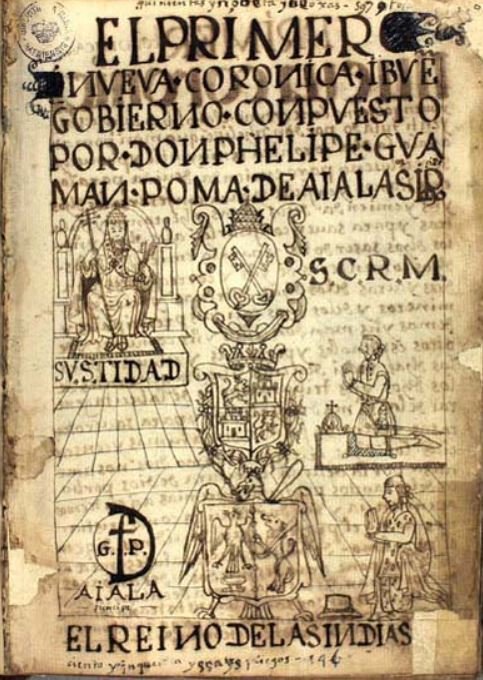
This is the first drawing of the book located on the title page. The image depicts the author of the book kneeling in the bottom right corner with his hands joined and a hat on the ground in front of him. The king of Spain is depicted kneeling beside him with a crown on the ground beside him. They are both kneeling before the pope, who is depicted on the left side of the image sitting in a large chair and holding a scepter in his right hand and what appears to be the globus cruciger in his left hand. There are three coats of arms illustrated in the centre of the image, and a symbol with the letters g, f, and p in a circle with the word aiala written beneath it. This is to represent the name of the author, which is Felipe Guaman Poma de Ayala. The caption at the bottom of the image reads El Reino De Las Indias [The Kingdom of the Indies].
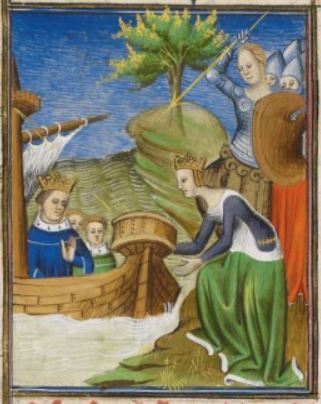
This illuminated image depicts a woman named Hypsipyle saying goodbye to her father, King Thaos of Lemnos, as he sails away on a boat. Hypsipyle is illustrated standing by the shore as she pushes the ship away. Both Hypsipyle and her father are wearing crowns to demonstrate their royal status. The women of Lemnos, who are depicted on the right side of the image, had planned to kill every man of the city to eliminate the patriarchy. Hypsipyle, unable to allow her father to die, told him of this plan and helped him escape by means of this boat. The women of Lemnos are illustrated wearing armour and carrying spears and sword.
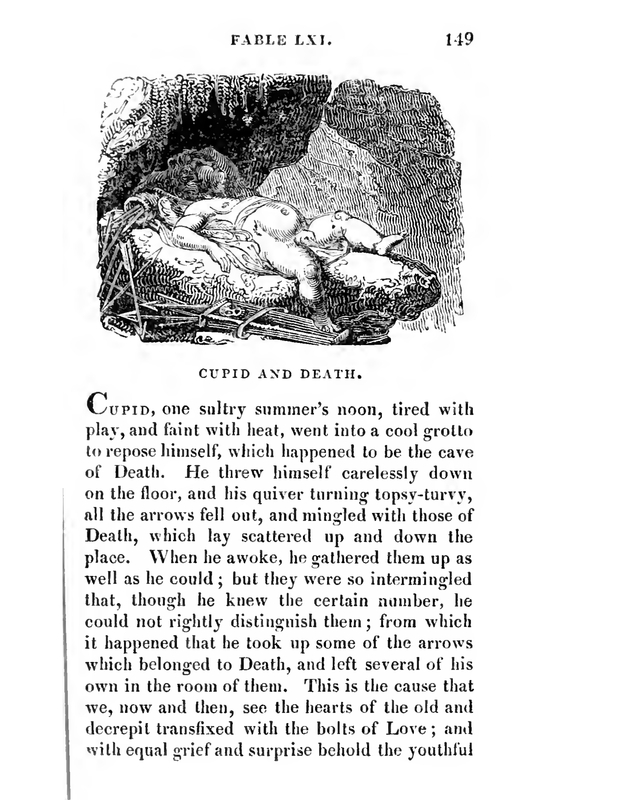
Cupid lays under the shelter of a small cave. A cloth runs across his chest and covers his groin. He rests his head on his quiver. Arrows spill out of his quiver at all angles and onto the ground. Next to his arrows, there is what appears to be a quiver with a skull on it to symbolize death.
Joseph Sedley sits in a large chair with a sword leaning against his leg and a pitcher in his hand. Rebecca Crawley, dressed in a witch’s hat, leans over him, stroking his arm and his chin. To the right and above her head is the letter T from The.
Here Gulliver meets the captain of the Hopewell, William Robinson. Robinson came to ask Gulliver to accompany him on his upcoming trip to the Levant. Gulliver agreed, setting off on his third adventure. This image appears at the beginning of Chapter One, and the letter I is in the top corner, as it is the first word of the chapter.
A group of Tupinambá people – four women and a man – gather around a deceased man who lays in a hammock. Two women crouch beside the hammock with their hands over their faces in distress. Behind the hammock, two more women hold each other by the shoulders as they mourn, and a man stands behind them holding a rattle or ornament with one hand and wiping his face with the other. Both the deceased and living man have a facial adornment on their chin.
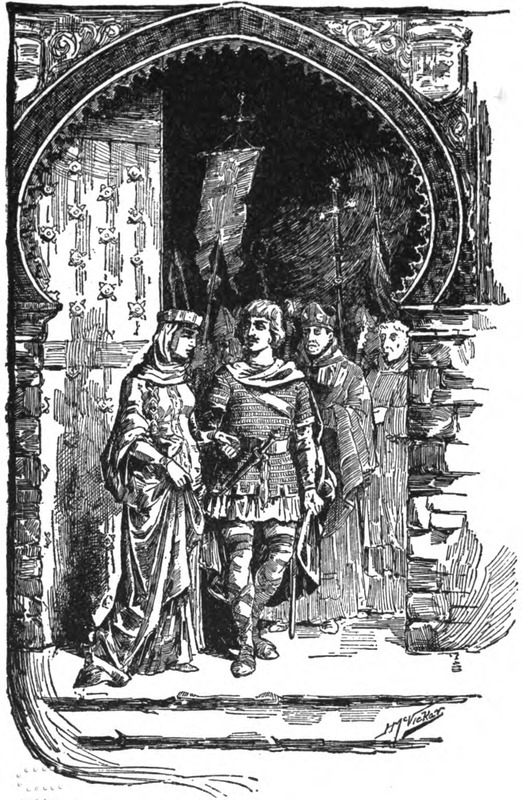
Rodrigo and Ximena are married. This image shows the procession out of the church following the wedding with the two leading the way. They are followed by the bishop who presided over the service as well as several other clergymen, one of whom holds a processional cross while another holds a banner. This marriage was considered surprising, as Rodrigo had previously killed Ximena’s father in a duel, but in order to end the feud they married.
Here Gulliver is caught by a monkey who belonged to a clerk of the kitchen in the court of Brobdingnag. Gulliver was left in his box while Glumdalclitch went out and left the windows open. The monkey got loose and found Gulliver’s box and reached in the window and picked up Gulliver. The monkey held Gulliver as though he were a baby about to suckle and Gulliver pulls away from it, which is seen in this image. The monkey was startled by a noise and climbed out the window, taking Gulliver with him. Rocks were thrown to try and get the monkey down, however someone had to go up to the roof to get the monkey down with Gulliver. The same image appears in both the 1839 and 1843 Krabbe editions.
The illustration depicts a scene which might have been part of the story if it was written in a different style. The Marquis of Osbourne, in an embellished robe, has handed a letter to his ‘petit tigre’ for deliver to Lady Amelia. In the background of the image hangs a portrait on the wall of that same woman, with the words Lour A Gauche on her skirt.
Two sticks hold up a banner with the title Vanity Fair. Each letter is on a separate piece of paper, connected by a string tied to the sticks. Beneath the banner is printed the subtitle and author, A Novel without a Hero. By William Makepeace Thackeray.. At the base of the banner, a haggard man with a plumed helmet is lounging against an open chest, holding up a mirror from which he peruses his reflection. By his side are a doll and what appears to be a handmade axe or hammer, with a flat rectangular stone or piece of wood tied to a longer, thinner stick. In the background can be seen trees, a fence, and several buildings.
The maids of honour of the Queen of Brobdingnag entertain themselves looking at Gulliver. In the image we see two women with their shoulders exposed, partially undressed. Their hair is loose and the woman on the right has her corset unlaced. They wear earrings and necklaces. Gulliver sits in the centre looking up at the women. The scene appears when Gulliver describes the women on Brobdingnag, talking about their dress, appearances, and scent. The same image appears in the 1839 Krabbe edition.
Several Indigenous men and women cut down brazilwood trees along the coast. They use axes to fell the trees, stack the logs into piles, then load the logs into rowboats to ferry them out to the larger European ships. Brazilwood was very popular in Europe in the 16th century and was mainly exported by the Portuguese with the help (and later, enslavement) of the Tupi people, although pirates and other European merchants also harvested and traded the wood. This image is identical to one found one page 950 verso of Paris, 1575 (Chaudière).

![[Gulliver sees his family after returning home from Brobdingnag]](https://collections.cemvc.ca/files/large/55fe574ccc82877de961f2d2b6773fd8cbe26e3c.jpg)
![[an immortal child born on Luggnag]](https://collections.cemvc.ca/files/large/09d02776c65c40d615a0cdbcb8c8b7c6bddeef53.jpg)
![[Rebecca Brings Coal]](https://collections.cemvc.ca/files/large/db61c30c085d71ae49f9d233d760b46fd0e6cb79.jpg)
![[Vanity Fair Volume II. Chapter XXX Historiated Initial, T]](https://collections.cemvc.ca/files/large/c5538a95d426bb15e75a4d224c504041f50ead79.jpg)
![[Gulliver meets with Captain William Robinson]](https://collections.cemvc.ca/files/large/1a4ab4a3726db35cb9e4b7113cf373aedd448c9e.jpg)
![[Tupinambá men and women mourn a deceased man]](https://collections.cemvc.ca/files/large/4a89a60ad090ea4927508e08949c9c7ff1c126e0.jpg)
![[Gulliver is caught by a monkey on Brobdingnag]](https://collections.cemvc.ca/files/large/8f5fdbad77d4b1da9021ee5af7c1d0989f0021e8.jpg)
![[A Genteel Rose-Water Alternate Style Part I]](https://collections.cemvc.ca/files/large/1b96a965fa42563e274045b666cf047f2330b04e.jpg)
![[Amelia Fixes Mr. Sedley’s Tie]](https://collections.cemvc.ca/files/large/b97ae88c7277ea86c9409f51acc7b1b30b04305c.jpg)
![[Vanity Fair Title Page]](https://collections.cemvc.ca/files/large/456d5845de255bd87f608c12ed5969aead2ee0b1.jpg)
![[The Queen of Brobdingnag's maids with Gulliver]](https://collections.cemvc.ca/files/large/682d15856f36a78cae947bb06ba80db2d3033105.jpg)
![Co[m]me ce peuple couppe et porte le Bresil és nauires.](https://collections.cemvc.ca/files/large/ac2894a3e96b4f58cc7e0a6fa5bc4d4f89b15945.jpg)