Here we see a group of Houyhnhnms. This image appears when Gulliver tells the readers about the philosophy of the Houyhnhnms. Gulliver tells us that the two principal values of the Houyhnhnms are friendship and benevolence, represented here as we see a group of Houyhnhnms that are friends and appear happy together. The same image appears in the 1843 Krabbe edition.
One of the men who appeared before Gulliver was the commander of a ship who fought at the Battle of Actium in 31 BCE when Octavian (later Augustus) defeated Marc Antony and Cleopatra. The commander was quite successful at the battle, however, he was overlooked by Augustus when it came time to appoint a commander of a greater ship. This position went to a young man who waited on one of the Emperor’s mistresses, showing the corruption of Augustus’ court, like many other courts throughout history. The commander was charged with neglect of duty after he asked to be promoted, and he retired to a poor farm outside Rome. His ship was then given to a favourite page of the Vice-Admiral. The commander’s son who was killed at the battle appears with the commander. Intrigued by the story of this commander, Gulliver called upon Agrippa, a friend of Octavian and the admiral at the Battle of Actium, who confirmed this story. Agrippa’s version of the story paints Octavian in a much more favourable light, however. The same image appears in the 1843 Krabbe edition.
This image depicts a local native official in Spanish colonial Peru. He is depicted standing in the centre of the image looking and facing towards his left. He is depicted wearing Spanish trousers underneath his traditional tunic with a shawl wrapped over his shoulders while holding a long staff. He is also depicted wearing a head piece that has a feather at the back and a flower at the front. The author explains that these officials were responsible for not going above the law, and to plow the fields. The caption written at the bottom of the image reads, en este rreyno [in this kingdom].
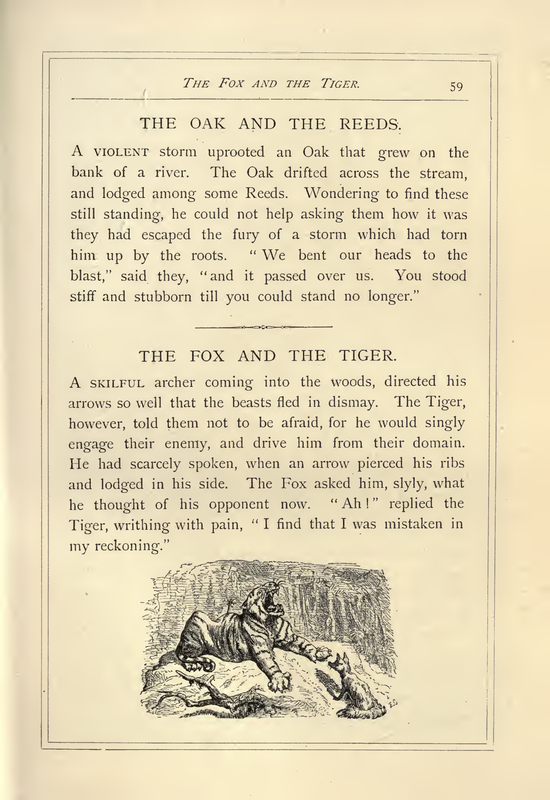
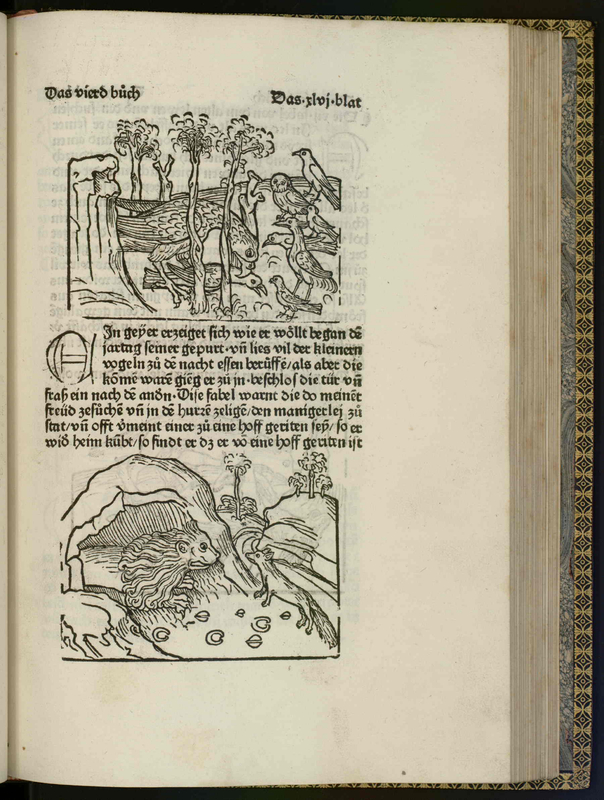
A tiger lies on its belly with its front paws stretched out on either side of him. His head is slightly bent back as he bares his teeth. In front of the tiger, a small fox sits down at the bottom of the rock.
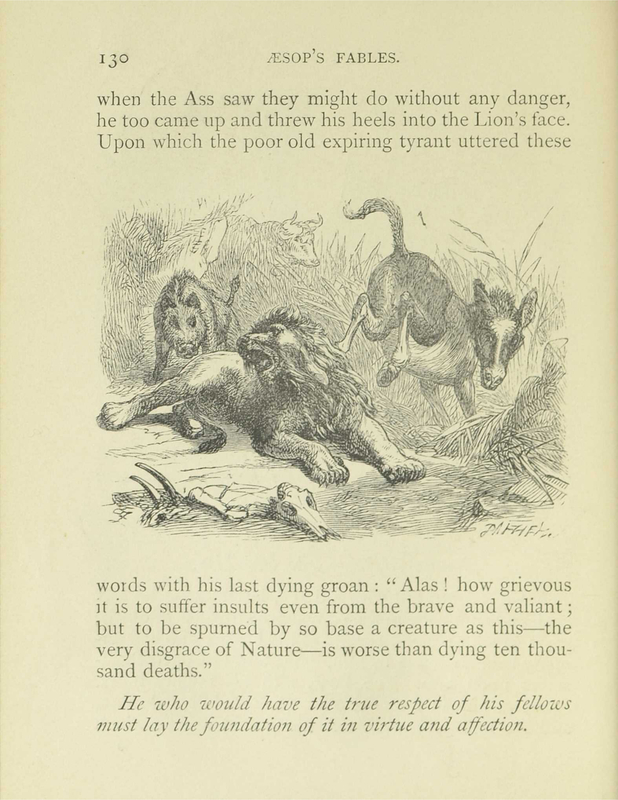
A lion lying prone on the ground is attacked by three animals- a donkey which kicks at his head, a boar who is behind him and a bull who stands watching the scene in the background. There is a skeleton in front of the lion. The lion is to the left, the boar is behind him. The donkey is to the left and the bull watches from the middle.
This illustration is interesting, since it is not specified in the narrative that Pleberio (leftmost figure) takes Alisa (central figure, leaning over Melibea) outside to see Melibea’s body, although he does tell her to look at it. It is just as likely that he is asking her to look through the window in their bedchamber. The rightmost figure almost certainly represents Lucrecia, who witnessed the preceding series of events.
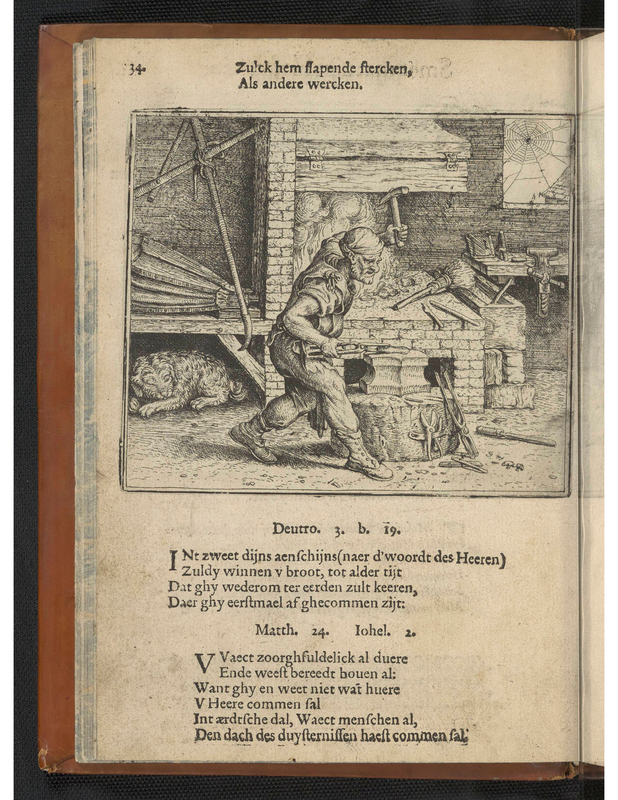
A man working in a forge. A dog sleeps under a bench in the back left of the room. The man raises a hammer as he works on a piece of metal. A fire burns in the back of the forge. Tools are scattered throughout the room.
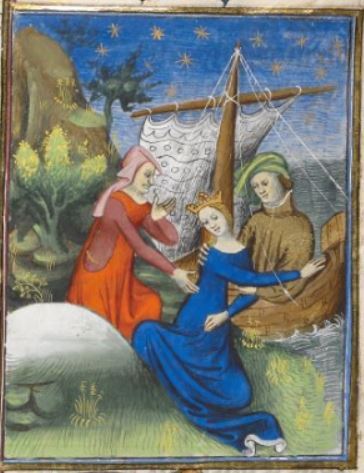
This image illustrates the beautiful Europa being kidnapped and placed on a ship. Europa is depicted in the centre of the image wearing a blue dress and a crown on her head. Boccaccio explains that Europa was convinced by a panderer to follow him to the shores of Phoenicia, where she was then kidnapped and put onto a ship and taken to Crete. There is a man standing in front of Europa, presumed to be either Jupiter or the panderer. There is a woman standing beside Europa, who is not mentioned in Boccaccio’s telling of this story.
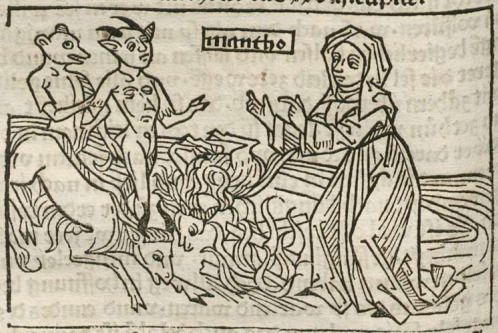
This engraving depicts Manto, the daughter of the famous seer Tiresias. She is depicted with her body leaning over a burning fire. We know this figure is Manto as the creator engraved her name beside her head. Boccaccio explains that Manto became an incredible seer just like her father. She uses the movement and colour of the fire’s flames to tell the future, which is why there is a fire in the engraving. She also used the entrails of animals such as sheep and oxen for signs of the future. There is an ox and a sheep illustrated in the engraving with their organs sticking out from their bodies. There are two distinct looking characters in the background of the engraving, which signifies Manto’s involvement in the dark arts in summoning spirits and gods from the underworld.
After Lucrecia (left-central figure) tells Celestina (right-central figure) that Melibea (rightmost figure) has requested her presence, they both go to Melibea’s house. There, Melibea informs Celestina about the pain in her heart and asks what the cause might be. [The identity of the leftmost figure is uncertain, since Alisa does not enter the scene until after the next illustration. This may be intended to represent another of Melibea’s servants.]
A group of different kinds of birds are outside between a few trees. One big bird is picking at a smaller bird in the middle of the image behind two trees. The other birds and an owl are watching on the right-hand side of the image.
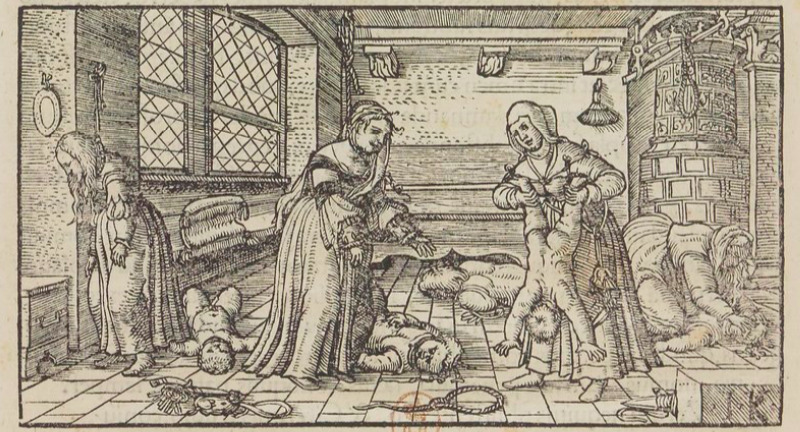
The wives of the Cimbrians are pictured killing their children to prevent them from living a life of foul servitude after the deaths of their husbands. The picture is illustrated in the stockade that they built, with nooses lying around them that would later be used to end their own lives. One woman on the left is in the process of hanging herself. By killing their children and themselves, they left nobody to be controlled by the soldiers, as their husbands were already dead.
Here we see shellfish including oysters and limpets on the shore of New Holland, where Gulliver landed after leaving the Country of the Houyhnhnms. Gulliver ate them raw, as he did not dare make a fire because he was unarmed and afraid that the peoples of New Holland might find and hurt him. The same image appears in the 1839 Krabbe edition.
Pictured in this image is 5 sheep, while one of them is getting sheared by a man planting his body on top of the sheep for support. Three of the sheep have been sheared while two of them are still full of wool. This is happening outdoors with a couple trees and hills in the background
Indigenous people in present-day Canada hunt wild animals including boars and deer in the winter. They hunt in groups of two or three, with one member of each group using a bow and arrow and the other(s) wielding spears. All of the individuals wear furry tunics belted at the waist, caps, tall boots and snowshoes on their feet. This image is identical to one found on page 1011 of Paris, 1575 (l’Huillier).
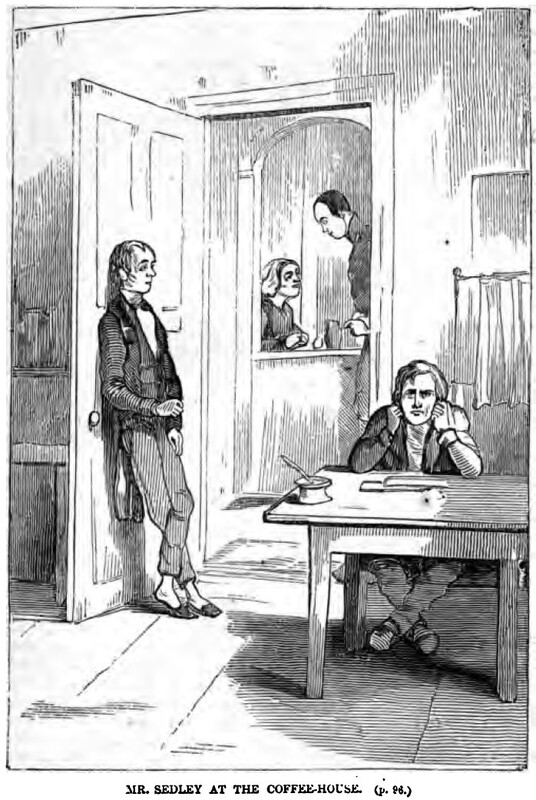
John Sedley is seated at a table at the Tapioca Coffee-house, slouching over with his elbows resting on the table and his face between his fists. On the table in front of him are several pieces of paper and an inkwell with a quill. The door to the room is held open by a tired or bored-looking man who leans against it. Through the doorway, William Dobbin can be seen talking to the woman at the desk. Below the illustration is printed its title and location in the story, MR. SEDLEY AT THE COFFEE-HOUSE (p. 96.).
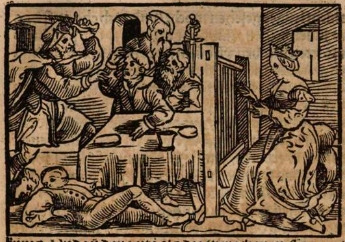
This image depicts Penelope, the wife of Ulysses, weaving at her loom on the right side of the engraving as she waits for her husband to return from the Trojan War. Penelope had many suitors over the 20 years that she waited for Ulysses to return home; however, Boccaccio explains in his story that Penelope remained entirely faithful over the duration of his absence. Penelope told the suitors that she would continue to wait for her husband to return until she was done weaving a cloth, which is why she is depicted weaving in this engraving. Each night, she would undo all the weaving she had done that day so she could continue waiting for Ulysses. When Ulysses finally returned home, he had slain every suitor in his palace. Ulysses is depicted on the left side of the engraving, disguised in peasant clothing with a sword in his hand as he kills the suitors. One of his servants is illustrated piercing a man’s shoulder as he helps Ulysses kill the suitors.

![[a group of Houyhnhnms]](https://collections.cemvc.ca/files/large/5c1eec9311d16853ce27aa24b644ccd7bf62fcda.jpg)
![[Commander of a ship who fought at the Battle of Actium]](https://collections.cemvc.ca/files/large/01401fd1b1b80c26c9a77ff313a477761fc3f05e.jpg)
![Algvazil Maior[e]s: Qve Sea Fiel I Dilegente, Quillis Cachi](https://collections.cemvc.ca/files/large/3683897fc43c30aee67b8e8694bf54b4fa57e957.jpg)
![[Act XXI (Second Illustration) – Alisa, Pleberio, and Lucrecia Mourning the Loss of Melibea]](https://collections.cemvc.ca/files/large/54c621a37e672830a555969ce0720eec3417c294.jpg)
![[Act X – Melibea, Celestina, and Lucrecia Talking as Alisa Approaches]](https://collections.cemvc.ca/files/large/5e94bc39af551f7ff893b2c6782a6d0b43d2ba78.jpg)
![[A bull and a mouse]](https://collections.cemvc.ca/files/large/4cfa628a0460b14b5e2f54d94f979c44a7c53ef6.jpg)

![[Shellfish on New Holland]](https://collections.cemvc.ca/files/large/9889bd1036189ab48c2d3f27798b9667bc29fc3c.jpg)

![[Sheep Shearing]](https://collections.cemvc.ca/files/large/b3e662d54e00a6825cd2813dffcdbc7cee1a1284.jpg)