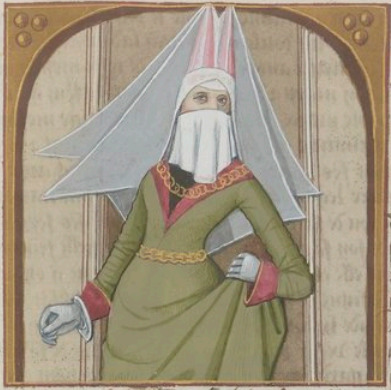
This illumination depicts a portrait of Sabina Poppaea, the wife of Emperor Nero. She is illustrated wearing a garment to cover her face and head and is pictured wearing heavy clothing. Boccaccio explains that Sabina Poppaea was modest when she was out in public, which is why she is depicted in this manner in the image. Sabina Poppaea was famous for using her cunning and beauty to seduce Nero into marrying her in order to be empress.
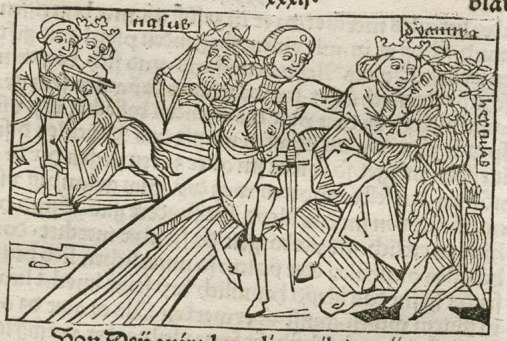
Hercules is depicted on the right side of the engraving holding his new wife Deianira in his arms as they attempt to cross the Evenus river. Hercules is illustrated with a wreath on his head and a bow and arrow by his legs. His name is engraved beside his body. Deianira is illustrated wearing a crown and has her name engraved above her head. A man named Nessus is depicted beside Deianira, holding his arm out to her as he offers to take her across the river on horseback. Boccaccio explains that Nessus was riding horseback, however, Nessus is known to be a centaur in Greek mythology. Boccaccio explains that Nessus betrayed Hercules’ trust and began to run away with Deianira after crossing the river. Hercules uses a poison infused arrow to shoot Nessus and rescue his wife. This is illustrated in the background on the left side of the engraving. Hercules’ bow is in hand, and his arrow is sticking out of the chest of Nessus.
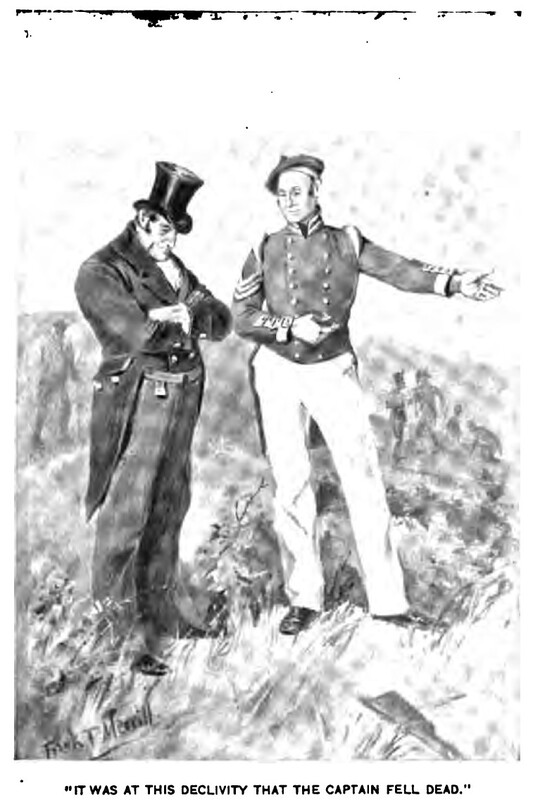
The image depicts a scene from page 352, in which the Sergeant shows John Osborne where his son died. The Sargeant, in military uniform, is standing in a field with one hand in front of him and gesturing outwards with the other. Next to him John Osborne is dressed in a top hat and tailcoat, looking down with his arms crossed. The silhouettes of other soldiers can be seen in the background. The quote given as the title of the image is an abridged version of the one given in the text.
Here Gulliver shows the captain of the ship some of the things that he brought from Brobdingnag. In his hand, Gulliver holds a ring worn on the pinky finger of the Queen of Brobdingnag. On the table are the comb made from the beard hair of the King of Brobdingnag, and stingers from the wasps on Brobdingnag. Gulliver tries to give the ring to the captain as thanks however the captain rejects him, asking instead for a tooth from one of Glumdalclitch’s servants. The same image appears in both the 1839 and 1843 Krabbe editions.
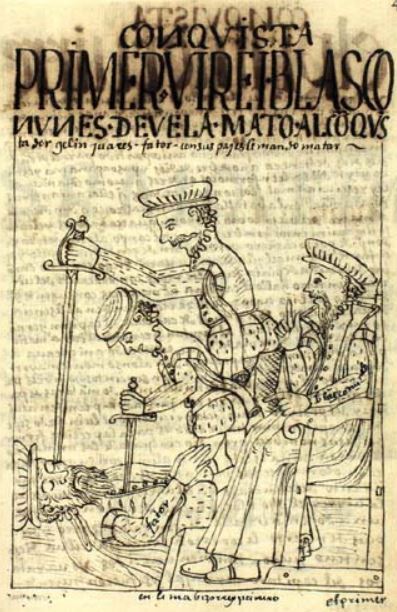
This chapter focuses on discussing the arrival of Spaniards and the Spanish conquest of Peru. This image depicts the first Spanish viceroy, Blasco Nuñes, sitting on the right side of the image as he orders an execution to be carried out. He ordered the execution of Gelin Juares (Illán Suárez de Carvajal), a conquistador who did not agree with the viceroy’s new rules. There are two men depicted hovering over the body of Juares as they stab him in the chest while Nuñes watches. The caption at the bottom of the image reads, en lima, bizorrey primero [In Lima, the first Viceroy].
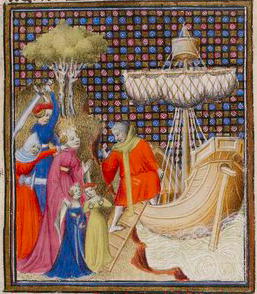
Hypsipyle became the Queen of Lemnos when she saved her father from murder and had him sent to Chios on a ship. Her father wears a red cloak and boards the ship to the right of the image. Hypsipyle is in the center of the image wearing a crown and a pink gown, standing with two children that were born to Jason. The children were required to be sent away, so she had them sent to her father in Chios, revealing that he was still alive after all. This caused her subjects to turn against her and send her away. Her subjects are seen to the far left of the image, sending Hypsipyle away.
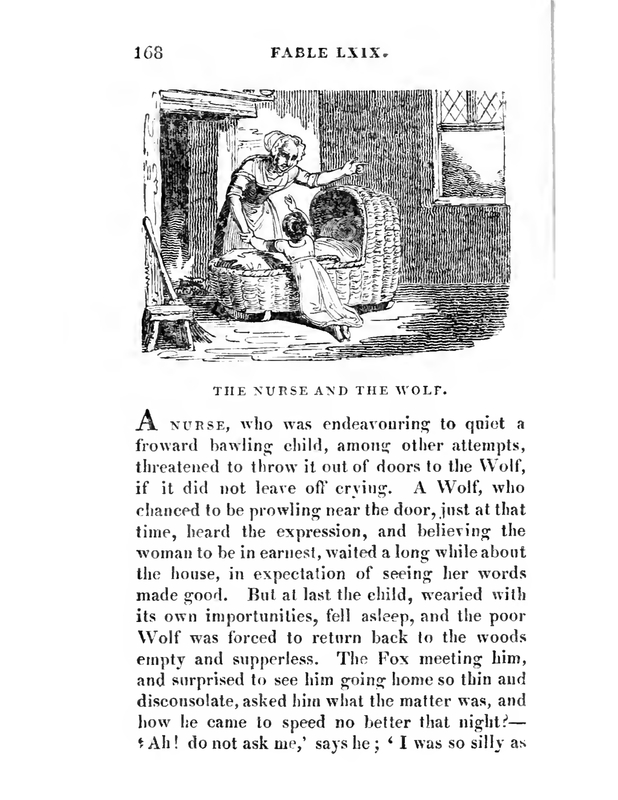
A two people are inside a room with a crib. One of them, a young child leans over the crib and holds the hand of the older nurse. The child reaches their other hand towards the nurse. The nurse leans over the child and points at the window in the room. In the background, on the left-hand side, there is a stool, a broom, and a doorway. On the right-hand side there is a window.
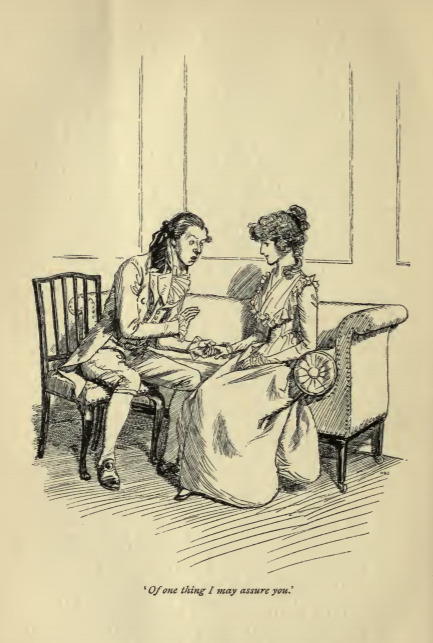
In this image John Dashwood assures Elinor that Mrs. Ferrars would have found a match between Edward and Elinor far more agreeable that his marriage to Lucy. Elinor went to visit her half-brother and sister-in-law shortly after the news of the engagement, but after Fanny had somewhat recovered from the shock. This scene occurs in chapter 41. The characters are shown in the traditional regency style. Elinor wears a regency style dress with an empire waistline. John Dashwood wears a waistcoat and tailcoat with breeches and a cravat. The regency period dated to the early nineteenth century (1811-1820) when George, Prince of Wales, later George IV (r. 1820-1830), reigned as regent for his mentally ill father, King George III (r. 1760-1820). The regency period is associated with the rise of neoclassicism in art and fashion.
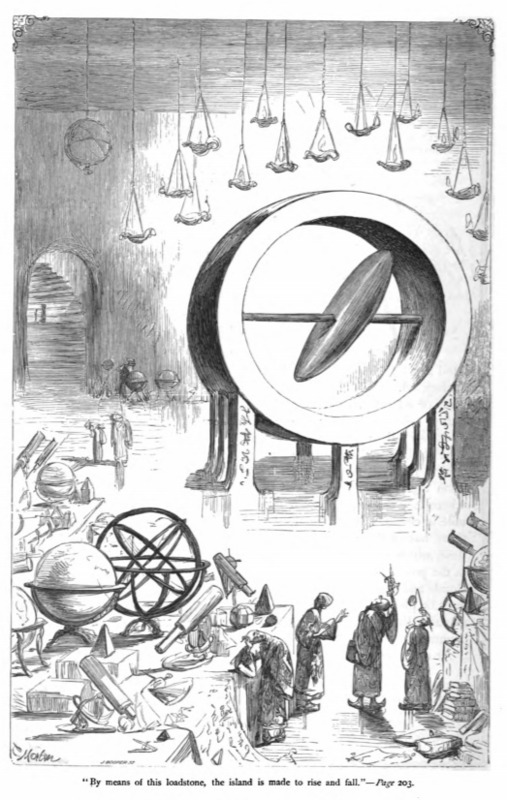
Here we see the technology used by Laputan scholars to move the island. The Emperor of Laputa could move the island over various parts of Balnibarbi – the land below Laputa. The Emperor would move the island to punish people on Balnibarbi so that Laputa would block the sun from Balnibarbi causing the crops to fail. If the Emperor felt so inclined, he could cause the island to drop onto Balnibarbi, but he had never done this for fear of damaging the adamantine bottom of Laputa.
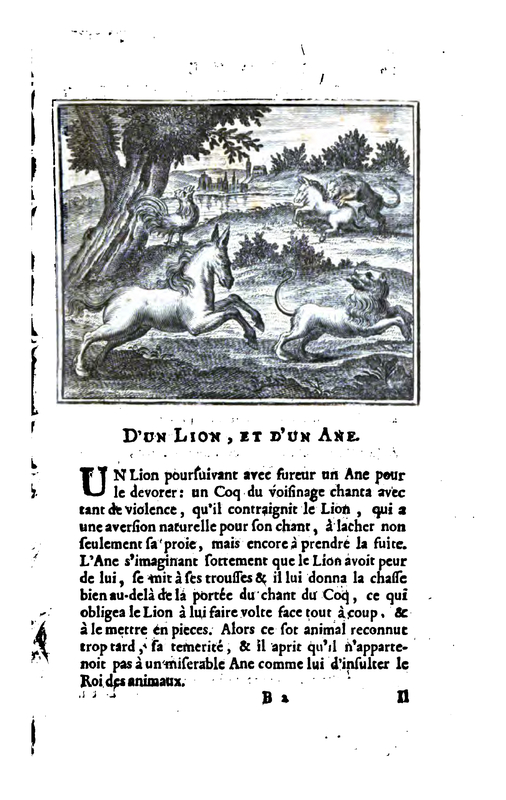
In front of the image there is a donkey or horse chasing a lion. Behind this scene there is a large tree with a chicken making a cluck. Not far behind the chicken there is another scene with a donkey and lion, but the lion is not eating the donkey. In the far distance there is a pond and a castle and trees in the horizon.
Here we see a hanging incense burner with a depiction of virtue and humans. Virtue is represented by a woman, with a Houyhnhnm on her helmet. She holds a mirror up to a man. While the man is dressed like an upper class European, in the reflection of the mirror we see a yahoo from the Country of the Houyhnhnms. This represents Gulliver’s disdain for humans, feeling that all humans lack the virtue of the Houyhnhnms, and are made of vice. The same image appears in the 1843 Krabbe edition.
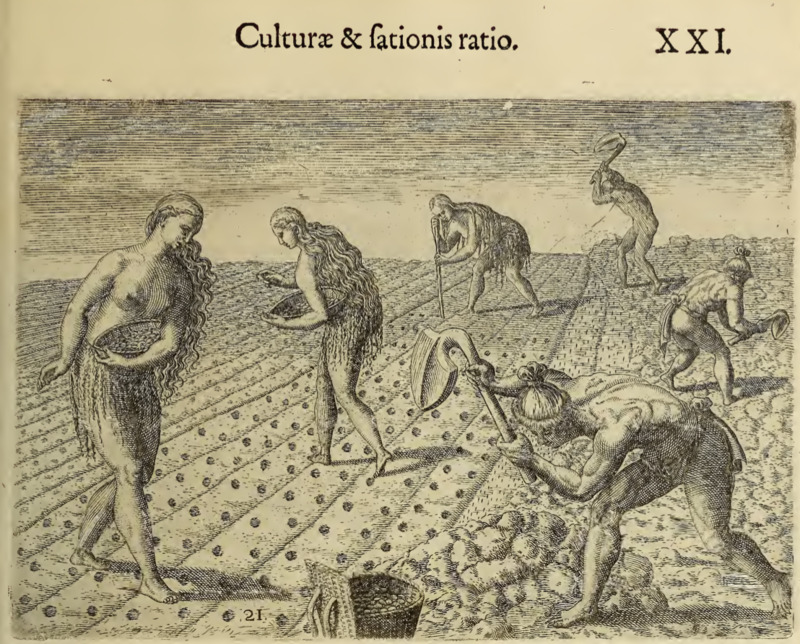
Several Indigenous people work in a large cultivated field. Men plow the ground using handheld, hoe-like implements while women scatter seeds from a basket in the furrows the men have made.
A mermaid with long hair and a thin twisting tail floats near some rocks, mostly out of the water. She is playing a small harp beneath the full moon, which forms the letter O from Our.
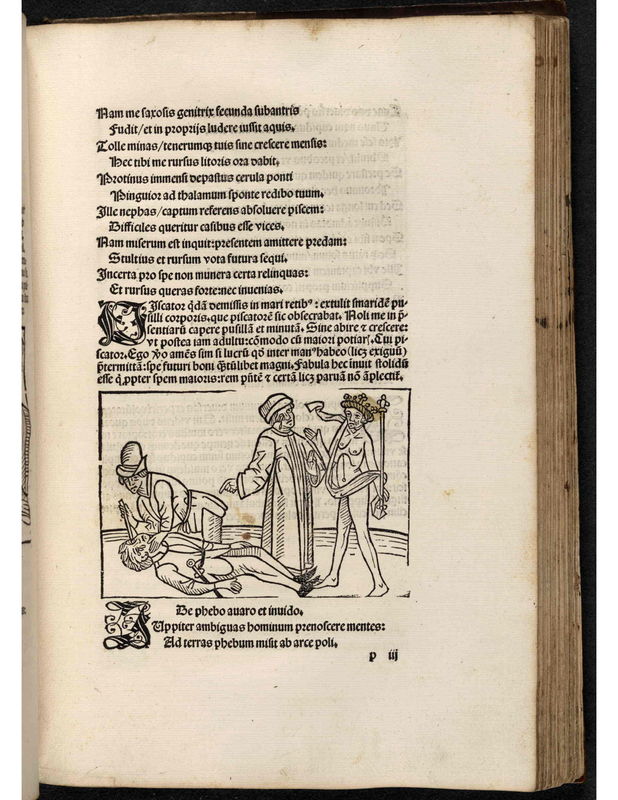
There is a man lying down on the ground on the left side of the image. One of his eyes is bleeding. There is a man on top of him sticking a device in his left eye. In the centre of the image, there is a standing man with blood coming out of his right eye, talking to a king with a crown and a sceptre
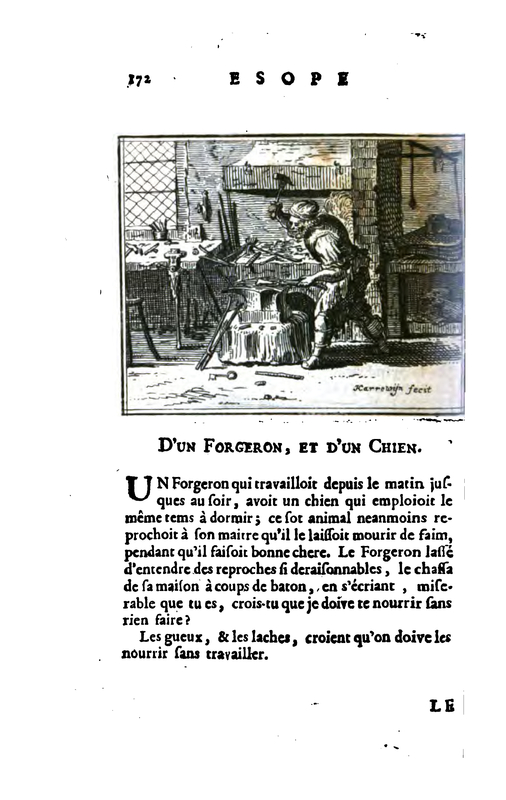
A blacksmith who worked from morning until the end of the day, had a dog who used the same time to sleep; this silly animal reproached his master for letting him die of hunger, while he was doing work. The blacksmith, sick of hearing such a reproach, hit him with a stick, saying, You poor thing, do you think I have to feed you if you don't do anything?
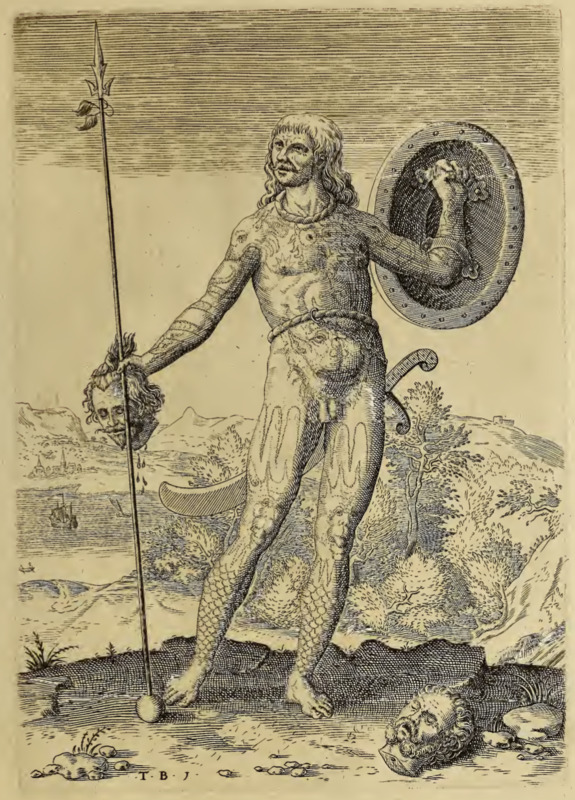
An Indigenous man is shown from the front. He carries a shield strapped to his left forearm and a long spear in his right hand. Also in his right hand is a severed human head, another head lays on the ground at his feet. His hair is long, he wears a twisted cord around his neck, and a sword with a curved blade hangs from another cord around his waist. He is nude, and his body is covered in painted designs. The Picts were an Indigenous group who lived in Britain long before the author’s time. Images of Picts were included in this book so that readers could compare their customs to those of the Indigenous people living in Virginia.
Here we see Gulliver walking through the streets of Lisbon with Don Pedro. Gulliver had a difficult time readjusting to life in Europe as he was accustomed to the virtues of the Houyhnhnms. Gulliver hold a cloth with rue or tobacco to his nose so he cannot smell the city, which Gulliver could not stand. The same image appears in the 1843 Krabbe edition.
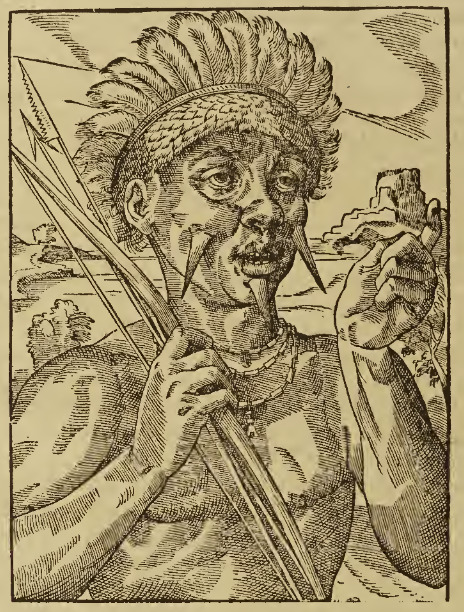
An Indigenous king or chief is shown in portrait from the chest up. He wears a feathered headdress and has three pointed face stones – one in each cheek and one in his chin. He also wears multiple strands of beads around his neck. The man carries a bow and two arrows in his right hand and gestures with one finger raised with his left hand. This image is identical to one found on page 955 verso of Paris, 1575 (Chaudière).
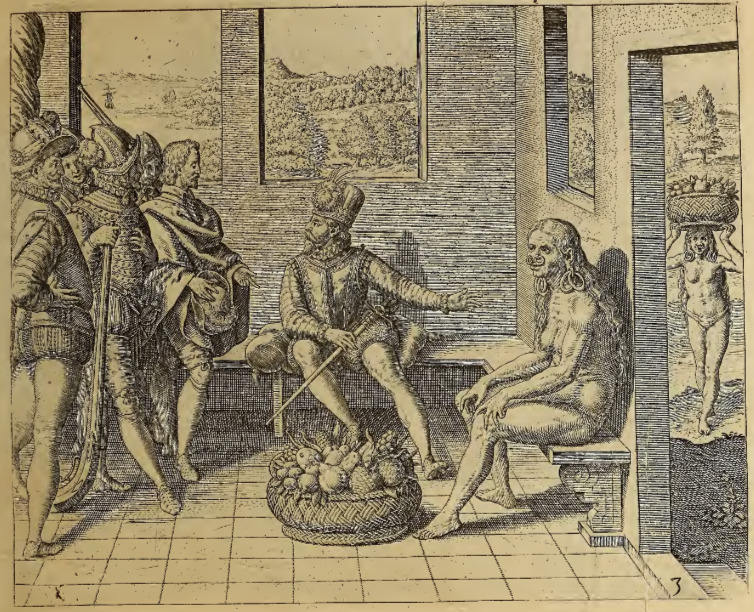
Inside a structure, and Indigenous woman and a European man sit on a bench, while several other European men stand nearby in conversation. The woman is nude with long, unbound hair. She wears two hoop earrings in each ear and two smaller hoops in her nose. The European men are all finely dressed in doublets and hose, and several wear fine hats or helmets. The man on the bench is seated on a cushion and gestures towards the Indigenous women while conversing with the other men. He carries a thin sword, while one of the other men holds a musket. In the center of the group on the floor there is a large basket of fruit, a gift presented by the Indigenous woman. Another woman can be seen on the right, approaching the building with another large basket of fruit. This image is identical to one found on page 153 of Frankfurt, 1594.

![[Gulliver holds up the Queen of Brobdingnag’s ring, showing it to the captain of the ship that rescued him]](https://collections.cemvc.ca/files/large/ac4efe0e12d6d794dabb93ccd1e27373d2696744.jpg)

![[a hanging incense burner with a depiction of virtue]](https://collections.cemvc.ca/files/large/025f312967cc67a178a029fef98b802ab7538255.jpg)
![[Vanity Fair Chapter XLIV Inhabited Initial]](https://collections.cemvc.ca/files/large/03f540dd05b87fe983ab3c892417547d262caadf.jpg)

![[Gulliver walking outside in Lisbon with Don Pedro]](https://collections.cemvc.ca/files/large/4b2cc85185caedf23a9a8f1c0fcc4817fb30a1eb.jpg)