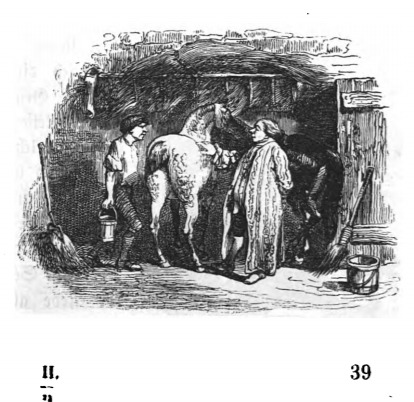
After his return to England, Gulliver bought two uncastrated stallions. Gulliver spent most of his time with these horses, as he found their company preferable to human company, and reminded him of his time with the Houyhnhnms. Gulliver says he spends at least four hours each day speaking with the horses. The same image appears in the 1839 Krabbe edition.
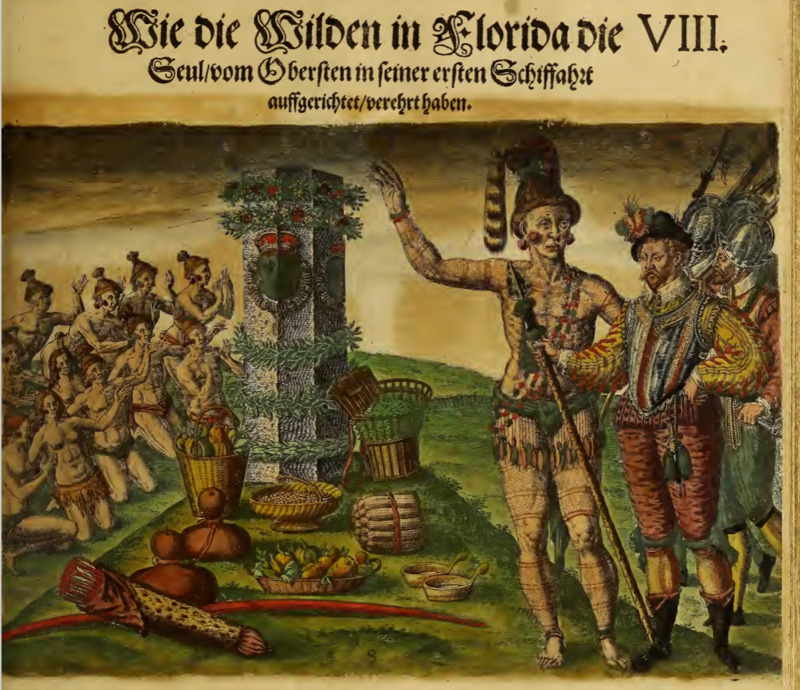
The monument erected by Jean Ribault during the voyage of 1562 is shown. There are various items on the ground around the monument, including a bow and quiver of arrows, baskets of foodstuffs, and other containers. In the foreground, an Indigenous man stands beside a colonist and gestures to the monument. The Indigenous man wears a headdress with racoon tails, a garment around his waist, a decorative chain of beads across his body, and large earrings. René de Laudonnière stands beside him. Behind the two men are several other colonists. On the left of the monument a group of Indigenous people are shown kneeling, appearing to worship the monument. This illustration is identical to the one found on page 51 of Frankfurt 1591, but colored.
During Hannibal’s war against the Romans, he made it to Busa’s homeland, Apulia. While there, he continued his slaughter and killed many Roman men. Busa was not scared of the gore, and offered shelter, medical care, clothing, food, and more, to many wounded men. In the image, she is seen in the center wearing a blue gown and crown. Behind her is her horse, and around her are the men accepting her offerings. At Busa’s feet is a pile of armor.
Two Indigenous men and a child stand around a tree. The man on the left crouches as he threads the items harvested from the tree (dried fruit or nuts) onto a string to make a leg rattle, like those worn by the man on the right. The man on the right dances with one hand on his hip, wearing leg rattles and holding a maraca or religious item in the other hand. Both men wear feathered headdresses.
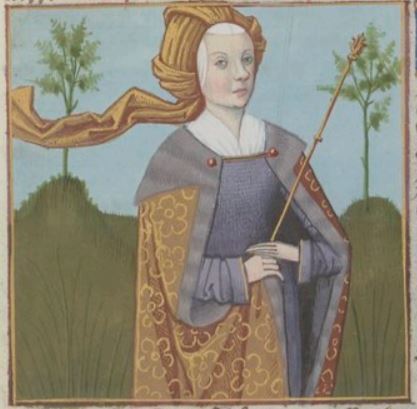
This illumination depicts a portrait of Queen Jocasta of Thebes. Boccaccio explains that Jocasta is widely renown for unknowingly marrying her son, Oedipus. After an oracle revealed the truth about her husband being her son, Oedipus gouged his eyes out and Jocasta killed herself.
Here we see a politician bribing a voter. The politician is on the right and hands the man on the left a piece of paper that reads vote … B, and a small bag of money. In this chapter Gulliver talks with the King of Brobdingnag about English traditions. Gulliver tells the King about diplomacy, religion, the justice system, the arts, the financial system, and the nobility, then debated these issues with the king. This image comes when Gulliver is discussing the corrupt political atmosphere and the election of officials. The same image appears in both the 1839 and 1843 Krabbe editions.
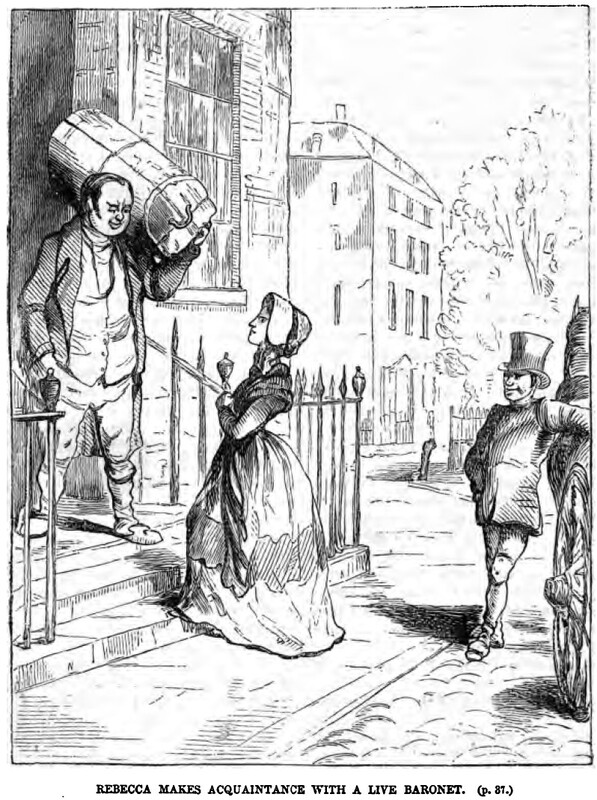
Rebecca Sharp stands in the center of the picture at the base of the staircase to Crawley mansion, scowling up at the man on the stairs. He is holding her trunk on his shoulder with his other hand in his pocket, and, though assumed by the others to be a porter, is Sir Pitt Crawley. To the right of the image, John, the Sedley’s groom, is leaning against his carriage with a smirk on his face. In the background the corner of the Crawley mansion and a neighboring house are lightly sketched. Below the illustration is printed its title and location in the story, REBECCA MAKES ACQUAINTANCE WITH A LIVE BARONET. (p. 37.).
Here we see three giant wasps attacking Gulliver after he was given a piece of sweet cake. Two wasps are flying around Gulliver’s head, while a third is lying, dead, on its back in front of Gulliver. Gulliver stands, waving his sword, defending himself from the wasps. The same image appears in the 1839 Krabbe edition.
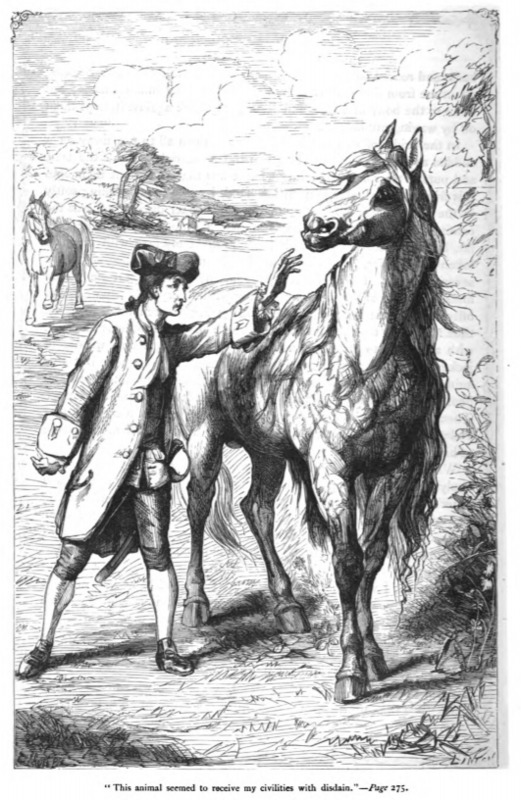
Here we see Gulliver's first encounter with the Houyhnhnms. He greeted the Houyhnhnm as he would treat a horse, and the Houyhnhnm was offended to be treated as an animal. Gulliver first met the Houyhnhnms after an encounter with the Yahoos.
Two small figures appear to be performing in the middle of a street. One, in a triangular hat, is standing on stilts, to which the other, in a hat with two tails and with a sword at his hip, clings. In the background are the shapes of buildings and people in the crowd. The top right of the image contains the letter W from When.
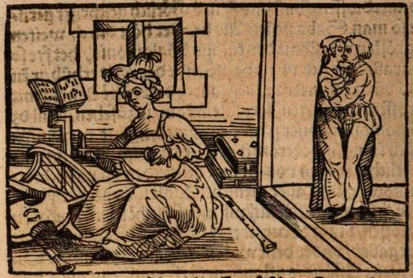
This engraving depicts Sappho, the famous poetess from Lesbos, on the left side of the engraving playing the lyre. There are other stringed instruments and sheet music surrounding her. She was famous for her lyric poetry. Boccaccio explains that Sappho was in love with a man who did not share the mutual feeling, and this is the reason as to why her music and poetry was so somber. The man that she loved is depicted on the right side of the engraving kissing another woman.
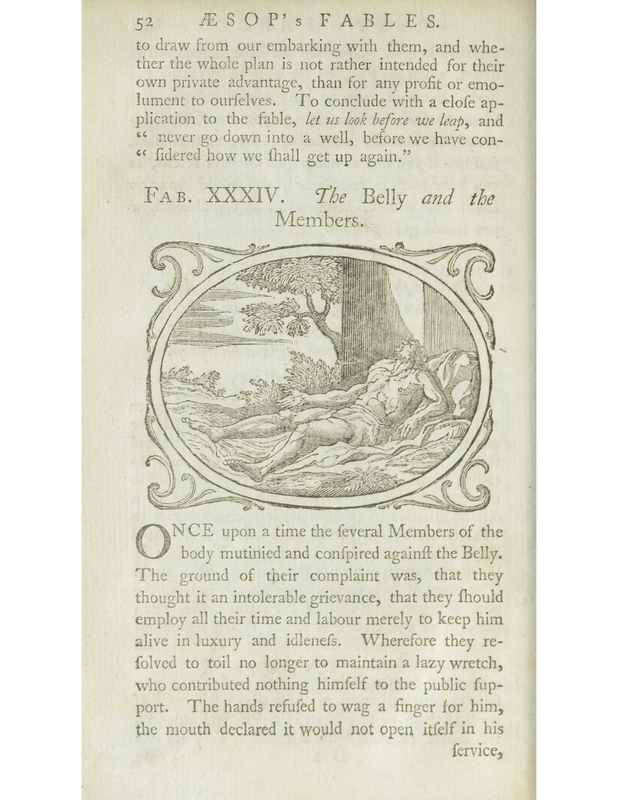
A half-clothed man lies beneath a tree against some rocks. He stares up at the trees above him, with his right hand facing upwards, as if he were to catch something falling from above. In the background stands a few trees with a field seen on the left side of the image.
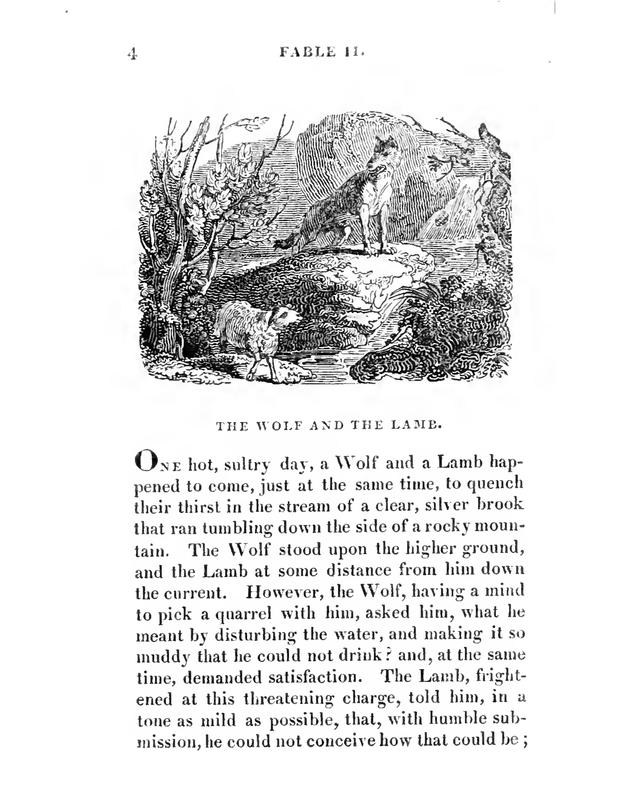
In the forest nearby a waterstream, a Wolf and a Lamb came to ease their thrists. The Wolf stood on a rock of the higher ground while the Lamb was located at some distance from him downstream. The wolf showed annoynance at the Lamb while accusing him as muddenifing the water. Fightened and submissive, the Lamb claimed his stand.
Georgy Osborne sits next to his friend Mr. Todd in the pit of the theater, where they are watching a play. Next to them is Mr. Rowson, Mr. Osborne’s footman and Georgy’s appointed servant, who is holding his cane and has placed his hat under the bench.
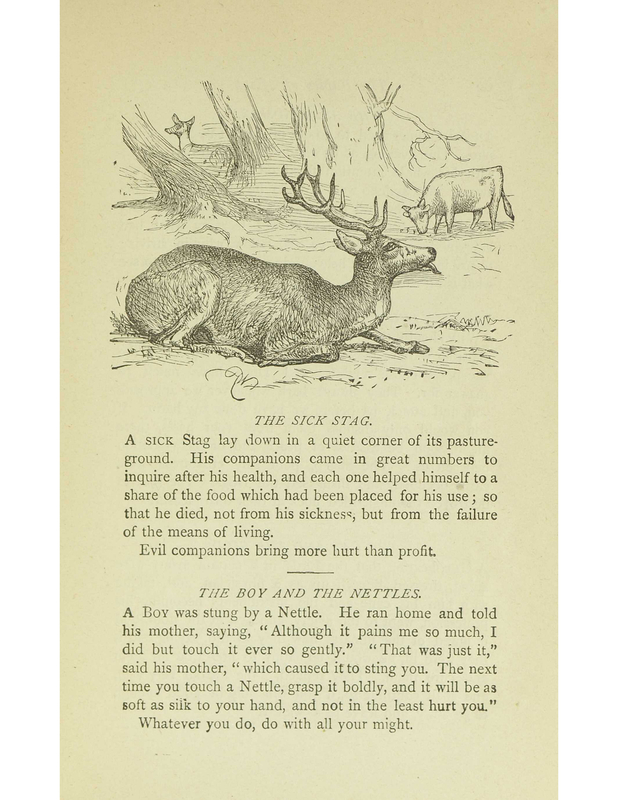
In foreground, a stag is lying down on the ground facing the right-hand side of the image. The stag has its tongue sticking out, as though it is sick. In the background, another stag and a cow are wandering about the trees.
Three people belonging to the Tupinambá Indigenous group are shown; a man, woman and child (possibly a family unit). The man stands in front holding a bow in his right hand and arrows in his left. He wears a necklace and an adornment on his chin and is otherwise nude. The woman stands behind him with one hand on his shoulder and a baby in her other arm. Her hair is long, and she is nude. There is a hammock behind the group.
In this image Lizzy covers a screen around Jane’s bed at Netherfield. After hearing of Jane’s illness, Lizzy walked to Netherfield herself to care for Jane. This scene occurs in chapter 8. The characters are shown in the traditional regency style. Lizzy wears a regency style dress with an empire waistline. The regency period dated to the early nineteenth century (1811-1820) when George, Prince of Wales, later George IV (r. 1820-1830), reigned as regent for his mentally ill father, King George III (r. 1760-1820). The regency period is associated with the rise of neoclassicism in art and fashion.
Two Tupinambá men are shown, each holding a different weapon. One man stands in front of the other, holding a club with feathers on the end in one hand. The man standing behind him points a bow and arrow at something beyond the right edge of the image. Both men are nude and have an adornment on their chin. The man in front has marks (tattoos or paint) on his chest, biceps and thighs. The head of another man from an enemy group lays on the ground behind the men.
The left panel depicts Calisto’s servant Pármeno, who is wearing a hat and has a sword mounted on his belt. To the right, we see Celestina wearing a robe and a veil, with what appears to be a rosary hanging from her waist. Both figures are placed outside.The left panel is identical to those found on pages 60, 173, and 187, and nearly identical to those found on pages 263 (where it is labeled ‘Sosia’), 299 (labeled ‘Pleberio’), and 326 (labeled ‘Sosia’). The right panel is identical to the panel found on the title page, and on pages 70, 114, 208, and 225 of the text.
This page seems not to have scanned properly, and so only the middle of the image is here. The title has also been cut off, and so part of it is speculative. The image presumably shows the champions fighting on behalf of the Cid in a trial by combat against the Infantes and their representatives for their crimes against his daughters. These champions included Pero Bermudez among others, all of whom were victorious in their duels.
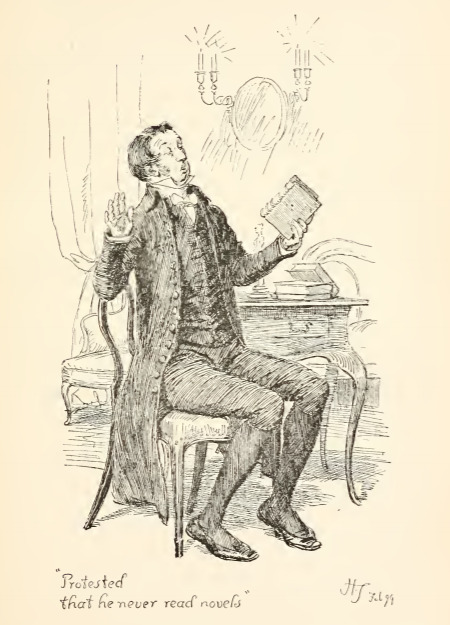
In this image Mr. Collins refuses to read a novel. Mr. Collins’ was Mr. Bennet’s heir, and came to visit Longbourn. While visiting, Mr. Bennet suggested he read out loud to the ladies and offers him a novel. Mr. Collins responds in disgust that he never reads novels, choosing instead a book of sermons. This scene occurs in chapter 14. The characters are shown in the traditional regency style. Mr. Collins wears a waistcoat and tailcoat and holds a book of sermons. The regency period dated to the early nineteenth century (1811-1820) when George, Prince of Wales, later George IV (r. 1820-1830), reigned as regent for his mentally ill father, King George III (r. 1760-1820). The regency period is associated with the rise of neoclassicism in art and fashion.


![[Indigenous Brazilians harvest fruit or nuts for leg rattles]](https://collections.cemvc.ca/files/large/9a0864f0a7296c5e60b2bf3fd44bd0bbdaed7238.jpg)
![[a man is bribed by a politician]](https://collections.cemvc.ca/files/large/b170edfcbf281d46fd01e6b96242be638c209b00.jpg)
![[Gulliver fends off giant wasps on Brobdingnag]](https://collections.cemvc.ca/files/large/0cec7e66e76dfa248d2339e678b0709c018148e7.jpg)
![[Vanity Fair Volume II. Chapter XIV Inhabited Initial, W]](https://collections.cemvc.ca/files/large/133eab09b1e677195a57ae14d5dadf3d98920d68.jpg)

![[Georgy, Todd, and Rowson]](https://collections.cemvc.ca/files/large/c523ed8d4f56653eddeeb5cbdf8b1607d89f34c7.jpg)
![[A Tupinambá man, woman and child]](https://collections.cemvc.ca/files/large/2200d81ef48cfbd86ae67f2d319a3a16866533fa.jpg)

![[Two Tupinambá men with weapons]](https://collections.cemvc.ca/files/large/d7fee196ec50dd67b2861de66902ec3612db44e2.jpg)
![[Act VII – Pármeno and Celestina]](https://collections.cemvc.ca/files/large/de92c5379012dec35448c4d6df0be9ec2db52a72.jpg)
![The Champion[s of the Cid]](https://collections.cemvc.ca/files/large/ec8e044898ed0f19ec1ed4a71e65a95011eb1476.jpg)