Here we see European sailors who found Gulliver in New Holland. The sailors saw Gulliver’s boat in the creek where it was anchored, and went and investigated it, finding Gulliver hiding. Gulliver explained his situation to the sailors who spoke Portuguese. The sailors were startled by Gulliver’s clothes and story, however, they took him in, and brought him back to Europe. The same image appears in the 1843 Krabbe edition.
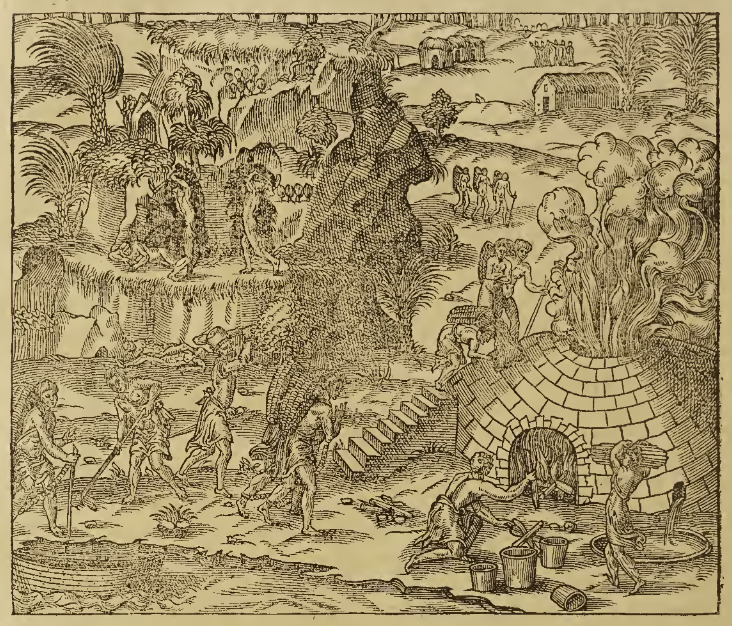
Enslaved Indigenous people work at a mine near the mountain Potosí (Thevet described the mountain as being on an island near Cuba but it was really a mining town in Upper Peru founded in 1545). Some of the Indigenous people mine the ore using hoes, then others carry it in baskets on their backs to a large kiln-like structure where the ore is smelted. A European man wielding a club supervises them and stands poised to swing the club. Large numbers of enslaved and indentured Africans and Indigenous South Americans died working in the silver mines of Potosí. Potosí is found in present-day Bolivia, where silver is still mined. This image is identical to one found on page 984 verso of Paris, 1575 (Chaudière).
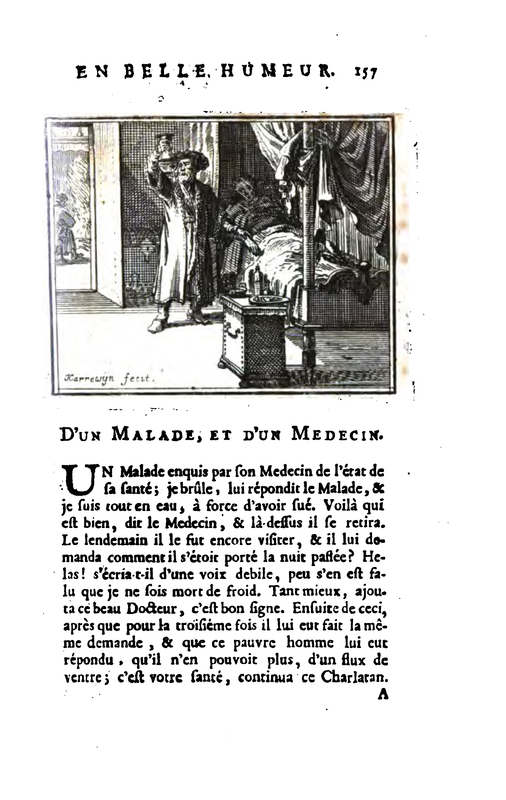
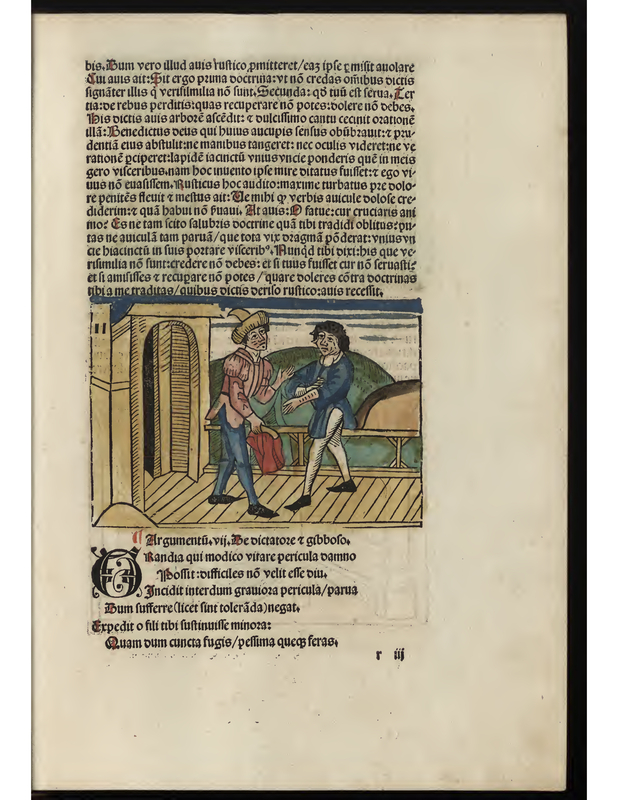
A doctor asks his patient how he was. The patient says he sweats a great deal: the doctor says that this is a good thing. On the next visit he asks the same question, and his patient says he's having shivering fits leaving him cold. The doctor says that this is a good sign too. On the third visit the doctor, as before, asks about his patients health, and the sick man says he felt feverish. The doctor says that this is a very good sign. Afterwards a friend came to see the patient, and on asking him how he is, the patient says he is dying of good signs.
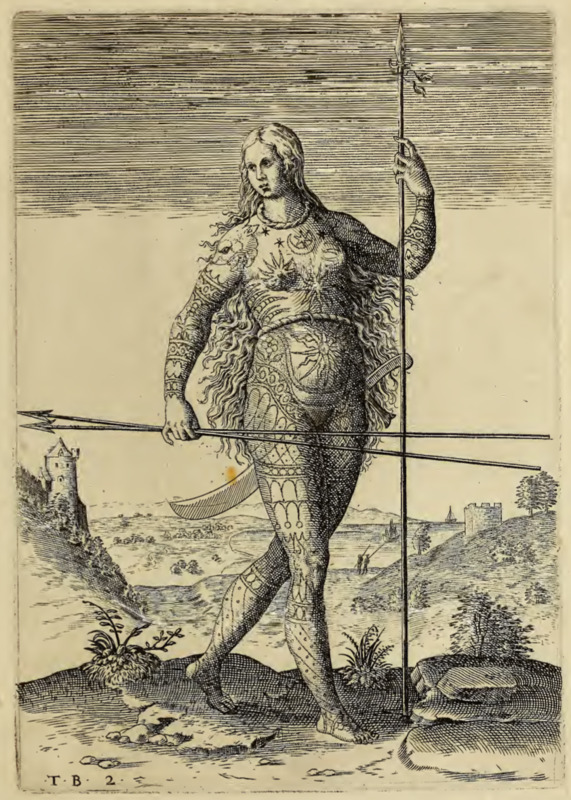
An Indigenous woman is shown from the front. She carries a spear in her left hand and two in her right. Her hair is long, she wears a twisted cord around her neck, and a sword with a curved blade hangs from another cord around her waist. She is nude, and her body is covered in painted designs. The Picts were an Indigenous group who lived in Britain long before the author’s time. Images of Picts were included in this book so that readers could compare their customs to those of the Indigenous people living in Virginia.
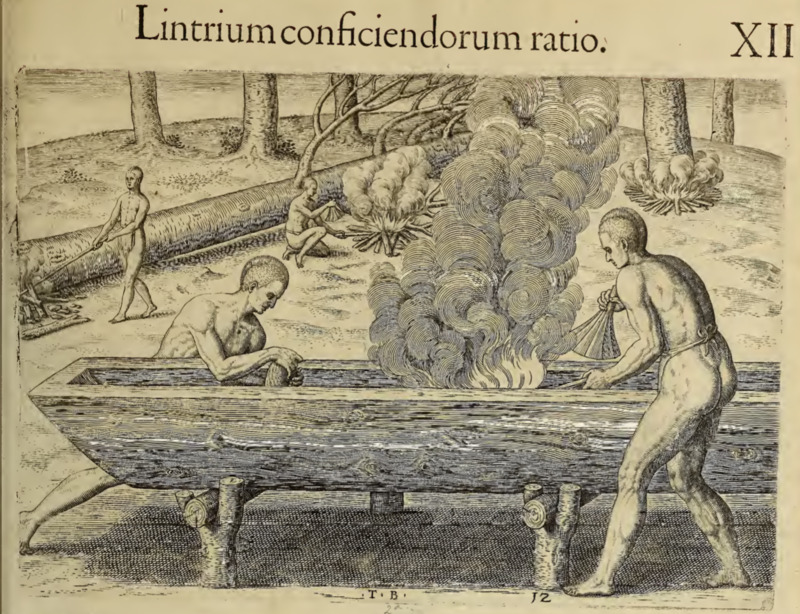
Indigenous men are shown in the process of making a canoe. The canoe they are working on is propped up on log braces. One of the men fans a fire inside the middle of the canoe while the other man scrapes the inside of one end of the canoe. In the background two other men are pictured tending to fires beside a large fallen tree, one at the base and one amongst the branches further up the trunk. There is also a fire at the base of another large tree in the background.
Lady Matilda Southdown, in her bed-gown and nightcap, carries a candlestick and a cup of medicine she has devised through the doorway into Rebecca Crawley’s room.
Gulliver tells us that the Laputan scholars were so wrapped up in their work that they are not aware of what is going on around them. This means that their wives would have affairs right under their noses. In this image we see a Laputan woman flirting with a man, while her husband sits in the background working, not noticing his wife.
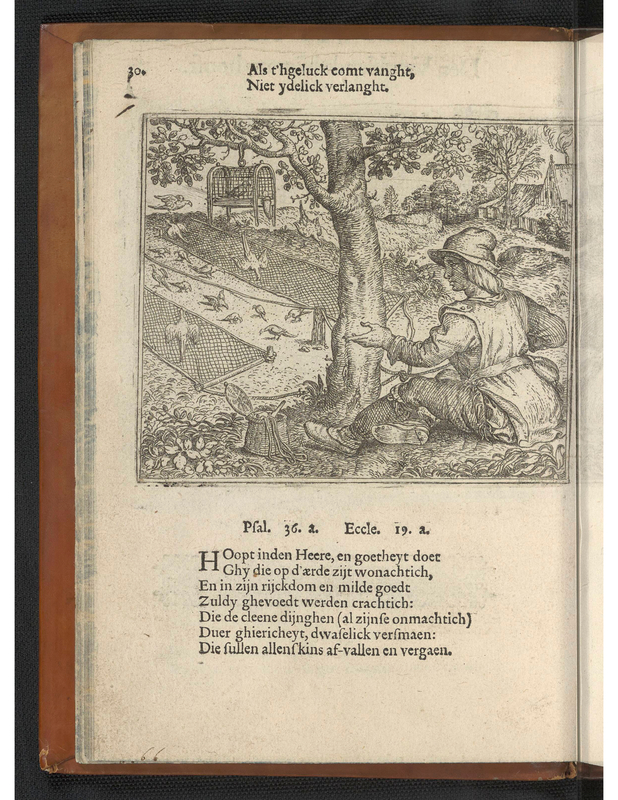
A young man sits behind a tree on a small hill looking down on birds grazing. Two long rectangular nets lie on the ground below the hill. Ropes extend from the nets to the hands of the young man sitting on the hill. The birds unknowingly stand on and around the nets. In the back right corner of the image there is a house with smoke coming from the chimney.
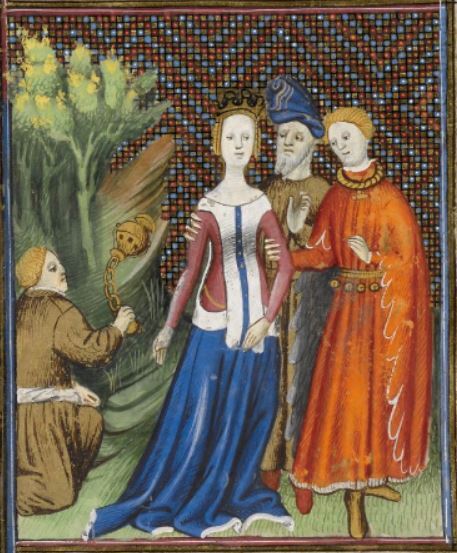
This illumination depicts the goddess Venus standing in the centre of the image, wearing a blue and pink dress. Venus was renowned for her beauty, as well as for her discovery of brothels. There are people depicted surrounding Venus as they admire her incomparable beauty. There is a religious looking man on the left side of the image kneeling and swinging a censer to honour the goddess.
Inside a structure, a group of Indigenous people tend to a sick man. The man stands in the middle of the group with his arms outstretched to either side. Two people each hold one of the sick man’s arms, with the person on the right touching his lips to the man’s arm. Another man stands behind the afflicted man and holds him by the shoulders. To the right, a man wearing a feathered headdress holds a rattle or other ornament over the group. There is a hammock slung between two beams of the structure behind the group, above them a monkey and a bird sit on another beam and a bow and bundles of arrows lie on the ground.
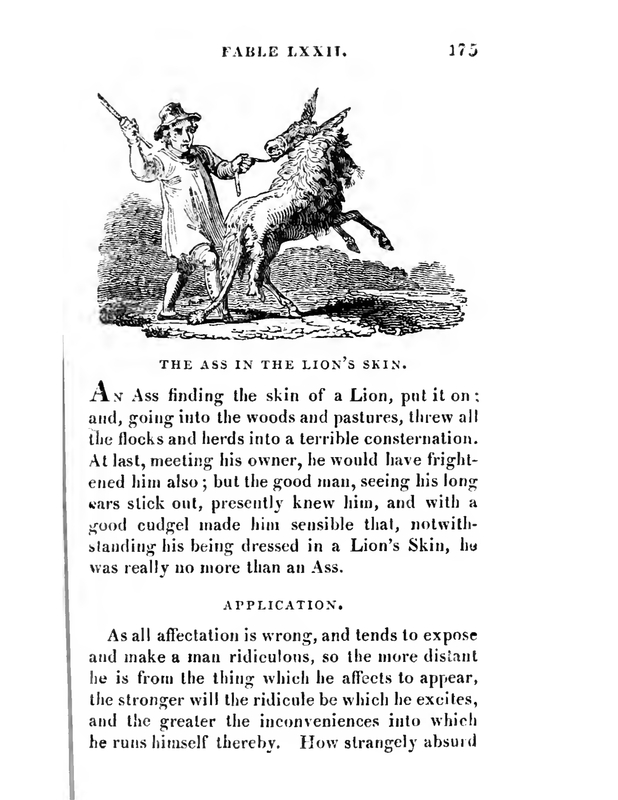
On the left-hand side of the image a man appears to be rearing up to strike an ass. He holds a cudgel in his right hand, and the leash holding the ass in his left. The ass is dressed in a lion's skin. It is on the right-hand side of the image. Its hind legs are planted on the ground while its front legs are in the air. Its head is turned to look at the man. It appears to have a fearful expression.
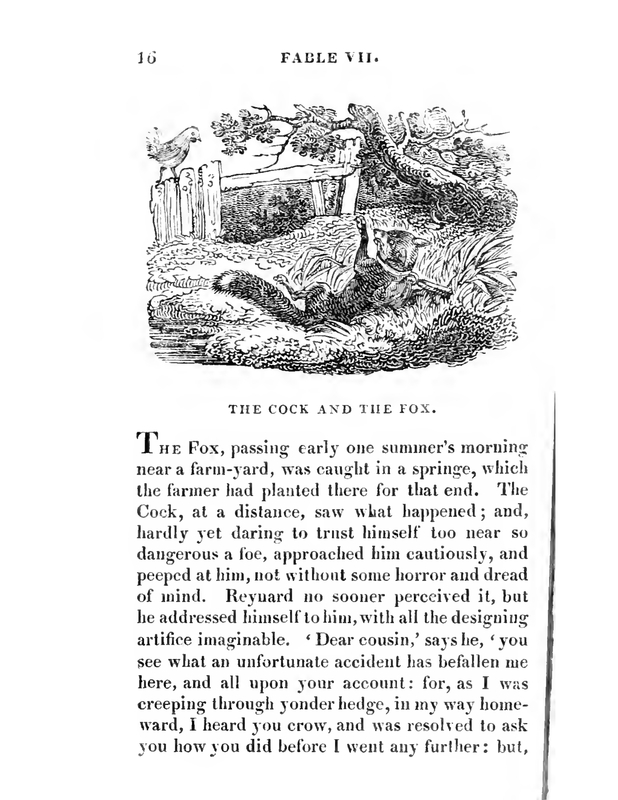
In the bottom of the illustration, A Fox was caught in a springe. His face showed helplessness. On the upper left corner was a Cock. He witnessed what happened standing on the fence.The Cock intended to approach cautiously with some horror and dread of mind.
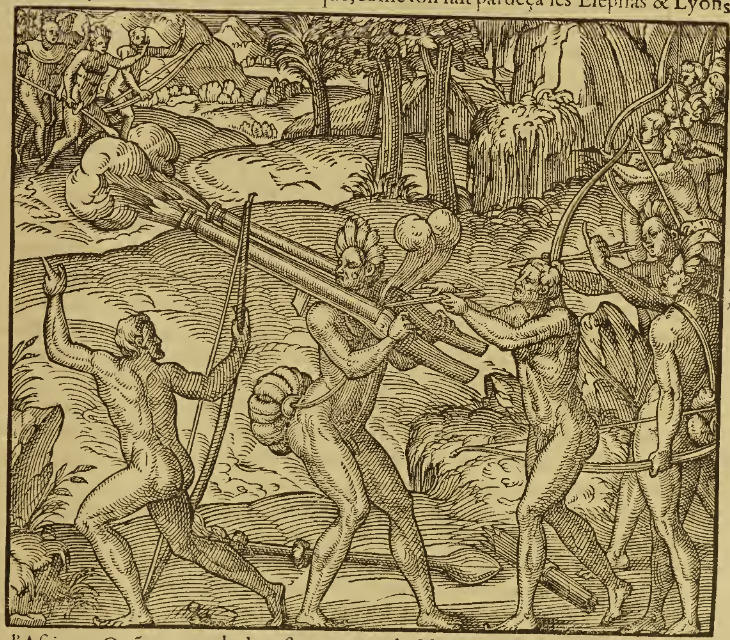
An Indigenous king or chief named Quoniambec (as identified by the author) holds two large guns or muskets, one on each of his shoulders, aiming behind him towards an enemy group. Another Indigenous man lights the fuses on both guns to fire them at the same time. Quoniambec wears a feathered headdress and a round feathered adornment hangs at his back. A decorated war club lays on the ground near his feet. Men of both groups carry bows and arrows and some wear feathered headdress and round adornments. This image is identical to one found one page 952 of Paris, 1575 (Chaudière).
Two men are talking on a deck outside of a building. One of the men who is wearing a hat is also holding what appears to be some kind of garments. There are hills in the background.
Gulliver’s master explained various aspects of the Yahoos that lived in the Country of the Houyhnhnms. He told Gulliver that female yahoos would sometimes stand behind a bush to watch the males, who would later approach her. The same image appears in the 1839 Krabbe edition.
This image depicts some of the thirty-nine comets observed by the Laputans. They were also able to calculate their orbits with accuracy. The Laputan astronomers also wanted to present their theory of comets to the rest of the world. Here we see the planets and several comets that were observed by the Laputans. The same image appears in the 1843 Krabbe edition.
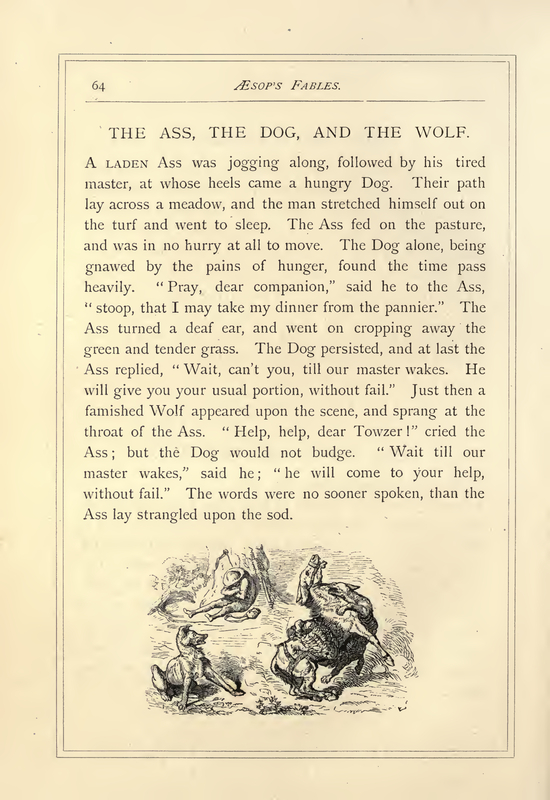
On the right side of the image, an ass is standing on its hind legs, its back curved. A wolf is attacking the ass, biting in its chest. The ass has its head bent backwards and its mouth slightly open in pain. To the left side of the image, a dog siting down, front legs spread out, looks at the ass and the wolf with a scared expression. In the background, a man is sleeping with his back against a tree. His hat covers his face, and he sleeps with his arms crossed.
Here we see Gulliver playing the piano in Brobdingnag. The piano is over sixty feet long, so Gulliver devised a new way of playing using two round bars. Gulliver used this method to play traditional English songs for the court of Brobdingnag. Gulliver stands on a raised bench. The king and queen look over the edge of the piano, watching Gulliver perform. The same image appears in both the 1839 and 1843 Krabbe editions.
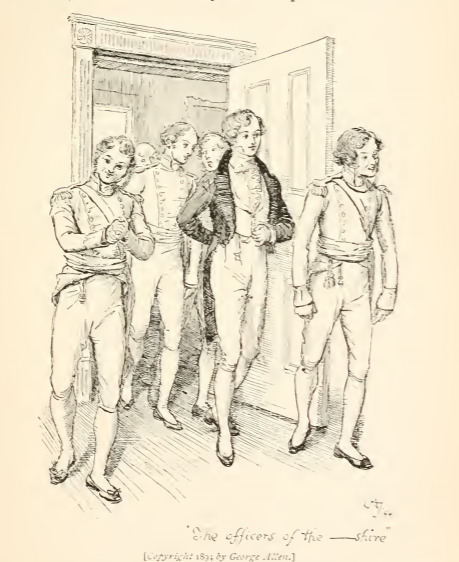
In this image Mr. Wickham and the other soldiers stationed in Meryton walk into a dinner party. Mr. Wickham was in the centre wearing a waistcoat and tailcoat with a cravat and breeches. The other soldiers wear their uniform with a sash and double-breasted coat. Because the others are in uniform, the image suggests that they were on duty, as soldiers would only wear their uniform while they were working and would not be worn while on leave or off duty. These uniforms date to the regency period. The regency period dated to the early nineteenth century (1811-1820) when George, Prince of Wales, later George IV (r. 1820-1830), reigned as regent for his mentally ill father, King George III (r. 1760-1820). The regency period is associated with the rise of neoclassicism in art and fashion. This scene occurs in chapter 16.
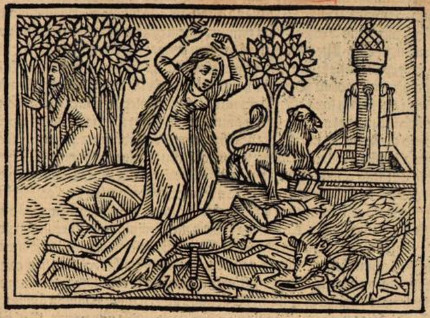
This engraving depicts Thisbe, a young virgin from Babylon killing herself after finding her lover Pyramus already dead. Boccaccio explains that the two lovers were forbidden from being together, so they devised a plan to run away. Thisbe waited for Pyramus by a fountain (depicted on the right side of the engraving) when a lioness suddenly appeared. Thisbe ran into the woods, as depicted in the background on the left side of the image. The lioness, with a blood-stained mouth, chewed on the cloak that Thisbe left behind after running. This is illustrated in the foreground of the engraving. Pyramus had then arrived at the meeting point, only to find the bloody cloak of Thisbe. Believing her to be dead, Pyramus killed himself with his sword. Pyramus is depicted lying on the ground with his sword impaled through his chest. Thisbe found Pyramus as he was dying and impaled herself with the same sword in order to be with her lover.

![[European seamen speak with Gulliver on New Holland]](https://collections.cemvc.ca/files/large/24c7da51089dc6bb749e2b6d8dce6d884f2f3848.jpg)

![[Lady Southdown’s Medicine]](https://collections.cemvc.ca/files/large/0e823170aca2bff0d2d3daf68b12466dbe8d2830.jpg)
![[A Laputan scholar does not notice as his wife has an affair]](https://collections.cemvc.ca/files/large/1ccd821cd98de641c143a8ec9ba0cec924ae6b70.jpg)
![[Practice of caring for the sick in an Indigenous Brazilian community]](https://collections.cemvc.ca/files/large/2adc2da20aed190e7e71a7a46a01e5cc9658dedf.jpg)

![[a female yahoo flirts with the males]](https://collections.cemvc.ca/files/large/ffb543bacea3d8df96875db9bc68aebcd0787146.jpg)
![[comets observed by the Laputans]](https://collections.cemvc.ca/files/large/22ca9af6a7b8bb36d3ca10dc7fee465f14c1d00d.jpg)
![[Gulliver plays piano on Brobdingnag]](https://collections.cemvc.ca/files/large/9cf13a921e0b58dbb326608df30c7bd6ecec349d.jpg)