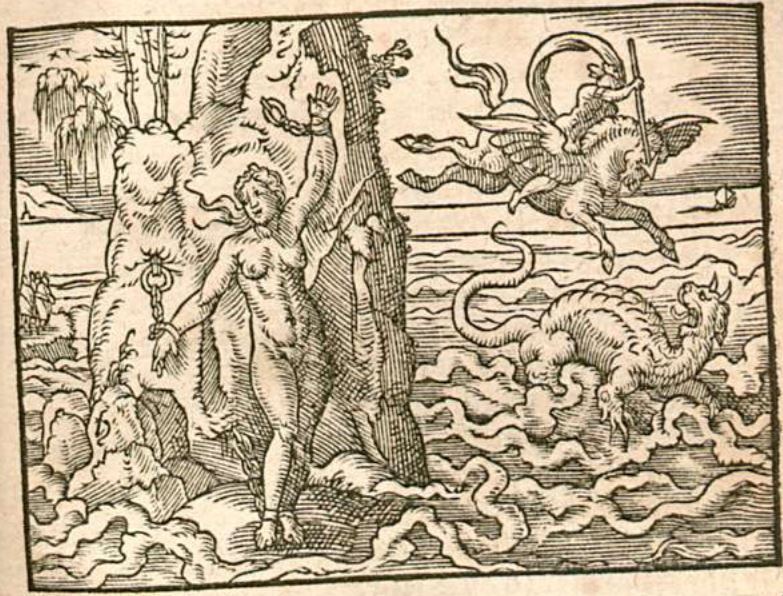
This image illustrates Andromeda, the daughter of King Cephus, chained to a rock in the sea. Andromeda was placed here to pay the penalty for something her mother had said. Perseus had been flying in the sky when spotted the beauty of Andromeda. Perseus asked Andromeda who she was and where she came from, but before she could finish speaking, a serpent had emerged from the sea. Andromeda’s parents agreed that they would allow Perseus to take Andromeda’s hand in marriage in exchange for killing the serpent and saving their daughter. Perseus flew to battle and slayed the monster, freeing Andromeda and taking her hand in marriage.
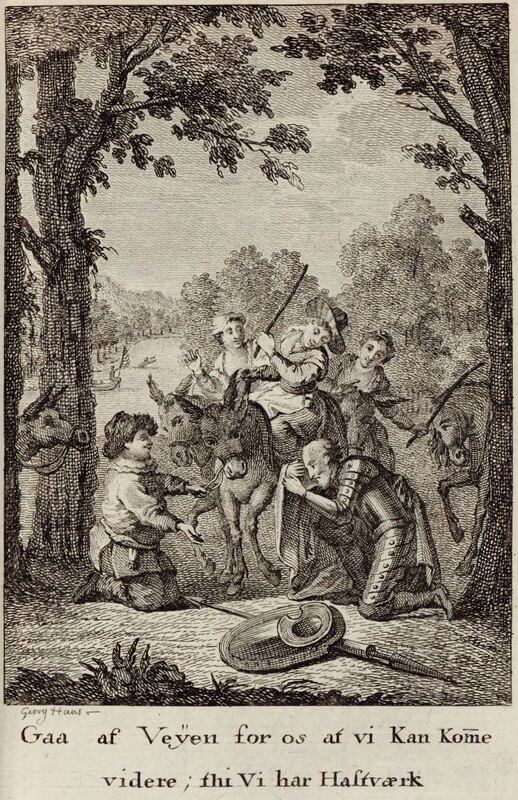
Don Quixote and Sancho Panza kneel before three peasant girls mounted on donkeys. Sancho introduces one of them as the enchanted Dulcinea. While Sancho holds the donkey’s reins, Don Quixote tries to kiss the enchanted Dulcinea’s foot. The landscape in the background includes a lake on which fishermen in boats are depicted. This is likely not faithful to La Mancha’s landscape. Signed by J.-J.-G. Haas (engraver). Part 2, ch. 10.
Don Quixote, choosing to join with Basilios's troop, following his faked death, leave the wedding. Sancho, pictured in a wide hat with his donkey dapple to the right appears sorrowful and overcast, as he can no longer stay and partake of Camacho's splendid entertainment and festival. Drooping and sad, he followed his master taking with him only the skimmings of the kettle, now with only one morsel left. In the background Camacho's town can be seen in outline.
A young woman, dressed in white flowing apparel, kneels on a large black cushion and looks down out of a small barred window. Her reflection is visible in the glass. The image is occasioned by countess Trifaldi saying "The necessary steps were taken; the vicar saw the contract and took the lady's confession; she acknowledged the whole, and was ordered into the custody of an honest alguazil of the court."
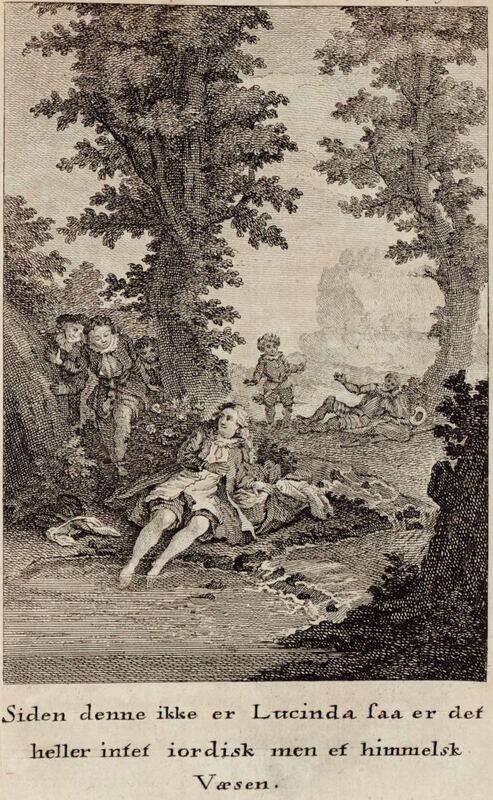
Two scenes are depicted in the illustration. In the first (foreground), the priest, the barber, and Cardenio encounter Dorotea, washing her feet in a stream and combing her hair. The priest is disguised with a fake beard and the barber with women’s clothes. In the second (background), Sancho Panza tries to convince Don Quixote to leave Sierra Morena. Unsigned. Part 1, ch. 28.
Seeking to inquire with Quixote about the islands he was promised, Sancho Panza (right) opens a wooden door with his right hand and waves away the housekeeper (left) with his left hand, turning his head towards her. The housekeeper grabs Sancho's left sleeve with both of her hands and tugs at him with all her weight behind her. Don Quixote's niece (middle) rushes to the housekeeper's side, a troubled look on her face.
Sancho sets out with a great number of followers holding banners, the squire dressed like a magistrate, having on a wide surtout of murrey coloured camlet, and is mounted upon a mule. On the right is led his donkey, Dapple, with a new harness decorated with ribbons. Both creatures are led at the bridle by pages.
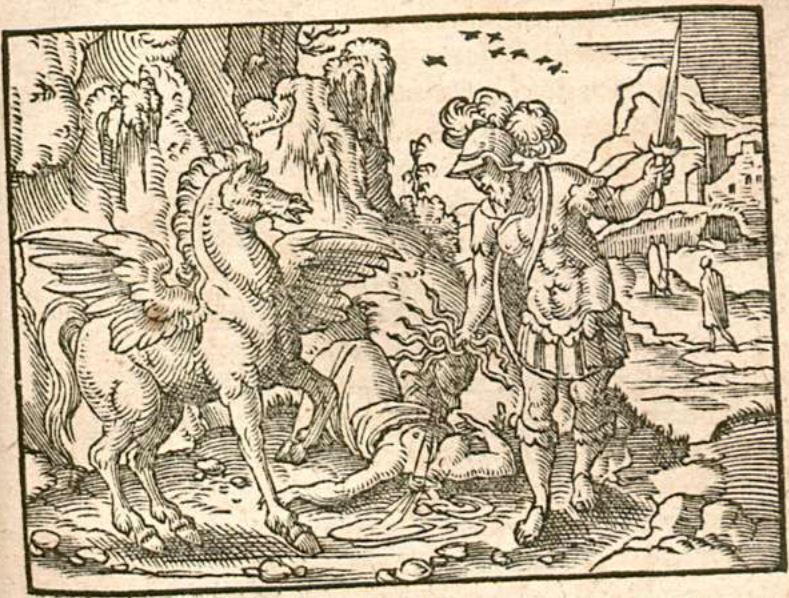
The dinner guests at Perseus’ and Andromeda’s wedding feast beg Perseus to recall the story of how he beheaded the Gorgon named Medusa. He obliged his new companions and recounted the tale. This image illustrates his story, as it depicts Medusa laying on the ground with her head in the hands of Perseus. Perseus had used his bronze shield to reflect Medusa’s gaze so she herself would turn into stone. Pegasus, Perseus’ winged horse is depicted on the left side of the engraving.
Upon seeing a procession of bound men who were carrying on against their will and looked quite unhappy, Don Quixote decided to set these slaves at liberty and free them. While Quixote attacked the guards and confused them, Sancho Panza set to work loosening the bonds of the slaves, beginning with the infamous Gines de Passamonte who immediately went about stealing the guns of swords of the guards, at which point the guards decided to flee. Once the galley-slaves had been freed they gathered round Don Quixote (mounted upon a horse and clad in full armor) to know his pleasure. Don Quixote tells them to present themselves as vassals before his princess Dulcinea in Toboso, but Gines De Passamonte (right) answers for all the galley-slaves and tells Quixote that such a request is impossible for them as all the galley-slaves will henceforth be hunted down by the Holy Brotherhood. Sancho Panza (middle) motions nervously to Quixote that they should depart quickly before the galley-slaves turn against them, which they then do.
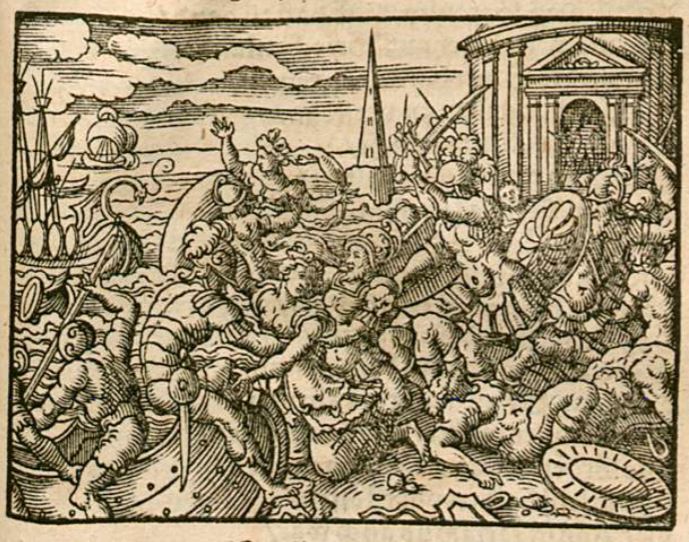
After a ten-year war, the city of Troy is destroyed by the Greeks. There are Greek ships illustrated on the water to signify them sailing towards home once the sacking of the city is complete. The focus of the engraving is the chaos of the Greeks destroying the city before they leave. There are women being taken, one of them being Cassandra, the daughter of King Priam and the head priestess of the temple of Apollo (which is illustrated in the background of the engraving). The other woman being taken is Hecuba, the wife of King Priam and mother to Cassandra.
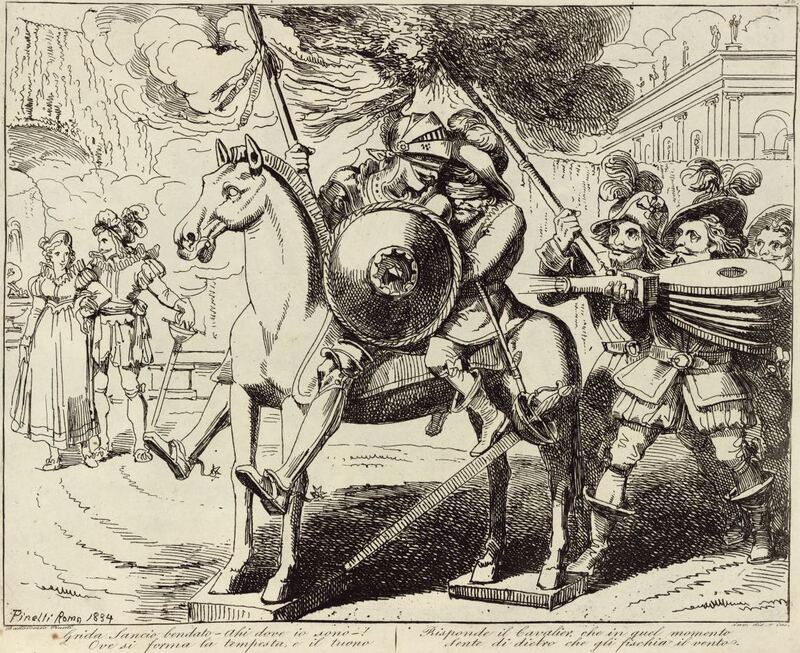
Don Quixote and Sancho Panza, both blindfolded, mount Clavileño while the duchess and duke’s servants simulate its flight with bellows and torches. Signed by Bartolomeo Pinelli (engraver and illustrator) and dated Rome, 1833. Plate 56. Part 2, ch. 41.
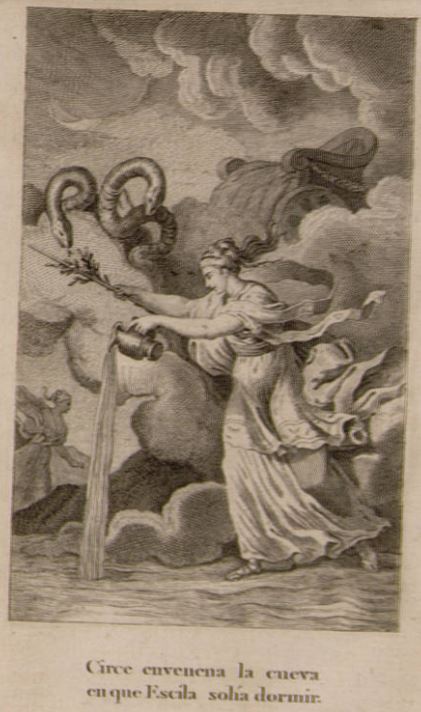
This image depicts the enchantress Circe poisoning a pool of water intended for the nymph Scylla. A sea-God named Glaucus had fallen in love with the beautiful Scylla and asked Circe for her help to get her to love him back. Circe was jealous of Scylla because she loved Glaucus. Instead of helping Glaucus, she let her jealousy overcome her. She poured a poison into a pool of water that was dear to Scylla. Circe is depicted pouring liquid from an amphora into the water with her left hand while she holds magical herbs in her right. Her chariot and snakes are floating on a bed of clouds behind her. Scylla is depicted in the background in her human form before she gets transformed into a monster from the poisonous water.
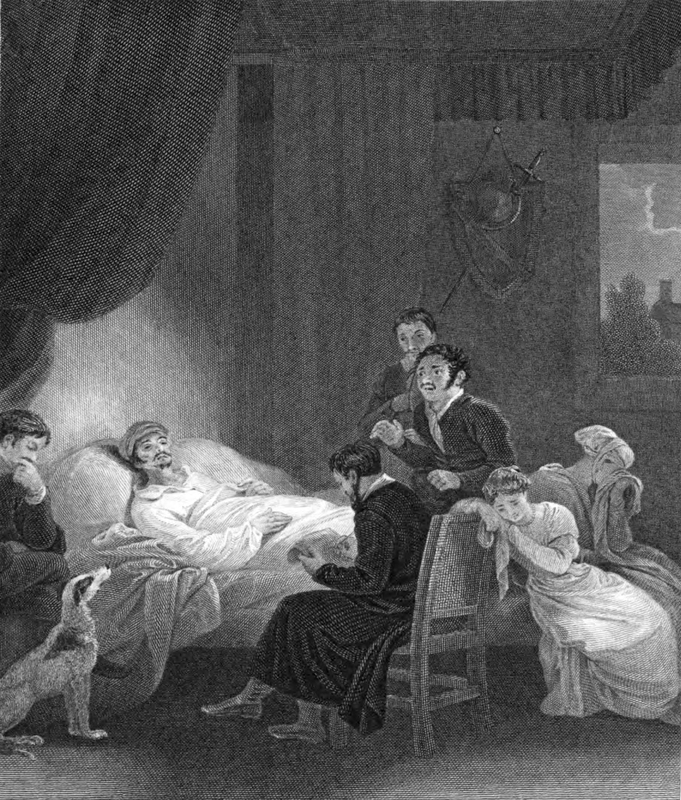
Confined to his bed, Don Quixote stretched himself out at length, nearing death his eyes closed and his hands fell by his side. On the left, the bachelor Samson Carrasco sits cross legged, stroking his moustache with his left hand, and at his feet Quixote's dog sits patiently by its master's bedside. Sitting in a chair at center, the notary to draws up a certificate, stating that Alonzo Quixano has died a natural death. Mourning her uncle's death, the niece rests her head on the notaries chair, and behind her the housekeeper dries her tears on her clothes. On the far side of the bed, Sancho Panza (right) is pictured rushing to his master's side, and to Sancho's left the priest stands straight and pensively strokes his beard.
This engraving illustrates Peleus, Jupiter’s grandson, physically forcing himself upon the sea-goddess named Thetis. Thetis is a shapeshifter and changed forms every time Peleus attempted his advances on her. Peleus eventually sought the help of the sea-god Proteus as she continuously rejected him. Proteus is illustrated in the water in the background of the engraving, with Peleus standing on land speaking to him. Proteus suggested to wait until Thetis falls asleep, and then tie her up and hold her tightly until her shape-shifting returns her to her normal form. This is illustrated in the foreground of the engraving, as Thetis is depicted with her head in human form and her body in the shape of an animal with a chain wrapped around her body. Peleus is illustrated with his arm around her. Thetis eventually gives birth to the mighty Achilles.
Having dismounted his horse, a page approaches some women washing in a brook. He is a young man who lowers his hat in his right hand to introduce himself to them while in his left hand he holds a horse whip. The four women washing clothes in the brook look up at the figure from their knees, their sleeves rolled up to their elbows.
Three men enter the garden clad in mourning-robes, so long that they sweep the ground, the bearded one on the right beating a large black drum with two sticks, the moustached man on the left blowing into a flute. In the middle kneels a a personage mantled with a black robe that trails along the ground. His face was covered with a very lengthy white beard that reached beyond his knee. In his right hand he held a large scimitar that touched the ground. In the background, there is a fourth and final courtly bearded man with a tall plumed hat.
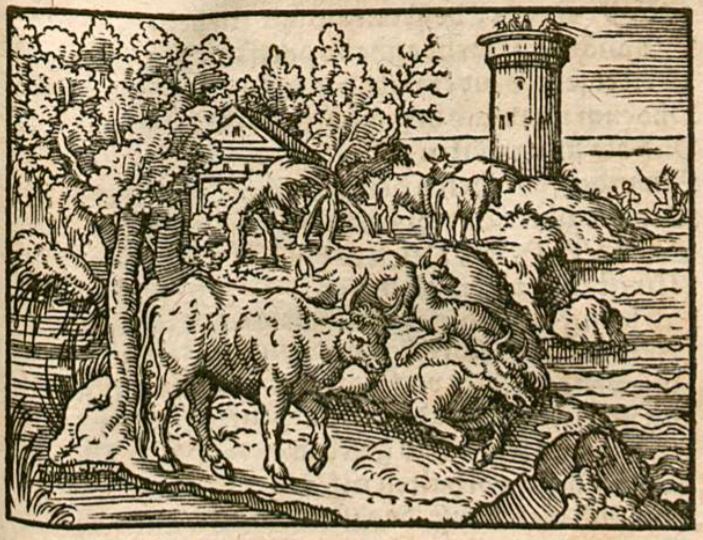
This engraving illustrates a wolf on the banks of a shore emerging from the waters, attacking a herd of cattle. The wolf is thought by Peleus to have been sent by the Nereid, Psamathe, in punishment for killing his half-brother (and Psamathe’s son), Phocus. Peleus prays to the Nereid in attempt to stop the wolf from ravaging the cattle and the herdsmen. This is illustrated in the background of the engraving, as the sea-goddess is emerged out of the water and Peleus is depicted standing on land facing her. Psamathe does not listen to Peleus’ prayers and allows the wolf to continue ravaging the cattle. Peleus’ wife, Thetis, convinced Psamathe to forgive Peleus and to stop the wolf by turning it into stone.
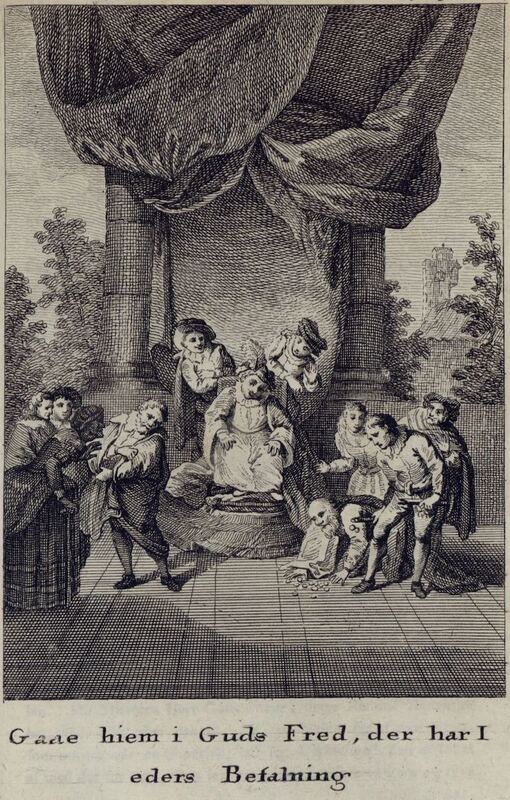
Sancho Panza, governor of Barataria Island, orders that the staff be broken, spilling the coins that were hidden inside. The plaintiff (left) and the defendant (right) are pictured standing before Sancho’s throne, which is at the foot of two columns obscured by large drapes. Unsigned. Part 2, ch. 45.
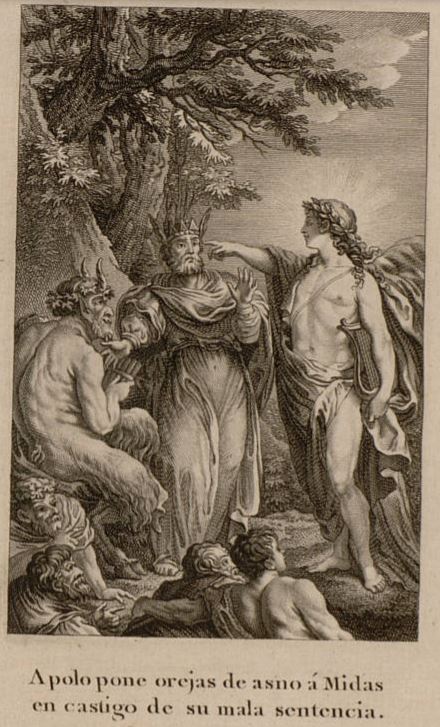
This image depicts the god Apollo transforming King Midas’s ears into the ears of a donkey. Apollo is on the right side of the image with a laurel wreath on his head and his lyre in his left hand. He’s using his right hand to point to King Midas who is standing with his arms up in defense as donkey ears begin to grow on the side of his head. The god Pan is sitting on the left side of the image holding his reeded pan pipe. Apollo and Pan had a contest to see who was better at playing music. King Midas chose Pan as his winner and Apollo punished him for this decision with the donkey ears.
The countess Trifaldi, who is older in age, falls to her knees and utters a word in heart-rendering voice dressed in black robes and a long black veil lifted over her head. The image is occasioned by the countess Trifaldi calling for Malumbruno to return Clavileno.
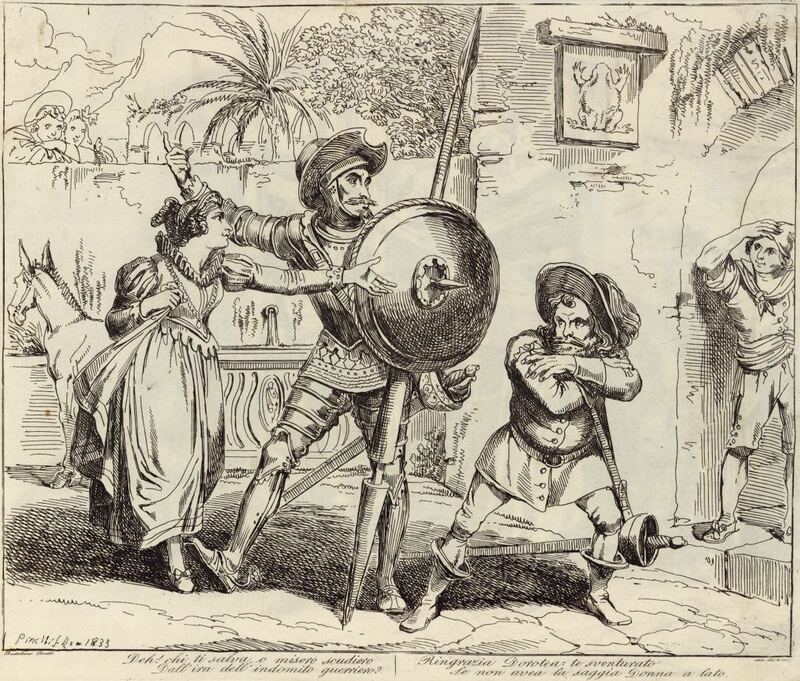
At the inn, Sancho Panza suggests that Mimicona (Dorotea) is not a genuine princess, provoking Don Quixote. The knight is infuriated and tries to punish him. Dorotea, who understands Don Quixote’s madness, tries to pacify him by claiming that Sancho Panza saw illusions that offended her good name. Signed by Bartolomeo Pinelli (engraver and illustrator) and dated Rome, 1833. Plate 34. Part 1, ch. 46.
In the midst of a grove, Don Quixote (right) accommodates himself at the foot of an elm, and Sancho face first at the foot of a beech, seeking a position to least renew the pain of his bruises. Don Quixote crosses his arms and spreads out his legs, spending his time it in meditations, with his shield and spear by his side.
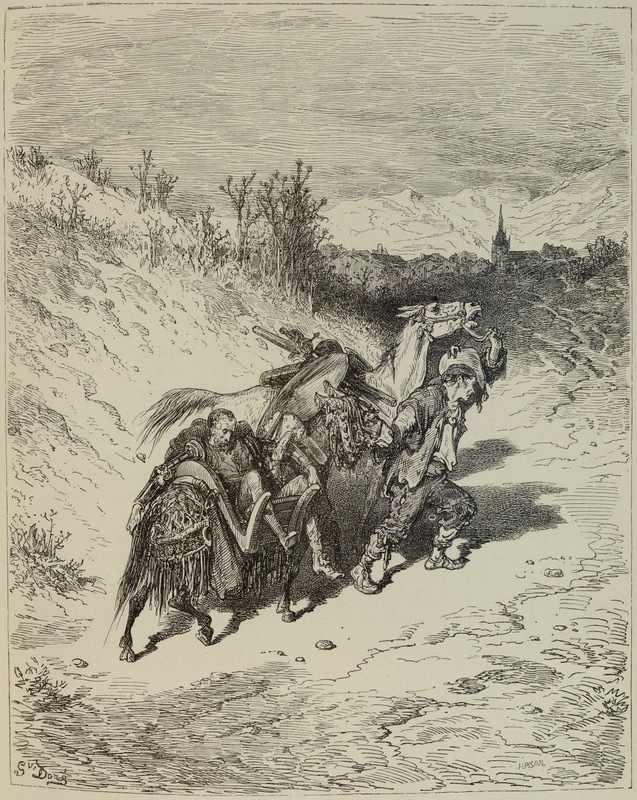
As Don Quixote recites the ballad of the Marquis of Mantua, a farmer from his village passes by, a neighbour of his on the way home after taking wheat to the mill. Pedro Alonso, recognising his neighbour Alonso Quijana, gathers his arms and the broken pieces of his lance and ties them to Rocinante. Lifting Don Quixote onto his donkey, he leads it by its halter and Rocinante by its reins toward the village. Signed by G. Doré (illustrator) and H.-J. Pisan (engraver). Part 1, ch. 5.
At Juan Palomeque’s inn, Sancho Panza, the priest, and the innkeeper discover Don Quixote attacking the wineskins while sleepwalking. He is half-dressed, has a blanket draped over his arm, and wields his sword. The wine from a punctured wineskin spills onto the floor in the foreground. Signed by A J.-J.-M. Devéria (illustrator) and A. J. Simonet, jeune (engraver). Part 1, ch. 35.
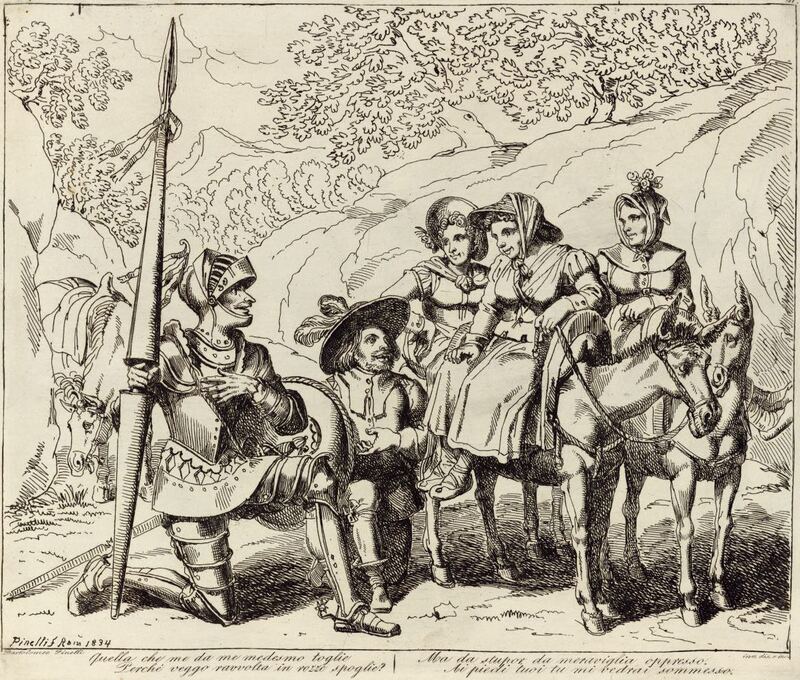
Don Quixote and Sancho Panza kneel before three peasant girls mounted on donkeys. Sancho introduces one of them as the enchanted Dulcinea and Don Quixote tries to kiss her foot. Signed by Bartolomeo Pinelli (engraver and illustrator) and dated Rome, 1833. Plate 41. Part 2, ch. 10.

![[Of How Sancho Was Miserable at Leaving Camacho's Care and Hospitality]](https://collections.cemvc.ca/files/large/a5c8d529cc668baada588be7fe4a3bd78b264516.jpg)
![[Antonomasia in Custody of the Court]](https://collections.cemvc.ca/files/large/9e59fb75357577c1467ecad518ede9034fcd456c.jpg)
![[The Housekeeper Defends Quixote's House from Sancho]](https://collections.cemvc.ca/files/large/39a5feecb5cf4eb5db06ee1927070523ea750a5c.jpg)
![[Sancho Sets Out to His Governance]](https://collections.cemvc.ca/files/large/0a2347c5d56c75505715086da013d95b52987c5c.jpg)
![[Having Been Freed, the Galley-Slaves Gather Around Don Quixote to Know his Pleasure]](https://collections.cemvc.ca/files/large/fe66fec7b9c478fae1e992ed6679cb5a7f1c7a6e.jpg)
![[Peleus Forces Himself Upon Thetis]](https://collections.cemvc.ca/files/large/5450a4dfbf4f00d69a5809b7f2f81af274457aba.jpg)
![[The Duchess' Page Meets Some Women On the Outskirts of La Mancha]](https://collections.cemvc.ca/files/large/71451f5954fb70ec46b4bc6135961d3fd62a7575.jpg)
![[The Squire and Company of the Countess Trifaldi]](https://collections.cemvc.ca/files/large/98a8fea422ac2d26273cefeaabd14b8a5fbc4481.jpg)
![[The Countess Trifaldi Calling for the Return of Clavileno]](https://collections.cemvc.ca/files/large/4a061c1595248f2ef32bfe50b1312027d3471222.jpg)
![[Don Quixote and Sancho Panza Rest Beneath Trees]](https://collections.cemvc.ca/files/large/508f1cbb24e9a9fd541c0b57eee0ef49d7ebbdc2.jpg)
![[Don Quixote attacks the wineskins]](https://collections.cemvc.ca/files/large/924bdb8649f549ccb4ae0a447aec6628d6a6eb27.jpg)