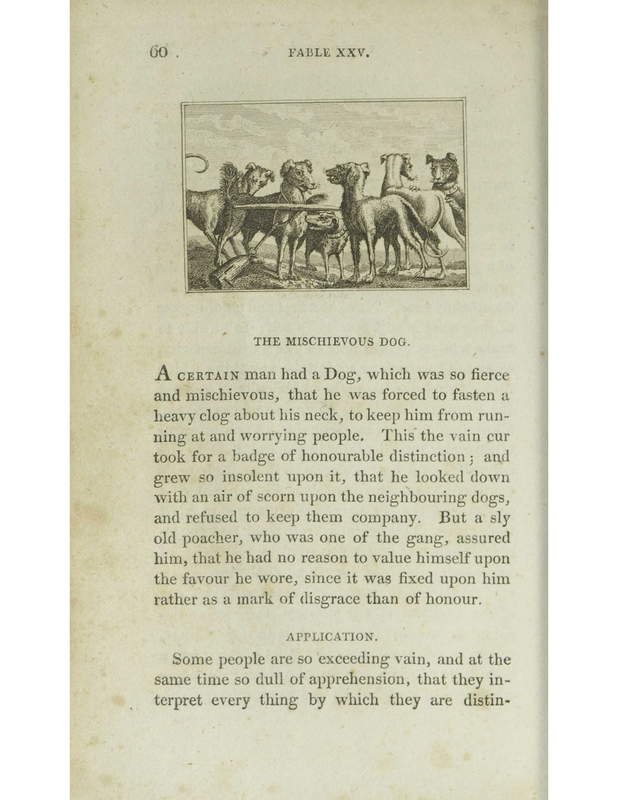
To the right of the image there is a mouse, to the right of the mouse are four weasels. The mouse and weasels are surrounded by grass and hills. In the upper middle of the image there is a large bunch of wheat.
A group of Indigenous Tupinambá people is shown preparing to execute a captive man. The captive man is restrained by a rope tied around his waist, with two men holding either end of the rope, and his hand is raised in a gesture of protest against his impending death. Another man swings a club above the head of the captive. To the left a man lays on the ground with a woman kneeling next to him. To the right, a man stands holding a bow with one hand and gesturing with the other. A crowd of Indigenous people holding bows stands in the background.
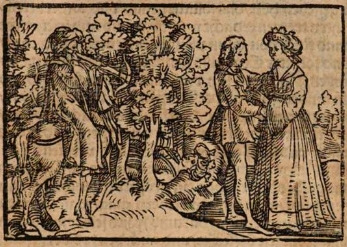
When Cephalus was told that his wife (Procris) would abandon him in exchange for money and treasures, Cephalus began testing his wife. Cephalus would disguise himself and offer her gold and treasures in exchange for her love. This scene is depicted on the right side of the engraving. Procris rejected the disguised Cephalus multiple times, however, she eventually accepted his treasures. In this scene she is touching his chest as she looks at him. Cephalus is depicted with his arm touching Procris’ arm. Procris ended up regretting what she had done to her husband. To punish herself, Procris went to live in the woods. Cephalus had been hunting one day and had mistaken his wife for an animal and shot her. Procris is visible between the trees fallen to the ground after being shot by Cephalus. Cephalus is on the left side of the engraving on horse-back as his crossbow is leveled to his eye.
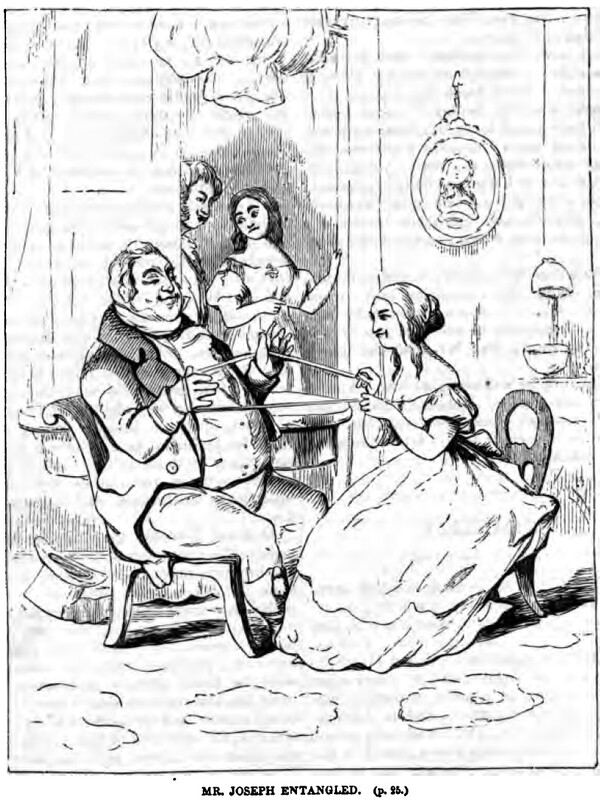
Joseph Sedley and Rebecca Sharp sit at two chairs in front of a round table; she holds both ends of a string of silk which is wound around his hands. Beneath the table is Joseph’s hat, and in the background are another table with a lamp and bowl and a portrait upon the wall. Amelia Sedley and George Osborne are entering through the doorway behind the round table at which the others sit. All four look pleased. Below the illustration is printed its title and location in the story, MR. JOSEPH ENTANGLED. (p. 25.).
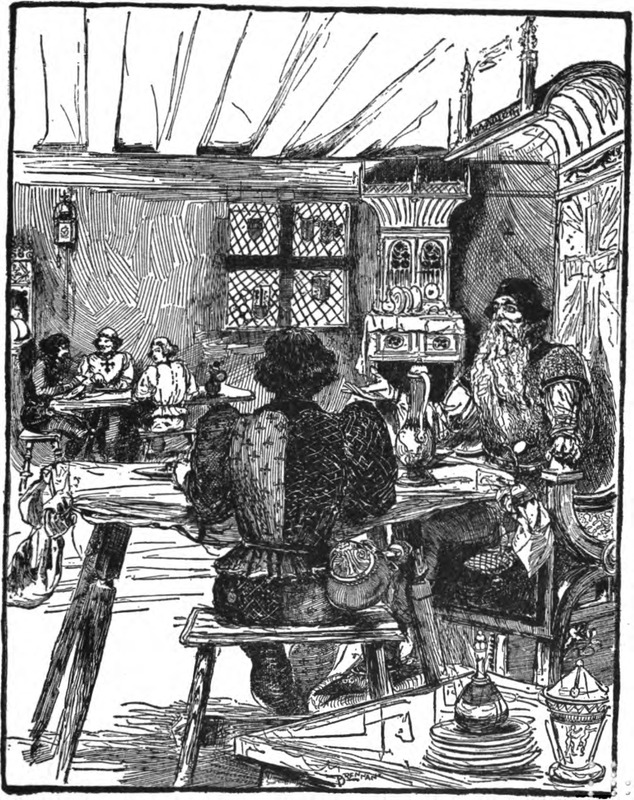
Martin Pelaez was a noted coward. One day, after he snuck away from a battle, the Cid had him sit at his table for dinner rather than with the rest of the knights. This was an attempt to shame Martin into acting more courageously, as eating at the leader’s table would normally be an honour but was something Martin clearly did not deserve. This ultimately worked, with Martin becoming a brave knight.
Perseus, wearing a red cloak, is seen seated on the winged horse Pegasus, inside of a boat that brings him to land. Pegasus represents both the emblem of the ship that Perseus rode, but also the mythical tale in which Perseus rode Pegasus the winged horse to fly to Medusa’s kingdom. Perseus was seeking Medusa because he heard of her beauty that was known to render men motionless. Medusa, wearing a blue gown and crown, is seated on the bank of the shore.
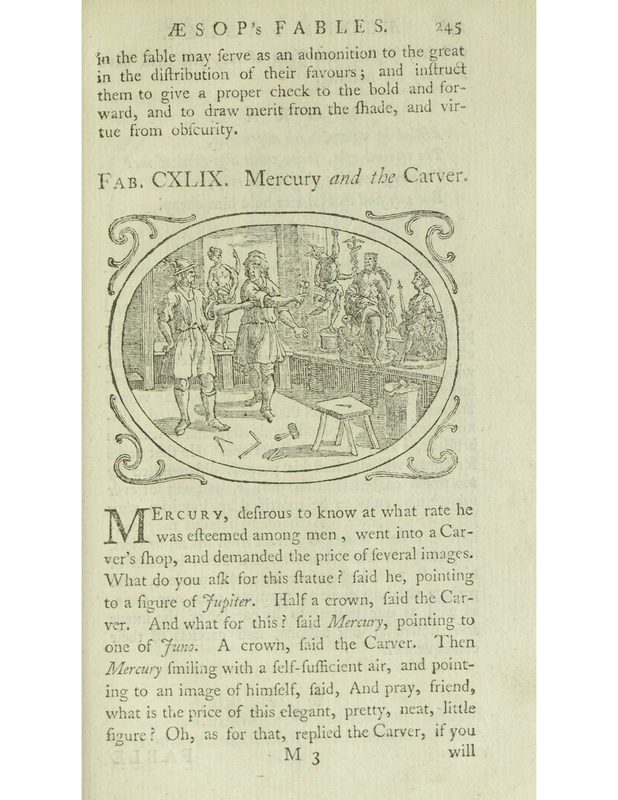
The scene is taken indoors, 2 men (Mercury and Carver) are in Carvers shop, they are both pointing at a statue in the image and are discussing prices about Mercury wanting to buy some of them. There are multiple statues on a table and other tools and objects on the ground, there is also a chair on the ground and what looks to be a garbage can. Behind the two men there seems to be a large opening or window looking outside.
Two Tupinambá people – a man and a woman – and a European man are shown. The woman has long hair twisted into two braids and is nude. She crouches on the ground with her hands over her face, seemingly in emotional distress. The European man sits in a hammock, also holding a hand over his face in a display of emotion. There is a bucket on the ground under the hammock. Behind the two, the Tupinambá man balances a bow and arrow in one hand and holds a knife against the end of the arrow in his other hand.
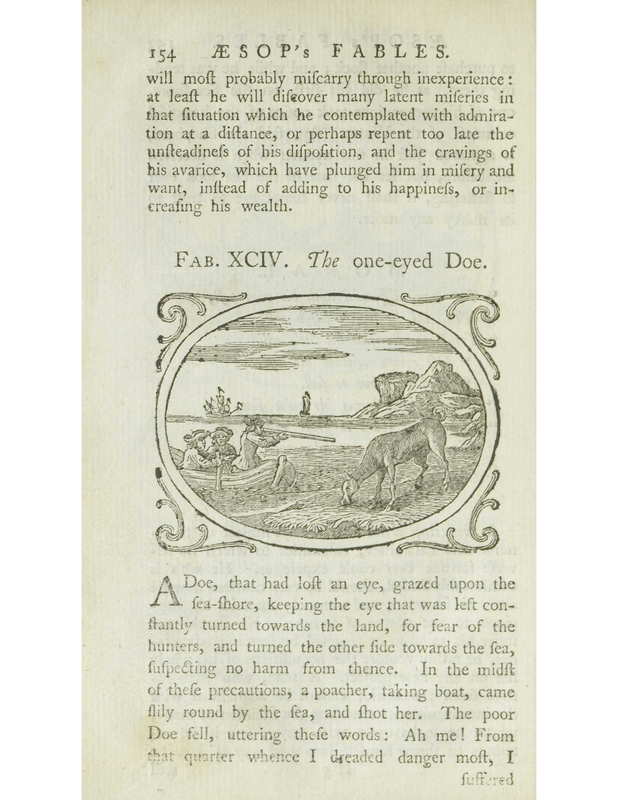
A doe is grazing on a bank while a row boat containing three men approaches. One of the men has a long gun pointed towards the unassuming doe. In the background, there is a large ship and a rocky mountain.
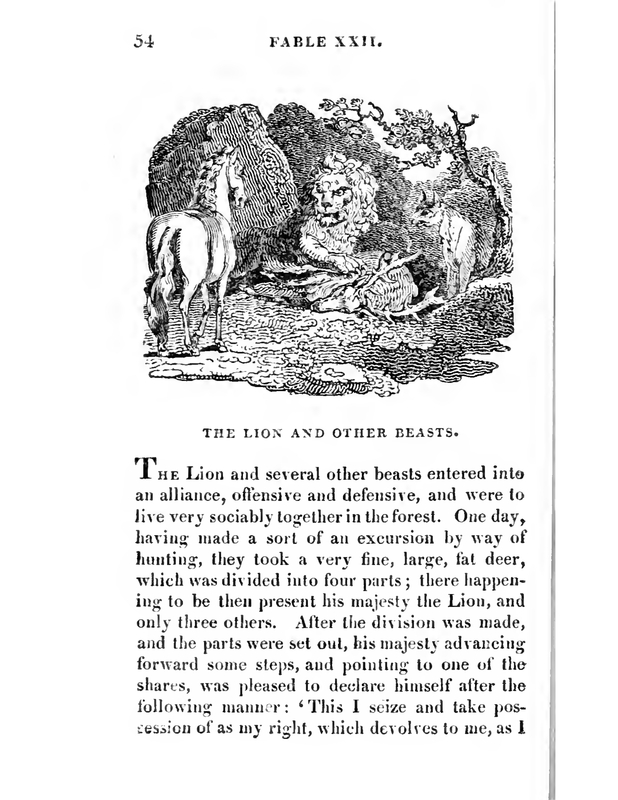
In the center of the illustration, a Lion hovered over a dead dear. The dear laid on the gound lifelessly with his head down pointing towards the left and eyes opened. The Lion had his right paw on the dear's neck. His face was fueled with fierceness, frowning looking to the left. On the left was a Horse with the same facial expresseion, facing the Lion. His front left leg was bent and positioned to approch. On the right of the Lion, a Wolf stared at the dear ravenously yet with no sign of approaching.
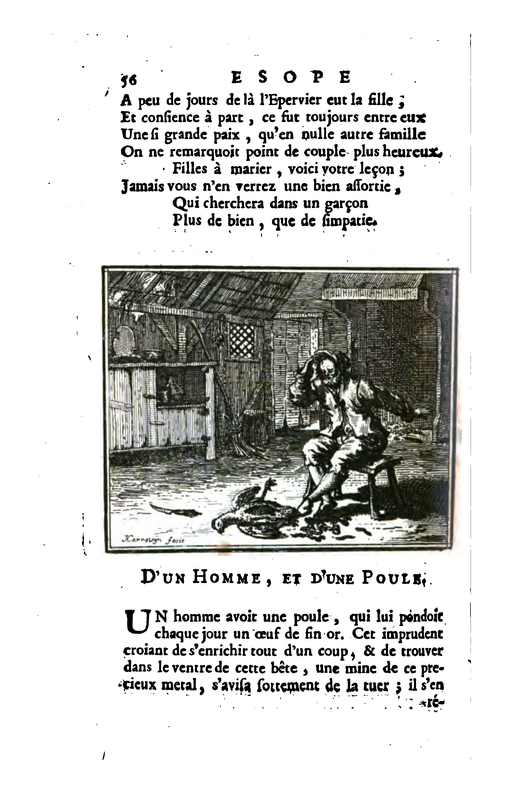
A man had a hen, who laid an egg of fine gold every day. This imprudent man, believing that he would suddenly become rich, and that he would find in the belly of this beast a piece of this precious metal, foolishly avidly killed it.
Here we see a tooth that was pulled from one of Glumdalclitch’s servants. Gulliver gave the tooth to the captain of the ship that rescued him. Gulliver’s hat and a plate are on the table next to the tooth to show the size. Gulliver stands in the background, with his back to the viewer. The same image appears in the 1843 Krabbe edition.
Here we see Gulliver as an old man. He imagines how he would spend his life if he were born immortal like some individuals on Luggnag. He begins by saying that he would make himself rich by all arts and other methods. By proper management of his money, he estimates within two hundred years he would become the richest man in the kingdom. The second thing Gulliver says he would do would be to apply himself to learning all the arts and scientists. Finally, he says he would record every consequential event and their outcomes, specifically changes to customs, language, dress, and diet. He would do this to become a living treasury of knowledge, thus making himself the Oracle of the Nation. The same image appears in the 1843 Krabbe edition.
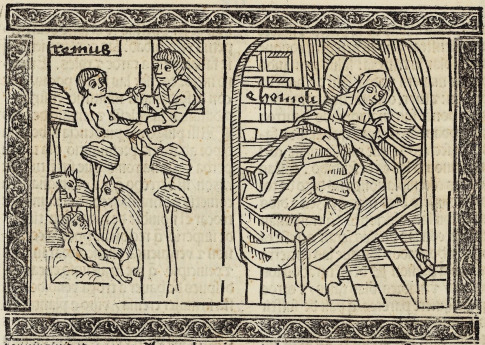
The vestal virgin Rhea Ilia is depicted on the right side of the engraving, lying in a bed with her eyes shut. We know that this is Rhea as her name is engraved beside her body. She has a saddened expression on her face as she had just given birth to twin boys named Remus and Romulus who were forced to be exposed. Boccaccio explains that as a vestal virgin, she was forbidden from becoming pregnant. Her son’s Remus and Romulus are depicted on the left side of the engraving being exposed through the window. Remus's name is engraved at the top left-hand corner of the image. There are wolves surrounding Romulus as the mother wolf ends up raising the boys as her own. Rhea is buried alive for her punishment.
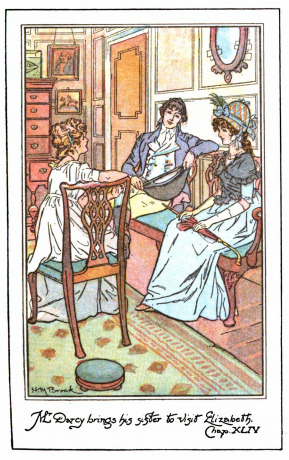
Here we see Mr. Darcy introducing Elizabeth to his sister, Georgiana. Elizabeth went on vacation to the north of England with her aunt and uncle, and visited Mr. Darcy's estate, Pemberley. He arrived at Pemberley unexpectedly, and he met Elizabeth while she was touring the gardens. He then offered to introduce Elizabeth to his sister, Georgiana, shown here. Elizabeth and Darcy sit on a couch, and Georgiana sits sideways on a chair opposite Elizabeth. Elizabeth wears her bonnet and holds her parasol. She also wears white gloves. Georgiana is dressed less formally. This scene occurs in chapter 46 as noted underneath the title of this image. The characters are shown in the traditional regency style, with Mr. Darcy wearing waistcoat, tailcoat, and knickers that stopped at the knee. Elizabeth and Georgiana wear the regency style dress with an empire waist. Their hair is worn tied up, as was tradition for women after their coming out before the queen, signaling her entrance into society. Elizabeth wears a bonnet, a popular fashion of this period to protect her from the sun. Bonnets were especially popular because in this period a common pastime for women was going out on walks. The regency period dated to the early nineteenth century (1811-1820) when George, Prince of Wales, later George IV (r. 1820-1830), reigned as regent for his mentally ill father, King George III (r. 1760-1820). The regency period is associated with the rise of neoclassicism in art and fashion.
In this image we see Gulliver and Glumdalclitch – the daughter of the farmer, who became Gulliver’s nurse. Gulliver kneels on a cushion, and hands Glumdalclitch his sword. A small sleigh bed that Glumdalclitch made for Gulliver is in the foreground, with Gulliver’s clothes lying on the ground. Glumdalclitch wears a dress with laces in the front, and a cap with her hair coming out from the bottom. The same image appears in the 1843 Krabbe edition.
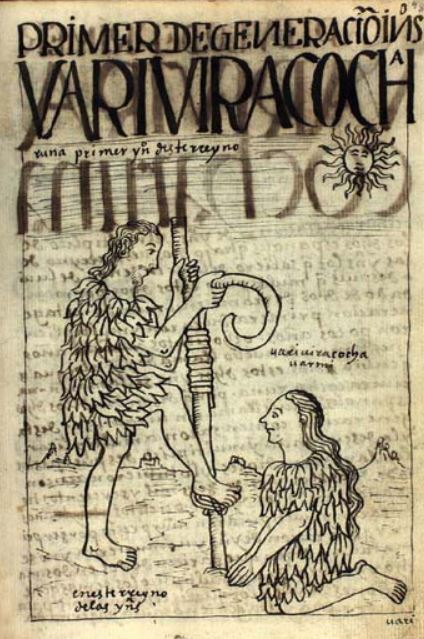
This illustration represents the first indigenous population of Peru, who, according to the author, were believed to have been sent there by God himself after the great flood. Guaman identifies these indigenous people as the Wari Wiracocha Runa. There is a man depicted on the right side of the image making a weapon, and a woman on the right kneeling down. There are words written above the woman’s head which reads Uari Uira Cocha uarm which is Wari Wirachocha Runa, the name of the indigenous people. There are more words written below the man’s feet which reads, en este rreyno de las Yndias. This translates to in this kingdom of the Indies.
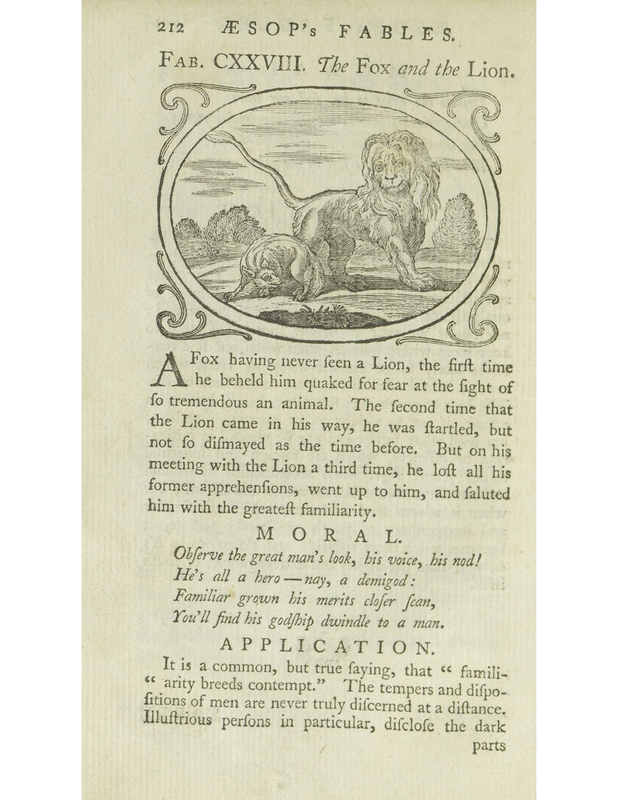
The scene is taken place outside in a field, in the background there is multiple trees and bushes along with other smaller plants around the area. There is a Fox and Lion standing next to eachother, the Lion went up and greeted the Fox, but the Fox never seeing a Lion before got scared.
Here Gulliver watches as the barber shaves the King of Brobdingnag. Gulliver then took the stubble from the King to make himself a comb, as his was missing several teeth. In this image Gulliver stands beside the bowl, and a straight razor sits in front.
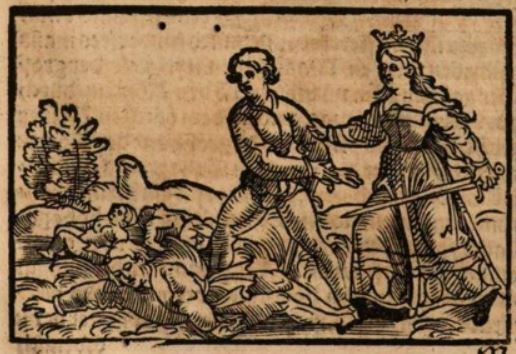
This engraving depicts Berenice, the queen of Cappadocia, about to stab a servant in his abdominal area to avenge her sons’ deaths. After her sons had died at the hand of her brother, Mithridates, Berenice sought vengeance against him. The slave that Berenice is stabbing in this engraving is Caenus, a man who was involved in the murder of her sons. Although she is depicted stabbing him with a sword in this engraving, Boccaccio explains in his story that she actually chased Caenus down in a chariot, and after hitting him in the head with a rock, she drove over his body with the chariot until he died. The dead figures in the engraving who are lying on the ground are assumed to be Berenice’s children.
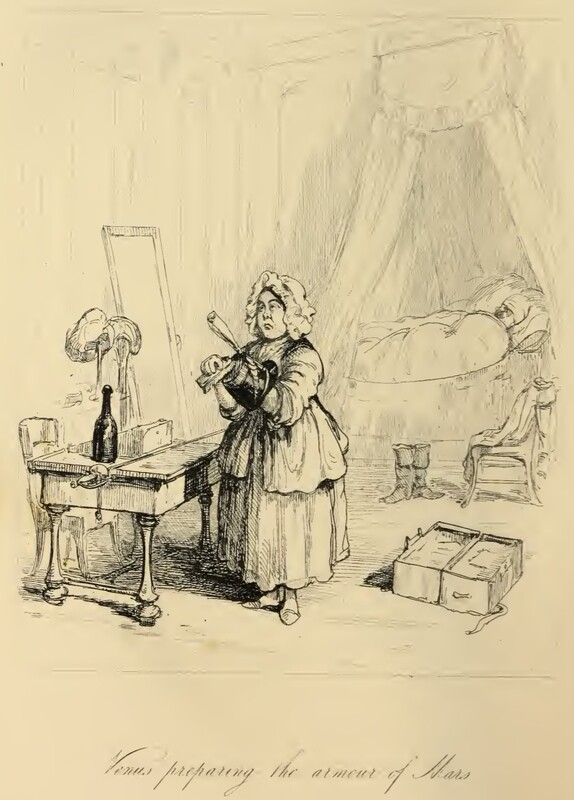
Peggy O’Dowd stands in her bedroom, brushing her husband’s cap. His sword lies on the table in front of her, along with a bottle and a large mirror. She has already packed his travelling-valise, which lies open on the ground next to her. Major O’Dowd himself is sleeping in the background, with his boots next to the bed and his coat thrown over a chair. Below the illustration is printed in cursive its title, Venus preparing the armour of Mars.

![[A group of Tupinambá people take a man captive]](https://collections.cemvc.ca/files/large/67a265a54b84ca4393e884a3495fe50665f6c290.jpg)

![[Vanity Fair Volume II. Chapter XXXI Inhabited Initial, F]](https://collections.cemvc.ca/files/large/0a8e7968e0fc7108204111fe1e6995611ff6b27d.jpg)
![[A European man and a Tupinambá woman weep into their hands while a Tupinambá man stands behind them]](https://collections.cemvc.ca/files/large/711e33488d6384bb99c8db4cbdd51d7a5288e9cd.jpg)
![[A tooth from Brobdingnag that Gulliver gave to the Captain]](https://collections.cemvc.ca/files/large/c2f59b4079e07162b80cb44969f6d80dcb4203ff.jpg)
![[Gulliver imagines himself as an immortal from Luggnag]](https://collections.cemvc.ca/files/large/504ba42b96ea0d60f17b5f905a6a135a85bd6ad8.jpg)
![[Gulliver and Glumdalclitch on Brobdingnag]](https://collections.cemvc.ca/files/large/1c8e5846273331c42b6ffb0f1f3266b543354171.jpg)
![[Gulliver observes as the King of Brobdingnag is shaved]](https://collections.cemvc.ca/files/large/78bd4268e172774fca7ab94d1aa44208d0967158.jpg)