This illustration depicts a simple scene including king Mithridates of Pontus and his wife Hypsicratea. The two figures are illustrated wearing their royal clothing and crowns, and Mithridates is illustrated holding a scepter. Queen Hypsicratea appears to be pregnant as her stomach is large and her hand is resting upon it. Boccaccio writes on Hypsicratea due to her bravery and devotion to her husband, as she ends up dressing in armor and goes to war in order to be with him, despite him having mistresses and concubines.
Here we see a depiction of the winemaking process in Europe. In the foreground we see the grapes and other fruits, and in the background, we see men working a mill to crush the grapes. This image appears when Gulliver explains the culture surrounding wine in Europe, including its effects on people and their behaviour, both the short-term drunkenness followed by hangovers, and the longer-term effects on one’s health. The image also reflects Gulliver’s account of the rich man benefiting off of the poor man’s labour. The same image appears in the 1843 Krabbe edition.
This image is illustrated in a chapter that discusses the Christian priests in the colonial government in Peru. A Spanish priest dressed in ecclesiastic adornments is depicted sitting on the left side of the image while a Spanish corregidor [magistrate] is sitting on the right. They are illustrated playing cards and gambling. There is a large pile of money on the edge of the table as they are gambling their salaries. The author criticizes the actions of both officials.
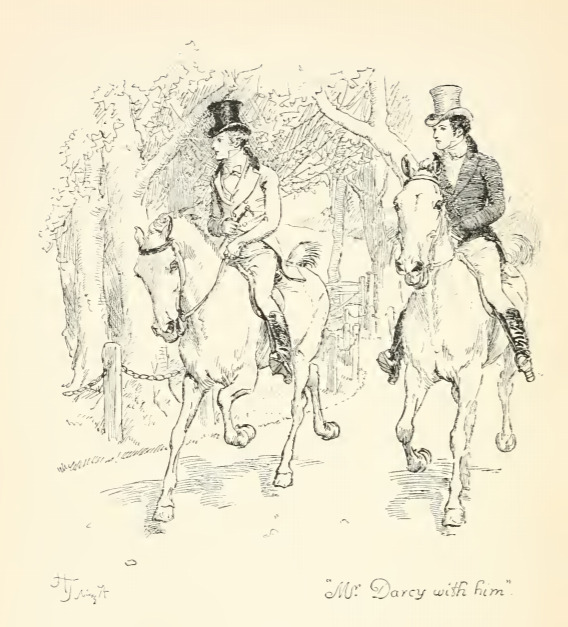
In this image Mr. Darcy and Mr. Bingley arrive at Longbourn. After Lydia’s wedding, Mr. Bingley returned to Netherfield, with Mr. Darcy. Shortly after their return the two men came to Longbourn. Mrs. Bennet greets Mr. Bingley warmly but does not extend the same courtesy to Mr. Darcy, mortifying Elizabeth. This scene occurs in chapter 53. The characters are shown in the traditional regency style. Mr. Darcy and Mr. Bingley ride on horseback, and wear waistcoats and tailcoats with top hats. The regency period dated to the early nineteenth century (1811-1820) when George, Prince of Wales, later George IV (r. 1820-1830), reigned as regent for his mentally ill father, King George III (r. 1760-1820). The regency period is associated with the rise of neoclassicism in art and fashion.
Here we see Gulliver’s meal at the court in Laputa. It is served by a Laputan servant, identified by his tilting head and eyes – one of which is turned inwards, the other looking up. The meal was presented in different shapes. In the first course – seen here – all the food was cut into geometric shapes. For example, the mutton was cut into a triangle, the beef into rhomboids, and the pudding into a cycloid. The bread was cut into cylinders and other mathematical shapes. In the second course, the food all resembled musical instruments. For example, the duck was cut to look like a violin, sausages and puddings were made to look like flutes and oboes, and veal in the shape of a harp. In this image we see the table set and served for the first course, with the beef in the shape of a rhombus sitting on the plates and the servant serving the pudding in the shape of cycloids. The same image appears in the 1839 Krabbe edition.
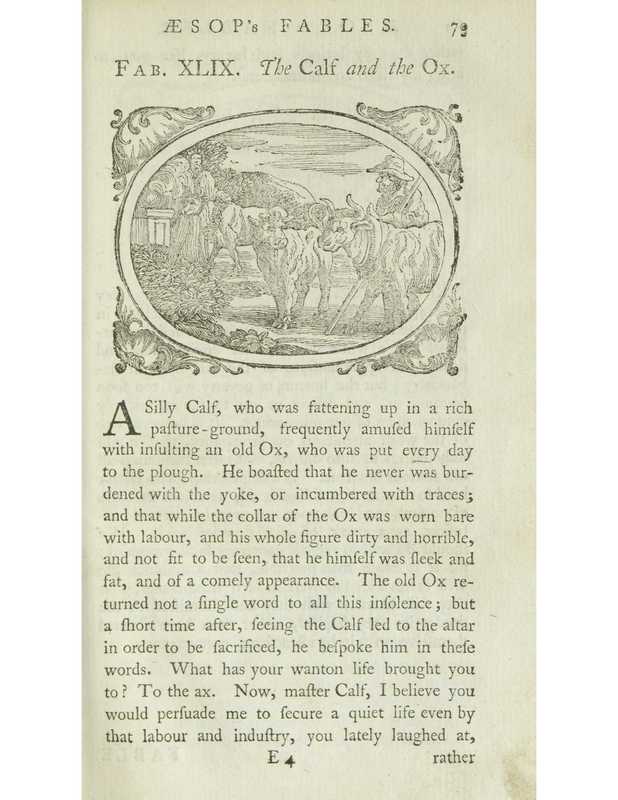
Three cows stand in a field alongside two farmers. One of the farmers holds a long pole, while the other (standing further back) wears a long robe. There is a lot of greenery surrounding them and clouds in the sky.
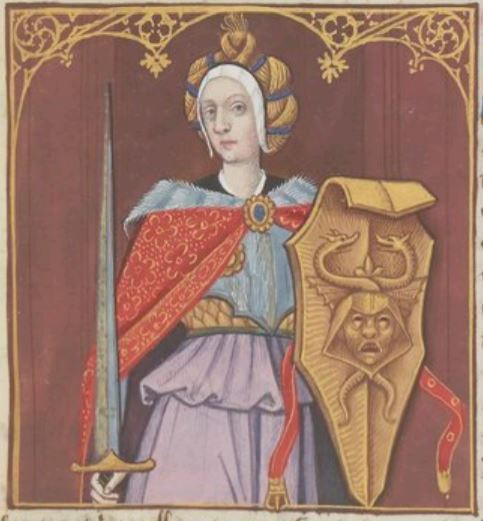
This illuminated image depicts Minerva (also known as Pallas), the goddess of wisdom and war. She is illustrated holding a sword in her right hand and a shield in her left. The shield that she is holding has a depiction of Medusa on the front. Minerva is also renown for having created weaving and wool work, however this image focusses specifically on her being the goddess of war.
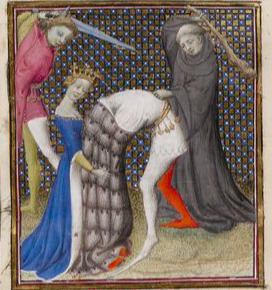
Clytemnestra, in the blue gown, strategically helps Agamemnon remove his cloak. While she does so, her lover Aegisthus strikes and kills Agamemnon. Aegisthus is pictured in the pink cloak swinging a sword. The man wearing the black cloak is representative of the death that was to follow.
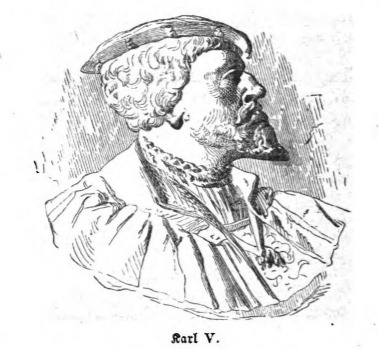
Here we see a bust of Charles V. This image appears when Gulliver describes the language of the Houyhnhnms. Gulliver describes the language as something similar to Dutch or German but is more delicate or expressive. Charles V allegedly said that he spoke to his horse in German, insulting the language. Charles V was the Holy Roman Emperor between 1519-1556. He was also Archduke of Austria, King of Germany, Archduke of Austria, King of Italy, Lord of the Netherlands, and King of Spain.
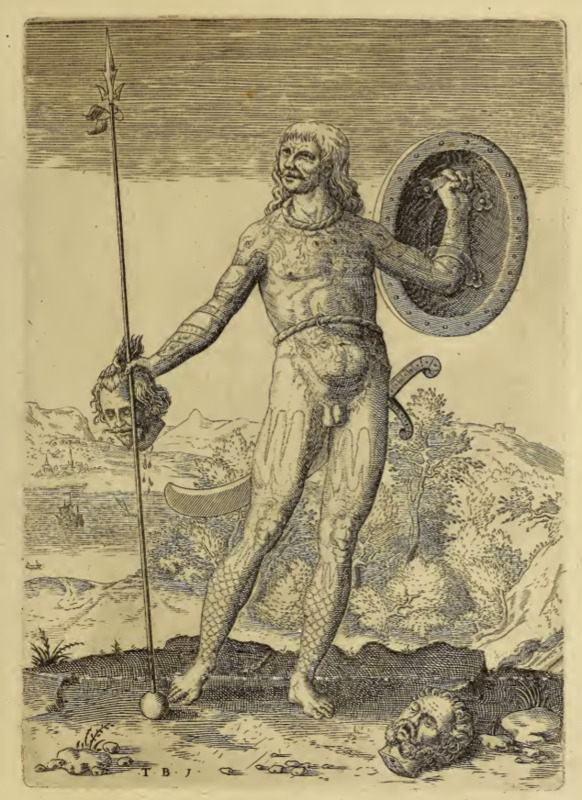
An Indigenous man is shown from the front. He carries a shield strapped to his left forearm and a long spear in his right hand. Also in his right hand is a severed human head, another head lays on the ground at his feet. His hair is long, he wears a twisted cord around his neck, and a sword with a curved blade hangs from another cord around his waist. He is nude, and his body is covered in painted designs. The Picts were an Indigenous group who lived in Britain long before the author’s time. Images of Picts were included in this book so that readers could compare their customs to those of the Indigenous people living in Virginia.
Gulliver explains the various medicines used in England to treat disease. In this image we see a man holding a cup of medicine that is steaming. He looks disgusted as the medicines often smelled and tasted horrible. Gulliver explains that the man vomits because of the foul taste of the medicine which included ingredients such as reptile skins, bones, excrements, insects, herbs, minerals, gums, oils, and juices. The same image appears in the 1839 Krabbe edition.
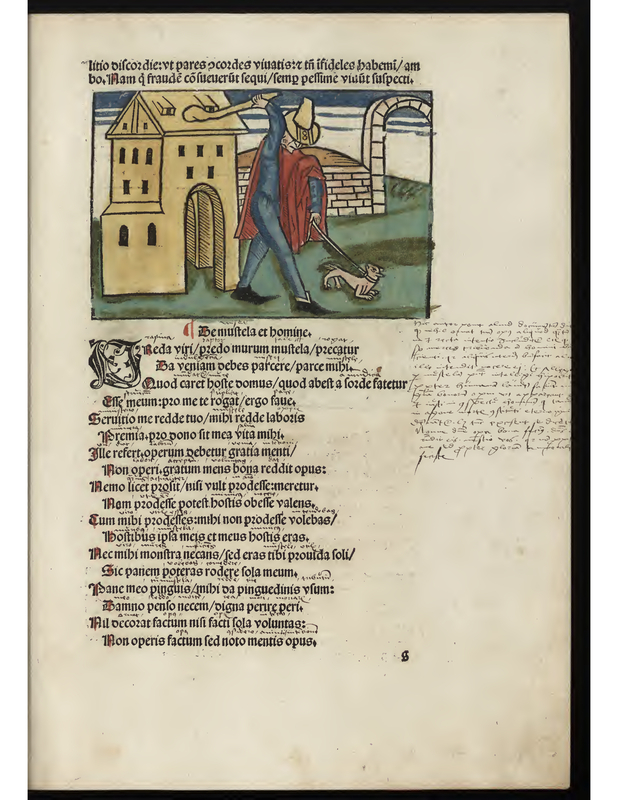
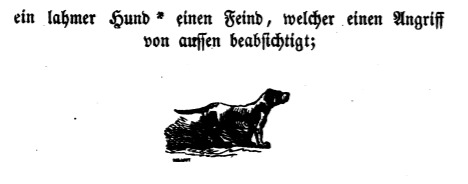
This image is of a lame dog. A lame dog was code for an invader. This image comes in a description of a conspiracy found by a professor from the Grand Academy on Balnibarbi. This idea is representing code word for terms in the conspiracy that Swift is satirizing. The professor advises that those named in the conspiracy papers be closely monitored at all times, naming specifically while they were using the bathroom, as this is when men were most thoughtful. This conspiracy is thought to be an allusion to the trial of Francis Atterbury, the bishop of Rochester for allegedly plotting with the Jacobites. Atterbury was charged with treason in 1722 and was exiled to France. During Atterbury’s trial, his dog was used as evidence against him as the dog was a present from the French. Other interpretations of this image see the dog as the crown pretender Jacob Stuart or Jacob III. The same image appears in the 1843 Krabbe edition.
This illustration depicts Verginius, a plebeian man, stabbing his daughter Verginia in the chest with a knife. Boccaccio explains that a man named Appius Claudius had fallen in love with Verginia, and although she was betrothed to Lucius Icilius, he devised a plan to make her his own. Appius Claudius, a judge and a decemvir, ordered a decree that stated she would become a slave so that he could own her. To protect his daughter’s chastity, Verginius stabbed Verginia as death would be better than her honour being destroyed. The two men illustrated behind Verginius are most likely Appius Claudius and Lucius Icilius, as they were present in Boccaccio’s telling of the story.
The decision to include Celestina in this illustration is odd, seeing as neither she (nor any other female character) is included in the second act. However, the illustration likely represents the end of the first act, in which Calisto gives her 100 gold crowns (likely referring to the form of currency known as 'crown' or 'Krone') as pre-payment for her services. We see that Calisto (central figure) is holding a small bag, and Celestina (leftmost figure) has something in her hands. Behind Calisto, we see another male figure (either Sempronio or Pármeno), who appears to be yawning.
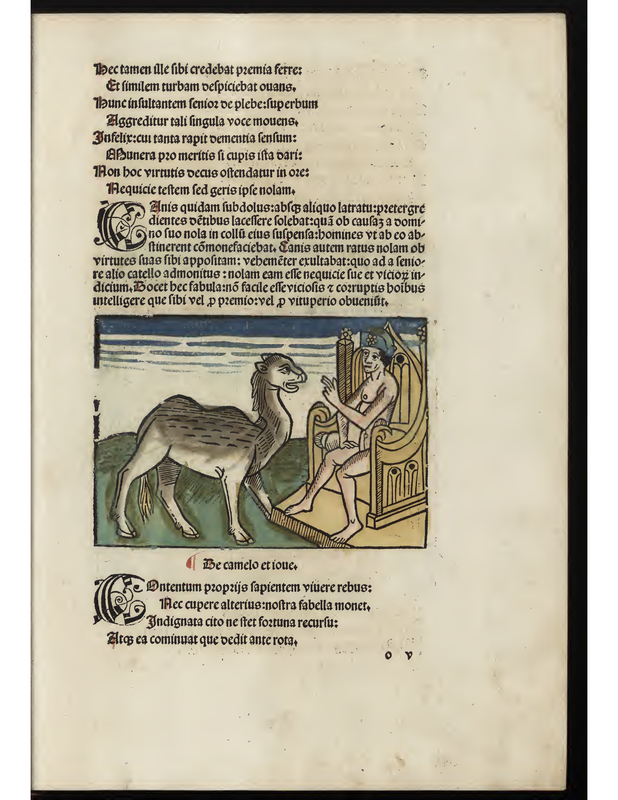
A naked man is seated on a throne outdoors interacting with a camel. The camel is conversing with the man, and the man is gesturing to the camel with two fingers.
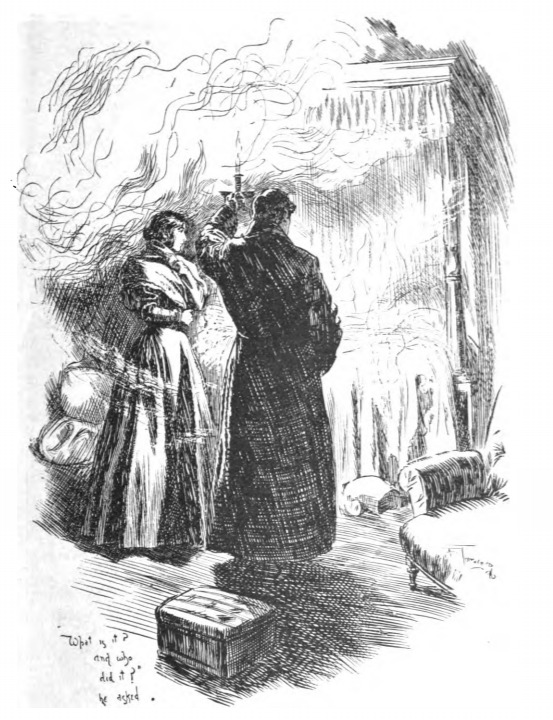
There were several mysterious incidents that occurred while Jane lived at Thornfield. This image shows the first, where Jane heard a noise outside her door, and when she went into the hall, she found that the bedcurtains in Mr. Rochester’s room had been set on fire. Jane blamed Grace Poole – another servant who took care of Mr. Rochester’s wife; however, we learn later in the novel that this was done by Mr. Rochester’s mentally ill wife.
Amelia Osborne holds Georgy Osborne tight to her chest, her body turned away from her mother but head facing her with a displeased expression. Mrs. Sedley stands next to her, in shock, holding the teaspoon from which she had just been secretly feeding her grandson medicine in front of her chest.


![[Hypsicratea Holding Hands with her Husband, Mithridates]](https://collections.cemvc.ca/files/large/fec63141a917039684c533fcd7634e921e028838.jpg)


![[Winemaking in Europe]](https://collections.cemvc.ca/files/large/b78acc8f14626a0e3890e44f1f4f3aaab8f92733.jpg)
![Jvega el P[adr]e a los Naipes con el Corregidor de la Prouincia](https://collections.cemvc.ca/files/large/aac5b339b42fffbfd283e97aa9baca0e114822fe.jpg)
![[Gulliver’s first meal at the Court of Laputa]](https://collections.cemvc.ca/files/large/4ee9aa7a9ab68612743d179306fbb8f9c4769405.jpg)
![[Vanity Fair Volume II. Chapter IV Inhabited Initial, O]](https://collections.cemvc.ca/files/large/345b035f8c398a585da94c45f16fb759489663be.jpg)


![[a sick man holds a cup of medicine]](https://collections.cemvc.ca/files/large/1952976a441e76a7b63ee47218bfe5b833f4afcf.jpg)
![[Verginius Stabbing his Daughter Verginia to Protect her Chastity]](https://collections.cemvc.ca/files/large/536e5bdd608dc1f7c85b7b33d5e15498357ba7bc.jpg)
![[Act II (First Illustration) – Calisto Paying Celestina While Another Figure (Either Sempronio or Pármeno) Yawns]](https://collections.cemvc.ca/files/large/79150e0bd814a93515dee943bef5bcd1a99a8e5c.jpg)
![[Amelia Osborne and Mrs. Sedley]](https://collections.cemvc.ca/files/large/14491ca92470c313dca6bd7497a6cfbd25e56d79.jpg)