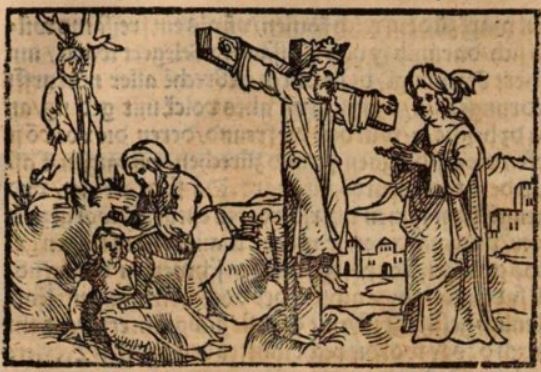
This engraving depicts Olympias of Macedonia on the right side of the engraving approaching a man hanging on a cross. The man being crucified is Pausanias, a man who helped Olympias with the murder of King Philip of Macedonia (husband to Olympias). Boccaccio explains that Olympias placed the golden crown that Pausanias is wearing on his head to honour him and reward him for the assassination. Along with getting her husband murdered, she also had her husband’s new wife and child murdered out of anger. Cleopatra, King Philip’s other wife, is pictured on the left side of the engraving hanging by her neck from a tree. Cleopatra’s child is depicted sitting on the ground as one of Olympias’ servants is bashing her head with a rock.
The right panel depicts a female figure. This must be Areusa, since she is the only female character in the eighth act. She is wearing a robe and a veil. In her right hand she is holding a flower, while in her left she is holding the girdle cord hanging from her waist. At her feet, a dog is standing on its hind legs with its front paws extended toward her. The left panel depicts a male figure, likely Pármeno (since he is the only male character in this act with whom Areusa speaks). The figure, dressed in regal attire, is wearing a hat and has a sword mounted on his belt. Both figures are placed outside.This entire illustration is identical to those found on pages 112 and 120 of the text.Both panels are near carbon-copies of panels found multiple times throughout the earlier 1529 Lyon edition. However, the lower attention to detail in these panels makes it clear that they are reproductions and not duplicates. The artist likely referred to a copy of the 1529 edition when creating these panels.
The picture shows Peggy O’Dowd in a feathered turban, holding a closed fan with both hands, with her elbows on the edge of an opera box. In the top right of the image is the letter M from Mr.
In this image Marianne and Willoughby sing together while Marianne plays piano. Young upper-class women were encouraged to practice some form of art, often either music or drawing. Elinor was a skilled artist while Marianne was a talented piano player. Willoughby and Marianne became close, and they often sang together. This scene occurs in chapter 10. The characters are shown in the traditional regency style, as Marianne wears the regency style dress with an empire waist. Willoughby wears a waistcoat and tailcoat with breeches and a cravat. The regency period dated to the early nineteenth century (1811-1820) when George, Prince of Wales, later George IV (r. 1820-1830), reigned as regent for his mentally ill father, King George III (r. 1760-1820). The regency period is associated with the rise of neoclassicism in art and fashion.
Here we see a depiction of Gulliver’s hat. This hat is used throughout the novel to identify Gulliver from other characters in the scene. The same image appears in the 1839 Krabbe edition.
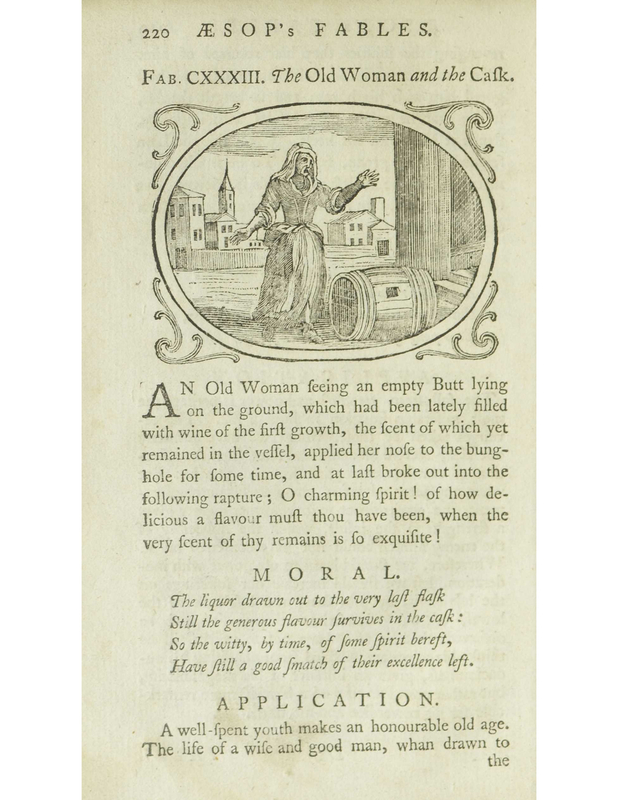
The scene is taken place outside, in the back there is multiple buildings with a fence surrounding a group of them. The old woman sees an empty 'Butt' lying on the ground and smells a scent of wine that was in it.
Here we see a giant’s eye looking at Gulliver. Only Gulliver’s upper body is visible in the image, with his back facing the viewer. In the giant’s pupil is the letter M, which is the first letter of the Meine, the first word of the chapter. The same image appears in the 1843 Krabbe edition.
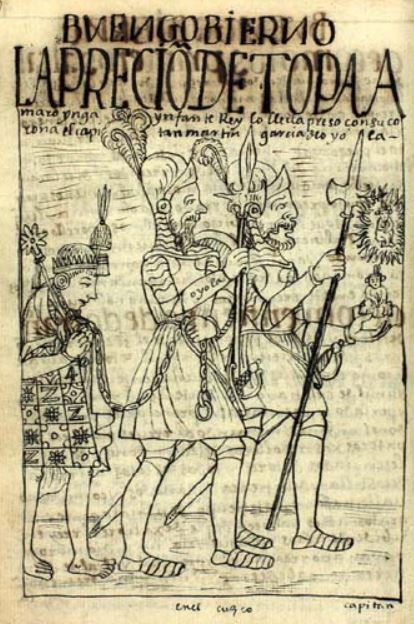
This chapter of the book focuses on discussing the good government of post-conquest Peru that the Spanish viceroys maintained. This image depicts Martin Garcia de Loyola taking Topa Amaro Inca captive under the orders of the viceroy, Don Francisco de Toledo. Martin Garcia de Loyola was Don Francisco’s captain of the guard and was instructed to capture the Inca as well as his loyal captains. This image illustrated two Spanish guards wearing full suits of armour and carrying spears. Martin Garcia has the word loyola written on his arm to identify him. The other guard is illustrated carrying a huaca [sacred object] belonging to the Inca in his left hand. Martin Garcia is holding a chain in his left hand that is bound to the young captured Inca who is walking behind the two guards. The Inca is dressed in traditional regalia. The caption at the bottom of the image reads, en el cuzco [in Cusco].
This image is illustrated in a chapter that discusses the Christian priests in the colonial government in Peru. This image depicts a Franciscan friar who the author praises for keeping true to his religious duties. The author previously criticized many priests for having abused their powers against the indigenous peoples of Peru. This exemplary vicar had humility and was charitable, especially towards the indigenous peoples. The image depicts the friar offering a round piece of bread to a poor man. There are words of dialogue written by the friar. He says, cay tantata micuy, uaccha [eat this bread, poor thing]. The indigenous man responds, sea por amor de dios [let it be for the sake of God]. The friar is also depicted holding a crucifix. The large caption at the bottom of the image reads, [es m]uy justo que tengan orden y yglecia de [...] de sancta catarina y de sancta madalena las yndias y los yndios [...]dien y ordene el auito de san juan bautista los padres de la [conpa]nia de jesus y de su parte los padres del bienauen[turado] san francisco tenga otra yglecia de la horden [it is right that the indians have order in the church of Saint Catherine and Saint Magdalene and the order of Saint John the Baptist, the priest of the company of Jesus, the priests of the Franciscan Order have another church.]
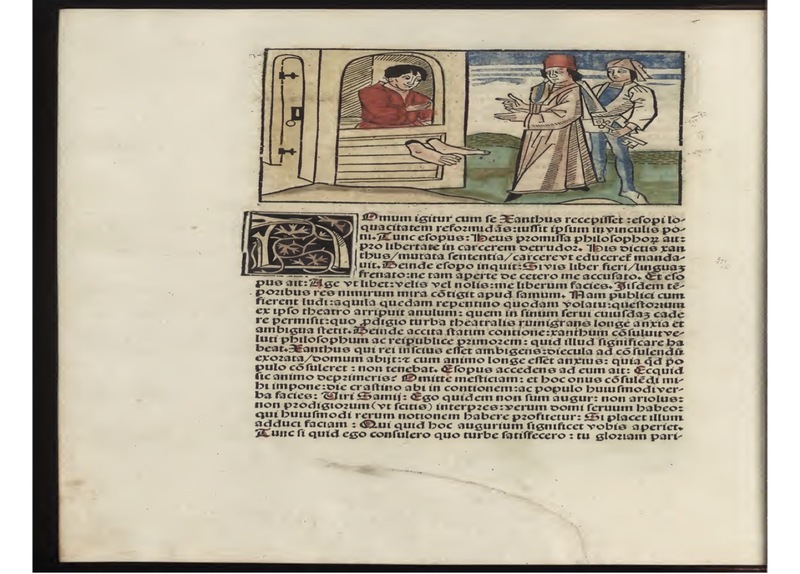
One man is locked inside a tower with his feet stuck in two holes on the side of the tower. He looks out the window of the tower to the two men outside. One of the men outside holds in his hand the key to the locked tower. The other man points at the man locked in the tower.
There is a man holding a large, hairy animal by its ear. In the man’s other hand he is holding a wooden bat. The man is hitting the animal with the bat.
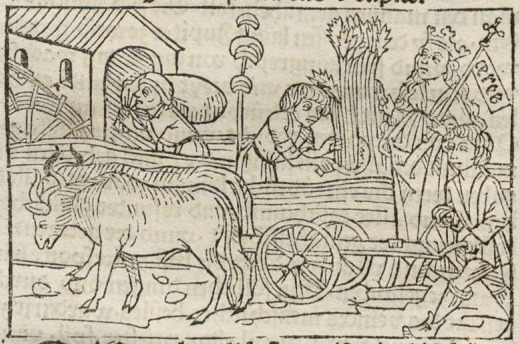
Ceres is depicted on the right-hand side of the engraving wearing a crown and holding a scepter. We know this is Ceres as her name is written beside her scepter. We also know this is Ceres as she is the goddess of harvest, which is what this engraving depicts. Boccaccio explains that after discovering agriculture, Ceres had tamed oxen and trained them to yoke. She also discovered planting seeds and then taught men how to harvest them once they matured. There is one man plowing the fields with the oxen, and another in the background husking grain. There is another man with a bag of flour over his head, as Ceres also taught men how to turn flour into an edible fare. Ceres wears the crown and scepter to signify her importance linked to agriculture and harvest.
When Pármeno and Sempronio arrive at Celestina’s house, they demand their share of the gold chain that Calisto had given her. Celestina gives endless excuses to escape the duty of her promise, telling them that she lost it, that she did all the work, that she never promised it in the first place, and that they are greedy. They begin threatening her, and she calls to Elicia for help. Sempronio draws his sword, causing Celestina and Elicia to scream in terror. He starts stabbing her, with Pármeno encouraging his violence (seen on the left of the illustration). As Celestina and Elicia scream for the Alguacil’s men, Sempronio and Pármeno hear the guards at the door (depicted by the two rightmost figures) and flee upstairs. With no other means of escape, they decide to jump from the third storey window (seen in the centre of the illustration).[None of the elements in this illustration are found elsewhere in this edition.]
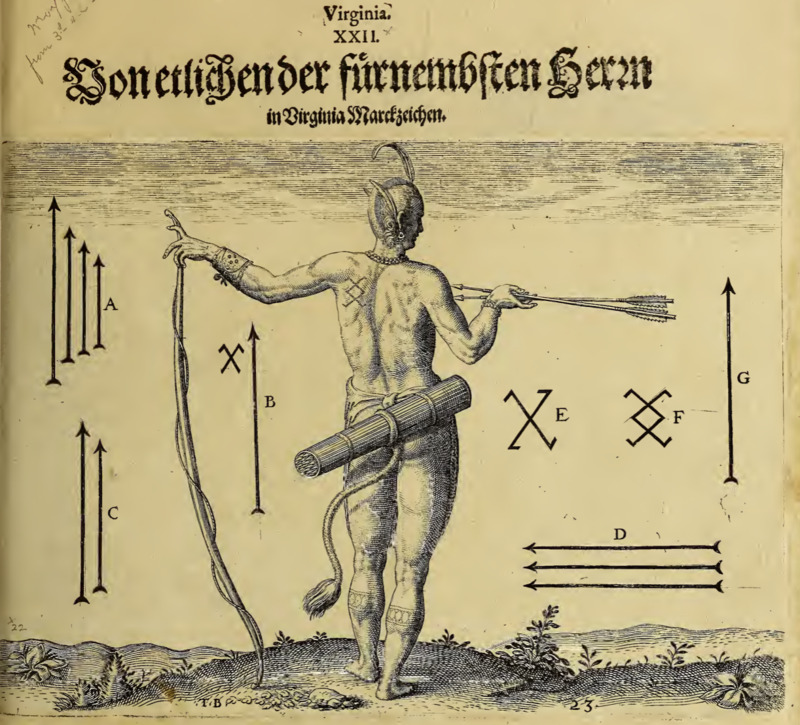
An Indigenous man is shown from behind. He holds a longbow in his right hand and two arrows in his left, and a quiver of arrows is tied around his waist. Drawn around him are seven designs that are labelled with the letters A to G. Design A is comprised of four arrows side by side pointing upwards, with the sizes decreasing from right to left. Design B has an arrow pointing upwards with a stylized ‘X’ to the left of the arrowhead. Design C has two arrows side by side pointing upwards in decreasing size from right to left. Design D has three arrows of the same size side by side pointing to the left. Design E is a stylized ‘X’. Design F is a crosshatch pattern. Design G is a singe arrow pointing upwards. The man has design F on the back of his left shoulder, suggesting that the designs are common tattoo/scarification art. (This image is misnumbered in the source as plate 22 – it should be 23).
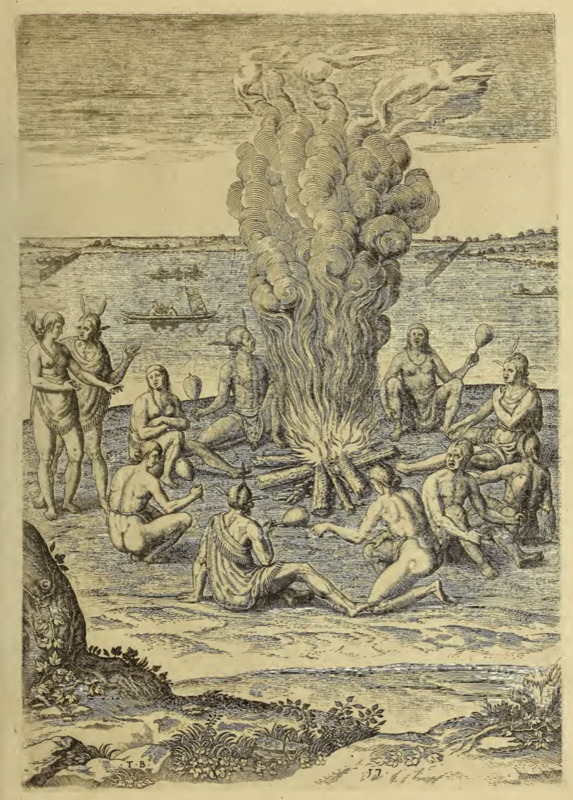
A group of Indigenous people sit on the ground around a bonfire on the bank of a river. Some of the individuals hold rattles. All wear fringed garments, either draped around their bodies and over their shoulders, over one shoulder, or tied around their waist. The men wear feathers in their hair, and at least one woman wears strands of beads. Behind the group, other individuals are seen in canoes on the river.
After arriving on Balnibarbi, Gulliver sees the floating island of Laputa for the first time. Gulliver first noticed it after it blocked the sun, causing him to look up and see the island. He shields his eyes as the bottom was reflecting from the water below and was very bright. The island floats and would move around, hovering over Balnibarbi. In this image we see Gulliver looking up at the island, which was semi-circular with a city on top, and the underside was totally flat. We also see Gulliver’s boat in the water next to him. The same image appears in the 1839 Krabbe edition.
Lady Matilda Southdown, in her bed-gown and nightcap, carries a candlestick, a cup of medicine she has devised, and her favorite tracts through the doorway into Rebecca Crawley’s room.
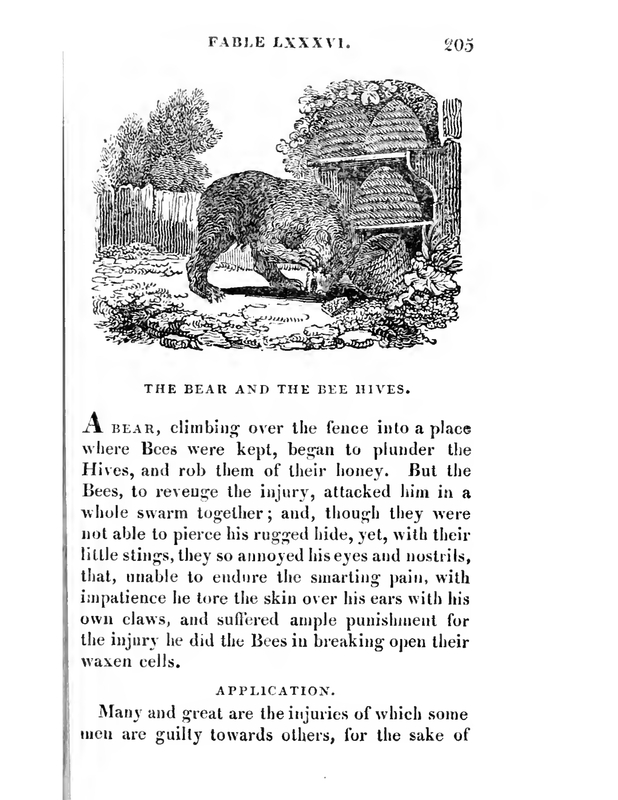
In the middle of the image there is a bear facing towards the right side of the image. The bear is getting into a beehive and taking honey. On the upper right side of the image there are three other beehives that have not been touched by the bear. On the left side of the image there is a fence, as well as various trees.
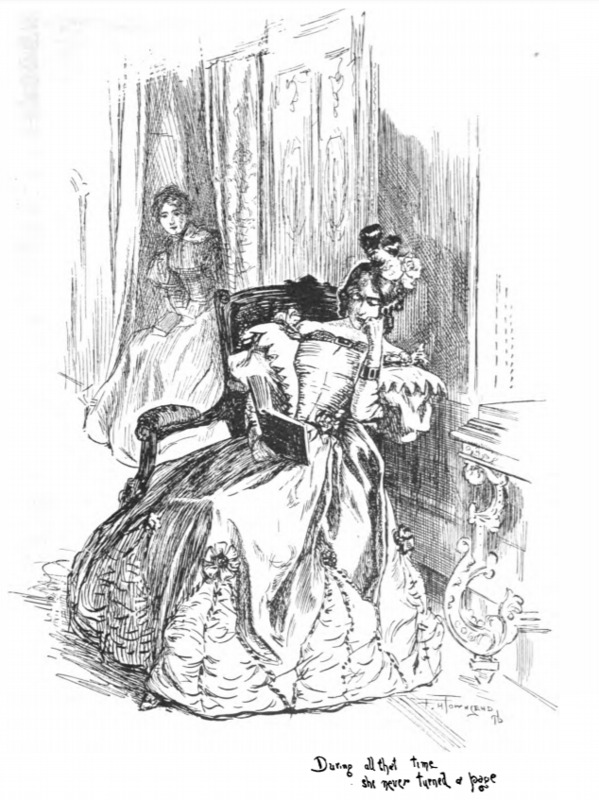
During the time in which Mr. Rochester hosted company at Thornfield, a psychic shows up at Thornfield while Mr. Rochester was out. Miss Ingram was the first to speak to the psychic and when she returned to the parlor, she appeared quite shaken and refused to tell anyone what was said. She simply sat down looking at a book but not reading it, shown here. The psychic spoke to all the women in the party. Jane met with the psychic last, and she discovered that the psychic was really Mr. Rochester in disguise.
Here we see a man falling over, drunk. This image appears when Gulliver explains wine to his master in the Country of the Houyhnhnms. Gulliver explains the effects of alcohol on humans, including drunkenness and hangovers. In this image we see a man leaning against the wall with bottles near his feet and a beer stein on the table in the background. The same image appears in the 1843 Krabbe edition.
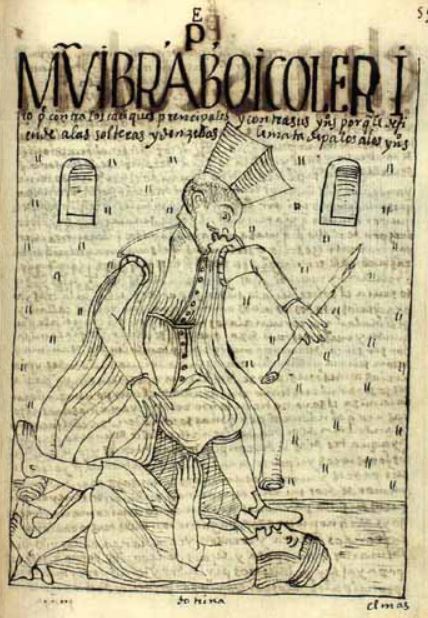
This image is illustrated in a chapter that discusses the Christian priests in the colonial government in Peru. This image depicts a Spanish parish priest standing over an indigenous man with his foot hovering over his face and a stick in his left hand. The priest is dressed in ecclesiastic adornments while the indigenous man is dressed in a simple tunic. The priest beats the indigenous man to death for having defended indigenous women from the priests. The author criticizes the priests for sexually harassing and abusing the unmarried indigenous women.

![[Act VIII – Pármeno and Areusa]](https://collections.cemvc.ca/files/large/8e784b7435daf3dd0a686a541605ee2e12f8db87.jpg)
![[Vanity Fair Vol. I Chapter XXIX Historiated Initial]](https://collections.cemvc.ca/files/large/7bca2c7beab20daaa64e55523238bdcf39335eeb.jpg)

![[Gulliver’s hat]](https://collections.cemvc.ca/files/large/3e37ad16a3b1b38ded023433f352b844a850a737.jpg)
![[a giant’s eye looking at Gulliver]](https://collections.cemvc.ca/files/large/5472fd2705bdbe922042fd05aadd8c2aaf1aafd9.jpg)
![Fraile Fran[cis]co, S[an]to, Q[ve] Tiene Caridad con los Pobres de Jesucristo en Todo el Mundo, Mucho Mas en Este Rreyno](https://collections.cemvc.ca/files/large/60e4608f8e75d1eca08331f9f8bd3dded8adaf56.jpg)
![[Man Hits Animal]](https://collections.cemvc.ca/files/large/068f6b984746e149e0c1b625e828701756c018c0.jpg)
![[Act XII (Second Illustration) – Pármeno and Sempronio Murder Celestina and Jump from a Window, Where They Are Caught by the Alguacil’s Men]](https://collections.cemvc.ca/files/large/2205bb263be2f27074035b45687d14b5c12ed7af.jpg)

![[Gulliver first sets his eyes on the floating island of Laputa]](https://collections.cemvc.ca/files/large/50e512c80ccf0743b156018af8d6b372b83c84ea.jpg)
![[Lady Southdown]](https://collections.cemvc.ca/files/large/98c797bf16bd1706fba453589c66e84b75fc2da4.jpg)
![[A drunk man]](https://collections.cemvc.ca/files/large/5315bfa118bc5561bef6b579f69716bc8849fe46.jpg)