The right half of the image is a scenario outside. A man is walking towards the widely open door to a house, his head bowed and looking sad. The man is holding a stick in his right hand. In the background, a person is seen to be hanging from a hanging post. On the left-hand side of the image, a woman is waiting for the sad man at the entrance of the house, holding a plate with her right hand and gesturing for him to come inside with her left hand. The woman wears a long dress that reaches the ground, and her hair is short.
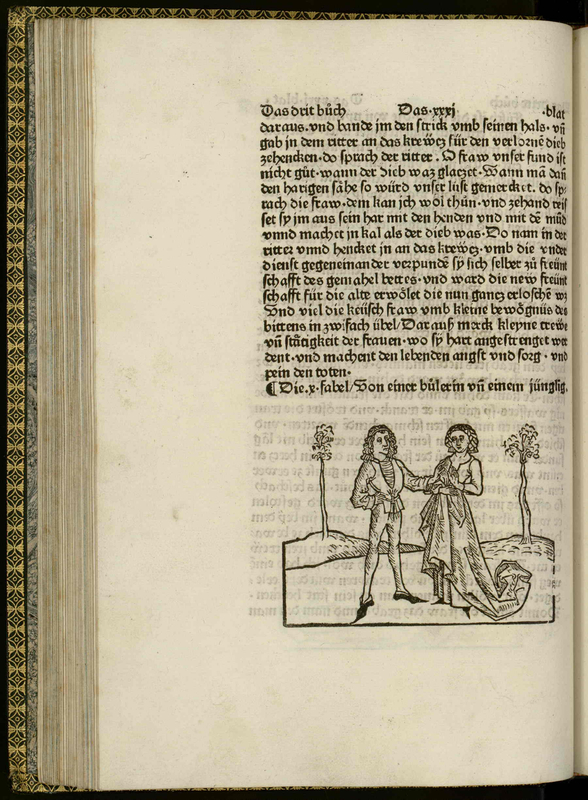
A man and woman are speaking in the outdoors with two tree’s in the background. The woman is wearing a long dress and has one hand on her stomach and the other is raised towards the man in front of her. The man has a hand on the woman’s shoulder and another on his hip. The two are having a conversation.
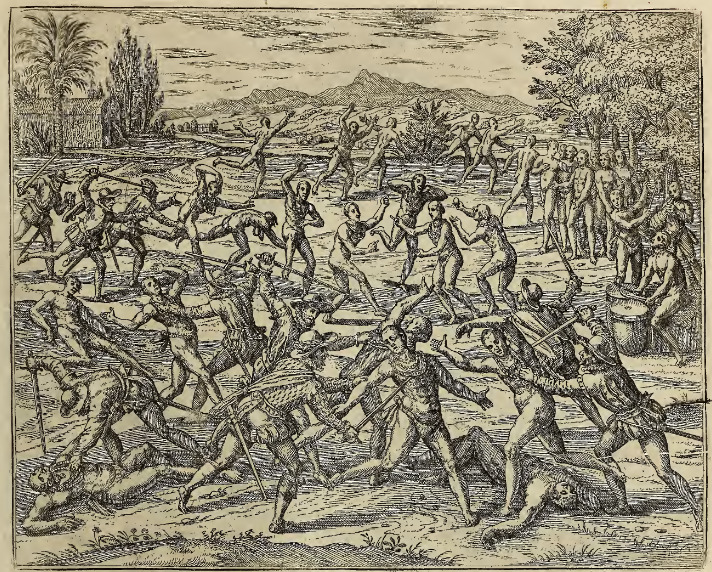
Hernan Cortés and the Spanish soldiers under his command occupied Tenochtitlan (Mexico City) in 1519. Cortés eventually left the city, leaving Pedro Alvarado in command. During an Indigenous festival the Spaniards attacked the Indigenous people out of greed, stealing the gold jewelry they had donned for the festivities. Here, Spanish men chase and grapple with unarmed Indigenous people, attacking them with swords and clutching at the gold necklaces they wear. At the edge of the skirmish, three Indigenous people still hold the musical instruments they played during the festival. A small group watches the violence on the right, while several others flee. One structure is visible in the background.
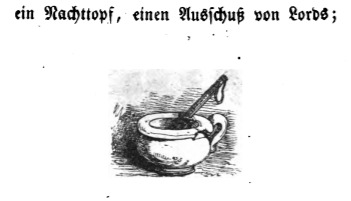
This image shows a chamber pot, which is the code word for a committee of Lords. This image comes in a description of a conspiracy found by a professor from the Grand Academy on Balnibarbi. This idea is representing code word for terms in the conspiracy that Swift is satirizing. The professor advises that those named in the conspiracy papers be closely monitored at all times, naming specifically while they were using the bathroom, as this is when men were most thoughtful. This conspiracy is thought to be an allusion to the trial of Francis Atterbury, the bishop of Rochester for allegedly plotting with the Jacobites. Atterbury was charged with treason in 1722 and was exiled to France. The same image appears in the 1843 Krabbe edition.
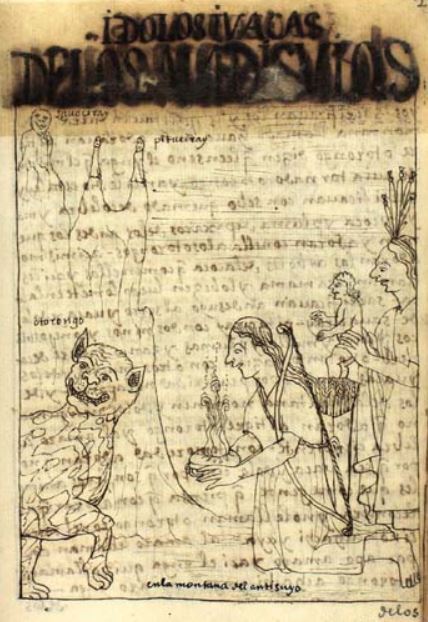
This chapter is dedicated to describing the idols and gods of the Incas. This image depicts the Inca king and the other indigenous people of the Antisuyo region of Peru making a sacrifice to an otoronco [jaguar]. The jaguar is depicted on the left side of the image. They are also honouring the two mountain peaks illustrated in the background. The mountain peaks are labelled as saua ciray [Sauasiray] and pitu ciray [Pitociray]. There is a caption at the bottom of the image that reads en la montana del antisuyo, which translates to in the Antisuyo mountain.
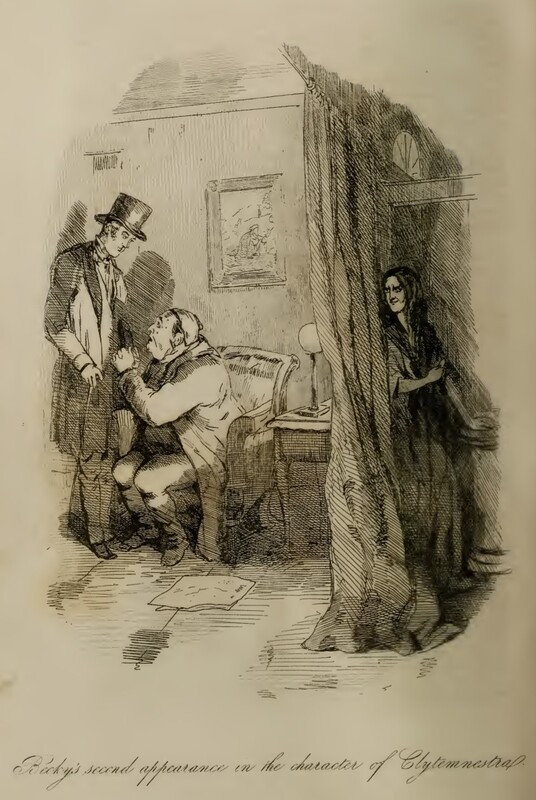
Joseph Sedley sits in a chair, begging William Dobbin, now his brother-in-law, to come and live near him, or else help him escape to India without Becky finding out. Behind a curtain on the far side of the room is Rebecca Crawley, listening in and holding a dagger in one hand. Below the illustration is printed in cursive its title, Becky’s second appearance in the character of Clytemnestra.
On the left side of the image there is a house with a bonfire inside. At the door is a man with a stick raise above his head, in motion to hit the snake that is slithering out of his house. The snake looks surprise, with an open mouth. The snake is on the left side of the page, which also has a tree in the background. The man is wearing a hat and a robe, with an ornament around his waist.
A coach drawn by two horses, driven by a coachman in a three-cornered hat. Beside him sits Sambo, the footman. On the right side of the image is the gate to Miss Pinkerton’s academy for young ladies, at which the coach has just arrived. In the background there are two trees and a building. In the top right of the image, overlapping with a tree, is the letter W from While.
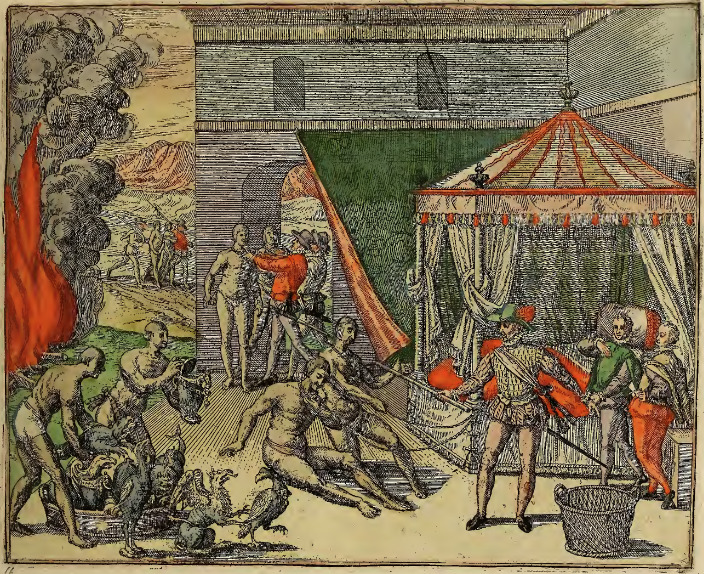
A group of Spaniards, one of whom is Diego Guttierez, governor of Costa Rica, takes at least four Indigenous leaders (Caciques) hostage and binds them in chains. Two of the Indigenous men have been bound by chains attached to the post of a large canopy bed inside the structure. Two others have been bound with chains around their necks, the ends of which are held by two Spanish men. On the left, two Indigenous men offer a basket full of exotic animals and vessels made of gold to the Spaniards. A large bonfire has been set on the left, and in the background two more Indigenous people walk towards the structure, escorted by two Spanish men. This image is identical to one found on page 147 of Frankfurt, 1595, but colored.
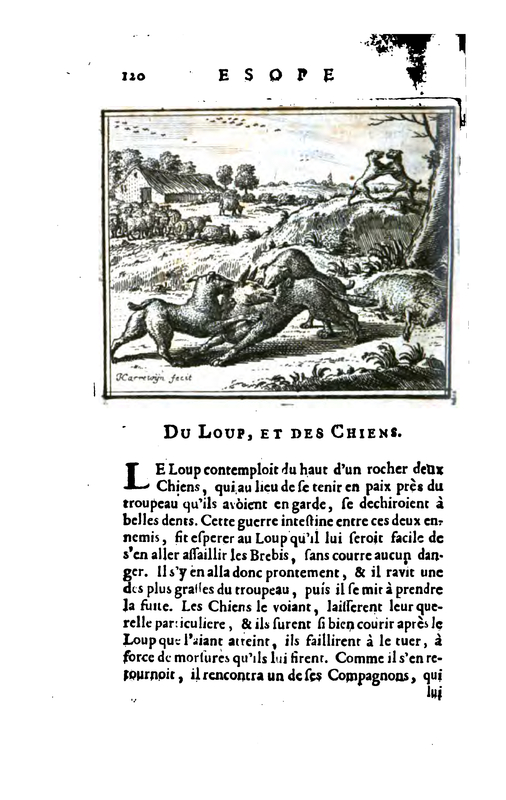
The wolf contemplates on top of a tall rock two dogs, who instead of keeping the peace close to the herd they are meant to guard, are distracted by a dog fight. This battle would make it easy for the wolf to infultrate the sheep, without any danger. so he promptly goes, and kills the biggest sheep. The dogs see the wolf, end their quarel, and chase the wolf, and kill him.
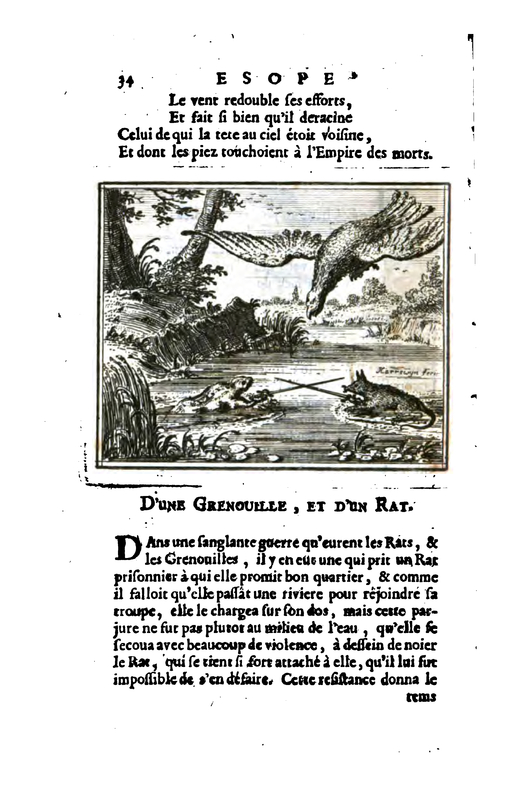
A rat and a frog are sperparated by a pond of water. The rat and the frog are having a sword fight. A large bird flys down towards the frog and rat. The illustration appears to have an illegible signature on the bottom left corner
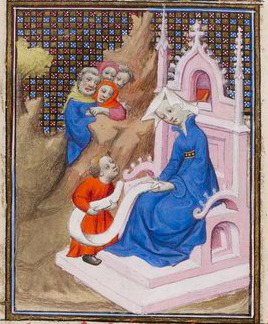
Upon arriving to the Capitoline Hill with her son, Carmenta found that the inhabitants were nearly illiterate. She decided to create letters for these people, allowing them to learn literacy and later, other academic fields. Rather than just using Greek letters, these new letters distinguished them from other nations. In the image, Carmenta is seated on a throne teaching the letters to the inhabitants.
There are three roosters standing on a patch of grass, one of them is on top of a fence. In front of them there is a cat who is eating the throat of another rooster. Behind the animals there is a house and a tree.
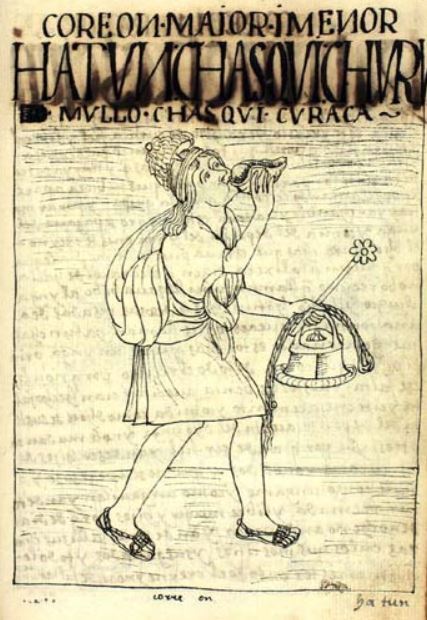
This chapter discusses the system of administrative officials in the Inca Empire. This image depicts a chasque [runner] who was responsible for taking food from storehouses and bringing it to the Inca when requested to. These runners were stationed at half-league intervals so that they could run faster and be time efficient whenever the Inca would call on them. This runner is depicted wearing a feathered visor on his head and blowing into a shell trumpet. He is also illustrated holding a star shaped club, a sling, and a basket of food in his left hand. The author explains that the feathered visor and trumpet were both visual and auditory cues to warn and prepare the next runner.
This image depicts some of the thirty-nine comets observed by the Laputans. They were also able to calculate their orbits with accuracy. The Laputan astronomers also wanted to present their theory of comets to the rest of the world. Here we see the planets and several comets that were observed by the Laputans. The same image appears in the 1839 Krabbe edition.
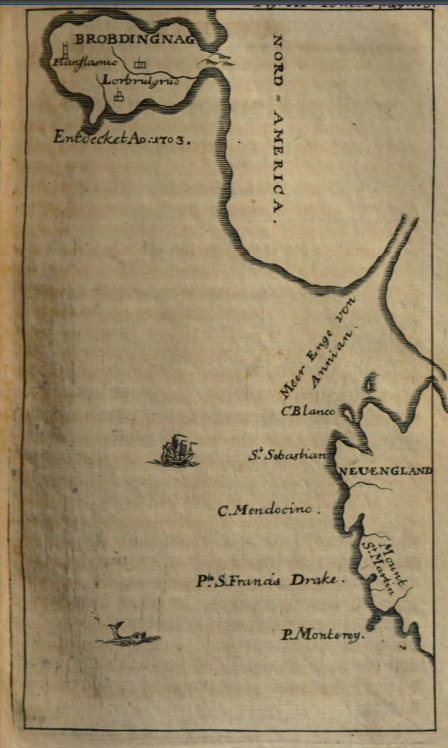
The image depicts the fictional land of Brobdingnag, off of North America. The cities of Flagnlamic and Lorbrulgrid are on the map as well. Underneath Brobdingnag reads Entdecket Ao. 1703, meaning Discovered in 1703. The bottom half of the map includes New England. A ‘man-of-war ship is shown off the coast of New England, and a dolphin is near the bottom of the image.
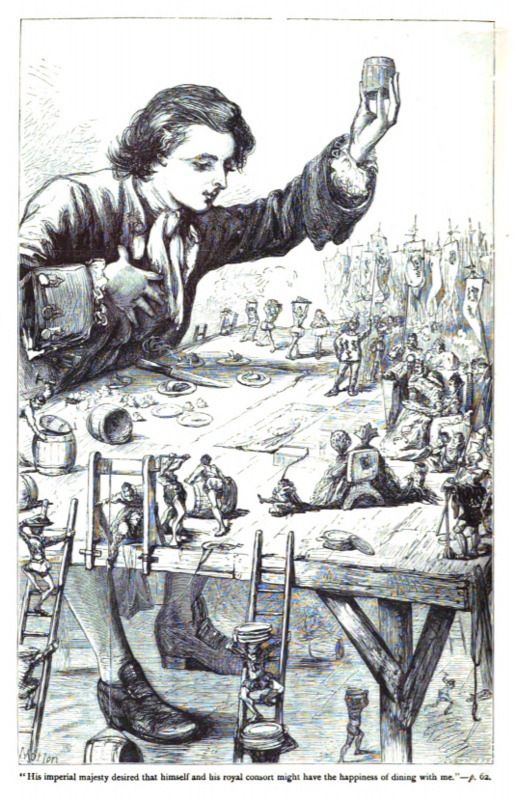
Here the Emperor of Lilliput and his consort sit eating dinner with Gulliver. Gulliver raises a barrel of wine in a toast to the Emperor. Ladders allowed the servers to reach the table from the floor. Guards hold banners with the Lilliputian crest. The Emperor sits in a throne opposite Gulliver.
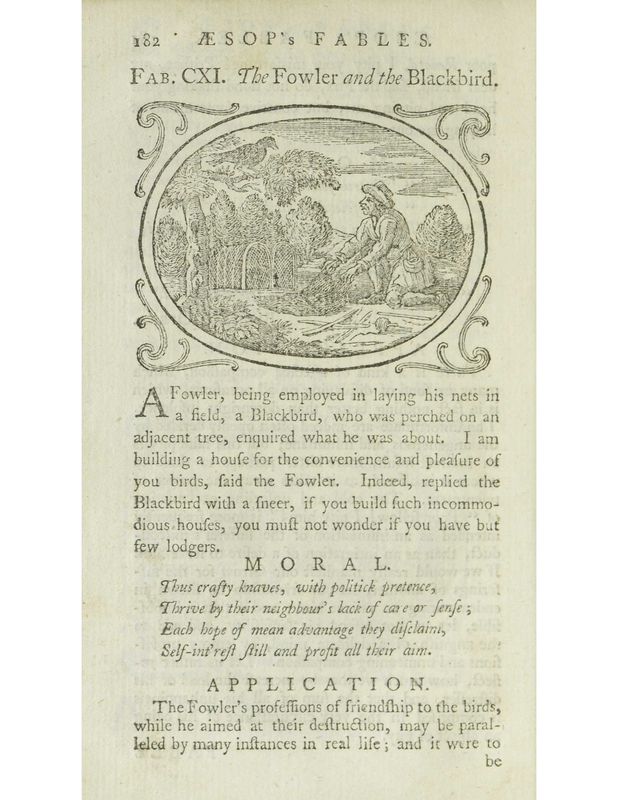
A wildfowl hunter sits on one knee while he lays a net on the ground. Next to the man is a tree with a Blackbird perched on a branch. Below the branch and next to the net is a cage with its door open. There are sticks and and a roll of twine on the ground next to the man. There are trees in the background.
The Laputan wives and daughters were confined to their homes, however they frequently tried to sneak out and go into the city. The image here is of a court Lady and her daughter who was married to the Prime Minister. The Prime Minister gave his wife and children a beautiful Palace, however they went into the city. The Prime Minister’s wife said she was going into the city was in rags in an Eating House. She had pawned her clothes and was in the company of another man who was abusive. an Eating House. She had pawned her clothes and was in the company of another man who was abusive. The same image appears in the 1839 Krabbe edition.
The left panel of this image depicts one of Celestina’s prostitutes Areusa, whom Celestina promised to Pármeno in exchange for his loyalty. She is wearing a veil, a robe, and a necklace of some sort. On the right, we see Pármeno holding some sort of satchel, with a sword mounted on his belt.The entire image is nearly identical to the one found on page 229 of the text (where the right panel is labeled ‘Centurion’). The left panel is identical to the one found on page 208. The right panel is nearly identical to those found on pages 51 (where there is a decorative panel under the figure’s feet), 82 (where it has a decorative panel and is labeled ‘Sempronio’) and 235 (where it has a decorative panel and is labeled ‘Tristan’).
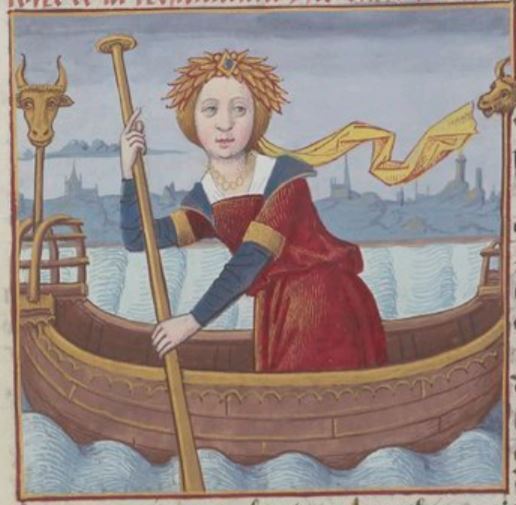
This illuminated image depicts Isis, previously called Io, holding an oar as she rows a ship. The ship has an emblem of a cow on the left side which symbolizes her transformation into a cow. She had been transformed into a cow by the god Jupiter, and after she was turned back into a human, she boarded a ship and sailed to Egypt. This image depicts her on her way to Egypt, where she eventually becomes queen and becomes deified.

![[The Grieving Man, the Comforting Woman, and the Man Who Was Hung]](https://collections.cemvc.ca/files/large/695ffb804d90c932bc805383730edac0c6e366ea.jpg)
![[Unwanted Snake]](https://collections.cemvc.ca/files/large/44d631807338b010187bb90dee09eb6dbf8dbbaa.jpg)
![[Vanity Fair Vol. I Chapter I Historiated Initial]](https://collections.cemvc.ca/files/large/6870596e6dbf7db5cdbc8254f4bf79f4d43f2d6e.jpg)
![[Cat eats rooster]](https://collections.cemvc.ca/files/large/b333956f77777d6a155bf01aa2e1fb7a12bd77eb.jpg)
![[Thirty-nine comets observed by the Laputans]](https://collections.cemvc.ca/files/large/465caa7b3d02b4d4826106f6252301bc87242e2c.jpg)
![[A Laputan court Lady and her daughter]](https://collections.cemvc.ca/files/large/f76e399780312381cc64002d28eeebdb473c5999.jpg)
![[Act VIII – Areusa and Pármeno]](https://collections.cemvc.ca/files/large/9d805637b4596ebf8c6625261b287eede7a5cc8d.jpg)