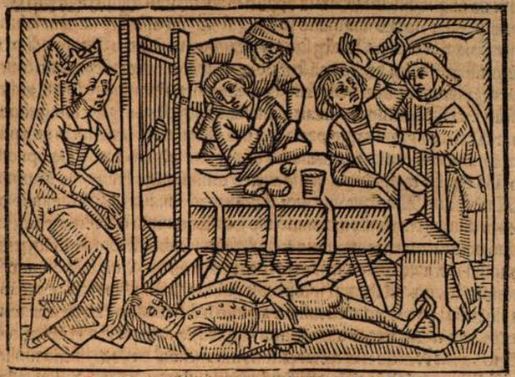
This image depicts Penelope, the wife of Ulysses, weaving on the left side of the engraving as she waits for her husband to return from the Trojan War. Penelope had many suitors over the 20 years that she waited for Ulysses to return home; however, Boccaccio explains in his story that Penelope remained entirely faithful over the duration of his absence. Penelope told the suitors that she would continue to wait for her husband to return until she was done weaving a cloth, which is why she is depicted weaving in this engraving. Each night, she would undo all the weaving she had done that day so she could continue waiting for Ulysses. When Ulysses finally returned home, he had slain every suitor in his palace. Ulysses is depicted on the right side of the engraving, disguised in peasant clothing with a sword in his hand as he kills the suitors.
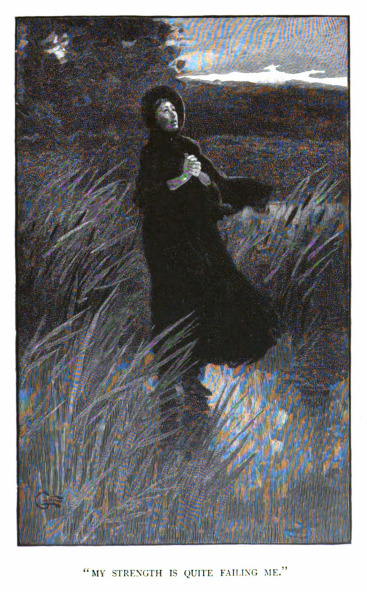
Here Jane clasps her hands in front of her, praying. She stands outside in the Moors after she ran away from Thornfield. She walked outside for two days, begging for food. Her strength was quickly failing. After two days, she arrived on the doorstep of the parsonage, begging for help when Mr. Rivers took her in.
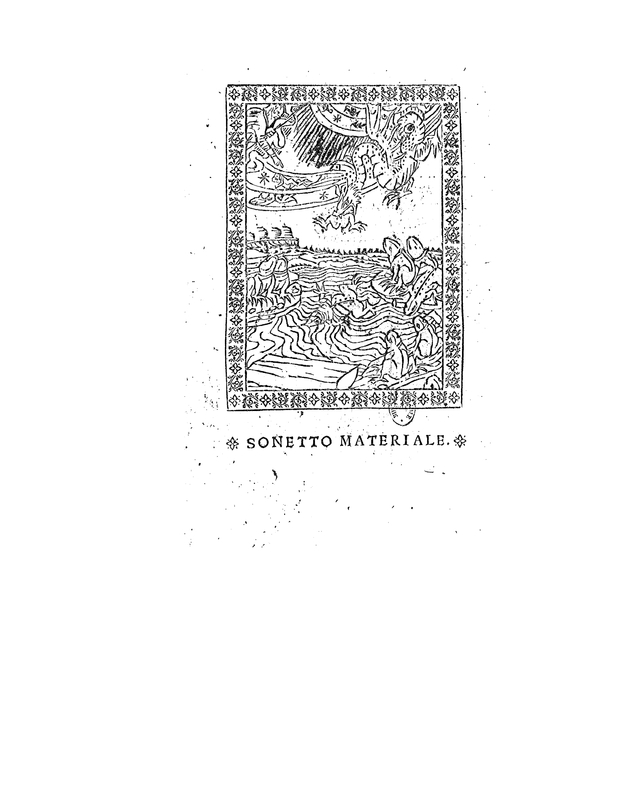
There are several frogs sitting around a pond looking up. They are looking at a dragon-like creature in the sky who is devouring a frog. There is a god-like figure it the top left corner of the image who seems to be commanding the dragon-like creature. Both the god-like figure and dragon-like creature are in the sky and surrounded by symbols and desings that imply supernatural status.
A large group of Indigenous people participate in an outdoor market in Cartagena, Colombia. Vendors have laid out their wares, which include belts, clusters of feathers, small handicrafts, and foodstuffs including fish and fruit. Some of the goods are laid out on pieces of fabric, and some are held in baskets or containers. Several individuals wear capes of feathers or fur. Three small villages can be seen in the background. This image is identical to one found on page 137 of Frankfurt, 1595, but colored.
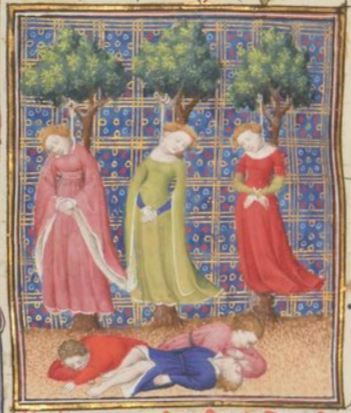
This illumination depicts the wives of the Cimbrians (a northern tribe) killing their children and hanging themselves. After their husbands were defeated in war against the Romans, the wives pleaded to their enemies for mercy and to let them become vestal virgins. When the Romans denied their request, they decided to kill their own children and hang themselves to save their virtue and to not die at the hands of their enemies. The women in the image are depicted with the nooses around their necks and hanging from trees, and their children are depicted dead on the ground.
Here we see a mercenary soldier on the battlefield, holding a musket with bayonet attachment. Gulliver explains that mercenary troops were available for hire for any nation, and thus did not necessitate a patriotic army. When Swift wrote Gulliver’s Travels in 1727, mercenary troops were common, and we are just beginning to see national armies. The same image appears in the 1839 Krabbe edition.
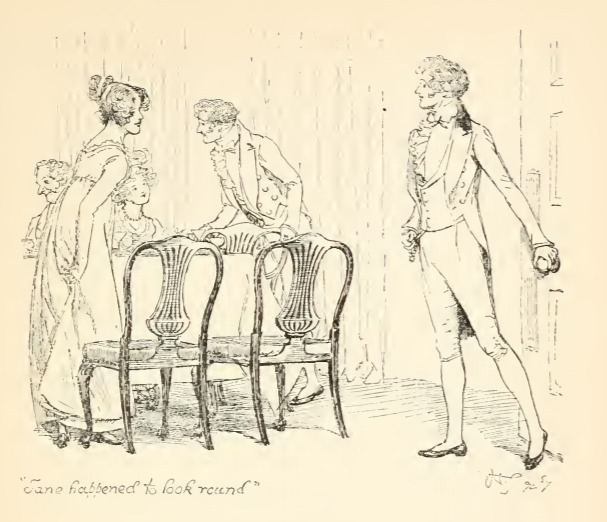
In this image Mr. Bingley sits by Jane at a dinner at Longbourn. After Mr. Bingley’s return to Netherfield, the Bennets invited him and Mr. Darcy to dinner. Jane and Mrs. Bennet were both anxious to see if Mr. Bingley would take his old seat next to Jane at dinner. This indicated to Jane that Mr. Bingley still loved Jane. This scene occurs in chapter 54. The characters are shown in the traditional regency style. Mr. Darcy and Mr. Bingley wear waistcoats and tailcoats. Jane wears a regency dress with an empire waist. The regency period dated to the early nineteenth century (1811-1820) when George, Prince of Wales, later George IV (r. 1820-1830), reigned as regent for his mentally ill father, King George III (r. 1760-1820). The regency period is associated with the rise of neoclassicism in art and fashion.
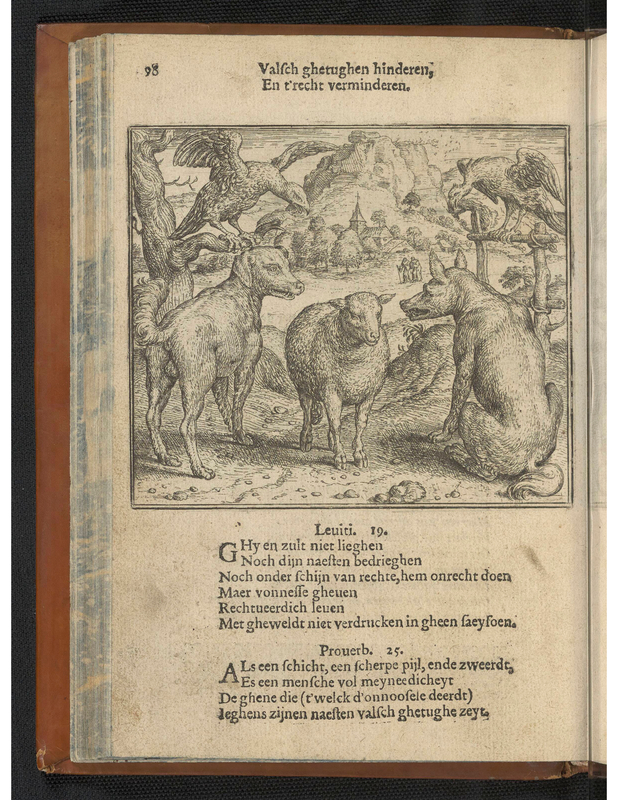
A wolf, dog, and sheep sit in the foreground. Two vultures watch them from perches. In the background, there is a church steeple and a large rock face.
Here we see four different wigs, representing different levels of society. On the right we see the church, represented by the mitre. In the centre right, we see the king, represented by the crown. On the centre left we see the long wig traditionally worn by the Lords, in the House of Lords with a tag that says Lords. On the far left we see the wig tied back, traditionally worn by the upper class who were in the House of Commons, with a tag that says Communes. In this chapter Gulliver talks with the King of Brobdingnag about English traditions. Gulliver tells the King about diplomacy, religion, the justice system, the arts, the financial system, and the nobility, then debated these issues with the king. The same image appears in the 1843 Krabbe edition.
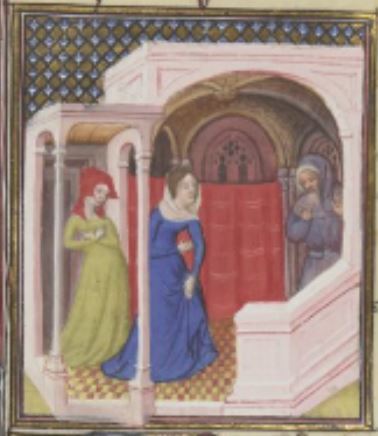
This illumination depicts Turia (also known as Curia), a Roman woman and wife of Quintus Lucretius, in the centre of the image wearing a blue dress as she hunches over. After her husband had gotten proscribed, Turia kept her husband safe within their house so that he would not have to go to war. She took care of him and went in public and pretended to have lost her husband so that no one would suspect that he was home. This image depicts Turia out in public pretending to be upset while looking for her 'lost' husband. There are other citizens in the image looking at Turia. Boccaccio explains that he wrote on Turia to highlight her devotion to her husband.
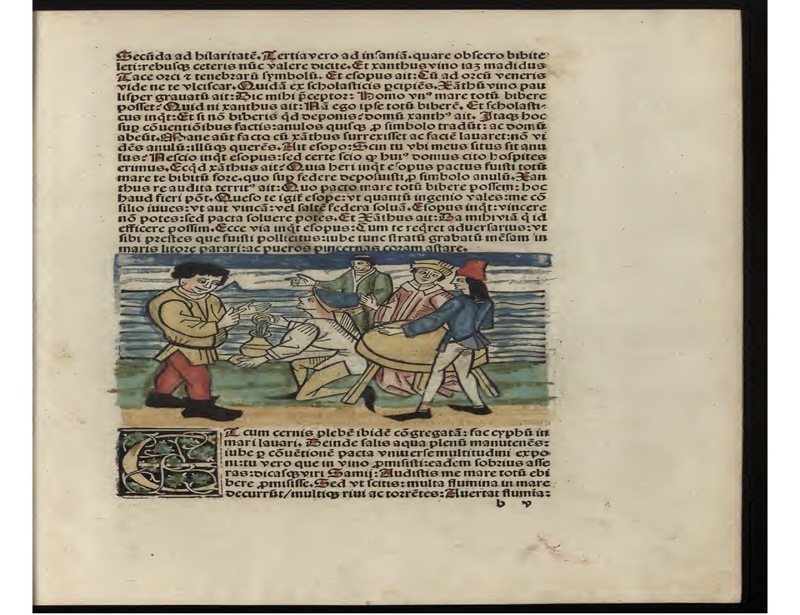
Five people stand together outside. One man stands holding a table, waiting for directions on placement. Another man kneels while pouring water for another member of the group. The man he pours water for appears to be reprimanding him.
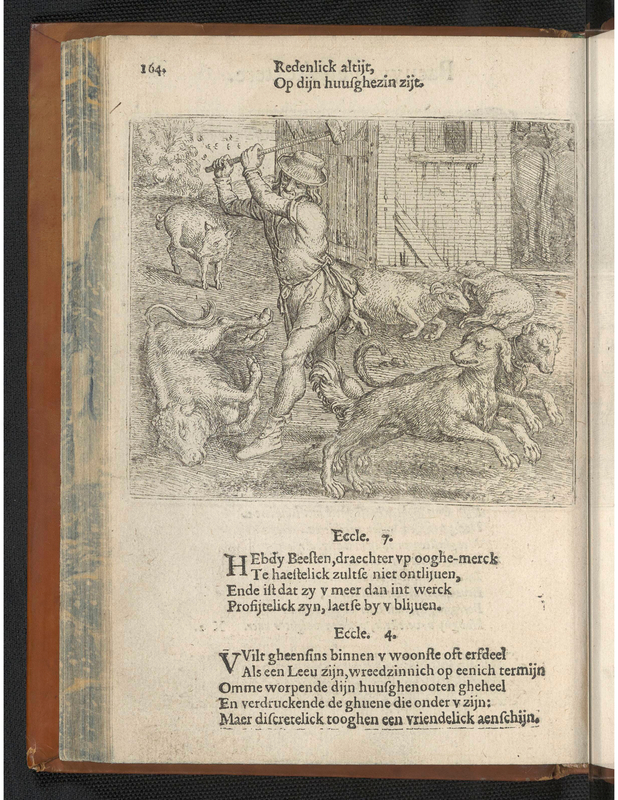
A man swings a hammer at a cow that is lying dead on the ground at left; on his right there are two running dogs; in the background there is a boar, there are two sheep and a barn with two cows in it.
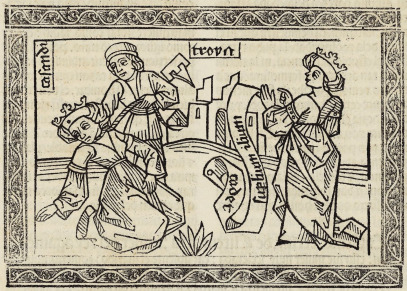
This engraving depicts Cassandra, the daughter of king Priam of Troy on the left side of the engraving being killed under the order of Clytemnestra, who is on the right side of the engraving watching the murder. Boccaccio explains that Cassandra was brought to Mycenae after the Trojan War as king Agamemnon’s mistress. Agamemnon’s wife, Clytemnestra did not like this, and ordered Cassandra to be killed. Cassandra is depicted with a rope around her neck and a man pulling on the rope. Clytemnestra is depicted with a pleased look on her face as she watches Cassandra die. Cassandra’s name is engraved in the top left-hand corner of the engraving to identify her. The fallen city of Troy is depicted in the background of the engraving.
Alfonso is sworn in as king of Castile following his brother’s death. He receives homage from all the knights but Rodrigo, who refuses unless Alfonso swears an oath that he was not involved in King Sancho’s murder. Alfonso is hesitant but agrees. Rodrigo then tells him that he actually wants him to take the oath three times rather than just once, to be completely sure, which causes Alfonso to become so angry that he banishes Rodrigo from Castile.
Here we see the overturned boat Gulliver found off the coast of Blefuscu. Gulliver refurbished the boat and used it to sail away until he was picked up by a larger ship. This image appears at the beginning of chapter eight, and the letter T is in the top corner, as the is the first word of the chapter.
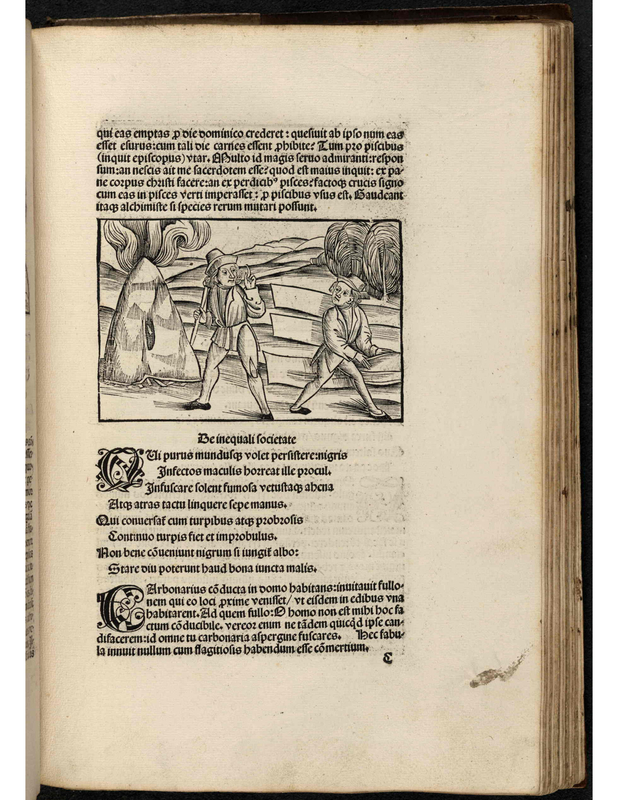
Two men are in a field. One man stands near a straw hut with plumes of smoke coming from the top of it. He is holding a stick and speaking to the other man. The other man is walking away from the man with the stick but facing him.
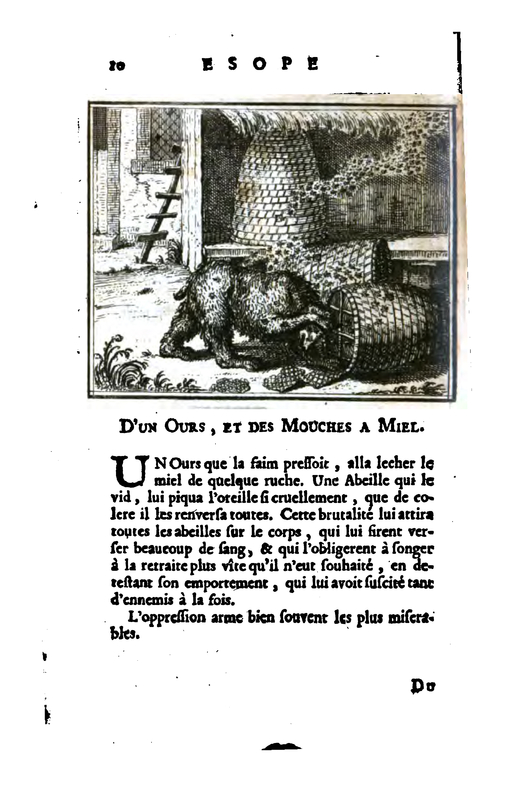
A bear appears to have knocked over an apiary, and honey bees are swarming around the bear. Honeycomb is lying on the ground, and the bear is covering its face with its paw. In the background, another apiary is fallen over. The illustration appears to have an illegible signature on the bottom left corner.
As the clock approaches midnight, Calisto leaves for Melibea’s house. He is joined by Sempronio and Pármeno, who stand guard while he speaks with Melibea through the door of her house (as seen here). As he is exchanging passionate words with her, Sempronio and Pármeno overhear a noise in the street and flee, leaving Calisto unguarded. When they realize that the noise is coming from the alguacil’s men (the ‘night watch’), who are patrolling another street, they return to their post. However, the alguacil’s men eventually enter upon Melibea’s street, forcing Calisto and his servants to flee. The three figures in this illustration are all male. Per usual, each of them is depicted wearing a hat with a sword mounted on his belt. To the left of the image there is an ornate window, although we are unable to see into Melibea’s house.
This image has two animals being angry with each other. They are staring at each other with the intent to cause harm. There are multiple other animals in the background also having some sort of conflict.
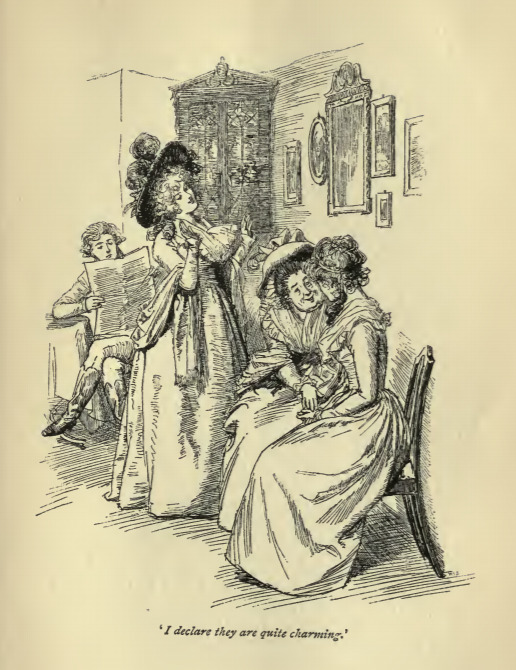
In this image Mrs. Jennings visits Barton Cottage with her daughter and son-in-law, Mr. And Mrs. Palmer. Elinor speaks with Mrs. Jennings and Mrs. Palmer, while Mr. Palmer sits in the corner, reading a newspaper. Elinor found Mr. Palmer to be cold and unfriendly, but Mrs. Palmer was warm and kind. This scene occurs in chapter 19. The characters are shown in the traditional regency style, as Mrs. Jennings, Mrs. Palmer, and Elinor wear the regency style dress with an empire waist. Mrs. Jennings and Mrs. Palmer wear bonnets. Mr. Palmer wears a waistcoat and tailcoat with breeches. The regency period dated to the early nineteenth century (1811-1820) when George, Prince of Wales, later George IV (r. 1820-1830), reigned as regent for his mentally ill father, King George III (r. 1760-1820). The regency period is associated with the rise of neoclassicism in art and fashion.
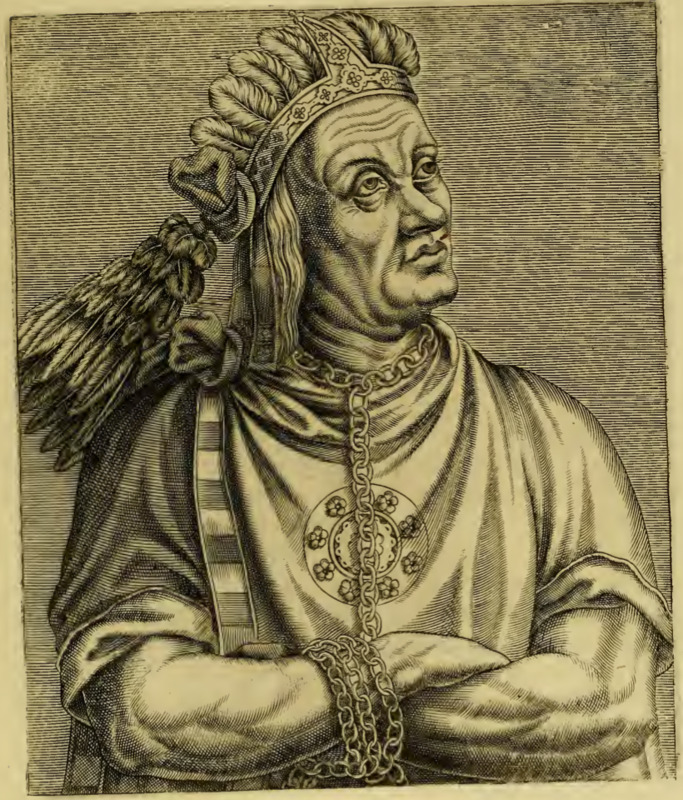
Atabalipa (Atahualpa in Quechua) is shown in portrait from the waist up, standing with arms crossed and gazing to his left with his head tilted slightly upwards. He wears a headdress decorated with feathers around the crown of his head and a large feathered tassel that hangs from a strip of cloth tied around the headdress. He also wears a short-sleeved tunic, bunched into a knot at his right shoulder, which has a circular, floral motif on the chest. He has chains around his wrists and neck. Atahualpa was the last Inca Emperor (or Sapa Inca) to officially rule before the Spanish conquistadors established their control. Atahualpa gained the title in 1532 after winning a civil war fought against his half-brother for control of the Inca Empire. He was captured by Spanish colonists led by Francisco Pizarro that same year and was executed by the Spanish in 1533.
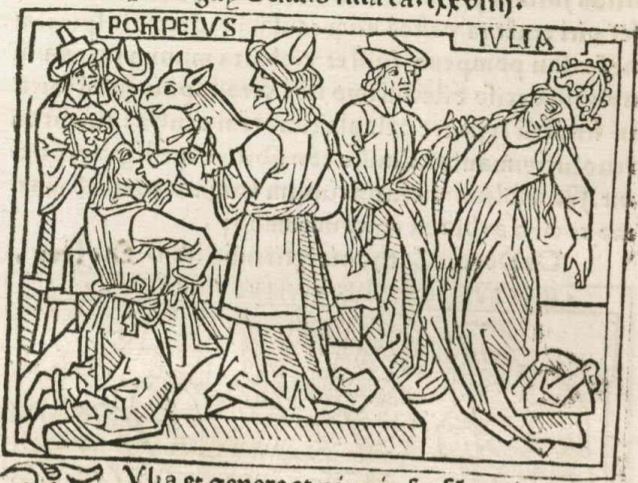
This engraving depicts two separate events. The left side of the engraving depicts Pompey the Great participating in a sacrifice of an animal. Pompey is depicted wearing a crown to signify his high status and nobility. The man to the right of Pompey is depicted cutting the neck of the animal that he is holding. There is blood splashing out from the animals wound, which stains Pompey’s clothing. Boccaccio explains that after Pompey’s garments became stained with the animal’s blood, a servant carried his stained clothes back home to get new ones. Julia, Pompey’s wife and the daughter of Julius Caesar, saw the blood-stained clothing of her husband and immediately thought that he had been murdered. Julia is depicted on the right side of the engraving after having just seen the clothing of her husband. She looks distraught and is depicted mid-fall to the ground. There is a servant beside her who is holding the blood-stained garments of her husband. Her name, written as Iulia, is engraved above her head to identify her. Similarly, Pompey’s name, written as Pompeius, is engraved above his head.
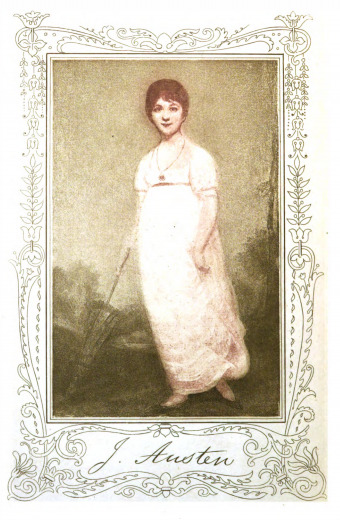
This is a portrait of Jane Austen, said to have been painted when she was fifteen years old in Bath. The painting was done by Johann Zoffany. At the time of printing of this edition, the painting was in the possession of Reverend J. Morland Rice, Rector of Bramber, Sussex, grandson of Jane Austen’s brother, Edward. It was reproduced with permission of Rev. Rice as the frontispiece of this collection of Austen’s novels. According to information in the list of illustrations, the painting belonged to Colonel Austen of Kippington, a descendant of Jane Austen’s great-uncle, Uncle Francis, and was a friend of her father. Colonel Austen then gave it to his friend, Mrs. Hardinge-Newman who greatly admired Austen's novels. Mrs. Hardinge-Newman's stepson, Dr. Hardinge-Newman, left it to Mr. Rice. In this painting, Austen wears a dress in the traditional regency style with an empire waist. Her hair is worn up, and she holds a parasol. The same image appears as the frontispiece for the Dent 1893, 1894, 1895, 1896, and 1897 editions of Sense and Sensibility.


![[A mercenary soldier]](https://collections.cemvc.ca/files/large/f9acb72e0b7c4a0f2cbc8969c4407c93ad8be74b.jpg)

![[Wigs representing the different factions of society]](https://collections.cemvc.ca/files/large/da6dbf6b23166191cc6ede2e57288b2848e371fe.jpg)
![[The Cid administers King Alfonso’s oath]](https://collections.cemvc.ca/files/large/6de6ee63eb822d1d18bb41f8f90ab1d967183725.jpg)
![[An overturned boat off the coast of Blefuscu]](https://collections.cemvc.ca/files/large/a7d9adf018c28c4f89e572f3ada9657ff25f9895.jpg)
![[Act XII] Calisto spreect.](https://collections.cemvc.ca/files/large/f0680ebbdbba2e6828285c837d85082401896809.jpg)
![[Two Animals get into an Argument]](https://collections.cemvc.ca/files/large/d439aa33654dd7cf084393cbed23545daeed01ff.jpg)