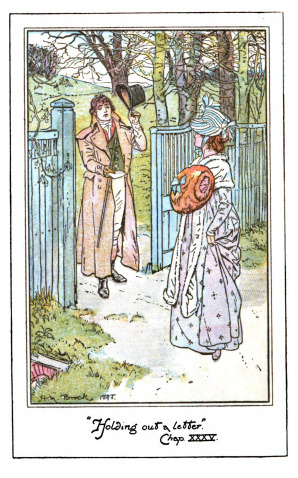
Here we see Mr. Darcy delivering his letter to Elizabeth when she came to the north of England with her aunt and uncle on vacation. Mr. Darcy stands outside the open gate, tipping his top hat to Elizabeth and holding out his letter. Elizabeth stands on the inside of the gate, holding a muff in front of her. In this letter, Mr. Darcy outlines the reality of the character and his relationship with Mr. Wickham. Mr. Wickham was a militia officer stationed in the town near Longbourn. He was very charismatic and Elizabeth’s sister, Lydia, ran away with him and got married, much to the distress of the rest of the Bennet family. Mr. Darcy disapproved of Mr. Wickham, as Wickham was Mr. Darcy's father’s godson, and Wickham tried to marry Darcy’s sister, Georgiana, in order to obtain her wealth. Wickham also inherited some money from Mr. Darcy’s father with the intention that he join the clergy, but he did not follow through with his clerical studies. In this letter he also explained why he split up Jane and Mr. Bingham, because he did not realize their mutual love. Darcy explained to Elizabeth that he thought Jane unworthy of Bingley and persuaded him to leave Netherfield. In his letter, he apologized for this misjudgment. The letter was intended to address Elizabeth’s accusations regarding his pride, and Elizabeth’s prejudices against him. The letter marks a shift in Mr. Darcy’s character and the beginning of the real love between Elizabeth and Darcy. This scene occurs in chapter 35 as noted underneath the title of this image. The characters are shown in the traditional regency style, with Mr. Darcy wearing waistcoat, tailcoat, an overcoat, and knickers that stopped at the knee. Elizabeth wears the regency style dress with an empire waist. Her hair is worn tied up, as was tradition for women after their coming out before the queen, signaling her entrance into society. She wears a bonnet, a popular fashion of this period to protect her from the sun. Bonnets were especially popular because in this period a common pastime for women was going out on walks. Elizabeth has a shawl wrapped around her shoulders. The regency period dated to the early nineteenth century (1811-1820) when George, Prince of Wales, later George IV (r. 1820-1830), reigned as regent for his mentally ill father, King George III (r. 1760-1820). The regency period is associated with the rise of neoclassicism in art and fashion.
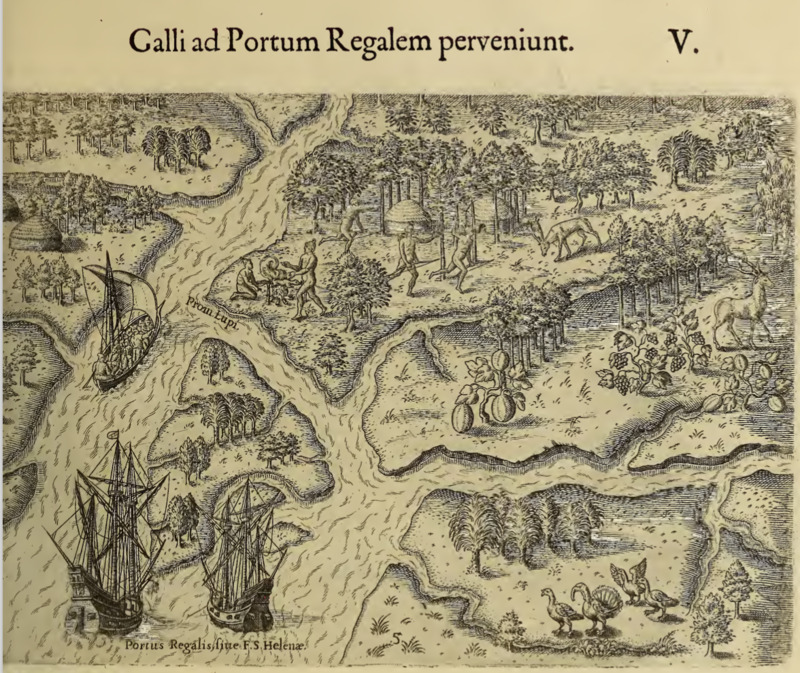
Two large ships are shown at the mouth of the river, while another smaller ship sails further up the river. Two Indigenous people on the bank of the river roast a small animal over the fire, while several others run with bows and arrows. On both sides of the river there are round structures.
After spending the night with Areusa, Pármeno returns to Calisto's house quite late to find Sempronio waiting. Pármeno tells Sempronio that he has joined him and Celestina in their plans, talks about the happiness he has achieved by meeting Areúsa. He expresses regret at having previously opposed them, and states that he is now willing to cooperate with them on everything, recognizing that there is an opportunity for him to profit from the love Calisto has for Melibea. They both agree on this and move forward with scamming Calisto. To the left we see Calisto, who appears to have a look of sadness or concern on his face.
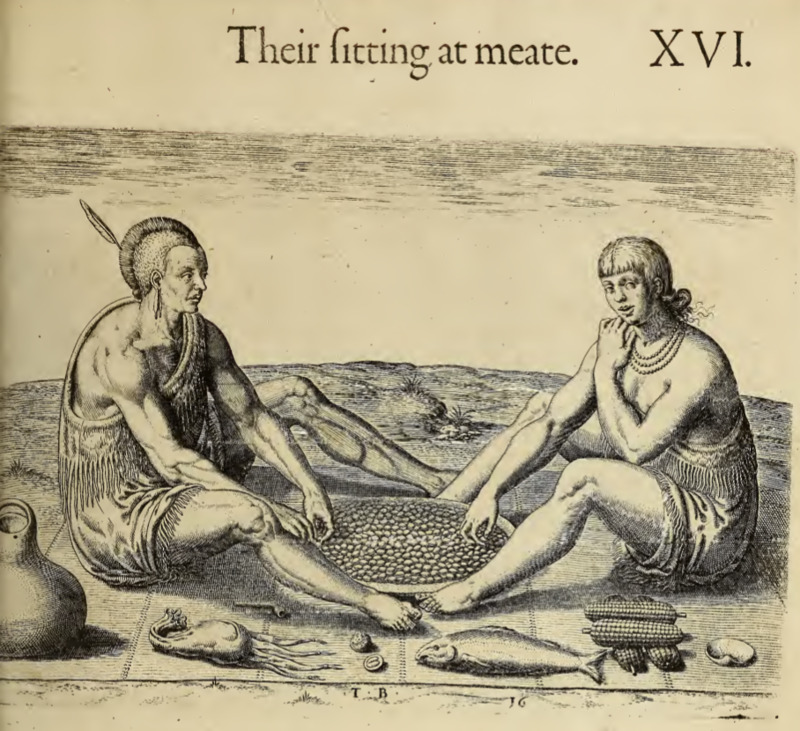
Two Indigenous people are shown sharing a meal. A man sits on the left, and a woman on the right. They sit on a mat on the ground. A large dish with food is between them, and around them are a jug, a pipe, some nuts, a fish, some cobs of corn, and other objects. The man wears a fringed garment draped around his body and over one shoulder and a single feather in his hair. The woman wears a similar fringed garment draped over one shoulder and two strands of beads around her neck.
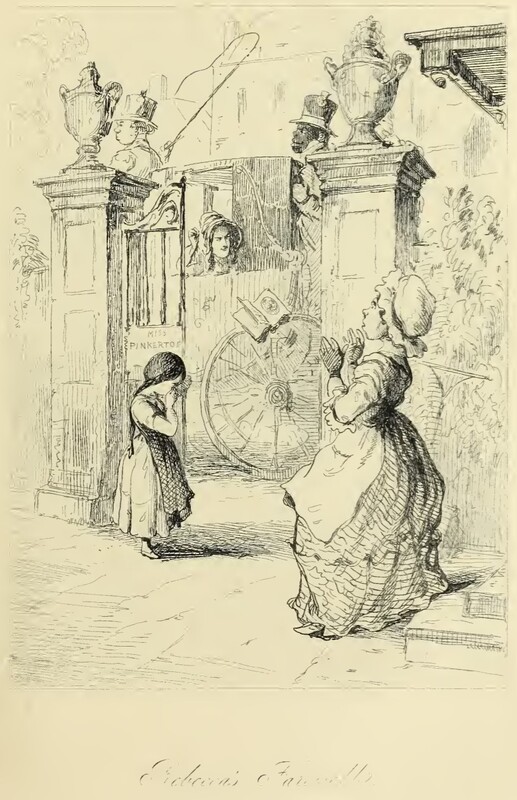
The image depicts two pillars topped with cups, between which is an open gate with a plate reading Miss Pinkerton. The pillars frame a carriage with very large wheels, at the front of which sits the coachman, holding his whip, and at the back of which stands Sambo. Rebecca Sharp’s face can be seen from the window of the carriage as she flings a book at the surprised Miss Jemima, who stands on the right side of the image at the bottom of the stairs. Next to the left pillar is a young girl with long braids, possibly Laura Martin, crying and covering her face with her hands. Below the illustration is printed in cursive its title, Rebecca’s Farewell.
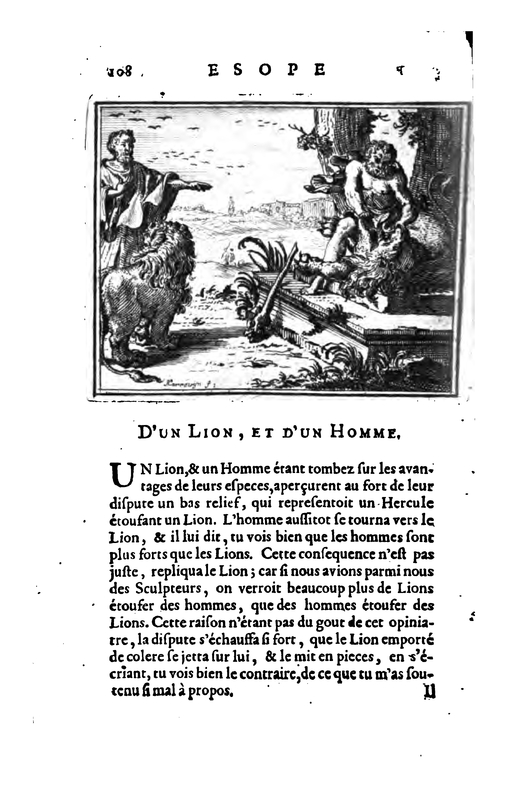
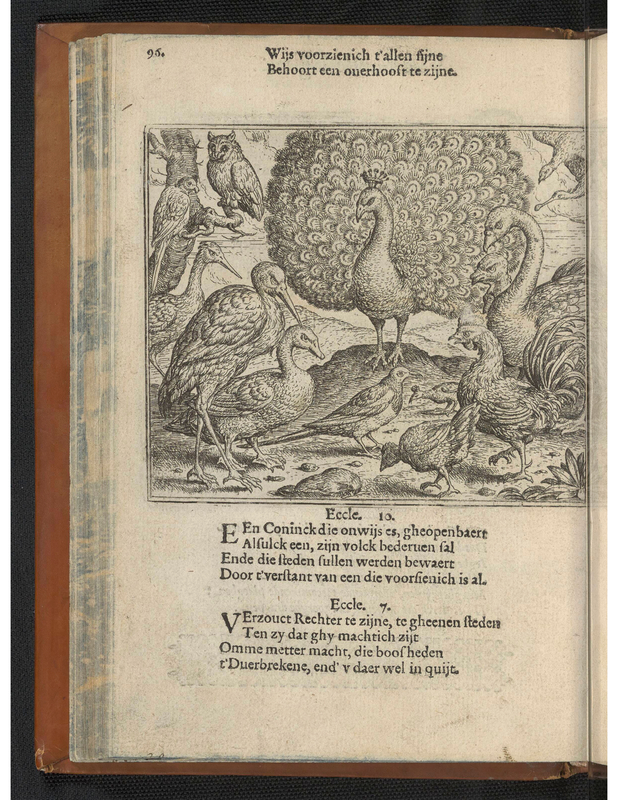
The image depicts a man and a lion discussing a statue on the left side. On the right side of the image there is a statue of a man and lion in combat, the man is winning the combat. The lion claims the statue was made by man if it were made by a lion the man would have been losing.
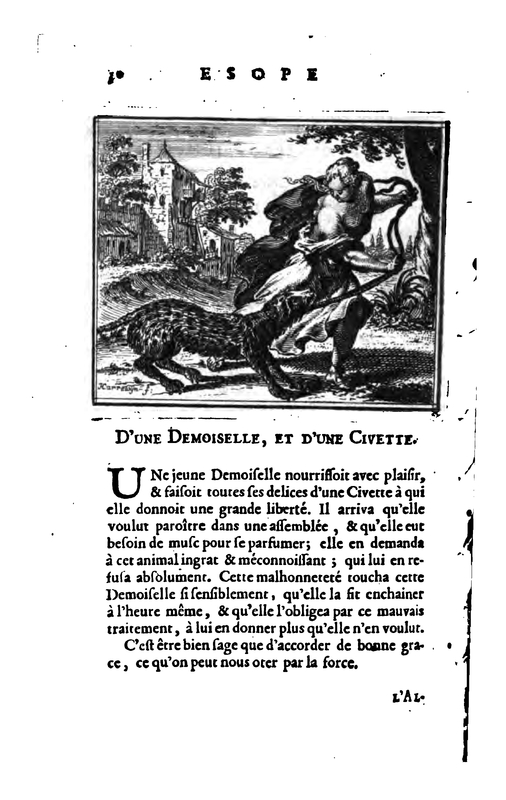
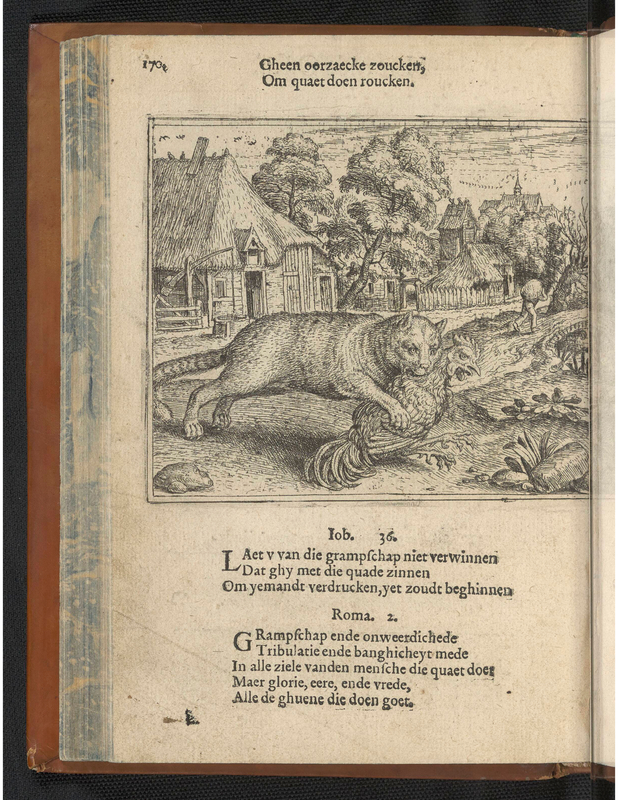
A young lady tugs on one end of what is presumably rope, while a civet tugs on the other end with its teeth. There are buildings in the background. The illustration has the signature of Harrewijn in the bottom left corner.
When evening arrives, Celestina, Elicia, and Areusa wait for Pármeno and Sempronio to join them for dinner. They arrive late, which leaves Elicia and Areusa frustrated. To make matters worse, Sempronio praises Melibea’s beauty and virtue, causing his lover Elicia to become jealous and infuriated. Celestina talks her down from her rage, and the four lovers share a meal while Celestina drinks her wine (as depicted to the left of the image). Lucrecia knocks at the door (seen to the right), and she tells Celestina that Melibea wants her girdle returned. More importantly, she tells Celestina that Melibea has an illness of the heart and has requested her presence. Thus, Lucrecia and Celestina depart for Melibea’s house.Every female figure in this image is depicted wearing a robe and a veil. Sempronio and Pármeno are depicted wearing hats. Celestina is seen holding a jug of wine in her right hand, while in her left she is holding a chalice/goblet.
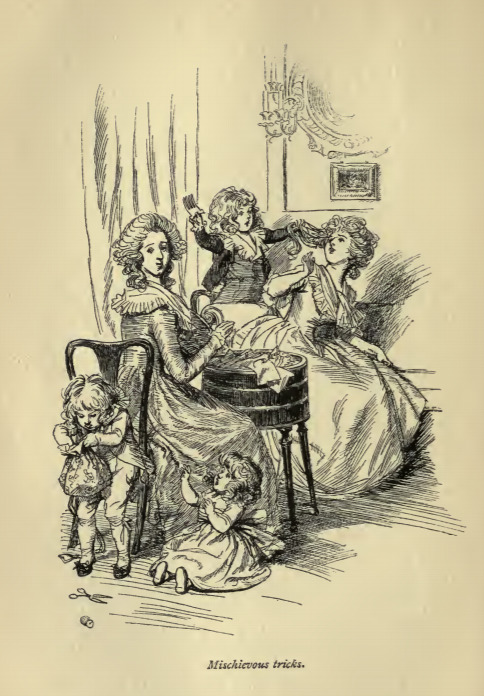
In this image Lucy Steele plays with Lady Middleton’s children. The children could be mischievous and while Elinor found it tiresome, but Lucy enjoyed their attention. Lady Middleton here continues with her work, rather than disciplining her children. One child plays with Lucy’s hair, while another looks through Lady Middleton's purse. This scene occurs in chapter 21. The characters are shown in the traditional regency style, as Lucy and Lady Middleton wear the regency style dress with an empire waist. The regency period dated to the early nineteenth century (1811-1820) when George, Prince of Wales, later George IV (r. 1820-1830), reigned as regent for his mentally ill father, King George III (r. 1760-1820). The regency period is associated with the rise of neoclassicism in art and fashion.
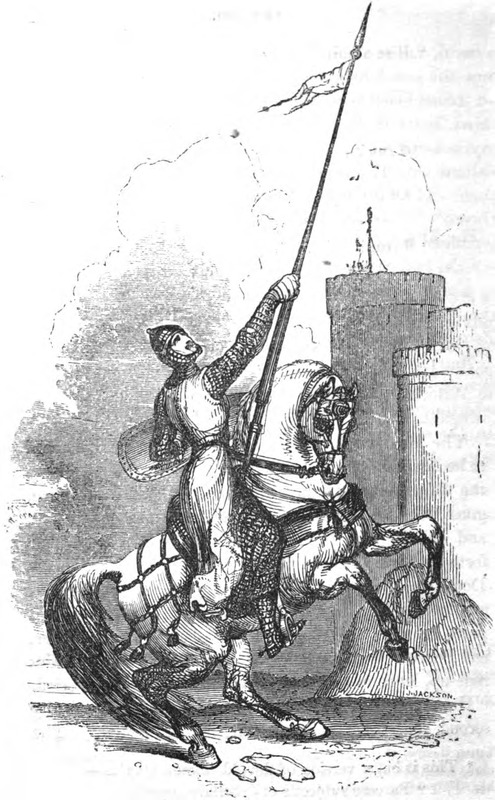
Diego Ordoñez rides outside the walls of Zamora, cursing the city and challenging Don Arias Gonzalo and his sons to fight him after King Don Sancho was treacherously killed by Bellido Dolfos. Arias had nothing to do with the plot to murder the king, and in fact warned him about it, but he accepts the challenge anyway.
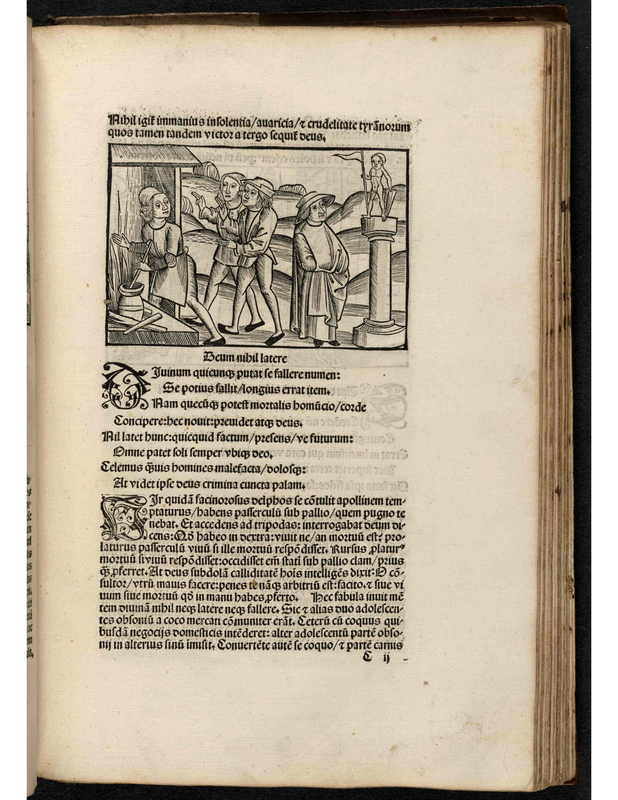
A woman stirring something in a pot with a stick looks at a woman across from her who is looking at a statue of a tiny man holding a flag and a shield. Two people are walking and talking in the background.
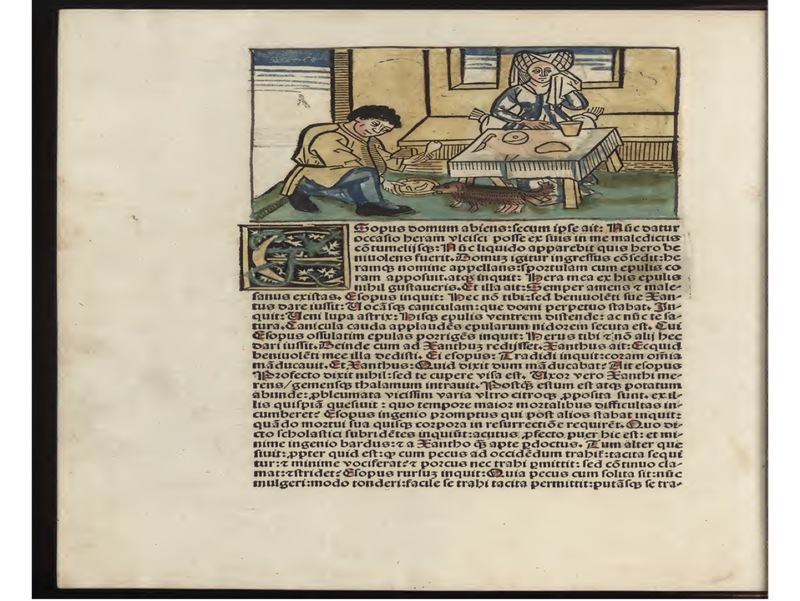
A woman of high status sits at the table crying and wiping away tears with a handkerchief. Aesop kneels below the table holding a plate and utensil in hand. From the plate, he feeds the pet dog of the woman sitting at the table.
Jones, a reader of the story, is seated in an armchair with his legs crossed and feet on an open-backed chair. He is holding his copy of the serial in his right hand and holding a pencil to underline a phrase in it with his left.
Here we see Gulliver attending to a concert given by the King of Brobdingnag. Gulliver stands at the window and holds his fingers in his ears because he found the music too loud. In the background we see a musician playing an oboe, with a trombone slide, a bass drum, and the bell of a trumpet visible behind him. The same image appears in the 1843 Krabbe edition.
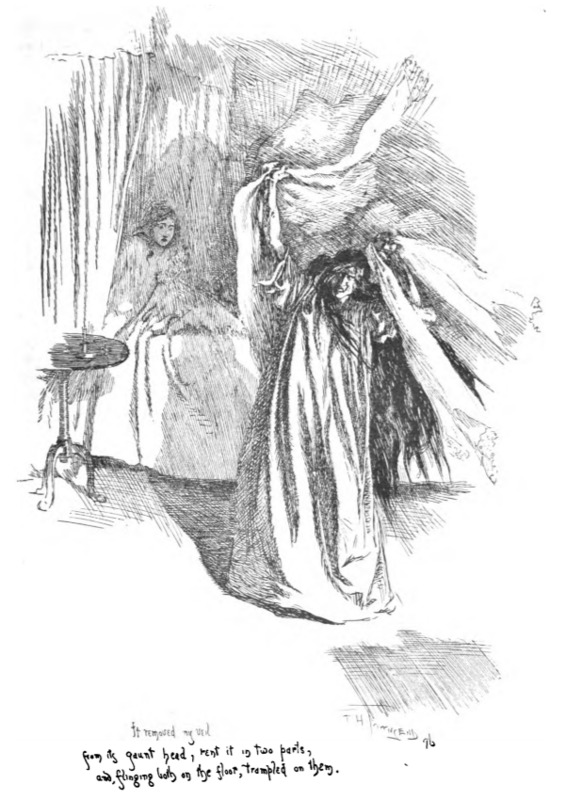
The night before her intended marriage to Mr. Rochester, someone broke into Jane’s room at Thornfield and ripped up her wedding veil. Jane did not know who this woman was, but she found out later that day that it was Mr. Rochester’s wife who was mentally ill.
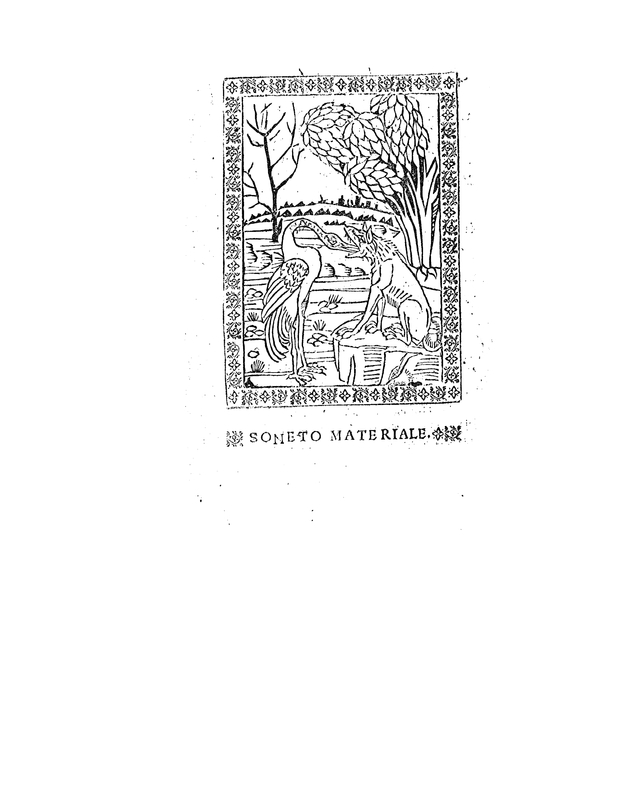
A fire is burning inside a furnace, lying next to the fire is a piece of wood dividing the space between a snake looking animal and the fire. The furnace is located inside a building with a few bins and boxes located around the outside of the furnace.
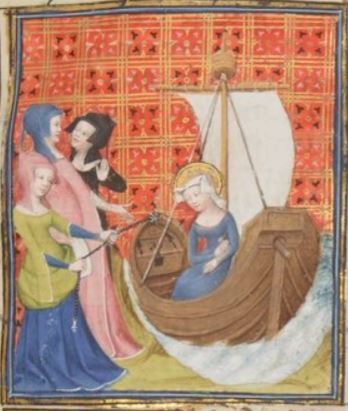
This illumination depicts Claudia Quinta, a Roman woman, standing on land as she pulls a ship to shore. Boccaccio explains that after Claudia Quinta was accused by other matrons of not being chaste, she prayed to the goddess Ceres to help prove her virtue. After a ship that contained a statue of Ceres had gotten stuck on a sandbar, Ceres gave Claudia Quinta the power to pull the ship to shore as proof of her chastity. The women who accused Claudia Quinta of being unchaste are standing behind her in the image as they watch her pull the ship to shore. The statue of the goddess is illustrated on the ship.
Gulliver explains how war works in Europe to his Master. Gulliver describes cannons, muskets, pistols, bullets, gunpowder, bayonets, sieges, battles, retreats, attacks, bombardments, sea battles, horses’ roles on the battlefield, and the various ways soldiers die on the battlefield. Several of these elements are shown in this image, including naval warfare, cannons, soldier’s deaths. The same image appears in the 1839 Krabbe edition.
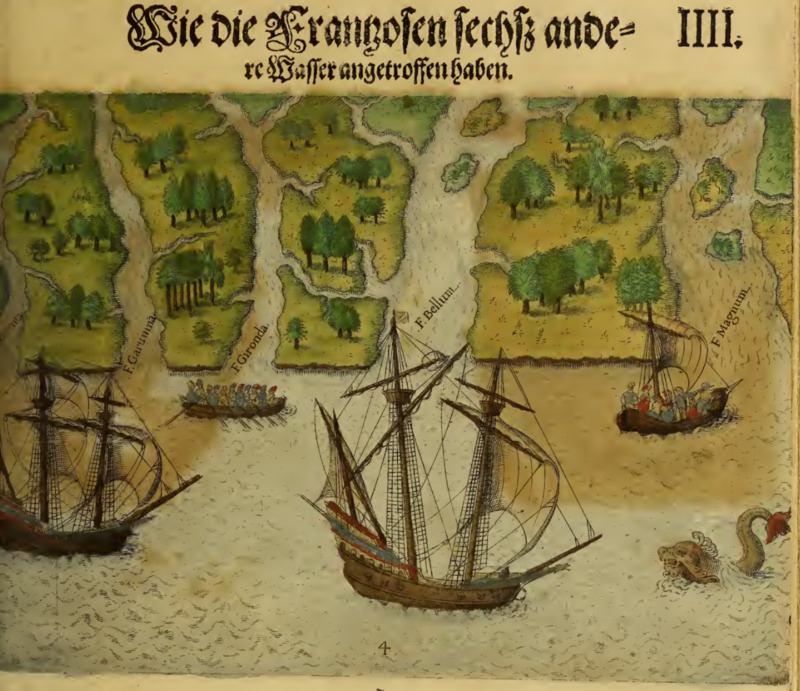
Two large ships are shown anchored off the coast, and two smaller rowing boats full of colonists approach the shore. Each boat is heading towards the mouth of a different river. Four rivers are shown. This illustration is identical to the one found on page 43 of Frankfurt 1591, but colored.
As midnight approaches, Calisto leaves for Melibea’s house once again, this time accompanied by Sosia and Tristan. When they arrive, Calisto uses a ladder to climb Melibea’s high garden wall (seen to the right of the illustration) and spends a romantic night with her. Meanwhile, Sosia and Tristan stand guard outside the wall (seen to the left of the illustration). The clock strikes 3AM all too soon, however, and he realizes that he must depart, lest he be seen by early risers. Calisto and his servants return home, and Calisto goes to sleep. When the sun rises, Sosia looks out a window and spots Elicia, who is walking toward Areusa’s house.[This illustration is identical to the one found on page 146 of the text (folio 75r).]

![[Act VIII - Pármeno Joins Sempronio and Celestina]](https://collections.cemvc.ca/files/large/91ff9530385e7588a20290c7ae99912e15fa14c3.jpg)
![[Act IX] Sempronio spreect tot synen ghezelle Pármeno.](https://collections.cemvc.ca/files/large/774e29f132c214d7cac18f3284518779c51ee9cd.jpg)
![[Jones Reading]](https://collections.cemvc.ca/files/large/92594e809d40f63eb2fce20428f0d1660ca92fac.jpg)
![[Gulliver listens to a concert given in the Court of Brobdingnag]](https://collections.cemvc.ca/files/large/25f89829934b9bedc33c52cb272db44a7950520c.jpg)

![[The Fire burning]](https://collections.cemvc.ca/files/large/56d31c8bae0085e0ef3853f84587fcf811b9fb09.jpg)
![[A battlefield]](https://collections.cemvc.ca/files/large/a2c97d56e15187388f858cb23284d682f7de6536.jpg)
![[Act XIV – Calisto Ascends Toward Melibea and Lucrecia While Sosia and Tristan Stand Guard]](https://collections.cemvc.ca/files/large/215247ff91d25f7ed25389d534b020463b3fdad0.jpg)