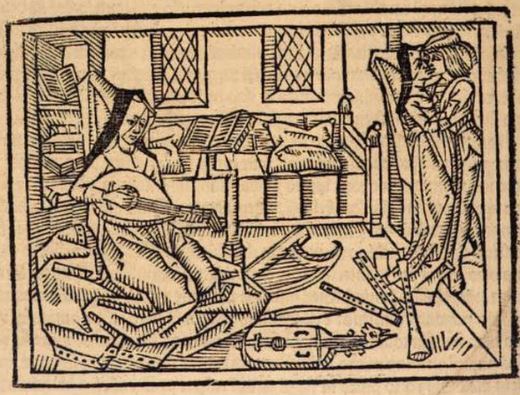
This engraving depicts Sappho, the famous poetess from Lesbos, on the left side of the engraving while playing the lyre. There are other stringed instruments and sheet music surrounding her. Sappho is also depicted on the right side of the engraving kissing a man. Boccaccio explains that this is the reason as to why her poems and music verses were so somber, as he did not share the mutual love that she had for him.
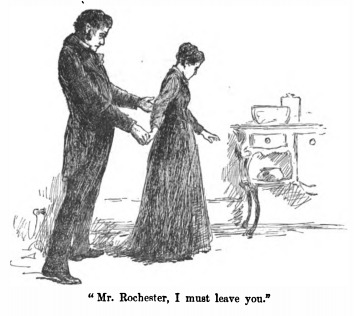
Here Jane Eyre tells Mr. Rochester that she cannot marry him. After the truth about his marriage came out, Jane decided she could not go through with her marriage on the morning that their wedding was scheduled. Jane walks away, and Mr. Rochester tried to stop her. She ends up running away, sleeping outside for several days before being taken in by the pastor for the village she arrived in. This pastor ended up being Jane’s cousin.
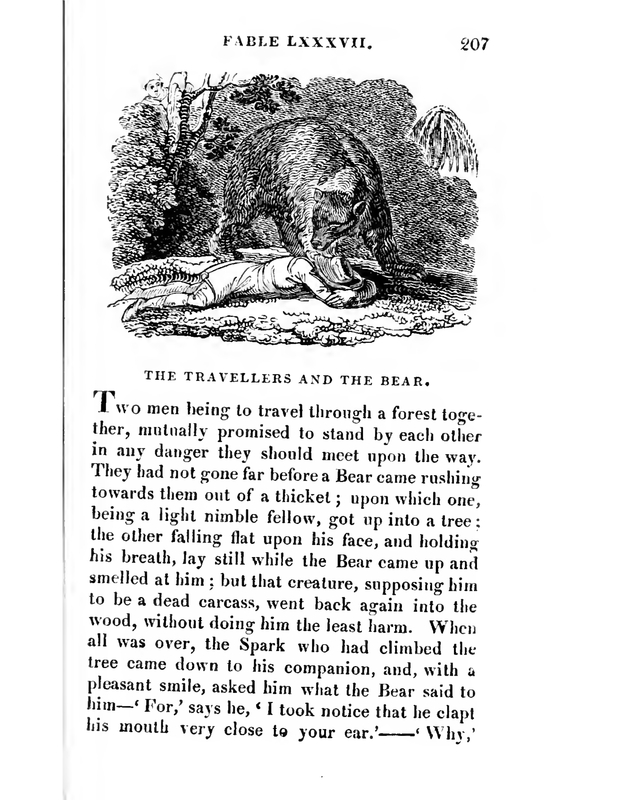
In the middle of the image there a large bear hovering over a traveller who is laying down on the ground. On the left and right side of the image there are many trees, plants, and bushes. On the upper left-hand side of the image there is a Spark sitting in a tall tree watching the bear and traveller.
The left panel depicts Sempronio (here spelled ‘Sepronio’, which is likely a printing error) dressed in regal attire. This panel was first used to represent Calisto, which explains the clothing, the falcon perched on his left arm, and the large chain he is wearing. It is odd that the printer would use this panel to represent someone other than Calisto, since the falcon is specific to his character. Beneath the figure’s feet there is small decorative panel. In the right panel we see Pármeno, who is pointing upward and has a sword mounted on his belt.The left panel is nearly identical to those found on pages 88 and 170 (where it is labeled ‘Calisto’ and has no decorative panel), 216 (where it is labeled ‘Pleberio’ and has no decorative panel), and 244 (labeled ‘Pleberio’). The right panel is identical to those found on pages 43 and 105, and is nearly identical to those found on pages 190, 221, and 235 (where it is labeled ‘Sosia’).
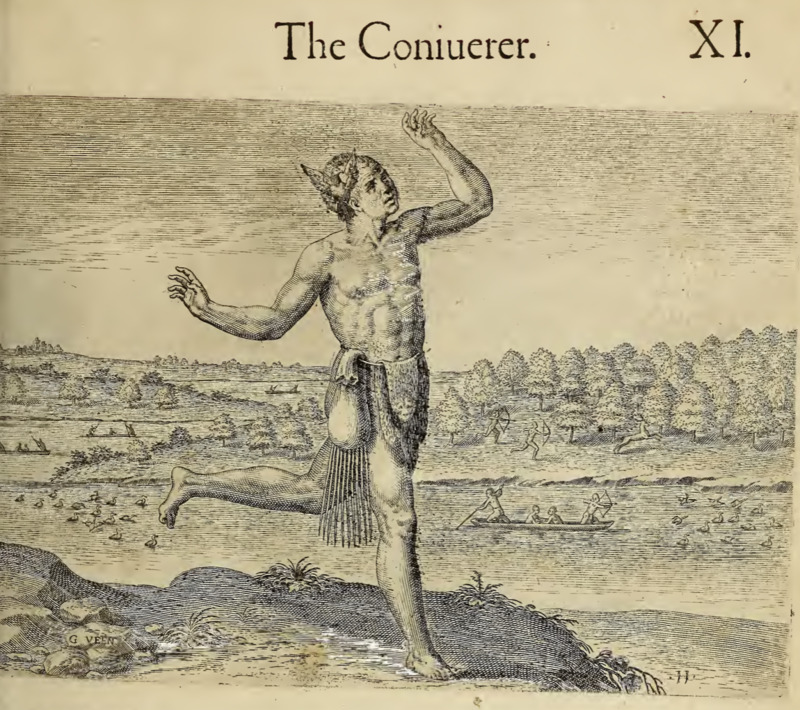
An Indigenous man, called a conjurer by the author, is shown standing on the bank of a river. He wears a black bird in his short hair as a symbol of his position. His only clothing is a hide tied around his waist, and a satchel hangs at his side. Behind him, other Indigenous people are seen in a canoe, hunting water birds with a bow and arrow.
Joseph Sedley is seated in a small, open, two-wheeled carriage pulled by a single horse. He holds the reins in his left hand with the whip raised high in his right as the buggy passes a post. At his side is seated another, unspecified, male figure in a tall hat. In the background can be seen the outside of some trees and two buildings. Too nervous to go see Becky Sharp in the drawing-room, he has decided to see a performance of Forty Thieves instead.
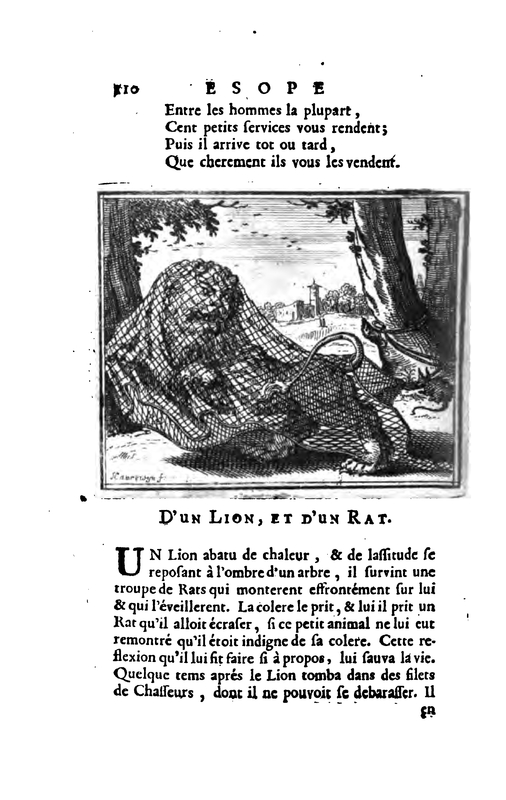
The image depicts a lion 0trapped in a net and a mouse chewing on the ropes to free the lion. The mouse helps the lion escape because the lion spared the mouse’s life in return for a favour.
This image is illustrated in a chapter that discusses the Christian priests in the colonial government in Peru. The author had criticized many parish priests for their sinful actions against the indigenous peoples of Peru. This image, however, represents an exemplary Christian priest, who does not involve himself in justices, commerce, servants, or unmarried indigenous women. The author praises their devotion to God. This priest is depicted standing at an altar that has a crucifix, two candles, a book, and the priest’s cap. An indigenous person is depicted kneeling behind the priest as he holds a bell and the priest’s cloak. The large caption at the bottom of the image reads, [M]isa parese bien con debocion y breue y se da mas debocion [...]a oy al bolber del saserdote los ojos serrados y umilde y al[zados] del sacramento los ojos al senor hacia arriua el braso alsar [cuan]to pudiere y detener un rrato para que pidan los pecadores del [mun]do y negocie y las ymagenes que ayan hecho milagro no se des[cuida], cino dos ueses en el ano con mucha ueneracion y fiesta en [e]l mundo.
Lord Tapeworm, the Secretary of Legation, bows as he introduces himself to Amelia Osborne with what he believes is a charming smile. Next to Amelia is seated her brother Joseph. Georgy is standing behind his uncle, peering around at the Secretary with curiosity. Next to him, William Dobbin stands with his hands on his hips.
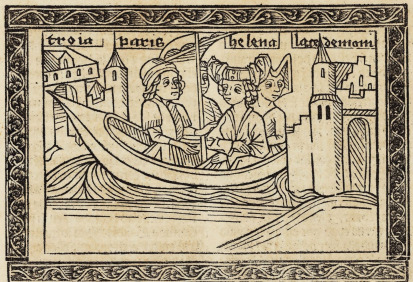
This engraving depicts prince Paris of Troy leaving the shores of Lacedaemon on a ship that carries queen Helen, wife of king Menelaus. Boccaccio explains that Paris had fallen in love with Helen while he was a guest in king Menelaus’ home. It is debated whether Helen’s feelings towards Paris were mutual and she willingly went with him, or if he had taken her by force. This image depicts Paris sitting on the left side of the ship (his name is engraved above his head), and Helen sitting on the right side (her name is also engraved above her head). Lacedaemon is illustrated on the right side of the engraving, while the city of Troy is on the left side. The ship is pointing towards Troy as that is their destination. Paris and Helen going to Troy is the cause of one of the greatest wars of all time: The Trojan War.
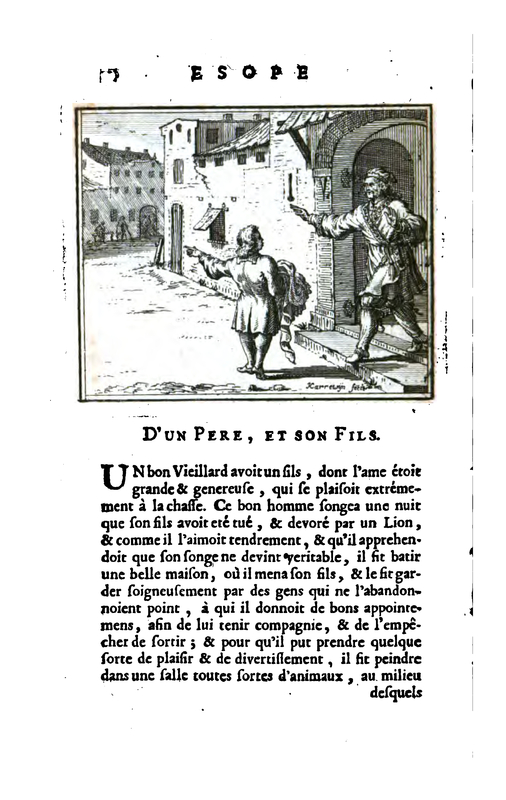
A good old man had a son, whose soul was great and generous, who was extremely fond of hunting. This good man dreamed one night that his son had been killed, and devoured by a Lion, and as he loved him dearly, and feared that his dream would not become true, he had a beautiful house built, where he led his son, and had him carefully guarded by people who did not abandon him, to whom he gave good wages, in order to keep him company, and to prevent him from forging; And so that he could take some pleasure and entertainment, he had all the strong animals hung in a room, in the middle of which he had a lion represented.
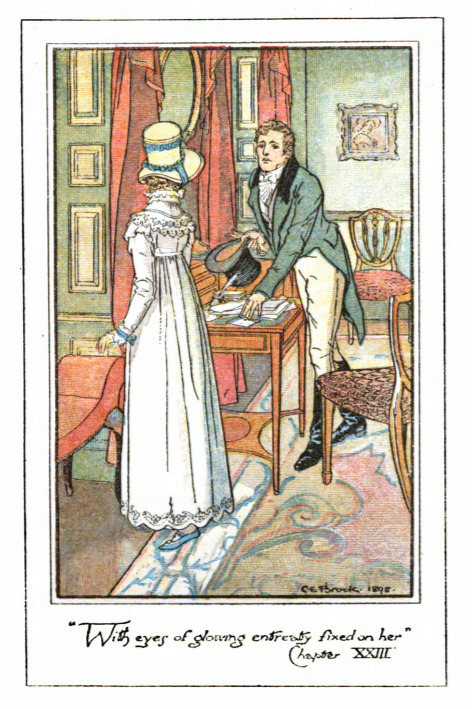
Here we see Captain Wentworth leaving his note for Anne. Both Anne and Captain Wentworth were visiting the Musgroves, and he was writing a letter when Anne arrived. After he finished writing, he left the note on the table for Anne. She then sat down at the desk to read the note. In this letter, Captain Wentworth wrote that he still loved her, and wanted to marry her. Anne was ecstatic, and the two got married shortly afterwards. This scene occurs in chapter 23 as noted underneath the title of this image. The characters are shown in the traditional regency style, with Anne wearing the regency style dress with an empire waist. Her hair is worn tied up and wears a bonnet. The bonnet had a large brim, used to protect a woman’s face from the sun. These bonnets were a popular style in this era as going for walks were common pastimes. Captain Wentworth wears a waistcoat and tailcoat with breeches and a top hat. The regency period dated to the early nineteenth century (1811-1820) when George, Prince of Wales, later George IV (r. 1820-1830), reigned as regent for his mentally ill father, King George III (r. 1760-1820). The regency period is associated with the rise of neoclassicism in art and fashion.
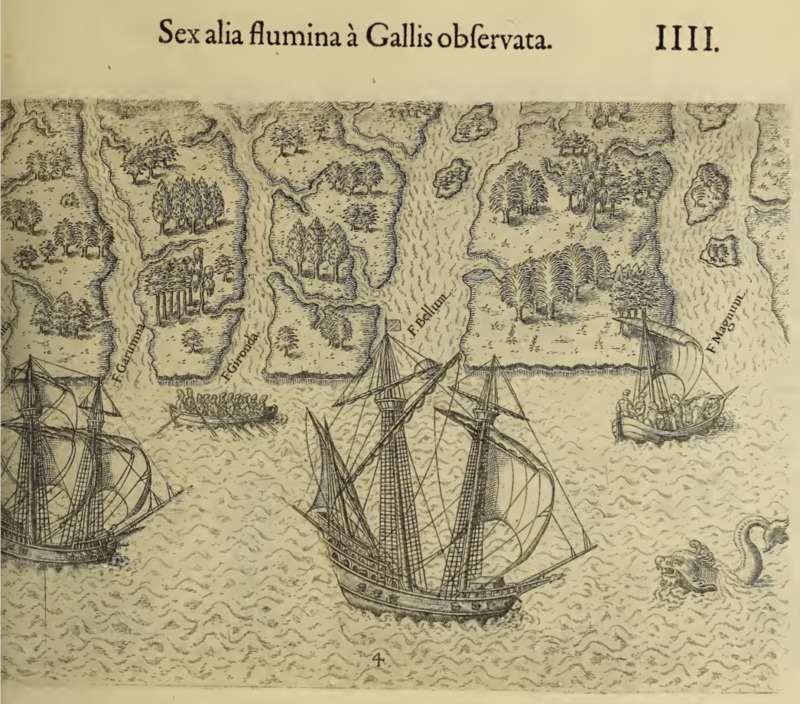
Two large ships are shown anchored off the coast, and two smaller rowing boats full of colonists approach the shore. Each boat is heading towards the mouth of a different river. Four rivers are shown.
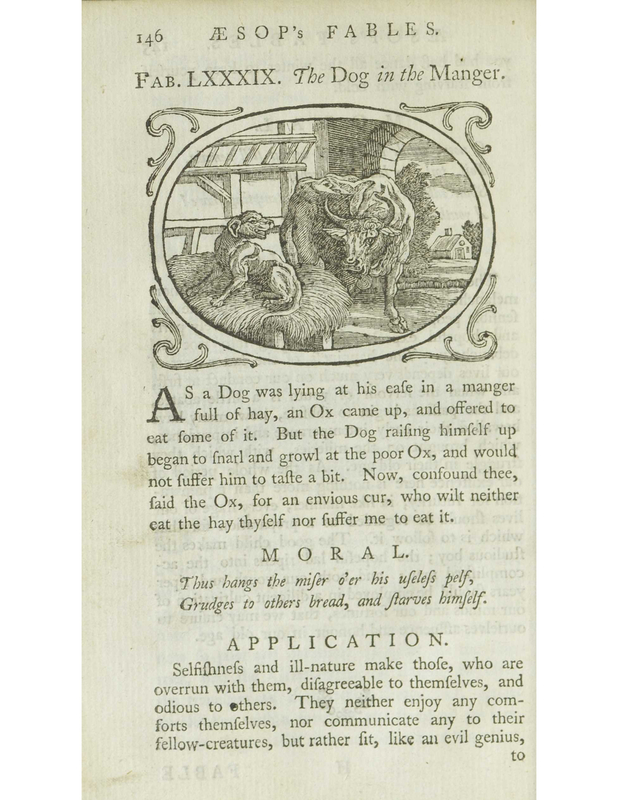
A snarling dog is sitting up in a manger facing an ox who is trying to take some hay from the manger on which the dog is sitting. The ox has a sad expression on its face and through the doorway, a small farmhouse can be seen.
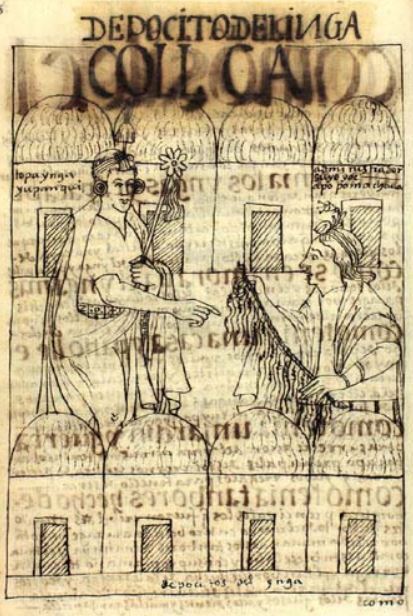
This chapter is dedicated to discussing the Inca and his life. This image depicts the Inca in front of his many collca [storehouses]. There are four storehouses illustrated at top of the image behind the Inca and four at the bottom in front of the Inca. The Inca had storehouses in many regions over the empire and they were mostly filled with food items such as maize, sweet potatoes, coca, and chile peppers. The Inca is depicted wearing his traditional regalia and holding a scepter in his left hand and pointing with his right as he speaks to an administrator who supervises the collca. The administrator is depicted holding a quipu in both of his hands. The caption to the left of the Inca’s head identifies him as Topa Inca Yupanqui. The caption to the right of the administrator’s head identifies him as administrador, suyoyoc, apo poma chaua [administrator, Apo Poma Chaua].
This is a bust of Voltaire, an influential philosopher writing at the same time as Swift. Voltaire promoted the translation of Gulliver’s Travels into other languages (first French) on the European continent. The image is a part of Swift’s biography which precedes Part One of Gulliver’s Travels. The purpose of this illustration in the biography is to provide context for the political atmosphere and insight into Swift’s satirical writings. The same image appears in the 1839 Krabbe edition.
Soon after Celestina leaves Calisto’s house, Calisto grows impatient and tells Sempronio to visit Celestina and urge her to fulfill her duties with expediency. Sempronio expresses concern about leaving Calisto alone in his state of despondency, so Pármeno comes to keep him company and Sempronio departs (as depicted in this illustration). While Sempronio is away, they discuss Calisto’s heartache, and Pármeno attempts to inform Calisto of Celestina’s treacherous ways. All three figures are depicted with hats, while Pármeno and Sempronio both have swords mounted on their belts.[The figures in this illustration are used in multiple other illustrations throughout this edition.]
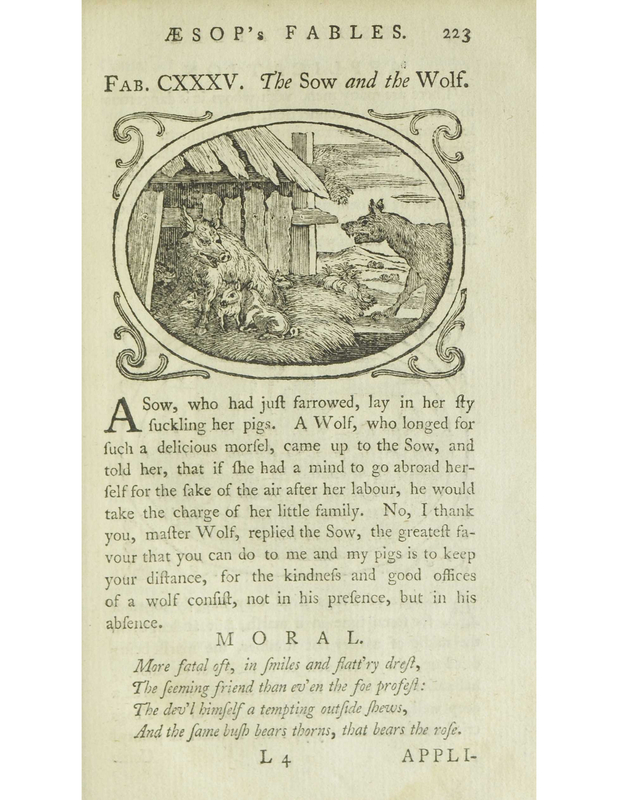
The scene is taken place outside, in the distance there is a small mountain and other plants scattered around the area. There is a Sow who had just farrowed lays in her sty suckling her piglets as a wolf confronts them looking for a meal, offering the Sow to take a break from her piglets after her labor and he would take charge, but the Sow declines and asks to keep his distance.
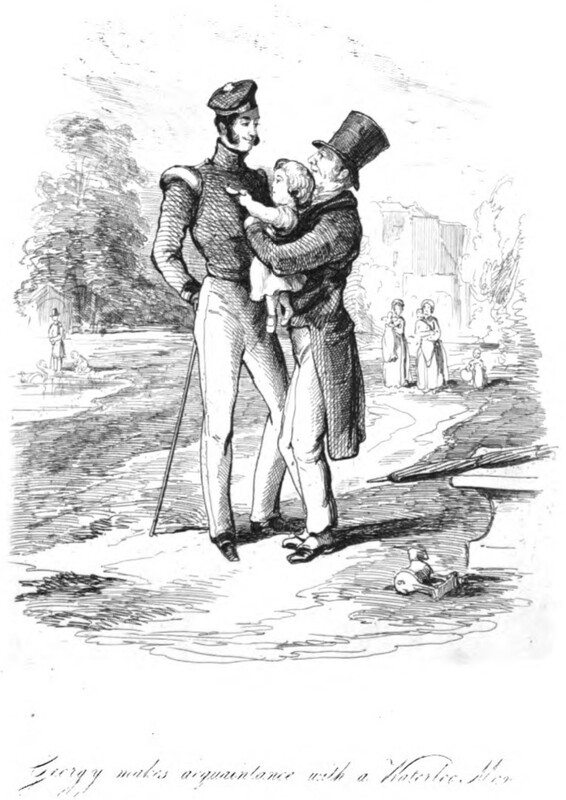
On a walk in the park, Corporal Clink, carrying a thin walking stick, is talking to John Sedley, in a top hat and coat. Georgy Osborne, held in the arms of his grandfather, has reached out to grab the Corporal’s medal. An umbrella is laying on the bench next to them, with a toy horse on the ground beneath it. In the background to the right are two women, each carrying a baby, and a child carrying a basket; to the left are a man and child reaching out towards a bird. Below the illustration is printed in cursive its title, Georgy makes acquaintance with a Waterloo Man.
This image is of an angel trumpeting. The angel is wearing a long dress and has large wings. She is flying over a city. The trumpet has a long banner hanging from it that the angel holds. It is the opening image of the story the editor’s address to the readers, and presumably is signaling for people to come listen to the story. The same image appears in the 1843 Krabbe edition.
![[Vanity Fair Volume II. Chapter VIII Inhabited Initial, T]](https://collections.cemvc.ca/files/large/bbe23c958bcf22e6ff4d13df16d5652846cb5240.jpg)
![[Act IX – Se(m)pronio and Pármeno]](https://collections.cemvc.ca/files/large/9a34741d71d3d2cbd4338d9a42061e6bc713223c.jpg)
![[Joseph’s Buggy]](https://collections.cemvc.ca/files/large/97c6459f6d42312bc5817092e542223a07b0246c.jpg)
![Cristianicimo P[adr]e Q[ve] Entiende Solo en Dezir su Misa Todo los Dias y no se Mete en Cosas de Justicia ni en Rrescates ni Pide Solteras ni Tiene Criados ni Hijos ni Ermanos, Biue Solo, Seruiendo a Dios en Este Rreyno](https://collections.cemvc.ca/files/large/61bd8babdeb69d2d2271e13d9e0ab05d36c1f5e9.jpg)
![[Lord Tapeworm]](https://collections.cemvc.ca/files/large/f4687c6204d5bd6f319b9edc3c544512661102ec.jpg)
![[Voltaire]](https://collections.cemvc.ca/files/large/59f90903b90e09e9958102df1b4e322f391fdea6.jpg)
![[Act II – Calisto Talks with Pármeno While Sempronio Leaves to Visit Celestina]](https://collections.cemvc.ca/files/large/fa7d983b04c967d06e41a7431c78aed967043bb5.jpg)
![[Angel trumpeting]](https://collections.cemvc.ca/files/large/8b91b5639798a0e7beb7ff40215585de4f14f136.jpg)