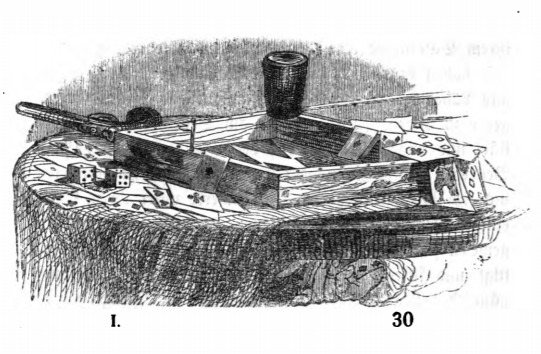
Here we see a games table with cards and dice spread over it. A cup, likely representing alcohol and a gun are also on the table. In this chapter Gulliver tells the King about diplomacy, religion, the justice system, the arts, the financial system, and the nobility, then debated these issues with the king. This image comes when Gulliver is discussing gambling in England. The same image appears in the 1839 Krabbe edition.
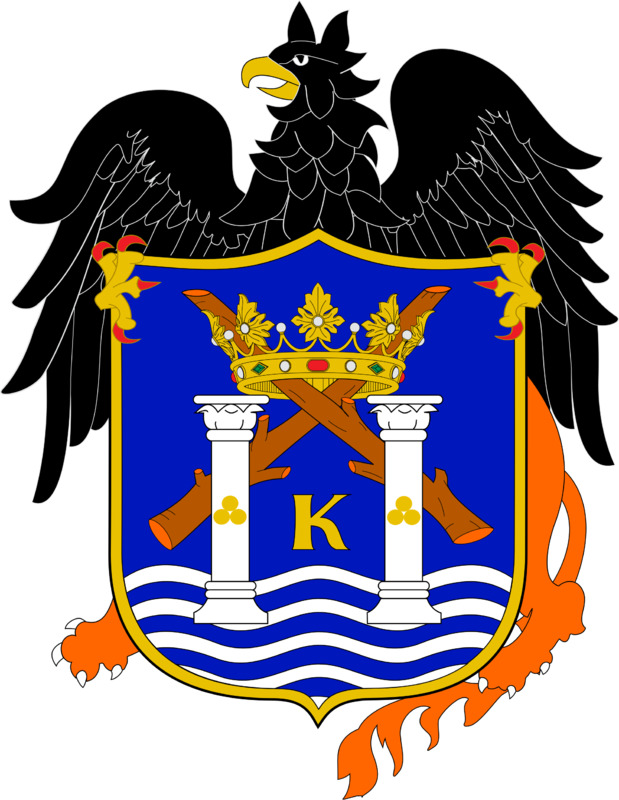
Here we see a broken column overlooking a city. This image appears at the beginning of the biography of Jonathan Swift that precedes the story. The same image appears in the 1839 Krabbe edition.
While atop the high tower of her parents' house (seen in the background of the image), Melibea confesses to her father Pleberio (stood on the ground below) that she had been seeing Calisto for some time, and that he had been visiting her in their garden frequently. After her confession, Melibea, disheartened by the loss of her true love, takes her own life by jumping from the tower (she can be seen dead in the bottom right corner of the image). Pleberio is devastated, and laments to his wife Alisa about the loss of their daughter. (As a side note: Alisa is not actually present when Melibea takes her own life. She remained in bed because of the sadness she felt upon hearing that Melibea was not feeling well.)Alisa, Melibea's mother, is seen standing to the left of the image. This is somewhat odd, seeing as her mother is not present when she takes her own life.
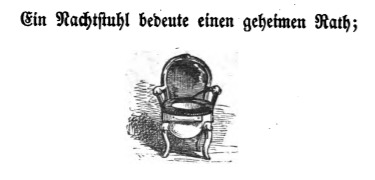
This image is of a close-stool, or toilet. The close-stool was code for the privy council. This image comes in a description of a conspiracy found by a professor from the Grand Academy on Balnibarbi. This idea is representing code word for terms in the conspiracy that Swift is satirizing. The professor advises that those named in the conspiracy papers be closely monitored at all times, naming specifically while they were using the bathroom, as this is when men were most thoughtful. This conspiracy is thought to be an allusion to the trial of Francis Atterbury, the bishop of Rochester for allegedly plotting with the Jacobites. Atterbury was charged with treason in 1722 and was exiled to France. The evidence used against him were papers found in his close-stool. Many believe this evidence to have been fabricated. The same image appears in the 1843 Krabbe edition.
This image depicts a statue of the Virgin Mary holding baby Jesus in her arms. Both her and Christ have halos around their heads. The Virgin Mary is encircled by a large rosary. Kneeling before the Virgin Mary and Jesus is Saint Peter. He is often depicted holding keys in Christian iconography which symbolize the keys to Heaven. Saint Peter also has a halo around his head. The author included this image as he wanted to demonstrate that the indigenous commoners of colonial Peru were devout Christians. The initials s.p.o are written above Saint Peter’s head to identify him as San Pedro. There are words written below the image of the Virgin Mary which read, santa maría de peña de francia [Saint Mary of Peñafrancia].
This illustration depicts a young woman named Thamyris sitting in front of an easel as she holds a brush with her right hand and a pallet in her left as she paints a portrait of what seems to be a king. There are two men standing behind her who look amazed at the work she is producing. Boccaccio explains that Thamyris was renowned for her exceptional painting skills.
This image is illustrated in a chapter that discusses the Christian priests in the colonial government in Peru. This image depicts a Spanish parish priest holding a sermon for the indigenous peoples of Cusco. He is illustrated standing in the pulpit on the right side of the engraving dressed in ecclesiastic adornments. The indigenous people are seated on the ground in front of him. The young male at the front of the group is resting his head in his hand and appears to be bored. Others have their hands together in prayer. There is a light shining through the window in the background of the illustration. There is a dove flying in the light which represents the Holy Spirit. The priest delivers his sermon in the language of the natives of Cusco, Quechua. The priest’s dialogue is written on the image and reads, euangeliota sagrada escritura uillascayque churicona uaca uilcataca manam sermoyquicho chaytaca naupa machoyque chi yacharca camca bautisacca nam canque churi [My children, I will tell you about the gospel, the sacred scripture. They should not serve local divinities. Before, your ancestors lived like this, but now you are baptized children].
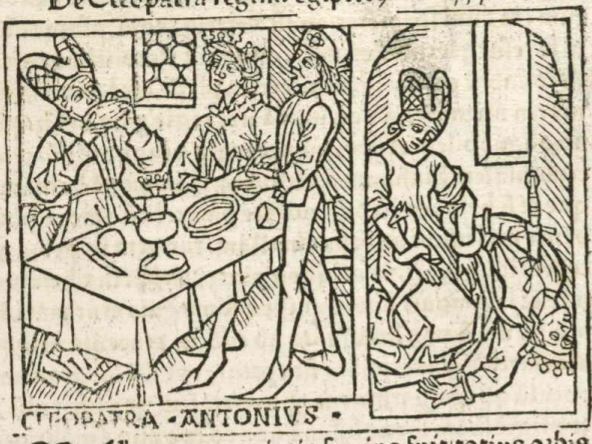
This engraving depicts two separate scenes. The left side of the engraving depicts queen Cleopatra of Egypt sitting at a dinner table, with her husband Antony beside her. Cleopatra had very expensive tastes and demanded a feast which would cost an outrageous amount of money. When Antony did not provide the entire feast Cleopatra demanded, she took out one of her pearl earrings and dissolved it in her drink and drank it to get the luxuriousness she desired. Cleopatra is depicted drinking the pearl in this image. The names Cleopatra and Antony (written as Antonius) are engraved at the bottom of the image to identify them. There is a third figure in this scene, which is a man named Lucius Plautus who was called to be a judge of the feast. The right side of the engraving depicts the suicide of Antony. After realizing the forces of Octavian were on their way to destroy them, Antony plunged his sword into his chest, as depicted in the engraving. Cleopatra is depicted kneeling over his body before she kills herself as well.
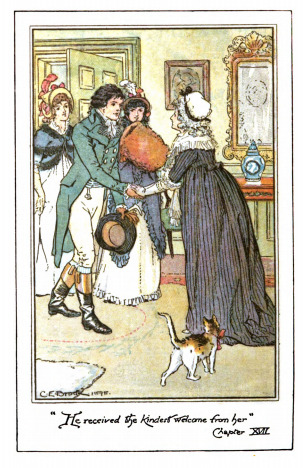
Here we see Edward Ferrars arriving at the Dashwood cottage near Barton Park. Elinor was flirting with Edward Ferrars, the eldest son of a wealthy family. He was also the brother of Elinor’s sister-in-law. He did not write to her after she left Norland but arrived unexpectedly and stayed for a week. He was greeted warmly by Mrs. Dashwood and her daughters. He arrived when Elinor and Marianne were coming home from a walk. This scene appears in chapter 16 as indicated underneath the image. The characters are shown in the traditional regency style, with Edward wearing a waistcoat and tailcoat. Elinor, Marianne, and their mother wear the regency style dress with an empire waist. Their hair is worn tied up, as was tradition for women after their coming out before the queen, signaling her entrance into society. Elinor and Marianne both wear bonnets to protect their faces from the sun while out on a walk, common pastimes for young women of this era. Mrs. Dashwood wears a mop cap to protect her hair. The regency period dated to the early nineteenth century (1811-1820) when George, Prince of Wales, later George IV (r. 1820-1830), reigned as regent for his mentally ill father, King George III (r. 1760-1820). The regency period is associated with the rise of neoclassicism in art and fashion.
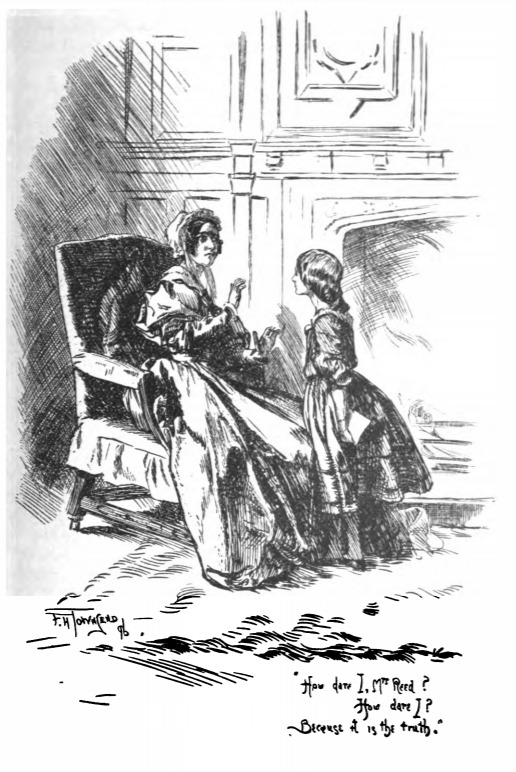
Here we see a young Jane Eyre addressing her aunt, Mrs. Reed. Before Jane left to go to Lowood School, she yelled at Mrs. Reed for her neglect for the past ten years. Mrs. Reed was shocked at Jane’s insolence, but Jane continued her rant. Jane left the next day without speaking to her. Jane did not speak to Mrs. Reed until eight years later when Mrs. Reed was dying and asked Jane to come.
Here we see a man on crutches. This image appears when Gulliver explains European nobility and their conduct. Gulliver explains that many upper-class men hire prostitutes which causes them to contract various diseases, while they are engaged to women chosen by their family. The upper classes also tended to be incestuous, which caused children to be born with deformities and they were more likely to have weak constitutions and were frequently ill. Thus, wealthy children were often sick and weak. The same image appears in the 1843 Krabbe edition.
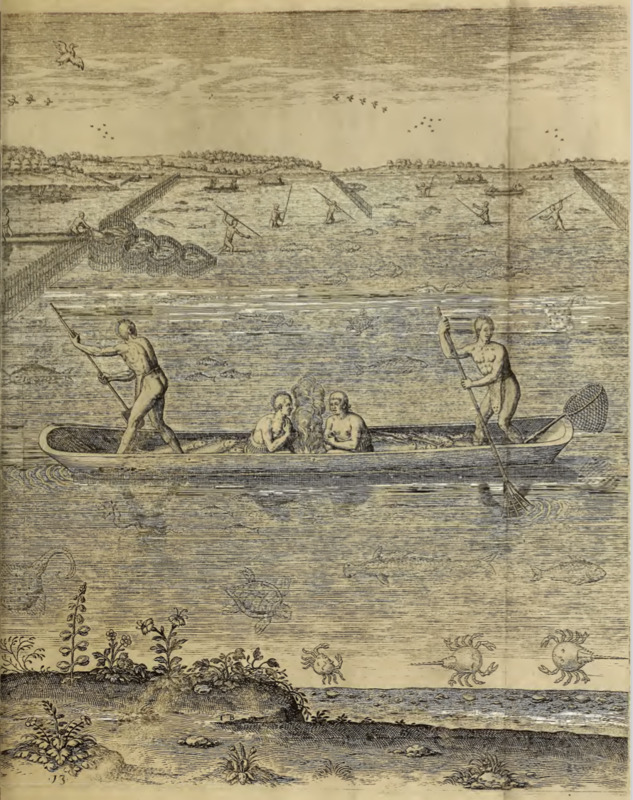
Four Indigenous people are shown in a canoe on the river. The person in the right end of the canoe fishes with a net on the end of a long stick, while the person in the left of the canoe appears to paddle. There are two individuals in the middle of the canoe sitting on either side of a fire. In the background several other Indigenous people fish in the shallows of the river on foot and in canoes using spears.
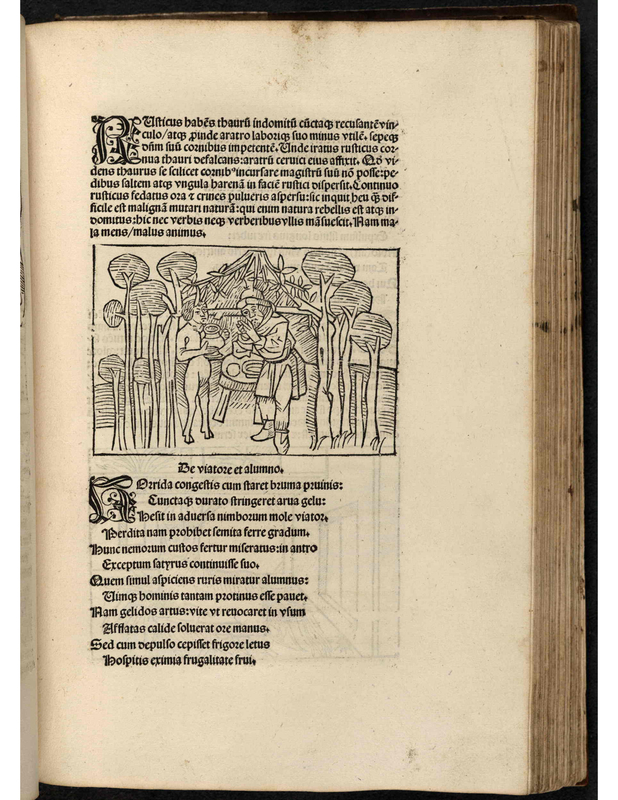
There a hut in a forest. Inside the hut, there is a devil with horns standing with a pot on the left side of the hut. On the right side of the hut, there is a man talking to the devil.
A coach labelled OMNIBUS drives along a narrow road away from London. One of the passengers is leaning out from the back with his arm outstretched, while two others can be seen seated inside. The coachman is seated above the carriage, holding his crop. Near the tip of the crop, in the sky, is the letter S from So.
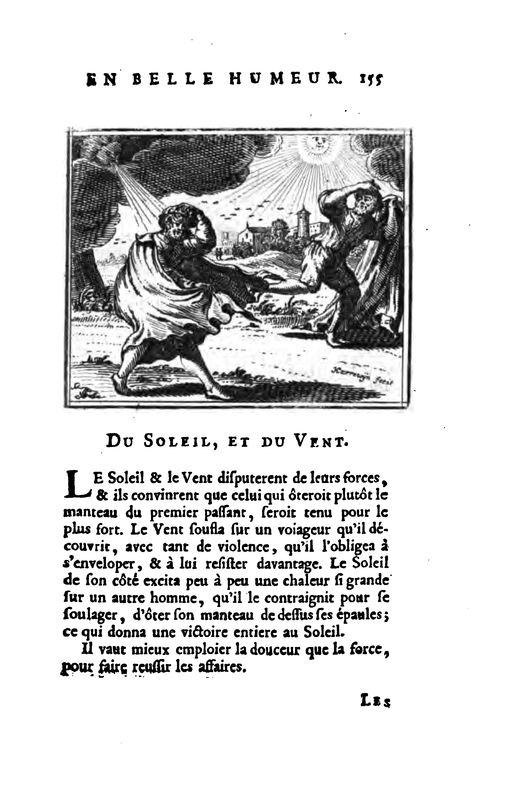
The wind and the sun were disputing over who was stronger. They saw a traveler and the sun said: I know how we can decide our dispute. Whichever of us can cause that traveler to take off his cloak shall be regarded as the stronger. So the sun went behind a cloud, and the wind began to blow as hard as it could upon the traveler, but the harder he blew the tighter the traveler wrapped his cloak round him, till at las the wind had to give up. Then the sun came out and shone upon the traveler, who soon found it too hot to walk with his cloak on.
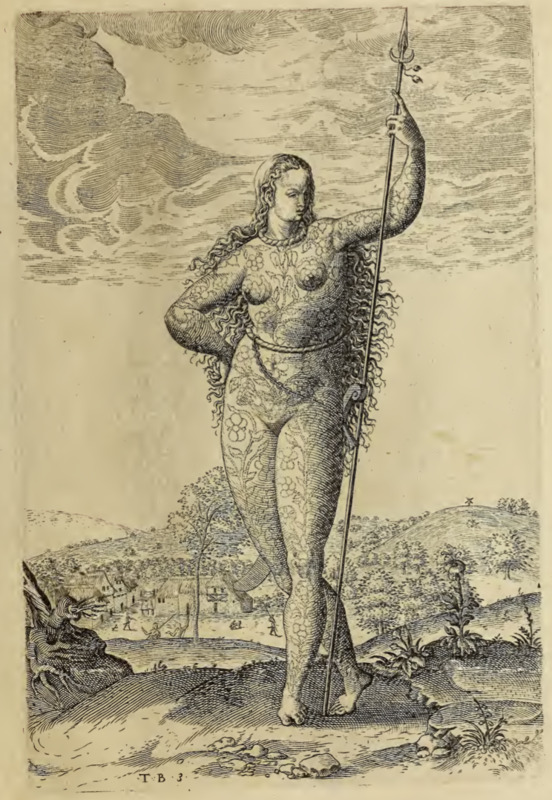
A young Indigenous woman is shown from the front. She carries a spear in her left hand. Her hair is long, she wears a twisted cord around her neck, and a sword with a curved blade hangs another cord around her waist. She is nude, and her body is covered in painted designs. The Picts were an Indigenous group who lived in Britain long before the author’s time. Images of Picts were included in this book so that readers could compare their customs to those of the Indigenous people living in Virginia.
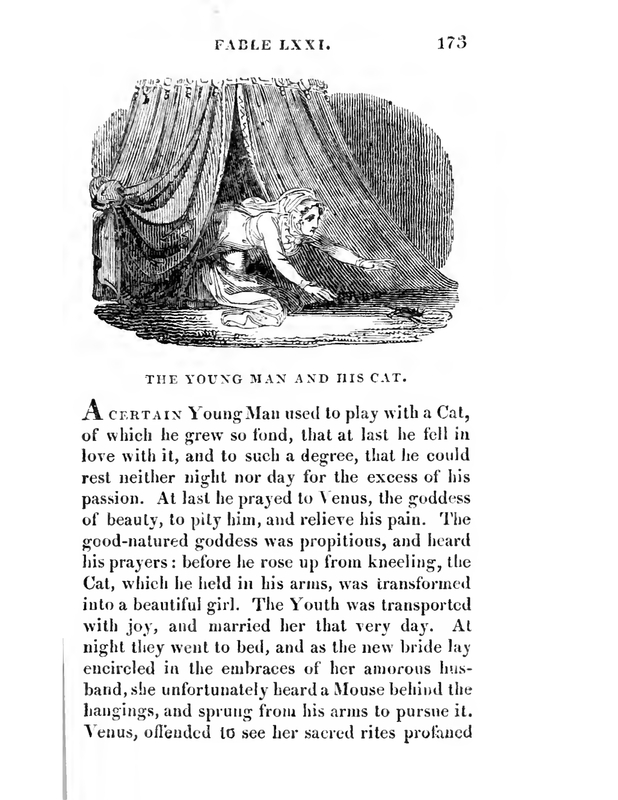
A kneeling person leans out of what appears to be some curtains towards a mouse scurring away from them. They wear a long dress and a head covering that ressembles a bonnet.
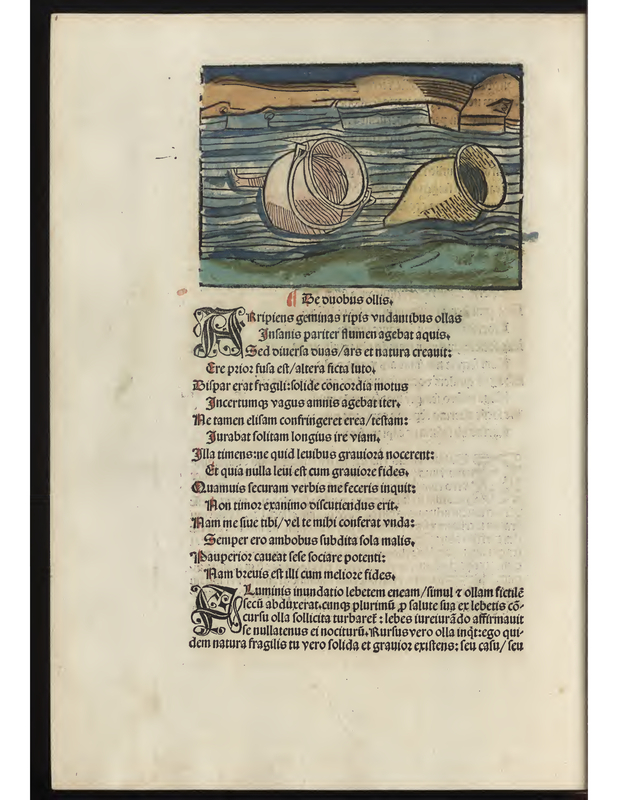
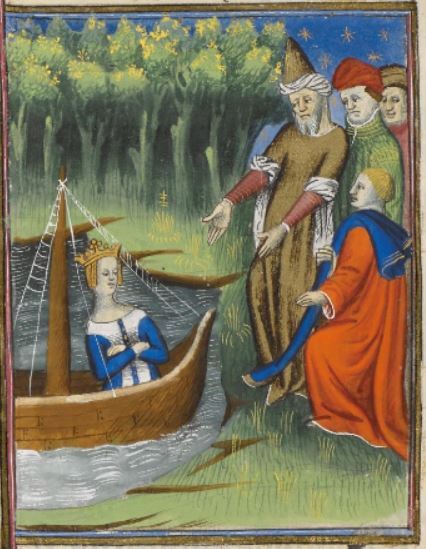
This illumination depicts the goddess Isis (previously known as Io) on a ship as she arrives in Egypt. It is unknown how she acquired Egypt; however, she becomes queen and eventually a venerated goddess. She is wearing a crown to demonstrate her royal status. There are people depicted on the shore as they welcome Isis to Egypt.
Several Indigenous Brazilian men and women, as well as a small child, weep together with their hands over their faces inside a dwelling. One individual sits in a hammock that has been strung between two beams of the structure with the others surrounding the hammock. A bow and bundle of arrows lie on the ground beside the hammock, and a bird sits on a beam above looking down on it.

![[A broken column]](https://collections.cemvc.ca/files/large/1508c41531ddb459f793d5db15be786a9b9bce68.jpg)

![[Act XVI - Death of Melibea]](https://collections.cemvc.ca/files/large/996d1fcf8402e65c10ba1a09511daadaacba8ac7.jpg)

![S[an]ta M[ari]a de la R[ei]na, Peña de Fr[an]cia, Copaca[ba]na y de Nuestra Senora del Rosario](https://collections.cemvc.ca/files/large/52510c0757290def6c7db3de49e5f80c33a1778c.jpg)
![[Thamyris Painting a Portrait of a King]](https://collections.cemvc.ca/files/large/a3638a09e916b939ea94fa83c2cc3dceb79fb32e.jpg)
![Cermon Del P[adr]e Cvra](https://collections.cemvc.ca/files/large/60e99d12e66004732995cc71b39e03329a99db30.jpg)
![[Vanity Fair Chapter XLI Historiated Initial]](https://collections.cemvc.ca/files/large/69971b28b1363ad8418ec5373b76c04cd28dc1f4.jpg)

![[Emotional solidarity in an Indigenous Brazilian community]](https://collections.cemvc.ca/files/large/8d28323b7d1b0cbb7a592ab31ab87f7dbdad0090.jpg)