Doña Rodríguez kneels before Don Quixote to kiss his foot. She begs him to help her daughter. Both are dressed in black, in mourning. The duke and the duchess, also seated at the table, look on. Signed by Bonard (illustrator), no given name, and L. Cars (engraver). Part 2, ch. 52.
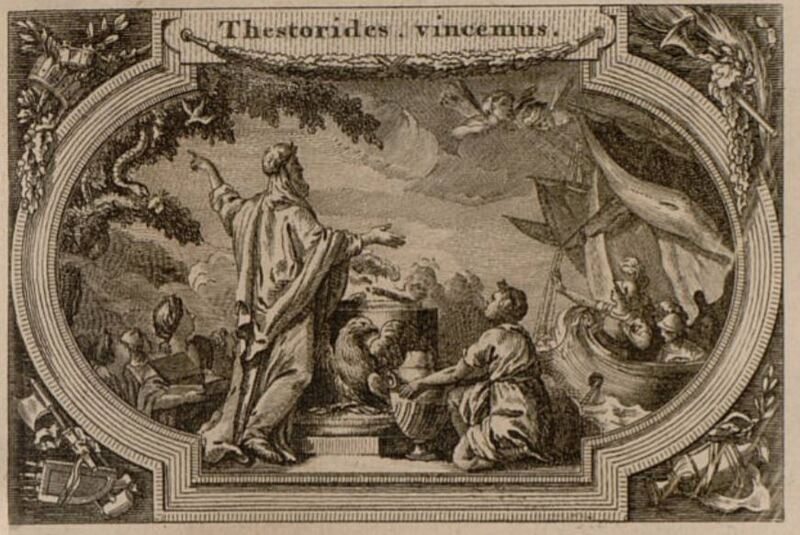
This image appears at the beginning of the twelfth book. It depicts a scene of the seer Calchas making a sacrifice and interpreting signs to determine that the Greeks will win the war against the Trojans in the Trojan War. There is a snake and a bird in the top left corner of the image which are some of the signs that Calchas interpreted about the war. Calchas is depicted standing in front of a fire which was lit to honour the god Zeus (Jupiter). The ship on the right side of the image represents the Greeks leaving for their journey to Troy.
A veritable feast is provided on a hard surface of which is pictured an empty glass, a bottle of wine, a steaming pot, two pigeons, and a large fowl. The image is occasioned by Don Quixote asking the bachelor Sampson Carrasco to do penance with him and speak about chivalry over some food.
Having been asked for 600 ducats, the governor, getting up, lays hold of the chair he sat on, and waves it aggressively above his head, threatening to bring it down upon the peasant who has entered his presence. The peasant, having taken a step backwards in fear, covers his head from the blow with his left hand, meanwhile his hat has fallen to the foreground. In the background sits a clothed table and behind that three men, one of them being the sewer.
Beneath a tree, Dorothea combs her long blonde hair which falls down from her shoulders to her feet with her hands, and also washes her feet in the rivulet. On the right lies a cloth tied up to hold her belongings.
An elderly woman dressed in a ruff and corset with cumbersome dress and a black shawl that covers her head and shoulders. On her head she also wears what looks like a beret with a pointed cross on its apex. This is Donna Rodriguez, an old servant of the duchess.
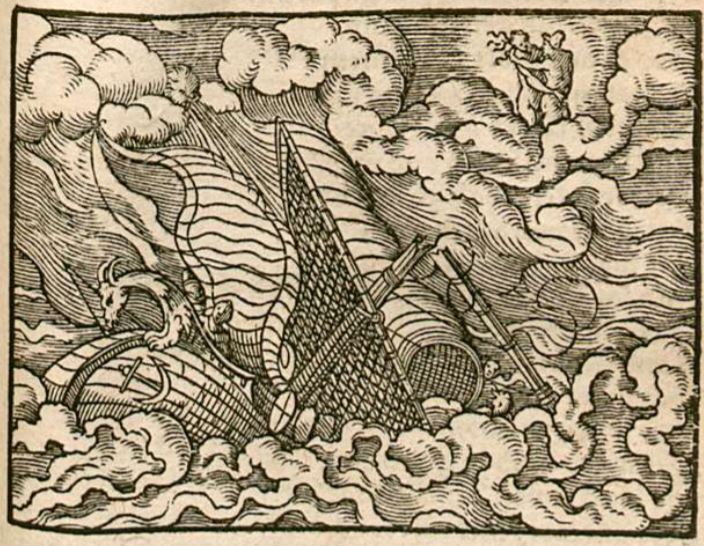
This engraving illustrates a horrible storm that engulfed the ship of Ceyx and his crewmembers. Ceyx, the king of Thessaly, left his native land to seek out the Oracle at Claros. His wife, Alcyone, had begged him not to travel by sea as she knew there were dangers associated with naval travel. He went, despite her warnings, and found himself amidst a terrible storm. King Ceyx can be vaguely seen behind the figurehead at the bow of the ship. King Ceyx continued to call out the name of his wife as the ship was being destroyed. King Ceyx and Alcyone are illustrated at the top-right hand corner of the engraving in clouds in an embrace. Ceyx dies in this shipwreck.
Two marksman with moustaches stand beside a woman, the man on the left is a portly fellow with a thick moustache and a musket by his side while the man on the right is a thin man with a spindly moustache. The woman's hair was tucked up under a network cawl of silk, and she also had on a pair of stockings, with garters and tassels of gold and seed pearl. Her breeches are of tissue, and she has on a loose coat of the same, under which she wears a very fine waistcoat of white and gold and white shoes.
In the foreground, Sancho Panza presents the barber’s basin (which Don Quixote believes to be Mambrino’s enchanted helmet) to the knight. In the background, the barber flees the scene. Signed by A J.-J.-M. Devéria (illustrator) and P. J. A. Vallot (engraver). Part 1, ch. 21.
After Lucinda, Fernando, Cardenio, and Dorothea reached a happy conclusion in their perplexing business only poor Sancho droops sadly. He seeks Don Quixote after his hopes are dashed into smoke; after the Princess Micomicona was changed to Dorothea, and the giant to Don Fernando. Thus, very melancholy, Sancho Panza (slouching on the right) slips into his master's chamber, who had slept on, and was just awakened, thinking little of what had transpired. Dressed in his nightgown, Quixote is much displeased by Sancho's disillusionment of his knightly affairs. To the right, Don Quixote has laid down his sword shield and hat.
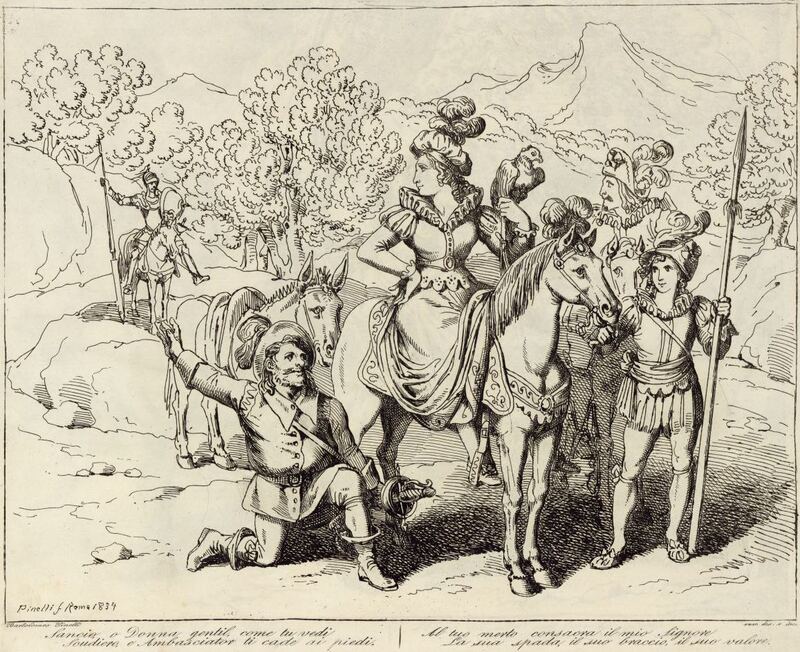
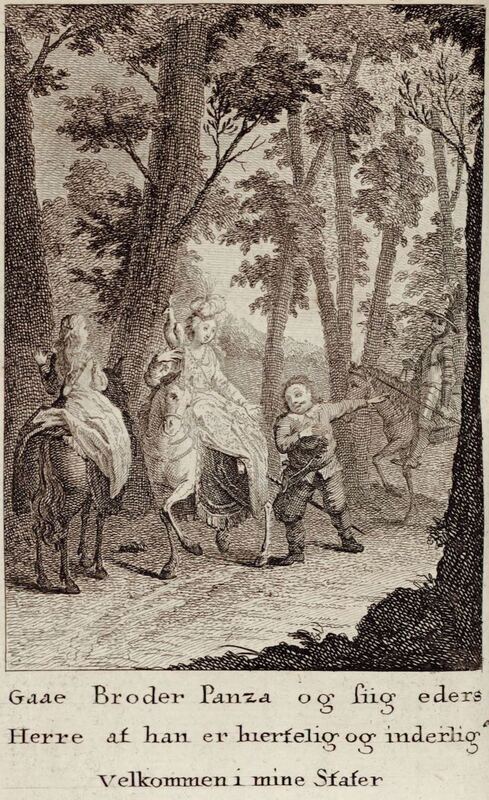
Sancho Panza, kneeling before the duchess and her squire, introduces her to Don Quixote, who waits in the background. The duchess is pictured on horseback and holds a goshawk. Signed by Bartolomeo Pinelli (engraver and illustrator) and dated Rome, 1833. Plate 52. Part 2, ch. 30.
Don Quixote and Sancho Panza attend the wedding of Quiteria the fair and Camacho the rich. The ceremony is interrupted by a man clad in a black jacket welted with crimson flames, holding in his right hand a great truncheon who many recognize as the gallant Basilius. At length Basilius planted himself before Quiteria and leaned upon his truncheon which had a steel pike on its end, making it seem as if he has thrown himself upon the edge. In his 'dying' breaths he tells Quiteria that he will not confess himself to God unless she marries him him. Quiteria has no desire to give Basilius her hand in marriage, but many of the guests beg her to grant his request including the priest. Hesitantly Quiteria approaches Basilius, kneels by his side and gives says she will be his lawfully wedded wife. Upon hearing these words Basilius gives up the act.
A young woman dressed in a white dress with long hair holds a lute which she plays while looking off into the night sky on the left. The image is occasioned by Altisidora courting Quixote from the duchess' garden.
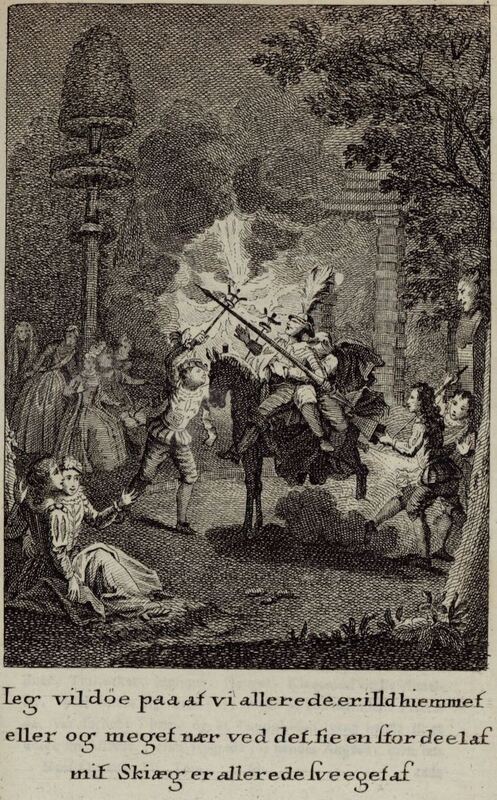
Don Quixote and Sancho Panza are blindfolded and mounted on Clavileño, the famed wooden horse. Servants simulate its flight with bellows and torches. The duke, the duchess, and a crowd of onlookers watch the spectacle, which takes place in a garden (indicated by the hedges) at the duke’s palace. Unsigned. Part 2, ch. 41.
Amidst herbs and leaves lie bushels of grapes and a loaf of bread. These are some of the morsels prepared for Sancho Panza at the table in the great hall of Barataria.
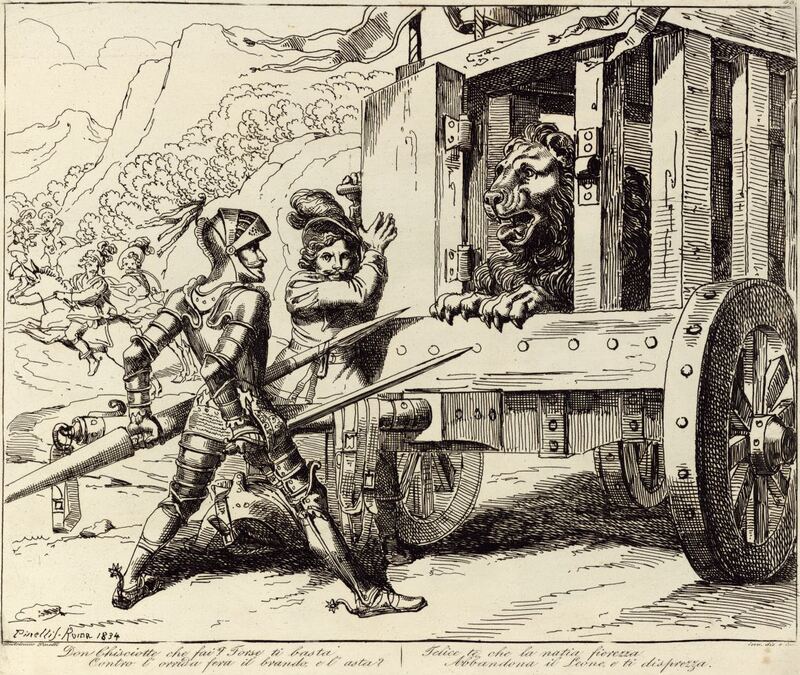
In the background, Sancho Panza and Don Diego de Miranda run away, while in the foreground, Don Quixote prepares to fight the lion as the the keeper opens the gate. However, the lion refuses to leave its cage. Don Quixote holds his sword in one hand and his lance in the other. Signed by Bartolomeo Pinelli (engraver and illustrator) and dated Rome, 1833. Plate 45. Part 2, ch. 17.
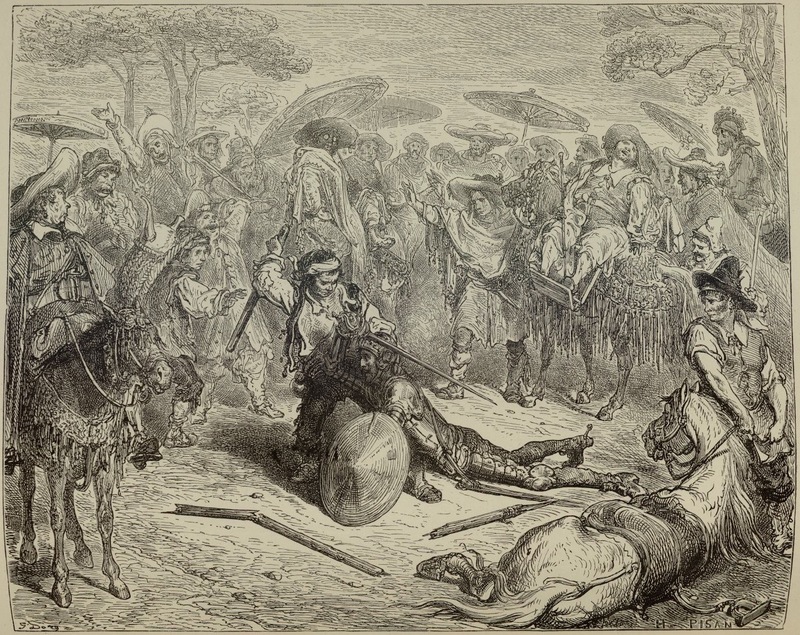
On the road, Don Quixote encounters a group of merchants from Toledo on their way to Murcia to buy silk. Cervantes writes that there are six of them, holding parasols, four servants on horseback, and three grooms on foot leading mules. Don Quixote orders them to halt and to confess that there is no woman more beautiful than Dulcinea of Toboso. When they refuse, the knight charges them but falls from his mount. One of the grooms breaks Don Quixote’s lance and Signed by G. Doré (illustrator) and H.-J. Pisan (engraver). Part 1, ch. 4.
Sancho Panza introduces Don Quixote to the duchess, who rides a white horse and holds a goshawk. Don Quixote, to the left, is mounted on Rocinante. One maiden accompanies the duchess. Signed by Bonard (illustrator), no given name, and L. Cars (engraver). Part 2, ch. 30.
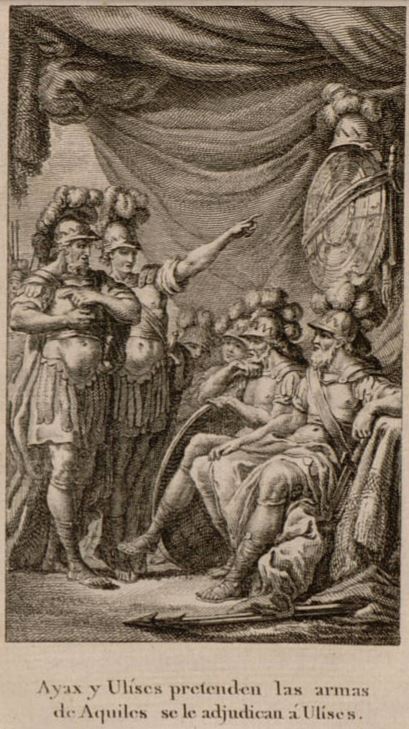
This engraving illustrates the Greek leaders of the Trojan war listening to a debate between Ajax and Ulysses. There is a contest between these two men to see who should be awarded the armour and weapons of the great Achilles. Ajax and Ulysses are depicted speaking to the judges as they debate who is more worthy of receiving Achilles’ weapons. Ajax believes he should be the one to inherit Achilles’ things as he is related to him. Ulysses believes he should be the one to receive Achilles’ things as he is the one who got Achilles to participate in the Trojan war in the first place. The Greek leaders are depicted on the right side of the engraving listening to Ajax and Ulysses as they decide who should be the recipient of the armor. The winner ends up being Ulysses
A post-boy, habited like a devil, with horns and decaying wings, rushes by on the back of a white horse, blowing into a monstrous hollow horn as he goes. The image is occasioned by Montesinos allegedly knowing the method to disenchant Dulcinea and sending a post boy to relay his message.
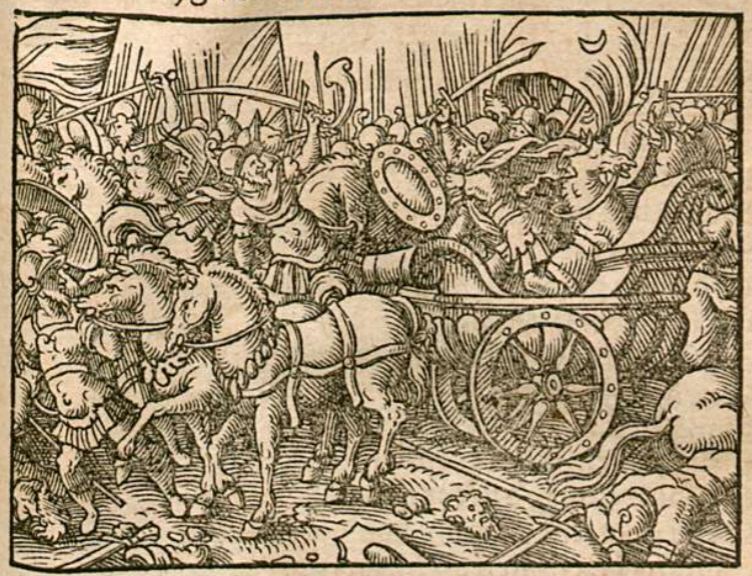
This engraving illustrates the first battle between the Greeks and the Trojans in the Trojan War. Amidst the chaos and fighting happening in the engraving, there are two soldiers depicted as the focal point in the center of the image with both of their swords in the air. The two soldiers are Achilles and Cycnus. In the battle, Achilles attempts to throw his spear at Cycnus, but his spear bounces off Cycnus’ armour every time. Cycnus reveals that he is the son of Neptune and cannot be harmed. Achilles ends up choking Cycnus, but before he dies, Neptune transforms him into a swan.
Montesinos (right) kneels on one knee with a dagger equipped by his side, and gifts the heart of his friend Durandarte to the lady Belerma (left) on a large plate. Belerma, sitting on a courtly chair, turns her head to her left and shields her eyes from the raw heart, her right hand extending beyond her side.
Sancho Panza, standing before the duchess and her squire, introduces her to Don Quixote, who waits in the background. The duchess is pictured on horseback and holds a goshawk. Unsigned. Part 2, ch. 30.
Don Quixote attacks the puppets of Maese Pedro’s theatre while several astonished theatregoers watch him. Maese Pedro appears from hehind a curtain. In the foreground, Maese Pedro’s servant, who was telling the story. Signed by F. Hayman (illustrator) and S. F. Ravenet (engraver). Part 2, ch. 26.

![[Doña Rodríguez begs Don Quixote to help her daughter]](https://collections.cemvc.ca/files/large/2a7f8869116c0e7c80c2f7b3f3acbdf0e71a1391.jpg)
![[Don Quixote's Banquet With Sampson Carrasco]](https://collections.cemvc.ca/files/large/b7e3da7d057a1d88aff348b25adb1b0afcd371d7.jpg)
![[The Governor Sancho Panza Lifts a Chair Above his Head in Rage]](https://collections.cemvc.ca/files/large/abf88015f5919f31816721ce36ae4e36aabf5770.jpg)
![[Dorothea Washing her Hair]](https://collections.cemvc.ca/files/large/b79a32a82e7355e206af973dd1d9195cb217fccb.jpg)
![[The Figure of Donna Rodriguez]](https://collections.cemvc.ca/files/large/b7b67b2cd68b51b5e9324e1169275b5388953692.jpg)
![[Two Archers of Barataria Hold a Crossdressing Woman By the Arm]](https://collections.cemvc.ca/files/large/bc67857a716bcb7403c4b5e39e4733003557b9a8.jpg)
![[Adventure of Mambrino's helmet]](https://collections.cemvc.ca/files/large/0d9db071a11f9c25e5a460964677a5d67f14d2f6.jpg)
![[Of How Sancho Reacted to Princess Micomicona Changing to Dorothea]](https://collections.cemvc.ca/files/large/7b54ed85ff7911006ebbf8bd367c9801dd7c1f31.jpg)
![[Sancho Panza's Letter to his Wife Teresa]](https://collections.cemvc.ca/files/large/ed995728ed5249bdc8b3d17e52afb06a938bef32.jpg)
![[Basilius Feigns Throwing Himself Onto his Dagger]](https://collections.cemvc.ca/files/large/14c2aeb18d3cf8cffc4bdf0b594c005fcf20485c.jpg)
![[Altisadora's Song]](https://collections.cemvc.ca/files/large/81fe548b3f9376fc7407b0233295b1fda3cdcd2c.jpg)
![[A Pile of Fruit and Cheese]](https://collections.cemvc.ca/files/large/424cf88bbef88b5a8475ff513c41effcab5cb0dc.jpg)
![[Sancho Panza introduces Don Quixote to the duchess]](https://collections.cemvc.ca/files/large/c9b11c51d3aea8e65b8f14d44a5cb63d7bf39b79.jpg)
![[The Devil Blows a Large Horn]](https://collections.cemvc.ca/files/large/8a7d4e5d0d259d4dc4485511039b17751cd7b226.jpg)
![[Montesino Gifts the Heart of Durandarte to the lady Belerma]](https://collections.cemvc.ca/files/large/15abf8e5f2ca11c074dd587fd9df8db1fffb693e.jpg)
![[Don Quixote attacks the puppets]](https://collections.cemvc.ca/files/large/3481660518d9ec1d6c0a0d14c53f5fd9c058d4a4.jpg)