Two Tupinambá people – a man and a woman – and a European man are shown. The woman has long hair twisted into two braids and is nude. She crouches on the ground with her hands over her face, seemingly in emotional distress. The European man sits in a hammock, also holding a hand over his face in a display of emotion. There is a bucket on the ground under the hammock. Behind the two, the Tupinambá man balances a bow and arrow in one hand and holds a knife against the end of the arrow in his other hand.
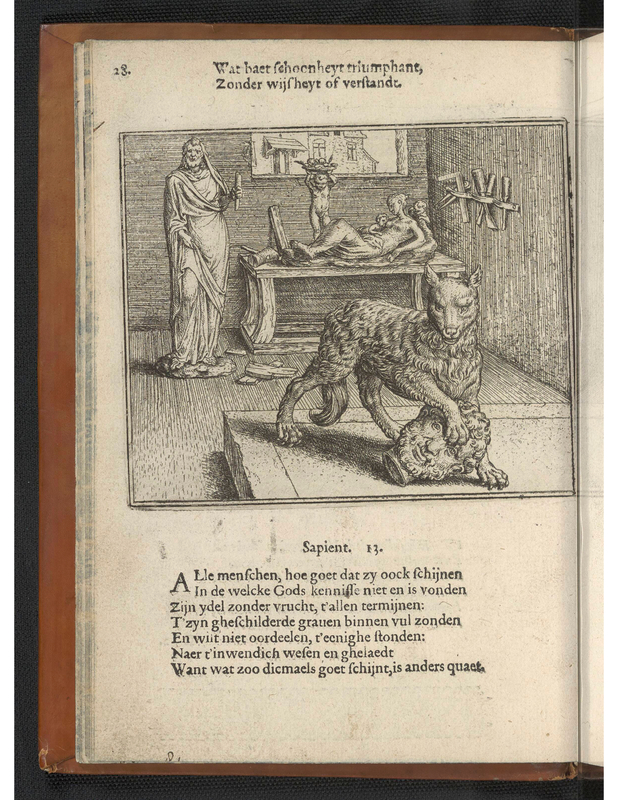
A room containing three sculptures. Sculpting tools are hung up on the right wall of the room in the image. The sculpture in the foreground is a fox with its paw covering the head of a man without a body. In the back of the room sitting on a table is a sculpture of a naked woman lying down as a child nurses. A sculpture of a baby holding a tray over its head also sits on the table. Beside the table stands a sculpture of a robed man holding a scroll.
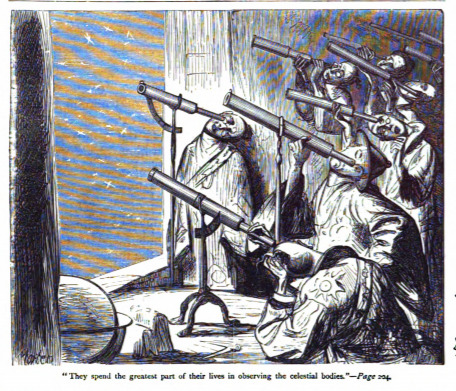
Here a group of Laputan scholars work as astronomers. They all look through telescopes through a large window in the observatory. Gulliver tells the reader that the scholars walk around with their heads tilted sideways as a result of their work habits.
This engraving depicts Nicostrata, a woman who was a famous prophetess during her time, holding a scroll of parchment. We know that this is Nicostrata as the creator engraved her name beside her body. Nicostrata had gone with her son, Evander, to Italy and he founded the city of Pallantium. Boccaccio explains that once Nicostrata realized that the inhabitants of this city were not well educated or literate, she decided to give them their own language with their own letters and symbols. This was the Latin language. Nicostrata taught the new letters and language to the people of Pallantium, which is what the engraving depicts. There are people sitting on the ground who are listening intently to the prophetess, as she is holding the parchment and pointing at the letters.
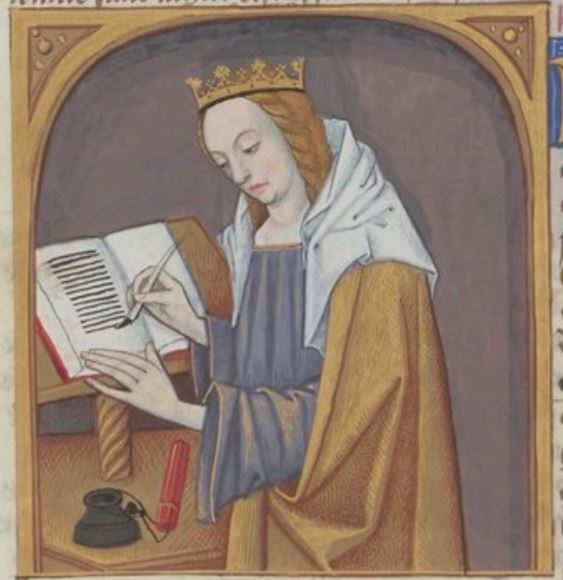
This illuminated image depicts a woman named Nicostrata (also called Carmenta) in front of a lectern as she writes in a book with a quill. She is the queen of Arcadia, which is why she is depicted wearing a crown in this illustration. When Nicostrata and her son, Evander, sailed to a new land to which he named Palatine, she discovered that the inhabitants were not well educated or literate. Nicostrata, an incredibly intellectual woman, created a new language with new letters for the people of Palatine which would be known as the Latin language. This image depicts her writing and creating this new language in her book.
This image is illustrated in a chapter that discusses and criticizes the government and society in Spanish conquered Peru. This image depicts a Spanish vagabond riding on a horse on the right side of the image. He is depicted yelling and pointing to the young indigenous man walking in front of him. The young man appears to be carrying to belongings of the Spaniard and has a sad expression on his face. There is dialogue written beside the vagabond’s hands which reads, puri perro yndio [get moving, Indian dog]. The author criticizes these vagabonds for robbing the indigenous peoples of Peru of their belongings and wives and daughters while traveling on highways.
Here Gulliver’s house is rescued by sailors after he was dropped into the ocean by an eagle. We see a rowboat with five men pulling in Gulliver’s house. In the background we see the large sailing ship that brought Gulliver back to England. Gulliver had a difficult time adjusting to interacting with humans his own size. The same image appears in both the 1839 and 1843 Krabbe editions.
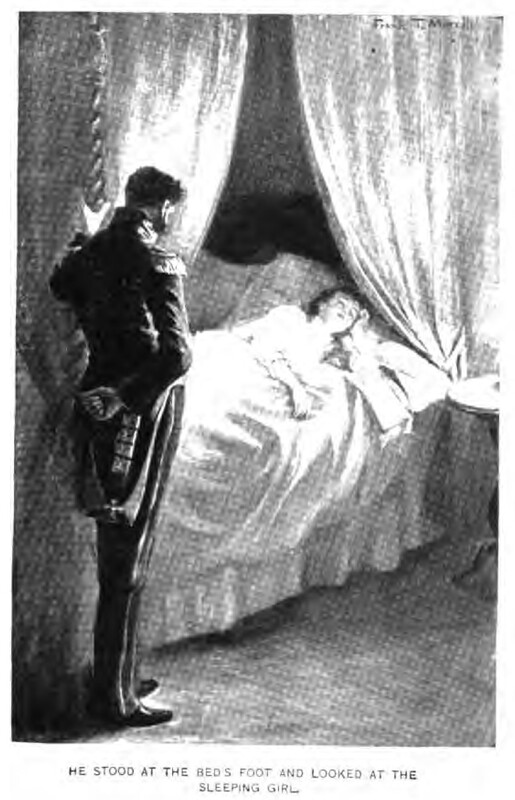
The picture depicts a scene from page 283 in Chapter XXIX in which George Osborne goes to see his wife before departing for the front. Amelia Osborne is depicted sleeping in a canopy bed with her face turned towards the reader. George is standing by the foot of the bed in his uniform, holding onto the curtain-rope with one hand and his other behind his back, facing towards his wife and away from the reader.
In this image we see Gulliver interacting with two beggars on Brobdingnag. The beggars came to the royal kitchens to asks for food. We see Gulliver recoiling from the giants with his hands blocking his face. The giant on the right is missing teeth, while the giant on the left has a bandage covering his eye. Both giants are looking up, as though they are on their knees looking up at another giant and asking for food. The same image appears in the 1839 Krabbe edition.
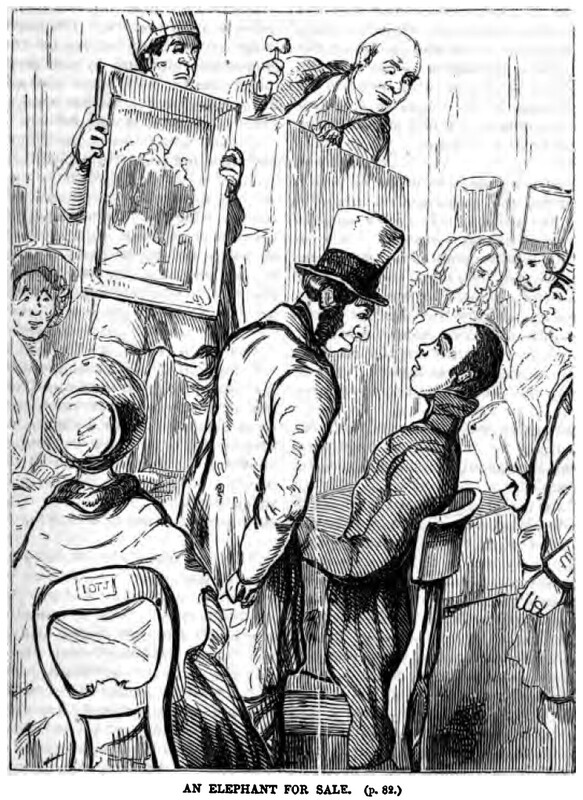
At the auction of the Sedley estate, Mr. Blowman holds up a portrait of Joseph Sedley riding an elephant to show the buyers. William Dobbin is seated directly in front of the painting, looking up with a startled expression at the bearded man looming over him. Mr. Hammerdown is peering down at the two men from the auction block, holding his mallet up. Among the figures in the background, on the right side of the picture, are Rawdon and Rebecca Crawley, who later purchase the painting. Below the illustration is printed its title and location in the story, AN ELEPHANT FOR SALE (p. 82.).
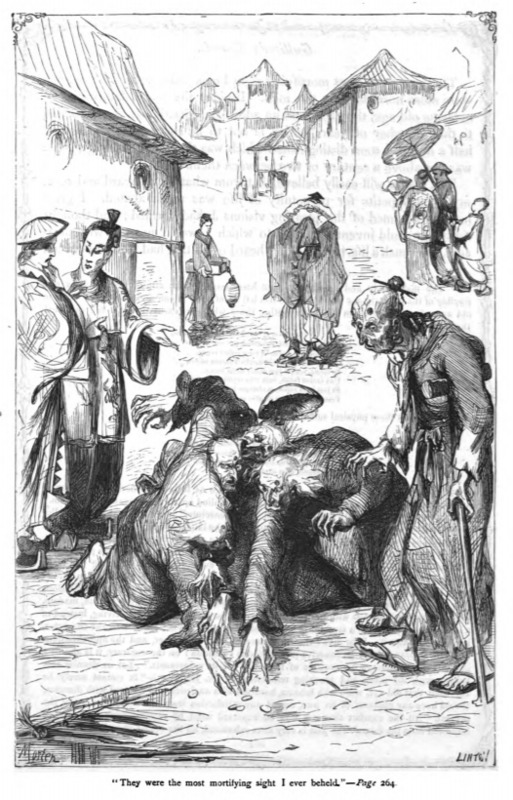
Here Gulliver sees the reality of immortality on Luggnagg. He learned that their bodies continued to age, making them a shocking sight. Gulliver then found himself ashamed that he rejoiced at the possibility of avoiding death.
Lord Steyne, who has come to visit Becky, stands in front of an ornate fireplace topped with a clock and elaborate candelabra. He is short, bow-legged, and nearly bald, and dressed in fancy clothes with a coat and sash.
Here we see Gulliver speaking with Pedro de Mendez, the captain of the ship that found Gulliver in New Holland. Pedro de Mendez asked Gulliver to explain his situation, however Gulliver remained quiet, wanting to return to his boat and get away from other people. Pedro de Mendez gave Gulliver food and a bed on the ship. Gulliver would not get undressed, and simply lay on top of the bed. Gulliver had planned to jump ship and swim back to his boat, however a crew member found out about his plan, and Gulliver was chained in the cabin. The same image appears in the 1843 Krabbe edition.
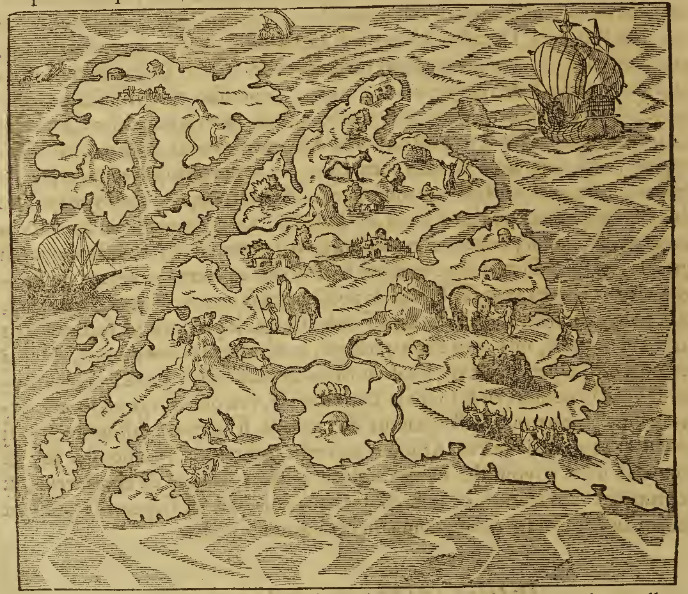
An aerial view of an island is shown, identified as Isle Espaignolle (Spanish Island – possibly Hispaniola, today Haiti and the Dominican Republic) by the author. Two groups of Indigenous people are engaged in combat with bows and arrows in the bottom right corner of the island. Elsewhere on the island, other Indigenous people fish and walk leading animals that resemble camels and elephants. There are several settlements on the island, as well as on a smaller island nearby. A large European ship sails in the top right corner. This image is identical to one found on page 911 verso of Paris, 1575 (Chaudière).
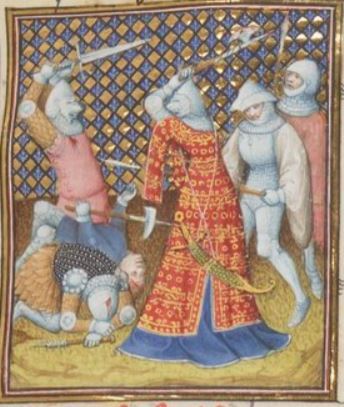
This illumination depicts a woman named Triaria wearing armor and holding an axe above her head. She is depicted wearing a dress to show that it is a woman. There are other soldiers standing with Triaria as they kill the people lying on the ground. Triaria is renowned for her military skills and devotion to her husband, Lucius Vitellius. She is depicted wearing a helmet and holding an axe in this image to demonstrate her fighting capabilities. Boccaccio explains that Triaria followed her husband into an enemy city and she fought violently and killed many citizens in order to magnify her husband’s glory.
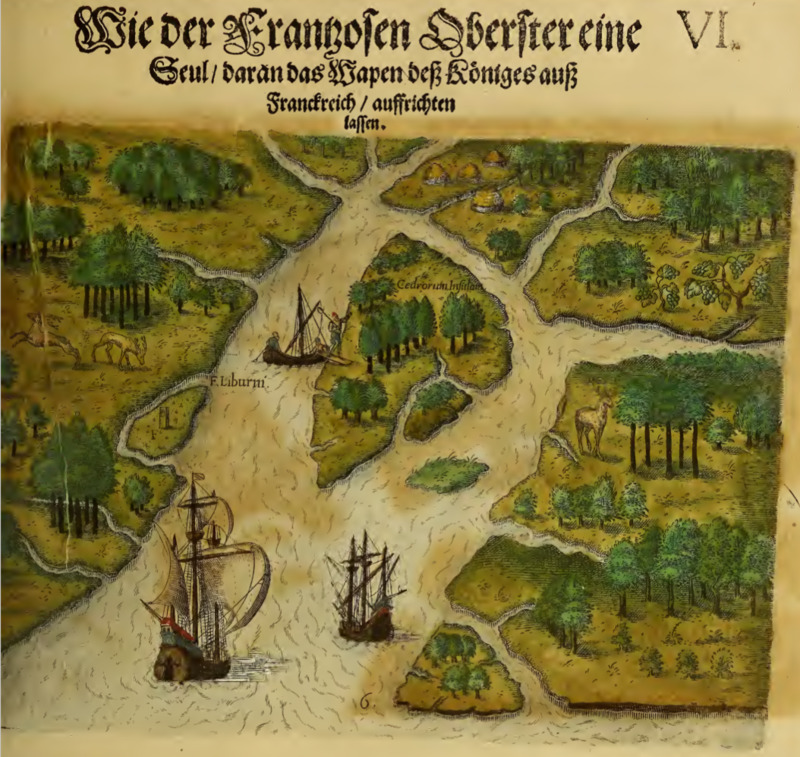
Three ships are pictured, one large and two small. Two sit at the mouth of the river, while one is further upstream. A colonist is disembarking the small boat upstream and stepping onto an island in the middle of the river. Further upstream several small round structures sit on the bank of the river. The monument mentioned in the image title can be seen on the left of the image in the middle. It was erected by Jean Ribault in 1562, during the first French voyage to Florida. This illustration is identical to the one found on page 47 of Frankfurt 1591, but colored.
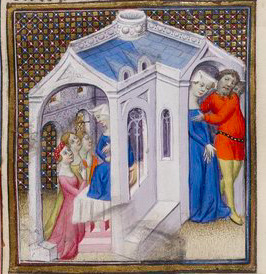
Being the wife of a plebeian, Verginia was cast out of the temple of chastity as a result of a quarrel. She left very angrily, defending her honor and her husband’s good deeds, while the rest of the women stayed in the temple. These women can be seen to the left of the image standing under a temple, while Verginia, wearing a blue gown, is escorted out by a man.
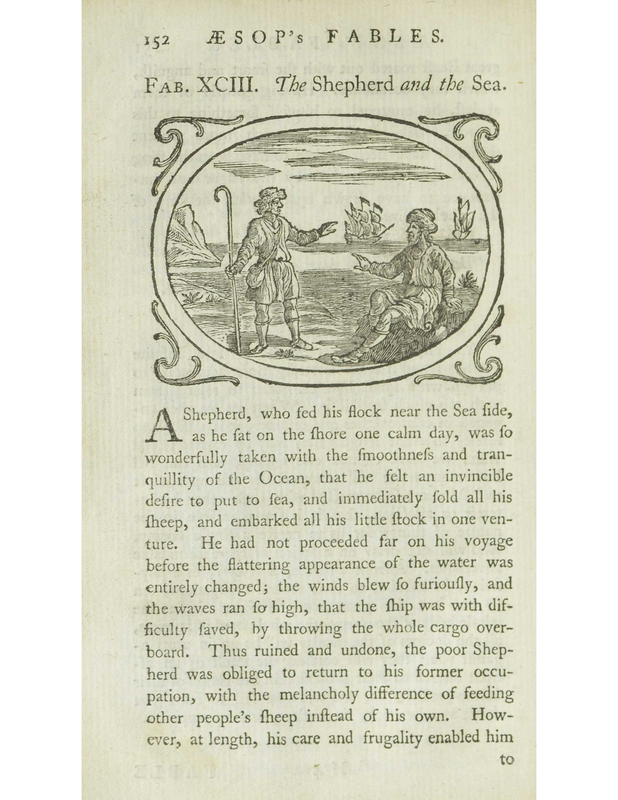
A shepherd and his friend talk by the seashore, one is sitting while the other stands. They observe the calm waves in the water and two ships can be seen off in the distance.
Rebecca Crawley, in a low-cut dress and black mask, leans over a gambling table. Behind her stands Georgy Osborne, who was brought there by Mr. Kirsch, his uncle’s courier, while the others went to the ball. Next to Becky is another man, facing away, with a stack of coins at his side.

![[A European man and a Tupinambá woman weep into their hands while a Tupinambá man stands behind them]](https://collections.cemvc.ca/files/large/d22f4b2bb4b61de9f9db5b97471108a072d38a2e.jpg)

![Espanol Gvagamvundo deste Rrey[n]o Como en Ca[s]tilla](https://collections.cemvc.ca/files/large/1252040b4e2043729990c1de555783fdb98e4385.jpg)
![[Gulliver is rescued by sailors]](https://collections.cemvc.ca/files/large/974c44fff73aa183941dce7cdfd365b1aa0826c3.jpg)
![[Gulliver speaks with beggars from Brobdingnag]](https://collections.cemvc.ca/files/large/4748a803885a78f6028cc7f636618c7ebc6450e5.jpg)
![[Lord Steyne]](https://collections.cemvc.ca/files/large/b2762501d14936bb8ef382bfeb8dc13f17d86b24.jpg)
![[Gulliver speaks with the captain of the ship]](https://collections.cemvc.ca/files/large/79d65610e0e0e730a11f951e2f0a833f53c0ec03.jpg)

![[Georgy Watches Becky Gamble]](https://collections.cemvc.ca/files/large/349a7d529a88705378915097763b98033981e86b.jpg)