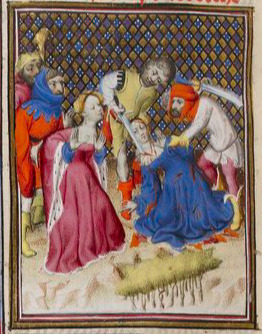
When Harmonia was ordered to be killed, her nurse arranged for a girl of her age to dress as Harmonia and die instead of her. This girl is seen in the image wearing a blue gown, and is getting murdered by the men behind her. Harmonia, wearing the pink gown, looks on with horror to the left of the girl who is being murdered. In the background are onlookers, and on the ground is the girl’s blood.
Here we see Gulliver’s reunion with his family. He was embraced by his wife and children, but he recoils. Gulliver finds himself disgusted by his family, preferring instead the family he lived with in the Country of the Houyhnhnms. Gulliver was especially distraught that he was a parent and had brought children into the world who lacked the virtues of the Houyhnhnms. The same image appears in the 1839 Krabbe edition.
After arriving in Lisbon, Gulliver stayed with the captain of the ship that brought him from New Holland to Portugal, Don Pedro. Gulliver refused to go outside in Lisbon, so after arriving at Don Pedro’s house, he would look out the window, trying to readjust to life in Europe. Here we see Gulliver looking out the window terrified. Gulliver found readjusting to European life very difficult, because he became so accustomed to the Country of the Houyhnhnms and the virtue of the Houyhnhnms, that in Europe all he saw were the vices of humans. The same image appears in the 1843 Krabbe edition.
A group of Indigenous Brazilian woman, called ‘Amazons’ by the author, fight against a group of Indigenous Brazilian men who attack from the water. The women fight with bows and arrows, spears and shields, while the men in canoes use bows and arrows and clubs. The women are unadorned with their hair worn unbound. Some of the men wear feathered headdresses. This image is identical to one found on page 960 of Paris, 1575 (Chaudière), and in Thevet’s Les Singularitez de la France Antarctique (page 124 verso of Paris, 1557 and page 124 verso of Paris, 1558).
Here we see Gulliver stuck in the hollowed-out marrow of a bone. The Queen of Brobdingnag’s dwarf stuck Gulliver into the bone because he was jealous that Gulliver replaced him as the Queen’s favourite. In the image we see Gulliver stuck in the bone with only his head sticking out of the bone. The bone sits on a platter with other leaves and food. The dwarf’s face is visible in the background. The same image appears in the 1839 Krabbe edition.
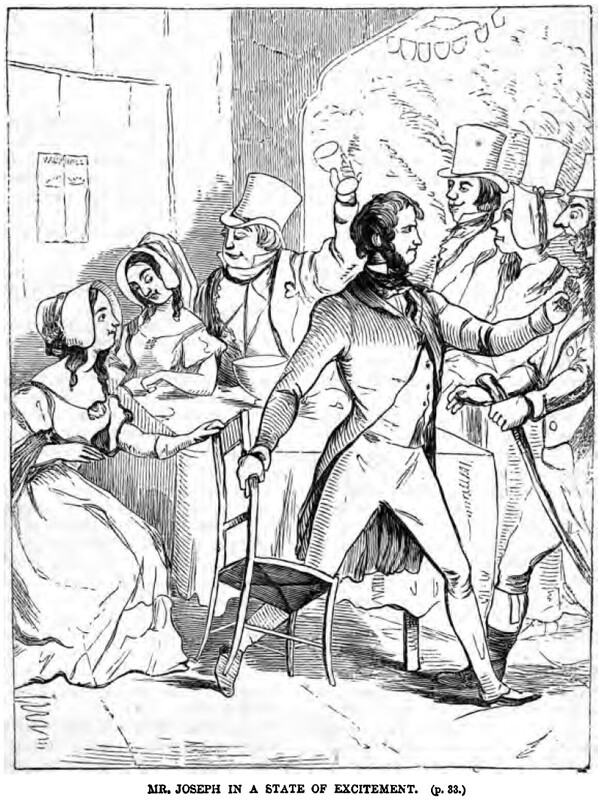
In the center of the image is Joseph Sedley, waving around his cup and singing. On the table before him is a bowl of alcohol which he has drunk all by himself. Amelia Sedley and Rebecca Sharp are seated at the table to the left of the image, with Rebecca gazing down at Amelia, who looks concerned. To the right is George Osborne, holding onto his chair and facing a crowd of onlookers, the nearest of which he is blocking from coming closer. Below the illustration is printed its title and location in the story, MR. JOSEPH IN A STATE OF EXCITEMENT. (p. 33.).
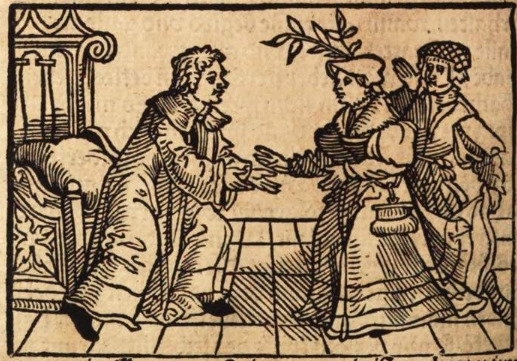
This engraving depicts Nicaula, the queen of Ethiopia, on the right side of the engraving shaking hands with King Solomon of Jerusalem. Nicaula, as Boccaccio explains, was incredibly wise and wanted to hear and listen to the wisdom and intellect of Solomon. She traveled from Ethiopia to Jerusalem to meet him. This engraving depicts their first meeting. King Solomon is depicted getting up from his throne to shake Nicaula’s hand. Behind Nicaula is presumably one of her servants, who is carrying a balsam tree. The tree was one of many gifts that Nicaula had given to Solomon.
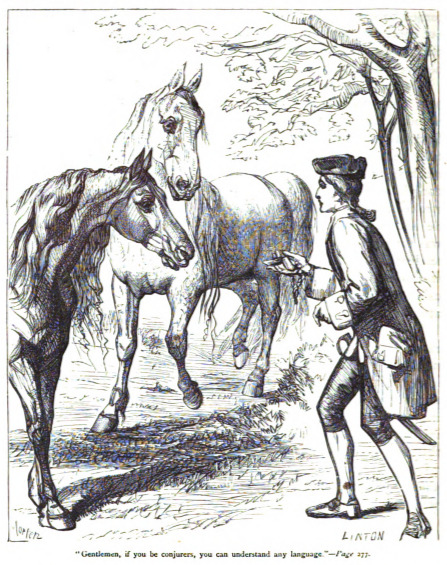
Here Gulliver tries to communicate with the Houyhnhnms. He initially thought the Houyhnhnms were conjurers or some other type of magical creatures. If they were magic, then Gulliver thought they might be able to speak another language and tried to speak to them in every language he knew, however he was unsuccessful in his attempt to speak with them. He eventually simply copied their language and began to learn it.
Rebecca Crawley walks into dinner at the Gaunt House on the arm of the Earl of Southdown. Behind them are her husband, Rawdon Crawley, and Mr. John Paul Jefferson Jones, from the American Embassy. Mr. Jones is scowling at Mr. Crawley, upset that he lost the chance to escort Mrs. Crawley.
Two groups of Indigenous Brazilians engage in armed conflict. Members of both groups wield bows and arrows and clubs, and some bite members of the opposing group. Most of the men in both groups wear feathered headdresses and adornments around their waists, and some wear necklaces. Several men have fallen to the ground.
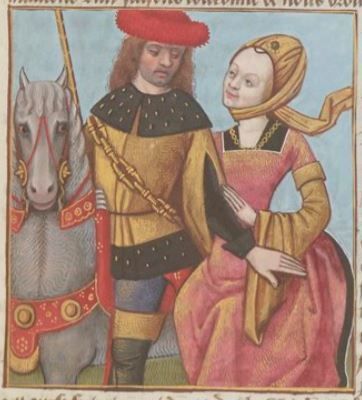
This illuminated image depicts Deianira, the wife of Hercules riding horseback with Nessus. Hercules was taking his new wife Deianira home to Calydon with him when the Evenus River flooded. Nessus, as described by Boccaccio, was riding by on his horse when he offered to take Deianira across the river safely by horse. Hercules allowed it, however, once Nessus crossed the river with Deianira, he tried to abduct her and run away with her. Before he could get away, Hercules shot an arrow and killed him and rescued his wife. Boccaccio explains that Nessus was riding horseback, however, in Greek mythology, Nessus is known to be a centaur.
Here we see two men fist fighting in the street, while a crowd watches from behind a short wall. Their hats and coats are on the ground. In the background we see a large castle, and a rooster. In this chapter Gulliver talks with the King of Brobdingnag about English traditions. Gulliver tells the King about diplomacy, religion, the justice system, the arts, the financial system, and the nobility, then debated these issues with the king. This image comes when Gulliver is discussing the judicial system. The same image appears in both the 1839 and 1843 Krabbe editions.
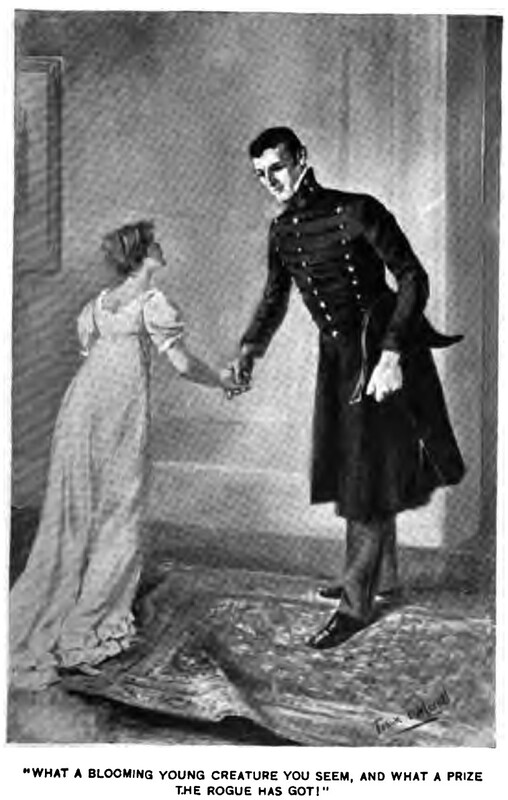
The image depicts a scene from page 45, when William Dobbin meets Amelia Sedley. Amelia is shown in a long gown, facing away from the reader while shaking the hand of William Dobbin, who is dressed in his military uniform. The two are standing on a slightly crumpled rug, between a door and a painting, both of which can only partially be seen.
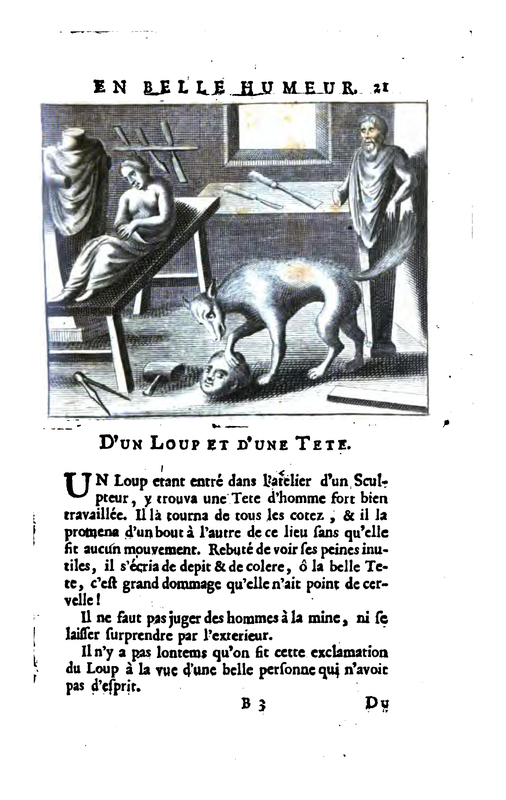
The image has a wolf holding a head, which resembles a human. There is a hammer and a large tweezer. Near the wolf there is a table, sitting on it is a human covered with a sheet. Next to the table there is a mannequin without a head. To the left of the wolf there is another mannequin but just a head and the upper part of a body, drapped in sheet. The expression on the mannequin seems to be shock. On the walls of this warehouse, there is an axe and other sharp equipments.
Here we see a diagram showing the movement of the floating island of Laputa. The Emperor of Laputa could move the island over various parts of Balnibarbi – the land below Laputa. The Emperor would move the island to punish people on Balnibarbi so that Laputa would block the sun from Balnibarbi causing the crops to fail. If the Emperor felt so inclined, he could cause the island to drop onto Balnibarbi, but he had never done this for fear of damaging the adamantine bottom of Laputa.
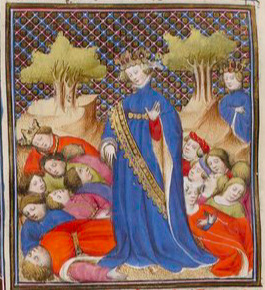
Niobe, in the center of the image wearing a blue gown and a crown, is surrounded by her dead husband and children. Her pride got the best of her when she gave birth to seven boys and seven girls. All of her children wound up dying of a plague – this lead to the suicide of her husband, Amphion. Niobe is said to have been so miserable after the death of her family that she became more of a motionless stone than a woman. This is represented in the image where she stands as a statue, surrounded by her family’s bodies.
A large group of Indigenous Brazilian people take part in a long procession, possibly preceding or following a burial as part of a mourning practice. They first stop at a vat on the ground where they take a bowlful of the beverage inside. The group then proceeds towards their village and through several of the structures. Many members of the group wear feathered headdress, ornaments around their neck or waists, necklaces, and/or feathered capes. Many also carry bows, clubs, rattles, conch shells or other wind instruments, or pipes.
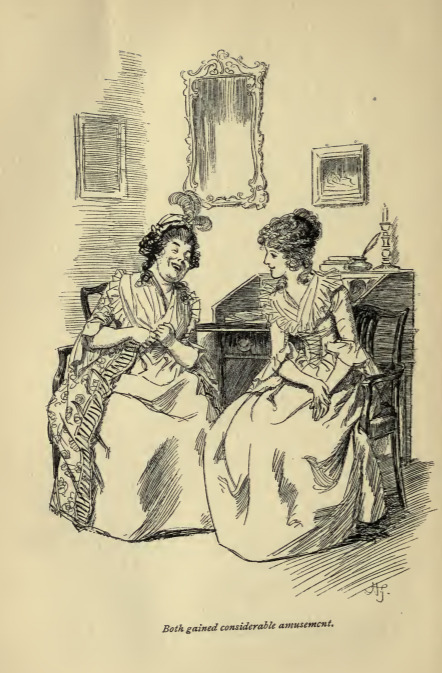
In this image Mrs. Jennings and Elinor sitting and laughing together. Colonel Brandon had come to the house earlier that day to ask Elinor to tell Edward Ferrars that he could offer him the parsonage at Delaford, near the Colonel’s estate. Mrs. Jennings originally thought that Colonel Brandon had come to propose to Elinor, but after clearing this miscommunication the two laughed about it. This scene occurs in chapter 40. The characters are shown in the traditional regency style. Elinor and Mrs. Jennings wear regency style dresses with empire waistlines. The regency period dated to the early nineteenth century (1811-1820) when George, Prince of Wales, later George IV (r. 1820-1830), reigned as regent for his mentally ill father, King George III (r. 1760-1820). The regency period is associated with the rise of neoclassicism in art and fashion.
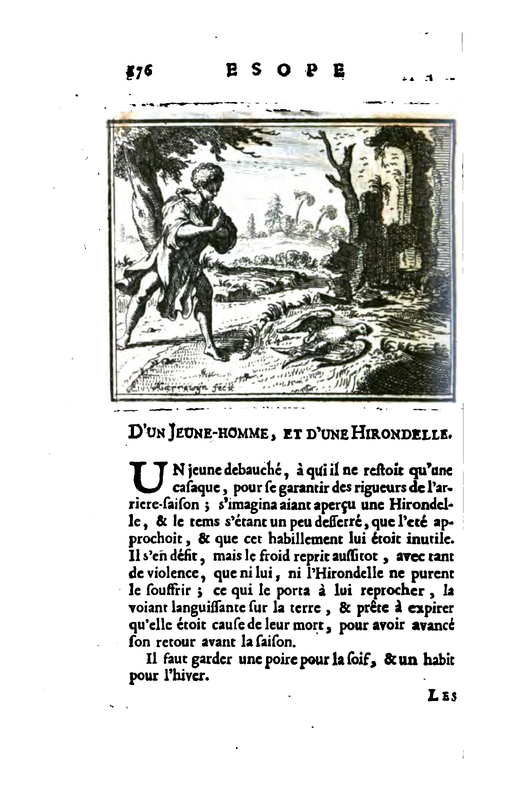
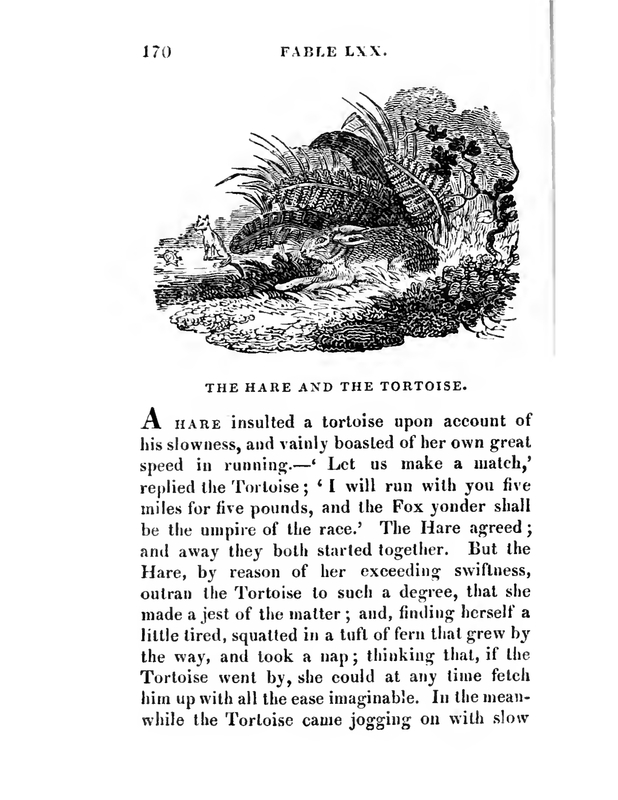
A young bachelor, to whom he had to wear only a coat to protect himself from the rigors of the cold weather, imagined that he had seen a swallow, and the weather being a little chilly, that summer was approaching, and that this clothing was useless to him. The first thing he did was to get rid of it, but the cold came on again, so violently that neither he nor the swallow could whip him; which led him to reproach her, seeing her languishing on the ground, and ready to expire, that she was to blame for their death, for having brought forward her return before dawn.

![[Gulliver is reunited with his family in England]](https://collections.cemvc.ca/files/large/e2803b974b5b1b31560913c281ab116cf2013337.jpg)

![[Gulliver’s looking out the window]](https://collections.cemvc.ca/files/large/db9d13305c2bb14b0afced0be5dc90e143b97bf4.jpg)

![Les femmes se deffende[n]t contre leurs ennemys.](https://collections.cemvc.ca/files/large/3482ec6898db0c979e83281acadc6ca5d42e5c4c.jpg)
![[Gulliver stuck in a hollowed out bone on Brobdingnag]](https://collections.cemvc.ca/files/large/2edcfbf662cb944d4d57907be94751b78b07cd04.jpg)
![[Entering the Banquet at Gaunt House]](https://collections.cemvc.ca/files/large/120b993b3fe2e497648638b9964bb9bbb3a12a7d.jpg)
![[Two Indigenous Brazilian groups in conflict with each other]](https://collections.cemvc.ca/files/large/51f49de52eb7bbe35b18b0a8bcd869d68b88f886.jpg)
![[Two men having a fist fight]](https://collections.cemvc.ca/files/large/42c3d526237a93fd67c63219afbe3c3683d93db1.jpg)
![[A diagram depicting the movement of Laputa]](https://collections.cemvc.ca/files/large/5c7d5cf2112da34f3bba523a832f25566524cc91.jpg)
![[An Indigenous Brazilian group participates in a ceremonial procession]](https://collections.cemvc.ca/files/large/d97e8ed50311830eef3d178538f44316b51beee1.jpg)