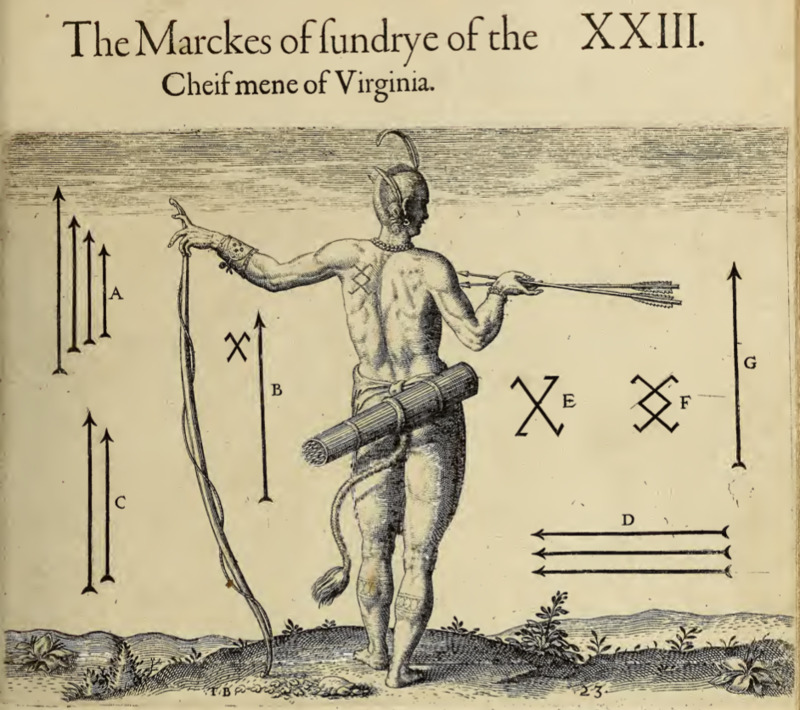
An Indigenous man is shown from behind. He holds a longbow in his right hand and two arrows in his left, and a quiver of arrows is tied around his waist. Drawn around him are seven designs that are labelled with the letters A to G. Design A is comprised of four arrows side by side pointing upwards, with the sizes decreasing from right to left. Design B has an arrow pointing upwards with a stylized ‘X’ to the left of the arrowhead. Design C has two arrows side by side pointing upwards in decreasing size from right to left. Design D has three arrows of the same size side by side pointing to the left. Design E is a stylized ‘X’. Design F is a crosshatch pattern. Design G is a singe arrow pointing upwards. The man has design F on the back of his left shoulder, suggesting that the designs are common tattoo/scarification art.
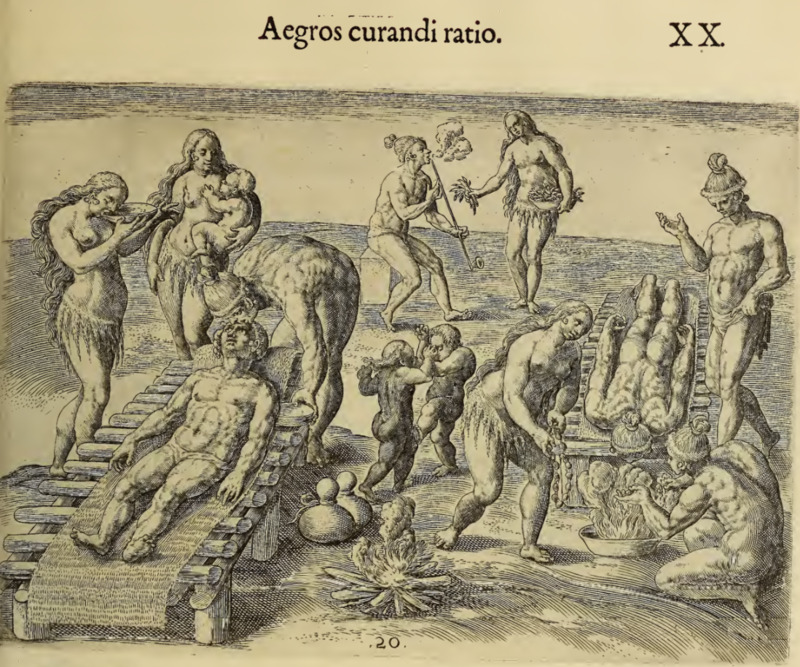
The sick lie on elevated beds made of wooden slats with woven mats laid on top. One lies on their stomach with their head hanging over the side of the bed and their face close to steam coming out of a pan on the ground. The other lies on their back being tended to by other individuals. There is a fire between the beds and two jugs on the ground. Children play between the beds, and a woman breastfeeds nearby. In the background, a man smokes from a long pipe.
In this image Lizzy, Jane, Mary, and Lydia discuss Mr. Wickham and the other military men who were staying in Meryton. They get ready for a dinner where they will see the soldiers. Mary yawns because she took no interest in the soldiers or finding a husband. This scene occurs in chapter 16. The characters are shown in the traditional regency style. Lizzy, Jane, Kitty, and Lydia wear regency style dresses with empire waistlines and their hair tied up. The regency period dated to the early nineteenth century (1811-1820) when George, Prince of Wales, later George IV (r. 1820-1830), reigned as regent for his mentally ill father, King George III (r. 1760-1820). The regency period is associated with the rise of neoclassicism in art and fashion.
The left panel depicts Calisto’s servant Pármeno, who is wearing a hat and has a sword mounted on his belt. The right panel depicts Celestina’s prostitute (and Pármeno’s lover) Areusa wearing a veil and a robe. Both figures are placed outside.The left panel is identical to those found on pages 60, 146, and 187, and nearly identical to those found on pages 263 (where it is labeled ‘Sosia’), 299 (labeled ‘Pleberio’), and 326 (labeled ‘Sosia’). The right panel is identical to those found on pages 287, 306, and 317, and is nearly identical to those found on pages 12, 208 and 271 (where it is labeled ‘Melibea’), page 84 (labeled ‘Lucrecia’), and page 350 (where it is labeled ‘Alisa’).
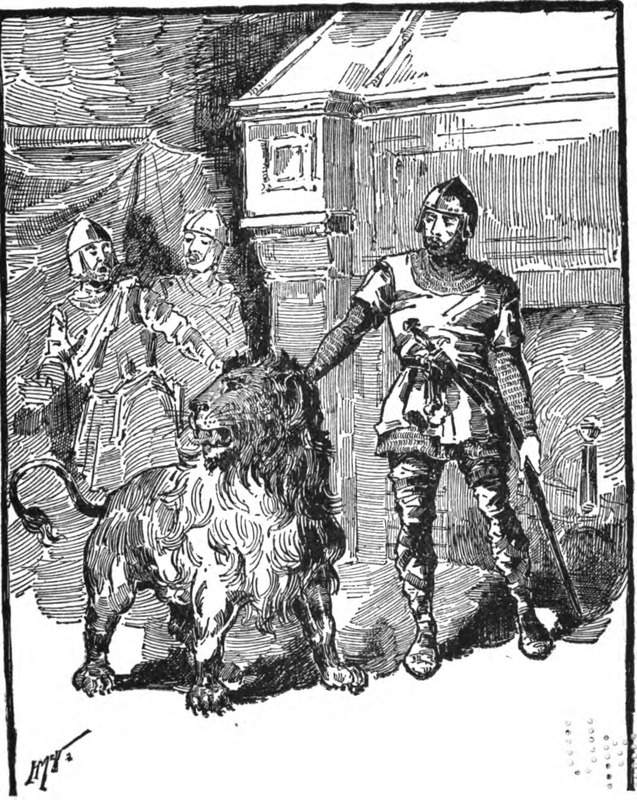
The Cid’s pet lion has escaped from its handlers and broken into a room in which the Cid was sleeping. Others were also in the room with him, including the two Infantes, who upon seeing the lion fled, hid, and soiled themselves. The other occupants acted more bravely and prepared to defend the Cid, but fortunately the Cid woke up. Upon hearing his voice, the lion stopped and allowed himself to be led back to his cage. The Infantes were mocked by the rest of their court for their conduct in this, and though the Cid did not personally fault them they blamed him for this, leading to future retribution against him by way of his daughters, to whom they were married.
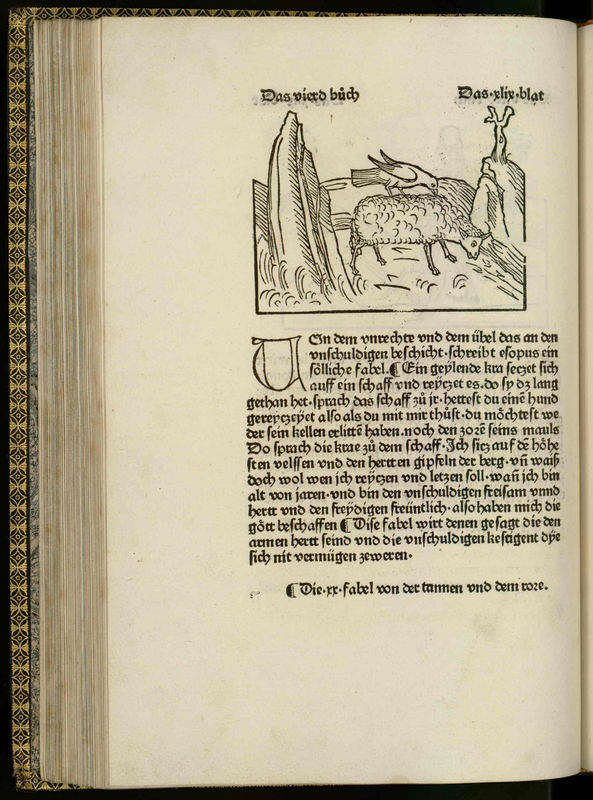
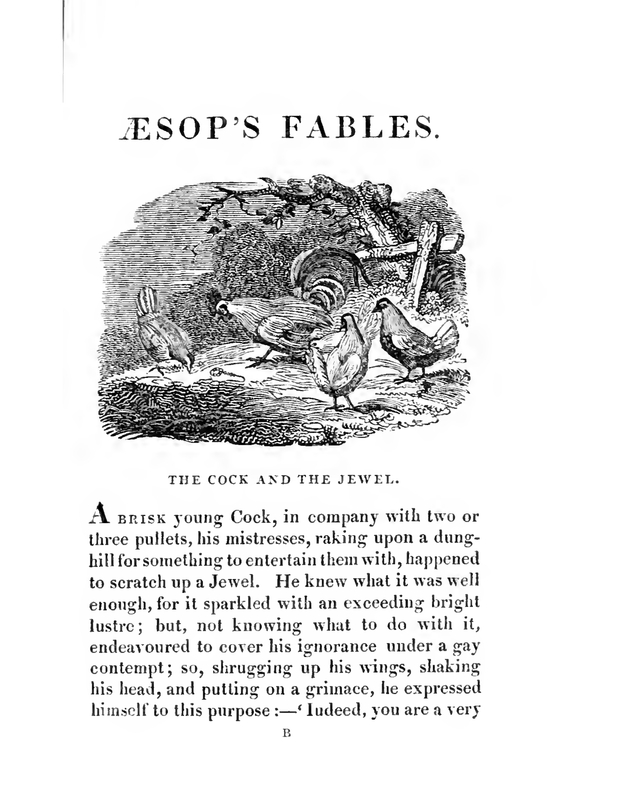
A cock and its 3 mistress pullets raked upon a hill. He discovered a jewel under the sunlight. Ingoraned, he expressed himself by bending down to attract pullets' attention.
On an especially warm day, Gulliver decided to bathe in the river while on a walk with the Sorrel Nag who was Gulliver’s protector. While Gulliver bathed the nag grazed nearby. A female yahoo watched Gulliver bathe and jumped into the water and embraced him from behind, scaring Gulliver. The nag returned and scared the yahoo away from Gulliver. The same image appears in the 1839 Krabbe edition.
Here we see a variety of mathematical instruments that were used on Laputa. This image comes at the beginning of chapter four, in which Gulliver leaves Laputa to travel to Balnibarbi, because the only things that the Laputans were interested in was mathematics and music, neither of which Gulliver was particularly interested nor skilled in. The same image appears in the 1843 Krabbe edition.
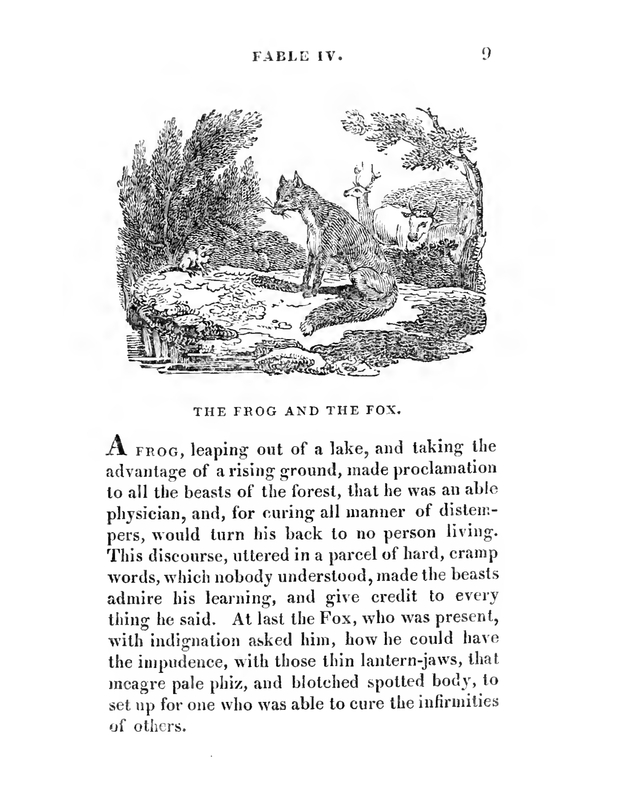
A Frog sitting on the edge of the lake performing consultation for animals. He was an able physician yet with strong sense of pride. A Fox who was presented with indignation was asking for his diagnose. After him, there were a dear, a bull, and a horse.
Mrs. Maria Bullock sits in her chariot, looking haughtily away from her nephew Georgy Osborne as he rides by. With her are her husband and their three children, who are looking out the window at their cousin. The carriage has a fancy lantern attached to the window and is decorated on the side with the image of a bull.
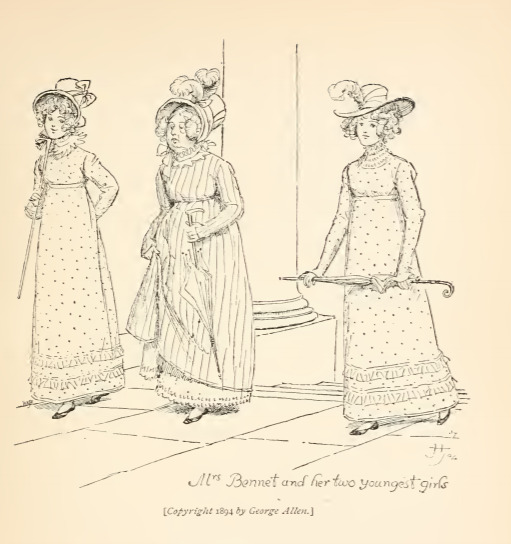
In this image Mrs. Bennet arrives at Netherfield Park with Lydia and Kitty. Lizzy wrote to Mrs. Bennet from Netherfield saying that she should come visit Jane who was ill. Mrs. Bennet spent most of her visit trying to raise Jane’s status and impress Mr. Bingley. This scene occurs in chapter 9. The characters are shown in the traditional regency style. Mrs. Bennet, Lydia, and Kitty wear regency style dresses with empire waistlines. They wear bonnets and parasols to protect their faces from the sun. The regency period dated to the early nineteenth century (1811-1820) when George, Prince of Wales, later George IV (r. 1820-1830), reigned as regent for his mentally ill father, King George III (r. 1760-1820). The regency period is associated with the rise of neoclassicism in art and fashion.
A group of Tupinambá people – four women and a man – gather around a deceased man who lays in a hammock. Two women crouch beside the hammock with their hands over their faces in distress. Behind the hammock, two more women hold each other by the shoulders as they mourn, and a man stands behind them holding a rattle or ornament with one hand and wiping his face with the other. Both the deceased and living man have a facial adornment on their chin.
A man can be found laying below what seems to be a cliff above grass. Another man with a distressed look on his face stands at the top of the cliff, and is reaching out as to catch the man. Three men towards the left-hand side of the image onlook.
A woman in a powdered wig and frilled gown performs a curtsey. Opposite her is a man, also in a powdered wig, holding a tricorne hat in his hand. The two are framed by a candleholder in the shape of the letter G from Good.
Here Gulliver meets a frog who accidentally got into the trough in which Gulliver sailed for the entertainment of the court of Brobdingnag. The trough was built so that Gulliver could sail and entertain the courtiers, and the water was changed every three days. The frog got in when the water was being changed and climbed into Gulliver’s boat. In the image we see the frog’s head comes out of the water, and Gulliver fends him off with a stick while in the ship. The same image appears in both the 1839 and 1843 Krabbe editions.
The illustration depicts a scene which might have been part of the story if it was written in a different style. Mademoiselle Anastasie holds in her hand the letter from Marquis Osbourne, which Lady Amelia reaches for eagerly. On the wall behind the two is a portrait of the Marquis, and in the background to the left of the image his ‘petit tigre’ is looking back over his shoulder at them as he departs.


![[Becky’s Coal-Scuttle]](https://collections.cemvc.ca/files/large/4ac0e378444d4c00eed33a5e8ee9db90e19b6579.jpg)
![[Lizzy, Jane, Mary, and Lydia discuss Mr. Wickham]](https://collections.cemvc.ca/files/large/863373422eaa1decbcad3d0f60f7b05a7304784a.jpg)

![[Act VIII – Pármeno and Areusa]](https://collections.cemvc.ca/files/large/fdfc88a6c57cacd5b869ba03e15a6752fb4a4043.jpg)

![[a female yahoo embraces a startled Gulliver]](https://collections.cemvc.ca/files/large/145d6e8416d9247a643899fdfda91c5d1dec6361.jpg)

![[various scientific instruments from Laputa]](https://collections.cemvc.ca/files/large/6260acd557ca39122b91e49f7f9cb8a475a3f5b1.jpg)
![[Mrs. Bullock’s Carriage]](https://collections.cemvc.ca/files/large/6e4b32e3a94bf551979e381ffb5006da5207a1db.jpg)
![[Tupinambá men and women mourn a deceased man]](https://collections.cemvc.ca/files/large/5995fe208060610462691c7e56ceaf28e1bb4ae3.jpg)
![[Man falling off cliff]](https://collections.cemvc.ca/files/large/81262c25ace3d17929fd1f1a0fc524cafe602a3f.jpg)

![[Vanity Fair Volume II. Chapter XXV Inhabited Initial, G]](https://collections.cemvc.ca/files/large/c67e23174bee9381b4080fb1394781f6242fb1f0.jpg)
![[Gulliver encounters a frog while sailing]](https://collections.cemvc.ca/files/large/855e85735d23fa6cdca214da3ec63b83c2c479a9.jpg)

![[A Genteel Rose-Water Alternate Style Part II]](https://collections.cemvc.ca/files/large/16964c86c10039e088545fd6d6740289eb5f02f5.jpg)