In his conversations with past Kings and Queens on Glubbdubdrib, Gulliver learns of the corruption of the throne. He was told on several occasions of corruption of the court. He was even told that virtue only slowed business down, and corruption was the only way to keep the throne working. In this image we see a Queen sitting on a throne whose back is made of snakeskin, while a courtier kneels in front of her, offering his hand. In the background we see a baby wearing a crown and holding a sceptre. The same image appears in the 1843 Krabbe edition.
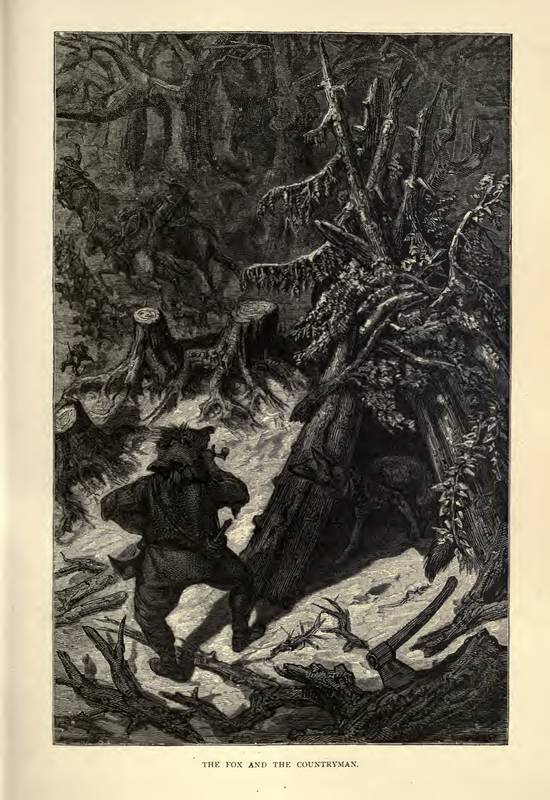
A countryman stands in the middle of a forest. He is standing with his legs apart, slightly bent at the knee. He is bracing both his hands on his hips. He has a pocketknife on his right hip and what looks like the blade of an axe on the left one. The image shows him from the back, but a pipe is seen sticking out from his mouth-area. To the right of the countryman, a hut is made of tree branches and wood. A fox is peaking its head out of the hut, looking in the same direction as the countryman. They are both looking at three tree trunks. The trees have been cut down. In the foreground, lower right corner, a tree stump lies on the ground with an axe stuck in it.
After Melibea takes her own life, her father Pleberio (central figure) is immersed in despondency. He goes to his bedchamber and informs his wife, Alisa (rightmost figure), of the death of their daughter. Alisa does not utter a word in this act. Based on Pleberio’s implorations for Alisa to help him deal with his sorrow, and his questioning whether she has joined Melibea in the afterlife, we can presume that Alisa has fainted. In the background to the left, we see a female figure, presumably Lucrecia.
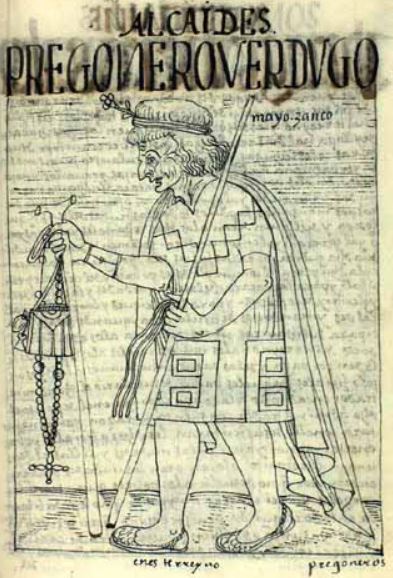
This image depicts an old native man who performs various administrative functions in colonial Peru. He is described as the town crier as well as the executioner. He is illustrated walking with a cane in his right hand as he also holds a bag and a rosary. His left hand holds a long ceremonial staff. He is dressed in traditional clothing with an embroidered unku [tunic] and a cloak draped over his shoulders. He also has a head piece that has a flower attached to the front. The caption at the bottom of the image reads, en este rreyno [in this kingdom].
Here we see a bust of Socrates. This image appears when Gulliver’s master explains their views on philosophy, reason, and morals. Gulliver explained the European views on natural philosophy, including those of Socrates, with which the Houyhnhnms agreed. According to Plato’s Republic, Socrates preferred knowledge to be informed by ethics, not just what can be observed in the real world. The same image appears in the 1843 Krabbe edition.
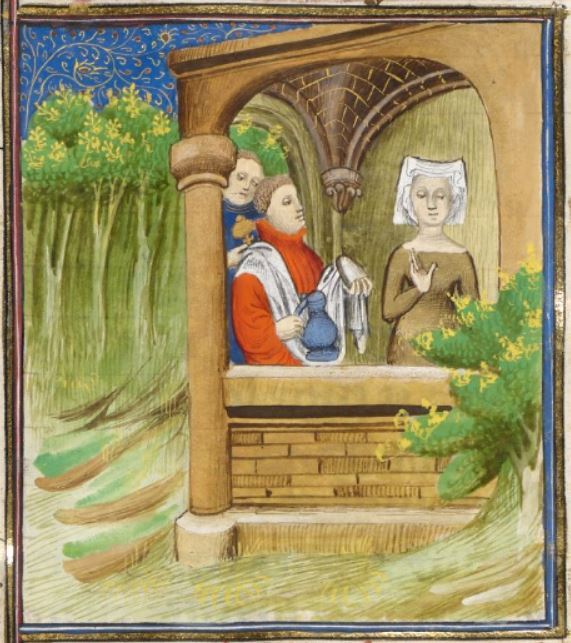
This illumination depicts Agrippina, the wife of Germanicus, being forced to eat food while in prison. Agrippina is on the right side of the image as she looks out of the window of her prison cell. Her father-in-law, Tiberius, put her in prison after killing his son (her husband, Germanicus). Agrippina decided to starve herself to death to avoid dying at Tiberius’ hands, however, Tiberius force fed her so that she would not die on her own accord. The men on the left side of the image are carrying food and water to force Agrippina to eat so that she does not starve herself to death. Agrippina has her hand up in rejection to this.
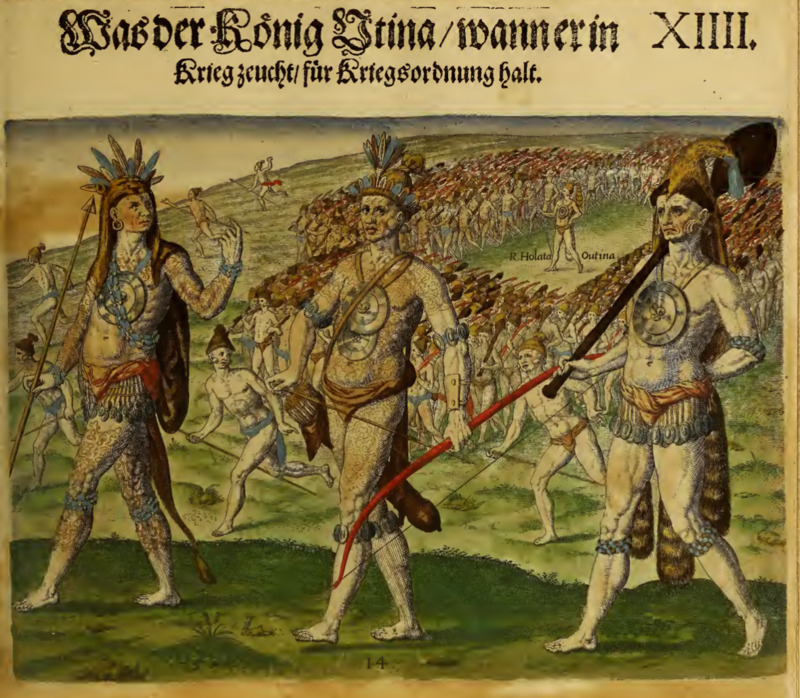
Three Indigenous men stand in the foreground. All three carry a different weapon: the one on the left a spear, on the right a club, and in the middle a bow and arrow. They each wear a different headdress as well, the one on the left a small mammal and feathers, on the right a bird, and in the middle feathers. All three men wear round plates hanging from their necks, loincloths with tails hanging from the rear, and various adornments including earrings, bracelets above their elbows, around their wrists and below their knees, and the two men on the left are painted or tattooed. In the background a large group of Indigenous people stand in a battle formation, al holding spears. In the center of the formation there is a square of empty space, where another man stands. This illustration is identical to the one found on page 63 of Frankfurt 1591, but colored.
Here we see Gulliver riding on a horse after arriving in England. He waves people out of the way as he rides home. He writes that he felt as though he were on Lilliput because everything felt so small. Thus, he waves people out of the way, fearing he might trample people. Naturally, he received several strange looks from people walking along the road, which can be seen in the image. The same image appears in the 1843 Krabbe edition.
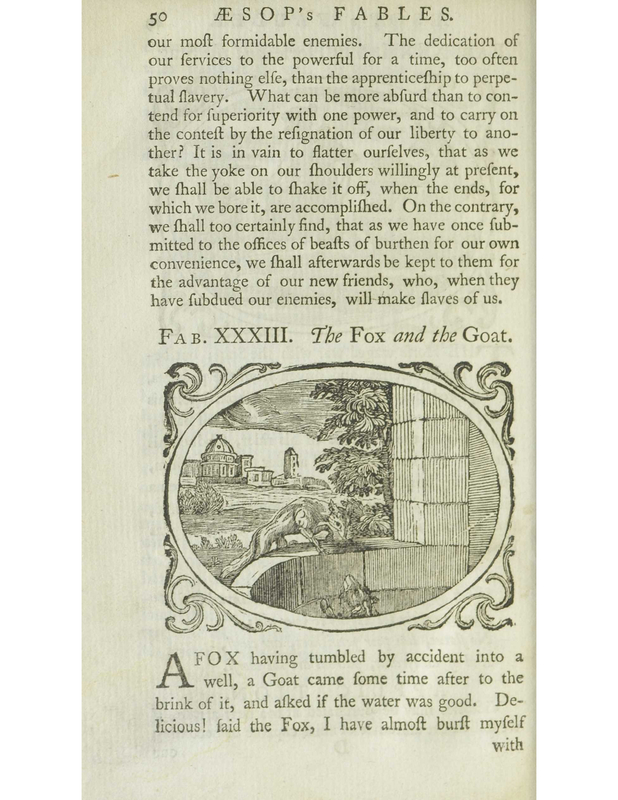
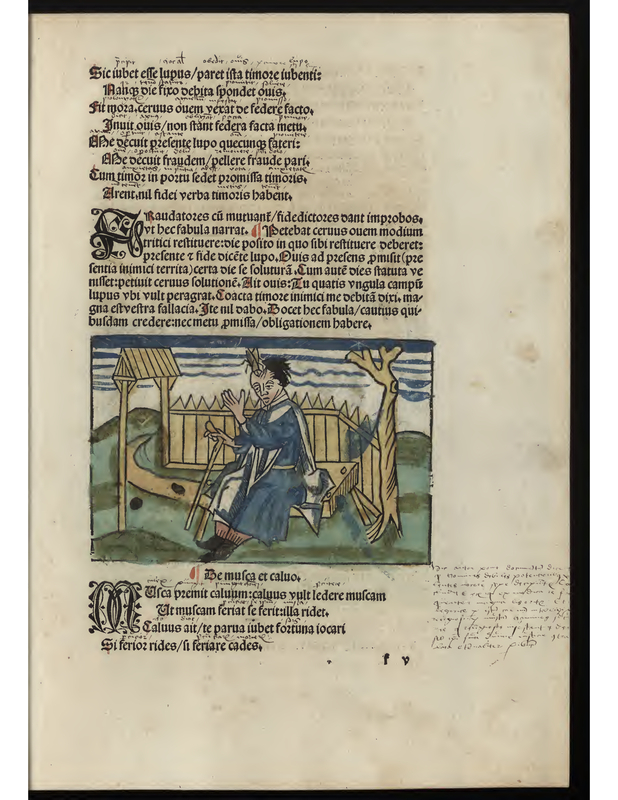
A fox stands on top of a ledge, looking down at a goat, whose head is visible at the bottom of the image in an enclosed area. In the background, there is a town visible with a four buildings standing on the left side of the image, with trees and bushes covering the remainder of the image.
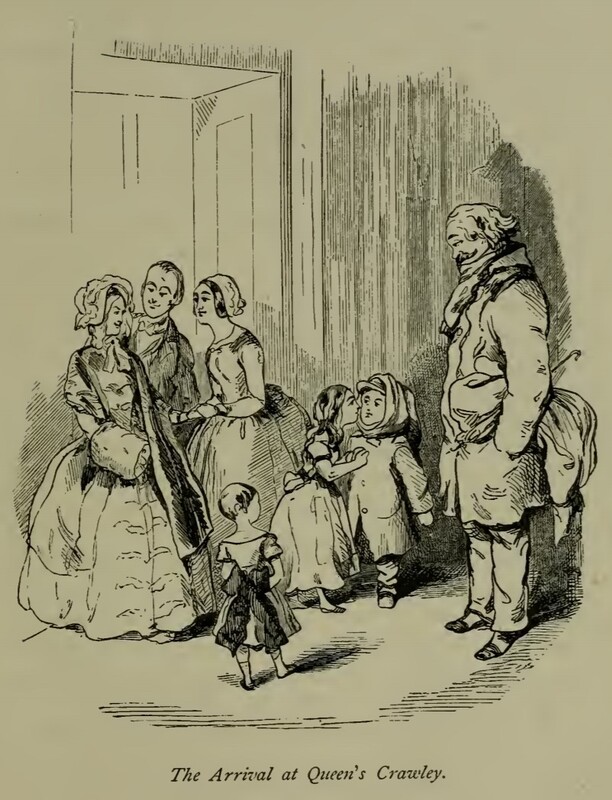
Matilda Crawley greets her cousin, the younger Rawdon Crawley, while her brother Pitt Binky hangs back and watches. To their side is Mr. Rawdon Crawley, watching his son. In the background, Sir Pitt and Lady Jane are greeting Rebecca Crawley, who has just arrived at Queen’s Crawley with her husband and son. Below the illustration is printed in cursive its title, The Arrival at Queen’s Crawley.
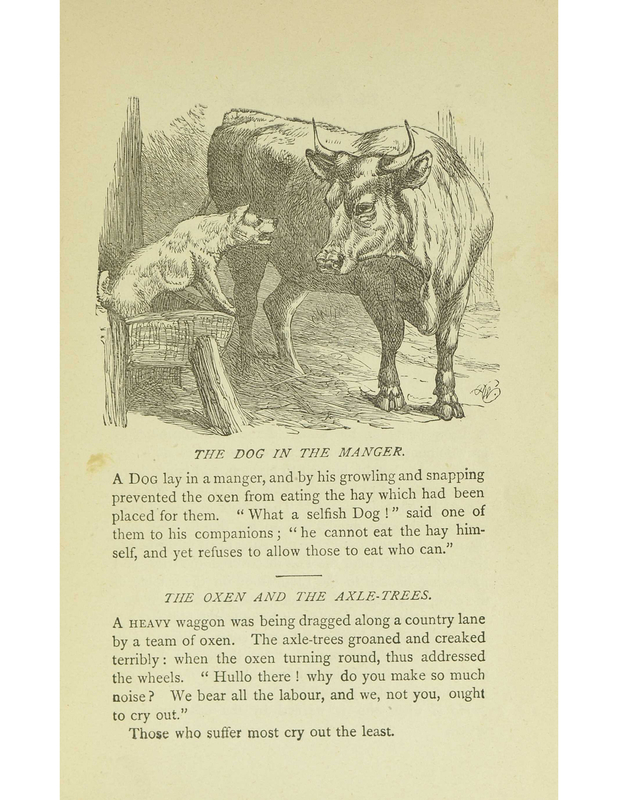
A dog is inside of a manger. Its hind legs stay inside the box, while he rests his two front legs on the top of the box. The dog in the manger is on the left-hand side of the image. The dog is looking straight ahead of him, to the right, and is barking. A large ox is in front of the dog, seeming angry that it cannot access its food. Its large head is slightly turned in the direction of the dog, but not completely.
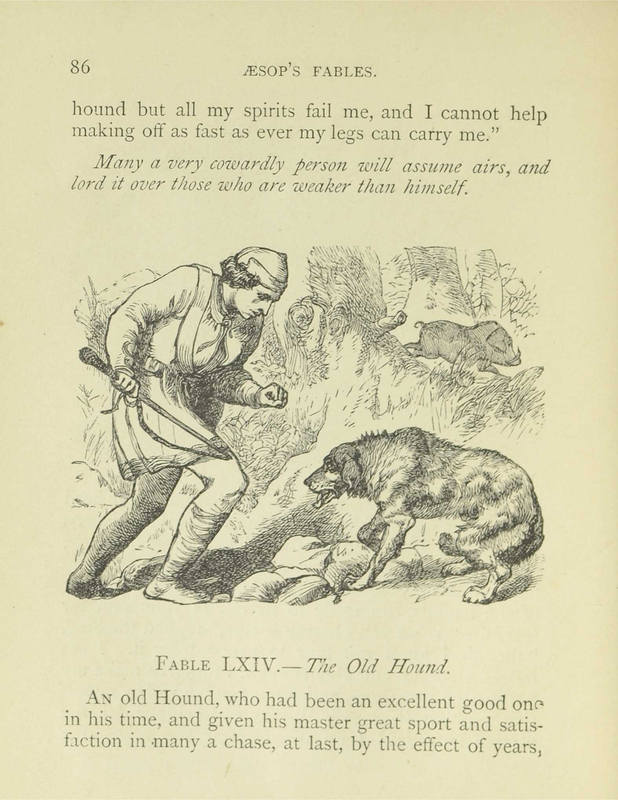
In the foreground to the right an old dog stands crouched and tired. To its left, a man is bent over the dog, holding a whip in his right hand and his left balled in a fist. In the distance a wild boar escapes the scene.
Lady Jane Crawley sits on a chair in the nursery, listening to her son’s morning prayers. Next to her chair is a toy horse, and above it the letter T from The.
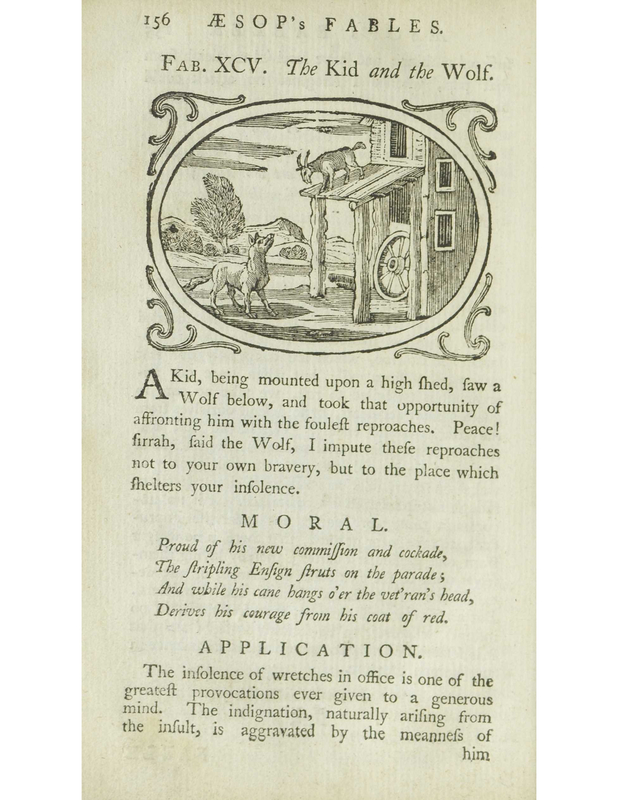
A wolf looks up at a goat who is perched on the roof of a shed and looking down at the wolf. The wheel of a wagon leans against the shed with trees and hills in the background.
Hans kneels outside the door to Rebecca Crawley’s room at the Elephant Hotel, pleading for her to dine with him and Fitz later that day. Joseph Sedley is behind him, having just come up the stairs to see Becky, speechless in surprise.
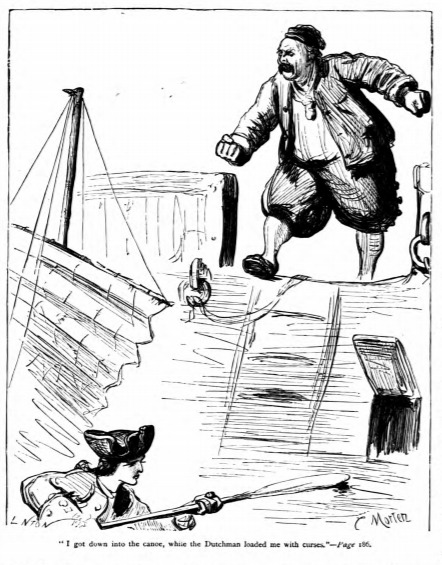
While sailing to the Levant, Gulliver’s ship was attacked by Dutch pirates, forcing Gulliver to plea for his life. The pirates took over the ship and sent Gulliver off in a lifeboat with very few provisions. It was because of this episode that Gulliver ended up in Laputa.
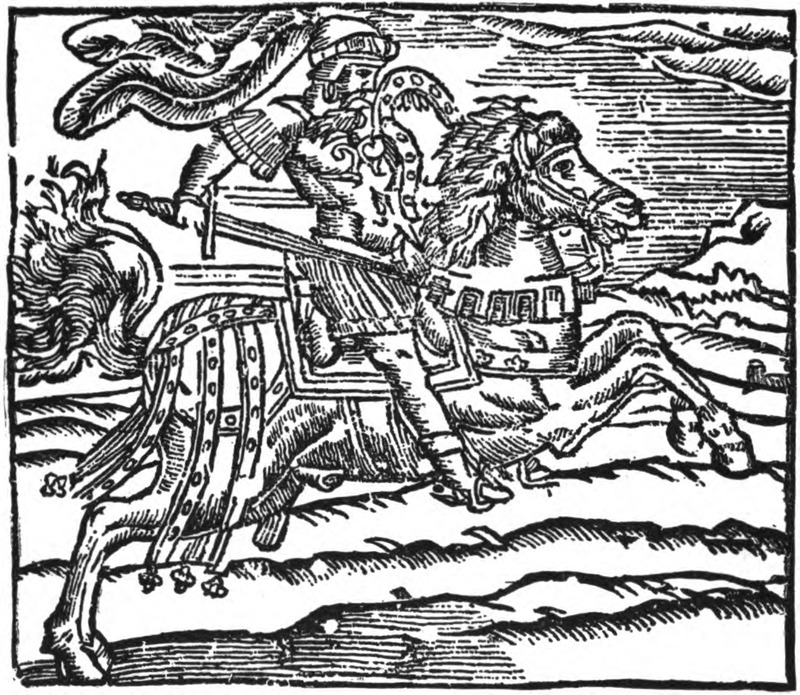
The Cid sits atop his horse Babieca, wielding a sword and a shield. Two long feathers flow behind him from his helmet. The horse is jumping or galloping to the right, presumably toward an unseen enemy.
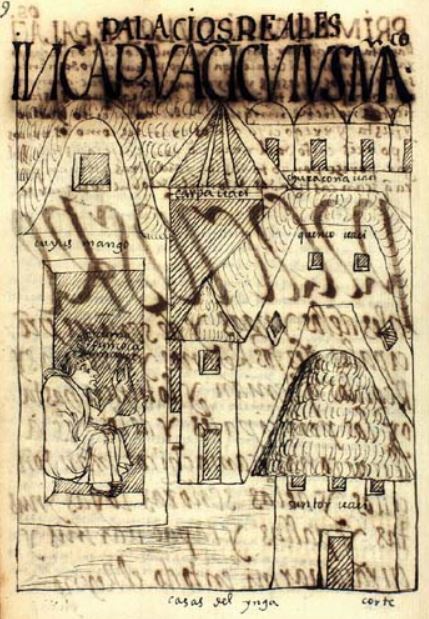
This chapter is dedicated to discussing the Inca and his life. This image depicts the Inca’s palace and his many houses. The house on the left side of the image is labeled as cuyus mango [guard house]. There is a man sitting by the door keeping watch. There are words written in the doorway above his head which reads cumo punco camayoc [humpbacked door official]. The house beside cuyus mango is labeled as carpa uaci [house with awning]. To the right of carpa uaci there is a structure with many doors labeled as churacona uaci [storehouses]. There is a unique structure below the churacona uaci which appears to have a hollowed center for a courtyard labeled as quenco uaci [curved house]. The house in the bottom right corner of the image is labeled as suntor uaci [circular house]. The caption at the very bottom of the image reads casas del ynga [houses of the Inca].
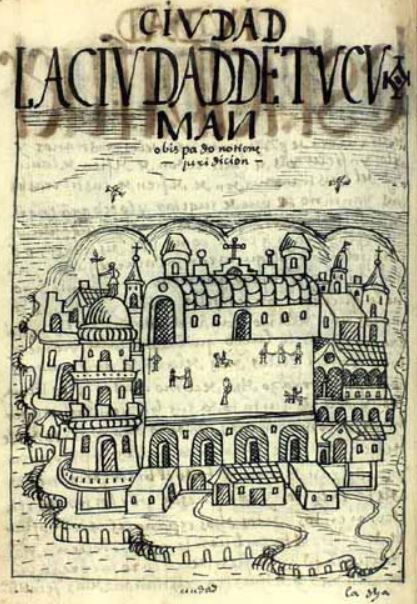
This image is depicted in the author’s chapter where he discusses cities, towns, villages, and provinces in colonial South America. This image depicts the city of Tucumán in modern-day Argentina. The city is arranged in a cluster of buildings that forms a town square in the centre where people are walking, and soldiers are riding horseback. There is a soldier standing on top of a building on the left side of the city who appears to be a watch guard. There are two winding paths that lead in and out of the city. The author explains that the city has little food apart from fish from the river, and although the city has no jurisdiction, there are good Christian people who live there. The caption at the bottom of the image reads ciudad [city].
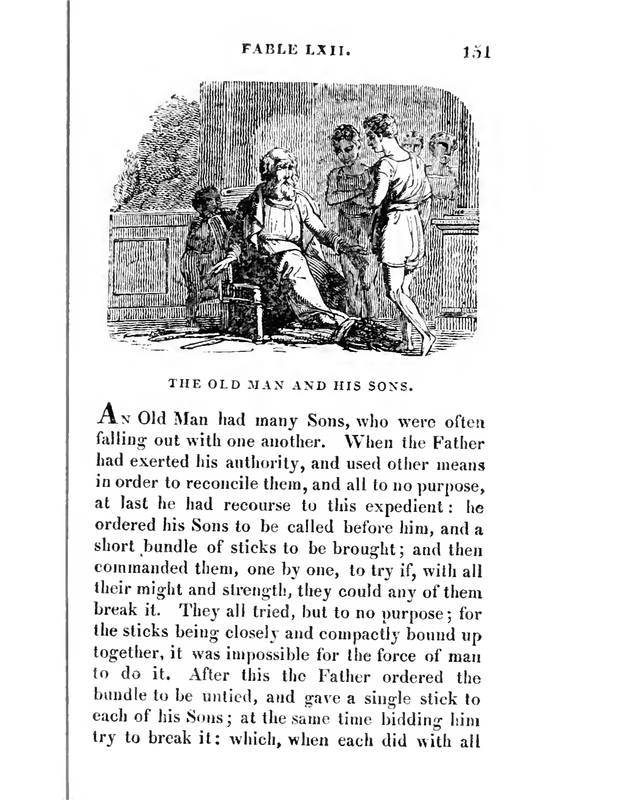
An old man sits in a chair, surrounded by three younger boys who stand around him. The man wears longer robes. The boys wear short-sleeved shorts and shorts. They appear to be in a room. Behind one of the columns on the right-hand side of the image we see two more figures.
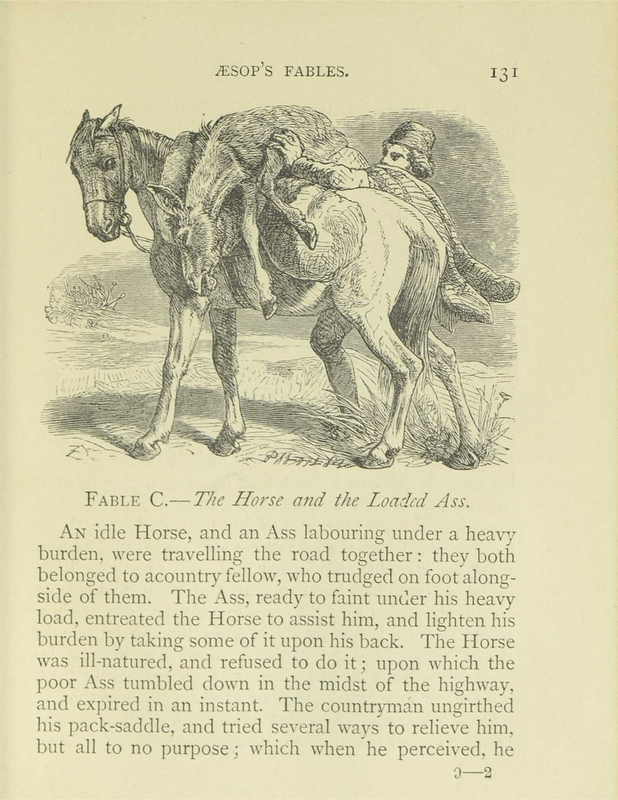
Three men stand around a horse, one of the men has his foot on the horse while he’s swinging back a stick in his right hand. One of the other guys is holding something out in front of the horse and the third guy is observing in the back.

![[a courtier kisses the hand of a queen]](https://collections.cemvc.ca/files/large/2362be7f3bed1f733cf8ead8f393b066bea31fb2.jpg)
![[Act XXI (First Illustration) – Pleberio Telling Alisa About the Death of Melibea while Lucrecia Stands at a Distance]](https://collections.cemvc.ca/files/large/6bbdf42b94d98498828575831a5c8efba68e260c.jpg)
![[a Bust of Socrates]](https://collections.cemvc.ca/files/large/a35d270ca0fdd4e23c2a890f2b5b05f38e97845d.jpg)
![[Gulliver arrives home in England]](https://collections.cemvc.ca/files/large/e747f499462ebdc01e6b01bb7b4da5f1e5127d5e.jpg)
![[Vanity Fair Chapter LIV Historiated Initial]](https://collections.cemvc.ca/files/large/d3f2936fb81e9e41d58fac71c59bec8b80aaf327.jpg)
![[Joseph Sees Hans]](https://collections.cemvc.ca/files/large/99ec80df5459acc5f57c418311b691bf33829128.jpg)
![[Three Men and a Horse]](https://collections.cemvc.ca/files/large/c912bf5082230c134bd9e1aa420abc5bf7c3e2c0.jpg)