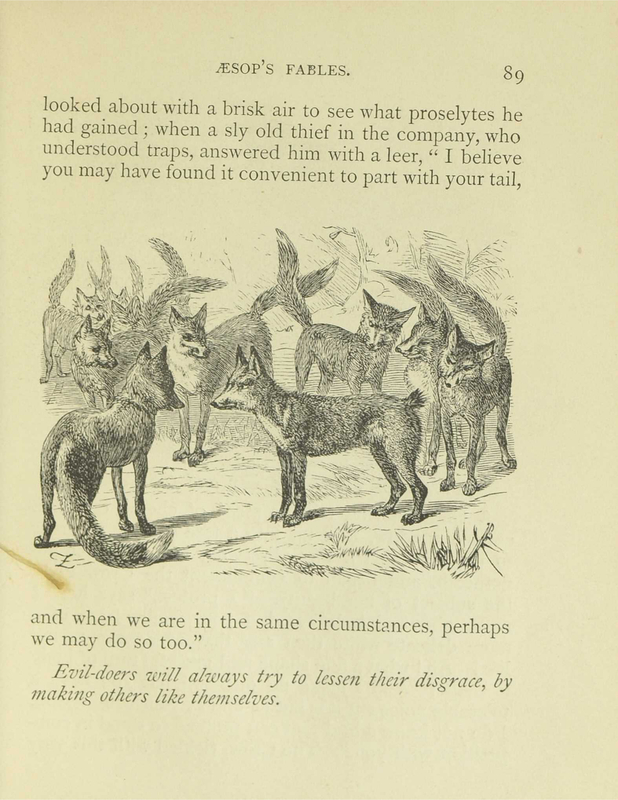
A fox without a tail stands in the middle of a pack other foxes with tails intact. The group of foxes have confused, disdainful, and angry facial expressions towards the centre fox.
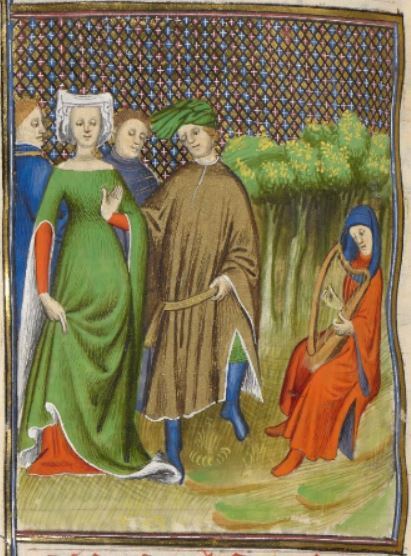
This illumination depicts Antonia, the daughter of the famous Mark Antony and Octavia. She is illustrated on the left side of the image wearing a green dress and a garment on her head. Antonia is famous for having remained a widow for the rest of her life following her husband Drusus’ death. She spent most of her time with her mother-in-law, Livia, who is presumably one of the women depicted on the left side of the image. There is a man attempting to garner Antonia’s attention, however, she has her hand up to reject him as she remains chaste her entire life.
Two weeks after Gulliver’s arrival in Luggnag the King invited him to court. Gulliver was required to lie on his stomach and lick the dust off the floor (which had been swept because he was a stranger) as he moved towards the King. This task was only allowed for those of the highest ranks at the court when they wanted to be admitted into the court. Anyone who does this is not permitted to wipe their mouth in the presence of the King. When a high-ranking criminal was sentenced to death, they would be executed by spreading a poisonous powder on the floor and having the criminal lick the floor in the same manner. In this image we see Gulliver licking the ground in front of the King’s footstool. In the background we see courtiers who are watching this ceremony. Two courtiers hold brooms, indicating that the floor had been swept before Gulliver began because he was a guest. If someone was an enemy of other courtiers, then extra dust would be spread before they licked the floor. The King sits on his throne with his dog sitting on his footstool, and a large cat behind him. The same image appears in the 1843 Krabbe edition.
A man carrying a sack over his shoulder stands by a doorway with a low gate. Opposite him is a woman leaning against the door frame, mending a piece of clothing, while a small boy hangs over the gate. On the wall next to the man’s head is the letter S from Sir.
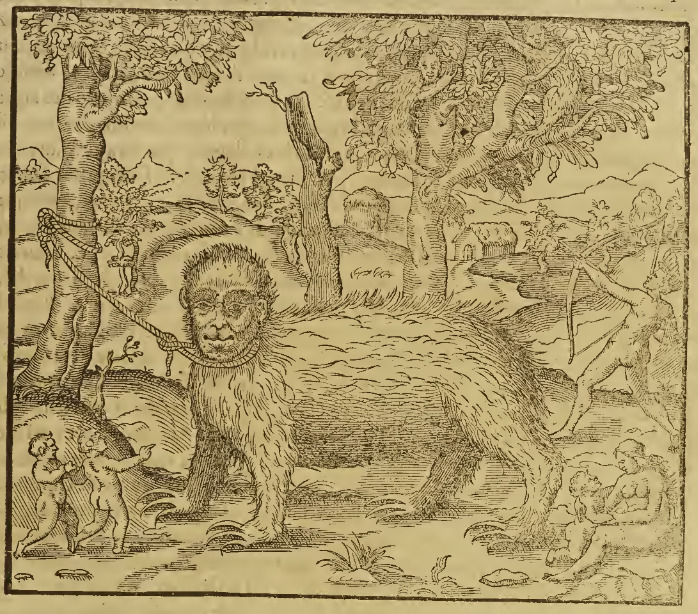
A large animal (the fictional representation of a sloth) stands on the ground, tied to a nearby tree by a rope around its neck. The animal has a bear-like body and a humanoid face, with three toes tipped with large claws on each foot. Two more of the creatures cling to a tree in the background and an Indigenous man aims a bow and arrow towards them. Two Indigenous children stand in front of the tethered sloth and a mother and child sit on the ground near the animal. According to the text, the name of the creatures, Haüt, or Haüthi, comes from the Indigenous name for the trees the sloths were commonly found in. Thevet calls them beasts that live on air because no one had managed to observe them eating. This image is identical to one found on page 941 of Paris, 1575 (Chaudière).
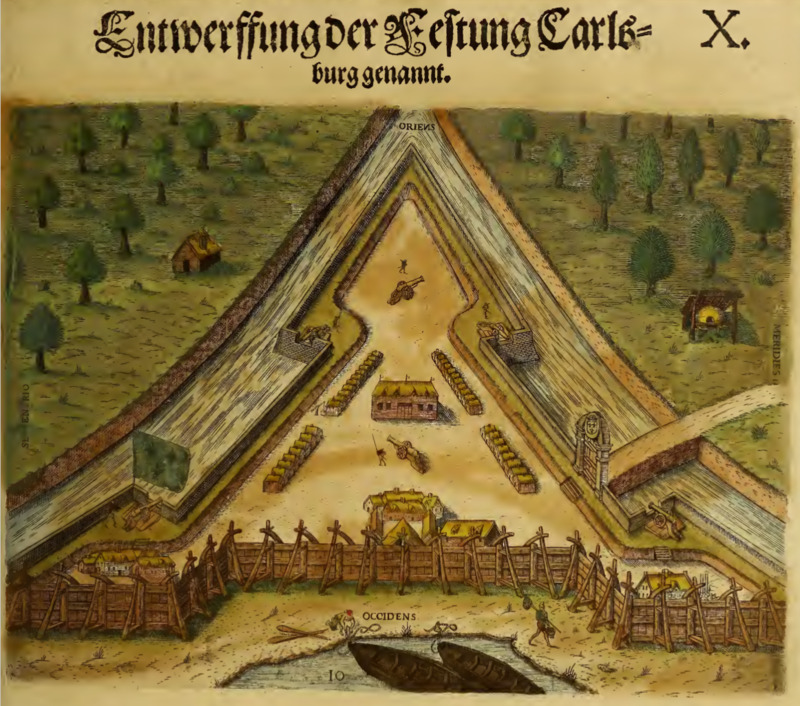
A fort, in the process of being built, is shown. The fort is situated on an island in the middle of a river and is triangular. A bridge on one side connects the island to the opposite riverbank. The front of the fort has a high wooden wall, and just inside the walls a trench runs all the way around the perimeter. Within the fort are cannons and various buildings. This is most likely a depiction of Fort Caroline. This illustration is identical to the one found on page 55 of Frankfurt 1591, but colored.
Here we see a group of Houyhnhnms. This image appears when Gulliver tells the readers about the philosophy of the Houyhnhnms. Gulliver tells us that the two principal values of the Houyhnhnms are friendship and benevolence, represented here as we see a group of Houyhnhnms that are friends and appear happy together. The same image appears in the 1839 Krabbe edition.
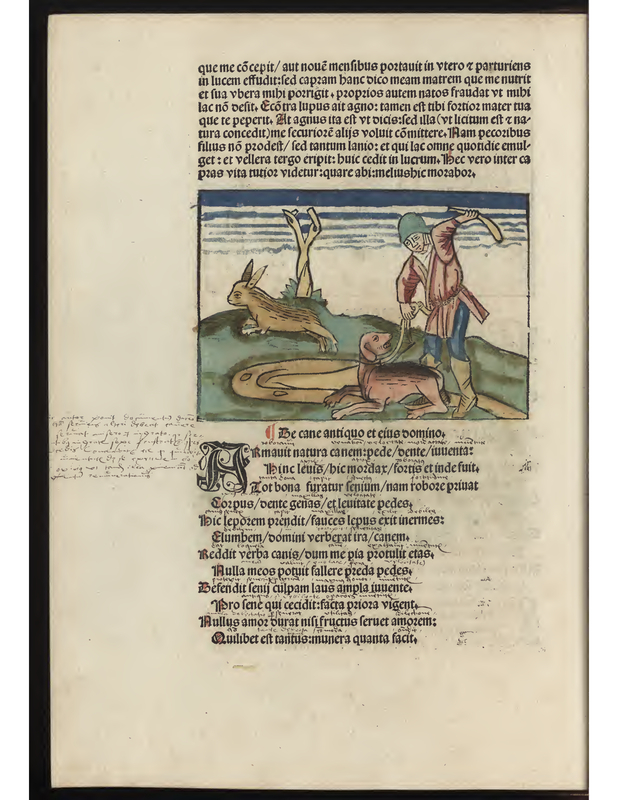
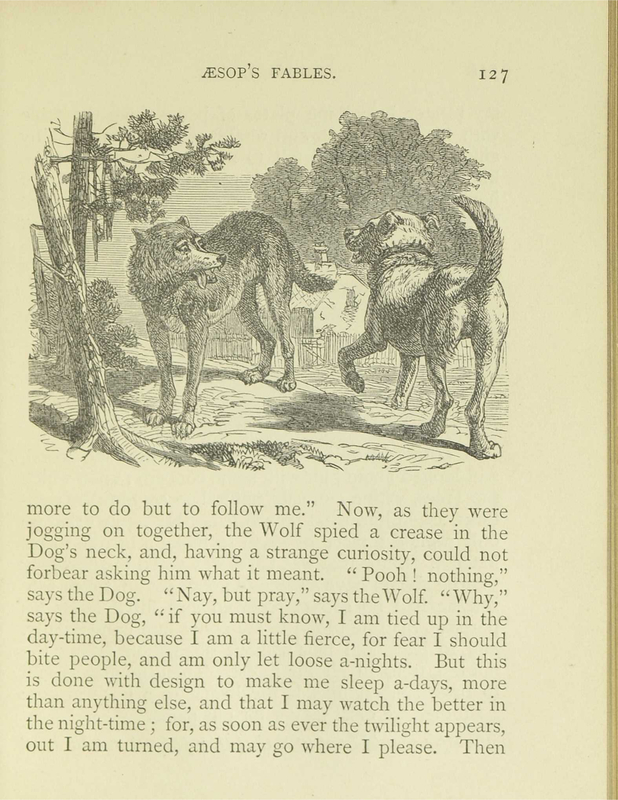
A exhausted wolf to the left side of the page, their tongue hanging, looks on at a dog. The dog, to the right of the page, is perky with their tail held up. The dog faces the wolf, with their flank to the viewer.
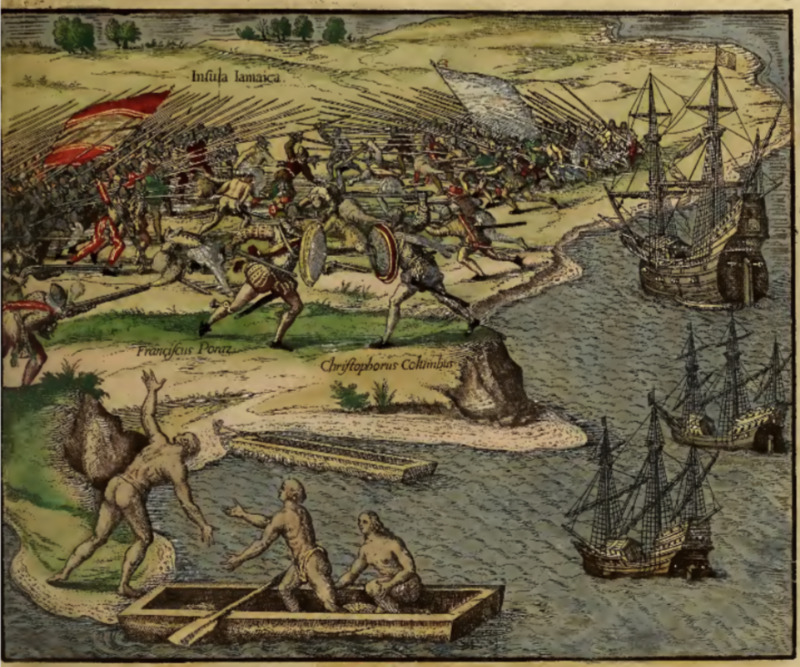
On the island of Jamaica, Christopher Columbus and Francisco de Porras (both labelled in the image) engage in battle. The two men face off against each other, each armed with a sword and shield. To one side of the two men and stretching along the shore, their two armies engage in combat with muskets, swords, and spears. Three European ships are anchored along the shore. In the foreground, three Indigenous people either arrive or depart the area by canoe. One of the men, standing on the shore, gestures widely in the direction of the battle. This image is identical to one found on page 175 of Frankfurt, 1594, but colored.
Rebecca Sharp, wearing a bonnet, holds onto the arm of Joseph Sedley, who is wearing a top hat and carrying a cane. The two figures are standing beneath a crescent moon. In the background is another couple, possibly George Osborne and Amelia Sedley, possibly a pair of strangers.
To the left, we see Celestina wearing a robe and a veil, with what appears to be a rosary hanging from her waist. The right panel depicts Melibea, also wearing a robe and a veil. Both figures are placed outside.The left panel is identical to the panel found on the title page, and on pages 70, 114, 146, and 225 of the text. The right panel is identical to those found on pages 12 and 271, and is nearly identical to those found on page 84 (where it is labeled ‘Lucrecia’), pages 173, 287, 306, and 317 (where it is labeled ‘Areusa’), and page 350 (where it is labeled ‘Alisa’).
Captain Swankey of the Body Guard stands with one knee on a wooden chair and his hat on the ground, describing pig-sticking to Amelia Osborne, who sits on a sofa with a paper in her hand, looking amused. In the background, Major Dobbin has come upon them while walking past the room.
While Gulliver was walking through the garden the gardener's dog picked up Gulliver in his mouth, before the gardener returned and rescued Gulliver. In the image we see Gulliver lying between the dog’s teeth. The same image appears in the 1839 Krabbe edition.
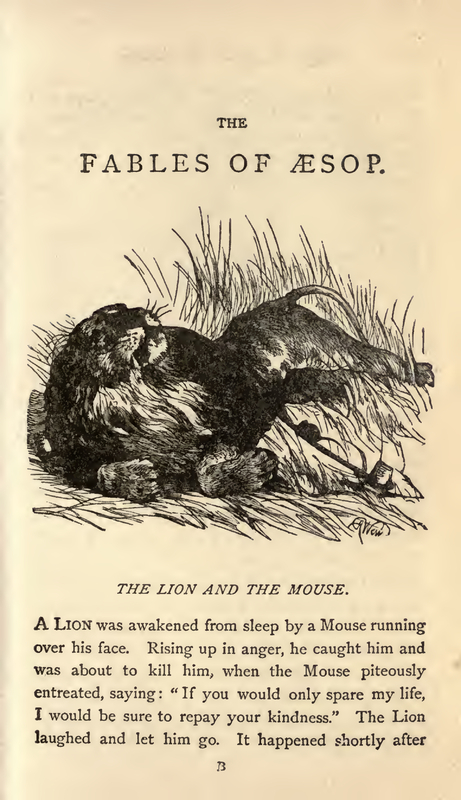
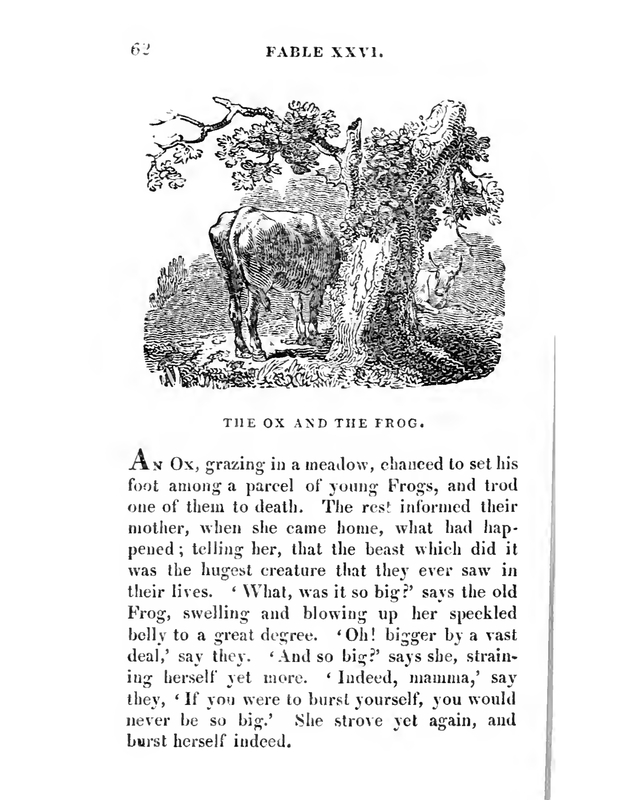
There is a ox standing on the left of a tree. The ox is turned around so that its head it blocked by the tree so one can only see the body after the head. There is a second ox whose upper body half can be seen emerging from the right side of the tree.
While walking home, Celestina (leftmost figure) sees Sempronio (right-central figure) and Pármeno (rightmost figure), who are going to check on Calisto (left-central figure) at Saint Mary Magdalene’s church. The two servants enter first, and Celestina follows closely behind. She tells Calisto that she has good news, and the four of them go to Calisto’s house for privacy. Once there, Celestina tells him that Melibea is passionately in love with him and has agreed to meet at midnight. Calisto is overjoyed, but Sempronio and Pármeno express suspicion at Melibea’s sudden change of heart.
A man carrying a sack over his shoulder stands by a doorway with a low gate. Opposite him is a woman leaning against the door frame, mending a piece of clothing, while a small boy hangs over the gate. On the wall next to the man’s head is the letter S from Sir.
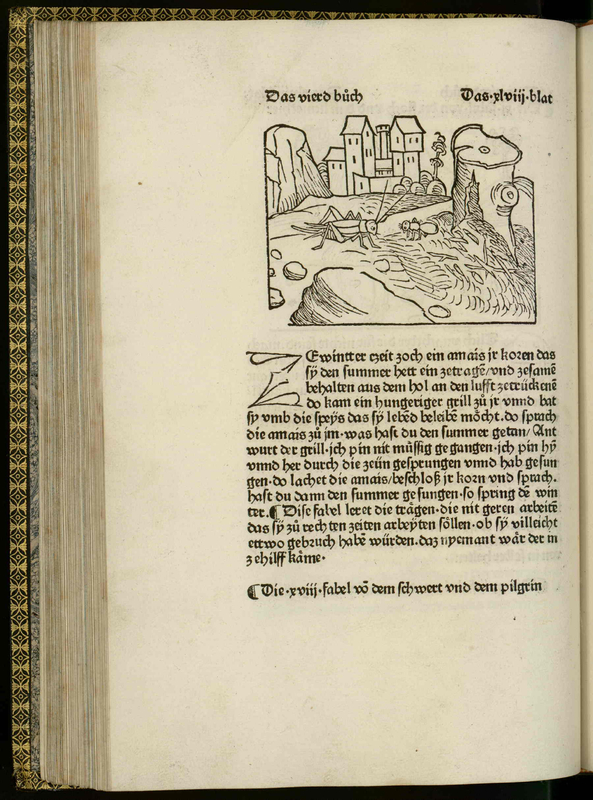
In the bottom part of the image, there is an ant and a grasshopper beside a tree trunk. In the top part of the image, there is a castle with bushes on the right side.

![[Vanity Fair Chapter LVI Historiated Initial]](https://collections.cemvc.ca/files/large/465c5c5b9fa4ec8e3e3df6b943ef92da7a0ccdeb.jpg)
![[Gulliver licks the dust in front of the King of Luggnag]](https://collections.cemvc.ca/files/large/978c803b3a6416465c3cb7352a4dbb0b5b467360.jpg)
![[Vanity Fair Vol. II Chapter XLV Inhabited Initial]](https://collections.cemvc.ca/files/large/46911da159ada7cbcbed22e374d665a77ada4d38.jpg)

![[a group of Houyhnhnms]](https://collections.cemvc.ca/files/large/f0c5902fb869469634fed969c59d953779983042.jpg)

![[Miss Sharp and Mr. Sedley at Vauxhall]](https://collections.cemvc.ca/files/large/540155f3095e9b5974803bdbb791ba6c539c6fad.jpg)
![[Act X (Mislabeled as ‘Septiesme Acte’/Seventh Act) – Celestina and Melibea]](https://collections.cemvc.ca/files/large/9ec58ca766fc341782cdcac7f73921fc237b6a79.jpg)

![[Amelia and Captain Swankey]](https://collections.cemvc.ca/files/large/eaa398ff02403a4e44060d82ba00dc21bae85d0a.jpg)

![[Act XI – Celestina Talks with Calisto While Sempronio Talks with Pármeno]](https://collections.cemvc.ca/files/large/a57fdc66b743f2440bc8c79e45ed6d9fe02fee49.jpg)

![[Vanity Fair Chapter XLV Inhabited Initial]](https://collections.cemvc.ca/files/large/334dc7608681e74901ad29b088ec409ba9d9864a.jpg)