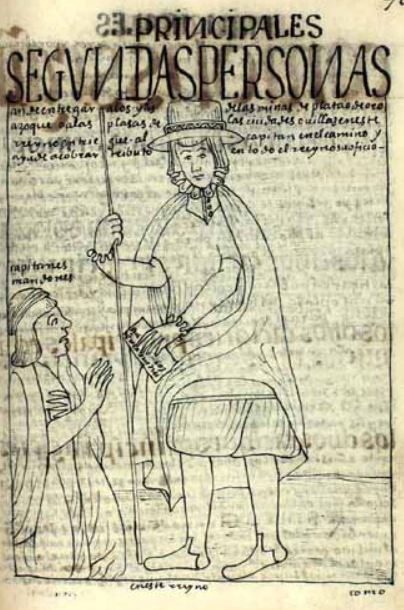
This image is illustrated in a chapter that discusses the descendants of the Inca and Andean nobles under Spanish colonial rule in Peru and their importance to a revived Andean society. This image depicts an Andean lord of the second highest ranking in the kingdom standing in the centre of the page. He is illustrated holding a staff in his right hand and handing over a sheet of paper to the kneeling man on the left. The kneeling man is a native administrator of a local pueblo who oversees tributary natives. The native lord is demanding that the administrator provide him with native labourers to work in mines. The caption at the top of the image reads, an de entregar a los yndios de las minas de plata o de oro, azogue o a las plasas de las ciudades o uillas en este rreyno, entriegue al capitan en el camino y ayude a cobrar tributo en todo el rreyno su oficio [to deliver the Indians from the silver and gold mines to the plazas of the towns or villages in this kingdom, surrender to the captain along the road and help collect tribute throughout the kingdom].
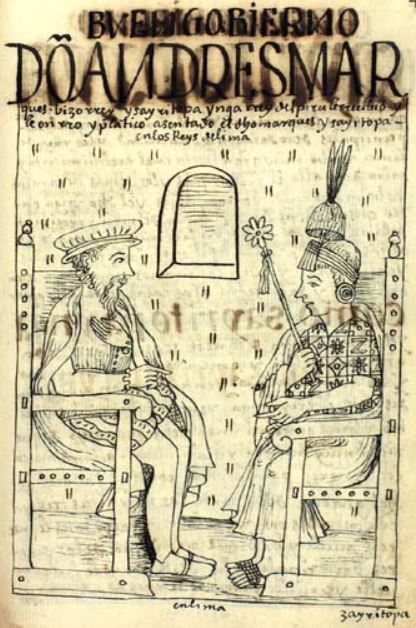
This chapter of the book focuses on discussing the good government of post-conquest Peru that the Spanish viceroys maintained. This image depicts Don Andres, the marquis of Canete and third viceroy of Peru, sitting on the left side of the image. He is facing towards Sayri Topa Inca, an Inca ruler in the region of Vilcabamba. They are differentiated by their clothing, with Andres wearing traditional Spanish/European clothing while the Inca is wearing an embroidered shirt and traditional Inca regalia. The author explains that the Inca was well received by Don Andres and they became good friends and maintained peace between the Spaniards and the indigenous peoples. The caption below the image’s title reads, le rrecibio y le onrro y platico asentado el dicho marques y sayi topa en los reys de lima [the marquis received him and honoured him and spoke with him, both the marquis and Sayri Topa were seated in the Kingdom of Lima].
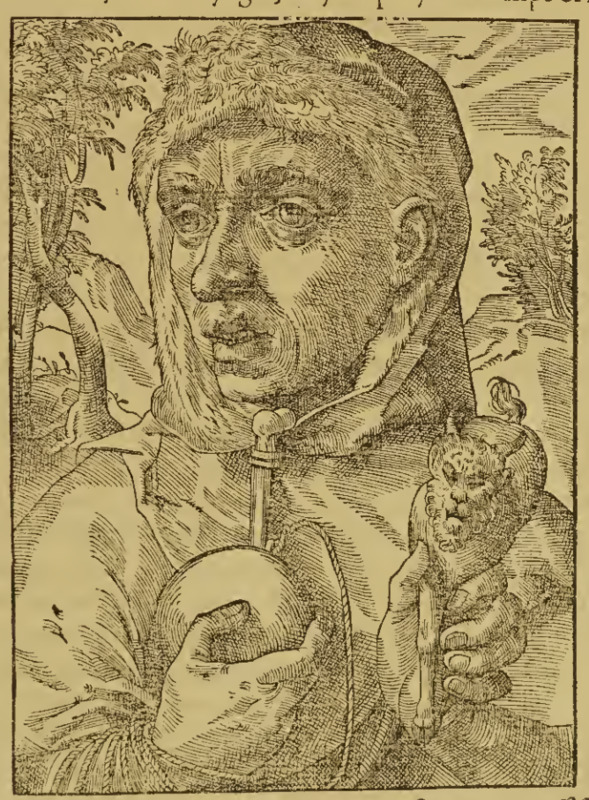
An Indigenous South American man of large stature holds an animal in one hand and an object in the other. He wears a long-sleeved garment with a hood. This image comes from a chapter entitled ‘D’une Isle, où les hommes sont grands de dix à douze pieds', (Of an island, where the men are tall at 10 to 12 feet), referring to an island in the region of Patagonia, South America. A Spanish expedition in 1520 led by Ferdinand Magellan explored the South American coast of Patagonia (today Argentina and Chile) and encountered a group of Indigenous people, likely the Teheulche. The Spaniards described the Teheulche as giants, but later travelers disputed this description, saying the Teheulche were of average build. This image is identical to one found on page 905 of Paris 1575 (Chaudière).
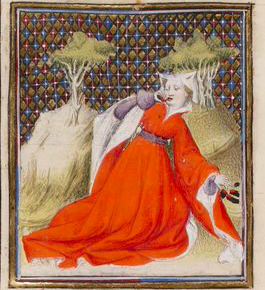
Portia knew that she could not live without her husband Brutus if he was killed, and had previously practiced hurting herself to see if she was capable of inflicting self-harm if Brutus died. When she eventually got word that Brutus died in battle, she had no instruments to use that would cause harm. Instead, she killed herself by swallowing hot coals. In the image, Portia is seen lying down dying as she swallows the coals, and holds more coals in her hand.
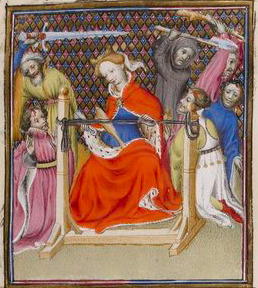
Penelope is seated weaving a royal cloth. She made a deal with her suitors that she could wait for her husband until she finished weaving the cloth. She wears a red gown, and is surrounded by suitors. Behind her, Ulysses and Telemachus attack the suitors with swords. Death is portrayed in a black cloak, also attacking the suitors.
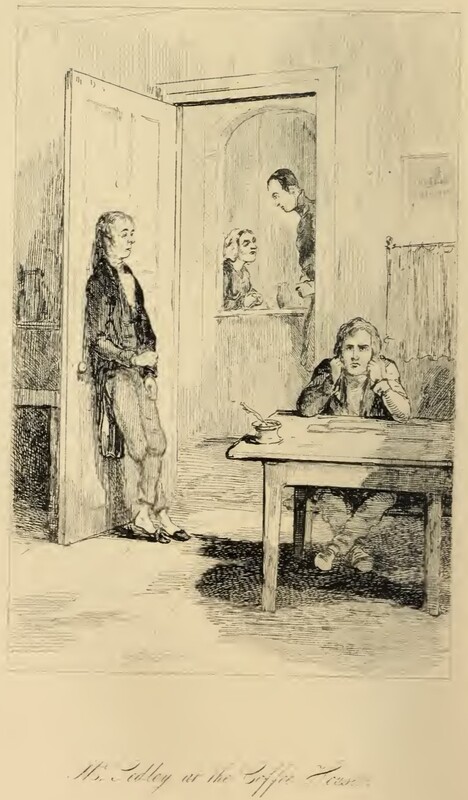
John Sedley is seated at a table at the Tapioca Coffee-house, slouching over with his elbows resting on the table and his scowling face between his fists. On the table in front of him are several pieces of paper and an inkwell with a quill. The door to the room is held open by a bored-looking man who leans against it. Through the doorway, William Dobbin can be seen talking to the woman at the desk. Below the illustration is printed in cursive its title, Mr. Sedley at the Coffee-House.
In this image we see a giant rat moving towards Gulliver and prepares to attack Gulliver. The rat is roughly the same size as Gulliver. Gulliver is seating, leaning against an intricately carved post with his sword in his hand preparing to defend himself. Gulliver ultimately ends up killing the rat after it attacked him. Fabric comes down on either side of the post, making the image look as though it were taking place on a stage. Gulliver’s hat is on the bottom left side of the image. The same image appears in the 1839 Krabbe edition.
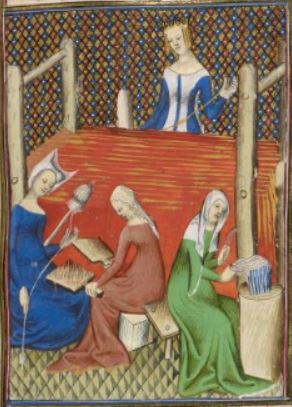
This illumination depicts Gaia Cyrilla, the wife of King Tarquinius Priscus, standing in the background of the image spinning wool. She is illustrated wearing a blue dress and a crown to signify her royal status. She is depicted spinning as she was renowned for being skilled in the art of weaving during her time. There are other women in the image who are also working with wool. Boccaccio believes Gaia Cyrilla to be praiseworthy as wool working was an admirable craft.
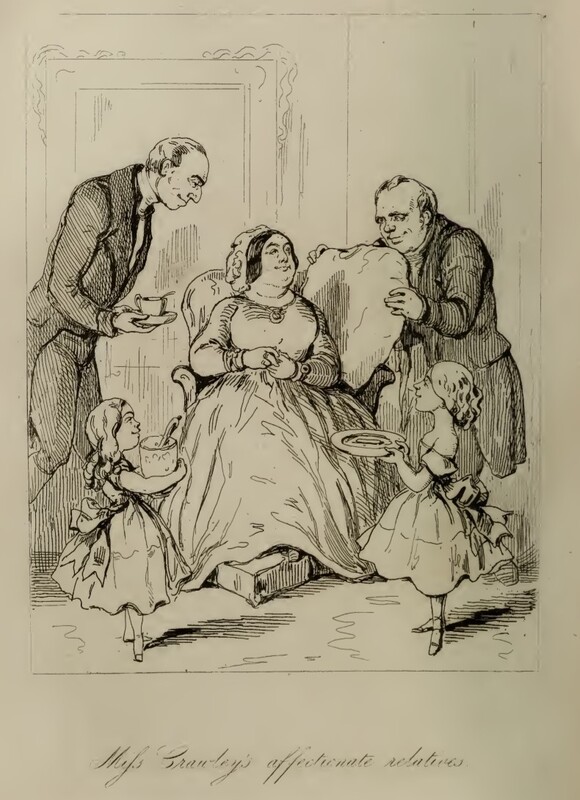
Miss Matilda Crawley is seated in a large, comfortable armchair. She is looking to the right of the image at her brother, Sir Pitt Crawley, who is adjusting one of her cushions. To the left is her other brother, Reverend Bute Crawley, who is bringing her a cup and saucer with a spoon. At her feet are Violet, holding a vase, and Rose, holding a plate, both attired in fancy dresses. Below the illustration is printed in cursive its title, Miss Crawley’s affectionate relatives.
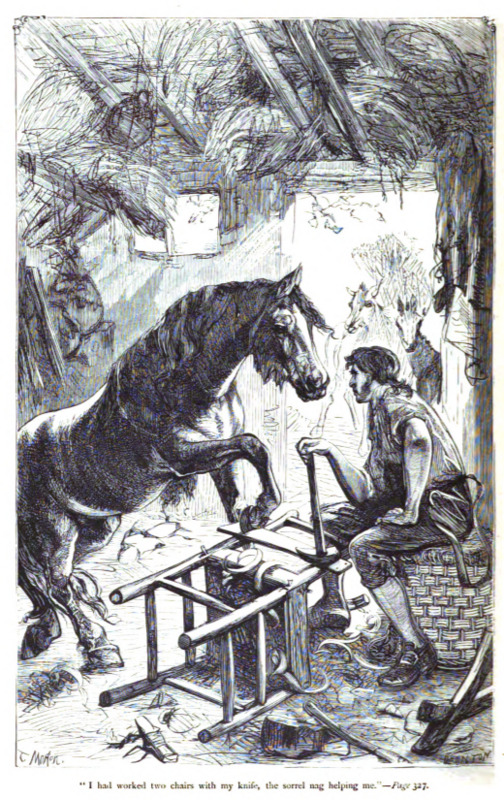
After finding out that he would have to leave the Country of the Houyhnhnms, Gulliver was given two months to build a boat so he could leave. Gulliver’s master told the sorrel nag to help Gulliver to build a boat so that he could sail away.
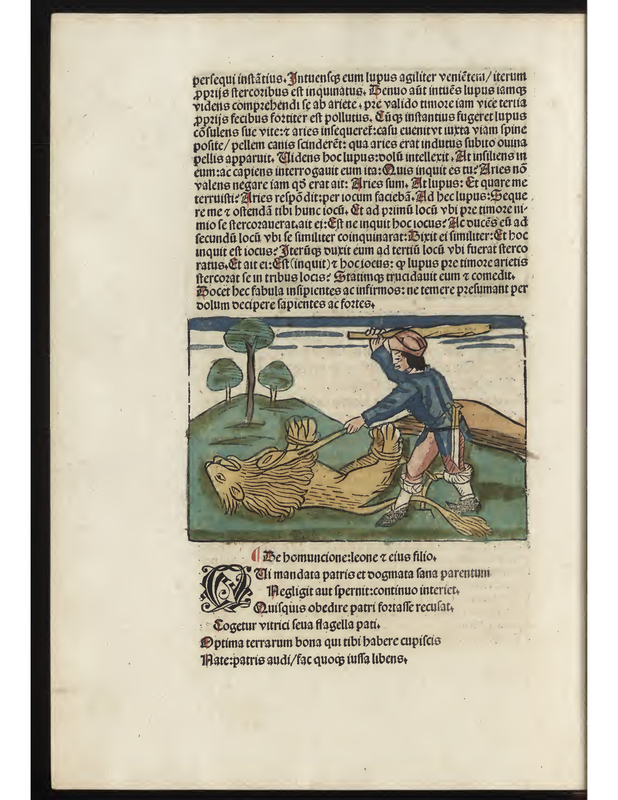
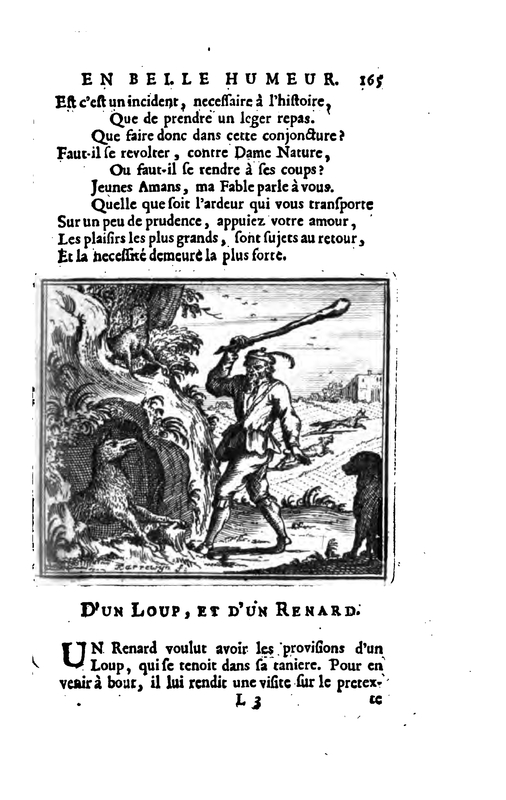
A wolf is back into a den a man standing infront of the wolf is holding a stick in his hand above his head and he appears to be upset. In the bottom on the image it appears to be the shadow of a nearby dog watching.
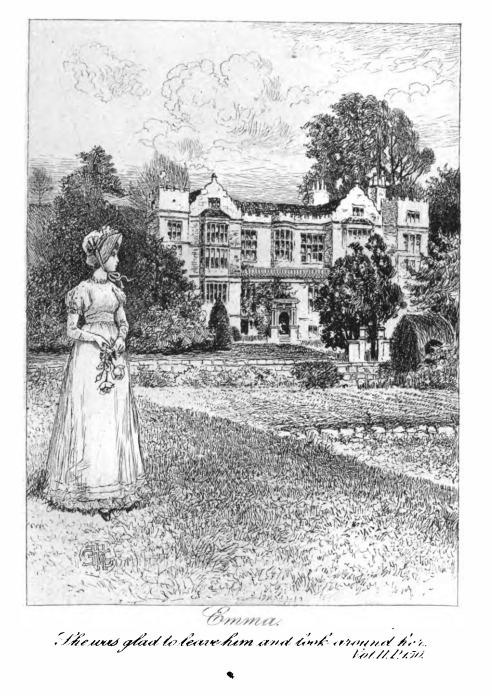
Here we see Emma standing outside Donwell Abbey, Mr. Knightley’s home. In the background of this image, we see the stately home, that Mr. Knightley opened to the party led by Mrs. Elton. Mr. Knightley rarely had guests, but willingly opened his house so that his friends could admire its art and architecture at the insistence of Mrs. Elton. Emma stands outside in the gardens, holding in her hands some flowers she had picked. This scene occurs in chapter 14, on page 150 in the second volume. The characters are shown in the traditional regency style, with Emma wearing the regency style dress with an empire waist. Her hair is worn tied up, as was tradition for women after their coming out before the queen, signaling her entrance into society. She wears a bonnet to protect her face from the sun. Bonnets were a popular accessory at this time because going for walks was a common pastime, and pale skin was believed to be the most fashionable as a means of indicating a woman’s status in the upper class, who did not have to perform outdoor labour. The regency period dated to the early nineteenth century (1811-1820) when George, Prince of Wales, later George IV (r. 1820-1830), reigned as regent for his mentally ill father, King George III (r. 1760-1820). The Prince of Wales was a fan of Austen’s work, and she dedicates the novel to him. The regency period is associated with the rise of neoclassicism in art and fashion.
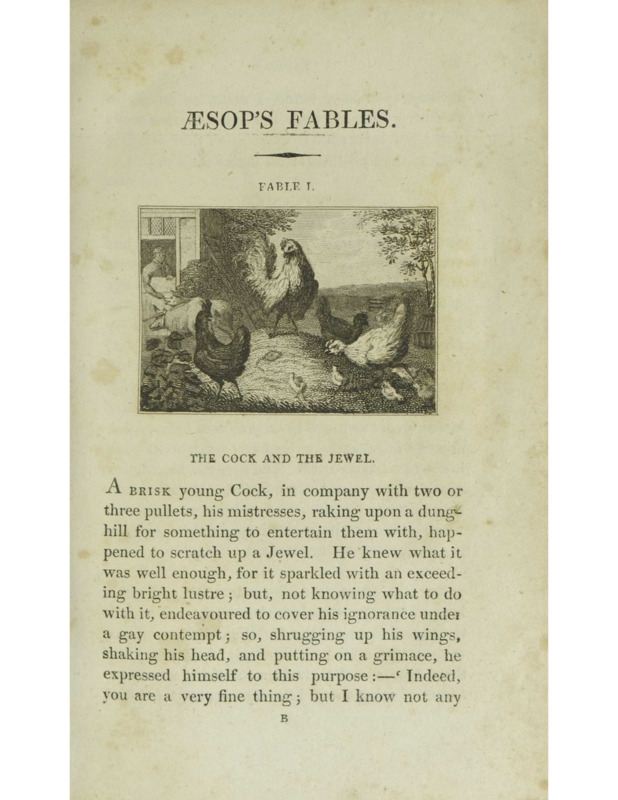
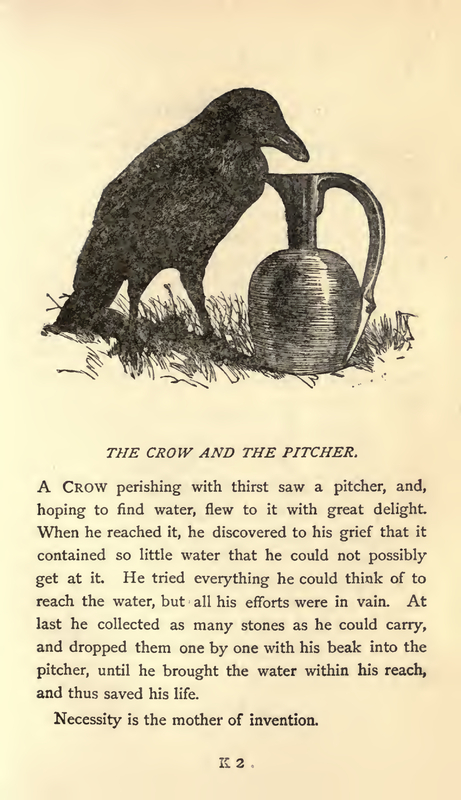
A crow is standing beside a pitcher in a field. The crow's on the left side of the image and the pitcher on the right. The crow is holding what seems to be a stone with its beak over the pitcher in a way that suggests that it is about to drop it in the pitcher.
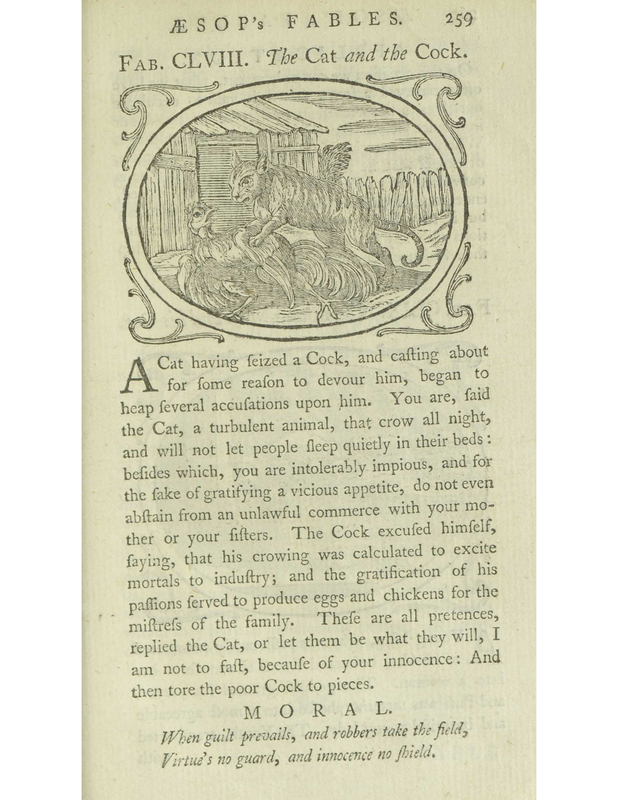
A cat stand on top of an injured cock. The two are speaking with one another, the cock looks concerned and the cat looks angry. They are outside, with a small shed on the far left corner and a fence that runs along the rest.
In this image we see Gulliver speaking to four Lilliputian pages, who were assigned to Gulliver’s household by the Emperor. The pages stand on a box, looking up to Gulliver. The pages wear conical hats with plumes coming out of the top. The same image appears in the 1843 Krabbe edition.
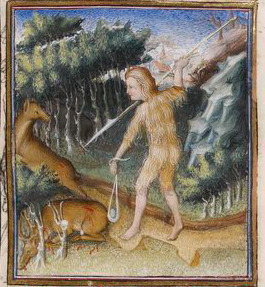
Camilla is pictured hunting in the forest, wearing animal skins as clothing. She was brought up in the wild and learned to hunt and live with nature. Two deer that she was hunting are to the left of the image.
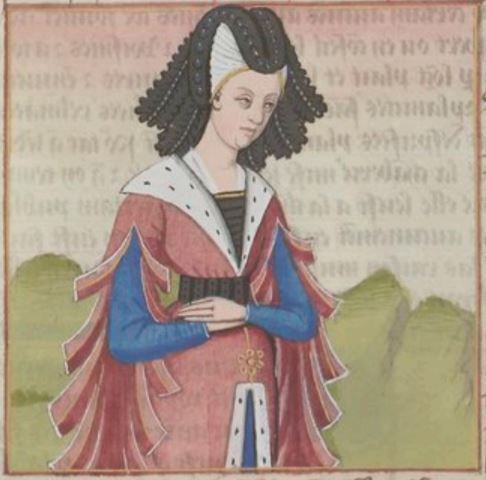
This illumination depicts a portrait of a woman named Sempronia. Sempronia was the daughter of the famous Tiberius Gracchus. Boccaccio explains that after her brothers were murdered, Sempronia was brought to trial by a tribune of plebeians. They told her to let herself be kissed by a man named Equitius and accept him as a member of the Sempronian family, however, Sempronia rejects this to protect her family’s honour and nobility. Boccaccio explains that he wrote on Sempronia to highlight her courage and bravery in this situation.
The lower half of the image is a vast sea, with frogs dispersed around everywhere. Most are looking up, while a few are jumping into the water. Above them, in the upper half of the image, is a large dragon that is swooping down on them. The large wings of the dragon are ornated with strange patterns, some look like snowflakes while others resemble fish. To the right of that dragon is a man with a long beard and long hair. He is pointing down at the water with two fingers.
Here Gulliver makes furniture with the help of the Sorrel Nag. Gulliver’s master gave Gulliver a small hut, and Gulliver had to build furniture to use. Shortly after Gulliver was given this hut, he found out that he would have to leave the Country of the Houyhnhnms.

![[Soldier]](https://collections.cemvc.ca/files/large/fa5bba6206e92ae808dc3634e47401904c699848.jpg)
![[Gulliver fights off giant rats on Brobdingnag]](https://collections.cemvc.ca/files/large/31c1ba7497d0128d25e80aec859cffb96407b011.jpg)
![[Gulliver and the Sorrel Nag build a boat]](https://collections.cemvc.ca/files/large/4cbd28c6f1836e4419aa60c2b89d5f344802b3a8.jpg)

![[Gulliver talking to his Lilliputian pages]](https://collections.cemvc.ca/files/large/4b86cdba9bdc885566dbbcb74e672dbad66ed5a2.jpg)
![[The Sea with Its Frogs, the Dragon and the Man]](https://collections.cemvc.ca/files/large/32bf77eb92a41b395232263664371c357881e6ab.jpg)