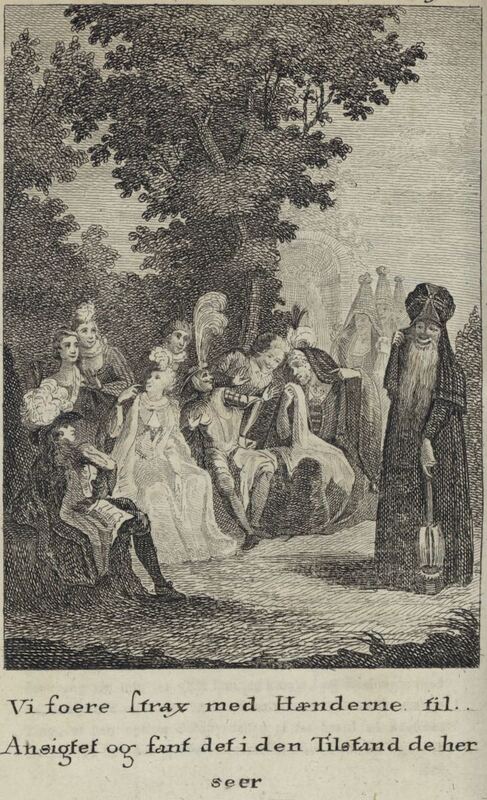
A venerable old man, clad in a long purple mourning cloak, which trailed upon the ground walks forward having opened two great folding doors. Over his head he has ablack Milan, and his beard reaches below his girdle. He carries no weapons, only a rosary of beads in his hand, bigger than middling walnuts.
In the court garden, countess Trifaldi shows her beard, shocking Don Quixote and Sancho Panza. The illustration is not accurate to the text: Trifáldin holds a mace, while he should hold a scimitar. Unsigned. Part 2, ch. 39.
Three flowers expand their their heads amidst a field before a murmuring brook. The sky is clear with the sun rising over distant mountains in the background.
Sancho Panza kneels before the duchess to thank her and the duke for granting him the governorship of Barataria Island. The party are seated around a dining table, on which is pictured some food. A dog is pictured in the foreground. Signed by Bonard (illustrator), no given name, and L. Cars (engraver). Part 2, ch. 32.
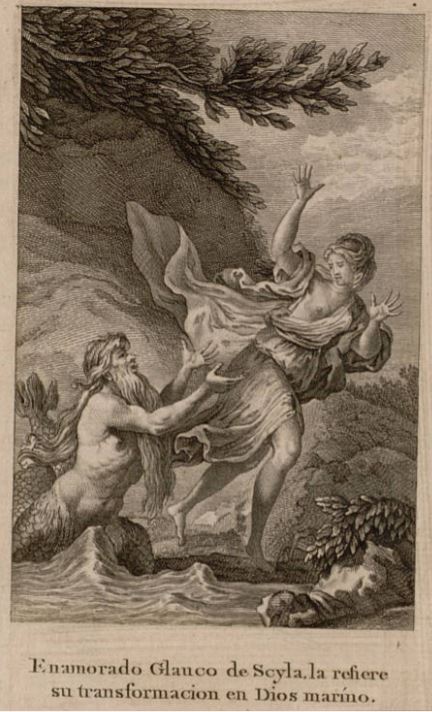
This image depicts the sea-God Glaucus chasing after the beautiful Scylla. Glaucus had seen Scylla walking alone the shoreline when he immediately became infatuated with her. He catches up to her and tells her the story of how he became a sea-God. After telling his story, she continues to run away. In this image, Scylla is depicted running away from Glaucus with her hands in the air and an expression of disgust. Glaucus has his arms reaching out towards her as the upper half of his body is emerging out of the water and the lower half of his body (a large fish tail) is in the water.
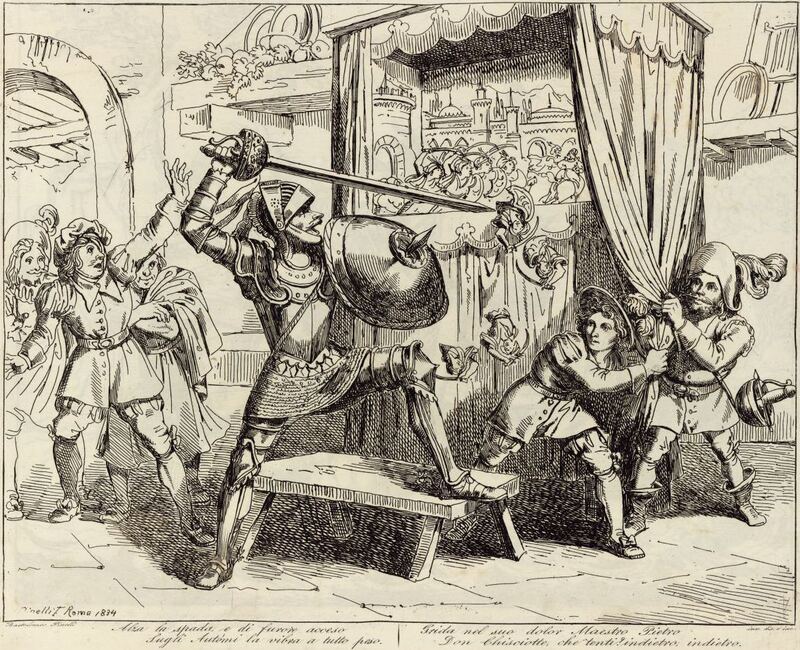
Don Quixote attacks the puppets while several astonished theatregoers and Maese Pedro watch him. To the right, Maese Pedro’s servant, who was telling the story, and Sancho Panza. Signed by Bartolomeo Pinelli (engraver and illustrator) and dated Rome, 1833. Plate 50. Part 2, ch. 26.
Don Quixote (left) stands on a doorstep with a cap on his head and places his left index finger over his lips to indicate some measure of silence, while with his right hand he shakes the hand of the bachelor Samson Carrasco (right), a baldheaded man in black robes who holds a round brimmed hat respectfully in his right hand.
A coat of arms for the countess Wolfina, because her domain abounded in wolves. Adorned across the shield there are four wolf faces looking up towards the left in an inverted triangular pattern. Three more wolves are climbing on top of the shield, and the final three are approaching the bottom of the shield as if to burrow a hole or feast upon a carcass.
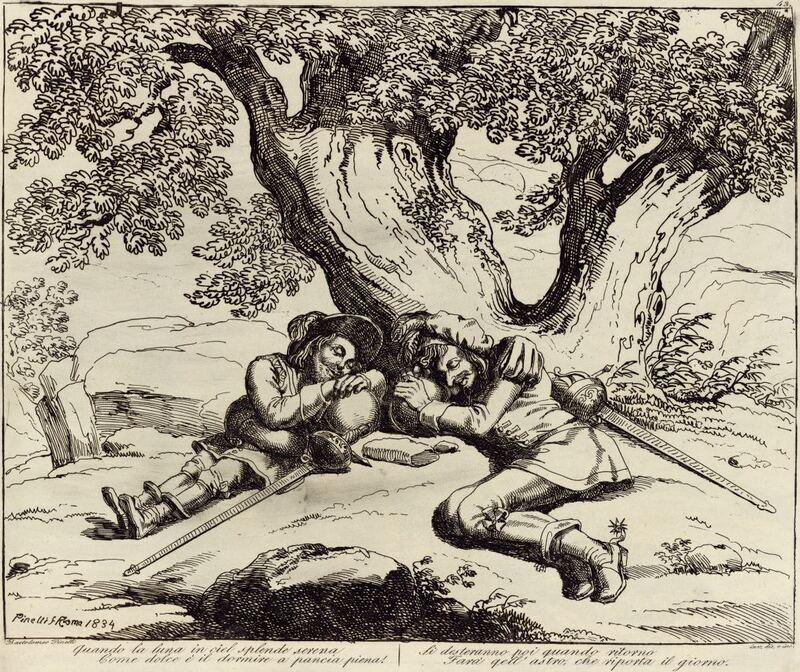
Sancho Panza and the Knight of the Mirrors’ squire (Tomé Cecial) sleep at the foot of a tree during the night before the duel. Each holds their flash in their arms. Signed by Bartolomeo Pinelli (engraver and illustrator) and dated Rome, 1833. Plate 43. Part 2, ch. 13.
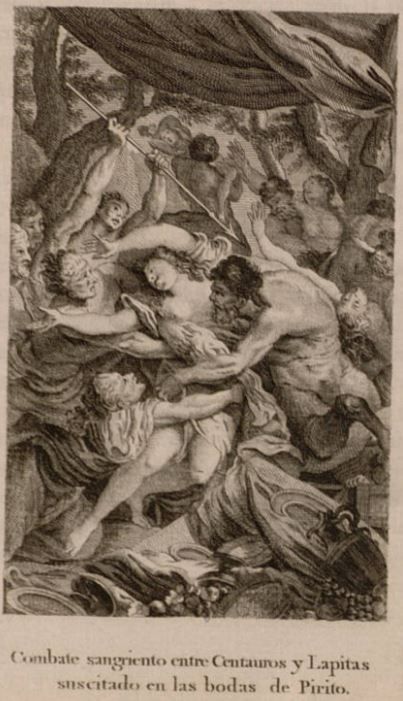
This engraving depicts the chaotic battle between centaurs and the Lapiths. The battle broke out due to one of the centaurs, Eurytus, stealing the bride of Pirithous, the king of the Lapiths. The centaurs were invited to the wedding ceremony, however, Eurytus betrayed Pirithous by being overtaken by Hippodame’s beauty and dragging her off. Hippodame is depicted in the centre of the image with her arms in the air as she pleads for help. Pirithous’ friend, Theseus, is illustrated on the left side of the image with a spear in his hands ready to stab the centaur and save Hippodame.
Sancho Panza kneels over the Knight of the mirrors and removing his helmet, sees the bachelor Sampson Carrasco's face. Meanwhile the Knight of the Mirrors showed no signs of life, and Sancho said to Don Quixote who stood over the knight in full armor with his sword drawn said that Quixote should thrust the sword down the throat of this enchanter. In the background, the Squire of the Woods runs over, yelling that the Knight of the Mirrors is Sampson Carrasco and that he should be spared.
Having been scratched by a cat, Don Quixote sits on a chair with a cloth over his face and eyes. He is tended to by Altisidora, a young woman in a white dress, who applies some oil of aparicio and bounds up his wounds.
After the departure of Don Quixote from the duchess' castle, a woman perched atop a balcony points her right hand towards the plains below and clenches her left hand above her head into a fist. She wears a courtly dress with long sleeves and frilly cuffs along with a black veil which has been pulled back.
Sancho Panza pretends to give himself lashes to disenchant Dulcinea (he whips tree trunks) while Don Quixote counts the lashes using the beads of his rosary. Signed by J. Rivelles (illustrator) and A. Blanco y Asensio (engraver). Part 2, ch. 71.
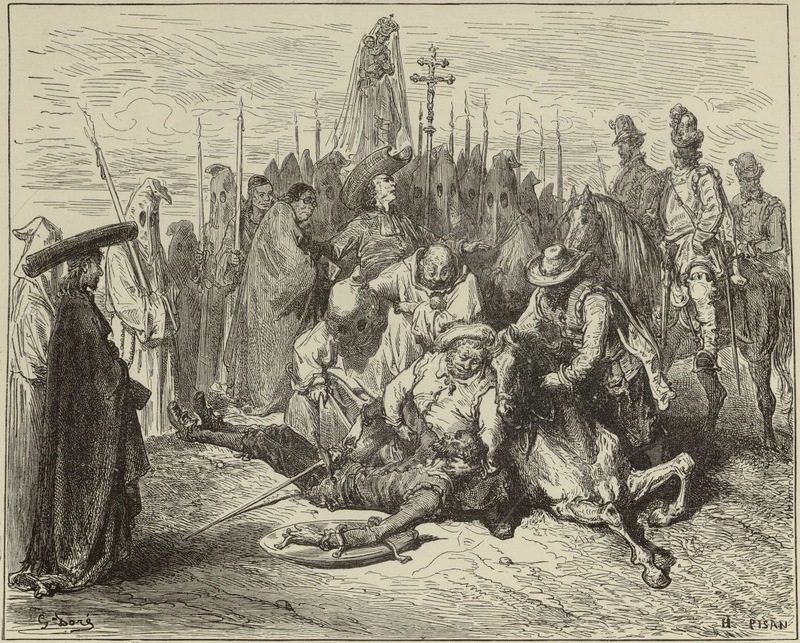
Sancho Panza tends to Don Quixote after he was beaten by one of the penitents (centre of the composition). Surrounding them are the canon of Toledo, the priest, the barber, the officers of the Holy Brotherhood, and the penitents with their pointed hoods. Signed by G. Doré (illustrator) and H.-J. Pisan (engraver). Part 1, ch. 52.
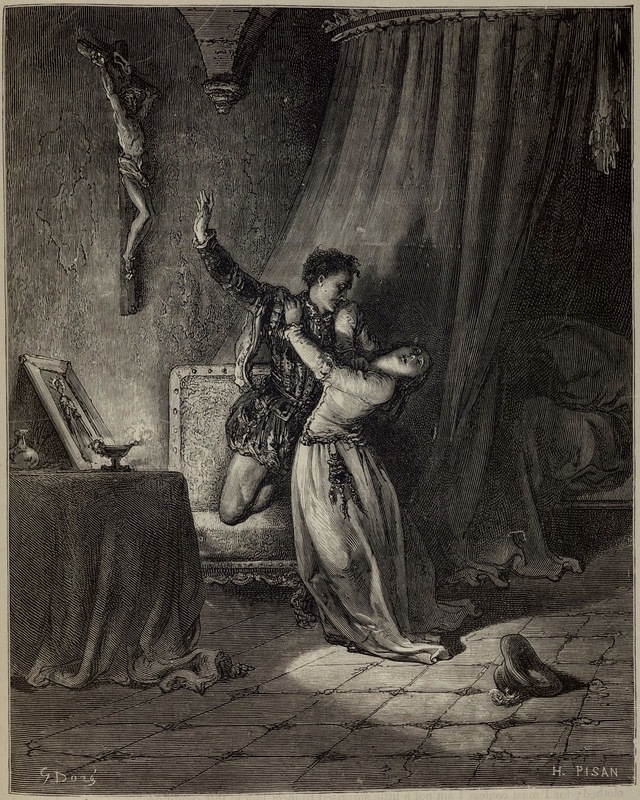
The illustration represents part of Dorotea’s story as she tells it to Cardenio, the priest, and the barber: Don Fernando offers his hand as husband to Dorotea, invoking heaven and an image of Our Lady (left) as witnesses. Signed by G. Doré (illustrator) and H.-J. Pisan (engraver). Part 1, ch. 28.
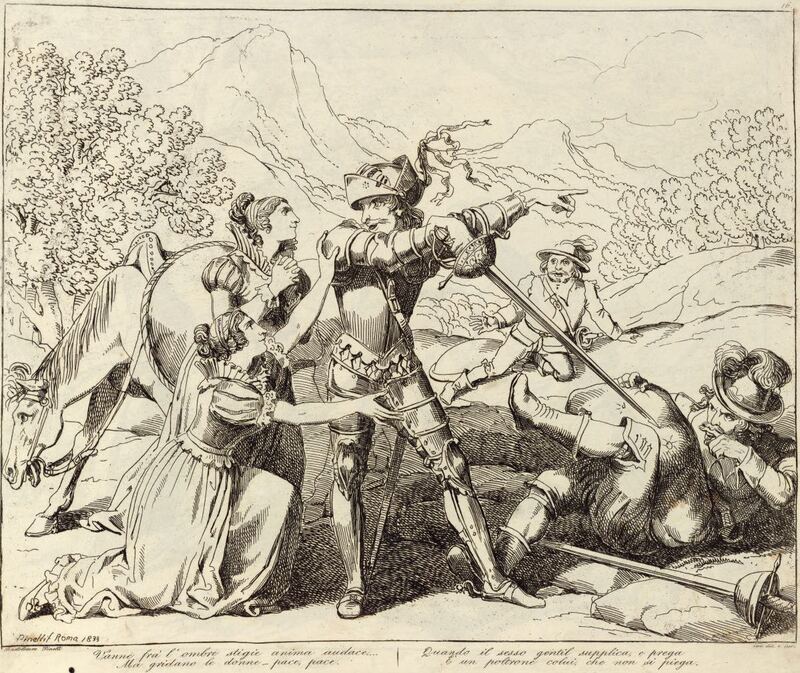
The two frightened Basque ladies beg Don Quixote not to hurt their squire. Don Quixote makes him promise to travel to Toboso and present himself to Dulcinea. Sancho Panza is pictured in the background. Signed by Bartolomeo Pinelli (engraver and illustrator) and dated Rome, 1833. Plate 16. Part 1, ch. 9.
Don Quixote and Sancho Panza are met by passing of a cart, full of actors in costume, and the carter, who drove the mules, had the appearance of a devil. While they were speaking, one of the motley crew came up capering towards them in the dress of an antic with Morris bells, and three full blown ox bladders tied to theend of a stick. Approaching Don Quixote, he flourished his bladders in the air, and bounced them against the ground close under the nose of Rocinante, who was so startled by the noise, that Don Quixote lost all command over him, and fell violently on his face. Sancho had no sooner dismounted, to assist Don Quixote, than the bladder-dancing devil jumped upon Dapple and set also flying over the field towards the village, where they were going to act.
In foreground, Don Quixote, wearing Mambrino’s helmet (the barber’s basin), kneels before Dulcinea. In the middle ground, Sancho Panza stands with Rocinante (right) and his donkey (left). Roland (centre), Amadis (centre), and Merlin (left) are also pictured. In the background, Don Quixote stands on a pedestal, depicted as the Knight of the Lion. Signed by L. Scherm (illustrator and engraver).
Along a path in the mountainous woods a lanky mule walks without a pannel, or any furniture on him. On the bottom left, behind the mule, a Regidor see's the creature and raises his harms in surprise and to try to capture it, but having been lost for 15 days, it had become something wild that, when the Regidor drew near, the mule reared away.
Don Quixote, holding the basin, tries to convince the barber (Maese Nicólas) that the basin is Mambrino’s helmet. Don Fernando, the priest, and Sancho Panza observe them. Signed by T. Stothard (illustrator) and W. Blake (engraver). Plate IX. Part 1, ch. 45.
In master Peter's puppet play, a figure approaches from the left on horseback, muffled up in a Gascony cloak with an astoundingly feathery helm and spear by his side. This is Don Gaiferos who rides, to save his spouse, who has been locked in tower by Algerians. From her quarter in the tower she shows herself to her husband with a calm and sedate manner, reaching down towards him. In the illustration the tower appears quite short, really no more than five feet, and it must be assumed that she is not really in front of him, but captive at a much higher elevation, otherwise she could just hop down on her own.
Don Quixote finds himself caught in nets of green string that are stretched between trees. Imagining that enchanters want to entangle him, he tries to break the nests when two shepherdesses appear before him and Sancho Panza. They are dressed in jackets and skirts made of fine brocade and rich moiré shot with gold. Signed by T. Stothard (illustrator) and Walker (engraver). Plate V. Part 2, ch. 58.
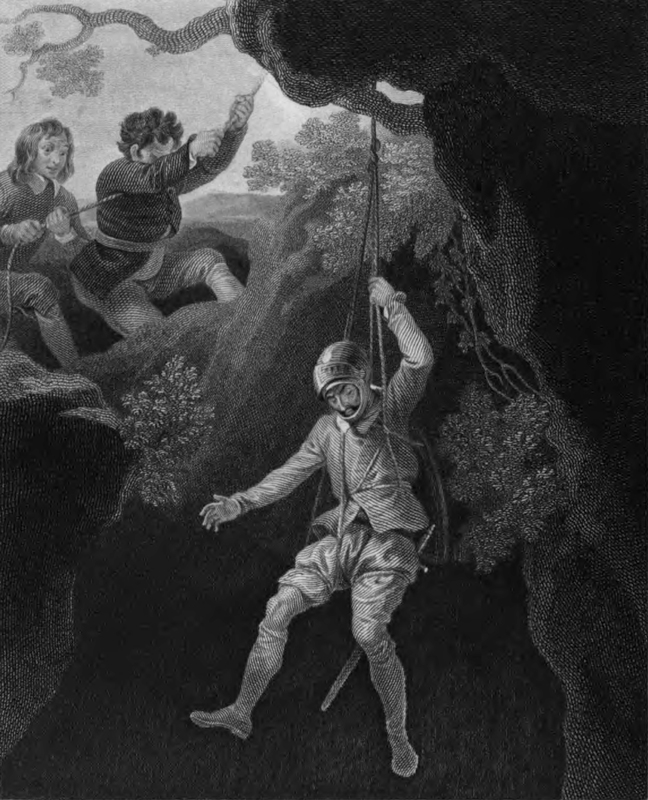
In the afternoon, Don Quixote, Sancho Panza, and the Scholar who served as their guide arrived at the the mouth of the cave, which they found to be wide and spacious, but so much overgrown with briars, thorns , and wild fig trees, as to be almost concealed . The scholar and Sancho proceeded to bind a cord around Don Quixote. The knight was well bound over his doublet. Thinking Quixote safely secured, the scholar (pictured looking down at Quixote and holding the rope) and Sancho (pictured closest to Quixote and shifting his weight backwards) let him down into the cavern; and, as he entered, Sancho gave him his blessing. Don Quixote looks down at the darkness below him having only brought with him his helmet and his sword.
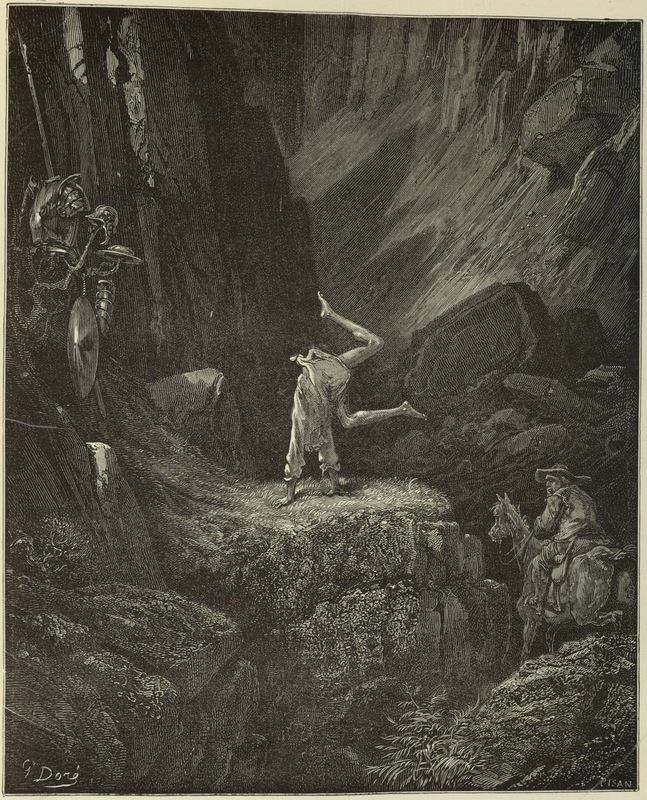
After cutting stalks of broom to serve as markers so he can find his way back, Sancho Panza asks for Don Quixote’s blessing and takes his leave. Mounted on Rocinante, he departs for El Toboso to deliver a letter written by Don Quixote to Dulcinea. Before he leaves, Don Quixote performs cartwheels half-naked as part of his penance. Signed by G. Doré (illustrator) and H.-J. Pisan (engraver). Part 1, ch. 25.

![[Montesinos Presents Himself to Don Quixote]](https://collections.cemvc.ca/files/large/e1f4639193556d36dad862598be3df69f1b5d34f.jpg)
![[Flowers and a Distant Dawn Over Far-Flung Mountains]](https://collections.cemvc.ca/files/large/1281e85f6c7a9d3497bdd4f3ef3606a672b7faec.jpg)
![[The duke gives Sancho Panza the governorship of Barataria Island]](https://collections.cemvc.ca/files/large/df54b227eab4da5a4861f5eee694a5649fd4f088.jpg)
![[The Bachelor Samson Carrasco Takes His Leave of Don Quixote's House]](https://collections.cemvc.ca/files/large/2da5ad421b1fe27237fdcd6b70da7e0575fe5787.jpg)
![[Countess Wolfina's (Trifaldi) Coat of Arms]](https://collections.cemvc.ca/files/large/3c47a810d2062064ceb63d554f088ea4ad006049.jpg)
![[Quixote and Sancho Stand Over the Knight of the Mirrors who Shares the Same Face as Sampson Carrasco]](https://collections.cemvc.ca/files/large/cf143d1c560f670b7137e5a13b8c95cd7fe84c47.jpg)
![[Altisidora Heals Quixote's Wounds]](https://collections.cemvc.ca/files/large/e98a8673e91530b405aed78cbb59e8b798ef67e4.jpg)
![[Altisadora Complains]](https://collections.cemvc.ca/files/large/5e9e8beae401287bff3fc566a56bb6fb0badc96e.jpg)
![[Sancho Panza gives himself lashes to disenchant Dulcinea]](https://collections.cemvc.ca/files/large/4ac204dae2918d60b0cf9b42d57ce34eb75ba969.jpg)
![[Dapple Stolen by an Actor]](https://collections.cemvc.ca/files/large/d647a9b6934c99f9fa185b67030638a783ec1ab5.jpg)
![[Frontispiece]](https://collections.cemvc.ca/files/large/5c03eff46f1f9f640ce9ec6c7a42ad54f7e7ed7d.jpg)
![[The Regidor Finds a Mule in the Mountain Wood]](https://collections.cemvc.ca/files/large/62a40cd56e4ef19a9ab02ce2d9adbe19595bf20d.jpg)
![[Dispute at the inn over Mambrino's helmet]](https://collections.cemvc.ca/files/large/4ff6bcaa525eaa91b523c0b12bcc524d25e2d090.jpg)
![[The Puppet Don Gaiferos Seeks to Rescue his Puppet Wife]](https://collections.cemvc.ca/files/large/71209b9a0c0558e0d128d32c6af1a935cd03d75f.jpg)
![[Don Quixote and Sancho Panza meet two shepherdesses]](https://collections.cemvc.ca/files/large/5ed775ec0a0f5b232184e30d34a6dc65b440bd95.jpg)