This engraving depicts Adam and Eve in the Garden of Eden. Eve is illustrated on the right side of the image taking an apple from the Tree of Good and Evil. The snake encouraging Eve to take the apple is depicted coiled around the tree. Boccaccio explains that he wrote on Eve as the first chapter in his book as she is the first mother of us all.
Four Indigenous Brazilian men pick and gather fruit from a tree. One man has climbed the tree to pick fruit and drop it down into the arms of another man on the ground. Two other men at the base of the tree gather the fruit and put it into a basket for transport. This image is identical to one found in Frankfurt, 1557.
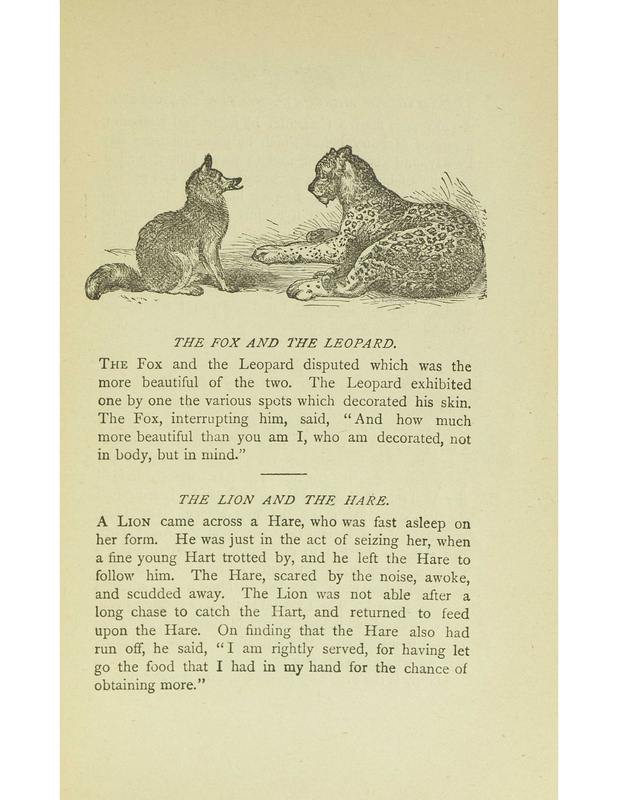
A fox sits politely on the left-hand side of the image, its small tongue sticking out. It is looking straight ahead in the direction of a resting leopard. The leopard is not paying much attention to the fox and is looking in another direction.
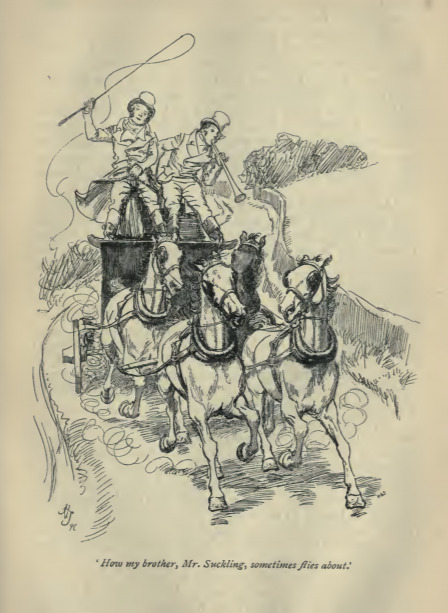
In this image we see Mrs. Elton’s brother, Mr. Suckling, and his driver. The two men sit on top of a carriage drawn by four horses. Mrs. Elton and Mr. Woodhouse discuss travelling, and Mrs. Elton tells Mr. Woodhouse how quickly her brother can travel sixty-five miles from his estate, Maple Grove, to London. By telling Mr. Woodhouse about this Mrs. Elton was subtly bragging about her family’s wealth, because her brother could afford to employ four horses at a time to draw his carriage, a luxury at this time. This scene occurs in chapter 36. The characters are shown in the traditional regency style. Mr. Suckling and his driver wear waistcoats and tailcoats, with breeches and a cravat. They also have overcoats and top hats. The regency period dated to the early nineteenth century (1811-1820) when George, Prince of Wales, later George IV (r. 1820-1830), reigned as regent for his mentally ill father, King George III (r. 1760-1820). The regency period is associated with the rise of neoclassicism in art and fashion.
An Indigenous woman is pictured standing on the bank of a river, from the front and from behind. She wears cuffs on her upper biceps and forearms, and on her calves. Her clothing consists of a fringed skirt tied around her waist, she is barefoot and shirtless. In the background behind her, other Indigenous people can be seen in canoes and fishing in the river. On the opposite bank of the river there is a forest.
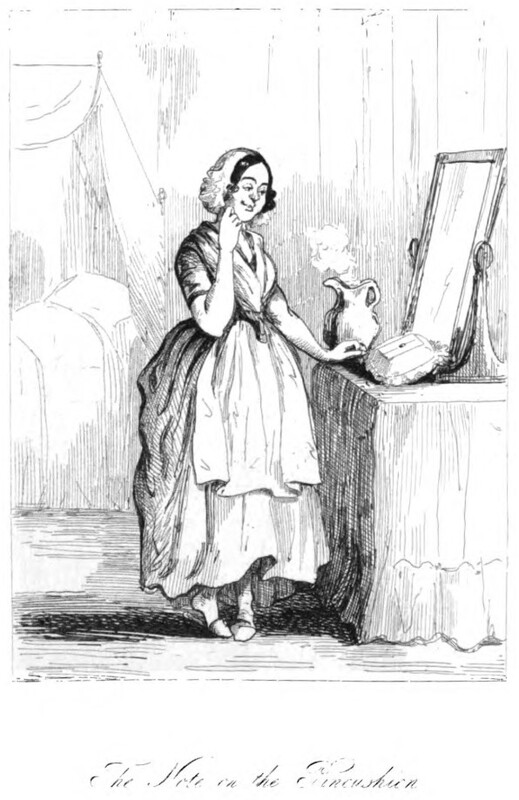
The image depicts a scene from Chapter XVI. Betty Martin, Miss Crawley’s upstairs maid, smiles as she sees the note left by Rebecca Sharp for Miss Briggs. The note itself is on a pincushion on the table by the window, along with a standing mirror and a pitcher. In the background, the bed, neat and unslept-in, can faintly be seen. Below the illustration is printed in cursive its title, The Note on the Pincushion.
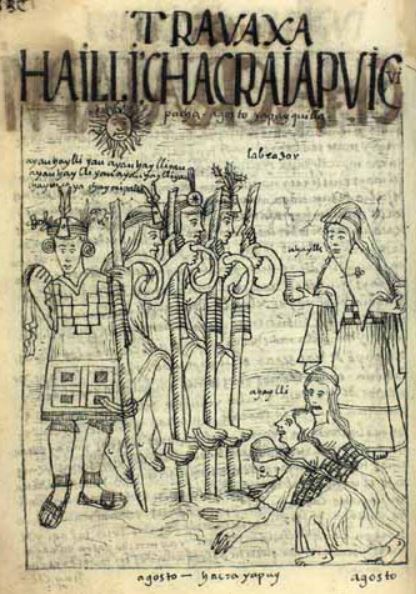
This image is reflected in the final chapter of Ayala’s chronicle where he provides a description of labours and festivals that occur in the rural areas of the Spanish colonial Andes during each month of the Inca calendar year. This image depicts the month of August which was a time of triumphal songs to celebrate the harvest, as well as a time for turning the soil in preparation for a new harvest season. The sun is illustrated shining in the top left corner of the image. There is a line of indigenous men dressed in traditional garb holding agricultural tools as they sing a song. The song lyrics are written above their heads: Ayau haylli yau, ayau haylli yau, ayau haylli yau, ayau haylli yau. chaymi coya, chaymi palla [Ayaw haylli, yaw, ayaw haylli, yaw, ayaw haylli, yaw, ayaw haylli, yaw, here is the queen, here is the lady]. There are three bowing women on the right side of the image and one woman who is standing with a cup in her right hand. The words Ahaylli [viva] are written beside the standing woman and the bowing women. The caption at the bottom of the image reads agosto, [c]hacra yapuy [august, ninth month].
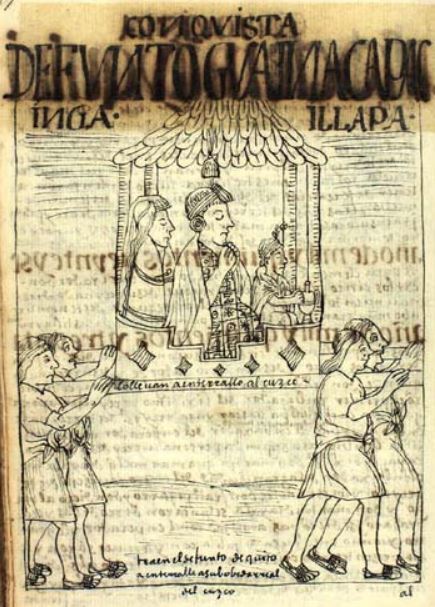
This image depicts the body of the Inca Emperor, Huayna Capac Inca, being carried to his burial in his royal litter. He is depicted sitting upright with his eyes closed dressed in traditional regalia. His coya [queen] is sitting behind him and a figure is sitting in front of him, presumably a priest of sorts to aid in burial rituals. There are four people carrying the litter on their shoulders with two in people the front and two in the back. The caption written on the litter, lo lleuan a enterrallo al Cuzco [they carry him to bury him in Cusco]. The caption at the bottom of the image reads, traen el defunto de Quito a enterralle a su bobeda rreal del Cuzco [they bring the deceased from Quito to bury him in the royal mausoleum in Cusco].
Here we see a young Lilliputian girl looking into a mirror. The upper-class Lilliputian children are sent to boarding school where they are taught domestic skills. The girl looks into a round mirror sitting on a table with a cloth draped over the back of the mirror and the table. A chair with clothes on it is behind the girl. Her arms are clasped behind her back and she is holding something resembling a handheld mirror. This image comes when Gulliver describes the education system in Lilliput in the sixth chapter in which Gulliver discusses the values and traditions of the Lilliputians. The same image appears in the 1839 Krabbe edition.
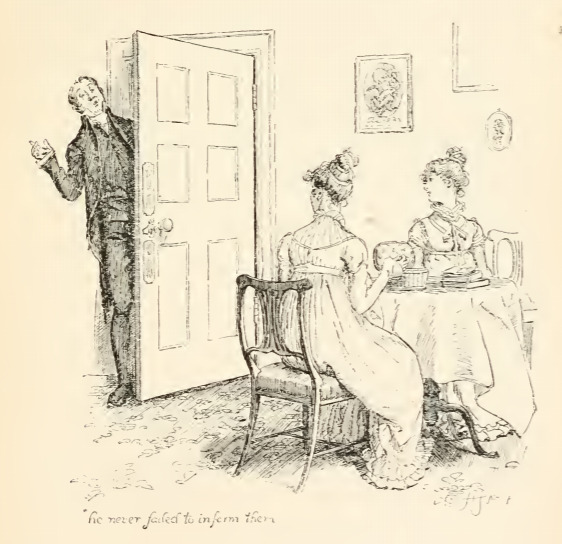
In this image Charlotte and Lizzy work on sewing projects as Mr. Collins comes in to announce each time Lady Catherine de Bourgh drove past. Mr. Collins spent much of his day in the laneway noting who drove past and relating who was out each day to his wife. This scene occurs in chapter 30. The characters are shown in the traditional regency style. Charlotte and Lizzy wear the regency style dress with empire waists. Mr. Collins wears a waistcoat and tailcoat. The regency period dated to the early nineteenth century (1811-1820) when George, Prince of Wales, later George IV (r. 1820-1830), reigned as regent for his mentally ill father, King George III (r. 1760-1820). The regency period is associated with the rise of neoclassicism in art and fashion.
Here we see a giant’s eye looking at Gulliver. Only Gulliver’s upper body is visible in the image, with his back facing the viewer. In the giant’s pupil is the letter M, which is the first letter of the Meine, the first word of the chapter. The same image appears in the 1839 Krabbe edition.
Three large European sailing ships are shown near the coast of Brazil. The three ships are shooting projectiles, likely cannons, at each other while several individuals flounder in the water. On land there is a small Indigenous village comprised of three long structures surrounded by a fence. The label beside the village reads ‘Buttagaris’. Three Indigenous people, two holding bows and arrows, stand on the shore watching the three ships.
Calisto goes to visit Melibea as promised, accompanied by Sosia and Tristan instead of Sempronio and Pármeno. He ascends the high wall to Melibea’s garden while Sosia and Tristan stand guard (as seen in this image). Centurio’s men arrive and begin harassing Sosia, but Sosia manages to scare them off. To the left of the image we see Calisto, with a sword mounted on his belt, climbing a ladder to enter Melibea’s garden. Sosia and Tristan stand behind him with swords and shields. To the right we see Melibea and Lucrecia looking out from a window. Each is wearing a robe and a veil. They seem to be making eye contract with Calisto, though perspective makes this impossible. The entire image is identical to those found on pages 178 and 209 of the text.
In this image the Lilliputian Emperor addresses Gulliver. The Emperor stands on a podium with two attendants. The Emperor holds his arms up during the speech. Gulliver is not in the image. The Emperor wears a form of turban with a large feather and a long cape that one of the attendants holds up. Behind the podium we see a line of Lilliputian militia men holding spears. The same image appears in the 1843 Krabbe edition.
Amelia Sedley is depicted holding a Black doll with curly hair, possibly representing Miss Rhoda Swartz, at which she gazes lovingly. Next to her, on the right side of the image, is the letter L from Love.
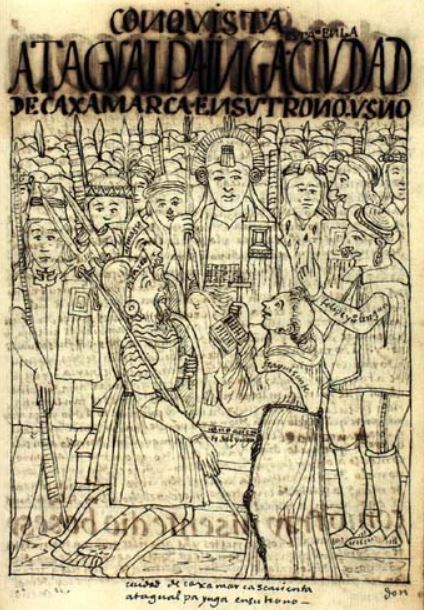
This chapter focuses on discussing the arrival of Spaniards and the Spanish conquest of Peru. This image depicts Atawalpa Inca sitting on his usno [throne] in the centre of the image. There is a crowd of his citizens standing behind him. The Inca is being approached by two Spaniards who led the conquest of Peru, Don Diego de Almagro and Don Francisco Pizarro. They are illustrated on the left side of the image looking up at the Inca. Their last names are written on their helmets. There is also a Franciscan Friar by the name of Fray Vicente holding a cross and a breviary in front of the Inca. His name is written on his left shoulder. A language interpreter is standing to the right of Fray Vicente, with his name, Felipe, written on his left arm. Almagro and Pizarro are urging the Inca to befriend their Castilian king. The Friar is urging the Inca to adopt Christianity. When the Inca rejects Christianity and remains strong in his own spirituality, the conquistadors attack.
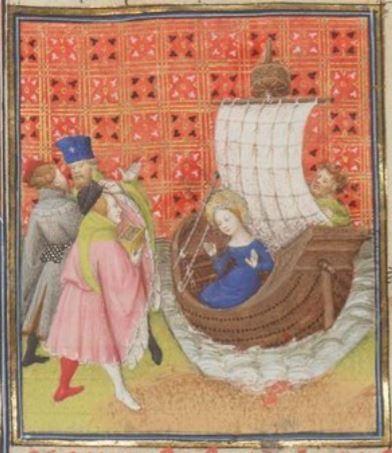
This illumination depicts the goddess Isis (previously known as Io) on a ship as she arrives in Egypt. There is another person on the ship, which Boccaccio explains is most likely a friend of Isis’. Once Isis arrives in Egypt, she becomes a venerated goddess and queen. There are people depicted on the shore as they welcome Isis to Egypt.
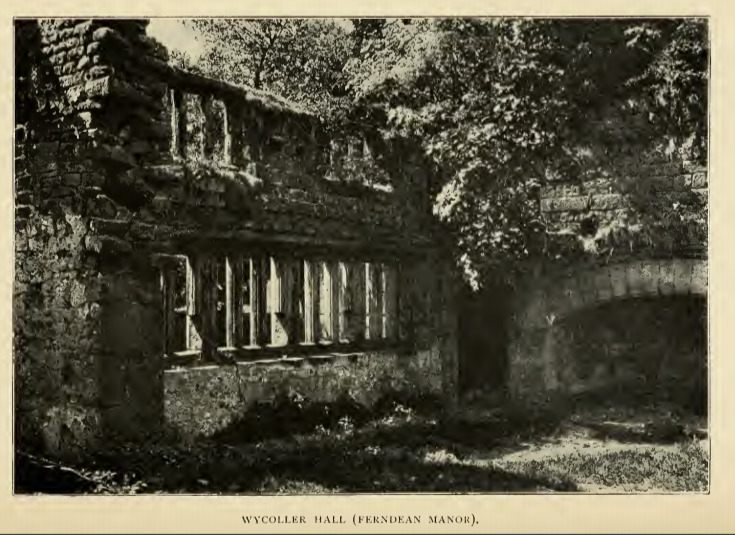
Here we see the Wycoller Hall, a manor house in the village of Wycoller in Lancashire. After hearing Mr. Rochester’s voice calling to her while at Moor House, Jane decided she had to return to Thornfield to see him. When she arrived, she found that Thornfield had been burnt down, and Mr. Rochester had moved to Ferndean Manor. Jane then married Mr. Rochester and moved into Ferndean Manor. The same image appears in the 1899 Bigelow, Brown, and Co edition of Jane Eyre.

![[Vanity Fair Vol. I Chapter XXIV Inhabited Initial]](https://collections.cemvc.ca/files/large/3ae964889350fa55a5331db37cb167e0609b2ec4.jpg)

![[Indigenous Brazilian men pick fruit from a tree]](https://collections.cemvc.ca/files/large/b9ad9e9dd318783216303aee8fcd350a4816a60a.jpg)


![[A young Lilliputian girl]](https://collections.cemvc.ca/files/large/42b92aaf741d7befe558f1a563a22d012569fe52.jpg)
![[Person Signaling Animal]](https://collections.cemvc.ca/files/large/d704b99d28768bc7c16171b44ec9b8b0e40edfda.jpg)
![[A giant’s eye looking at Gulliver]](https://collections.cemvc.ca/files/large/55e20e73b83263150260f74de6e78f318d8c43b7.jpg)
![[European ships engage in battle near the coast, where there is an Indigenous village]](https://collections.cemvc.ca/files/large/0fe92fd6b561c24283e1e94bbfd0e30f92ed0e62.jpg)
![[Act XIX – Calisto, Guarded by Sosia and Tristán, Climbs Melibea’s Garden Wall While Melibea and Lucrecia Watch from a Window (Repeated)]](https://collections.cemvc.ca/files/large/4fd836f0a93758090ec0cabca4828df4435181f7.jpg)
![[The Lilliputian Emperor addresses Gulliver]](https://collections.cemvc.ca/files/large/db032b14055f12b7085d66ee25b2d83d3a26f719.jpg)
![[Vanity Fair Vol. I Chapter XXI Historiated Initial]](https://collections.cemvc.ca/files/large/ee4ab3f81759398bd94fc259c442915ccf34229d.jpg)