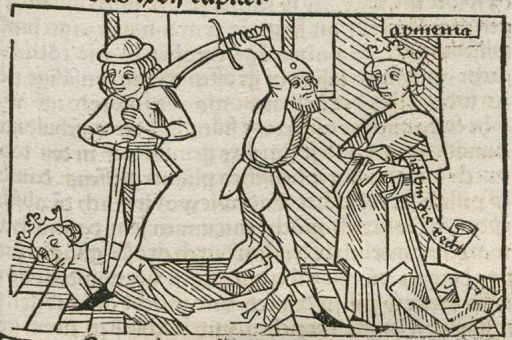
This engraving depicts a young servant girl getting stabbed in the chest with a sword by a man standing above her. This young servant girl is disguised to look exactly like Harmonia, the daughter of Gelon (brother to the king of Syracuse). Boccaccio explains that there was a rebellion in Syracuse against nobility, and before the murderers could get to Harmonia, her nurse disguised this young woman to look like Harmonia. The real Harmonia is depicted on the right side of the engraving. The creator engraved her name, written as Armonia, above her head to identify her. There is a man swinging a sword above his head which appears to be heading in Harmonia’s direction, however, Boccaccio explains that Harmonia hid from the murderers until they killed the look-alike servant.
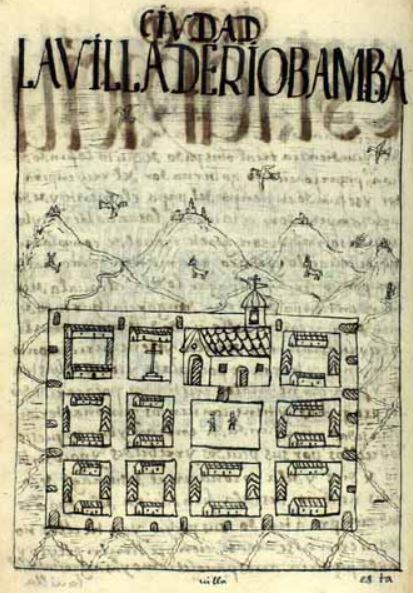
This image is depicted in the author’s chapter where he discusses cities, towns, villages, and provinces in colonial South America. This image depicts the town of Riobamba, Ecuador. The town is laid out in a grid and has twelve blocks within that grid. There are eight blocks in the grid that have four houses within them. One of the blocks is a church, and to the left of the church, there is a block with a cross in it. The block in front of the church appears to be a main square with two people standing in it. The Andean mountainous landscape is visible in the background with birds flying above and goats roaming the mountains. The caption at the bottom of the image reads villa [town]. The author explains that this city was founded by Spanish conquistador, Francisco Pizarro.
This image is illustrated in a section where the author discusses and calls for literacy and better bilingualism amongst Andean nobles in the colonial Spanish government. He desires native officials to be bilingual in Spanish and Quechua in order to better navigate the colonial system and be better equipped to help the native people of Peru. The local official in this image is depicted standing in the centre of the image wearing a tunic with a shawl draped over his shoulders. He wears a head piece that has a feather and a flower. He is holding a long staff in his right hand and a rosary in his left. This official was responsible for ensuring local villages and towns were well fed and stocked with hens, food, sheep and all other necessities of life. The caption at the bottom of the image reads, en este rreyno [in this kingdom].
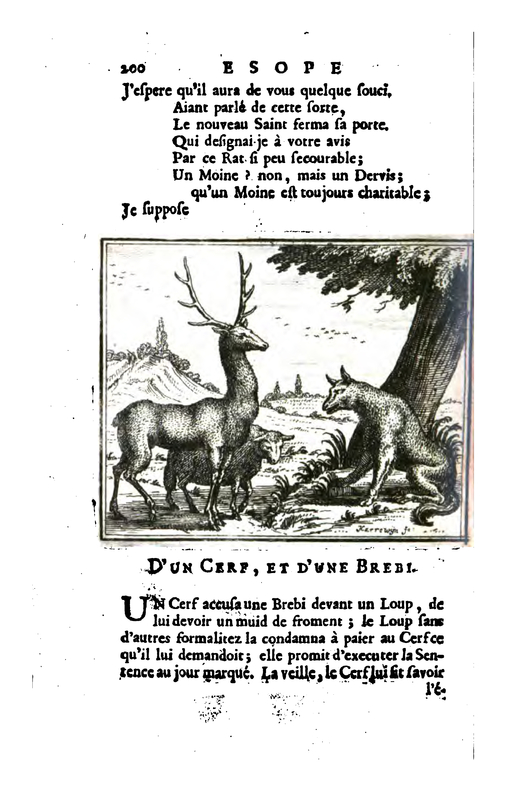
An old man is sitting down holding a pile of sticks. Three younger men stand around him, one motioning at the old man. A dog is sitting in front of the old man. They are all standing in front of stables.
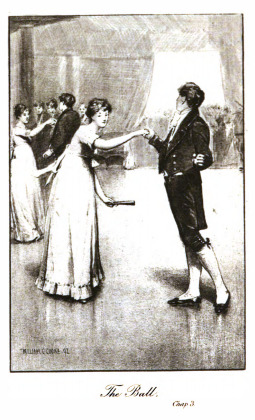
Here we see Jane Bennet dancing with Mr. Bingley. Mr. Bingley moved into his house, Netherfield Park, near the Bennet household, Longbourn, in the country. Mr. Bingley hosted a ball shortly after his arrival at Netherfield. Much to the delight of her mother, Mr. Bingley asked Jane to dance. Mr. Bingley holds Jane’s hand as she curtseys to him as they prepare to dance. This scene occurs in chapter 3 as is noted underneath the title of this image. The characters are shown in the traditional regency style, with the men wearing waistcoats, tailcoats, and knickers that stopped at the knee. Jane wears the regency style dress with an empire waist. Her hair is worn tied up, as was tradition for women after their coming out before the queen, signaling her entrance into society. The regency period dated to the early nineteenth century (1811-1820) when George, Prince of Wales, later George IV (r. 1820-1830), reigned as regent for his mentally ill father, King George III (r. 1760-1820). The regency period is associated with the rise of neoclassicism in art and fashion. The same image appears as an insert between pages 6 and 7 for the Dent 1893, 1894, 1895, 1896, and 1897 editions of Pride and Prejudice.
While walking home, Celestina (leftmost figure) sees Sempronio (right-central figure) and Pármeno (rightmost figure), who are going to check on Calisto (left-central figure) at Saint Mary Magdalene’s church. The two servants enter first, and Celestina follows closely behind. She tells Calisto that she has good news, and the four of them go to Calisto’s house for privacy. Once there, Celestina tells him that Melibea is passionately in love with him and has agreed to meet at midnight. Calisto is overjoyed, but Sempronio and Pármeno express suspicion at Melibea’s sudden change of heart.
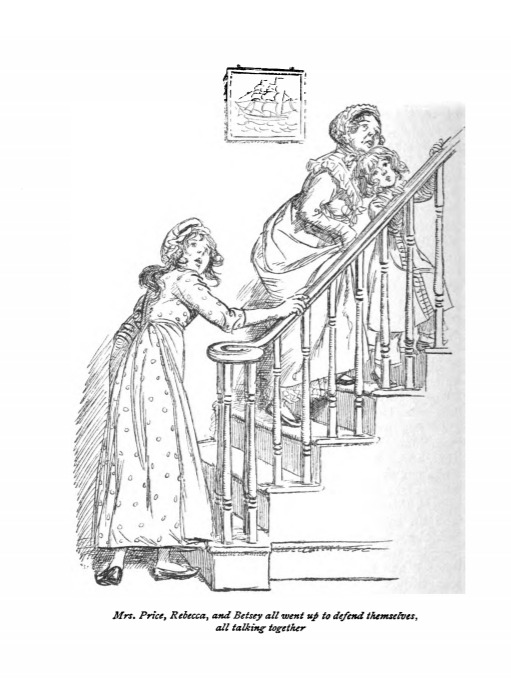
Here we see Mrs. Price, Fanny’s mother, Rebecca, the maid, and Betsey, Fanny’s youngest sister, going up the stairs. William had gone to try on his new lieutenant’s uniform which needed alterations that were not done. Mrs. Price and Rebecca both went to defend themselves, each believing the other was supposed to do the alterations. Betsey followed them upstairs. This scene occurs in chapter 38. The characters are shown in the traditional regency style. Mrs. Price, Rebecca, and Betsey all wear regency style dresses with empire waistlines. Mrs. Price and Rebecca both wear mop caps to cover their hair. The regency period dated to the early nineteenth century (1811-1820) when George, Prince of Wales, later George IV (r. 1820-1830), reigned as regent for his mentally ill father, King George III (r. 1760-1820). The regency period is associated with the rise of neoclassicism in art and fashion.
There are two soldiers fighting while riding their respective horses. The first soldier on the left is wearing a helmet and a tunic under his armour. He is also wearing a belt. He has a sword ready to strike a blow on the other soldier as he is holding his sword in the air with his two hands. The horse is wearing armour as well. The other soldier on the right is wearing a tunic as well with a hat with a veil on it. He is also positioned to hit the other soldier with his scimitar.
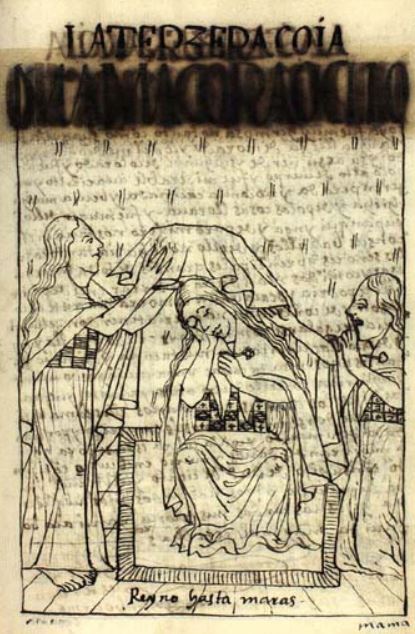
This illustration depicts Mama Cora Ocllo, the third Coya [Queen] of the Inca Empire. She was the sister and wife of Inca king Manco Capac. She is described by the author as being incredibly beautiful and sacred. She is also described as being pregnant and miserable by the author, which is why she is illustrated looking sad in the image as she looks down and is resting her face into her hand. There are two servants on both sides of Mama Cora Ocllo who appear to be putting a veil or fabric over her head. The words Reyno hasta maras is written at the bottom of the image which translates to He reigned to Maras. This is referring to her husband, who reigned the regions up to the city of Maras, a city north of Cusco.
A boy with short curls and a girl with long ringlets and oversized ribbons walk towards each other on tiptoes, both smiling. Between and above them is a large letter T, from The.
Two older men are seen in conversation at the middle of the image. Both are wearing robes, while one wears a crown and holds a staff. Both men have two birds at their backs, each of which is holding a baby in a pouch. Each baby is holding a baby rattle.
Intrigued by the European’s technology, Gulliver explained how he arrived on the island. He explained how ships work and used his handkerchief to explain the ship’s sails, seen here. In this image Gulliver uses his breath to simulate wind, using a handkerchief to simulate the sails to his master. Gulliver did this to explain how ships were built and how they worked and how he arrived in the Country of the Houyhnhnms. The same image appears in the 1839 Krabbe edition.
Here we see a horseshoe and the hammer and nails used to attach them. Gulliver explained to the Houyhnhnms how horses were treated in Europe and how horseshoes worked. Gulliver explained that horseshoes were used to protect horses' hooves while they were working.
George Osborne stands, looking uncomfortable, with his hand slightly extended towards Rebecca Sharp. Miss Sharp is seated in a one-armed chair under a portrait. She is looking challengingly up at Mr. Osborne and has a single finger extended in his direction.
Hypermnestra and her husband, Linus, are illustrated on the edge of the bed on the left-hand side of the engraving. We know these figures are Hypermnestra and Linus as their names are engraved above their heads. Hypermnestra is depicted with her arm lovingly touching Linus’ chest. As Boccaccio explains, a prophecy told Hypermnestra’s father that one of his nephews would kill him, so he married all his daughters to his nephews and instructed them to kill their new grooms to avoid this prophecy from happening. Hypermnestra, however, fell in love with her cousin Linus. Hypermnestra instructs him to leave to avoid her father and sisters from killing him. One of her sisters is depicted lying in the bed behind her, already having killed her husband, along with the other husbands that have been murdered.
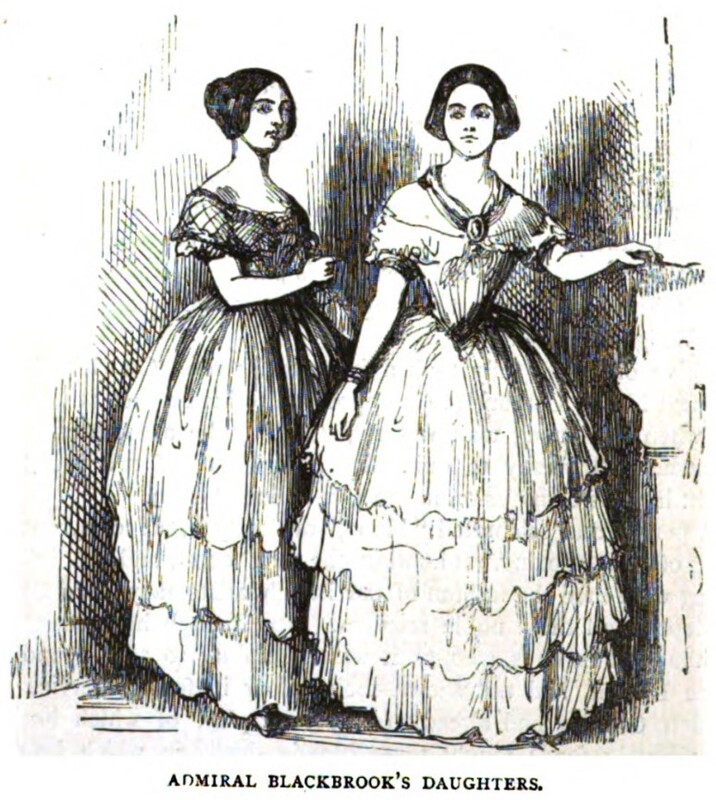
The Blackbrook sisters, daughters of Admiral Blackbrook, wearing fancy dresses and unhappy expressions. The image is placed at the end of the chapter before their only appearance in the book.
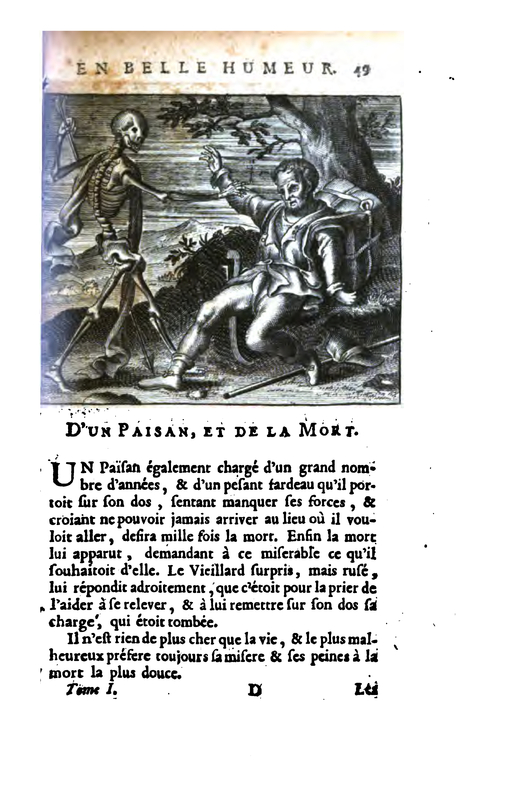
There is a man in the centre of the image sitting down in front of a tree. The man is carrying a heavy bag which is tied to his back. The man's legs are collapsed and a skeleton is dragging his hand. The skeleton is drapped in a long cloth and is holding a sharp object on the other hand. While the man looks tired and sad, the skeleton does not express any emotions. There is a hat which is appreared to have fallen off the man's head is next to him. The sky seems grey and there is a mountain range in the background.
After his brief encounter with Melibea in her garden, Calisto (figure to the right) laments the absence of his love. Calisto’s servant Sempronio (on the left) proposes that he employ the help of Celestina, an old procuress and brothel owner. Calisto agrees, and he tells Sempronio to visit Celestina and request her aid. When Sempronio departs, Calisto’s other servant Pármeno warns Calisto against the old woman’s deceptive and treacherous ways.
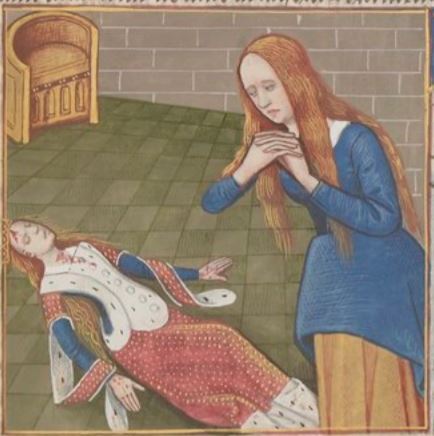
This illumination depicts a woman named Harmonia standing over the body of a servant girl disguised as Harmonia. Boccaccio explains that there was a rebellion in Syracuse against nobility, and because Harmonia was the niece of the king, she was in danger. Harmonia’s nurse disguised a servant girl to look exactly like Harmonia so that when the rebels came, the real Harmonia would be safe. This illumination depicts the servant girl who died in Harmonia’s place. She is depicted with a wound on her head and blood stained on her neck and shirt. Harmonia is illustrated with her hands together and a sad expression on her face. Boccaccio explains that Harmonia was saddened for losing such a faithful servant, however, she also admired the loyalty and bravery of the young girl.
Here we see a depiction of the war between Lilliput and Blefuscu. In the foreground we see two Blefuscudian ships, with the men jumping ship out of fear of Gulliver. These ships are fairly small, as they only have one sail, compared to the multiple sails on the Lilliputian ships shown in other images. Gulliver, who’s head and shoulders are above the water are visible in the background. Gulliver’s participation was what won the war for the Lilliputians. The same image appears in the 1839 Krabbe edition.
![[Vanity Fair Vol. I. Chapter II Inhabited Initial, W]](https://collections.cemvc.ca/files/large/1e7939072d19e1e0bb780305f758f9e48748a5a1.jpg)
![Alcaldes Hordenario de Sv Mag[esta]d, Camiua](https://collections.cemvc.ca/files/large/4b54f55074fbff355fa63200c46db5a9c75c6de5.jpg)
![[The Old Man and His Sons]](https://collections.cemvc.ca/files/large/f72b162dab08663b94f8dd260f576c3bee298e2a.jpg)
![[Act XI – Celestina Talks with Calisto While Sempronio Talks with Pármeno]](https://collections.cemvc.ca/files/large/47d26d91ca24f3db2fc8860d21f48ce4d6fc1a7b.jpg)
![[The Cid fighting in battle]](https://collections.cemvc.ca/files/large/41cb574732cba9f38be5c65ded7871ceee5e672e.jpg)
![[Vanity Fair Vol. II Chapter XXXIV Inhabited Initial]](https://collections.cemvc.ca/files/large/826fb818b7ce13d4365557f841fc9225fed41a20.jpg)
![[Two Men Surrounded by Four Birds Carrying Infants]](https://collections.cemvc.ca/files/large/62c15fb8bcb9e5c0d48d1a0b3bed2858ffc86867.jpg)
![[Gulliver explains how he arrived at the Country of the Houyhnhnms]](https://collections.cemvc.ca/files/large/163032a2a32925abe1b06fd76f2b175879dccd0f.jpg)
![[A horseshoe and the equipment for attaching them]](https://collections.cemvc.ca/files/large/52385a77ae9e8e3abbd8845e69da0e370e99e0cf.jpg)
![[George Greets Rebecca]](https://collections.cemvc.ca/files/large/481d4189ea1f51c941c66dab4edb245a56006f72.jpg)

![[Act I (Second Illustration) – Calisto Laments the Absence of Melibea to Sempronio]](https://collections.cemvc.ca/files/large/613033d15464902023ff7e854b8a87e1d7dc143c.jpg)

![[Gulliver in the war with Blefuscu]](https://collections.cemvc.ca/files/large/d0243628b192fc43b4fe8dce46b6a9754c43674e.jpg)