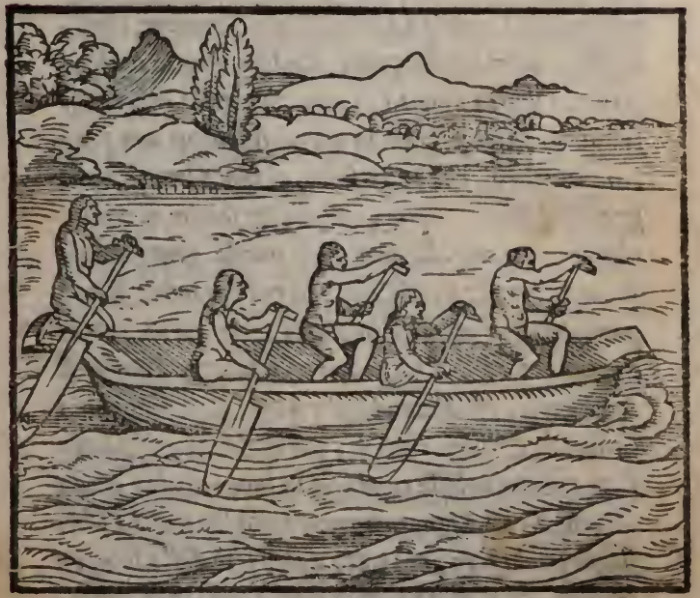
Five Indigenous people in a large dugout canoe paddle near the coast in what is likely either the Caribbean Sea of the Gulf of Paria. Two individuals paddle on the left and two on the right, while the person in the back sits elevated and guides the canoe. The hilly coastline is visible in the background.
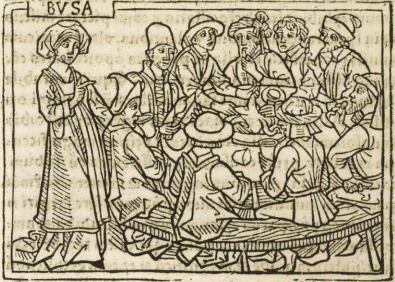
This engraving depicts a woman named Busa on the left-side of the image looking at the group of people in front of her. We know that this figure is Busa as the creator engraved her name above her head. Boccaccio explains that after a city called Cannae was attacked by Hannibal the Carthaginian, the people fled to Canusium. Busa opened her home graciously to the people who fled the danger of war and provided them with hospitality and food. These are the people who are depicted sitting around Busa’s table.
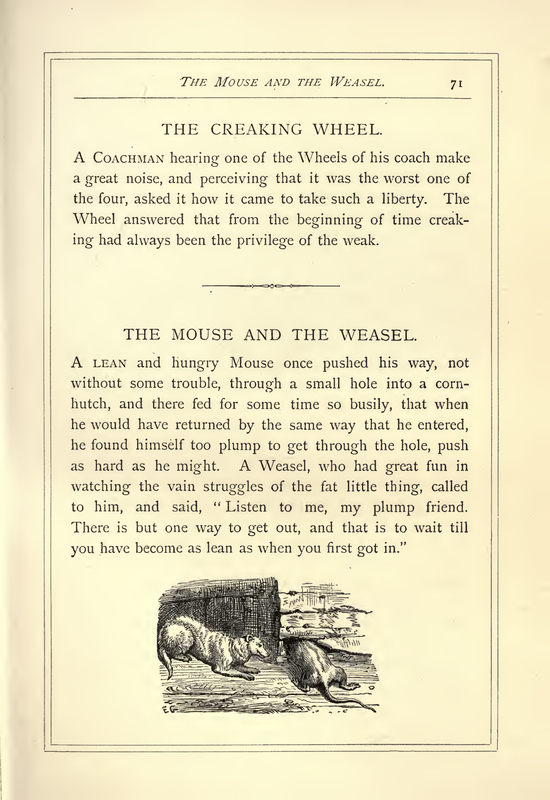
A mouse is pushing its way in a small hole in a corn-hutch on the right-hand side of the image. To the left, a weasel is lying on the ground looking at the mouse working its way to the other side of the hole.
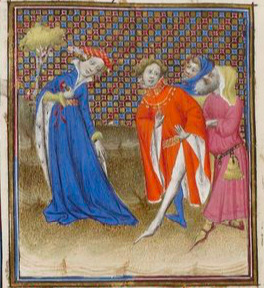
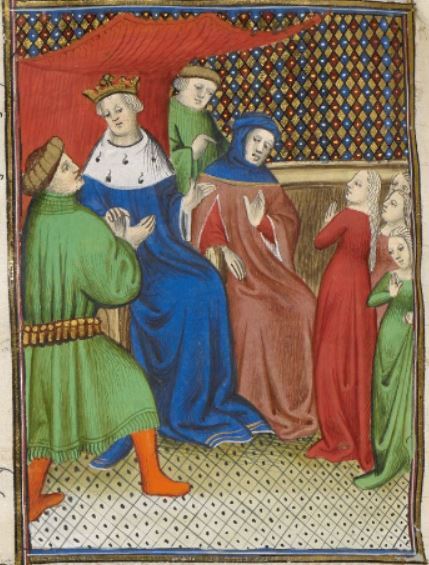
This image appears in the chapter that treats the Florentine maiden named Engeldruda. Engeldruda is famous for having spoken up against her father to protect her chastity. Boccaccio explains that Emperor Otho IV had gone to Florence for a festival, and when he noticed the beauty of Engeldruda, he asked her father who she was. Engeldruda’s father had offered her up to the emperor as if her chastity meant nothing to him. She spoke against her father for having done this. The emperor was so impressed with Engeldruda, he offered a nobleman named Guido to be her husband. Engeldruda is depicted on the right side of the image wearing a red dress speaking with the man in a red and brown cloak. Emperor Otho is presumably the man sitting on the throne as he is wearing a crown. Engeldruda’s father, then, is most likely the man speaking with Emperor Otho on the left side of the image.
The custom of stepping on a crucifix was common in Japan in the early modern period. Christianity was outlawed in Japan, and anyone who was suspected of Christianity was required to step on a crucifix to demonstrate that they were not Christians. In major trading cities the Dutch, who were the only Europeans to trade with Japan, were often required to perform this custom. Gulliver requested to that he be allowed to bypass this custom, which made some Japanese question if he were really Dutch (he pretended to be Dutch as they were the only Europeans permitted in Japan), as most Dutchmen, according to Swift – who had a negative view of the Dutch – would perform this ritual regularly and without opposition. Gulliver asked the King of Luggnag to request Gulliver’s exemption from this custom in his letter. Gulliver was in Nagasaki, a Dutch colony in Japan at this point in the story. The same image appears in the 1843 Krabbe edition.
In this image Jimena is sitting on a cushion on a chair. She has long dark hair wearing a dress. Her face is not visible because she has her hand covering her face. On the desk she is sitting in front of, there is a pen, ink, and a piece of paper. To the right of the image there is a little table with a cloth on it. In the background there is a window on one side and two columns on the other.
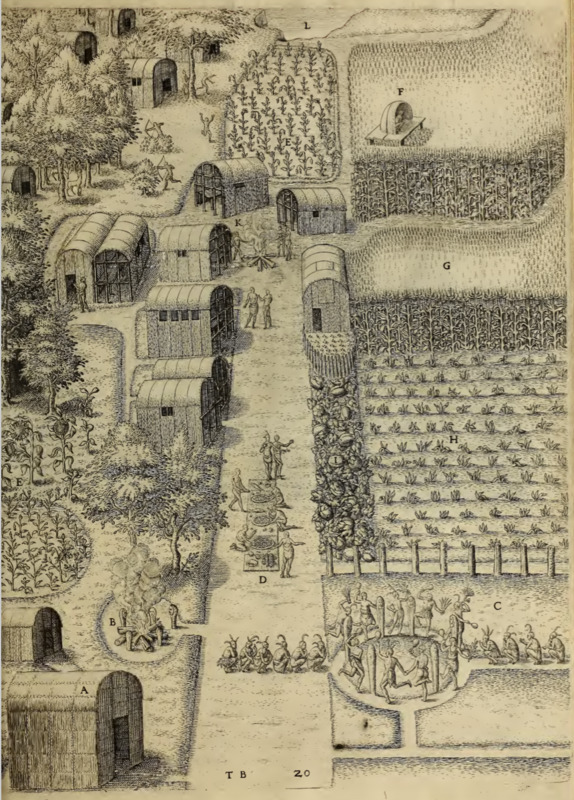
The Indigenous town of Secota is pictured. Multiple structures are grouped along a flattened path. There are cultivated fields all around the structures where corn and other crops are seen in varying stages of growth. There are several bonfires, and in the centre of the village several individuals are grouped around a meal. There is a dance circle where a ceremony is taking place, several people sit and others dance. Elsewhere a few individuals hunt or practice with bows and arrows.
Rawdon Crawley, smoking a cigar, leans over the billiards table as he lines his cue up with a ball. On the other side of the table is a man holding his cue vertically. In the background to the right are two other men, one standing and wearing a suit, and the other seated on the edge of a table while smoking.
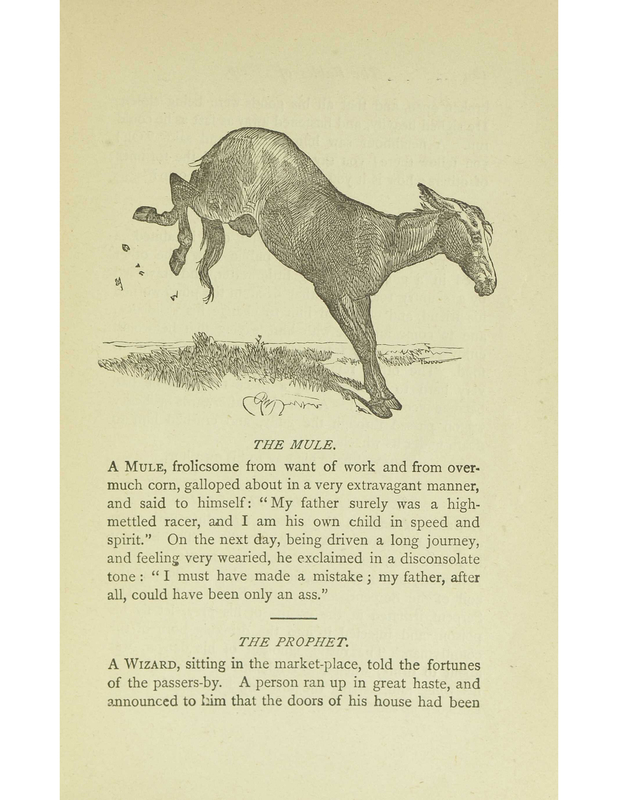
A mule is bracing itself on its front legs as it kicks back in the air behind itself with its hind legs. The mule is standing on a patch of grass, so as it kicks up, pieces of grass fly upwards.
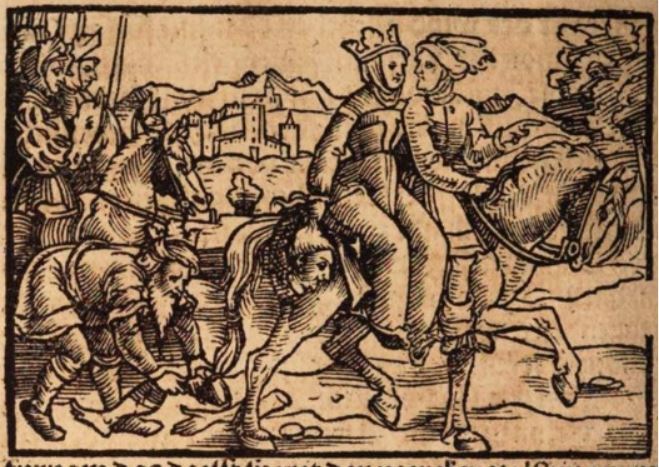
Jason of Thessaly and Medea of Colchis are illustrated riding on a horse together as they flee from Medea’s father, King Aeetes. Boccaccio explains that Medea betrayed her father by helping Jason on his task to find the Golden Fleece. Jason is seated at the front of the horse and Medea is riding behind him. Medea is depicted holding a severed head in her right hand, which is the head of her brother, Aegialeus. Medea had dismembered her own brother and scattered his limbs around the road behind her and Jason in order to distract her father from pursuing them. King Aeetes is illustrated on the left side of the engraving as he is picking up his son’s limbs.
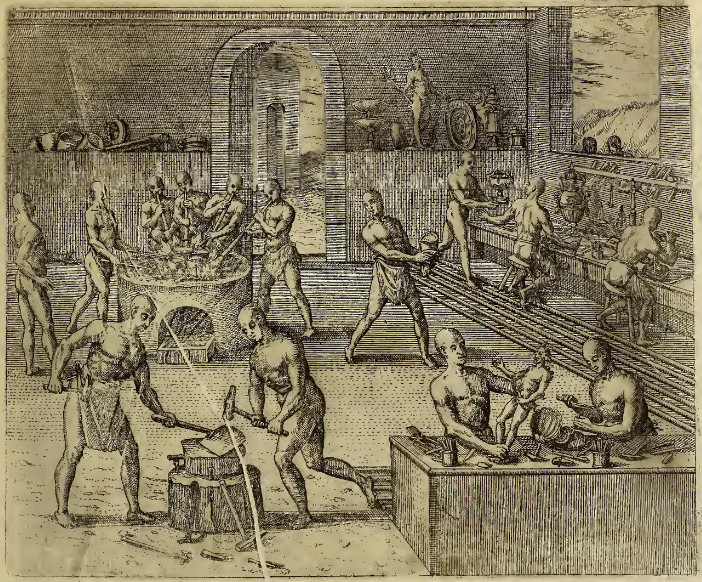
A group of Inca men work with gold in a space that is both forge and workshop. In the middle of the room is a large round kiln or furnace with a fire burning on top, in which several pots have been placed. A group of men stand around the kiln, blowing on the fire through hollow reeds. In the foreground two men hammer a sheet of gold, and beside them at a table two men use fine engraving and carving tools to ad detail to gold statuettes and ornaments. On the left there is a second, similar worktable. On a recessed shelf along the far wall of the building are several finished pieces, including a large plate, several vessels and a small statue.
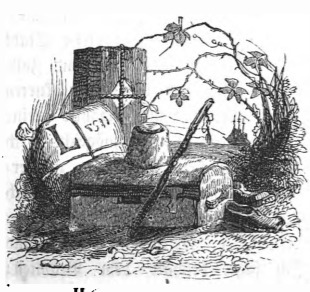
Here we see Gulliver’s luggage. This image appears at the beginning of the ninth chapter, as Gulliver prepares to leave Glubbdubdrib and return to Luggnagg, and from there he will sail to Japan, then finally home to England. In the third part of the story, Gulliver travels more frequently than in any other part. In this chapter we see Gulliver’s trunk, hat, walking stick, shoes, and book. There is a letter L on the book because it is the first letter of the chapter. The same image appears in the 1839 Krabbe edition.
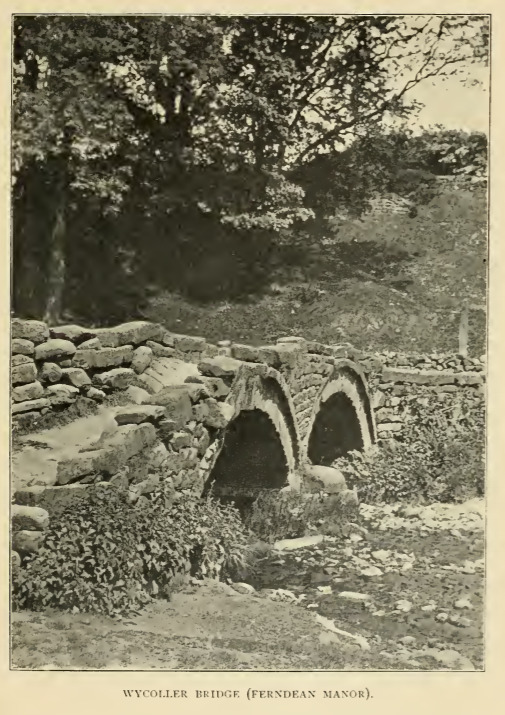
Here we see the Wycoller bridge, near the manor house called Wycoller Hall in the village of Wycoller in Lancashire. After hearing Mr. Rochester’s voice calling to her while at Moor House, Jane decided she had to return to Thornfield to see him. When she arrived, she found that Thornfield had been burnt down, and Mr. Rochester had moved to Ferndean Manor. Jane then married Mr. Rochester and moved into Ferndean Manor. The same image appears in the 1899 Bigelow, Brown, and Co edition of Jane Eyre.
Boccaccio explains that a Greek woman named Hippo had been captured by enemies, and when she heard them speaking of defiling her chastity, she decided that an early death was far better than having her honour destroyed. This engraving depicts Hippo on a boat surrounded by the men who had captured her. Hippo is illustrated at the front of the boat with her body plunging into the water. She drowned and successfully saved her honour. Her name is engraved at the bottom left corner of the engraving.
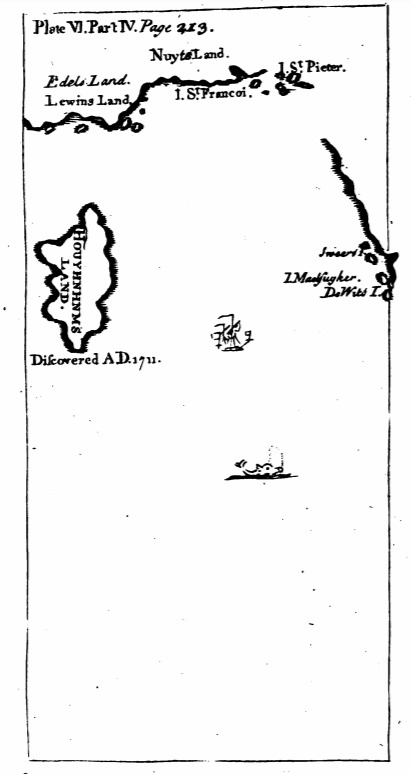
Here we see a map of the Country of the Houyhnhnms. Written under the land is Discovered AD. 1711. The Houyhnhnms’ Land is shown near Nuyts Land and Eidels Land. A man-of-war style ship is shown in the water.
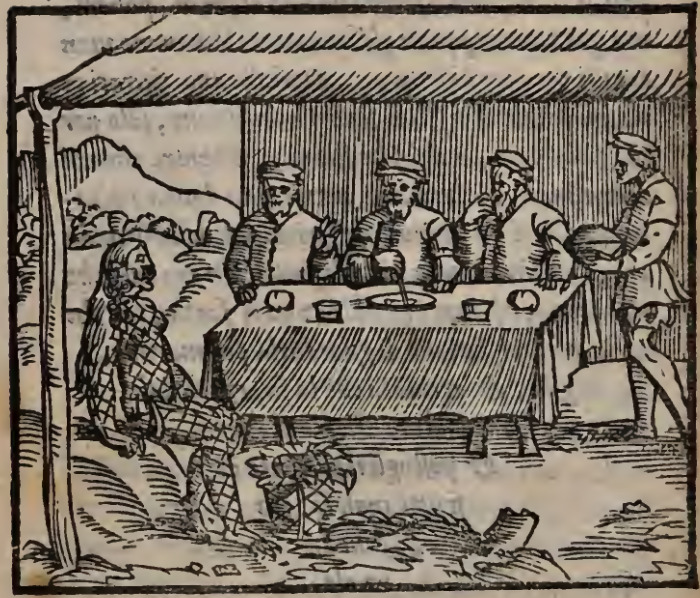
An Indigenous woman with long hair, a ring through her nose and heavy earrings sits on a cluster of rocks under a man-made overhang. At her feet she has a basket of fruit that she has brought for four European men, who sit and stand around a nearby table to eat. The woman’s body is covered in a crosshatch pattern, possibly tattooed or painted on.
This image illustrates the beautiful Europa being kidnapped by Jupiter. Europa is depicted on the left side of the image with a crown on her head. Boccaccio explains that Europa was convinced by a panderer to follow him to the shores of Phoenicia, where she was then kidnapped and put onto a ship by Jupiter. There is a man standing in front of Europa, presumed to be either Jupiter or the panderer. Europa was placed on the ship that is illustrated on the right side of the image and taken to Crete. There is a white bull emblem on the flag of the ship, which is a symbol of the god Jupiter. The original tale suggests that Jupiter transformed into a white bull and rode with Europa on his back to Crete.
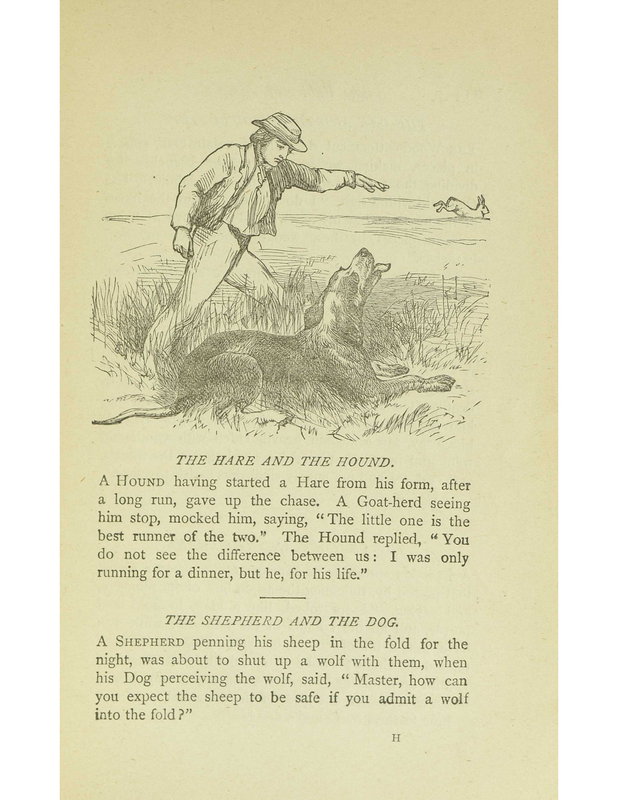
A large hound is lying on the ground, its tongue sticking out, looking upwards towards its master. The man is standing on the left side of the hare in a large and strong stance. It is looking at the dog and pointing in front of it where a hare is running off.
In this image we see Gulliver, still tied up, drinking wine from a barrel, while two Lilliputians roll another barrel up to Gulliver using a ramp on his chest. Another Lilliputian guard is standing by Gulliver’s head with a spear. The same image appears in the 1843 Krabbe edition.
Lecretia is pictured in a blue gown with a knife stuck into her chest. She is committing suicide to punish herself for being victim of a horrible crime committed by Sextus. After seeing her amazing beauty and loyalty, he decided to rape her after blackmailing her. The morning after, Lucretia ran to her relatives and husband to tell them what Sextus had done to her. She said she could absolve herself from sin but not from punishment, so she killed herself with a knife hidden in her dress. In the image, her father, husband and relative who she sought to tell the truth, stand to the right.


![[depiction of the custom of stepping on a crucifix]](https://collections.cemvc.ca/files/large/05b3ab7ed413ecf99868d39218e0d634d4e327f6.jpg)
![[Jimena sitting at a desk]](https://collections.cemvc.ca/files/large/c9f02538d4f631561b3d6ec116f1f88da1149ad3.jpg)

![[Rawdon’s Skill at Billiards]](https://collections.cemvc.ca/files/large/c05715bc9debbec91d7f47a3d146d92acf82224d.jpg)



![[Gulliver drinks from barrels on Lilliput]](https://collections.cemvc.ca/files/large/1db743e8bacec8e849ef9ae4541db7f5ea2a4bbb.jpg)