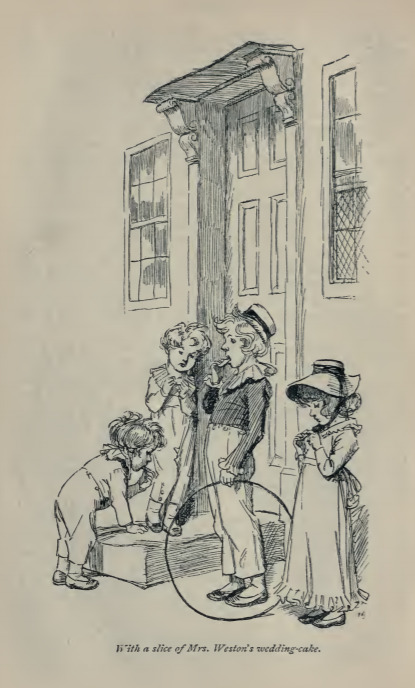
Here we see the Perry children eating Mr. And Mrs. Weston’s wedding cake. Mr. Perry was the apothecary of Highbury, and Mr. Woodhouse being a hypochondriac called upon him very frequently. Mr. Woodhouse felt that the wedding cake was too rich and should not be eaten, and Mr. Perry agreed that it should only be eaten in moderation. Nevertheless, Mr. Perry gave his children some of the cake, seen here. This scene occurs in chapter 2. The children play with a hoop. The older children are dressed in the regency style with the young girl wearing a dress with an empire waist and a bonnet, and the young boy wearing a short coat and breeches. The regency period dated to the early nineteenth century (1811-1820) when George, Prince of Wales, later George IV (r. 1820-1830), reigned as regent for his mentally ill father, King George III (r. 1760-1820). The regency period is associated with the rise of neoclassicism in art and fashion.
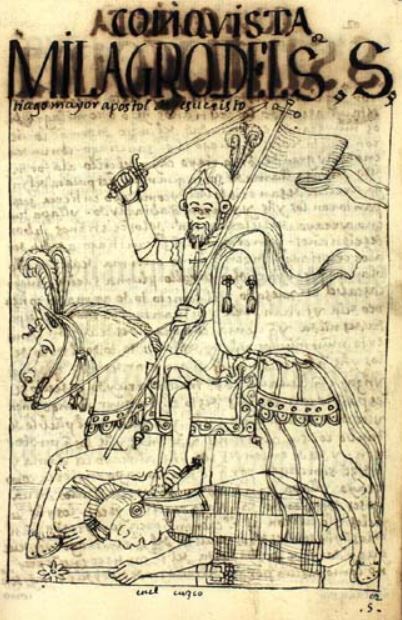
This chapter focuses on discussing the arrival of Spaniards and the Spanish conquest of Peru. This image depicts the miracle of Saint James, sent by God to aid the Christian Spaniards fight against the indigenous people of Peru in Cusco. Saint James is illustrated wearing armour and holding a sword as he rides on a horse that has a suri [plume] on its head and bells and decorations on its harness. Saint James also has a cross depicted on his chest to signify that he was sent by God. The author explains that Saint James had brought much destruction to the indigenous people in Cusco and aided in undoing the siege against the Christian Spaniards. There is an indigenous person laying on the ground underneath the horse to demonstrate this destruction. The caption at the bottom of the image reads, en el cuzco [In Cusco].
On an island near the coast, a European man (likely representing Staden) is taken by the arms by two Tupinambá Indigenous people. Around the island are five canoes all filled with Indigenous people. There are several fortifications and buildings on another island and along the coast of the mainland in the background.
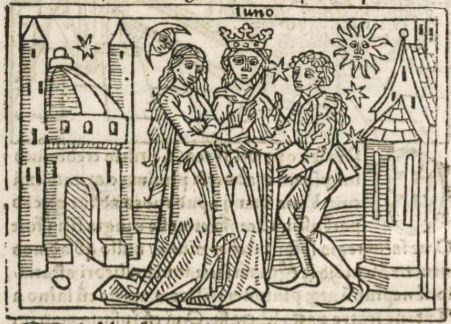
This engraving illustrates the importance that the goddess Juno holds to the city of Samos. The background of the engraving on the right side illustrates a temple which was erected in the goddess’ honour. In the foreground of the engraving, there is a marble statue of Juno dressed in her wedding attire standing in front of the temple. We know that this is Juno as her name is engraved directly above her head. There are people standing in front of the statue of Juno, most likely engaging in a wedding ceremony as Juno is a goddess of marriage. Boccaccio explains that Juno was sent to live in Samos during her early childhood years until she hit puberty and married her brother Jupiter. The people of Samos built the temple and statue to honour their connection to the goddess.
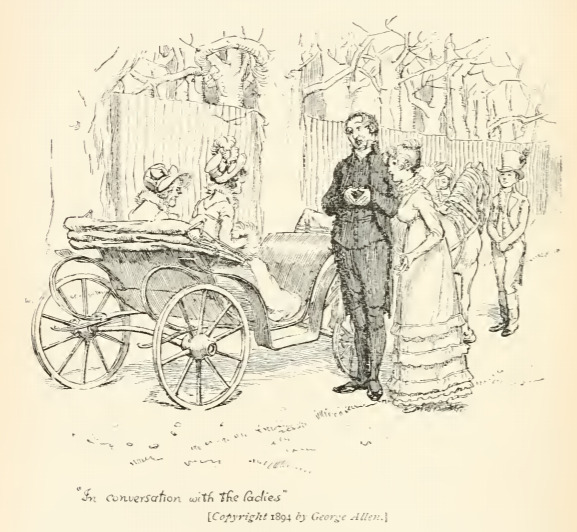
In this image Charlotte and Mr. Collins speak with Lady Catherine de Bourgh and her niece. Lady Catherine and her niece were driving past Mr. Collins and Charlotte while out for a walk and stopped their carriage to invite them to come to dinner. This scene occurs in chapter 28. The characters are shown in the traditional regency style. Charlotte wears a regency style dress with an empire waistline. Mr. Collins wears a waistcoat and tailcoat. The regency period dated to the early nineteenth century (1811-1820) when George, Prince of Wales, later George IV (r. 1820-1830), reigned as regent for his mentally ill father, King George III (r. 1760-1820). The regency period is associated with the rise of neoclassicism in art and fashion.
In this image there are three men, El Cid, a man wearing a robe, and Don Sancho dead on the table. El Cid is the man standing on one knee and he has his hand on his face crying. He is wearing chainmail and a helmet. On the table in the tent is the dead body of Don Sancho covered with a blanket. On the left of the bed there is a man completely covered with his cloak holding a lit torch. On top of the tent there is a flag billowing in the wind. At the foot of the bed there is a shield, a helmet, a sword and a piece of cloth folded neatly. At the very front of the image there is a lit candle.
Here we see Gulliver going to the Emperor’s castle outside the city. Not wanting to cause any damage to the city and because he was still a prisoner of the Emperor, Gulliver was brought in on a stretcher. Gulliver was escorted by the military and a crowd gathers to see Gulliver. The same image appears in both the 1839 and 1843 Krabbe editions.
This image is illustrated in a chapter that discusses and criticizes the government and society in Spanish conquered Peru. This image depicts a Spanish encomendero [trustee] being carried on a litter by native men. The encomendero is depicted making a ceremonial entrance into an indigenous village and being greeted with dancers who are depicted on the right side of the image wearing traditional ceremonial garb. The author criticizes the encomenderos for doing this as they acted as if they were Inca rulers.
Two children, a boy and a girl, stand huddled under a large umbrella, their backs turned to the rain which is coming at them from the right at a steep angle. Behind them, to the right of the image, the letter W from We is beneath an arch.
A rooster appears to be on a farm and staring down at a token with a quatrefoil design. behind the rooster is a fence and in the distance there are trees on a hill. To the right of the rooster there is a house or a barn.
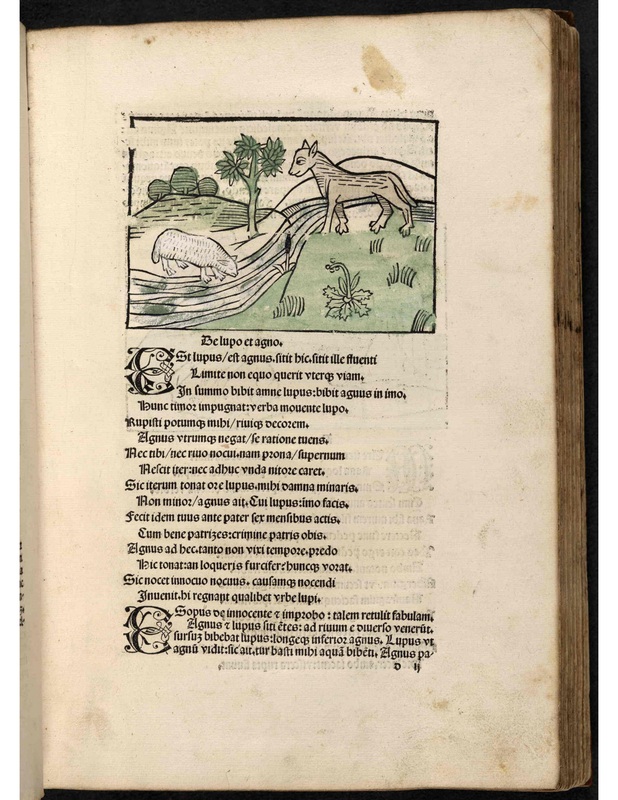
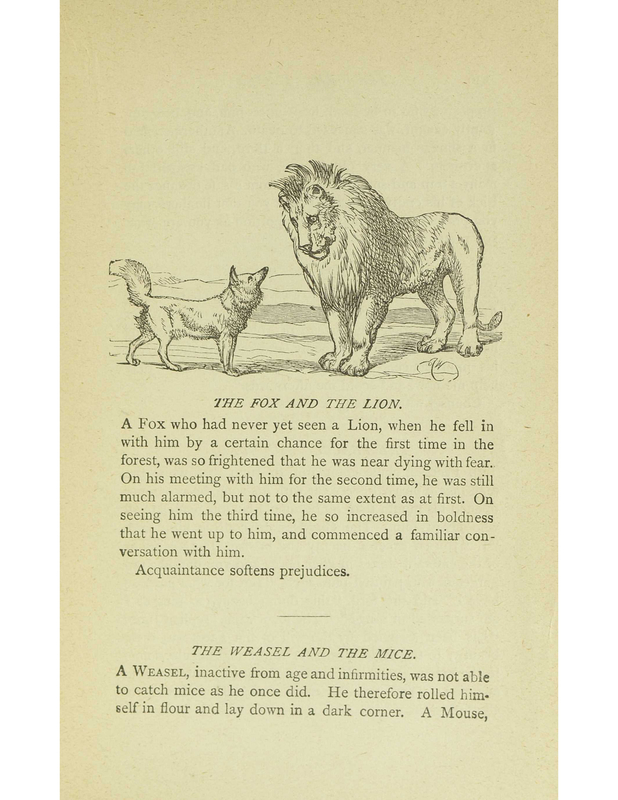
On the left side of the image, a fox stands on all its legs, looking upwards in front of itself towards a large lion. The lion, on the right side of the image, looks down at the fox.
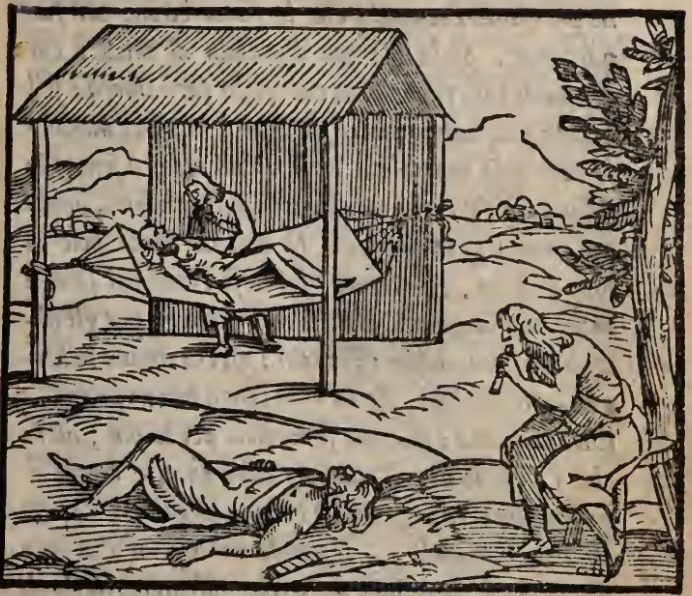
An Indigenous man seated on a three-legged stool smokes a pipe, while a second man lays on his back on the ground nearby with a pipe on the ground near his arm. In the background, a man tends to another person lying on a hammock under a shelter with a roof and one wall.
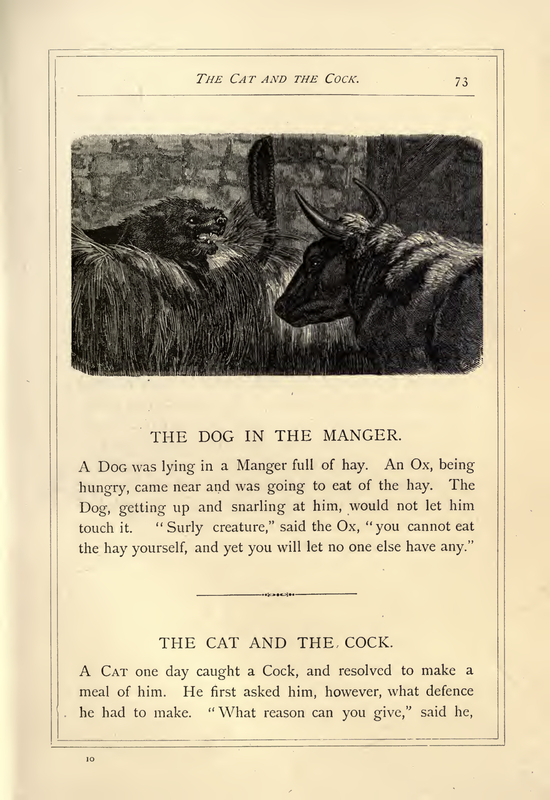
On the left side of the image, a dog is in an Ox’s manger hidden in the hay. He has both his front paws on the border of the manger as he sticks his head out. His mouth is slightly open, and his nose is wrinkled back as though he is snarling. In front of the dog, to the right of the image, the upper body of an ox is visible. The ox is looking directly at the dog with anger in his white-glowing eyes as he cannot eat since the dog is in there. Behind them, the walls are made of brick-like materials.
This image depicts a group of female immortals from Luggnagg. Gulliver describes the women as looking more horrifying than did the male immortals. Gulliver says it was easy to pick out the oldest immortal of the group, as they became ghastlier as the years went on. Like their male counterparts, the female immortals act like mortals until about the age of thirty, and then become very melancholy until about eighty years old. At this time, they recon themselves with the reality of never dying. The diplomat also says that the immortals often become opinionative, peevish, morose, vain, covetous, talkative, and incapable of friendship. Furthermore, they lose all ability for affection, even for their descendants. Their primary characteristics become impotent desires and envy. They cannot experience pleasure, and when they attend a funeral, they find themselves envious of others who could die. Their memories also begin to fade. In this image we see a group of these immortal men looking angry and discontent. They are identified by the large spot on their forehead above their left eyebrow. The same image appears in the 1843 Krabbe edition.
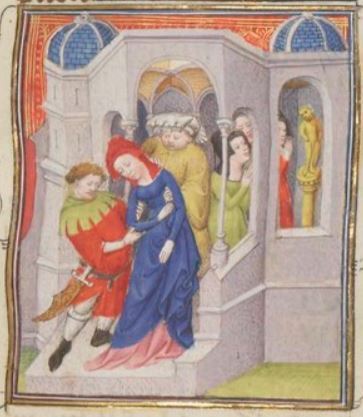
This illumination depicts the noble Roman woman named Verginia getting cast out of the Patricia Pudicitia temple. Verginia was born into a noble family and married a former consul named Lucius Volupinus. Because her husband became a member of the plebeian class when he was no longer a consul, Verginia was cast out of the temple by noble women. Verginia is famous for having created her own temple for the plebeian women called the Plebeia Pudicitia. Verginia is depicted leaving the temple in a saddened manner. She is being escorted out of the temple by a man in a red garment. The noble women are watching Verginia leave from inside the temple.
In this image Gulliver puts out a fire in the Empress’s apartments on Lilliput. He does this by urinating on the fire. Gulliver stands in the centre of the palace, and the fire is coming from the wing closest to the viewer. Several Lilliputians work to put out the fire with some spraying hoses and climbing ladders to get into the palace. In the foreground we see other Lilliputians trying to rescue some of the precious goods from the burning Palace. Gulliver successfully put out the fire, however this incident was one of the reasons later used by the Lilliputians to charge Gulliver for treason and forcing him to leave Lilliput after nine months. The same image appears in the 1839 Krabbe edition.
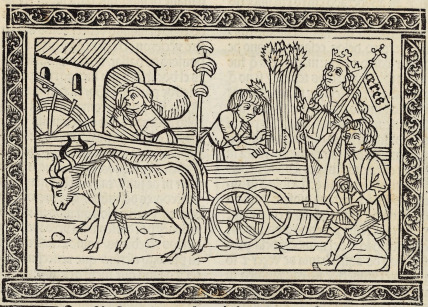
Ceres is depicted on the right-hand side of the engraving wearing a crown and holding a scepter. We know this is Ceres as her name is written beside her scepter. We also know this is Ceres as she is the goddess of harvest, which is what this engraving depicts. Boccaccio explains that after discovering agriculture, Ceres had tamed oxen and trained them to yoke. She also discovered planting seeds and then taught men how to harvest them once they matured. There is one man plowing the fields with the oxen, and another in the background husking grain. There is another man with a bag of flour over his head, as Ceres also taught men how to turn flour into an edible fare. Ceres wears the crown and scepter to signify her importance linked to agriculture and harvest.
Upon hearing about the immortals of Luggnag, Gulliver rejoices at the possibility that each child has the possibility of being immortal. Gulliver’s celebration was short lived, after he noticed that no one at court was immortal. He then learned that the immortals continued to age but did not die, therefore their quality of life continued to decrease over time. The same image appears in the 1839 Krabbe edition.
A small girl in a long dress, likely Rosalind or Violet Crawley, is seated on the floor. In front of her on a stool is a small card tower, three high, towards which she is reaching.
Sir Pitt Crawley kneels on the ground in his sister’s parlour, one hand extended towards Rebecca Sharp, who stands in front of him looking slightly startled. In the background are two life-sized portraits of women.

![[A European man is captured by Tupinambá people]](https://collections.cemvc.ca/files/large/4e1740436e75d76b5efebf5bdb068f7cfebb0a26.jpg)
![[The death of king Sancho]](https://collections.cemvc.ca/files/large/4c7680a25bef7ebfafe508ad0b4cea487a253179.jpg)
![[Gulliver is brought to the Emperor’s castle outside the city]](https://collections.cemvc.ca/files/large/fa2c2cac3671fa0a177a7a9357b056f68bf8f714.jpg)
![Q[ve] el Comendero se Haze Lleuarse en Unas Andas Como Ynga con Taquies y Danzas Quando Ilega a sus Pueblos. Y ci no, le Castiga y Maltrata en Este Rreyno](https://collections.cemvc.ca/files/large/010da9d04cd58e0aa67fb1bfa2f627ec9a3bba18.jpg)
![[Vanity Fair Vol. II Chapter XXXVIII Inhabited Initial]](https://collections.cemvc.ca/files/large/8b42ebd0001d556f7ac44d48e59c71c4b1b39b52.jpg)
![[Rooster and a Quatrefoil Token]](https://collections.cemvc.ca/files/large/98188c06b5f9301d2989131e4dde85cd7475a1ea.jpg)

![[a group of female immortals from Luggnag]](https://collections.cemvc.ca/files/large/f51bb1e183816f9c92fa30c0076fa9ae06278c3d.jpg)
![[Gulliver extinguishes a fire in the Imperial Palace on Lilliput]](https://collections.cemvc.ca/files/large/5211b1ef67891d23932c1622a92bd24d2d2ef85c.jpg)
![[Gulliver celebrates the possibility of an immortal child born on Luggnag]](https://collections.cemvc.ca/files/large/ec4d37fc01b57cfb23f37813366d04896dfeb6f3.jpg)
![[Girl Building a House of Cards]](https://collections.cemvc.ca/files/large/92775011f5d0960feb9c50427eb7e2c0d4182210.jpg)
![[Sir Pitt’s Proposal]](https://collections.cemvc.ca/files/large/7d3eb1cc151e1b129208609c1ca9361f87f9cc89.jpg)