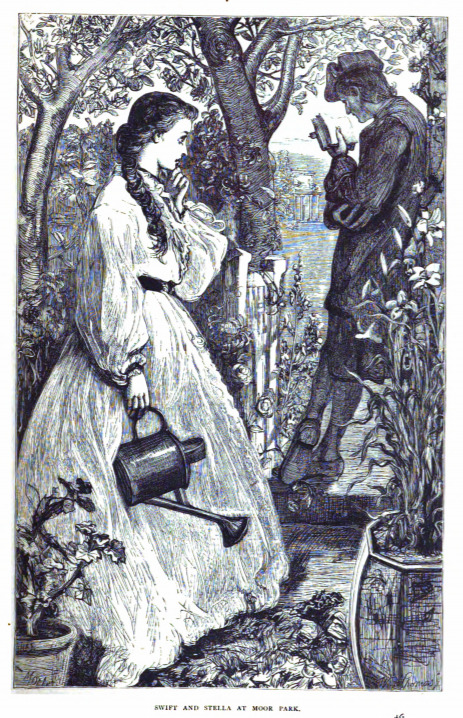
Here we see Jonathan Swift with Stella Johnson. Swift met Stella while working at Moor Park. The two remained in contact for the rest of their lives. Swift and Johnson were romantically involved, however, Swift was already engaged to Jane Waring. This image appears as part of the biography of Jonathan Swift.
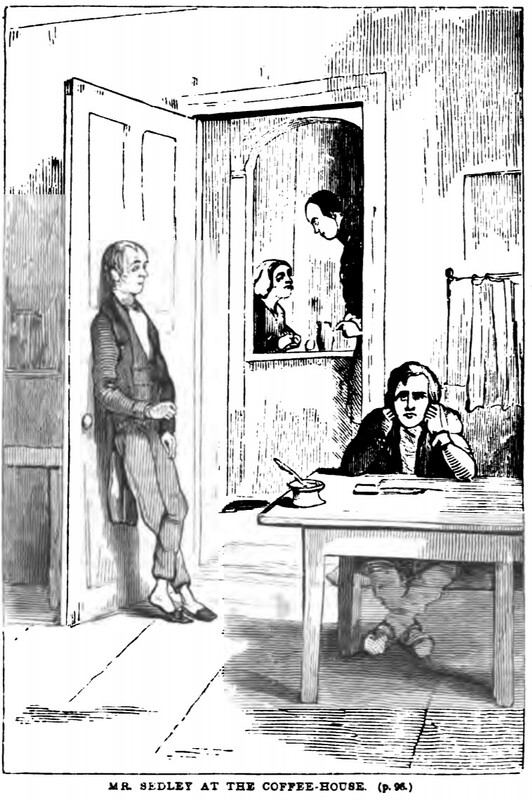
John Sedley is seated at a table at the Tapioca Coffee-house, slouching over with his elbows resting on the table and his scowling face between his fists. On the table in front of him are a few pieces of paper and an inkwell with a quill. The door to the room is held open by a bored-looking man who leans against it. Through the doorway, William Dobbin can be seen talking to the woman at the desk. Below the illustration is printed its title and location in the story, MR. SEDLEY AT THE COFFEE-HOUSE. (p. 96.).
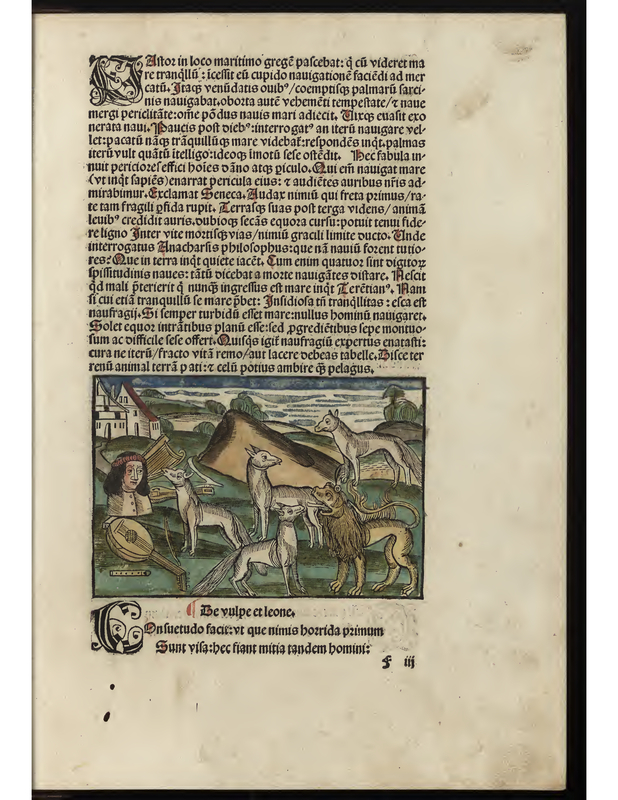
A lion is snuggled up in a cave outside. A fox is walking away from the cave on the left side of the illustration. A large tree is branching out around the top of the cave. Mountains and other trees are in the background.
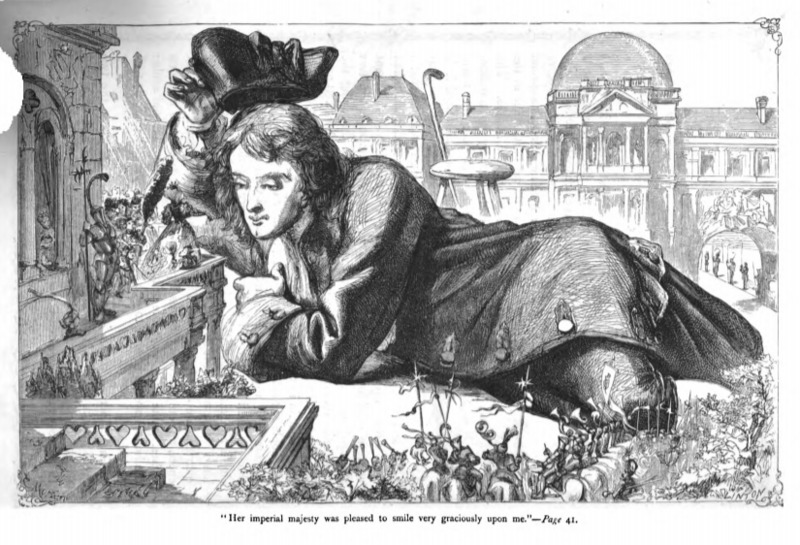
Here we see Gulliver looking in the window of the Imperial Palace of Lilliput in the city of Mildendo. Gulliver lies on his side and looks in. He raises his hat in greeting of the Empress, who stands on the balcony and greets him. A crowd of guards surrounds Gulliver in the courtyard of the palace.
Here we see a triptych showing the separation between the Lilliputians and the Blefuscans. In the first image we see the two emperors as friends, then they have an argument which we seen in the second image with the man further from the viewer crossing his arms and is standing in an aggressive stance. In the third image we are left with only the Lilliputian Emperor. In the first image, there are two shoes in different styles in front of the two men, one with a tall heel, the other with a small heel and a feather detail. In the second image only the shorter heel shoe remains, while in the third image only the higher heeled shoe is shown. The viewer is meant to understand that the argument between the two men was about the correct style of shoes. This is a thinly veiled reference to the religious wars of the sixteenth and seventeenth centuries.
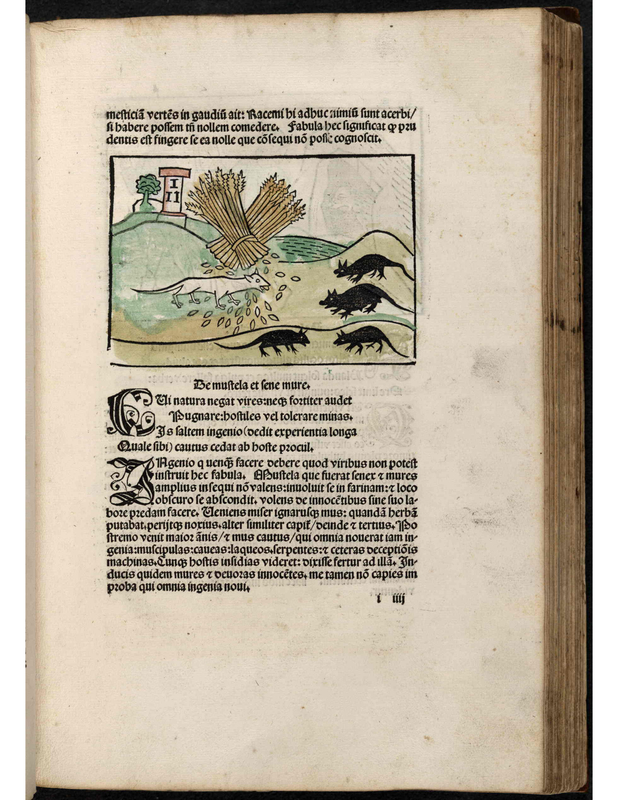
A white mouse eats pieces of wheat from two bundles of wheat, four black mouses encircle the white mouse and, in the distance, there is a tower and a tree.
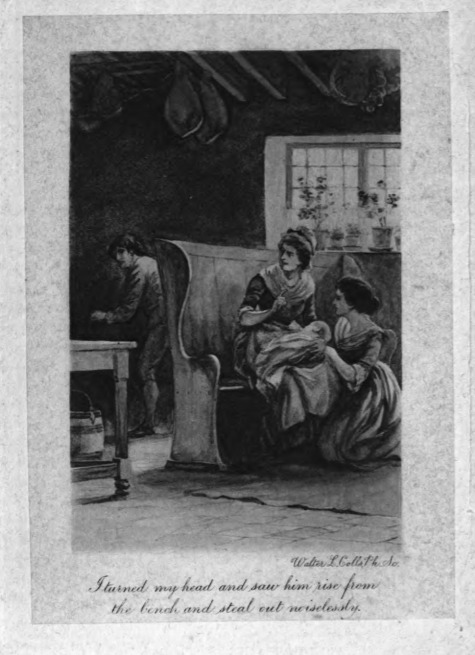
Here we see a scene where Heathcliff visits Catherine after she married Edgar Linton. Catherine sits with her sister-in-law Isabella, on a bench, as Heathcliff leaves the room. Heathcliff and Linton argue, and Catherine implores them to stop. Eventually Heathcliff leaves the room, leaving Catherine crying to Isabella.
A bull is standing in a small river on the left side of the image. In the lower right corner, two frogs are sitting on a dry piece of land. The bull is looking at the frogs with a curious expression. Behind them are three fruit trees that spread out into a thick forest.
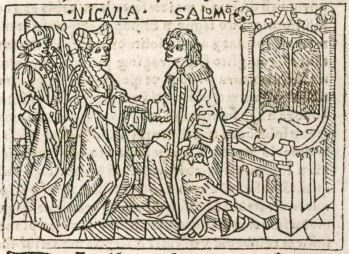
This engraving depicts Nicaula, the queen of Ethiopia, on the left-hand side of the engraving shaking hands with king Solomon of Jerusalem. We know that these figures are Nicaula and Solomon as their names are engraved above their heads to identify them. Nicaula, as Boccaccio explains, was incredibly wise and wanted to hear and listen to the wisdom and intellect of Solomon. She had traveled from Ethiopia to Jerusalem to meet him. This engraving depicts their first meeting. Behind Nicaula is presumably one of her servants, who is carrying a tree. The tree was one of many gifts that Nicaula had given to Solomon.
An Indigenous village is shown, along with the fields nearby. On the right a man cuts down trees to clear the land. In the field beside the trees, two women with children on their backs tend to cassava (manioc) plants. On the left, two women carry harvested plants back to the village. The village is comprised of four long structures arranged in a square, surrounded by a fence. To the right of the village a bearded man kneels beside a cross.
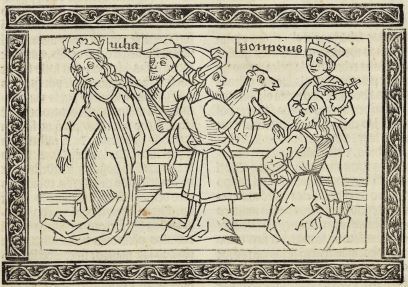
This engraving depicts two separate events. The right side of the engraving depicts Pompey the Great participating in a sacrifice of an animal. Pompey is depicted wearing a crown to signify his high status. The man to the left of Pompey is depicted cutting the neck of the animal that he is holding. There is blood splashing out from the animals wound, which stains Pompey’s clothing. Boccaccio explains that after Pompey’s garments became stained with the animal’s blood, a servant carried his stained clothes back home to get new ones. Julia, Pompey’s wife and the daughter of Julius Caesar, saw the blood-stained clothing of her husband and immediately thought that he had been murdered. Julia is depicted on the left side of the engraving after having just seen the clothing of her husband. She looks distraught and is depicted mid-fall to the ground. There is a servant beside her who is holding the blood-stained garments of her husband. Her name, written as Iulia, is engraved above her head to identify her. Similarly, Pompey’s name, written as Pompeius, is engraved above his head.
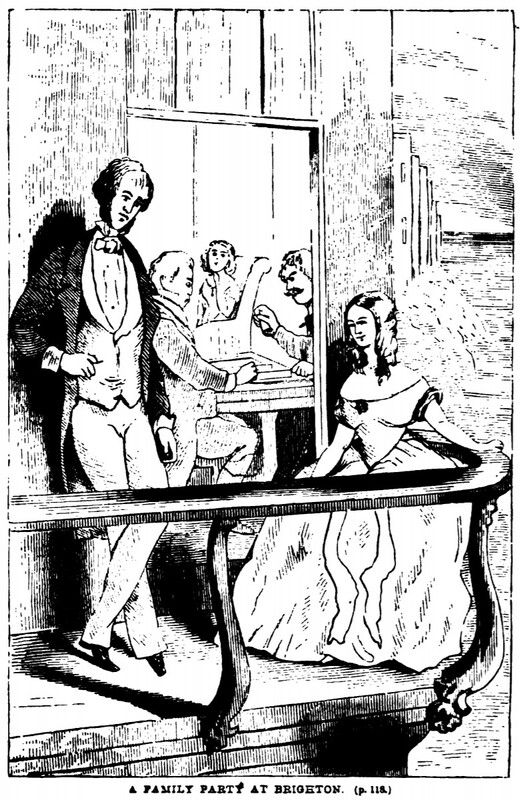
George Osborne and Rebecca Crawley are on the balcony of the inn at Brighton, looking at the ocean. He is leaning against the building, facing out, while she is seated by the railing, facing him. Through the doorway, Joseph Sedley and Rawdon Crawley can be seen inside at the table, playing backgammon. In the far background, Amelia Osborne is sitting alone in an armchair, looking forlornly at the others. Below the illustration is printed its title and location in the story, A FAMILY PARTY AT BRIGHTON. (p. 118.).
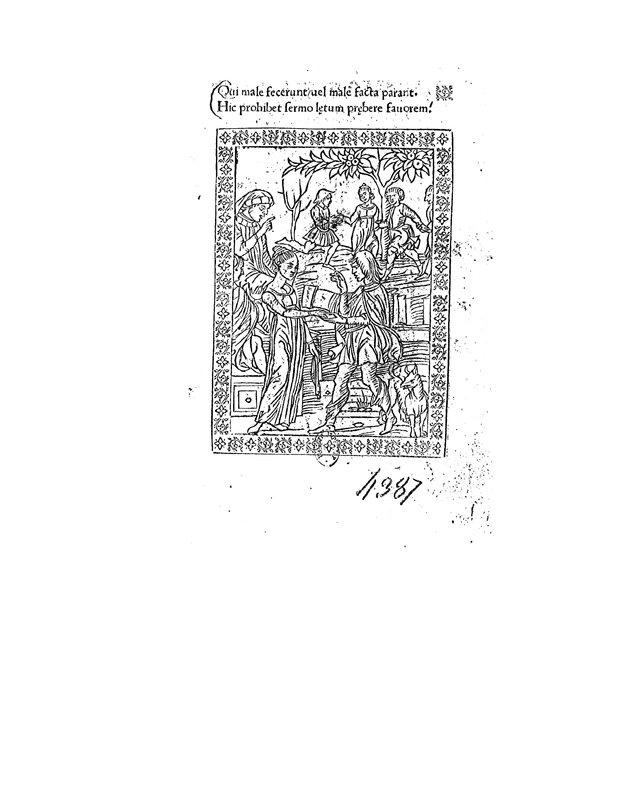
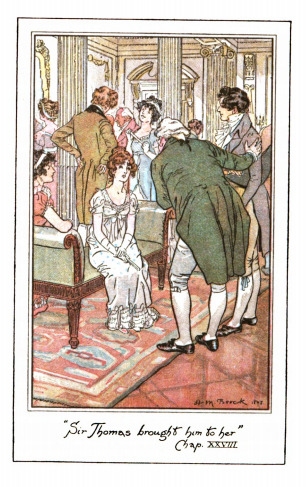
Here we see Sir Thomas bringing Mr. Crawford over to Fanny at the ball. Sir Thomas gave the ball in honour of William’s visit to Mansfield. It was at this time when Mr. Crawford decided he wanted to make Fanny love him. At the ball, Sir Thomas came over to ask if she had a partner for the first dance. She answered that Mr. Crawford had engaged her for the first two dances. Then Sir Thomas told her that she was to open the dancing with Mr. Crawford. She was shocked and tried to convince him that Edmund should open the dancing with Miss Crawford because she was very shy. Sir Thomas insisted, and Fanny relented and began the dancing with Mr. Crawford. This scene occurs in chapter 28 as noted underneath the title of this image. The characters are shown in the traditional regency style. Fanny wears the regency style dress with an empire waist. Her hair is worn tied up. She holds a fan in her hand. A fan in this era was often used to signal to communicate with others at the party. Using the fan, a woman could signal if she was married, single, or engaged, that she was being watched by a chaperone, that she loved another man, among other things. Sir Thomas and Mr. Crawford wears a waistcoat and tailcoat, and knickers that stop at the knee. The regency period dated to the early nineteenth century (1811-1820) when George, Prince of Wales, later George IV (r. 1820-1830), reigned as regent for his mentally ill father, King George III (r. 1760-1820). The regency period is associated with the rise of neoclassicism in art and fashion.
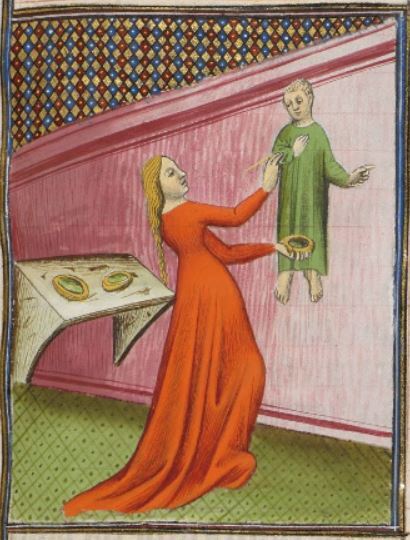
This illumination depicts a woman named Irene painting a figure of a child on the wall in front of her. There is a table beside her with her painting tools laying on top. Irene was a renowned, skillful painter during her time which Boccaccio believed to deserve praise as the arts were not a common practice of women. Boccaccio explains that Irene was the daughter of a man named Cratinus, who was also a painter (although much less renown).
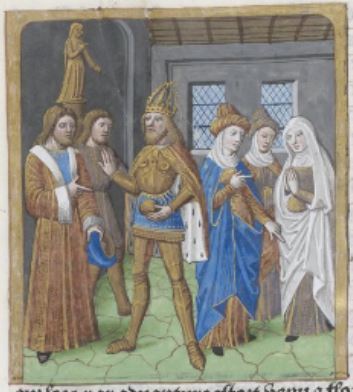
This image appears in the chapter that treats the Florentine maiden named Engeldruda. Engeldruda is famous for having spoken up against her father to protect her chastity. Boccaccio explains that Emperor Otho IV had gone to Florence for a festival, and when he noticed the beauty of Engeldruda, he asked her father who she was. Engeldruda’s father had offered her up to the emperor as if her chastity meant nothing to him. She spoke against her father for having done this. The emperor was so impressed with Engeldruda, he offered a nobleman named Guido to be her husband. Engeldruda is depicted on the right side of the image wearing a blue cloak speaking to two other women. Emperor Otho is presumably the man in the centre of the image as he is wearing a crown. Engeldruda’s father, then, is most likely the man speaking with Emperor Otho on the left side of the image.
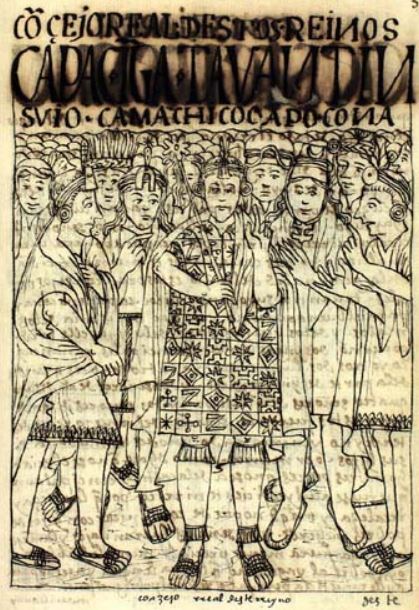
This chapter discusses the system of administrative officials in the Inca Empire. This image depicts the members of the royal council of the Tahuatinsuyo [Inca Empire] who aided in governing the empire. Tahuatinsuyo was a term to describe the four quarters of the Inca Empire, Chinchaysuyo, Antisuyo, Condesuyo, Collasuyo. Chinchaysuyo and Condesuyo are further divided into two regions: Hanan Cusco, and Hurin Cusco. The Hanan Cusco, Hurin Cusco, Antisuyo, and Condesuyo regions were each governed by two lords, while four lords each governed Collasuyo and and Chinchaysuyo. These council members were tasked with providing good governance to their region. The Inca, Capac Inca, is illustrated standing in the centre of the image, differentiated through his royal regalia. The other council members are depicted surrounding the Inca. The caption at the bottom of the image reads conzejo rreal deste rreyno [royal council of this kingdom].
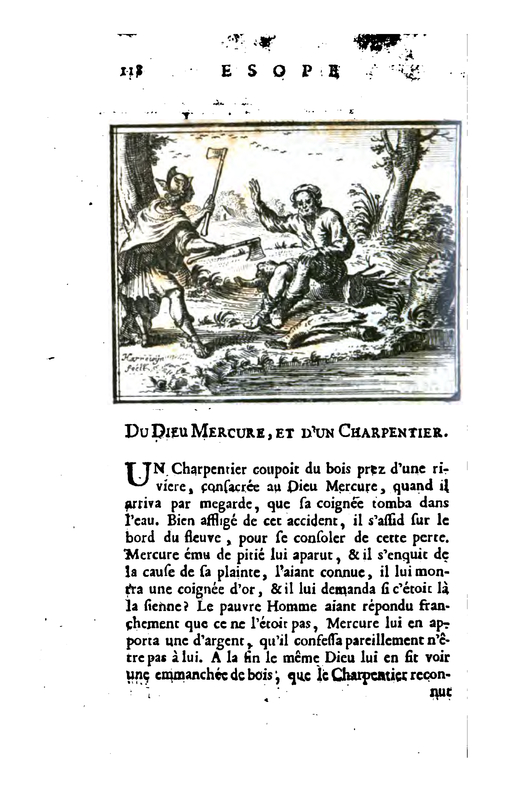
A carpenter cuts wood by a river, his axe fell from his hands into the water. The god Mercury appeared and asked what the trouble was. The carpenter told what had happened, and Mercury dived into the water. When he came up he held a golden axe. The carpenter was honest about the golden axe not being his. Mercury laid the golden axe on the bank and sprang back into the pool, this time he brought up an axe of silver. The carpenter again was honest about it not being his axe. Mercury dived down for a third time, coming up with the lost axe. The carpenter was very thankful for Mercury's help. Mercury was pleased with the carpenters honesty and rewarded him with all three axes.

![[Man In Bed]](https://collections.cemvc.ca/files/large/e50bc88853fc4e04f0f4a652c10976f76b003d48.jpg)

![[The Fox and the Sick Lion]](https://collections.cemvc.ca/files/large/dce1b0aa1a969c2f9b64b7e118d552838ad0dc5b.jpg)
![[Depiction of the separation between the Lilliputians and the Blefuscans]](https://collections.cemvc.ca/files/large/83d76e508ff3c13eae9d4854ab1ba1f79c0becb5.jpg)
![[The Bull and the Frogs]](https://collections.cemvc.ca/files/large/fb20e6e5796489a1e75d9cdfb085d776d4875be6.jpg)
![[Agriculture near the Tupinambá village]](https://collections.cemvc.ca/files/large/4e1ab2fefe5123c5935ad81b8d36eb2630d80386.jpg)