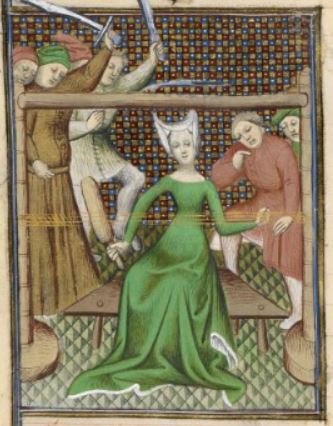
This image depicts Penelope, the wife of Ulysses, weaving in the centre of the image as she waits for her husband to return from the Trojan War. Penelope had many suitors over the 20 years that she waited for Ulysses to return home; however, Boccaccio explains in his story that Penelope remained entirely faithful over the duration of his absence. Penelope told the suitors that she would continue to wait for her husband to return until she was done weaving a cloth, which is why she is depicted weaving in this image. Each night, she would undo all the weaving she had done that day so she could continue waiting for Ulysses. There are suitors to the right of Penelope looking at her. When Ulysses finally returned home, he had slain every suitor in his palace. Ulysses and his servants are depicted standing on the left side of the image as they swing their swords to kill Penelope’s suitors.
Inside of a triangle, a woman leans over a large trophy with one hand on her chin. At the base of the trophy are a cross and a shape that may be a sphinx or a large dog. Beneath the triangle, the word SACRED is printed. Above the left side is a cut-off rectangle imprinted with O QUIES and above the right side is the letter T from The.
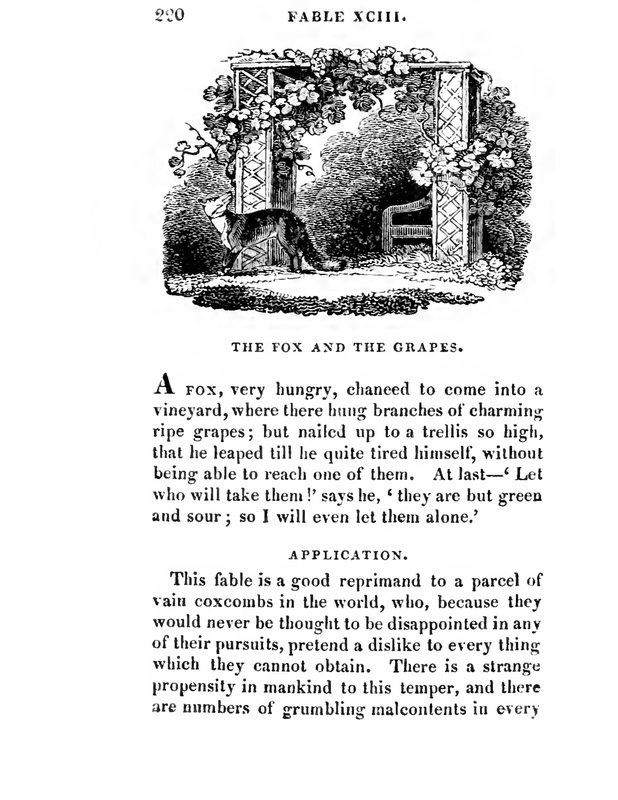
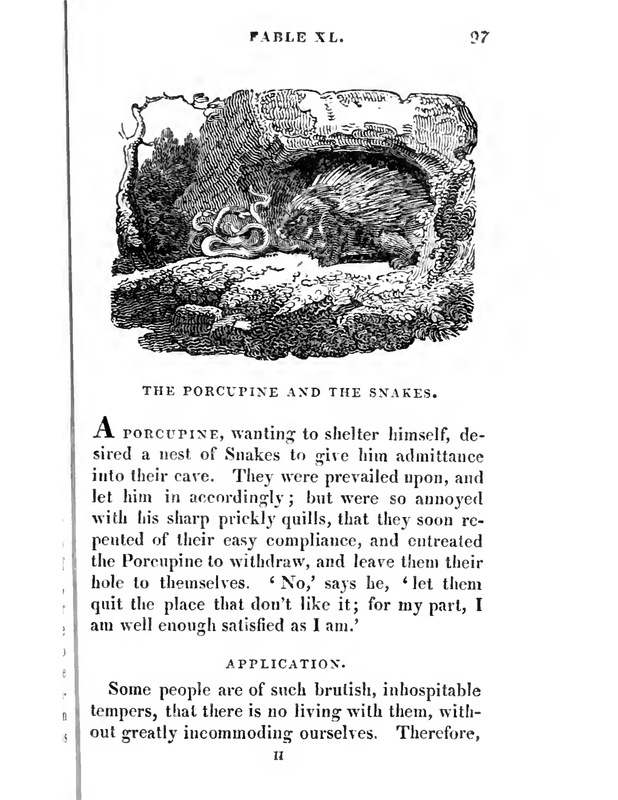
There is a small cave/burrow in the centre left of the image, raised up on some dirt. A porcupine is half out of the hole, facing left and angrily looking at many snakes directly to its left. The snakes are upright, and they appear to be coiled around each other. There is one tree in the background on the left and many bushes.
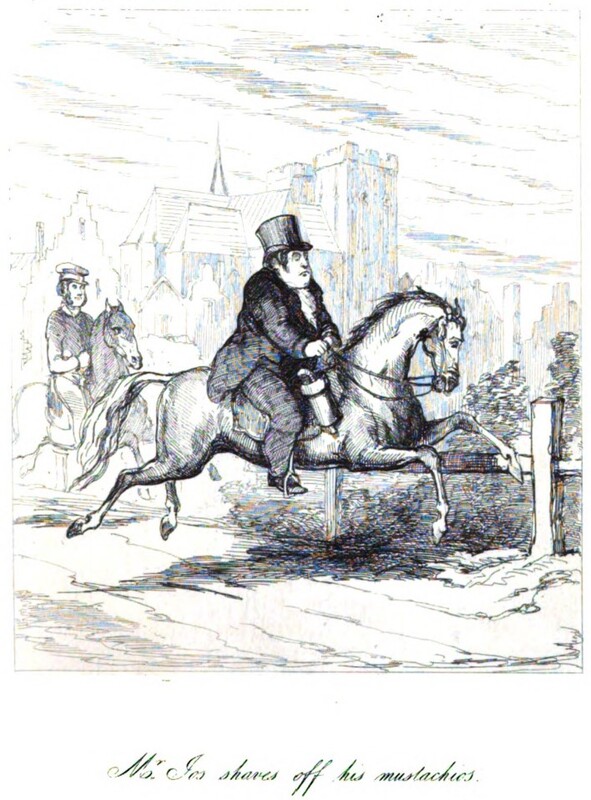
Joseph Sedley, freshly shaven, upon one of a pair of horses he has just purchased from Rebecca Crawley for an unreasonably large sum in order to flee from Brussels. Behind him is Isidor, his valet, on the other horse from the pair. Amelia has refused to go with the two, as her husband is still on the battlefield. Below the illustration is printed in cursive its title, Mr. Jos shaves off his mustachios.
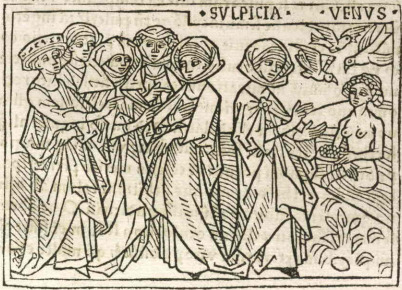
This engraving depicts Sulpicia, a woman renown for her chastity, consecrating a statue of Venus. Sulpicia is depicted on the right-hand side of the engraving with her hands reaching out towards the nude statue of Venus. We know that these figures are Sulpicia and Venus as their names are engraved above their heads. There are doves illustrated flying above the statue of Venus as dove’s are known to be one of many symbols of the goddess. There is a group of women depicted behind Sulpicia as they were all chosen as some of the most chaste women of their time, and they all voted for Sulpicia to be the one to consecrate the statue.
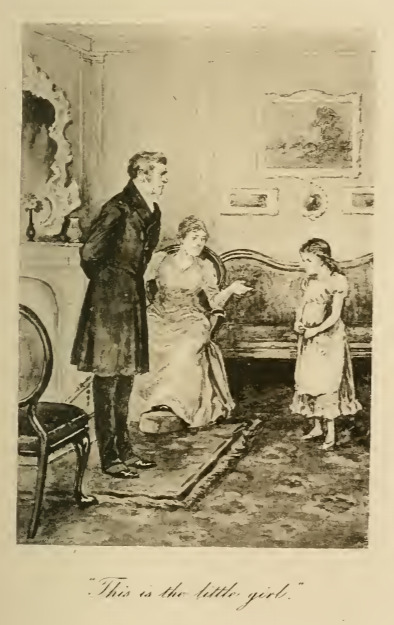
Here we see Jane meeting Mr. Brocklehurst at Gateshead Hall. Jane was sent to live with her aunt after her parents died, however after her uncle died her aunt became very neglectful of Jane. She expressed an interest in going to school, so her Aunt Reed found Lowood School, a charity school run by Mr. Brocklehurst, the pastor in the village near the school. Lowood was often neglectful of its children while it was run solely by Mr. Brocklehurst, however after a typhus outbreak in the spring after Jane’s first year Mr. Brocklehurst’s sole control was replaced with a committee on which he sat.
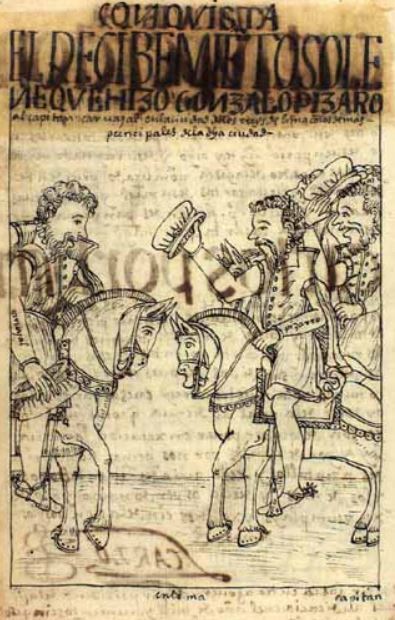
This chapter focuses on discussing the arrival of Spaniards and the Spanish conquest of Peru. This image depicts Gonzalo Pizarro on the right side of the image riding on his horse as he lifts his hat to greet Captain Francisco Carvajal. There are soldiers riding behind Pizarro accompanying him to greet Carvajal. Captain Francisco Carvajal is illustrated on the left side of the image on horseback, lowering his head as he accepts his greeting. Captain Carvajal is being greeted by Pizarro and his soldiers as he came to their aid to rebel against the crown of Spain. Captain Carvajal is identified by having his name written on his right sleeve, and Pizarro is identified by having his name written on his left sleeve. The caption at the bottom of the image reads en Lima [in Lima].
A European man is held captive inside a Tupinambá village, which is comprised of five long structures arranged in a pentagon and surrounded by a fence. The village is labelled ‘Uwattibi’. The man is shown having his hair cut by a Tupinambá woman in the left, and then on the right he is shown standing in a group of women with a rope tied around his neck. Several Tupinambá women hold both ends of the rope and dance around the man. There are two children present as well, and a monkey and parrot sit on top of one of the buildings on the left.
George Osborne and Amelia Sedley sit together on a chaise lounge, talking. Amelia is working on a bit of sewing, while George is leaning against her with his hat placed upside-down on the floor.
Two groups of Indigenous Brazilians engage in armed conflict. Members of both groups wield bows and arrows and clubs, and some bite members of the opposing group. Most of the men in both groups wear feathered headdresses and adornments around their waists, and some wear necklaces. Several men have fallen to the ground. This illustration is a simplified and mirrored version of the one found on page 71 verso of Paris, 1557.
During Gulliver’s stay on Lilliput, a fire broke out in the Imperial Palace, in the Empresses' apartment. Gulliver put the fire out by urinating on it. Here we see the Empress and two of her maids looking out of a large palace window after the fire. The Empress is in the centre and can be distinguished from her maid and lady-in-waiting by her headpiece and clothing. The maid is on the left and the lady-in-waiting is on the right. Although the fire was in the Empress’s apartments, she chose not to return to those apartments after they had been refurbished given the manner in which Gulliver extinguished the fire. The same image appears in both the 1839 and 1843 Krabbe editions.
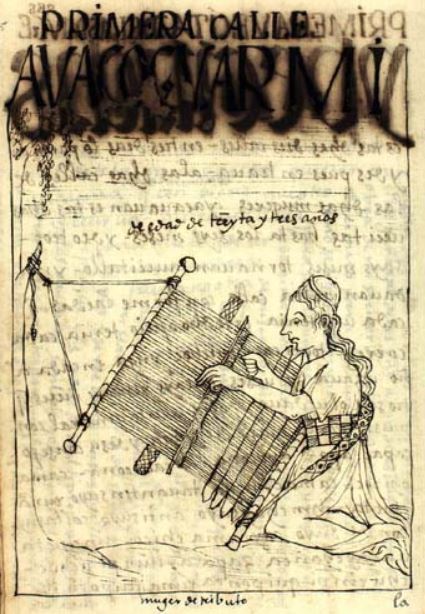
The author explains that there were ten paths for women to follow in the Inca Empire based on age division. This first group of women were called auacoc huarmi [weaver woman]. These women were the wives of warrior’s and were thirty-three years old when they married their warrior husbands. Their duties were to weave garments for the Inca, captains and soldiers. The woman in this image is depicted kneeling while weaving from a loom which appears to be strapped around her back. The caption on the image reads de edad de treynta y tres años, muger de tributo which translates to thirty-three years old, woman tribute.
Astonished by the concept of clothing, Gulliver’s master examines both his clothes and his body. His Master noted that Gulliver’s body was different from that of the yahoos, in colour, softness and smoothness of the skin, and lack of hair, saying he must be a perfect yahoo. This reflects the European prejudice against Native Americans. Gulliver explained to his master why Europeans wear clothing, both for decency and for protection against the elements. His master questioned why someone would want to hide what nature had given them, as the Houyhnhnms were not ashamed of their bodies. Nevertheless, his master told Gulliver to do as he wished. The same image appears in the 1843 Krabbe edition.
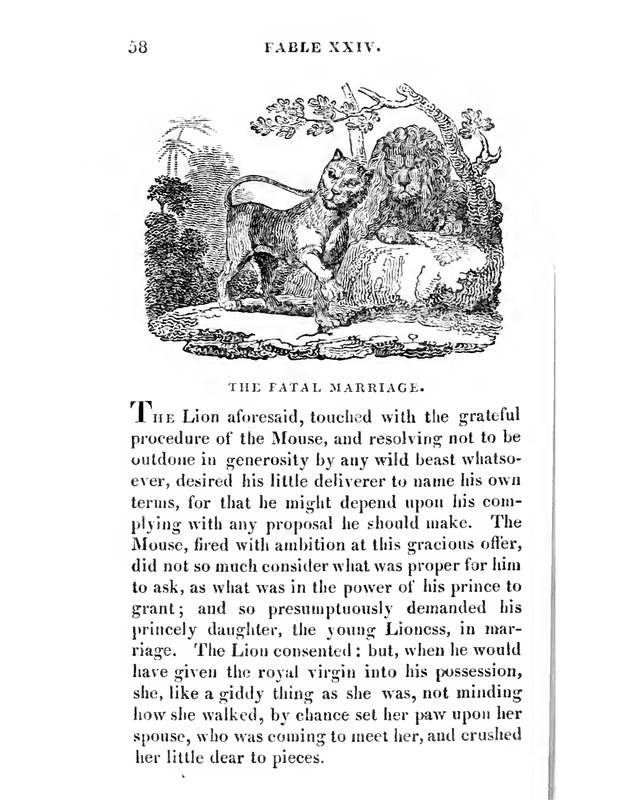
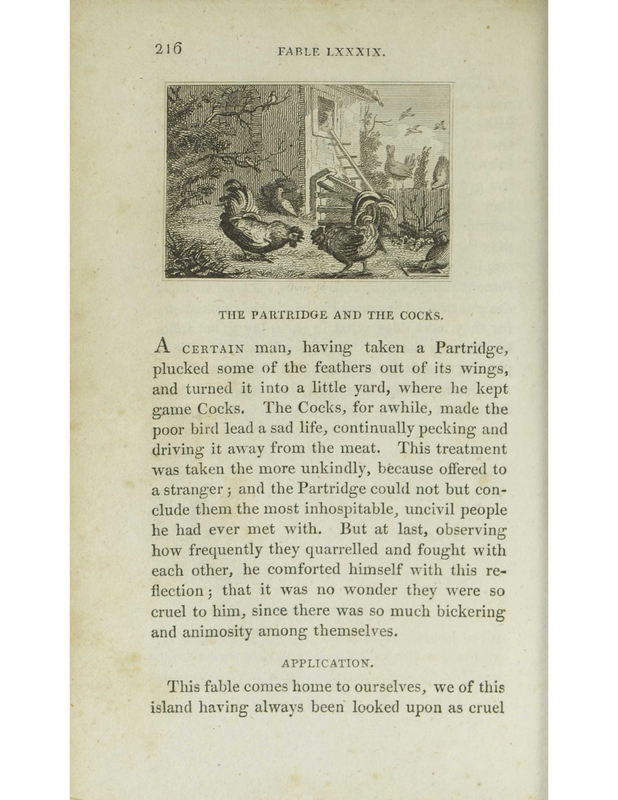
This image depicts two lions, one male and one female. The male lion is lying on a rock above the ground, with the female lion standing in front of him. Surrounding them is a series of trees and branches.
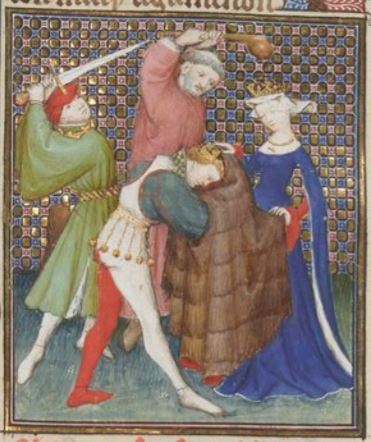
Queen Clytemnestra of Mycenae is depicted on the right side of the illumination wearing a crown and a blue dress. The man she has been having an affair with, Aegisthus, is depicted holding a sword beside her. Aegisthus and Clytemnestra conjured a plan to kill Clytemnestra’s husband, King Agamemnon, in order to gain control of Mycenae. Clytemnestra gave Agamemnon a piece of clothing that had no neck hole. He is depicted putting his head into the garment. As he struggled with the clothing, the adulterer Aegisthus pierced Agamemnon with a sword. Orestes, the son of Agamemnon and Clytemnestra, sought to avenge his father’s death. He is depicted on the left side of the image swinging a sword towards Aegisthus.
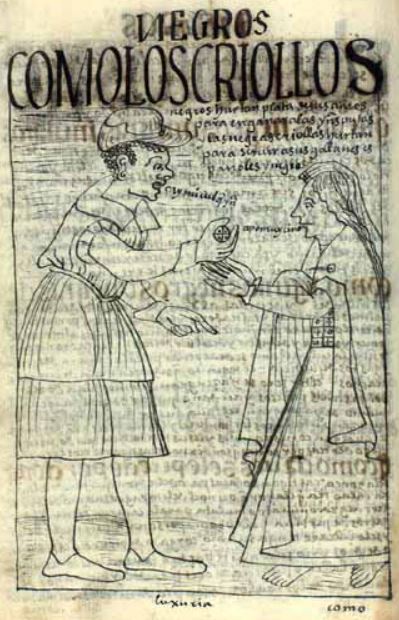
This image depicts an African slave on the left side of the page as he gives money to an indigenous woman on the right. The slave is dressed in Spanish clothing while the indigenous woman is dressed in her own culture’s traditional clothing. The author explains that some slaves in colonial Spanish society in Peru would steal their master’s money because they would not feed them. He also says that the slaves sought money for native prostitutes. There is dialogue written by the man’s mouth which reads, caymi culque yndia [here’s some money, indian]. The woman replies, apo muy cino [Lord, dear sir].
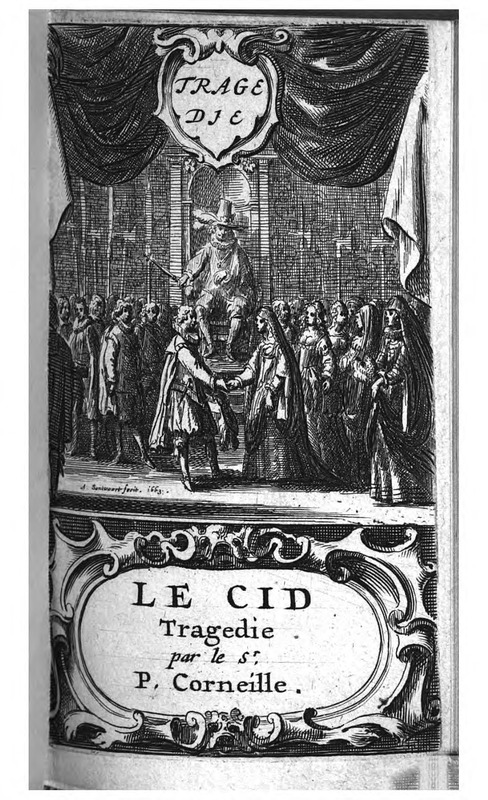
Don Rodrigue and Chimene stand holding hands in front of King Don Fernand and a crowd of nobles including most of the other characters of the play. This reunion occurs at the end of the play, after Chimene has revealed that she still loves Rodrigue despite the fact that he killed her father in a duel at the beginning of the play. She is not ready to marry him, however, and so the king decides to send Rodrigue off on a campaign in the hopes that this will give Chimene time to deal with her grief and Rodrigue a chance to prove himself to her.

![[Vanity Fair Chapter XXXIV Inhabited Initial]](https://collections.cemvc.ca/files/large/485be5f738e818d7f0458890ab4b614b854c317b.jpg)

![[Inside a Tupinambá village a European man is held captive]](https://collections.cemvc.ca/files/large/1229b1f17fd89242a72c530a179d33139af70815.jpg)
![[George and Amelia]](https://collections.cemvc.ca/files/large/a88f06240a274920a2986e387ff6458a946d1de0.jpg)
![[Two Indigenous Brazilian groups in conflict with each other]](https://collections.cemvc.ca/files/large/a2ddc43212099eb524dc13bcf4ecbfc7887d96d8.jpg)

![[The Empress and her ladies look out the window at the fire]](https://collections.cemvc.ca/files/large/2b0239867c42a3a8433028e41564630fb0279c08.jpg)
![[Gulliver’s master examines his body]](https://collections.cemvc.ca/files/large/bc400cf4d7b50aaea49e8f27b88e2e087b68f2eb.jpg)