A Tupinambá Indigenous village is shown from above. The village consists of four long buildings end-to-end, arranged in a square. There are two fences surrounding the village, a tall outer fence that circles the village, and a lower inner fence arranged in a pattern around the four buildings. At the entrance to the village there are several skulls mounted on long poles beside the fence.
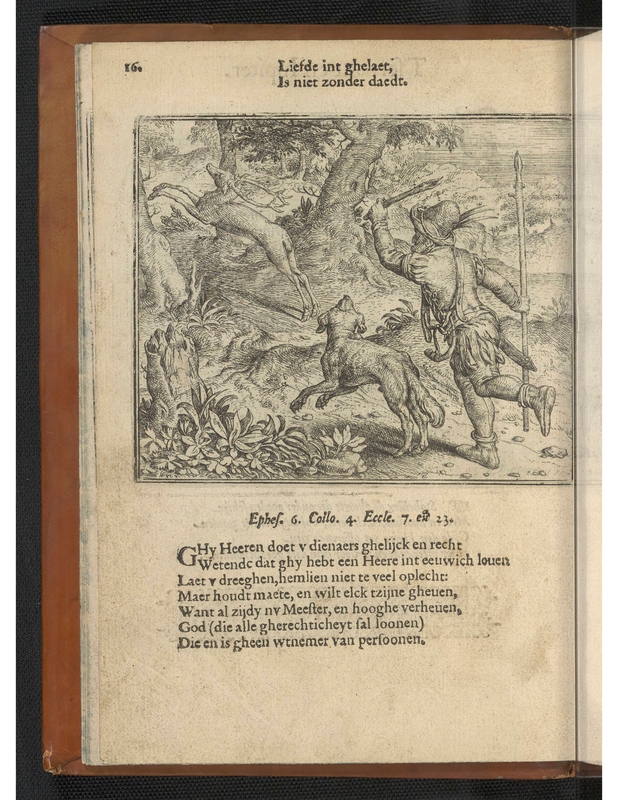
A man and dog chase after a deer in a forest. The man runs with a long spear in his right hand and a short spear in his right. The dog is running at his side. The deer has long antlers and is running into the forest on the left-hand side of the page.
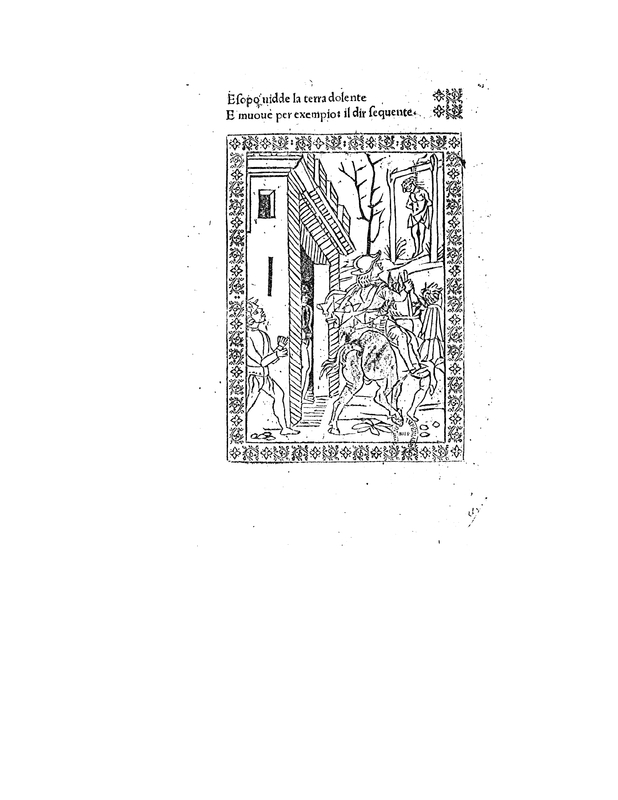
There is a person who has been hanged on top of a hill in the background. There is a man on a horse on the right in the forefront there is man on a horse at the bottom of the hill looking up at the person who has been hanged. There is a man infront of the building on the left also looking up at the hanged person. A fourth person can be seen in the shadow of the entrance to the building.
Amelia Osborne stands with her head tilted slightly to one side, with one hand held to her chest and the other holding a closed fan by her side. She is framed in the letter C from Conducted.
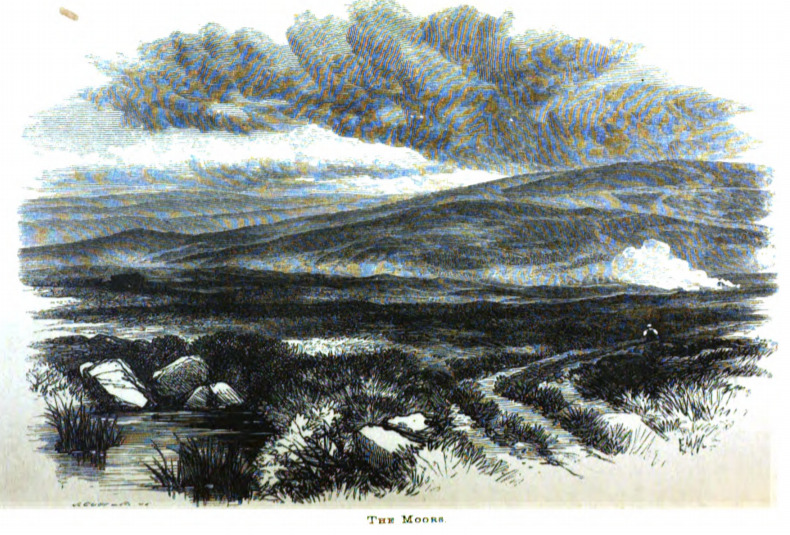
Here we see the Moors of Northern England. Wuthering Heights takes place in the stormy Moors of Northern England, depicted here. A small figure walks along the Moors, a common pastime in the novel. Dark clouds loom above the Moors as it was almost always storming in the novel.
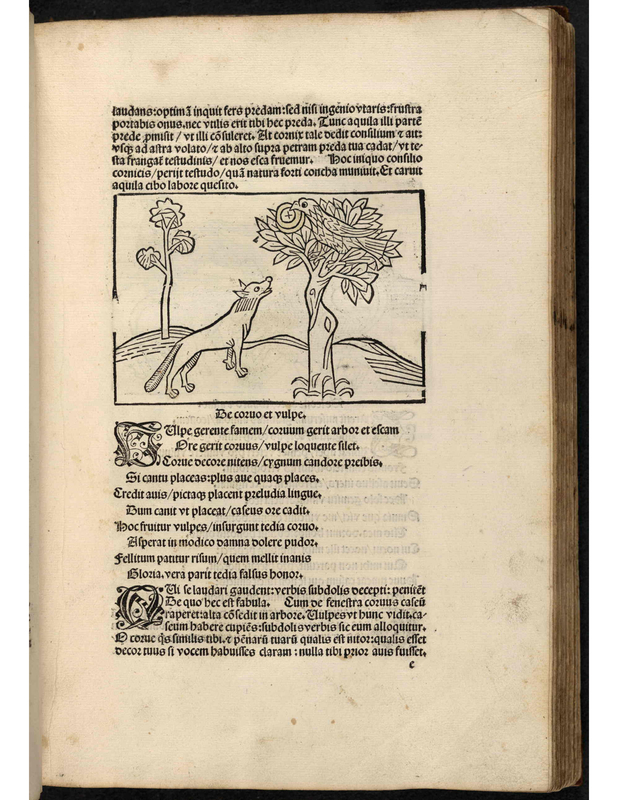
In a field, a group of four peacocks are surrounding what looks like a large crow or a pigeon. The tow peacocks on the right-hand side are looking down at the other bird with their heads bent towards it, one of them has some weeds in its mouth. The other two peacocks on the left-hand side, their heads remaining leveled, but their eyes on the other bird. One of those two peacocks is eating weeds as well. The other bird has weeds in its mouth as well.
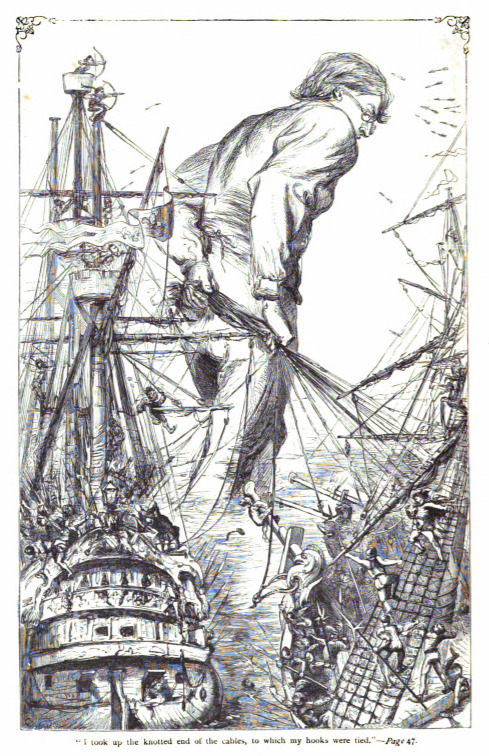
Here Gulliver pulls Blefuscudian ships back to Blefuscu during the war between Lilliput and Blefuscu. Gulliver threw ropes with hooks that attached to the ship and waded across the water. Gulliver then picked up the ropes and pulled the ships away from Lilliput and back to Blefuscu.
This image depicts what appears to be the author of the book, Giovanni Boccaccio. He is sitting in a study with a burning fire in the background and he is holding a book in his right hand which is presumably the book in which this image appears. He has white hair as he composed De Claris Mulieribus in his older age.
In this image Gulliver puts out a fire in the Empress’s apartments on Lilliput. He does this by urinating on the fire. Gulliver stands in the centre of the palace, and the fire is coming from the wing closest to the viewer. Several Lilliputians work to put out the fire with some spraying hoses and climbing ladders to get into the palace. In the foreground we see other Lilliputians trying to rescue some of the precious goods from the burning Palace. Gulliver successfully put out the fire, however this incident was one of the reasons later used by the Lilliputians to charge Gulliver for treason and forcing him to leave Lilliput after nine months. The same image appears in the 1843 Krabbe edition.
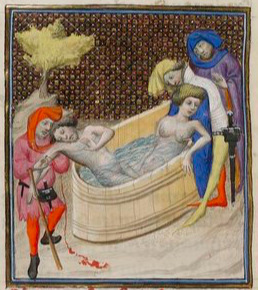
When Seneca was ordered to die by Nero, Pompeia Paulina wanted to die with him because her love for him was so dear. To die in the same way, she got into the same warm bath tub as Seneca, and cut open her veins so that she could bleed out too. Her slaves saved her when they entered the room and found her bleeding. In the image, Seneca and Pompeia Paulina are both in the bath tub. He is on the left, bleeding and dying as his arm is cut by a man, while she is on the right being pulled out of the bath tub by her slaves.
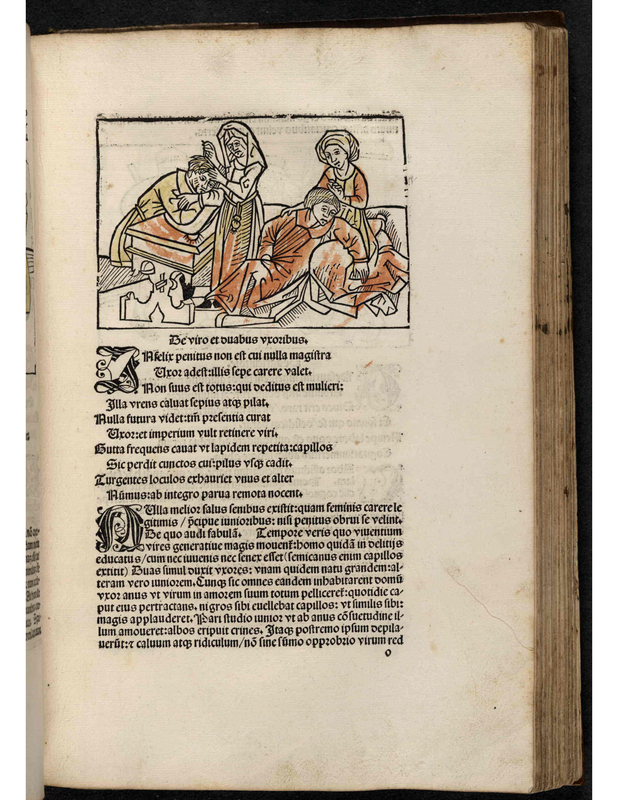
One man leans on an alter/table while a woman in a veil and ‘G’ on ger sleeve combs this hair. Another man is laying on the floor, leaning on another woman, who has one hand on his shoulder and another over his head.
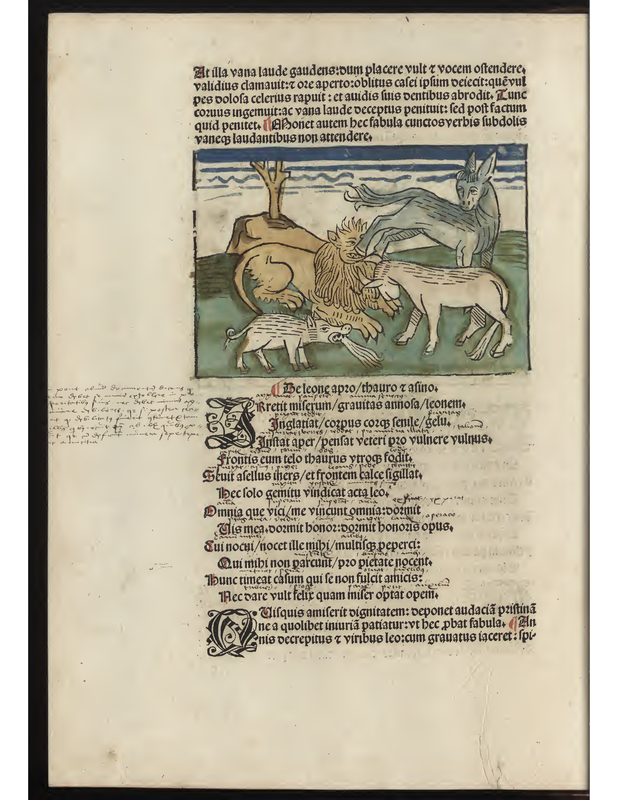
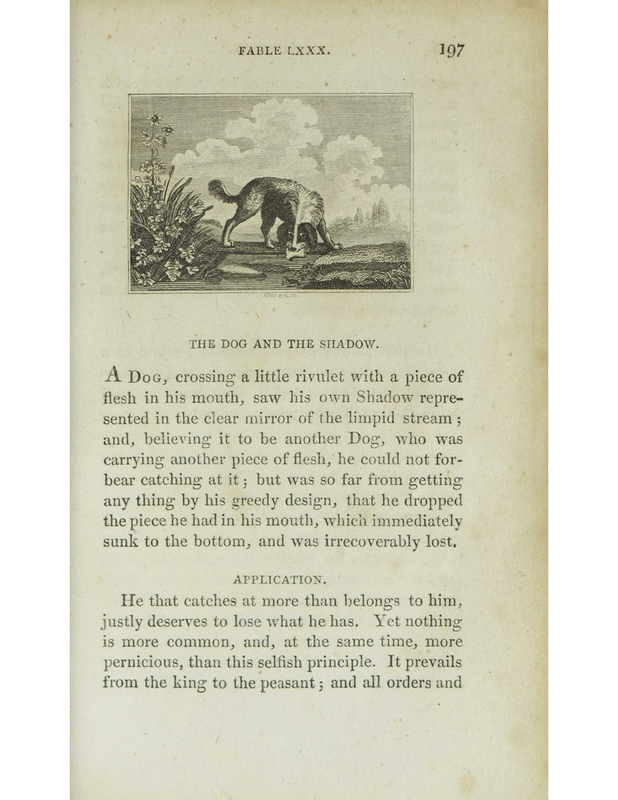
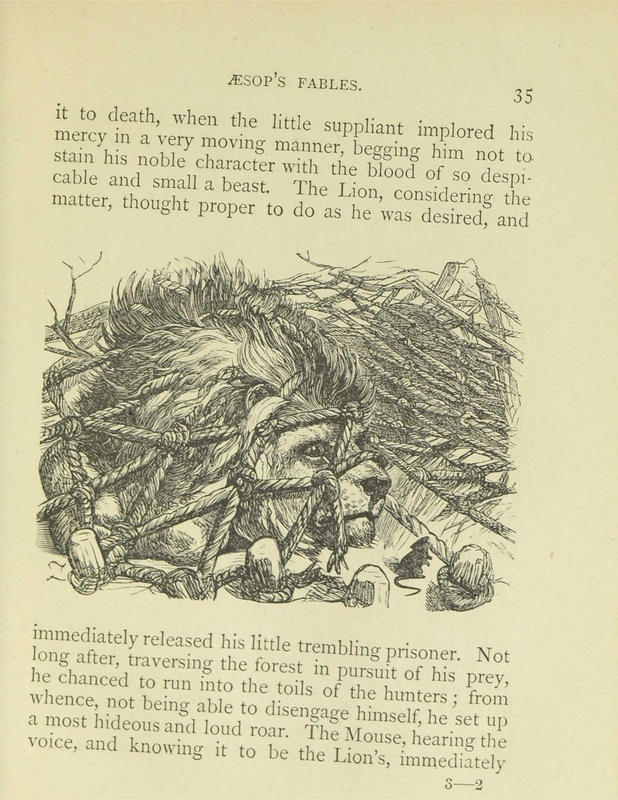
A Lion, faint with heat and weary with hunting, was laid down to take his repose under the spreading boughs of a thick shady oak. It happened that, while he slept, a company of scrambling Mice ran Over his back, and waked him.
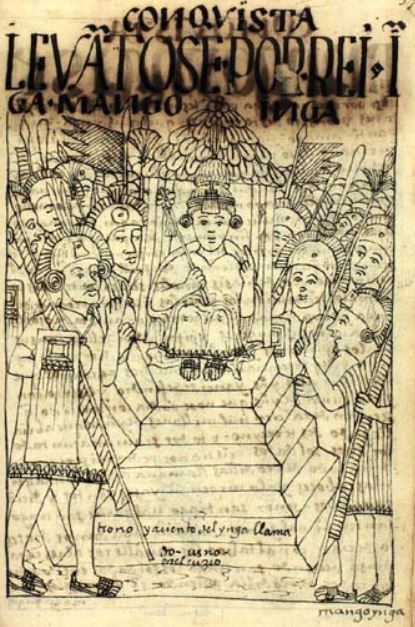
This chapter focuses on discussing the arrival of Spaniards and the Spanish conquest of Peru. After the conquistadors had murdered Capac Apo Guaman Chaua, a noble lord second in command to the Inca, the people of the Inca Empire rose and rebelled against the Spaniards to defend their kingdom. This image depicts Manco Inca sitting on his elevated usno [throne] in the centre of the image with his loyal troops surrounding him. They are all carrying spears and shields as they prepare to face the Spaniards. The caption at the bottom of the image reads, trono y aciento del ynga, llamado usno, en el cuzco [throne and seat of the Inca, called usno, in Cusco].
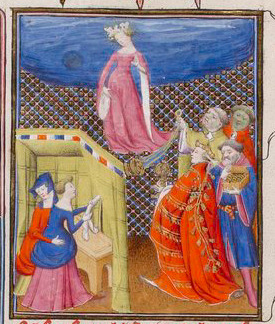
Queen Juno, goddes of wealth, marriage, and childbirth, is represented at the top of the image, wearing a pink dress. She was originally considered to be the queen of heaven, which is represented in this image as she floats above the mortals. The people surrounding her are Romans performing ceremonial rituals in her honor.
In the foreground and to the left, we see a female figure knocking on the door of a house. Her long veil and slightly more aged appearance indicate that this is meant to represent Celestina. In her left hand she is holding either a lantern or a bag. In the foreground and to the right, we see a male figure (Calisto?) walking toward the house with a horse. A figure (Melibea?) watches from a window in the top left corner, and two other figures (perhaps Melibea’s parents Alisa and Pleberio) watch from a balcony.The entire image is identical to the one found on page 13 of the text.
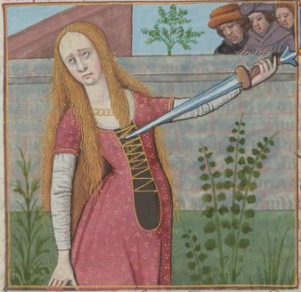
This illumination depicts a woman named Lucretia stabbing herself with a long knife. There are three men in the background of the image watching Lucretia carry out this act. Boccaccio explains that a relative of Lucretia’s husband (Collatinus) had raped her during the night. This man’s name was Sextus, and he had been welcomed into Lucretia and Collatinus’ home as a guest before he committed this crime. Lucretia told her husband, her father (Tricipitinus) and a relative named Brutus what Sextus had done to her. These are presumably the three men illustrated in the background. After she told them what Sextus had done to her, she killed herself in shame of what happened.
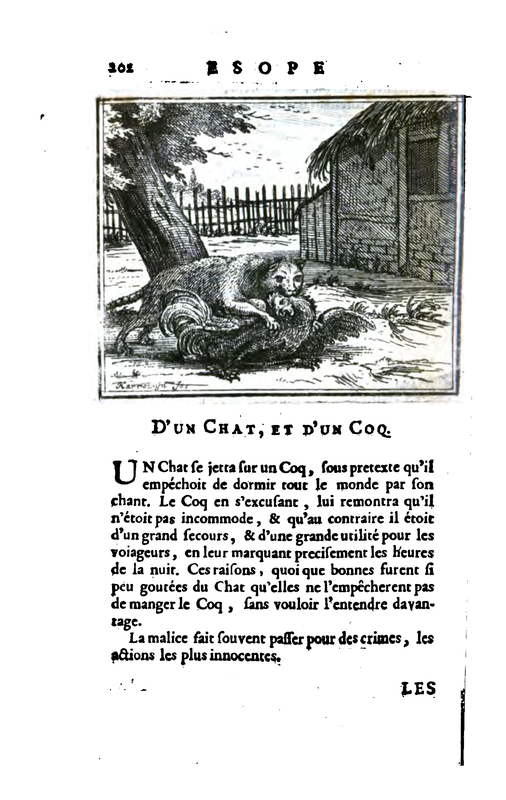
A cat appears to be pouncing on a rooster and has its mouth around the neck of the rooster. They are near a tree and a building. There is a fence along the back of the ilustration. The illustration has the signature of Harrewijn in the bottom left corner.
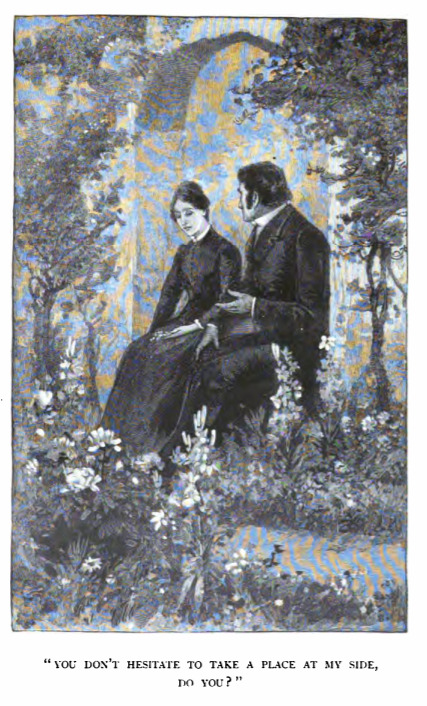
Here Jane and Mr. Rochester sit outside of Thornfield talking. Mr. Rochester initially tells Jane she must leave because he is marrying Miss Ingram. She begins to cry and says she cannot live without him. Mr. Rochester then confesses his love for Jane, and asks her to marry him, saying that Miss Ingram lost interest in him because he started a rumor that he was not as rich as she thought he was.
In this image we see the Lilliputian Emperor, Empress, and Prime Minister playing a game to determine the hierarchy of the court. The process involves courtier walking underneath sticks of different height. Depending on the height of the stick – held by the Emperor and Prime Minister – the participants are awarded different coloured uniforms. The uniforms are either blue, red, or green, and these colours indicate their place within the court. This episode was understood as a satire on the process of gaining knighthood in the English Court, where appointment as a Knight appeared to be based not on objective merit of the honour, but rather on the whims and bribes of King George I. The same image appears in the 1839 Krabbe edition.

![Figur der hütten un[d] stocketen](https://collections.cemvc.ca/files/large/b15cf3d63303582158c64edb306f2d939a7231b1.jpg)
![[Vanity Fair Chapter XXV Historiated Initial]](https://collections.cemvc.ca/files/large/ee0ea82aed5bb36e7604f2681857bb13f73d10e4.jpg)
![[The Four Peacocks and the Odd Pigeon]](https://collections.cemvc.ca/files/large/1fd038fcbc0abf4ab5e6dca9a9065b5a88585fde.jpg)
![[Boccaccio Sitting in His Study]](https://collections.cemvc.ca/files/large/bcca37f8c6ee86e318b834339f79c6dd9ccadd62.jpg)
![[Gulliver puts out the fire in the Royal Palace on Lilliput]](https://collections.cemvc.ca/files/large/64e56abe3d8640ee729aee331b7d55c4ccd9efeb.jpg)


![[Title Page – As Celestina Knocks on a Door, a Horseman Approaches and Three Figures Observe]](https://collections.cemvc.ca/files/large/c181167618817932de73c498e056c92d2795efc6.jpg)
![[Lilliputians play a game while Gulliver watches]](https://collections.cemvc.ca/files/large/82fadc6e2b255a463c222412c9536e7d51fb1d8f.jpg)