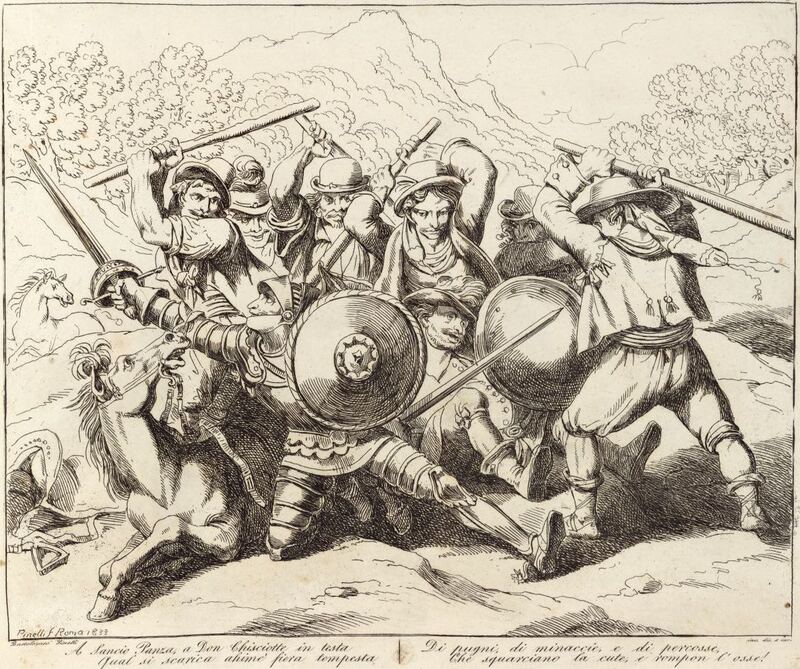
Don Quixote, Sancho Panza, and Rocinante are beaten by a group of Yanguesans. Signed by Bartolomeo Pinelli (engraver and illustrator) and dated Rome, 1833. Plate 19. Part 1, ch. 15.
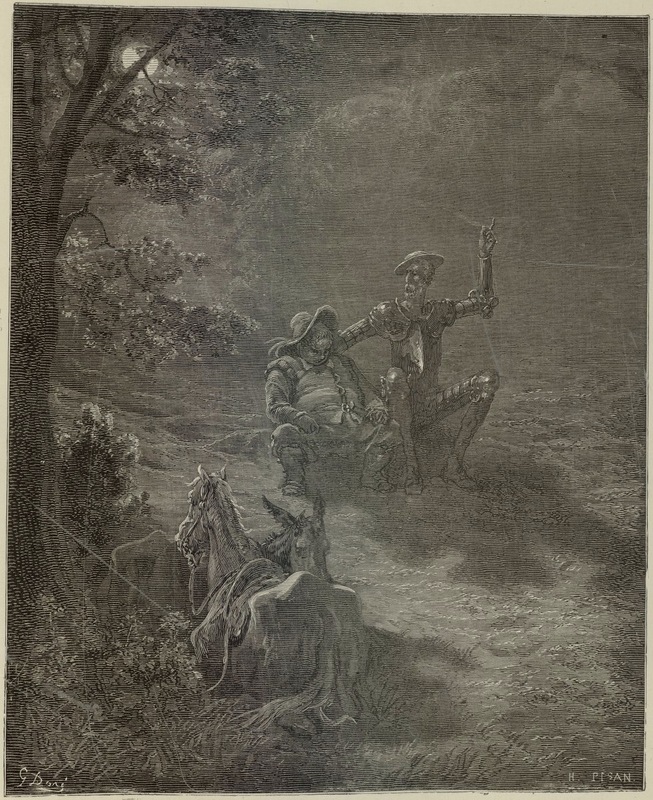
As night falls, Don Quixote and Sancho Panza talk about comedy before their encounter with the Knight of the Mirrors (Sansón Carrasco). Signed by G. Doré (illustrator) and H.-J. Pisan (engraver). Part 2, ch. 12.
Having told the story of how he gave up his government, Sancho Panza appears in a wretched plight, and takes the hand of the duchess. The woman seated on a tall and regal chair on the right (the duchess) takes his hand and looks off to her left, leaning forward as she does.
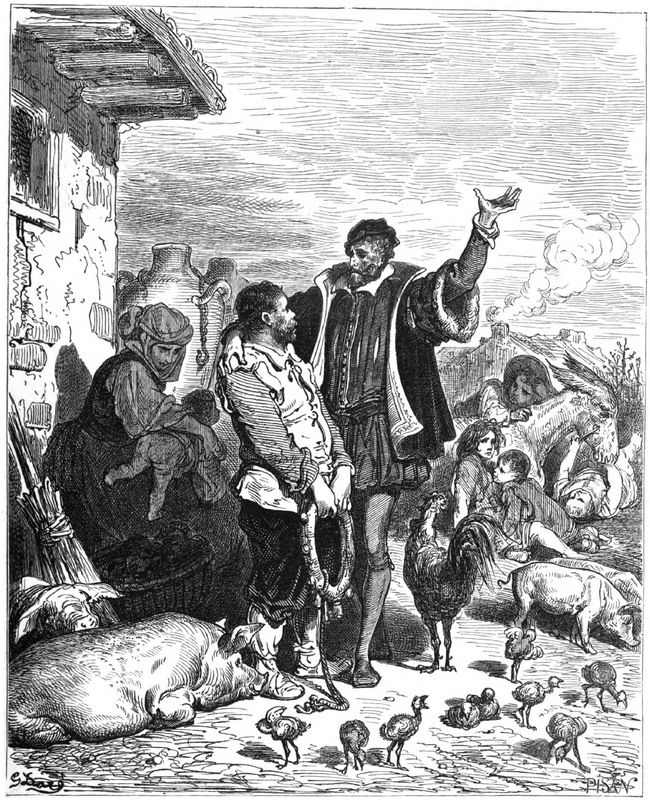
While recovering at home from his first sally, Don Quixote convinces a poor neighbour named Sancho Panza to join him and serve as his esquire. Don Quixote and Sancho Panza stand talking in Sancho Panza’s yard while scenes of domestic farm life surround them. Pigs and chicks lie in the foreground, a rooster stands by Don Quixote, a woman (presumably Sancho Panza’s wife) tends to a baby on the left, a man cares for a mule on the right and children play around them. This scene can be found in Part I, Book 1, Chapter 7.
A two story stone house stands in the midst of a plain, a small vineyard to the right, and a stable on the left. A flock of birds flies towards an opneing in the side of an extension of the house, raised off the ground. In the background on the right there is a town with a large spire. The image is occasioned by Sancho Panza saying "the hidalgoes say thatyour worship, not containing yourself within the bounds of gentility, have taken upon you the style of Don and invaded the dignity of knighthood, with no more than a paltry vineyard, a couple of acres of land, with a tatter behind, and another before."
Don Quixote lays hold of his sword and make thrusts all around him, crying as he swings because of a cat which seizes Quixote by the nose with its claws and teeth. The duke, hearing this, ran in all haste up to his chamber, to find the poor gentleman striving with all his might to disengage the cat from his face.
Two birds fly amongst the clouds. At the top, a heron flaps its wings with its legs trailing behind it. On the bottom, a duck glides pleasantly, its beak agape.
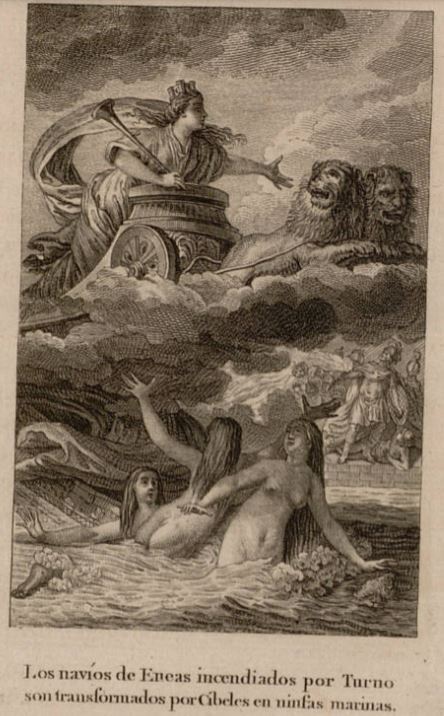
A battle between Aeneas’ army and Turnus’ army resulted in Turnus conjuring a plan to attack by burning Aeneas’ ships. The goddess Cybele, however, was furious because Aeneas’ ships were made from her favourite trees. Cybele interferes by riding past the battle in her lion-drawn chariot, as illustrated at the top of the engraving. She makes it rain enough to put the fires out, and to save the ships even further, she transforms them into nymphs. There are nymphs depicted in the water beside the ships to illustrate the transformation. The soldiers from the battle are depicted in the background of the image.
Don Quixote and Sancho Panza are mounted on Clavileño, the famed wooden horse. Two servants simulate its flight with bellows and torches, while another ignites its fuse. The duke and the duchess, seated beneath a grand tent in the background, look on. Unsigned. Part 2, ch. 41.
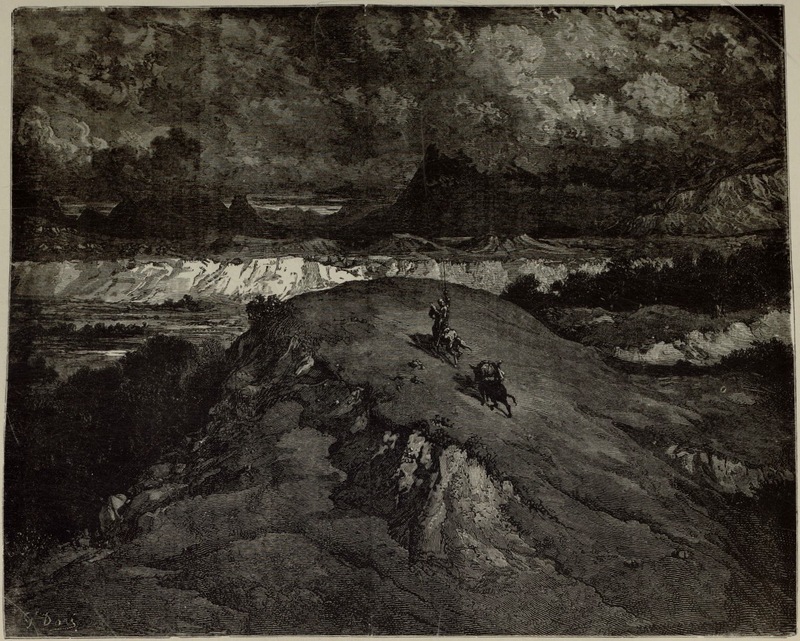
Don Quixote and Sancho Panza enter Sierra Morena at the top of a hill from where they can see the vast mountain range on the horizon. It is Sancho’s intention to cross the entire range and come out at Viso, or Almodóvar del Campo. In that rugged terrain they can hide for a few days and not be found if the Holy Brotherhood comes looking for them for having released the galley slaves. Signed by G. Doré (illustrator) and H.-J. Pisan (engraver). Part 1, ch. 23.
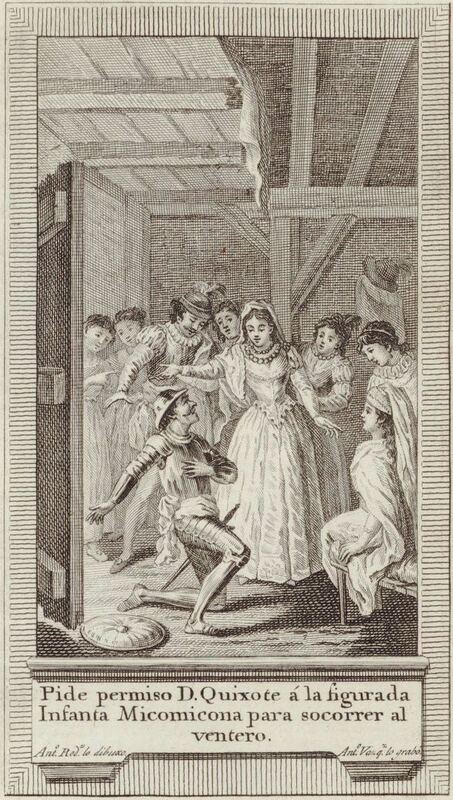
Don Quixote kneels before princess Mimicona (Dorotea) and begs for her permission to help the innkeeper, who is being beaten by two guests who attempted to leave the inn without paying what they owed. The innkeeper’s wife and her daughter beg Don Quixote to help her husband, but at first Don Quixote refuses to do so, replying that he cannot embark on an adventure until he has brought a felicitous conclusion to the one to which he is currently pledged. Also pictured are Don Fernando, Luscinda, Zoraida, Doña Clara, and others. Signed by A. Rodríguez (illustrator) and B. Vázquez (engraver). Part 1, ch. 44.
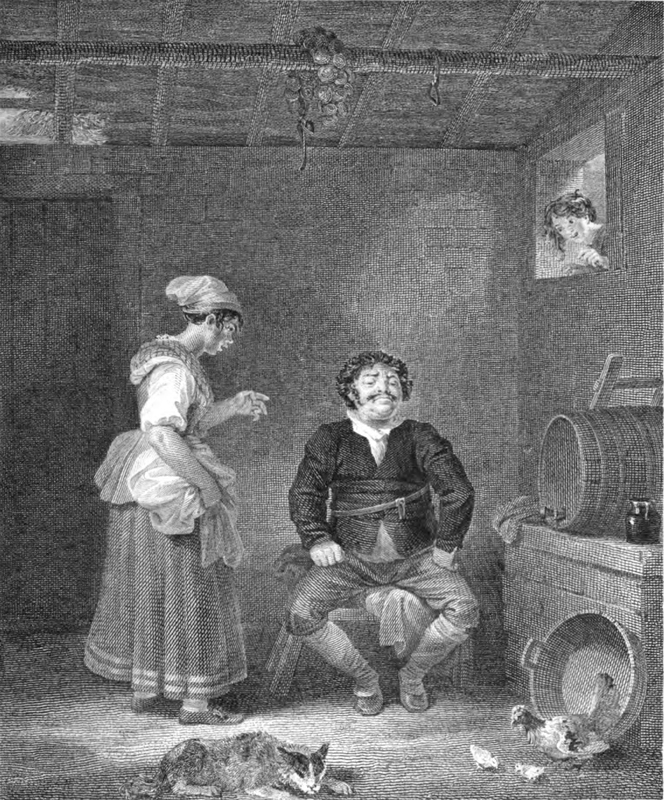
Sancho Panza debates with his wife Teresa in a cellar, Sancho seated on a stool with a stubborn expression and pose, Teresa standing to his left, trying to convince him not to return to the service of his master Don Quixote. They are watched by their daughter from a window in the top right. Other items in the image are a barrel and jug on a brick table on the right, basket below; a hen with two chicks and a cat lying in the foreground. A garland of onions hangs above Sancho Panza.
A moustachioed bald man with short horns and angelic wings hides behind a wooden cross, peaking out from behind the shadow, his feet dangling by the base. The image is occasioned by Quixote saying "I have heard say that the devil lurks behind the cross, and all is not gold that glitters".
A monkey on the right sits on his master's shoulder and puts its mouth to its master's ear, whispering into it. On the left, Master Peter, a black haired man with a patch over his eye listens attentively to the monkey.
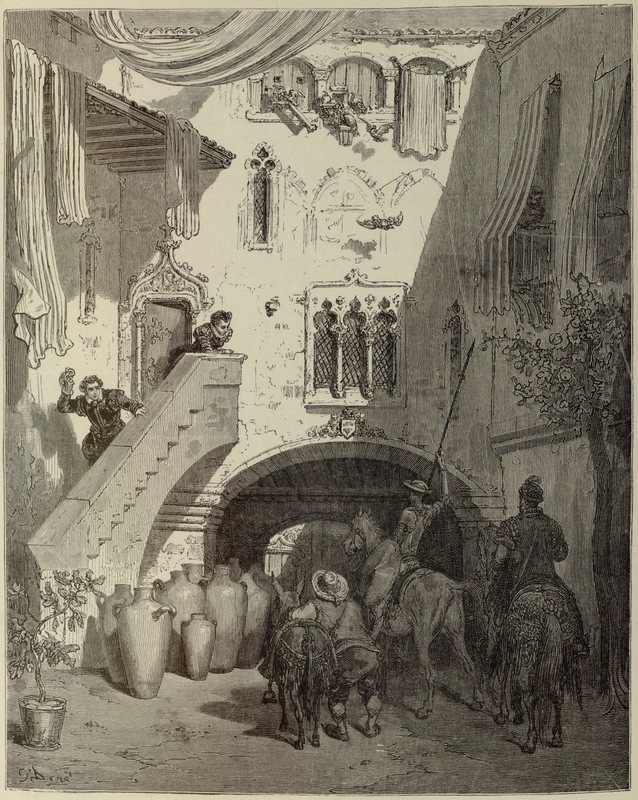
Don Quixote and Sancho Panza arrive at Don Diego de Miranda’s house, where they meet his son, Don Lorenzo, and his wife, Doña Cristina. In the courtyard, Don Quixote finds some tinajas from El Toboso that remind him of Dulcinea. Signed by G. Doré (illustrator) and H.-J. Pisan (engraver). Part 2, ch. 18.
At the soirée, Don Quixote dances with Don Antonio Moreno’s wife and some of her friends. Signed by T. Stothard (illustrator) and O. Birrel (engraver). Plate X. Part 2, ch. 62.
During master Peter's puppet show, an old man is pictured on the left with a crown on his head and a sceptre in his hand, meant to depict the emperor Charlemagne. The puppet on the right depicts Don Gaiferos' puppet, the son in law of emperor Charlemagne, who motions to walk off to the left of the castile. On the left a table lies on its side, having been flipped over, the remnants of a dice game lying on the floor.
A black bear (left) sinks its maw into the leg of a felled and bearded man amidst the forest. The image is occasioned by Sancho Panza remembering the verse of an old romance, which went "May Fabila's sad doom be thine, And hungry bears upon thee dine."
The illustration depicts one of Don Quixote’s visions in Montesinos’ cave: a procession composed of two lines of maidens, dressed in mourning and wearing white turbans, accompanies the matron Belerma, dressed in black and wearing a lengthy white train. She carries Durandarte’s heart, wrapped in cloth. Signed by D.-N. Chodowiecki (illustrator) and D. Berger (engraver), dated 1779. Plate 12. Part 2, ch. 23.
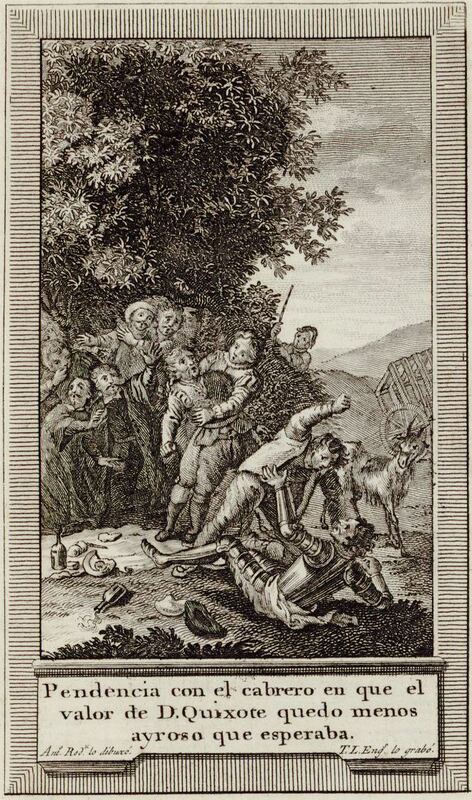
After Eugenio provokes him, Don Quixote seizes a loaf of bread and hits the goatherd with it full in the face. Eugenio leaps on Don Quixote and wraps both hands around his neck. Sancho Panza rushes to help Don Quixote, but is held back by the canon’s servants. The canon, the priest, the barber, and the officers of the Holy Brotherhood look on, some laughing. Eugenio’s goat is also pictured. Signed by A. Rodríguez (illustrator) and T. Enguídanos (engraver). Part 1, ch. 52.
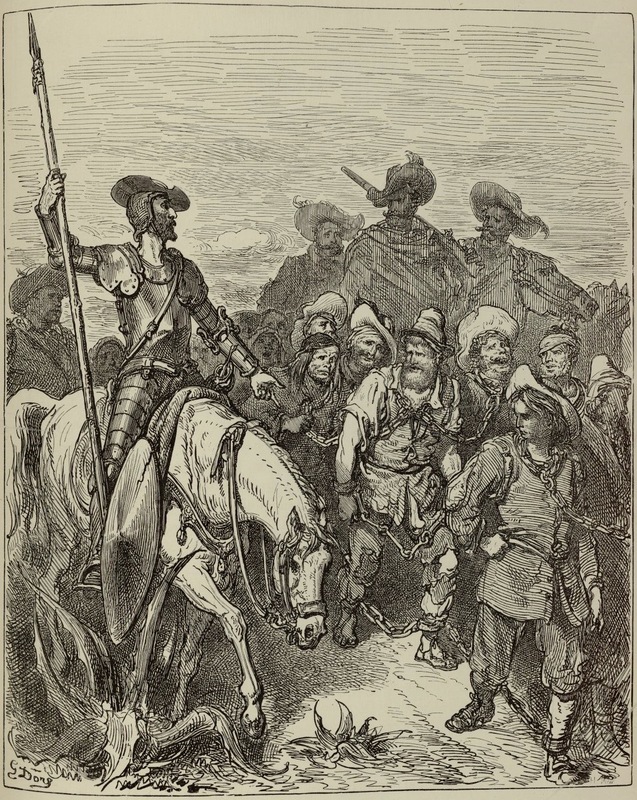
Don Quixote asks the galley slaves about their crimes. In the background, Sancho Panza and three of the soldiers on horseback are depicted. Signed by G. Doré (illustrator) and H.-J. Pisan (engraver). Part 1, ch. 22.
During his governorship of Barataria, Sancho Panza is led to a sumptuous palace in the great hall where a royal table was elegantly furnished. when the governor entered, and four pages came forth. Sancho took his place at the upper end of the table that was accommodated for one. To his left stood a physician with a rod of whalebone in his hand. A great variety of dishes were brought forward for Sancho and a page tucked a laced bib under Sancho's chin. Sancho was only able to taste one morsel when the doctor touched the plate with his wand, and it was taken away by a page. Another dish was presented, but this was touched by the wand just as quickly and another page took the dish away with incredible speed. The three pages in the foreground are young boys taking Sancho's dishes away after being given the signal by the whalebone wand of the physician (pictured to the right with a long white beard), who was enjoying this practical joke with all others who were in Sancho's presence.
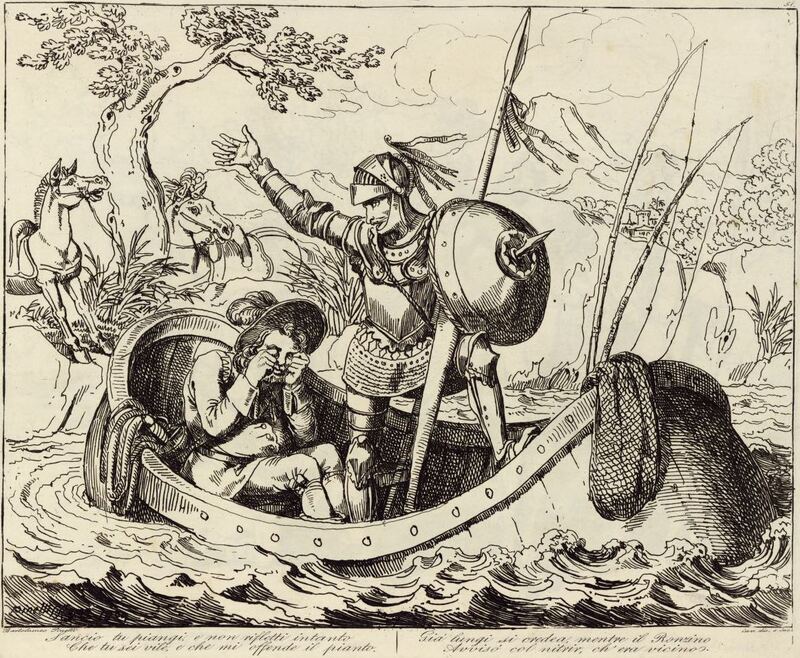
Don Quixote and Sancho Panza get into a boat on the Ebro River, leaving Rocinante and Sancho’s donkey on the riverbank. The boat lacks oars but two fishing poles are pictured in the bow. Signed by Bartolomeo Pinelli (engraver and illustrator) and dated Rome, 1833. Plate 51. Part 2, ch. 29.
Don Quixote (clad in armor) mistakes windmills for giants and speeds upon the first windmill he could come at, breaking his lance into pieces, and being hurled away to the ground. Sancho Panza ran as fast as his ass could drive to help his master, whom he found lying, and not able to stir.
In the foreground, Sancho Panza climbs a tree in fear. In the middle ground, Don Quixote is pictured driving his sword into a wild boar. In the background, the duke embraces the duchess. Also pictured are several hunting dogs. Signed by Bonard (illustrator), no given name, and L. Cars (engraver). Part 2, ch. 34.

![[The Duchess Embraces Sancho]](https://collections.cemvc.ca/files/large/e7a61666fc9eb38709e276cb81946544a2a0a713.jpg)
![[Don Quixote's Home]](https://collections.cemvc.ca/files/large/161a9b8dcccfb036d4d2d835467e9d76935e6edf.jpg)
![[Don Quixote Attacked By a Cat]](https://collections.cemvc.ca/files/large/f25dc0d0180343903616ab090b10685f43cef117.jpg)
![[Two Birds in Flight]](https://collections.cemvc.ca/files/large/040f982369eedccbe6077a9251547c46fcb3a746.jpg)
![[Don Quixote and Sancho Panza mounted on Clavileño]](https://collections.cemvc.ca/files/large/ad51e53cd0709a4f9be84db4cc2b680ec5e3e7fb.jpg)
![[The Devil Lurking Behind the Cross]](https://collections.cemvc.ca/files/large/c65e8dd3270234b25f4fc2d79952bc439a564344.jpg)
![[Master Peter's Ape Speaks into his Ear]](https://collections.cemvc.ca/files/large/c73349ada2f7f6bc0339e28ade402e8c19681956.jpg)
![[Don Quixote dancing with Don Antonio Moreno's wife]](https://collections.cemvc.ca/files/large/d7f88f590b4df8ec209702a618b4878a806ee4dd.jpg)
![[Of How Emperor Charlemagne's Puppet Scolded his Son in Law]](https://collections.cemvc.ca/files/large/f6382b1e6a3a084f2aeb4eca2797e04ee1a6f0f6.jpg)
![[A Bear Dines on Man]](https://collections.cemvc.ca/files/large/395929667edd243261f87e43bf415a98f80088e7.jpg)
![[Belerma's procession]](https://collections.cemvc.ca/files/large/a5e300ba4c11fa4588b4bb82da2cb6a1c121c316.jpg)
![[Of How Sancho was Refused Morsels as Governor]](https://collections.cemvc.ca/files/large/452f5819f9051af65a8c9a34d2af2b462b56b148.jpg)
![[Sancho Panza Rushes to Aid his Master]](https://collections.cemvc.ca/files/large/df5a3d6c872c3585c00afeeb98094c37a7de3dec.jpg)
![[Boar hunting]](https://collections.cemvc.ca/files/large/8a9d0df7d611dddf338118577bbea1529fae9d9d.jpg)