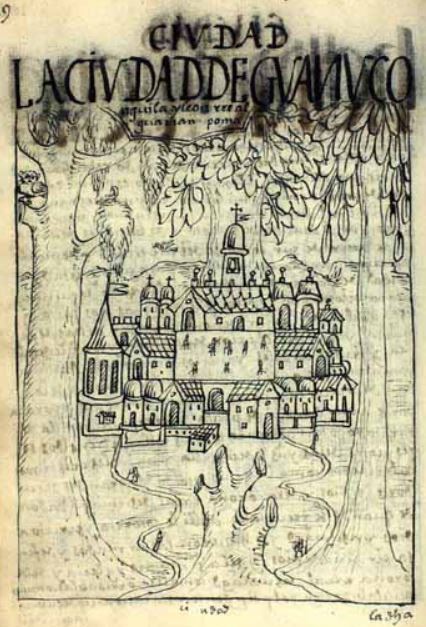
This image is depicted in the author’s chapter where he discusses cities, towns, villages, and provinces in colonial South America. This image depicts the city of Huanuco, Peru. The city is visible between two large trees that are in the foreground of the image. There is also a large tree illustrated behind the city. There are two winding pathways that lead into the city with people walking along them. The city is arranged as a cluster of buildings which forms a square in the centre of the town. There are eight people illustrated walking within the square. The caption at the bottom of the image reads ciudad [city].
A framed portrait of Joseph Sedley holding a gun while riding on the back of an elephant, with a native driver sitting behind its head. In the top right of the painting is the letter I, from If. The picture is tagged in the top left corner with a paper labelled LOT369.
Here we see an overturned boat that Gulliver discovered off the coast of Blefuscu. With the help of the Emperor’s largest vessel, Gulliver retrieved the boat and brought it back to land and spent several days fixing the bottom which was damaged. Gulliver then used this boat to leave Blefuscu and sailed off and was picked up by and English merchant’s ship. In the background is a lighthouse. Above the lighthouse is the letter T, because the first word of the chapter is Theils. The same image appears in the 1843 Krabbe edition.
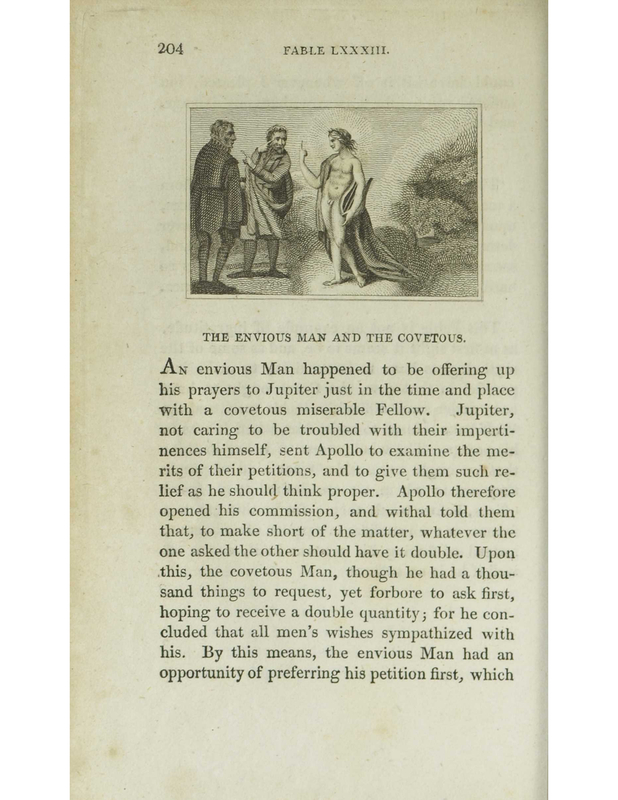
There is an illustration at the bottom of the page, and above this illustration is a body of text. In the illustration, a short man with curly hair is talking to a person in Holy attire. This short man is holding the holy person’s robe as he talks to him.
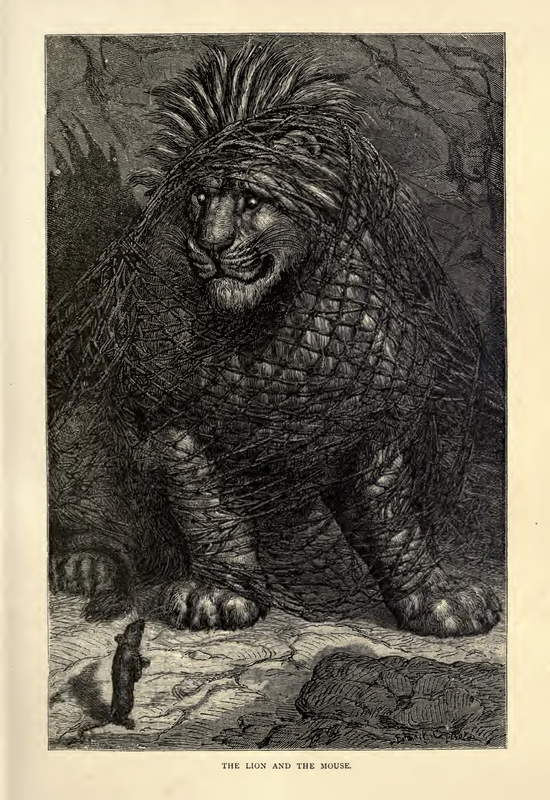
A large lion takes up most of the background of the image. The lion is wrapped in a net, with only its face sticking out. His eyes glow white. He is turned slightly to the left, where a mouse stands on its back legs looking up at the lion.
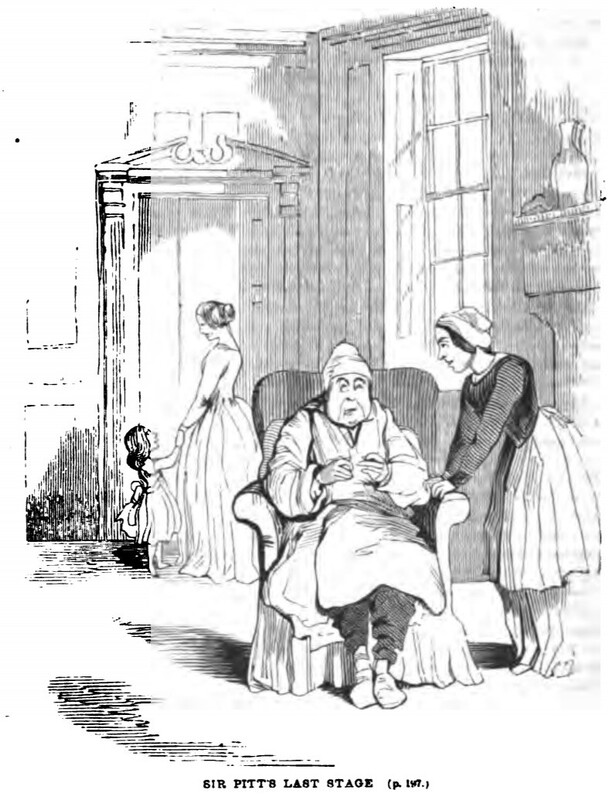
Sir Pitt Crawley, in a nightcap, sits in the chair in front of the fireplace in his apartments. Behind him, Lady Jane Crawley and her daughter, Matilda Crawley, are holding hands as they leave the room. Next to Sir Pitt, Miss Hester, now his nurse, has turned his chair away from the fire with a scowl on her face. Below the illustration is printed its title and location in the story, SIR PITT’S LAST STAGE (p. 197.).
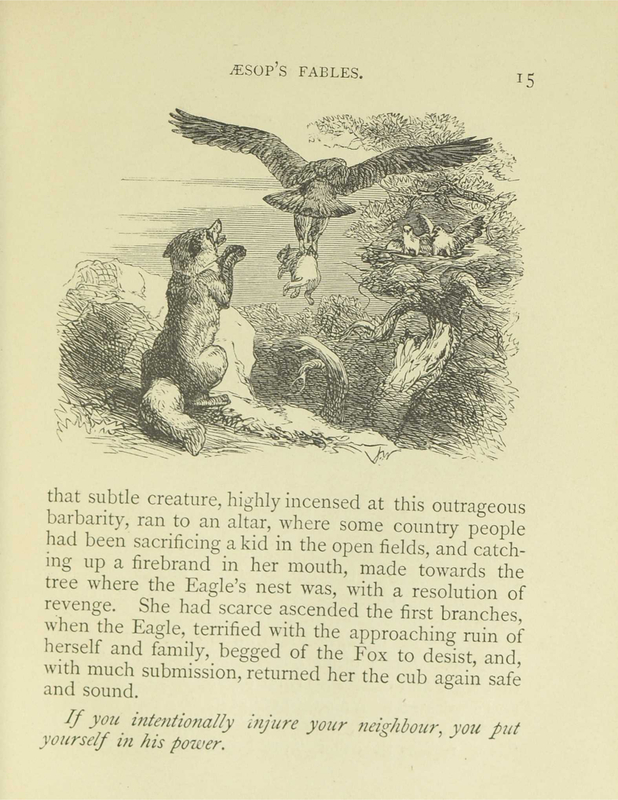
An Eagle that had young ones, looking out for something to feed them with, happened to spy a Fox's cub that lay basking itself abroad in the sun. She made a stoop and trussed it immediately; but before she had carried it quite off, the old Fox, coming home, implored her, with tears in her eyes, to spare her cub, and pity the distress of a poor fond mother who should think no affliction so great as that of losing her child.
A European ship is sinking near the coast of Brazil. A group of survivors stand on the shore, and a few more individuals make their way to shore holding on to debris from the ship. The islands of Saint Vincent and Saint Maro are labelled, as are two Indigenous settlements: Itege Ehm and Brigiaco.
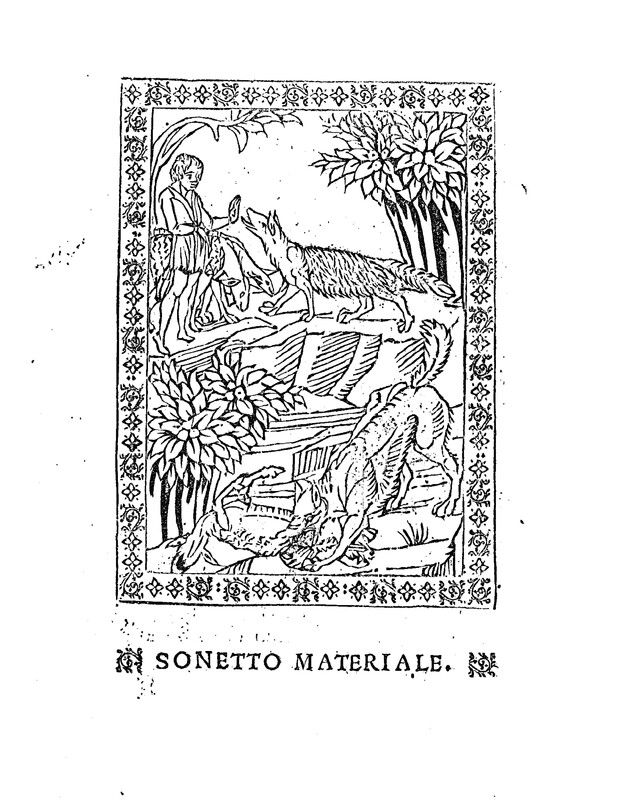
In this image, There is a wolf eating what looks like a fox. Above this, there is a wolf howling and aproaching a man who is with 2 sheep, he seems calm and is holding one hand out towards the wolf. The image is bordered by a vine design
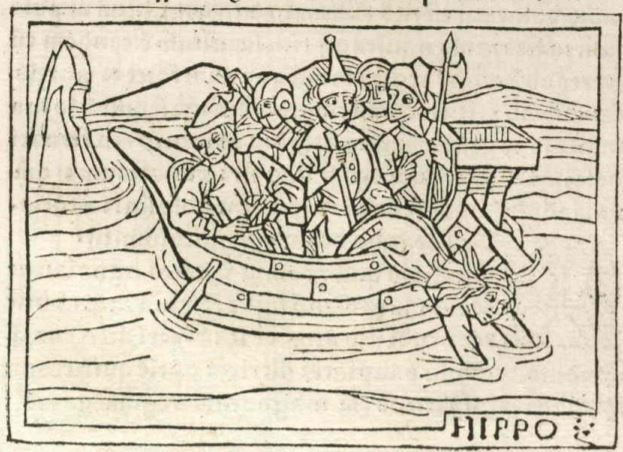
Boccaccio explains that a Greek woman named Hippo had been captured by enemies, and when she heard them speaking of defiling her chastity, she decided that an early death was far better than having her honour destroyed. This engraving depicts Hippo on a boat surrounded by the men who had captured her. Hippo is illustrated at the front of the boat with her body plunging into the water. She drowned and successfully saved her honour. Her name is engraved at the bottom-right hand corner of the engraving.
In foreground, a family of eagles are perched high up in a tree, On the left side, the biggest eagle is perched on a branch, feeding its babies. The babies are in the middle of the tree in their nest. On the right side, another smaller eagle in perched on a branch. In the background on the right side a town is visible. There are small hills decorated with trees in the horizon.
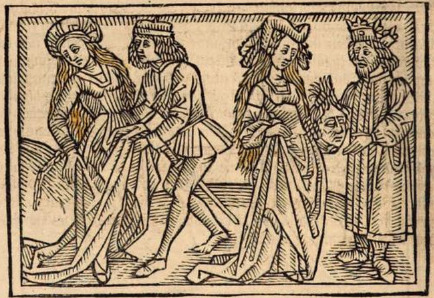
This engraving depicts the queen of the Galatians standing on the right side of the image holding a decapitated head. This woman’s name is unknown; however, she is the wife of King Drigiagon. After being taken as a captive by Roman enemies, the Galatian queen was defiled by a Roman centurion. This is depicted on the left side of the engraving as the queen is bound by a chain on her right hand while the centurion is putting his hand up her dress. She is illustrated looking away and fighting back as he forces himself onto her. To seek her vengeance, once she was freed through ransom, she ordered her servant to decapitate the centurion who raped her. The Galatian queen is holding the severed head as she presents it to her husband to prove that she was defiled by this man. Boccaccio explains that she wrote on this woman to highlight her daring and courageous nature.
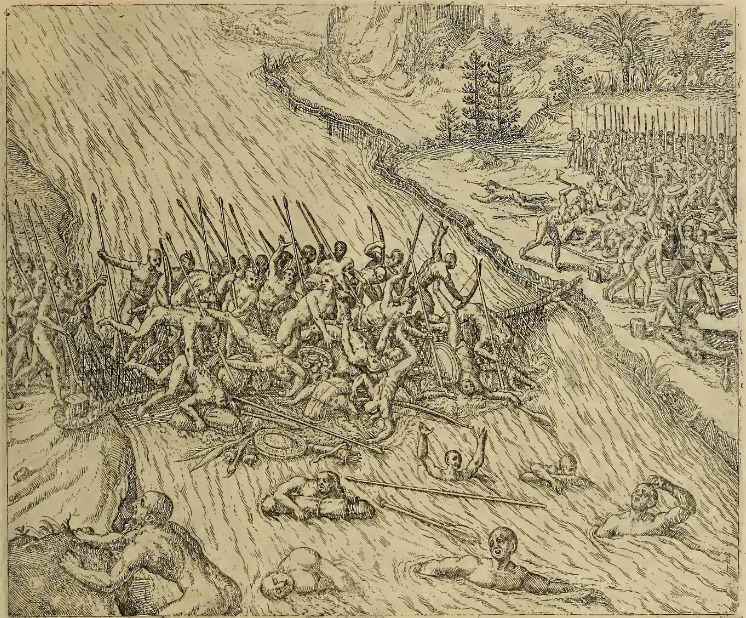
A group of Indigenous people braided ropes together to make a bridge across a river, in order to confront a rival group. However, as they were crossing, warriors on the other side of the river cut the ropes that anchored the bridge to the riverbank with a hatchet, sending the men crossing the bridge into the water. Several warriors are being carried downstream by the river current along with their weapons, although one man has managed to climb out of the water. Men in both armies are armed with bows, spears, and shields. This image is identical to one found on page 25 (159) of Frankfurt, 1596.
An Indigenous village is shown from above. The village is located close to the coast and is comprised of four long structures arranged in a circle. The village is surrounded by both an inner and outer fence. The inner fence follows the angles of the structures within it, and the outer fence is a simple circle. There are several long poles with skulls mounted on the ends of them at both entrances in the outer fence. A group of Indigenous people are shown in the center of the village, and three canoes are anchored along the coast.
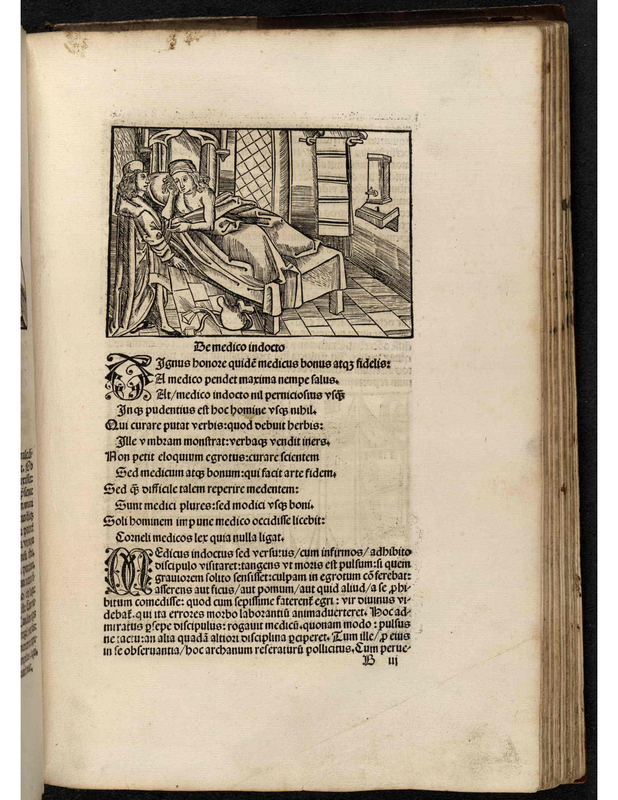
Two men are in a room, with one lying in bed. The room resembles a hospital room. other stands beside the bed, and it looks as if they are having a consultation.
This image illustrates Ulysses arriving home to Ithaca after twenty years of absence due to the Trojan War. Ulysses is depicted on the right side, holding onto a spear with both of his hands. He is the only man in the image with facial hair. The figure standing beside Ulysses holding a sword is his son, Telemachus. One of their slaves is the least visible figure beside Telemachus. The three of them are attacking the man whose arms are in the air in shock. This is a suitor who had been attempting to marry Penelope, Ulysses wife. Penelope is seated in a chair, looking away from the scene as she is holding her weaving spindle and shuttle. Penelope had remained chaste for the twenty years that her husband was gone and rejected every suitor that approached her.
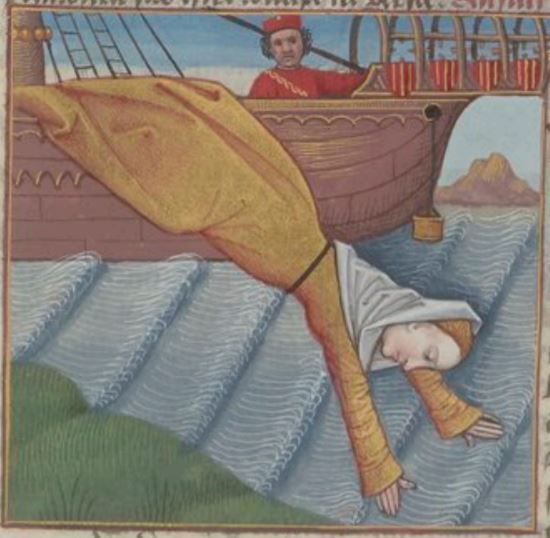
Boccaccio explains that a Greek woman named Hippo had been captured by enemies, and when she heard them discussing a plan to defile her chastity, she decided that an early death was far better than having her honour destroyed. Hippo is illustrated plunging herself head first into the ocean. She drowned and successfully saved her honour. There is a man on the ship watching her jump to her death.
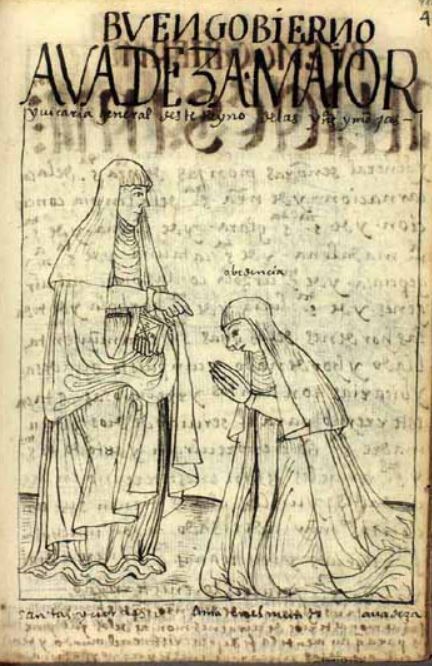
The author spends this section of this chapter discussing religious establishment in Peru and different orders within the Church’s hierarchy. This image depicts the order of nuns and convents within the Spanish conquest in Peru. The head abbess of a convent is depicted standing on the left side of the image dressed in her habit and holding a Bible in her left hand. She is pointing to another nun who is kneeling before her in prayer. The word obedencia [obedience] is written above the kneeling nun. The caption at the bottom of the image reads, santas y cieruas de lima en el mundo [saints and servants of Lima and throughout the world].
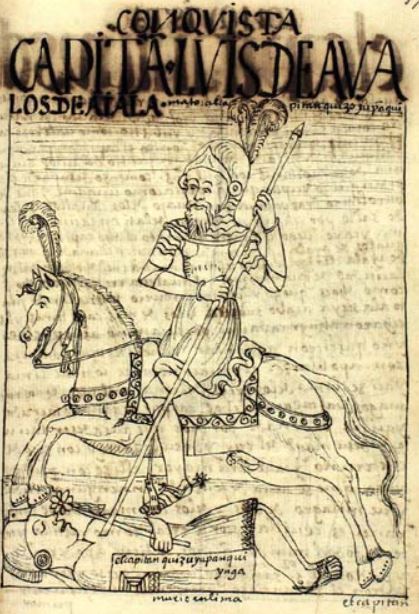
This chapter focuses on discussing the arrival of Spaniards and the Spanish conquest of Peru. This image depicts a captain named Luis de Avalos suited in armour as he rides on his horse in a battle against the indigenous peoples of Peru. Luis de Avalos is driving a spear into the chest of a captain named Quiso Yupanqui Inca. Whereas Luis de Avalos is suited in his armour, Quiso Yupanqui Inca can be differentiated by his traditional tunic and head gear. There is a caption written on Quiso Yupanqui Inca’s shield which reads, el capitan quizu yupanqui ynga, murio en lima [The Captain Quiso Yupanqui Inca, he died in Lima].
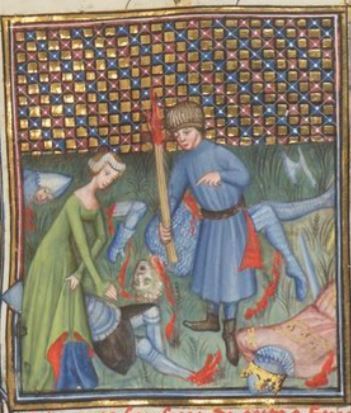
Argia, the daughter of King Adrastus of Argos, is depicted on the left side of the image looking for the body of her husband, King Polynices of Thebes. Boccaccio explains that Polynices had fought in a war against his brother Eteocles and died on the battlefield. Argia snuck herself onto the battlefield after the war to see her husband’s body. She is accompanied by a servant who is holding a torch. Boccaccio believes her to be praiseworthy as it took courage to risk her life in order to find her husband on the battlefield.

![[Vanity Fair Volume I. Chapter XVII Historiated Initial, I]](https://collections.cemvc.ca/files/large/3d6e1b20fc582bb90c1d8c854d64166b57358ccf.jpg)
![[an overturned boat off the coast of Blefuscu]](https://collections.cemvc.ca/files/large/2ab7529f61391d1d4e3262d0275a871a0bb010c9.jpg)
![Vita et Fabulae [A short man is conversing with a man in Holy attire]](https://collections.cemvc.ca/files/large/34230c0582e68a0d14ceacdc69bd2ede65998714.jpg)
![[Europeans are shipwrecked near coastal settlements]](https://collections.cemvc.ca/files/large/9dccb524899da5e99948e02261de243a902c3850.jpg)
![[The Eagle Family in Their Nest]](https://collections.cemvc.ca/files/large/7352500f24b31f89adc2549b249a4ae92c1a1964.jpg)
![[Aerial view of an Indigenous village]](https://collections.cemvc.ca/files/large/4bc4cd24aeffce9a6db5c7c465e5de54bd801870.jpg)
![[Ulysses Returns Home and Kills Penelope’s Suitors]](https://collections.cemvc.ca/files/large/80fb8647206fba1f3b28c6ed8f5042690fbb3c21.jpg)