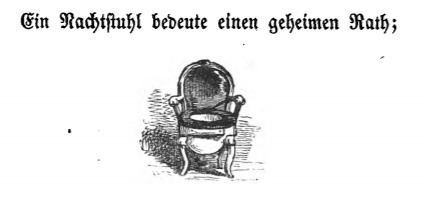
This image is of a close-stool, or toilet. The close-stool was code for the privy council. This image comes in a description of a conspiracy found by a professor from the Grand Academy on Balnibarbi. This idea is representing code word for terms in the conspiracy that Swift is satirizing. The professor advises that those named in the conspiracy papers be closely monitored at all times, naming specifically while they were using the bathroom, as this is when men were most thoughtful. This conspiracy is thought to be an allusion to the trial of Francis Atterbury, the bishop of Rochester for allegedly plotting with the Jacobites. Atterbury was charged with treason in 1722 and was exiled to France. The evidence used against him were papers found in his close-stool. Many believe this evidence to have been fabricated. The same image appears in the 1839 Krabbe edition.
Mrs. Firkin and Miss Briggs stand outside the parlour door, listening in on the conversation between Sir Pitt Crawley and Rebecca Sharp. Mrs. Firkin has her eye to the keyhole while Miss Briggs is watching her with her hands clasped together. Both look worried.
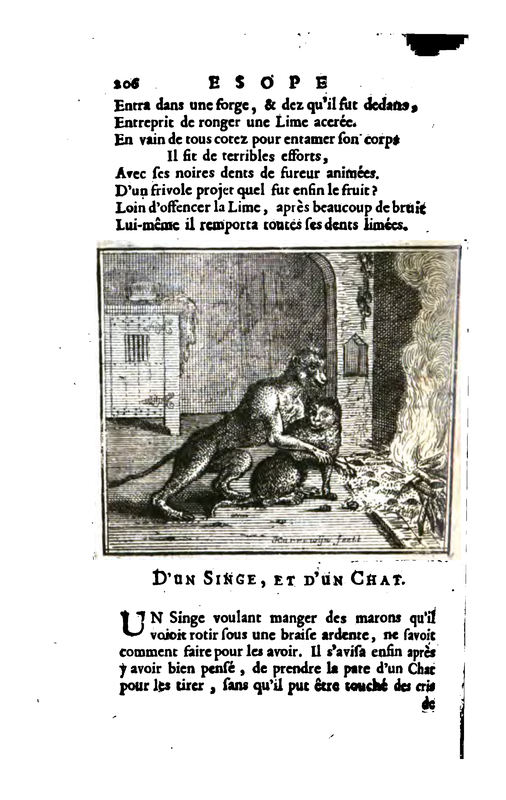
A cat and a monkey are near an indoor fireplace. There appears to be a cabinet of some kind in the background. The illustration has the signature of Harrewijn on the bottom middle.
A group of Tupinambá men have set up a camp near the shore. Their four canoes have been pulled up along the shoreline, and the men sit and stand in relaxed groups. One man has been hunting and return to the group with a deer over their shoulder, and there are fish set on a wooden frame over a fire. In the background several hammocks have been hung between trees and are used for napping. Most of the men wear feathered headdresses and adornments around their waists and carry bows and arrow quivers. A bearded European man stands amongst the group to the left.
In this image we see Gulliver’s telescope and glasses lying on a tablet. All of which are lying on a sheet. The image comes at the end of the chapter. The same image appears in the 1839 Krabbe edition.
Here Jane stands at her ailing aunt Reed’s bedside. She asked for Jane repeatedly and a servant was sent to fetch her from Thornfield. Jane’s aunt told her that her paternal uncle had written to her asking about Jane, but Mrs. Reed ignored the letter. She then gave Jane the letter and Jane reached out to her uncle, who left her his fortune when he died.
This illumination depicts Turia, a Roman woman and wife of Quintus Lucretius, in the centre of the image with her hands together as she expresses a look of despair. After her husband had gotten proscribed, Turia kept her husband safe within their house so that he would not have to go to war. She took care of him and went in public and pretended to have lost her husband so that no one would suspect that he was home. This image depicts Turia out in public pretending to be upset while looking for her 'lost' husband. There are other citizens in the image pointing and looking at Turia. Boccaccio explains that he wrote on Turia to highlight her devotion to her husband.
Here we see the gifts Gulliver gave to the Houyhnhnms that gave him shelter. These included two knives, three bracelets, a small mirror and a necklace. It was common practice for sailors to carry gifts of these kinds to offer locals of the places they visited. The same image appears in the 1843 Krabbe edition.
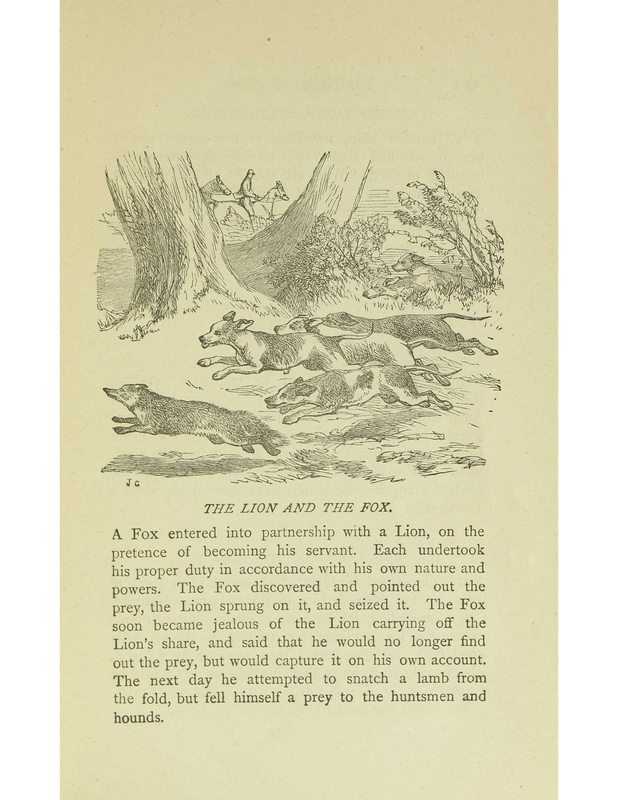
A group of six dogs are running after a fox in the forest. In the background, behind two trees, two horses are seen. In the middle of the space between two trees, a man is ridding one of the horses, while the other horse only shows its head. The rest of its body and possibly its ridder is hidden between the tree to the left.
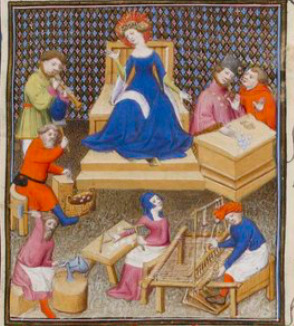
Minerva is seated at a throne at the top of the image, wearing a blue robe. Around her, workers perform each of her inventions. From left to right, those are the flute, making olive oil, forge, carding wool, the use of a loom, and finally, calculus.
A fox without a tail is standing by four other foxes sitting. They are by a large tree. A house is in the distance. The fox without the tail appears angry and aggressive.
A wolf consumes a smaller canine in the foreground, on a ridge in the back a human overseeing two sheep commands a canine to stand down. Trees surround them both in the foreground and background.
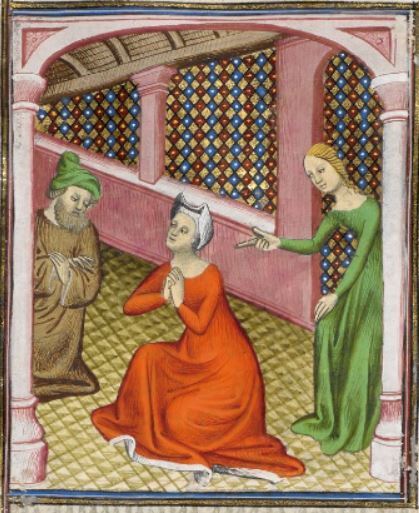
This illumination depicts Claudia Quinta, a Roman woman, standing on land as she pulls a ship to shore. Boccaccio explains that after Claudia Quinta was accused by other matrons of not being chaste, she prayed to the goddess Ceres to help prove her virtue. After a ship that contained a statue of Ceres had gotten stuck on a sandbar, Ceres gave Claudia Quinta the power to pull the ship to shore as proof of her chastity. The women who accused Claudia Quinta of being unchaste are standing to the left of her in the image as they watch her pull the ship to shore. The statue of the goddess is illustrated on the ship.
In this image we are shown the scale of all the animals on Lilliput next to Gulliver’s ruler which measures twelve inches. The average Lilliputian man measures six inches tall. The scale includes a human, cow, horse, goat, ram, sheep, dog, monkey, cat, fox, rabbit, mouse, rooster, owl, parrot, parakeet, dove, swan, duck, toucan, turtle, lizard, frog, snake, fish, butterfly, moth, and several other types of insects. The purpose of the image is to demonstrate that the animals on Lilliput are roughly the same scale to the human as is true in the real world. Due to this scale we are also led to believe that the same animals exist on Lilliput as do in reality, simply on a smaller scale, and thus they likely have the same roles and utilities. This contrasts to some animals in the other lands visited by Gulliver later in the story where the animals are more highly fictionalized. The same image appears in the 1843 Krabbe edition.
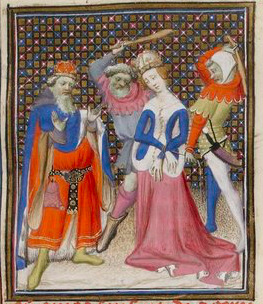
After threatening to make Nero lose his empire, Nero plotted his mother’s death. Agrippina knew he was up to something, but Nero continued planning. He finally had three men sent to kill Agripinna. They killed her by hitting her over the head and then stabbing her in the womb. This is represented in the image with one man, on the far left, looking at Agrippina, the man behind her with a bat raised to strike her, and the man on her other side also ready to strike her with a bat. She stands in the center, prepared for certain death.
Here we see Gulliver performing for a crowd of Giants. The Farmer sold tickets to other giants to see Gulliver. On the front right, we see Glumdalclitch speaking to Gulliver and giving him instructions, while an older woman leans over her shoulder. Two other children stand in front of the table watching Gulliver. Behind the children are their parents. There are two more rows of giants in shadow. Gulliver stands on a table holding a piece of straw as though it was a fencing sword. The same image appears in both the 1839 and 1843 Krabbe editions.
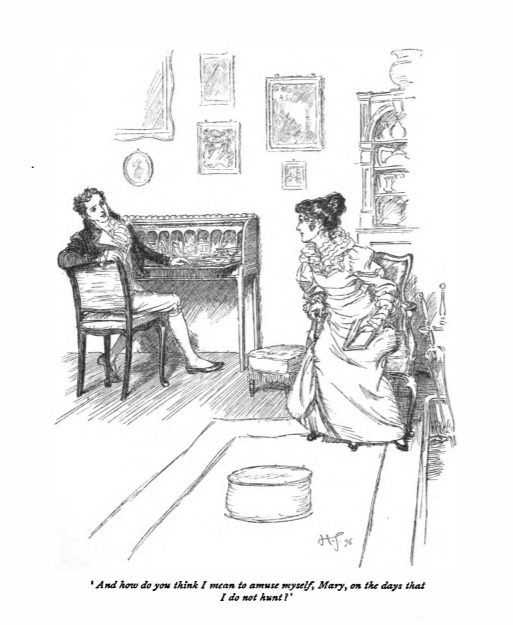
Here we see Mr. And Miss Crawford upon his return to the parsonage at Mansfield. In this scene Mr. Crawford announces to Miss Mary Crawford that he intends to make Fanny fall in love with him. Mary asks why he wanted to, and he responds that he needed something to entertain him on days when he could not go out and hunt. Mr. Crawford sits at a desk, while Miss Crawford sits by the fire, reading. This scene occurs in chapter 24. The characters are shown in the traditional regency style. Miss Crawford wears the regency style dress with an empire waist. Mr. Crawford wears a waistcoat and tailcoat, and knickers that stop at the knee. The regency period dated to the early nineteenth century (1811-1820) when George, Prince of Wales, later George IV (r. 1820-1830), reigned as regent for his mentally ill father, King George III (r. 1760-1820). The regency period is associated with the rise of neoclassicism in art and fashion.
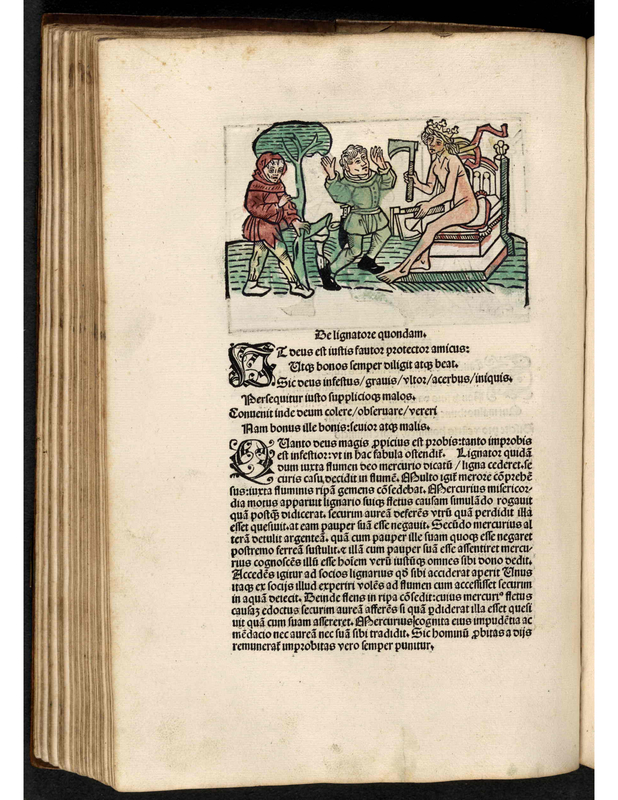
A naked King sits on a throne, with trees in the background. The King holds an axe, while one man in a green outfit stands with his hands in the air.While the other man waits nervously nearby.
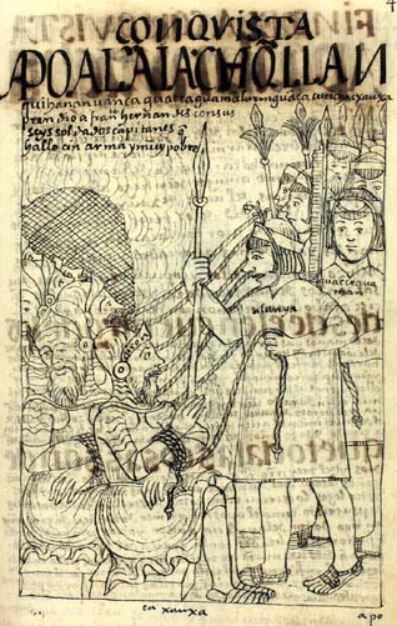
This chapter focuses on discussing the arrival of Spaniards and the Spanish conquest of Peru. This image depicts the capturing of the Spanish conquistador, Francisco Hernandez Giron. Giron was a traitor to the crown as he had declared a rebellion against the king of Spain. After Giron and his men fled a battle against the crown in Huatococha, a group of indigenous peoples found and captured them. Giron and his soldiers are illustrated sitting on the left side of the image with their hands bound with rope. Giron is identified by his name being written on his helmet. They were captured by the Wanca indigenous peoples, led by Apo Alanya Chuquillanqui and Waccra Waman. Chuquillanqui and Waman are identified by their names being written on their chests on the right side of the image. The caption at the bottom of the image reads, en Xauxa [in Jauja].


![[Miss Firkin and Miss Briggs Eavesdropping]](https://collections.cemvc.ca/files/large/cca71846cb77254f34c1a1530544b24b205caa2c.jpg)
![[Tupinambá warriors make camp near the shore]](https://collections.cemvc.ca/files/large/321fa3a60b2260c4f77cb2c94744545e173a6fce.jpg)
![[Gulliver's glasses and telescope]](https://collections.cemvc.ca/files/large/33b2fe63c6180bc4caca9d08b57299a5e9494e7e.jpg)

![[Gulliver’s presents to the Houyhnhnms]](https://collections.cemvc.ca/files/large/4ba0ab80d219e83d5a4dea53821c5b859e71f0f7.jpg)



![[A Fox without a Tail]](https://collections.cemvc.ca/files/large/44895f65f22662bd2d90e3828fad329d483fcdc4.jpg)

![[The scale of humans and animals on Lilliput]](https://collections.cemvc.ca/files/large/ea7b6346093e7ef752a6b68226b4a863e5a78c5f.jpg)
![[Gulliver performs for a crowd on Brobdingnag]](https://collections.cemvc.ca/files/large/b4339b8ffe82b7dcf89c9d84ead734d552ad83d1.jpg)