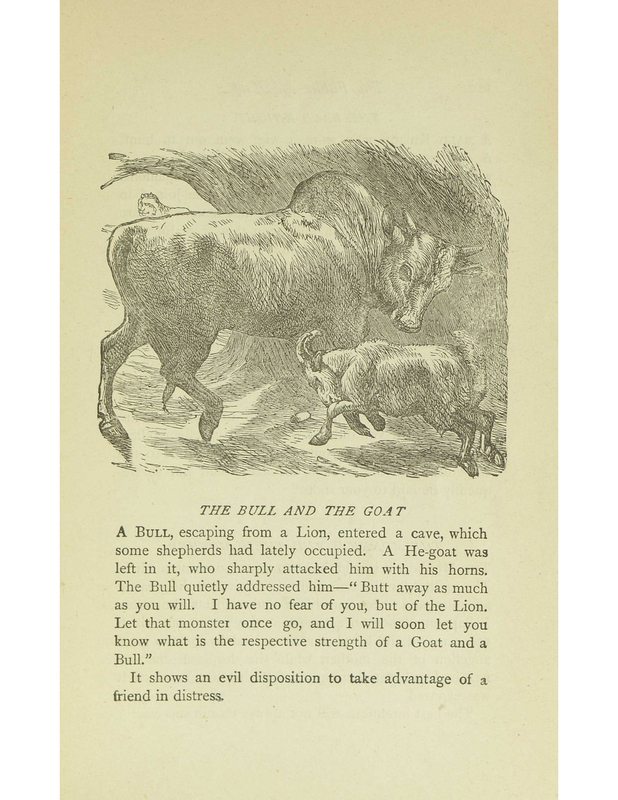
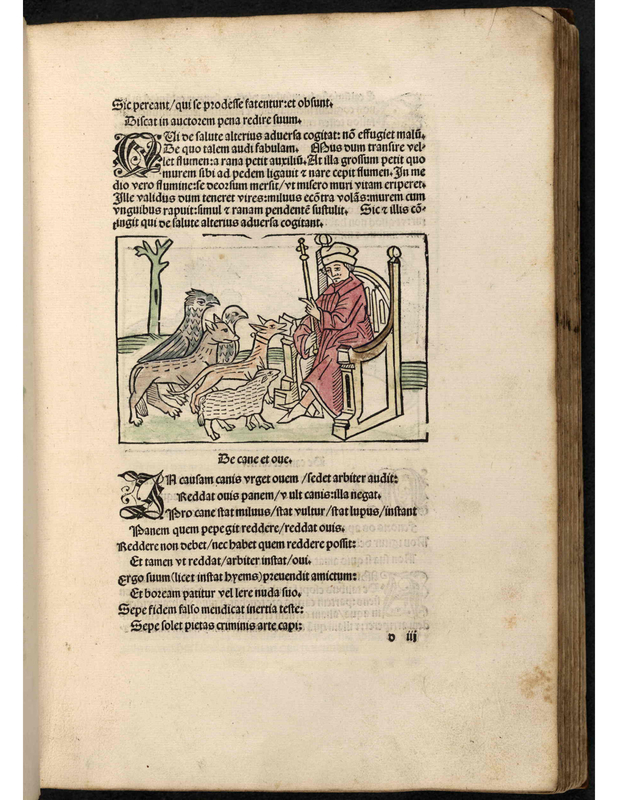
A Sow had just farrowed, and lay in the sty, with her whole litter of pigs about her. A Wolf, who longed for one of them, but knew not how to come at it, endeavoured to insinuate himself into the Sow's good opinion, and accordingly coming up to her.
There is a group of birds standing on the ground to the left. There is another group of birds standing on the ground to the right. Both groups of birds face each other. An eagle flies above the two groups in the middle of them. The eagle is holding a creature in its claws
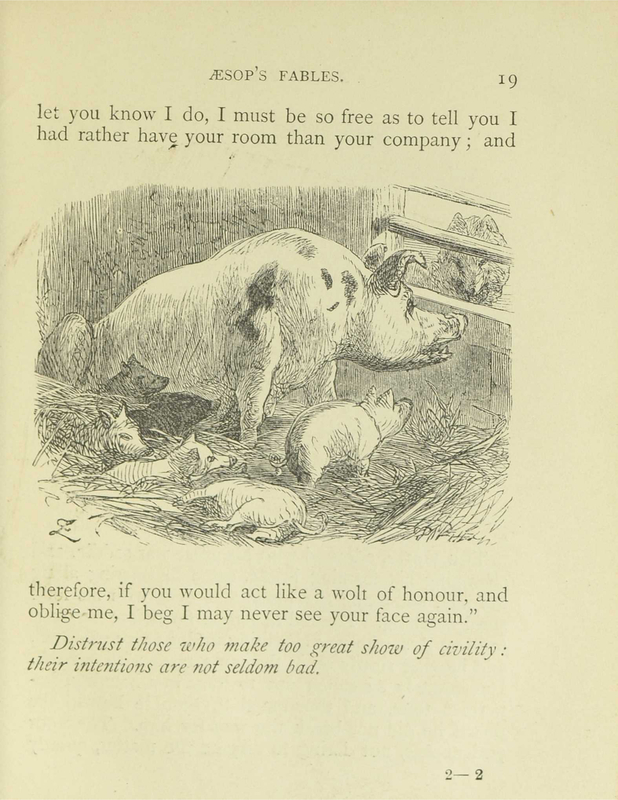
The author explains that there were ten paths for men to follow in the Inca Empire based on age division. This seventh group was called tocllacoc uamra [hunter boys]. These boys were aged from nine to twelve years old and their duties included hunting small birds to use their meat and use their feathers to decorate weapons. The caption at the bottom of the image reads de edad de nueue años cirue a su padre y al cacique which translates to nine years old, he serves his father and the chief. The boy in the image is depicted running towards a flock of small birds with a stick in one hand and a dead bird in his other hand.
Here we see a knife used to castrate male horses and make them tamer. Gulliver’s master was shocked that humans would ride horses, so Gulliver explained how horses were trained from a young age, and bred for human use. The same image appears in the 1843 Krabbe edition.
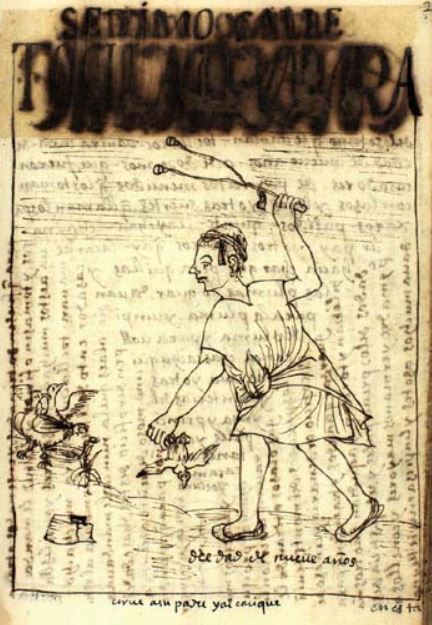
Here we see two mice next to a ram from Blefuscu. The ram is the same size as the mice, showing the difference in size between the animals on Lilliput and Blefuscu and those in the real world. The same image appears in the 1843 Krabbe edition.
This image appears in the chapter that treats the widow named Camiola. The image depicts a fleet of ships which were the fleet of King Peter II of Sicily. The fleet was to bring aid to the city of Lipari which was under siege. During this siege, a man named Roland of Sicily was captured and Camiola paid for his ransom in exchange for his hand in marriage. When he was freed, he lied and said that he never agreed to marry Camiola. She presented her case to a judge and won against Roland.
A wolf chases a buck deer in the background atop a ridge while another large buck deer calmly feeds in the foreground. The scene is filled with trees, bushes, and weeds.
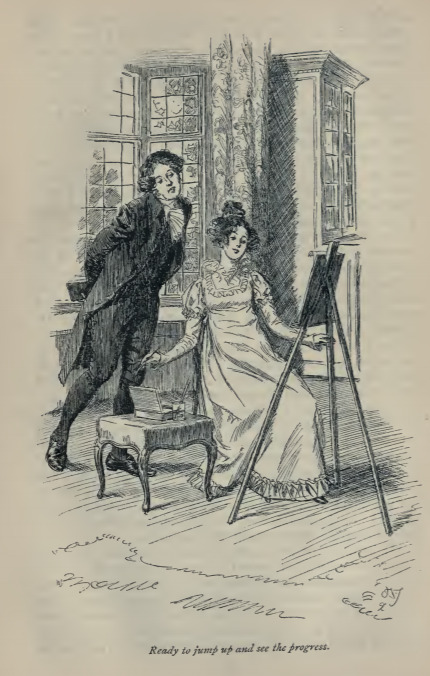
Here we see the Emma drawing Harriet’s portrait, while Mr. Elton looks over her shoulder. Mr. Elton flattered highly the portrait Emma was working on, and Emma took this as a sign that Mr. Elton was in love with Harriet. She was mistaken, however, because Mr. Elton was flattering the portrait because of Emma’s skill in producing it, as he was in love with her. This scene occurs in chapter 6. The characters are shown in the traditional regency style, with Emma wearing the regency style dress with an empire waist. Her hair is worn tied up, as was tradition for women after their coming out before the queen, signaling her entrance into society. Mr. Elton wears a waistcoat and tailcoat, with a cravat. The regency period dated to the early nineteenth century (1811-1820) when George, Prince of Wales, later George IV (r. 1820-1830), reigned as regent for his mentally ill father, King George III (r. 1760-1820). The regency period is associated with the rise of neoclassicism in art and fashion.
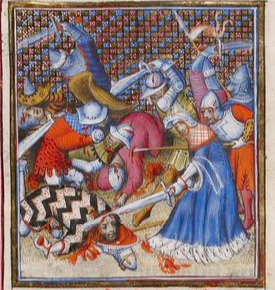
When Cyrus’ army, ruler of Asia Minor, stormed Thamyris’ kingdom, she had a strategy to outsmart them. When her young soldiers were tempted by wine, they fell asleep and were slaughtered, meaning her strategy was not successful. After many of her soldiers died, she tricked Cyrus’ army and was able to successfully attack back. Cyrus did not escape, and was instead ordered to be decapitated by Thamyris, and then have his head stuck in a bag full of her soldiers’ blood. The image represents the ongoing battle as men in the background fight, with Thamyris in a blue gown decapitating Cyrus in the foreground. Cyrus is clearly recognized on the ground with blood pouring out and Thamyris’ sword on his neck.
Here we see Gulliver throwing empty barrels of wine which he had just consumed. The Lilliputian named Hekinah Degul told Gulliver to throw the barrels, however the Lilliputians are still scared of the flying barrels. These Lilliputians can be seen at Gulliver’s feet. All around Gulliver we see various ladders and a ramp which the Lilliputians used to climb on Gulliver. On the far right of the scene, we see the podium the Emperor used to speak to Gulliver. The city skyline can be seen farther in the background. Gulliver’s head and feet are still tied; however, both of his arms are now free. The same image appears in the 1843 Krabbe edition.
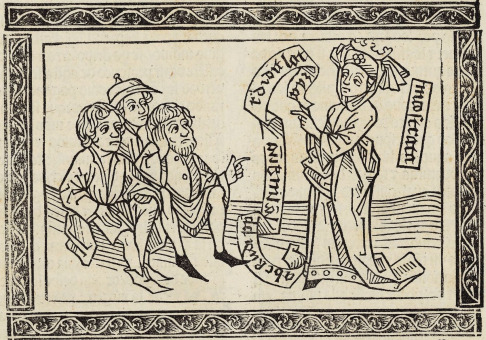
This engraving depicts Nicostrata, a woman who was a famous prophetess during her time, holding a scroll of parchment. We know that this is Nicostrata as the creator engraved her name horizontally adjecent to her body. Nicostrata had gone with her son, Evander, to Italy and he founded the city of Pallantium. Boccaccio explains that once Nicostrata realized that the inhabitants of this city were not well educated or literate, she decided to give them their own language with their own letters and symbols. This was the Latin language. Nicostrata taught the new letters and language to the people of Pallantium, which is what the engraving depicts. There are people sitting on the ground who are listening intently to the prophetess, as she is holding the parchment and pointing at the letters.
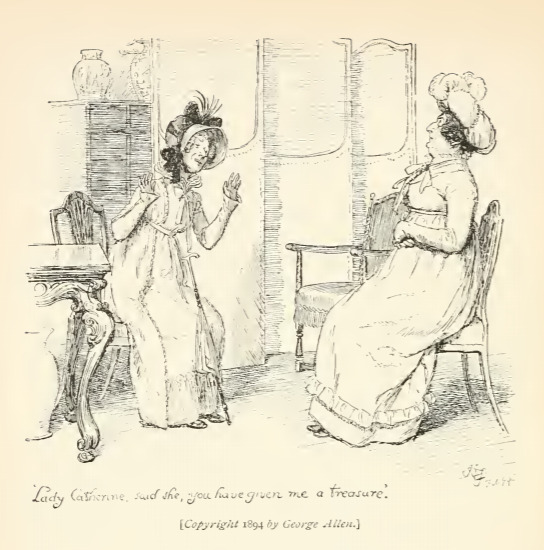
In this image Lady Catherine de Bourgh relates that Lady Metcalfe had called upon her the day before to Mr. Collins, Charlotte, and Lizzy. Lady Catherine had helped Lady Metcalfe’s niece find a husband, and Lady Metcalfe had called to express her gratitude. At this time, finding a good match was crucial and informed a young girl’s livelihood and financial security for the rest of her life. This scene occurs in chapter 29. The characters are shown in the traditional regency style. Lady Catherine and Lady Metcalfe wear regency style dresses with empire waists and bonnets. Lady Metcalfe has a walking stick leaning against her knee as she rises in exclamation of her thanks. The regency period dated to the early nineteenth century (1811-1820) when George, Prince of Wales, later George IV (r. 1820-1830), reigned as regent for his mentally ill father, King George III (r. 1760-1820). The regency period is associated with the rise of neoclassicism in art and fashion.
Two groups of Indigenous people are shown attacking each other. One group stands on an island near the coast, while the other group is divided into four canoes and attacks from the water. Both groups are armed with bows and arrows, and both are accompanied by a European wielding a gun. On the mainland in the background there are scattered settlements and buildings.
In this illustration we see Melibea lying dead on the ground after jumping from the tower of her house (the tower can be seen in the background, though the perspectival distance is off). The leftmost figure is Pleberio, who is wearing a hat and a cloak of sorts, with a sword mounted on his belt. One of the two women beside Melibea is Lucrecia, and we can assume that the other is meant to represent Alisa (even though she is not present when Melibea jumps). Both women are wearing a robe and a veil. The other male figures appear to be random onlookers who witnessed her fall. This illustration is odd, seeing as there is no scene that occurs outside after Melibea jumps. Instead, the entire 21st act consists of Pleberio going to his wife Alisa in their bedchamber and informing her of their daughter’s death.
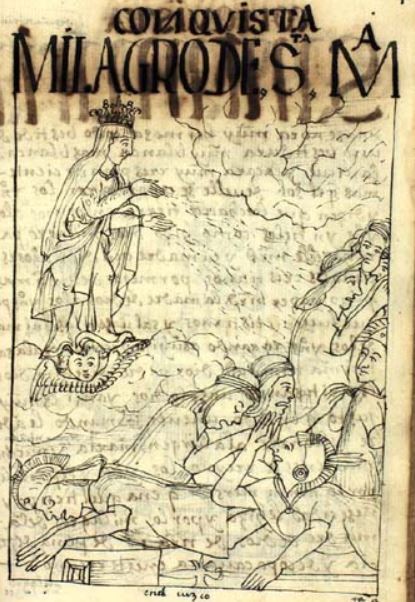
This chapter focuses on discussing the arrival of Spaniards and the Spanish conquest of Peru. This image depicts the Virgin Mary appearing before the indigenous people of Peru in Cusco. The people of the Inca Empire had just attempted to burn down a temple that the Christians had stolen from them, and when it would not burn down, it was taken as a sign that the church was now established in Cusco. The apparition of the Virgin Mary was another miracle presented by God. She showed mercy to the Christian Spaniards and threw dirt into the eyes of the indigenous Peruvians for attempting to burn down the church. She is illustrated floating in the clouds in the image as she throws the dirt into the eyes of the struggling indigenous soldiers on the ground. From then on, the Virgin Mary was honoured and adored by not only the Spaniards, but the indigenous people of Cusco as well. The caption at the bottom of the image reads, en el cuzco [In Cusco].
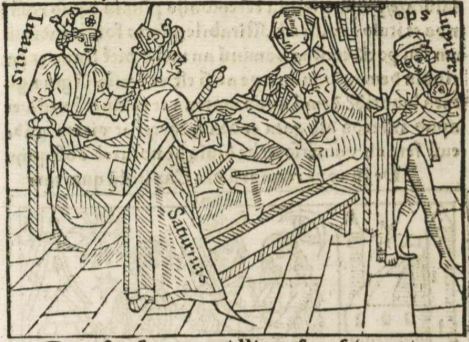
Ops, wife of the god Saturn, is depicted laying in a bed after just having given birth to her children, Jupiter, Neptune and Pluto. We know the woman lying in the bed is Ops as her name is engraved directly beside the bed, in the top right-hand corner. Jupiter, as a baby, is illustrated being carried away. His name is engraved just above the person carrying him. Boccaccio’s story explains that Saturn and Ops’ brother, Titan, planned to kill the children to avoid them growing up and defeating them. Saturn is illustrated with his hands outstretched towards baby Jupiter. His name is engraved on his leg. Titan is on the opposite side of Ops’ bed, similarly with his arm stretching out, facing Jupiter. His name is engraved horizontal to his body.
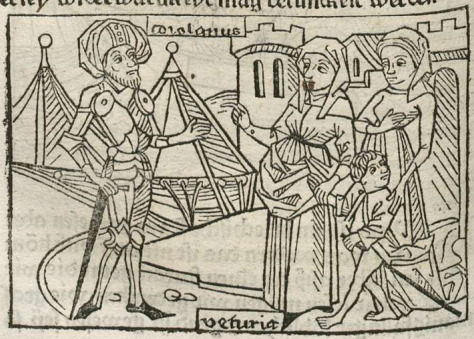
An old noble Roman woman named Veturia is depicted on the right side of the engraving with her daughter-in law and grandchild beside her. We know this figure is Veturia as her name is engraved below her feet. She is illustrated pointing at the man on the left side of the engraving. This man is her son, Coriolanus (his name is engraved above his head). Boccaccio explains that after Coriolanus had been exiled from Rome for neglecting the plebian class, he planned an attack on Rome. Veturia, with the help of her daughter-in-law (Volumnia) and grandchild, went to speak with Coriolanus at his camp and convinced him to not go through with the attack. Boccaccio explains that he decided to write on Veturia for her honour as a mother and a woman.
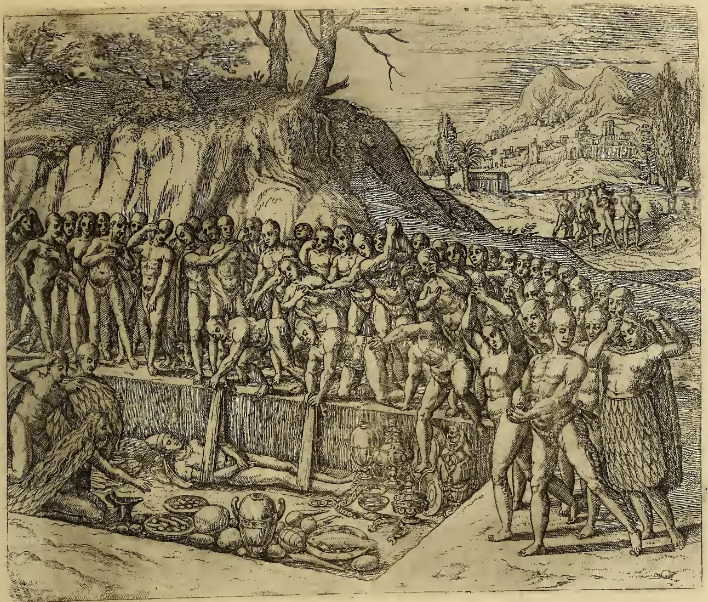
A group of Inca people in Peru bury one of their Emperors. They have dug a large, rectangular hole in the ground for the burial. The body of the Emperor has been laid out along one side of the grave, and the rest of the space is filled with food, jewelry, and gold and silver ornaments and vessels. A man kneeling in the grave lays down a feathered cloak or blanket. A large group of mourners gather along one side of the burial, many holding their hands clasped together. Several individuals wear feathered cloaks or skirts, including a woman kneeling in the grave. In the distance, a walled city is visible.
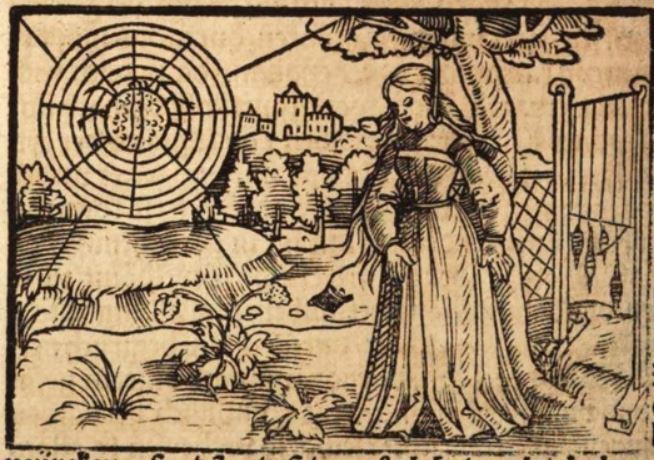
This engraving depicts a woman named Arachne hanging herself. There is a loom on the right side of the engraving and a net to the left of the loom. Boccaccio explains in his story that Arachne is known by ancient writers as being the one who discovered the uses of woven wool and the first to make nets. Arachne became too confident in her wool work and challenged Minerva to a weaving competition. After the goddess had won, Arachne hung herself, as depicted in the engraving. There is a spider on a spider-web on the left side of the engraving, as Arachne is said to have been transformed into a spider after this event.
Here we see a guard posted outside Gulliver’s door in Luggnagg. The officer with whom Gulliver spoke said he must be confined until permission from the Court could be granted to Gulliver to stay on the island as he was a guest. Despite his confinement, Gulliver’s quarters included gardens. Gulliver had several visitors during his confinement who came to ask him about his home, with the help of an interpreter Gulliver hired while on the ship from Glubbdubdrib. The same image appears in the 1839 Krabbe edition.
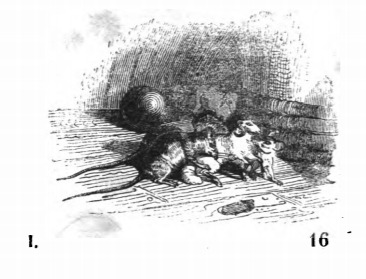
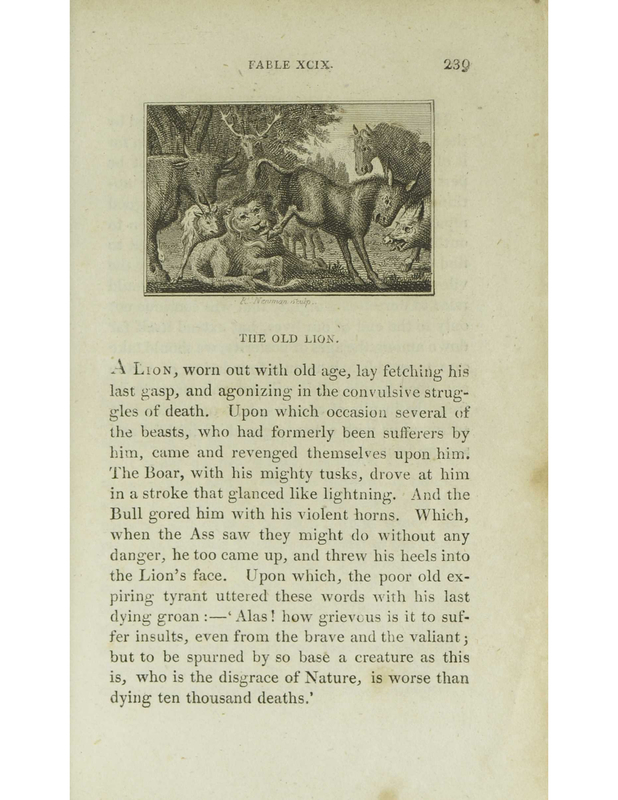
A small goat is charging towards a large bull. The goat’s head is bent low so its horns will hit the bull. The bull is slightly moving away, its head looking in the direction of the charging goat.

![[Eagle Flies Over Birds]](https://collections.cemvc.ca/files/large/3b576e6fead774c1c89a3956ca1cb2a264585bf1.jpg)
![[a knife used to castrate male horses]](https://collections.cemvc.ca/files/large/783279634602653f9196e83c610edf8fad470111.jpg)
![[Fleet of King Peter II of Sicily]](https://collections.cemvc.ca/files/large/a944f8f1517d228d58cc0d0a794d8668ec1d4bea.jpg)
![[Gulliver throws empty barrels]](https://collections.cemvc.ca/files/large/94dabfa030aa66cd599edb309a5b4b0606cf3bde.jpg)
![[Two Brazilian Indigenous groups, one group in canoes and the other on land, attack each other]](https://collections.cemvc.ca/files/large/79e79eb965ccc8619a0795c53242e797f51b8558.jpg)
![[Act XXI – Having Jumped to Her Death, Melibea is Surrounded by Pleberio, Lucrecia, and Many Other Concerned Onlookers]](https://collections.cemvc.ca/files/large/c2c345474a3dcecc51e64adea0a8b3dff002c3d6.jpg)
![[a guard outside Gulliver’s door in Luggnagg]](https://collections.cemvc.ca/files/large/a93d2c9fc883582ba5426c906cb762789934f4ae.jpg)