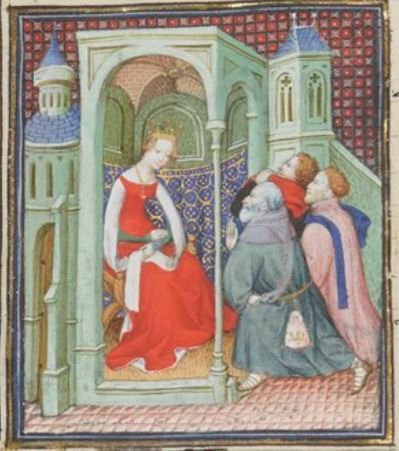
This illuminated image depicts Libya, the daughter of King Epaphus of Egypt. She is illustrated sitting down as she looks at the citizens who are kneeling in front of her. Boccaccio explains that Libya bore a child with her husband, Neptune, who grew up to be a tyrant of Upper Egypt. Their child’s name was Busiris. Libya was so renown during her time that the region in Africa which she ruled was named after her.
This image is illustrated in a chapter that discusses the descendants of the Inca and Andean nobles under Spanish colonial rule in Peru and their importance to a revived Andean society. The author explains that the noble native Christians should be clean and dress like the Spaniards so that they can be differentiated by a common native. The image depicts a cicaque [noble] on the left side of the image dressed in Spanish clothing. He is wearing puffed trousers, a cloak, a hat, and a sword on his left side. The native is wearing a simple tunic with a small line of embroidery at the bottom. A shawl is wrapped over his shoulders. The caption at the bottom of the image reads, en este rreyno [in this kingdom].
The Houyhnhnms were astonished that the only skin visible on Gulliver was on his hands and face, as the yahoos were completely naked. This served as a distinction between Gulliver and the other yahoos. It was Gulliver’s custom to undress at night and cover himself with his clothes. His master’s valet walked in on Gulliver while he was sleeping, and his clothes had fallen off and discovered that Gulliver’s body was the same as the yahoos. His master was astonished by this, and Gulliver explained how clothing worked. Gulliver asked him to keep this information to himself. The same image appears in the 1839 Krabbe edition.
A mouse is sitting down with its back facing us. It is sitting atop of a circular image with mice sitting around a candle, they seem to be talking as the bigger mouse in the middle is making some hand gestures. There is a small bell hanging above them. In the lower right corner, the letters R. H are written, representing Richard Heighway.
At the general council of the Houyhnhnms it was decided that Gulliver could no longer live with the Houyhnhnms. Gulliver must either live with the Yahoos or leave the Country. When Gulliver heard this news he fainted, seen here. This image appears at the beginning of chapter nine, and the letter I is in the top right corner as it is the first word of the chapter.
Rebecca Sharp is pictured kneeling on a checkered floor at the base of a statue, crying with her face in her hands. The image is framed in an ornate letter E of Every, from behind which a devil leers.
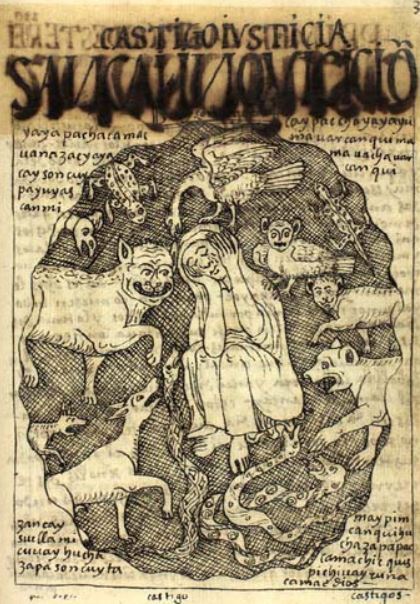
This chapter is dedicated to discussing the justice and punishment systems of the Inca Empire. The author discusses five methods of punishment in detail, and this image represents the first punishment. This image depicts what a jail cell resembled during the Inca Empire. The author explains that any wrongdoers, traitors or criminals, especially those who were in the Inquisition, would be forced into a subterranean sancay [dungeon] that was filled with jaguars, snakes, foxes, bears, vultures, and other predatory animals. The animals would be put into the dungeons so that the criminal would be eaten alive. This image depicts a man sitting in the dark dungeon surrounded by animals who approach him. The caption at the top left corner reads yaya pachacamac uanazac yaya cay soncuypa yuyascanmi [father Pachacamac I will learn my lesson, father is my heart’s memory]. The top right corner reads caypaccho yaya yumauarcanqui mama uachauarcanqui [father did you beget me for this, mother did you give birth to me for this]. The bottom left corner reads zancay suclla micuuay huchazapa soncuyta [prison eat my wicked heart once and for all]. The bottom right corner reads maypim canqui huchazapapac camachic quispichiuay runa camac dios [where are you creator of sinners, save me creator of man, God].
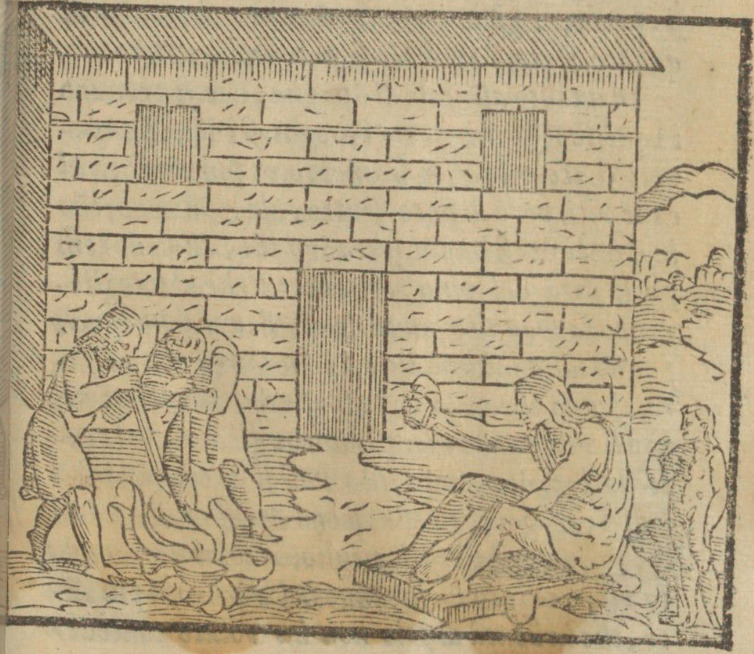
Three Indigenous people in Peru engage in metalworking with gold and silver. Two people use long tubes or hollow reeds to blow air onto a fire to melt the metal. Another person to the right sits on the ground and pounds the heated metal with a rock to shape it. A child stands nearby. In the background is a large stone structure.
A massive statue on a pedestal, with vertical, pointed ears, wearing a crown and holding a staff. The upper part of the staff forms the letter A from And topped with a crown. At the base of the statue there are many seated figures, and in the silhouettes of buildings are in the background.
Melibea (presumably the right-central figure, since her robe appears ornate and she is wearing multiple necklaces) overhears Pleberio (left-central figure) and Alisa (leftmost figure), her parents, talking about the prospect of giving her away in marriage. They discuss the mistaken fact that she is still a virgin, and Alisa points out that she has probably never considered having a male companion. Melibea grows frustrated with their presumption that she is ignorant, and she orders Lucrecia (rightmost figure) to interrupt the conversation.
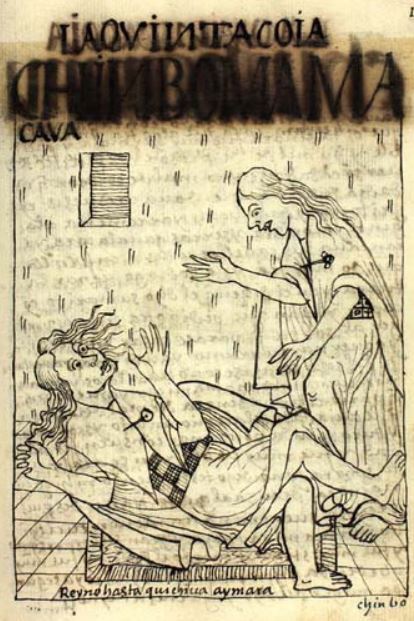
This illustration depicts Mama Caua, the fifth Coya [Queen] of the Inca Empire. She was married to the Inca king, Capac Yupanqui. The author explains that this queen suffered from heart issues which caused her pain. In this image, she appears to be in pain, which could be from her heart condition. There is another woman in the image who appears to be running to help the queen. The words Reyno hasta Quichiua Aymara are written at the bottom of the image which translates to He reigned to Quechua, Aymara. Quechua and Aymara are two indigenous languages of Peru and Bolivia.
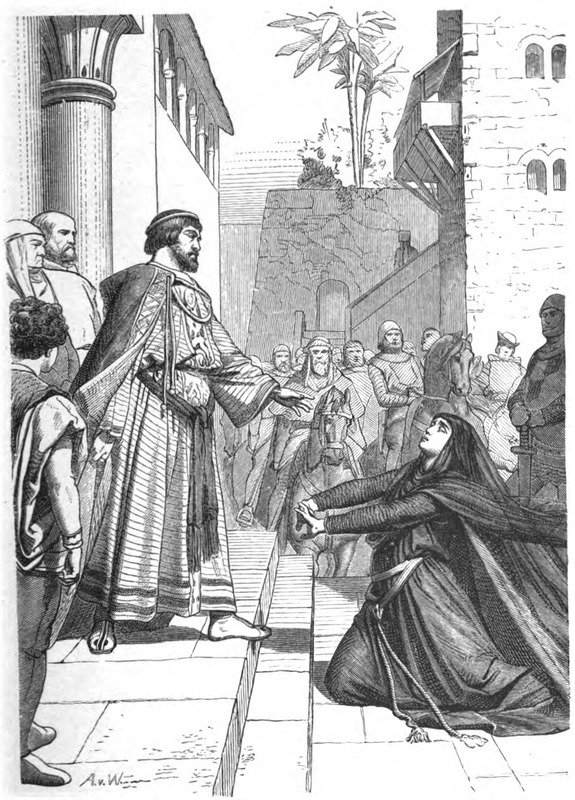
Jimena, wife of El Cid, is in front of the king Fernando. Jimena is wearing a black dress covered with a black cloak. Her hair and head are covered with a black veil. She is wearing a belt around her waist. She has her eyes closed and is leaning in front of the king. The king is wearing a band on his head and robes. He is wearing a cape and a belt across his waist. He has short hair and a beard. Behind him there are three people watching him. The man has a beard and has little hair on his head, the other man’s head is covered and the one at the front of the image has curly hair and wearing a tunic and pants. In the background there are soldiers, two of them are on horses and the one behind Jimena has his sword in front of him. There are also buildings in the background. The one on the left has a column and the ones on the right are made of bricks and have windows on them. There is also a tree distinguishable in the background with shrubbery surrounding it.
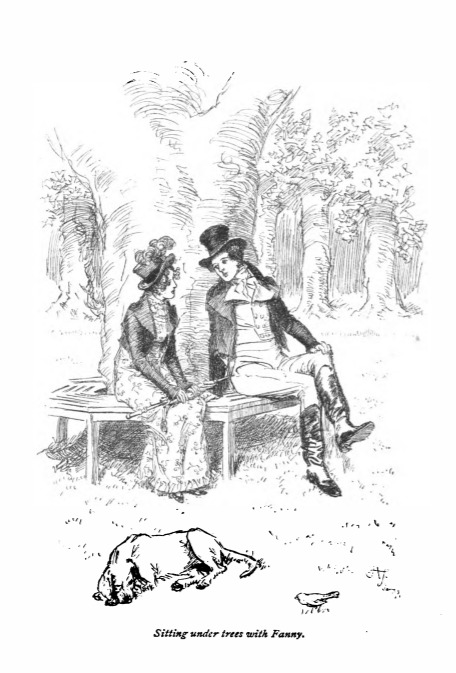
In this image Edmund and Fanny sit under a tree on the Mansfield estate. The two spent many evenings walking through the grounds together and had a tremendous effect on improving Edmund’s mood. Edmund had been very concerned about his brother Tom’s illness, Maria’s scandal with Mr. Crawford, and Julia’s elopement with Mr. Yates. Spending time with Fanny dramatically improved his mood and made him come to the realization that he loved Fanny, and the two ultimately got married. This scene occurs in chapter 48. The characters are shown in the traditional regency style. Fanny wears a regency style dress with an empire waistline. She has a short coat, bonnet, and carries a parasol. Edmund wears a waistcoat, and tailcoat, with breeches. In his hand he holds a top hat and a walking cane. The regency period dated to the early nineteenth century (1811-1820) when George, Prince of Wales, later George IV (r. 1820-1830), reigned as regent for his mentally ill father, King George III (r. 1760-1820). The regency period is associated with the rise of neoclassicism in art and fashion.
The left side of the image has a satchel with a text. The right side of the image has three men interlocking arms. The two men on the exterior are dressed similar and each has a sword on their waist. The man on the right is holding a a large chalice, with a brim design of 6 semi-circles. The man in the middle is wearing a robe and feels to be oldest in age.
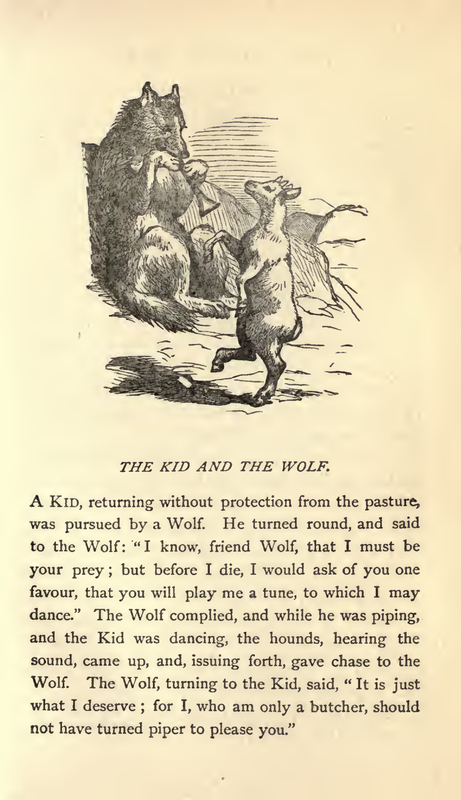
There are two animals in the image: a kid and a wolf. The wolf is sitting on its hindlegs in the distant left, and it is using its forelegs to hold onto a pipe which it seems to be playing. The kid, who is in the near right of the image, is standing on its hind legs and seems to be dancing.
Miss Matilda Crawley sits in her wheelchair, bundled up in a bonnet and muff. The chair is being pushed by a thin man in a coat and tall hat. In the top right of the image is the letter T from The.
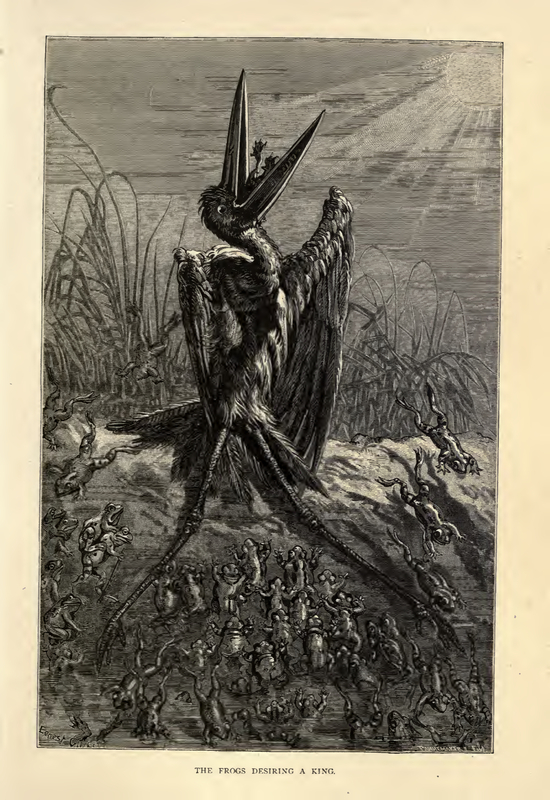
A crane is sitting down on the ground, its long legs spread out on either side and its left wing slightly open. Its head it bent back as it opens its large beak wide open. Inside its beak, a frog is sliding down its throat. All around the crane, frogs are hopping away from it and into the lake, trying to save themselves from being eaten. Behind the crane, high grass grows, and the sun is shining in the upper right corner.
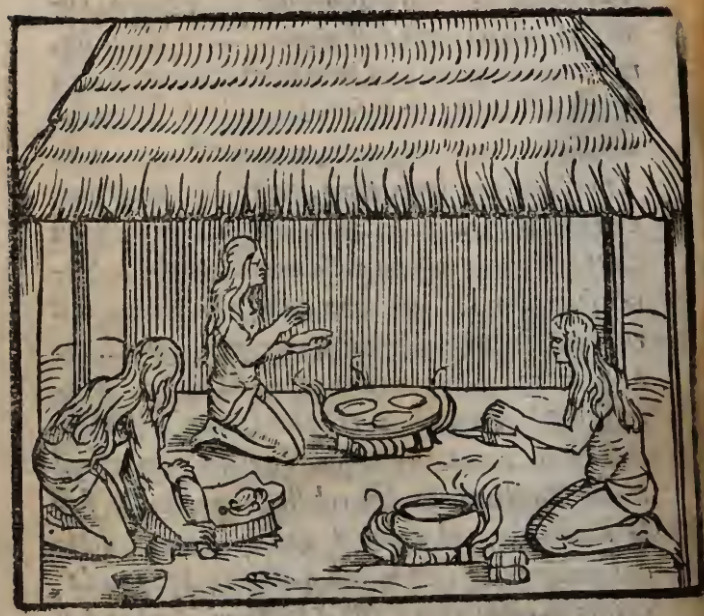
Three Indigenous women make bread inside a shelter comprised of a thatched roof and one wall. The woman on the right grinds corn and cooks it over a fire, the woman on the left rolls dough, and the woman in the middle grills the bread on a flat surface over a fire.
A diplomat from Luggnag explains the reality of the immortals to Gulliver. He says that they act like mortals until about the age of thirty, and then become very melancholy until about eighty years old. At this time, they recon themselves with the reality of never dying. The diplomat also says that the immortals often become opinionative, peevish, morose, vain, covetous, talkative, and incapable of friendship. Furthermore, they lose all ability for affection, even for their descendants. Their primary characteristics become impotent desires and envy. They cannot experience pleasure, and when they attend a funeral, they find themselves envious of others who could die. Their memories also begin to fade. In this image we see a group of these immortal men looking angry and discontent. They are identified by the large spot on their forehead above their left eyebrow. The same image appears in the 1843 Krabbe edition.
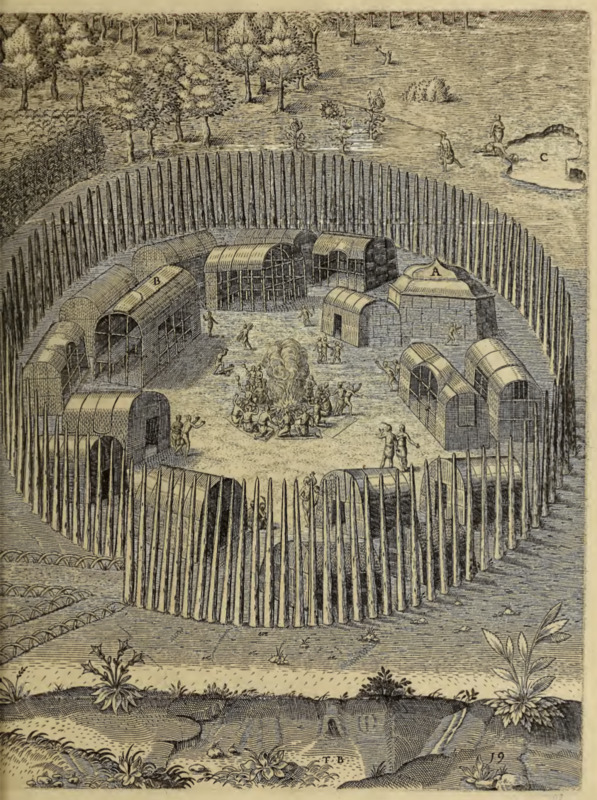
The Indigenous town of Pomeiooc is shown. Multiple structures are arranged in a circle. At the center of the circle is a large bonfire, and surrounding the structures is a fence of tall poles stuck into the ground. There is one gap in the poles that serves as an entrance. There is a cornfield to the left of the village.
In this image there are three men. They are in the cloister at San Pedro de Cardeña. El Cid is standing on the left and he is wearing a tunic and a cloak. On his waist there is a sheathed sword. He has a beard. The man wearing the crown is the king Alfonso. He is wearing armour with a cloak. At his waist there is also a sheathed sword. Right in front of the king is a monk wearing his habit. They are in a hallway close to a courtyard as shown by the pillars that make an opening outside where branches are visible.


![Q[ve] Vien Parese el Principal con su Bestido, el Yndio con su Trage Como Yndio lo Sea](https://collections.cemvc.ca/files/large/8bc390c2bf2bc48487ba26d2b531f47641a6f1c3.jpg)
![[Gulliver’s master discovers the truth about Gulliver’s clothes]](https://collections.cemvc.ca/files/large/71c512ff9142797aa9c7e6ae24ad68e9bfd5a286.jpg)
![[Gulliver faints after hearing he must leave the Country of the Houyhnhnms]](https://collections.cemvc.ca/files/large/2a4ac18d4ffef184241d4878539903768a7871aa.jpg)
![[Vanity Fair Chapter XV Historiated Initial]](https://collections.cemvc.ca/files/large/9dbc2ac162e0b3fed3dbb7568b41fcbd34056393.jpg)
![[Vanity Fair Vol. I Chapter X Inhabited Initial]](https://collections.cemvc.ca/files/large/edf113e6ad4e21308707b4adc11f549a773fd20d.jpg)
![[Act XVI – Melibea and Lucrecia Overhear Pleberio and Alisa Discussing the Possibility of Finding a Husband for Melibea]](https://collections.cemvc.ca/files/large/0b5515cc4a3059778eb7ef8605d35ae6b3d35939.jpg)

![[Three Men Interlocking Arms]](https://collections.cemvc.ca/files/large/ee91e9c1e75af5c8f5fb234580b403def11ac545.jpg)

![[Vanity Fair Vol. II Chapter XXXIII Historiated Initial]](https://collections.cemvc.ca/files/large/a223efd0d4626fc0b0c698676eac3f0d9dfc5ef3.jpg)
![[a group of male immortals from Luggnag]](https://collections.cemvc.ca/files/large/77ba7f3800506159d8481b3b958f9d90d2dc296d.jpg)
![[The Cid with king Alfonso in the cloister of San Pedro de Cardeña]](https://collections.cemvc.ca/files/large/2d3a244f5532bfb3ff1d494855d1aea644aba842.jpg)